Planning a Demolition Project: Regulations, Safety and Site Clearance
By Housey · Last reviewed 19th of May 2026
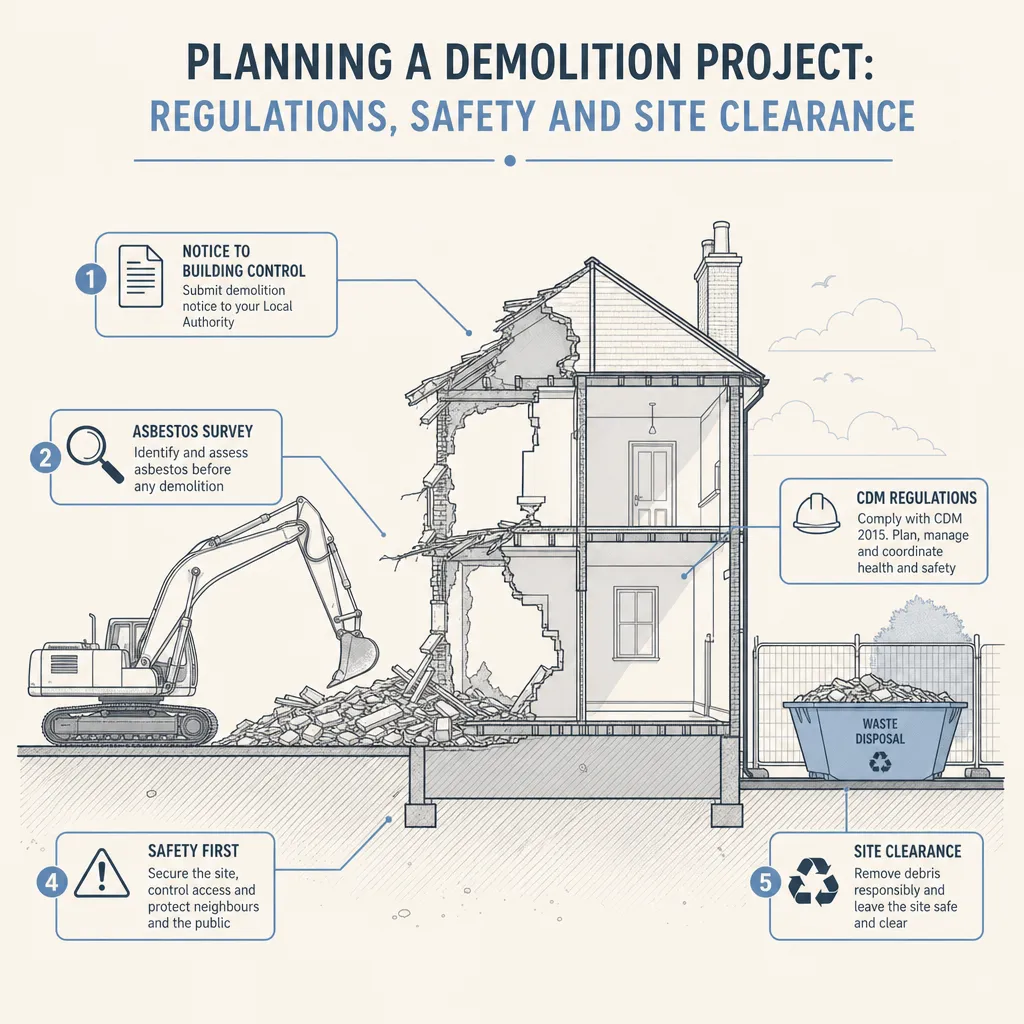
Planning a Demolition Project: Regulations, Safety and Site Clearance
Whether you are pulling down a derelict outbuilding, clearing a plot for a new build, or undertaking a partial demolition as part of a larger project, the regulatory requirements in England and Wales are considerably more extensive than many homeowners expect. Failing to notify the correct authorities, survey for hazardous materials, or manage waste correctly can result in enforcement action, criminal liability, and significant delays to the wider project.
Key points
- Demolition of a building exceeding 1,750 m³ in volume requires prior approval from the local planning authority under the Town and Country Planning (Demolition — Description of Buildings) Direction 2014.
- A Section 80 demolition notice must be served on the local authority at least 6 weeks before demolition begins under the Building Act 1984; the authority may impose conditions via a Section 81 counter-notice.
- A Refurbishment and Demolition (R&D) Survey for asbestos is a legal requirement under the Control of Asbestos Regulations 2012 before any demolition starts on a building that may contain asbestos-containing materials (ACMs).
- The Construction (Design and Management) Regulations 2015 (CDM 2015) apply to demolition work; where more than one contractor is involved, the client must appoint a Principal Designer and a Principal Contractor.
- As the legal waste producer, the homeowner holds a duty of care under the Environmental Protection Act 1990 for all waste generated on site, regardless of who carries out the removal.
Which permissions apply to your demolition?
Permitted development rights for demolition are more limited than most homeowners assume. Use the following to identify your likely requirements before engaging any contractor.
- Prior approval needed — building volume exceeds 1,750 m³: apply to the local planning authority before starting work.
- Planning permission needed — property is in a conservation area or is a listed building: contact the local planning authority. Listed building consent is also required for any listed structure or structure within its curtilage.
- Part of wider development — demolition is preparatory to a new build: it is assessed as part of the planning application for the new development, not separately.
- Section 80 notice required regardless — even for smaller domestic structures outside conservation areas, the building control notice obligation still applies.
- Unsure? — consult a building control consultant or planning advisor before committing to a programme or purchasing a demolition contract.
For standalone demolition of a smaller structure — a garage or outbuilding under 1,750 m³ outside a conservation area — permitted development rights may apply, but you should always confirm with your local planning authority first. Rules vary depending on local plan policies and site history.
Building Act notices: what you must do before starting
Under Section 80 of the Building Act 1984, a demolition notice must be served on the local authority at least 6 weeks before work begins. The local authority can then issue a Section 81 counter-notice imposing conditions — including requirements for shoring of adjacent structures, utility disconnection, or specific asbestos management measures.
Key actions before serving the notice:
- Identify all services (gas, electricity, water, drainage) and arrange safe disconnection with utility providers.
- Obtain the Refurbishment and Demolition asbestos survey and prepare an ACM management or removal plan.
- Check whether the property shares a wall, roof, or structure with adjacent buildings — a party wall agreement under the Party Wall etc. Act 1996 may be required before demolition can proceed.
- Establish whether building control will require a demolition method statement for the specific structure.
- Confirm insurance: the demolition contractor must carry contractor's all-risk and public liability insurance.
Asbestos: the non-negotiable pre-demolition requirement
The Control of Asbestos Regulations 2012 require a Refurbishment and Demolition (R&D) Survey before demolition begins on any building that may contain ACMs. This is a more intrusive survey than a standard asbestos management survey — it involves partial dismantling of the structure to access and sample materials in areas that will be disturbed.
Properties most likely to contain asbestos:
- Built or substantially refurbished between 1950 and 1999
- Containing any of the following: artex or textured coatings, floor tiles, ceiling tiles, corrugated roof sheets, pipe lagging, or insulating board panels
Asbestos removal must be carried out by a contractor holding an HSE licence for notifiable non-licensed work (NNLW) or licensed work, as appropriate. The HSE maintains a public register of licensed asbestos contractors.
Do not start demolition until all ACMs have been identified and either removed by a licensed contractor or formally managed. This is a legal requirement under the Control of Asbestos Regulations 2012 — not a precaution.
CDM 2015: roles and responsibilities
The Construction (Design and Management) Regulations 2015 apply to virtually all demolition projects. Where more than one contractor is involved, the client (homeowner) must appoint a Principal Designer and a Principal Contractor who have the necessary skills, experience, and resources.
CDM role | Appointed by | When required | Key duties |
|---|---|---|---|
Principal Designer | Client | Where more than one contractor is or will be involved | Manage pre-construction phase health and safety; produce construction phase plan |
Principal Contractor | Client | Where more than one contractor is or will be involved | Manage on-site health and safety; maintain site rules |
Contractor | Client or Principal Contractor | All projects involving construction work | Comply with site rules; report risks; provide welfare |
Where the project involves more than 30 working days with more than 20 simultaneous workers, or more than 500 person-days of work in total, an F10 notification must be submitted to the HSE before work begins. On smaller single-contractor projects, CDM duties still apply and the client retains obligations.
Waste management and environmental duties
Demolition generates significant quantities of waste that must be managed in accordance with the Environmental Protection Act 1990 and the Waste (England and Wales) Regulations 2011.
- Duty of care: as the waste producer, the homeowner holds a duty of care from the point waste is generated. Verify that your contractor is registered with the Environment Agency as a waste carrier.
- Waste transfer notes: must be completed and retained for at least 2 years for non-hazardous waste and 3 years for hazardous waste.
- Segregation: concrete, brickwork, timber, and metals should be separated at source where feasible, reducing disposal costs and supporting circular material reuse.
- Hazardous waste: asbestos-containing materials and other hazardous waste must be transported by a licensed carrier and disposed of at a licensed facility. Fly-tipping demolition waste carries unlimited fines under the Environmental Protection Act 1990.
Important limitations
This article provides general information about demolition regulations in England and Wales as of May 2026. Rules differ in Scotland (Building (Scotland) Act 2003), Wales, and Northern Ireland. Planning and building control requirements vary by local authority, property designation, and project scope. This is not legal or professional advice. A building control consultant, qualified demolition contractor, and asbestos specialist should be involved in any but the most straightforward site clearance projects.
When this becomes urgent
- If suspected asbestos is disturbed before a survey has been completed — stop work immediately, seal the area, and contact a licensed asbestos surveyor before anyone re-enters.
- If demolition affects a shared wall, roof, or foundation with a neighbouring property — structural advice and any required party wall procedures must be resolved before work proceeds.
- If the local authority issues a Section 81 counter-notice with conditions — comply with those conditions or seek professional advice before continuing.
- If ground conditions reveal unexpected contamination, voids, or buried infrastructure — stop and seek specialist environmental or geotechnical advice.
What to ask a qualified professional
- Do you carry full contractor's all-risk and public liability insurance, and what are the coverage limits?
- Are you or your sub-contractors licensed by the HSE for asbestos removal?
- Who will act as Principal Contractor under CDM 2015 on this project, and what is their experience?
- Have you worked on similar structures in this location — are there any known ground, drainage, or structural complications?
- How will hazardous and non-hazardous waste streams be segregated, documented, and disposed of?
- Will you handle the Section 80 notice submission and liaise with building control on our behalf?
- What method will you use to protect adjacent structures, utilities, and the public highway during demolition?
When to get professional help
Any demolition involving a structure attached to or close to neighbouring buildings, any suspected hazardous materials, a listed building, a conservation area property, or a site near a public highway requires professional input from the outset. For most homeowners, engaging a building control consultant and a CDM-compliant contractor before any planning submission substantially reduces the risk of enforcement action or costly programme delay.
How Housey can help
Housey can connect you with fully insured and CDM-compliant demolition contractors who can manage the full pre-demolition regulatory process. Building control consultants accessible through Housey can handle notice submissions, review method statements, and advise on local authority conditions. If pre-demolition hazardous material assessment is required, arranging an environmental survey is an essential first step.
Frequently asked questions
Do I need planning permission to demolish a garden wall?
Demolishing a wall, gate, or fence forming a boundary with a public highway (including a footpath or bridleway) requires planning permission. Internal garden walls are generally permitted development, but if the property is listed or in a conservation area, additional consent will be required. Always confirm with your local planning authority before any demolition work begins.
Who is responsible for ensuring demolition waste is disposed of legally?
As the client commissioning the work, the homeowner is the legal waste producer and holds a duty of care under the Environmental Protection Act 1990. This applies even if a contractor manages all removal. Ask to see your contractor's waste carrier registration with the Environment Agency, and retain copies of all waste transfer notes for at least two years.
How long does a demolition project typically take?
A simple domestic outbuilding may be cleared in one or two days, but pre-work — asbestos survey, Section 80 notice (minimum 6-week lead time), and utility disconnections — typically extends the total timeline to 8–12 weeks. More complex or larger structures take proportionally longer, and any planning prior approval process adds further time.
What happens if I demolish without notifying building control?
Failure to serve a Section 80 notice is an offence under the Building Act 1984. The local authority can require reinstatement, issue a stop notice, or pursue prosecution. Enforcement action is most likely where the work causes a safety hazard or structural damage to an adjacent property.
Sources and further reading
- Building Act 1984, Section 80: Demolition notices — legislation.gov.uk
- Control of Asbestos Regulations 2012 — legislation.gov.uk
- Construction (Design and Management) Regulations 2015 — Health and Safety Executive
- Demolition and planning permission — GOV.UK
- Register as a waste carrier — GOV.UK / Environment Agency
- Licensed asbestos contractors register — Health and Safety Executive
Useful next reads
 Improvement & Build
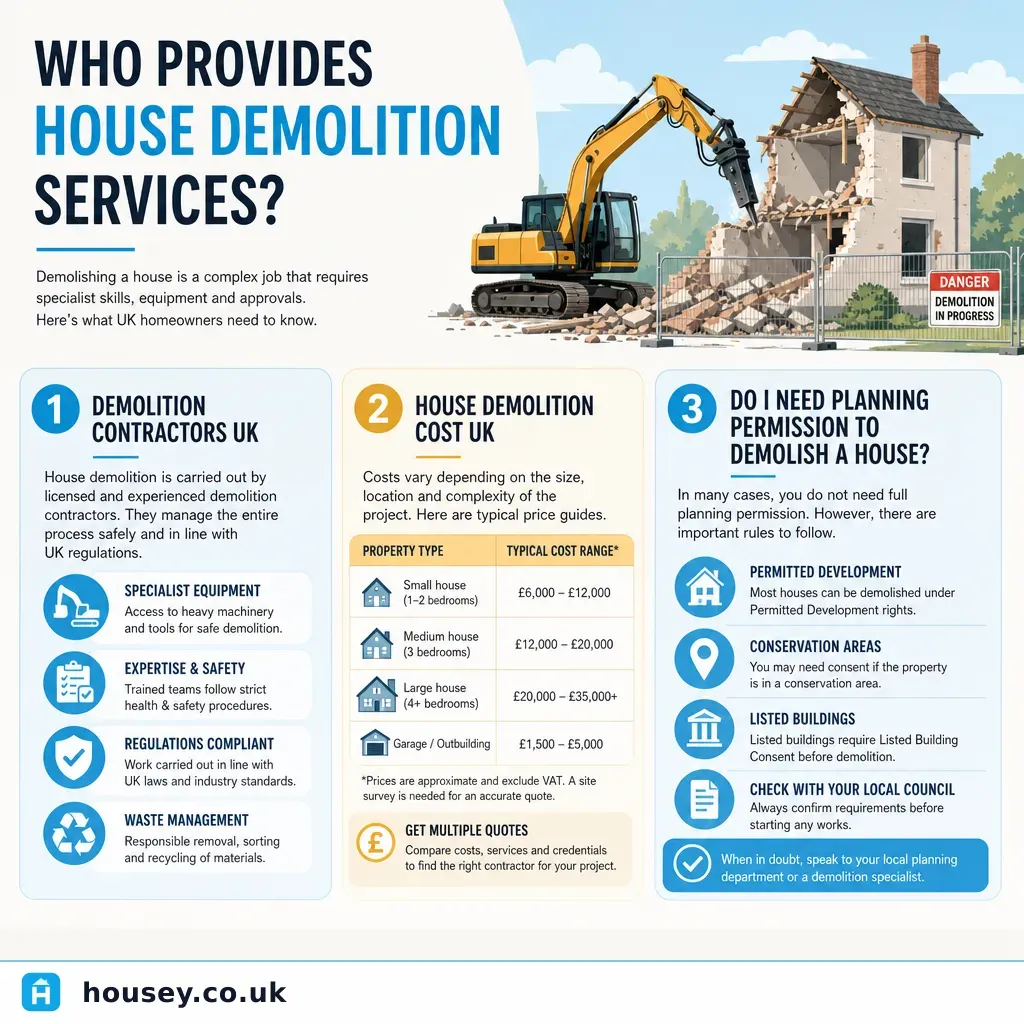
Who Provides House Demolition Services
House demolition in the UK is carried out by specialist demolition contractors, often members of the National Federation of Demolition Contractors (NFDC).
 Improvement & Build
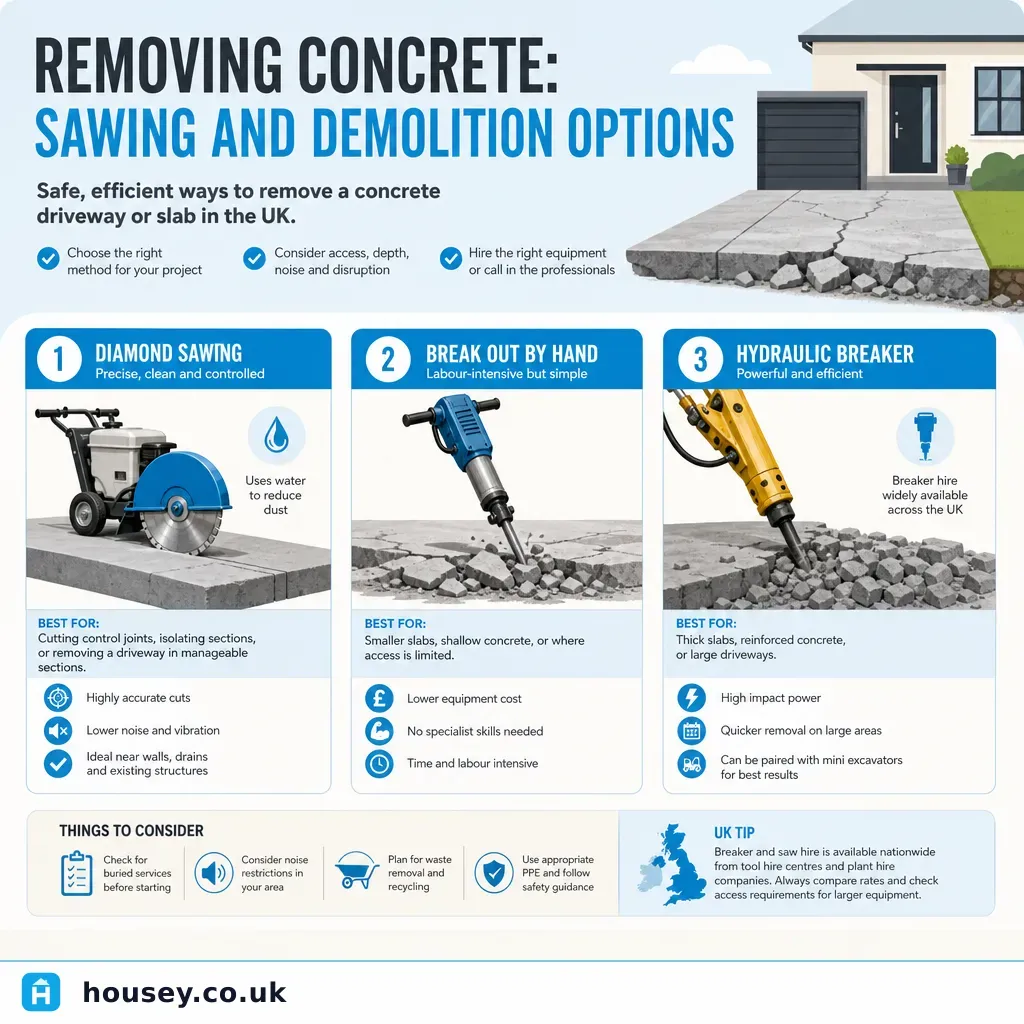
Removing Concrete: Sawing and Demolition Options
Concrete removal methods include hydraulic or electric breakers for bulk demolition, diamond disc or wire sawing for precision cuts, and hand tools for small areas.
 Improvement & Build
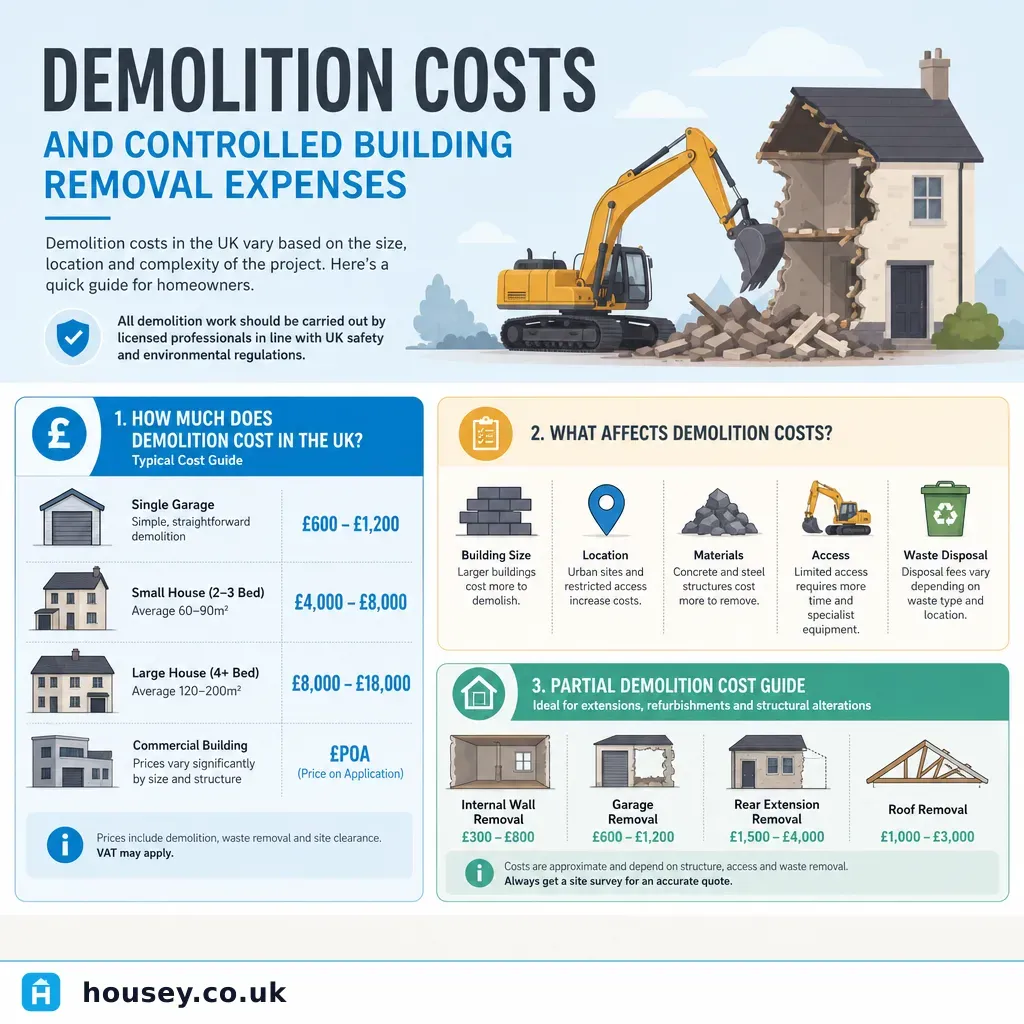
Demolition Costs and Controlled Building Removal Expenses
Full building demolition in the UK typically costs £5,000–£50,000+ depending on structure size, materials, and site access.
 Improvement & Build
Open Plan Living Space Conversion Costs
Opening up a living space in the UK typically costs £3,000–£15,000+ depending on whether walls are load-bearing, the beam specification required, and the extent of remodelling.
 Improvement & Build
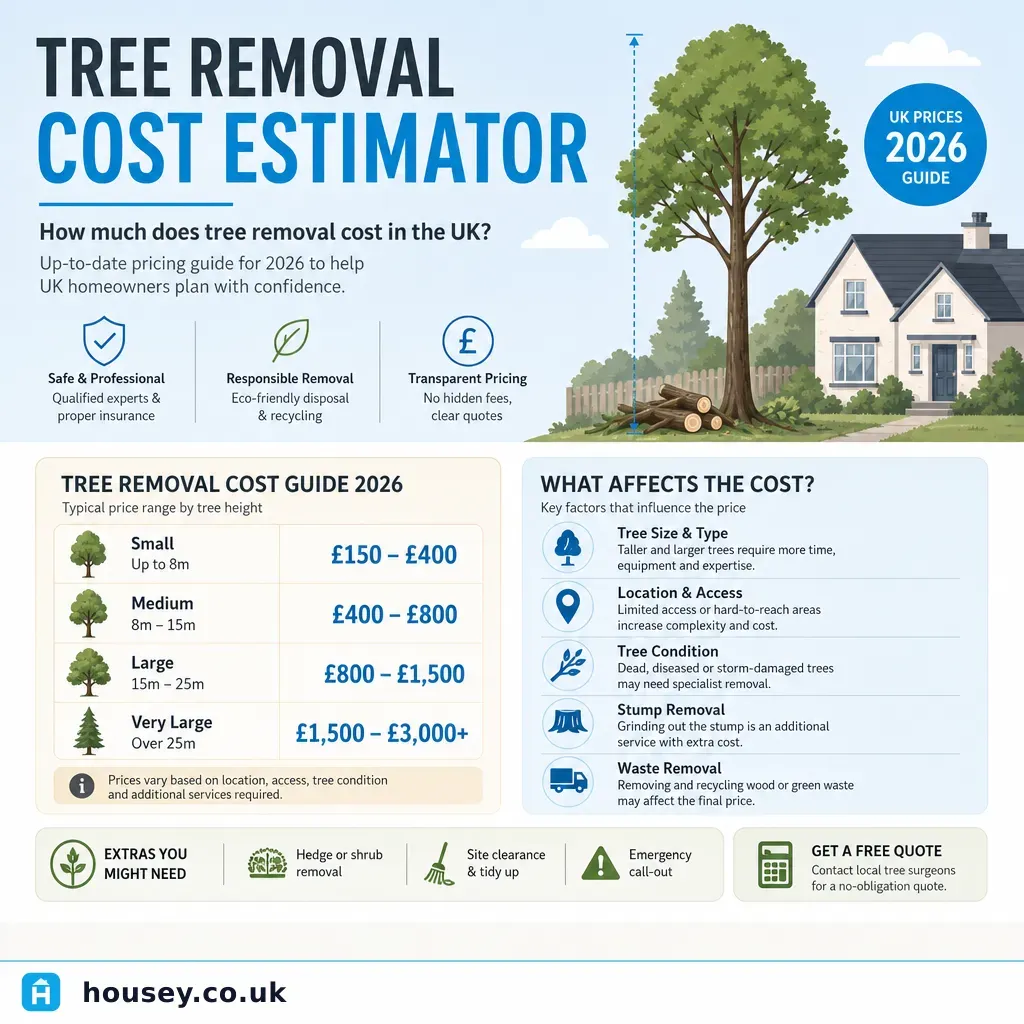
Tree Removal Cost Estimator
Tree removal in the UK costs roughly £150 to £5,000 or more, depending on the tree's height, species, access conditions, and whether stump removal is needed.