Planning a Two-Storey Extension: Design, Permissions and Build
By Housey · Last reviewed 19th of May 2026
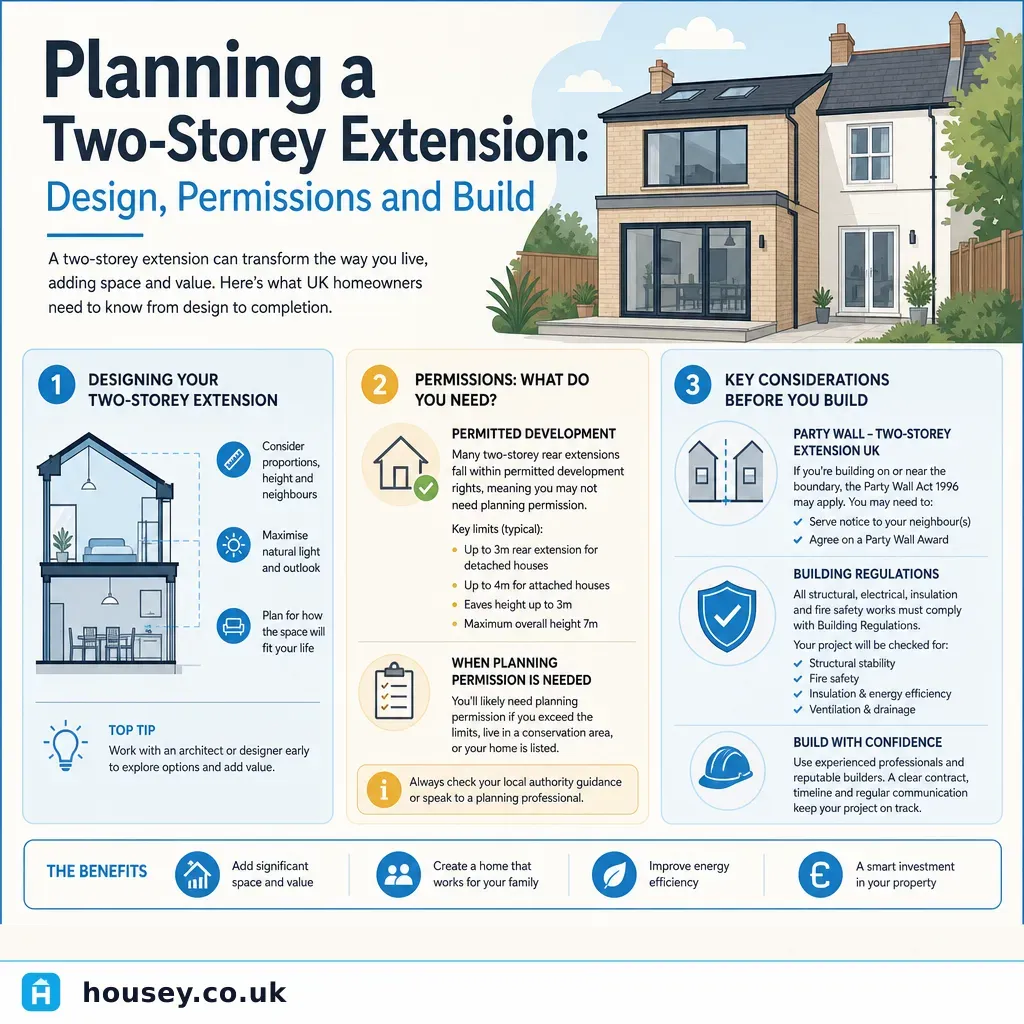
Planning a Two-Storey Extension: Design, Permissions and Build
Adding a two-storey extension is one of the most ambitious projects a UK homeowner can undertake — and one of the most process-intensive to plan correctly. It typically arises when a growing family needs additional bedrooms or a larger ground-floor living space, or when the cost of moving outweighs the cost of building. Unlike a single-storey addition, a two-storey project almost always requires full planning permission, structural engineering input, and formal obligations under the Party Wall etc. Act 1996 where neighbouring properties share a boundary wall. The regulatory, technical, and legal requirements are substantial, and the consequences of proceeding without proper professional advice — from planning enforcement notices to structural failures — make early engagement with the right team essential.
Key points
- Two-storey rear extensions under Permitted Development must not extend more than 3 metres beyond the original rear wall of the dwelling.
- Full planning permission is required for any two-storey side extension and for most two-storey rear extensions that exceed Permitted Development limits.
- The Party Wall etc. Act 1996 requires written notice to adjoining owners at least 2 months before work affecting a shared or boundary wall begins.
- Building Regulations approval is always required for a two-storey extension, covering structure (Approved Document A), fire safety (Part B), drainage (Part H), and thermal performance (Part L 2021).
- Indicative build costs for a two-storey extension are typically £1,800–£2,500/m² of added floor space, varying significantly by region, specification, and site complexity. (Indicative UK costs, last reviewed 2026-05-19.)
Permitted Development vs full planning permission
Most two-storey extensions require full planning permission from the local planning authority (LPA). Permitted Development (PD) rights allow a two-storey rear extension without a planning application only if all of the following conditions are met — for a house, not a flat or maisonette:
- The extension does not project more than 3 metres beyond the original rear wall.
- The eaves height does not exceed 3 metres and the overall height does not exceed that of the original roof.
- No more than half the area of the land around the original house is covered by buildings.
- The materials closely match the appearance of the existing dwelling.
- The property is not listed, in a National Park, Area of Outstanding Natural Beauty (AONB), or World Heritage Site.
- No Article 4 direction has removed PD rights — common in conservation areas and some local authority housing estates.
In practice, any two-storey side extension requires planning permission — side extensions that face a highway are explicitly excluded from PD rights. Most two-storey rear extensions of meaningful size on semi-detached or terraced properties also require a full planning application.
The "larger home extension" prior approval scheme does not apply to two-storey structures — it is limited to single-storey rear extensions up to 8 metres (detached houses) or 6 metres (other houses). If you believe your proposal may fall within PD limits, apply for a Lawful Development Certificate from your LPA rather than relying on an informal assumption.
Which professionals do you need?
Professional | When needed | What they deliver |
|---|---|---|
Architect or architectural technologist | Always | Planning drawings, building regulations drawings, project coordination |
Structural engineer | Always | Foundation design, beam and padstone calculations, structural specifications |
Party wall surveyor | When the Party Wall etc. Act 1996 applies | Party wall notice service, schedule of condition, Party Wall Award |
Planning consultant | Complex sites, conservation areas, likely objections or appeals | Pre-application strategy, planning statement, handling representations |
Building control surveyor (LPA or approved inspector) | Always | Approval and inspection of Building Regulations compliance |
Designing the extension
Planning drawings
Your architect or architectural technologist will produce existing and proposed floor plans, elevations for all affected sides, a site plan and block plan, and a design and access statement if required by the LPA. Pre-application enquiries to the LPA are not mandatory but are strongly advisable for two-storey schemes — they can surface design objections before you invest in full drawings and significantly improve approval prospects.
Building Regulations drawings
A separate set of technical drawings is required for Building Regulations approval. These cover foundation design (coordinated with the structural engineer), steel beam and padstone specifications, floor and roof construction with U-value calculations under Part L, junction details at party walls, drainage runs, and means of escape from upper-floor bedrooms under Part B — typically requiring a protected staircase enclosure or appropriately specified escape windows.
Structural engineering
A structural engineer is essential for foundation design (strip, pad, or raft depending on ground conditions — clay soils widespread across southern and central England may require deeper foundations), steel beam design for any openings in the new or existing structure, and specifying the structural connection between the extension and the existing building. Proximity to trees can trigger Tree Preservation Order (TPO) considerations and may require arboricultural assessment before foundations are designed.
Party wall obligations
If the extension is built on or close to the boundary, or involves excavation within 3 metres of an adjoining owner's foundations (or within 6 metres if the excavation is deeper than the neighbour's foundation depth), the Party Wall etc. Act 1996 applies.
Written notice must be served on each affected adjoining owner:
- 2 months before work begins where the work involves building on or into the party wall or party structure.
- 1 month before work begins for adjacent excavations that fall within the Act's distance thresholds.
A neighbour can consent in writing, after which no further formality is needed. If they dissent or fail to respond within 14 days, the Act's surveyor process is triggered. The building owner typically bears the cost of appointing the party wall surveyor.
Common party wall triggers for two-storey rear extensions:
- A rear extension on a semi-detached property where the new flank wall sits on the boundary line.
- Extension foundations within 3 metres of the depth of the neighbour's existing foundations.
- Removal of a chimney breast shared between properties.
The planning and build process
Stage | Typical timeframe | Key actor |
|---|---|---|
Concept design and pre-application enquiry | 2–6 weeks | Architect or architectural technologist |
Full planning drawings and application submission | 2–4 weeks | Architect or planning consultant |
LPA determination period | 8 weeks (statutory for householder applications) | Local planning authority |
Conditions discharge (materials, landscaping, tree protection) | 4–8 weeks per condition | Applicant or consultant |
Building Regulations application and approval | Before work starts | Architect, structural engineer, building control |
Party wall notices and process | Notices at least 2 months before work | Building owner or party wall surveyor |
On-site build | 3–5 months | Extension builder |
Decision tree: does my project need planning permission?
- Two-storey rear extension, ≤3m projection, standard house, no PD restrictions? → Likely Permitted Development — Building Regulations always required regardless. Consider applying for a Lawful Development Certificate to confirm.
- Two-storey rear extension, >3m projection? → Full planning permission required.
- Two-storey side extension on any house type? → Full planning permission required.
- Any extension on a listed building? → Listed building consent required in addition to any planning route.
- Extension boundary on or adjacent to a party wall, or excavation near neighbour's foundations? → Party Wall etc. Act 1996 notices required.
- Property in a conservation area or AONB? → Check with the LPA — PD rights may be restricted or removed entirely by Article 4 direction.
Important limitations
This article provides general information only. Planning and building regulations requirements vary by property type, location, planning history, tenure, and local planning policy. Party wall obligations depend on the specific nature of proposed works and precise boundary conditions. Nothing in this article constitutes legal, structural, planning, or party wall advice. A qualified architect, structural engineer, solicitor, and party wall surveyor should each assess your specific project before any works begin, planning applications are submitted, or formal notices are served.
When this becomes urgent
Stop work and seek immediate professional advice if:
- Work has already started without planning permission or a confirmed Permitted Development right — an enforcement notice can require full or partial demolition at the owner's expense.
- You have received a formal party wall dissent or counter-notice without having engaged a surveyor, as prescribed timescales under the Act are strict.
- Signs of structural movement — cracking, settlement, sticking doors or windows — appear during or after foundation excavation.
- A building control officer has raised concerns about structural adequacy or fire compartmentation that require redesign before work can continue.
- You are a leasehold owner who has not yet confirmed that your lease permits structural alterations and that any necessary landlord consent has been obtained.
What to ask a qualified professional
Before appointing your design team, ask:
- Does my property have full permitted development rights, or have they been removed by an Article 4 direction or a planning condition attached to a previous permission?
- Is a pre-application enquiry to the LPA recommended given my site's history, location, or the scale of the scheme?
- Which adjoining owners are likely to be affected under the Party Wall etc. Act, and when should notices be served to fit the programme?
- What ground investigation or trial pits will be needed before the foundation design can be finalised?
- Will you manage the full plans building regulations application, and who will act as my building control contact throughout the build?
- Are there any Tree Preservation Orders or root protection zones that could restrict the foundation position or construction method?
- What conditions is the LPA likely to attach to planning permission, and how long will discharging them typically take?
When to get professional help
Professional input is not optional for a two-storey extension — it is a minimum requirement for a safe, compliant, and mortgageable outcome. Instruct an architect or architectural technologist at the very outset, before any design decisions are made. Add structural engineering and party wall advice as early as the design allows. Do not begin any groundworks without Building Regulations approval formally in place.
How Housey can help
Housey connects you with the professionals a two-storey extension project requires. Start with an architectural technologist for planning and building regulations drawings, engage structural engineering for foundation and beam design, and use planning consultancy if your site or location presents complications. When you are ready to build, find vetted extension builders through the platform.
Frequently asked questions
Do I always need planning permission for a two-storey extension?
Not always, but in most cases yes. A two-storey rear extension may fall within Permitted Development if it projects no more than 3 metres beyond the original rear wall and meets all other PD conditions. All two-storey side extensions require full planning permission. If in doubt, apply for a Lawful Development Certificate from your local planning authority to confirm your position before any work begins.
How long does a two-storey extension take to build?
From first appointment with a designer to practical completion, expect 10–16 months for a typical two-storey extension: 2–4 months for design, 8 weeks for LPA determination, 1–2 months for pre-start matters including conditions discharge and party wall, and 3–5 months on site. Complex sites, planning appeals, or slow conditions discharge can extend this considerably.
How much does a two-storey extension cost in the UK?
Indicative UK costs, last reviewed 2026-05-19. Build costs typically range from £1,800 to £2,500 per m² of new floor space, with London and the South East at the top end. Add professional fees, the planning application fee (currently £258 for a householder application in England), Building Regulations fee, party wall surveyor costs where applicable, and a contingency of 10–15%.
Do I need a party wall agreement for a two-storey extension?
You will need to serve party wall notices under the Party Wall etc. Act 1996 if the extension involves building on the boundary, working on a shared wall, or excavating within 3 metres of an adjoining owner's foundations. If the neighbour consents in writing, no surveyor is needed. If they dissent or do not respond within 14 days, the formal surveyor process is triggered, and the building owner usually bears the cost.
Can my neighbour stop my two-storey extension?
A neighbour cannot veto a valid planning permission, but they can make representations during the application process. Under the Party Wall etc. Act 1996, a dissenting neighbour does not stop the works but triggers a formal surveyor process resulting in a Party Wall Award that sets conditions for how and when the work may proceed. Enforcement of the Award, if breached, is via the courts.
Sources and further reading
- Planning Practice Guidance — when is permission required? — GOV.UK / MHCLG
- Party Wall etc. Act 1996 — explanatory booklet — GOV.UK / MHCLG
- Approved Document A: Structure — GOV.UK / MHCLG
- Approved Document L: Conservation of Fuel and Power (2021) — GOV.UK / MHCLG
- RICS — party wall guidance — RICS
Useful next reads
 Planning & Pre-Build
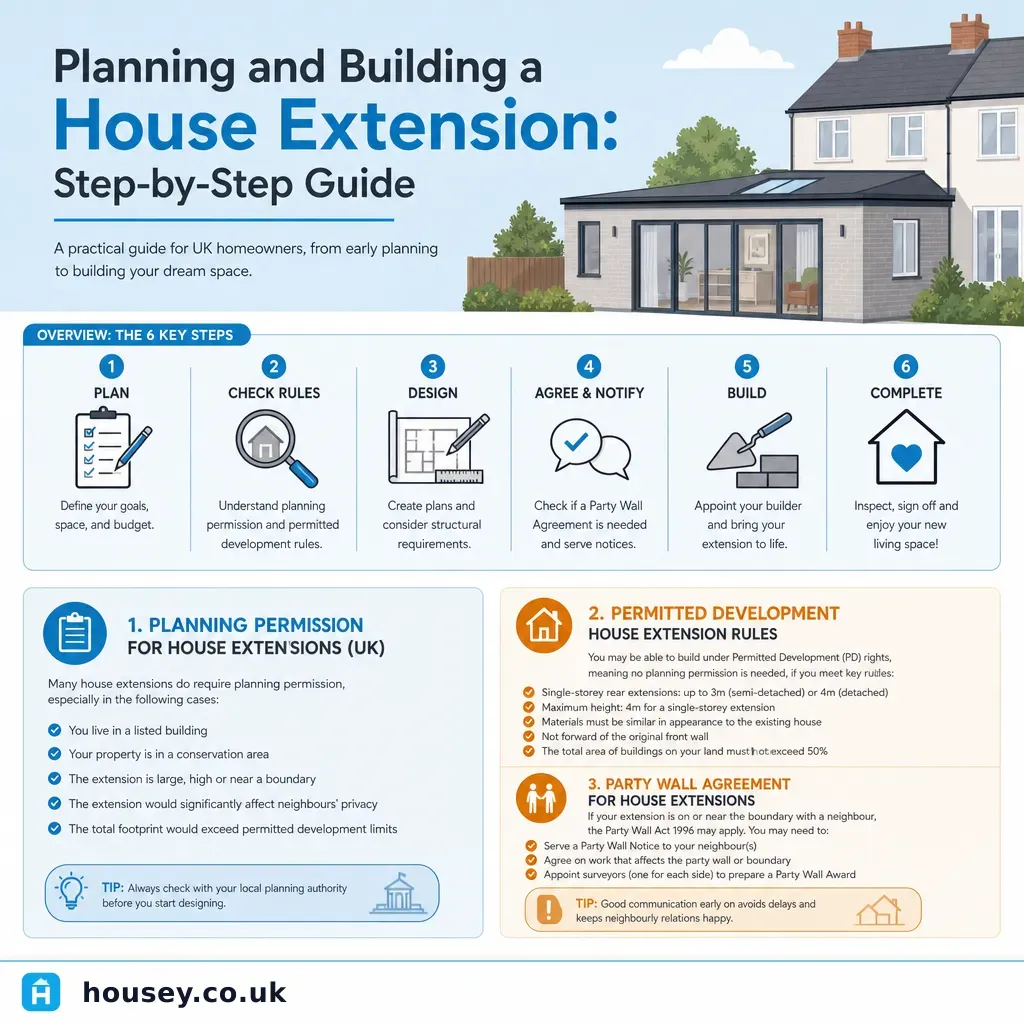
Planning and Building a House Extension: Step-by-Step Guide
A house extension in the UK usually requires either planning permission or confirmation of permitted development rights, Building Regulations approval, and — where work affects a shared wall or boundary — compliance with the Party Wall etc.
 Planning & Pre-Build
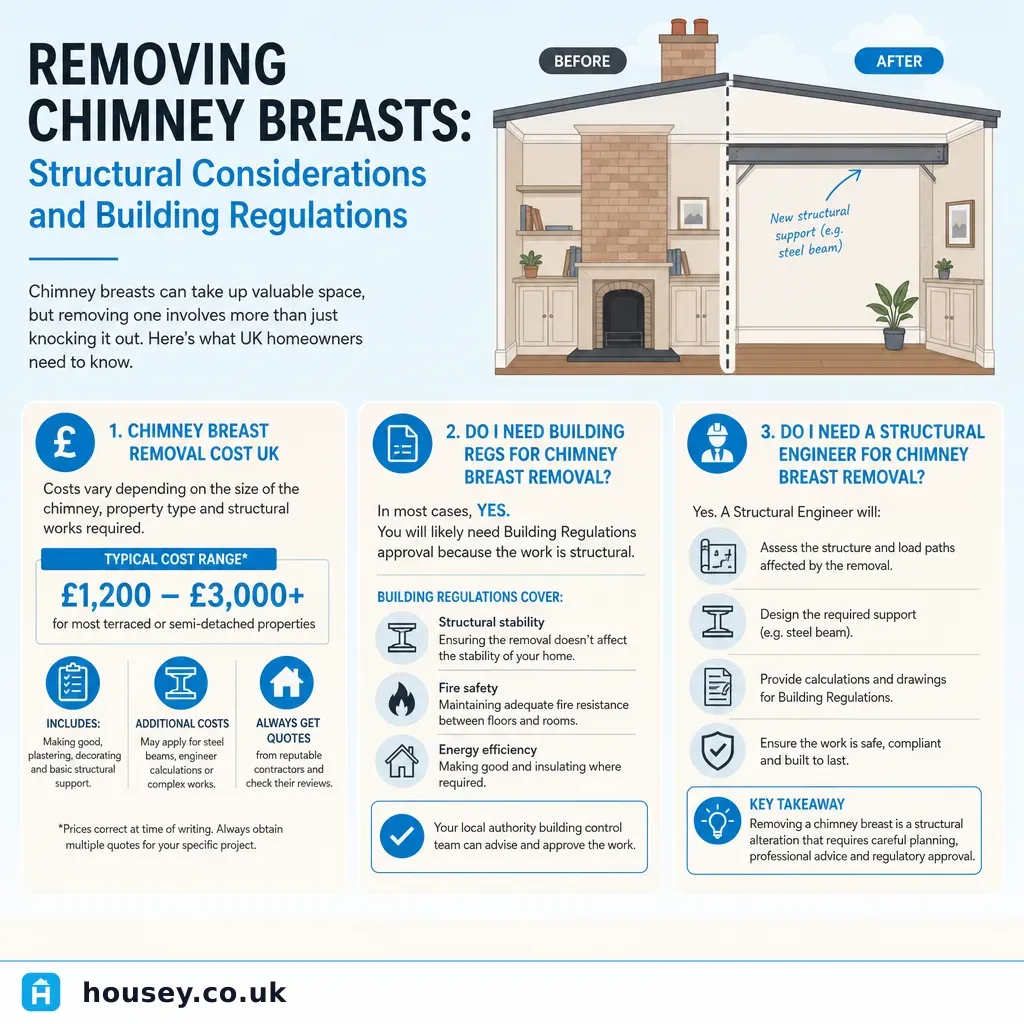
Removing Chimney Breasts: Structural Considerations and Building Regulations
Removing a chimney breast in England and Wales almost always requires building regulations approval because it is structural work.
 Planning & Pre-Build
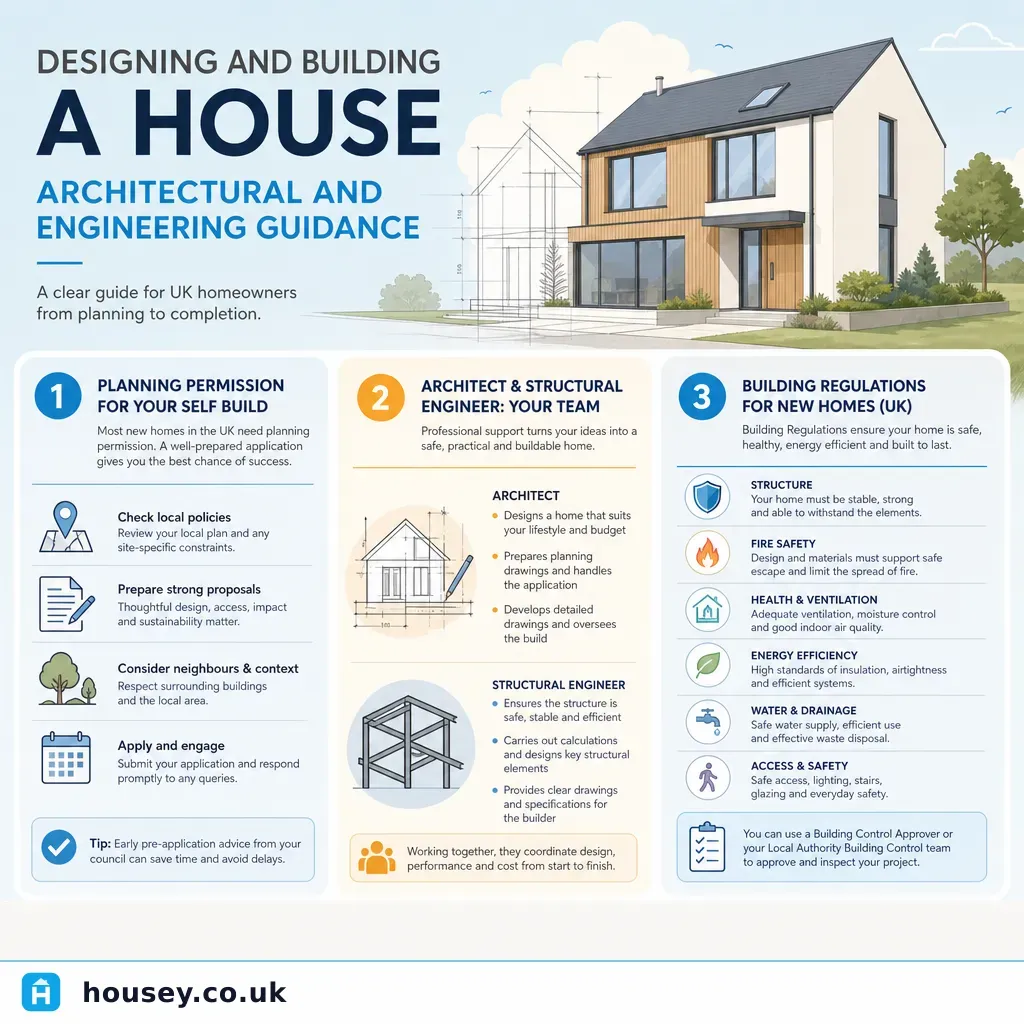
Designing and Building a House: Architectural and Engineering Guidance
Building a new house in the UK requires separate planning permission and Building Regulations approval, a professional team typically including an ARB-registered architect, a structural engineer, and often a civil or geotechnical engineer.
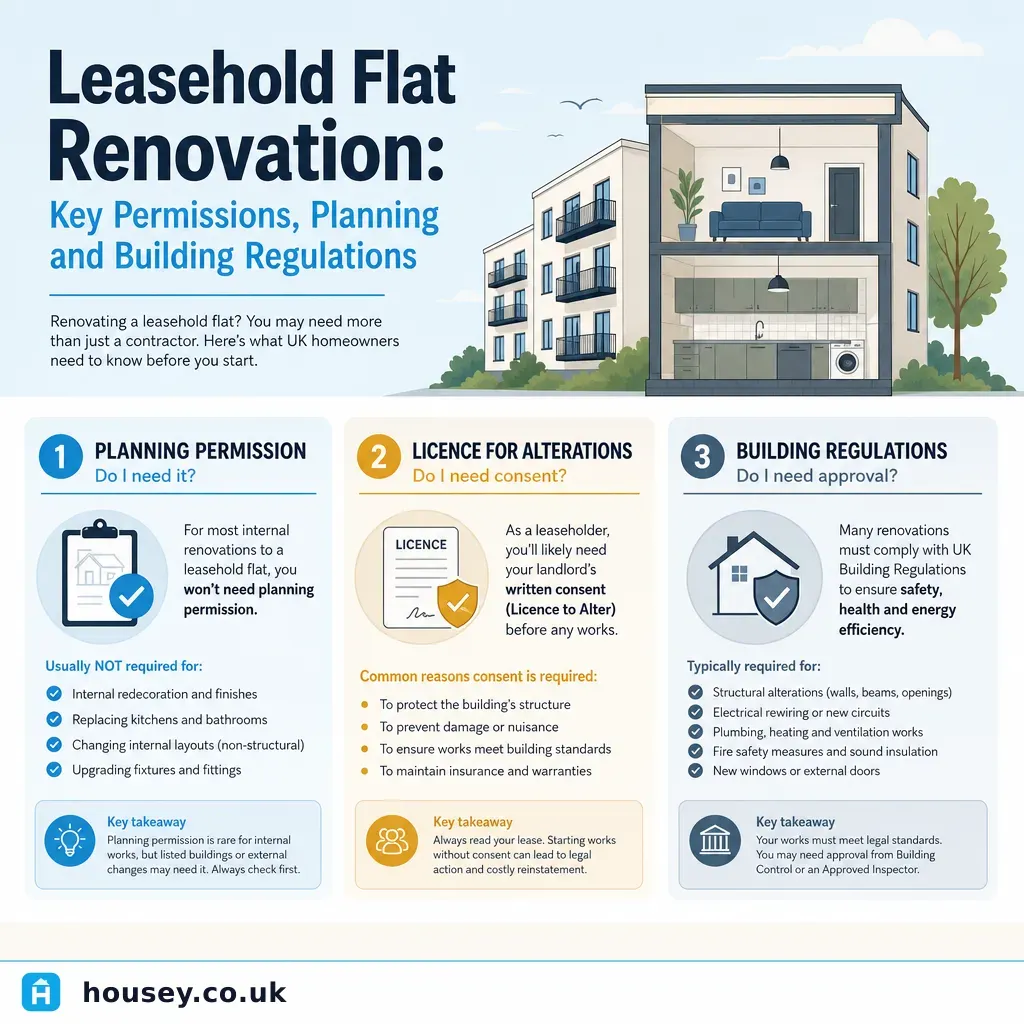 Planning & Pre-Build
Leasehold Flat Renovation: Key Permissions, Planning and Building Regulations
Most leasehold flat renovations require written consent from your freeholder or managing agent before work begins — this is usually called a licence for alterations.
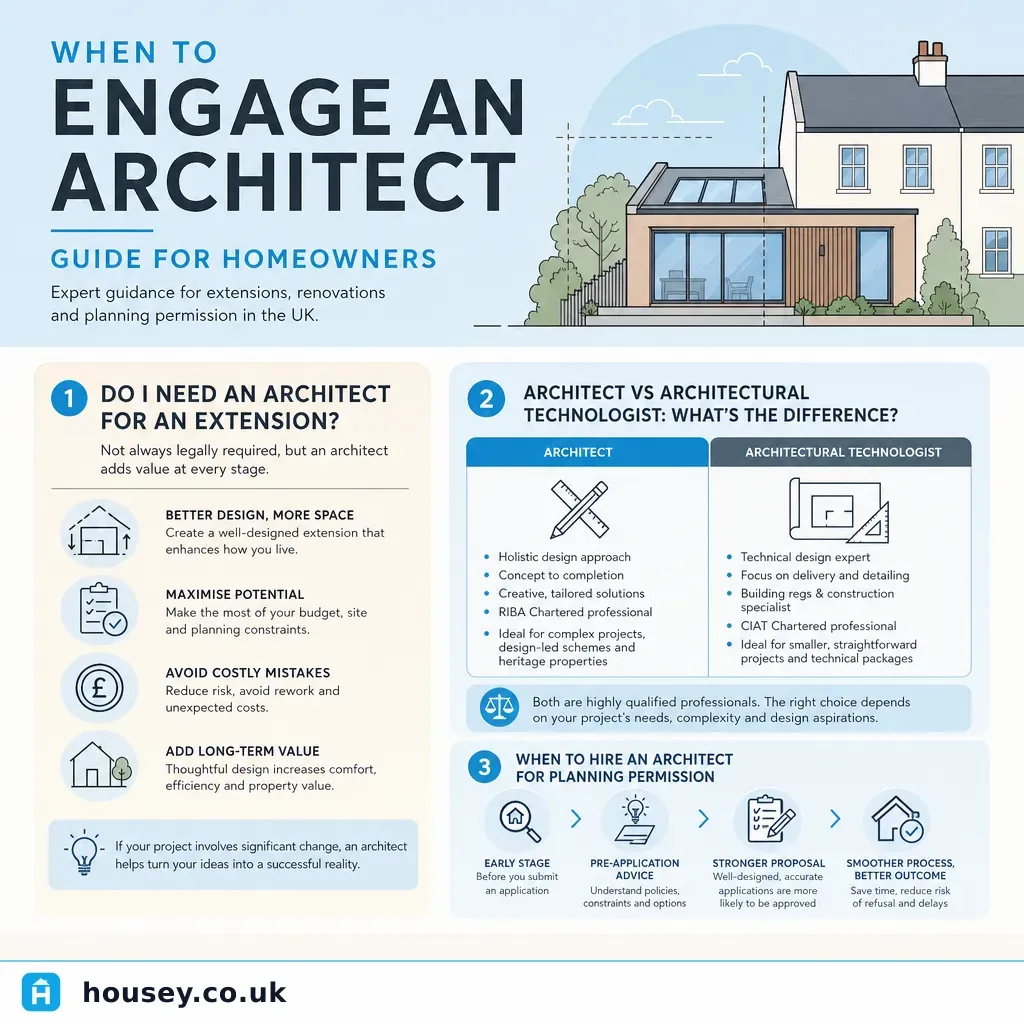 Planning & Pre-Build
When to Engage an Architect: Guide for Homeowners
You usually need an architect for complex extensions, new builds, listed building works, conservation area projects, or contentious planning applications requiring detailed design drawings.