Designing and Building Your Dream Home: Architecture and Custom Construction
By Housey · Last reviewed 18th of May 2026
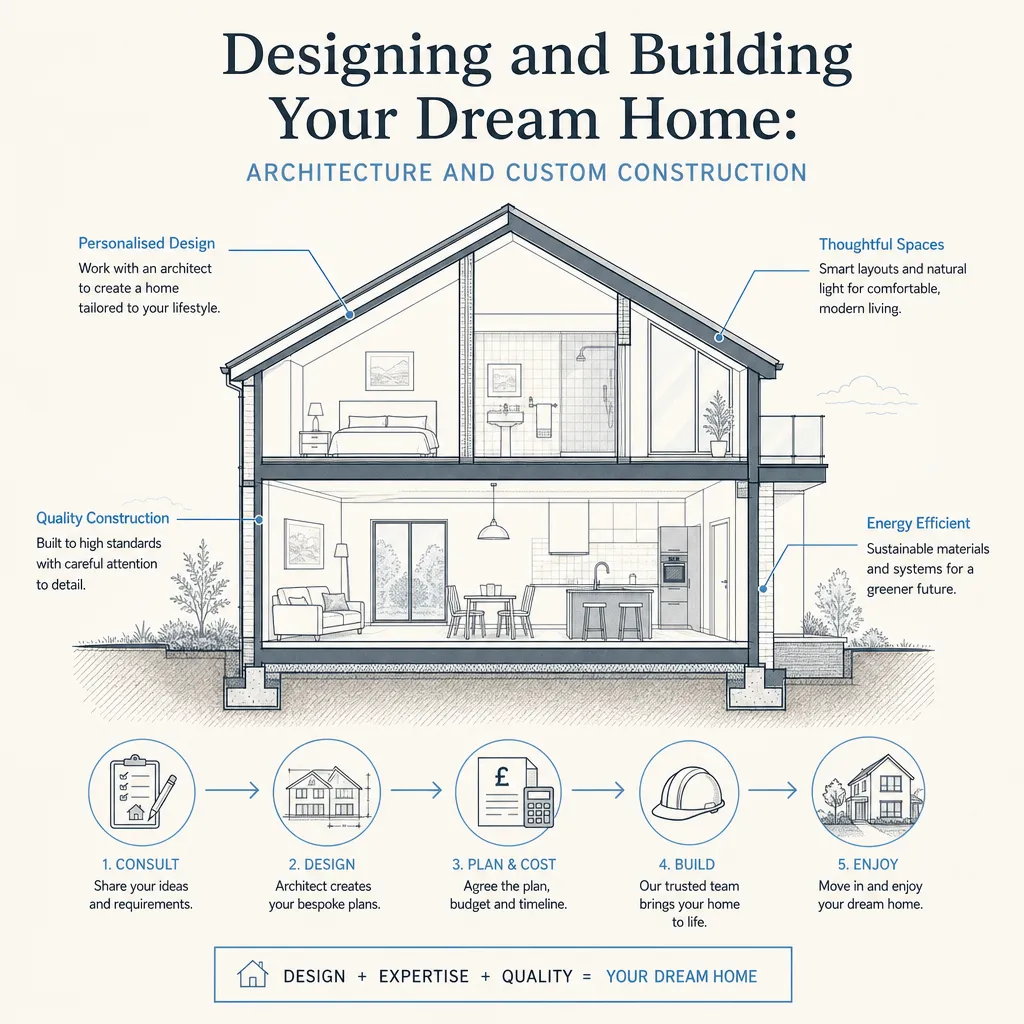
Designing and Building Your Dream Home: Architecture and Custom Construction
Custom home projects in the UK — whether a self-build on a rural plot, a replacement dwelling on a brownfield site, or a bespoke commission through a design-and-build firm — involve a longer and more complex journey than most homeowners anticipate. Understanding who does what, and when decisions need to be made, is essential before committing to a site, a professional, or a procurement route.
Key points
- The RIBA Plan of Work divides a building project into eight stages (0–7): Strategic Definition, Preparation and Brief, Concept Design, Spatial Coordination, Technical Design, Manufacturing and Construction, Handover, and In Use.
- New dwellings always require full planning permission — permitted development rights do not apply to the creation of a new home, though prior approval routes exist for some agricultural and commercial conversions.
- HMRC's VAT DIY Housebuilders Scheme allows self-builders to reclaim VAT on eligible materials; claims must be submitted within three months of the building control completion certificate.
- Architectural fees for a full RIBA service on a bespoke new-build typically range from 8–15% of construction cost. (Indicative UK costs, last reviewed 2026-05-18.)
- A structural engineer is required for foundations, load-bearing elements, and roof structures — their role is separate from, and complementary to, the architect's design role.
Which professional do you need?
The design team for a custom home project can include architects, architectural technologists, structural engineers, project managers, and a main contractor. Understanding who does what helps you assemble the right team without duplicating fees or leaving gaps.
Professional | Best for | Not ideal for | Typical output | Main risk if wrong choice |
|---|---|---|---|---|
Chartered architect (ARB/RIBA) | Complex or bespoke designs, planning-sensitive sites, listed building settings | Straightforward extensions or standard house types | Planning drawings, technical design, contract administration | Over-scoped brief, unnecessary cost |
Architectural technologist (CIAT) | Standard house types, technical detailing, building regulations compliance | Highly bespoke or experimental designs | Technical drawings, building regulations applications | May lack planning design expertise on complex sites |
Design-and-build firm | Single-point responsibility, faster programme, fixed-price certainty | Clients who want design control and independent oversight | Design and construction under one contract | Less client control over design quality |
Project manager | Coordinating separate consultants and contractors | Replacing the design team | Programme, cost control, procurement | Gaps if no separate design lead is appointed |
Structural engineer | Foundations, steel frames, load-bearing assessments | Architectural design and planning | Structural calculations, drawings, specifications | Structural failure, building control rejection |
The design process: RIBA stages explained
The RIBA Plan of Work provides a widely used framework for building projects in the UK. Understanding each stage helps you know what decisions are due when, how to commit budget in the right order, and when changes become expensive.
Stage 0–1: Strategic definition and preparation Define your brief — number of bedrooms, accessibility needs, energy performance ambition, budget, and timeline. Your architect should test whether the brief is realistic for your site and budget before any drawings are produced. An unrealistic brief discovered at Stage 3 is expensive to correct.
Stage 2: Concept design Outline proposals are developed. This is the stage to explore options — orientation, massing, internal layout — before committing to a scheme. Pre-application advice from your local planning authority (LPA) is often sought at this point and is usually worth the cost.
Stage 3: Spatial coordination The design is coordinated across disciplines. Structural principles are agreed. The scheme is refined and prepared for planning submission.
Stage 4: Technical design Full technical drawings and specifications are produced for building regulations approval and contractor tendering. Changes after Stage 4 typically increase cost significantly — this is the last practical point to alter the design without disrupting procurement.
Stage 5: Manufacturing and construction Work begins on site. If you have appointed your architect for contract administration, they issue instructions, certify interim payments, and manage practical completion.
Stage 6–7: Handover and in use The building is handed over; defects are rectified during the liability period (typically 12 months). Stage 7 covers long-term building performance and post-occupancy evaluation.
Planning permission for a new dwelling
Every new residential dwelling in England requires full planning permission. Your LPA will assess the application against the local development plan, the National Planning Policy Framework (NPPF), relevant design guides, and site-specific constraints. Common constraints include:
- Green Belt designation — development is very tightly restricted and requires very special circumstances
- Area of Outstanding Natural Beauty (AONB) or National Landscape — design, siting, and materials are scrutinised closely
- Conservation area or listed building setting — design standards are higher and additional consents may be required
- Flood risk zone — a Flood Risk Assessment is required in Flood Zones 2 and 3, and sequential testing applies
- Ecological constraints — protected species (bats, great crested newts) or proximity to ancient woodland may require specialist surveys before the design can be fixed
Pre-application advice — a paid consultation with your LPA before formal submission — is generally worthwhile on any bespoke project. It significantly reduces the risk of a planning refusal and can save months of programme. Check your LPA's website for current fees and turnaround times, as these vary.
Decision tree: which route suits your project?
- Choose a chartered architect if your site is planning-sensitive, your design is bespoke or experimental, or you want independent professional oversight of the contractor during construction.
- Choose an architectural technologist if your scheme is a relatively standard house type and your priority is technical delivery and building regulations compliance rather than design complexity.
- Choose a design-and-build firm if you want a single point of responsibility, a fixed price, and a faster programme, and you are comfortable with less direct control over design quality.
- Appoint a project manager if you are running separate design and construction contracts and need someone to coordinate them, manage the programme, and control costs.
- Engage a structural engineer at Stage 3–4 at the latest — and earlier if your site has ground condition concerns, existing structures to demolish, or you are proposing a steel or timber frame.
- Check with your LPA before finalising any design element if your site is in a designated area, has a complex planning history, or is subject to pre-application discussions.
Costs and what drives them
Custom home costs in the UK vary considerably by location, specification, and structural approach. Broad construction-cost ranges for a bespoke new-build in England:
- Shell and core only: £1,500–£2,500/m²
- Good standard fit-out: £2,500–£3,500/m²
- High specification: £3,500–£5,000+/m²
(Indicative UK costs, last reviewed 2026-05-18. Quotes vary significantly — always obtain at least three competitive tenders from contractors with relevant experience.)
These figures exclude land, professional fees (8–15% of build cost for a full architectural service), planning application fees (check GOV.UK for current figures, as the fee structure is subject to ongoing reform), infrastructure connections (gas, water, electricity, drainage), and external works. VAT applies at 20% on most new-build construction services, though the zero-rated VAT treatment for new dwellings is complex — take specialist advice.
Key cost drivers include: plot size and ground conditions, distance from material suppliers, structural system (traditional masonry, timber frame, structural insulated panels, or steel), area and proportion of glazing, heating system specification (heat pump vs gas), and procurement route.
What to ask before hiring a professional
Before appointing an architect, architectural technologist, or design-and-build firm:
- Are you registered with ARB (if claiming to be an architect) or CIAT (architectural technologist)?
- Have you completed similar projects within this local planning authority area?
- What is your fee structure, and what triggers additional charges beyond the agreed scope?
- Who will I deal with day-to-day — the lead professional named in the contract, or a junior team member?
- What documents, drawings, or reports will I receive at each RIBA stage?
- What level of professional indemnity insurance do you hold, and does it cover the full construction value?
- Do you offer contract administration during construction, or is your service design-only?
- How do you approach contractor selection and tendering — open tender, negotiated, or framework?
When to get professional help
For any custom new-build, professional involvement is required by the planning and building regulations system — it is not discretionary. However, certain situations make early specialist input especially important:
- Your plot has unusual ground conditions, steep gradients, or proximity to protected trees (a BS 5837 arboricultural survey is typically required before design development)
- The site is in Flood Zone 2 or 3 (a Flood Risk Assessment is required and may constrain design)
- Ecology constraints are present — bats, great crested newts, or proximity to ancient woodland require surveys timed to specific seasons
- The site has previous industrial use, which may require a Phase 1 or Phase 2 contamination assessment
- You are proposing a non-standard structural system such as cross-laminated timber (CLT) or structural insulated panels (SIP), which has specific building regulations and warranty implications
Do not appoint a contractor before your technical design is sufficiently developed. Appointing too early leads to significant variation costs and disputes once work is on site.
How Housey can help
Housey connects homeowners with qualified professionals across the full custom-build journey. Whether you need a chartered architect for a bespoke design, an architectural technologist for technical drawings and building regulations applications, a design-and-build firm for single-point responsibility, or a project manager to coordinate your consultants and contractors, you can compare quotes from vetted local providers in one place.
Frequently asked questions
Do I need a full architect or can an architectural technologist design my new home?
Both can produce drawings for planning permission and building regulations approval. Architects (ARB-registered) have broader design training and are better suited to complex or planning-sensitive schemes. Architectural technologists (CIAT-registered) specialise in technical delivery and suit straightforward house types. On many projects the two work together — an architect leads the design, while a technologist handles the technical drawings and building regulations packages.
How long does it take to design and build a custom home in the UK?
From initial brief to moving in, most custom builds take three to five years when you account for land finding, planning, design, procurement, and construction. A plot with planning consent already granted, delivered through a design-and-build firm, can complete in 18–24 months from first appointment. Complex or planning-sensitive schemes frequently take considerably longer.
Can I reclaim VAT on a self-build in the UK?
Yes — HMRC's VAT DIY Housebuilders Scheme allows eligible self-builders to reclaim VAT paid on building materials (not professional fees). The claim must be submitted within three months of receiving the building control completion certificate. The scheme covers new builds and some conversions. Check GOV.UK guidance or speak to a specialist VAT adviser before starting work, as eligibility rules are specific.
What is the difference between a design-and-build contract and a traditional contract?
In a traditional contract, designer and contractor are appointed separately and the architect administers the contract on your behalf. In a design-and-build contract, a single firm is responsible for both design and construction, offering price certainty and one point of responsibility, but typically less client control over design quality, specification, and the ability to hold contractor and designer independently to account.
Sources and further reading
- RIBA Plan of Work — Royal Institute of British Architects
- VAT DIY Housebuilders Scheme — GOV.UK / HMRC
- National Planning Policy Framework — GOV.UK / DLUHC
- Architects Registration Board — ARB
- Chartered Institute of Architectural Technologists — CIAT
- Fees for planning applications — GOV.UK
Useful next reads
 Planning & Pre-Build
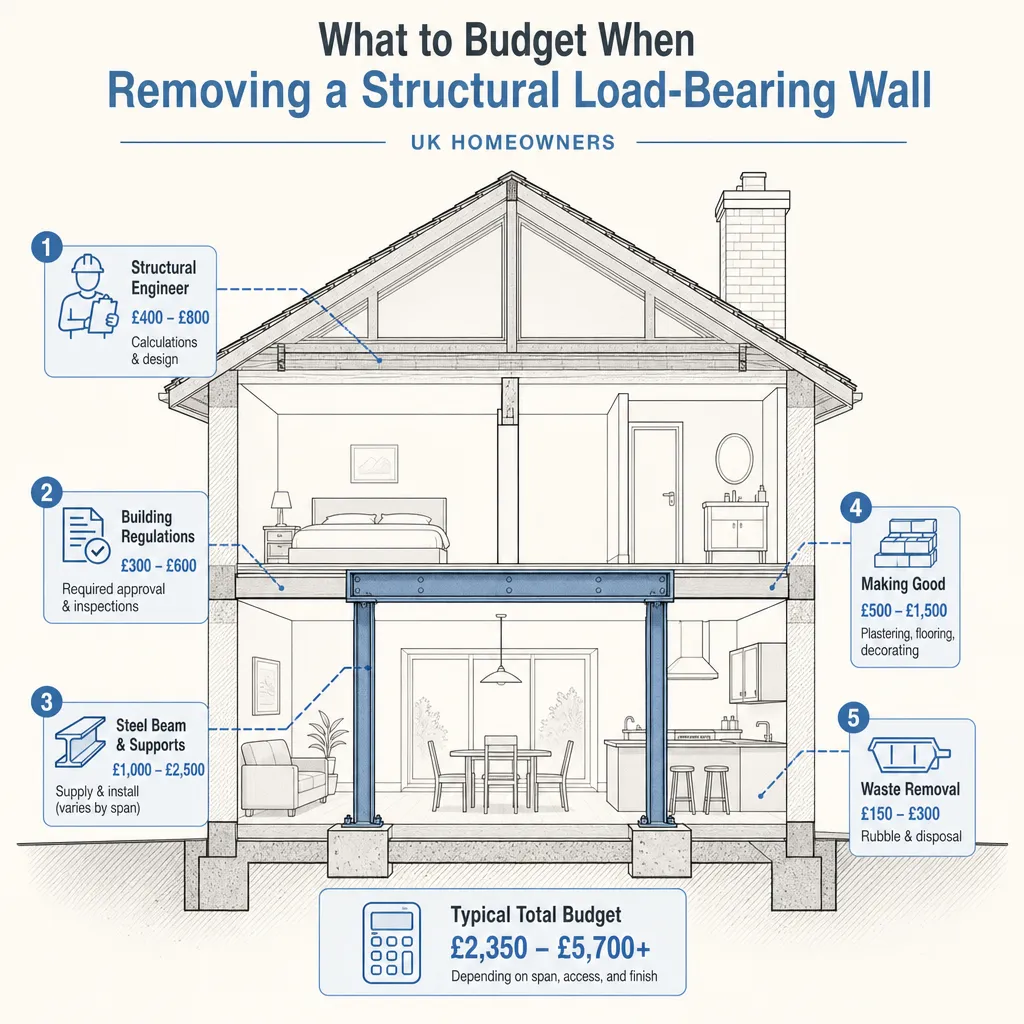
What to Budget When Removing a Structural Load-Bearing Wall
Removing a load-bearing wall in a typical UK home costs £2,500–£8,000 or more in total, covering a structural engineer's calculations, Building Regulations approval, the steel beam, builder's labour, and replastering.
 Planning & Pre-Build
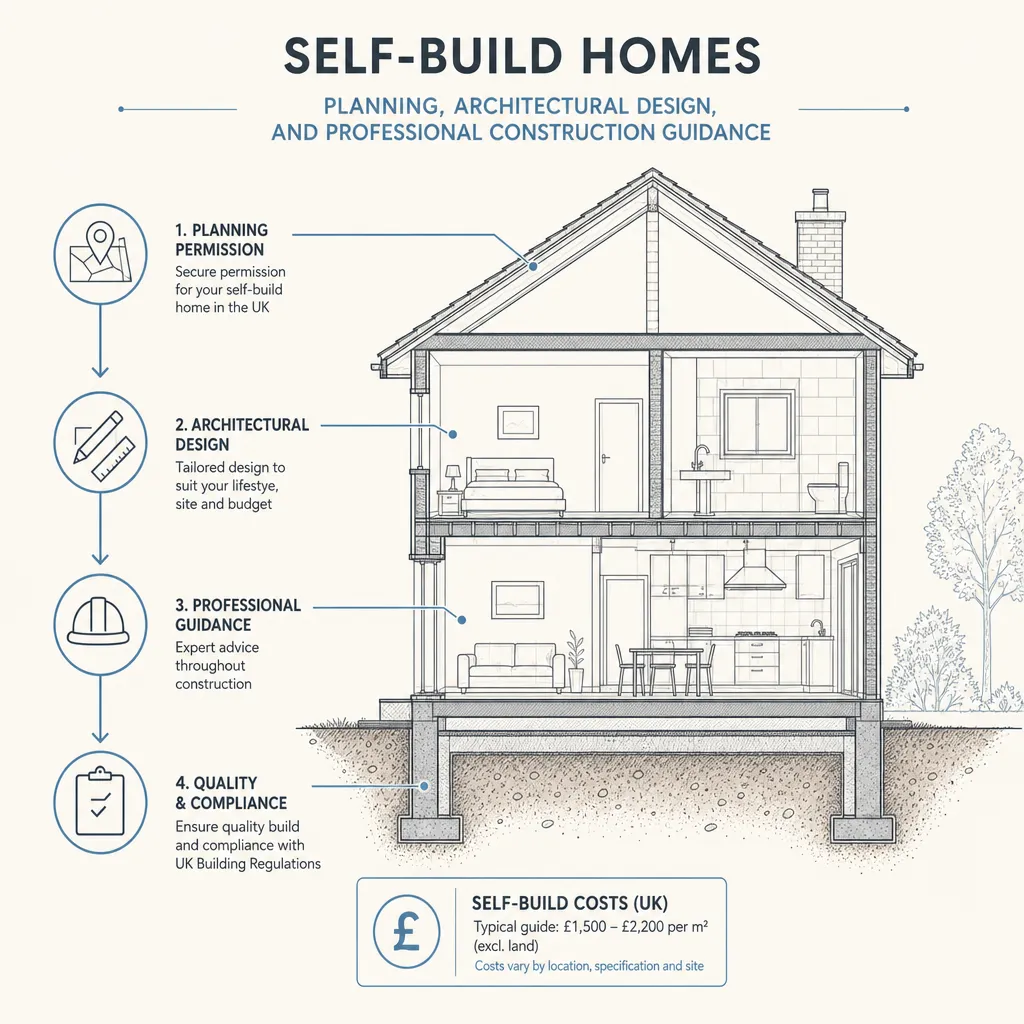
Self-build homes: planning, architectural design, and professional construction guidance
A UK self-build requires planning permission, separate building regulations approval, and a professional team typically including an architect, structural engineer, and building control body.
 Planning & Pre-Build
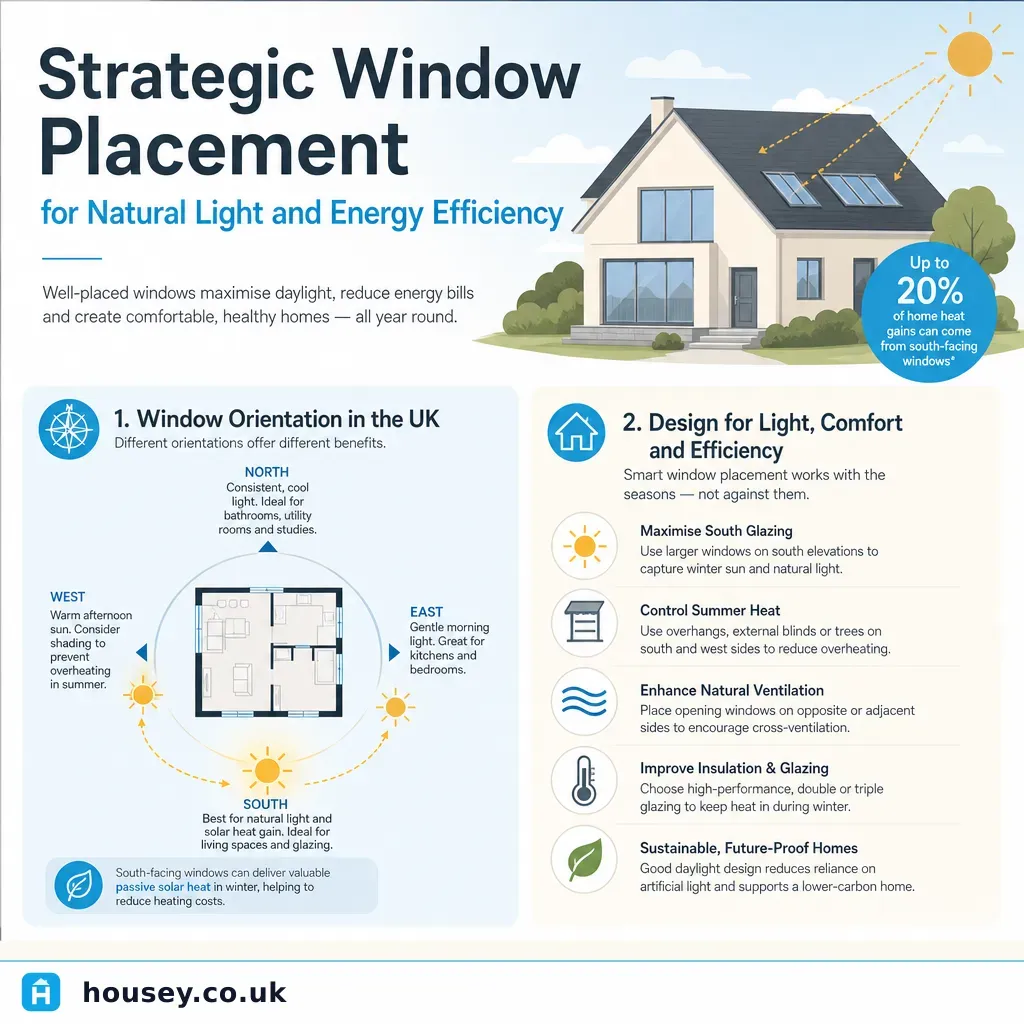
Strategic Window Placement for Natural Light and Energy Efficiency
In the UK, south-facing windows capture the most winter solar gain, while north-facing glazing provides consistent, glare-free daylight.
 Planning & Pre-Build
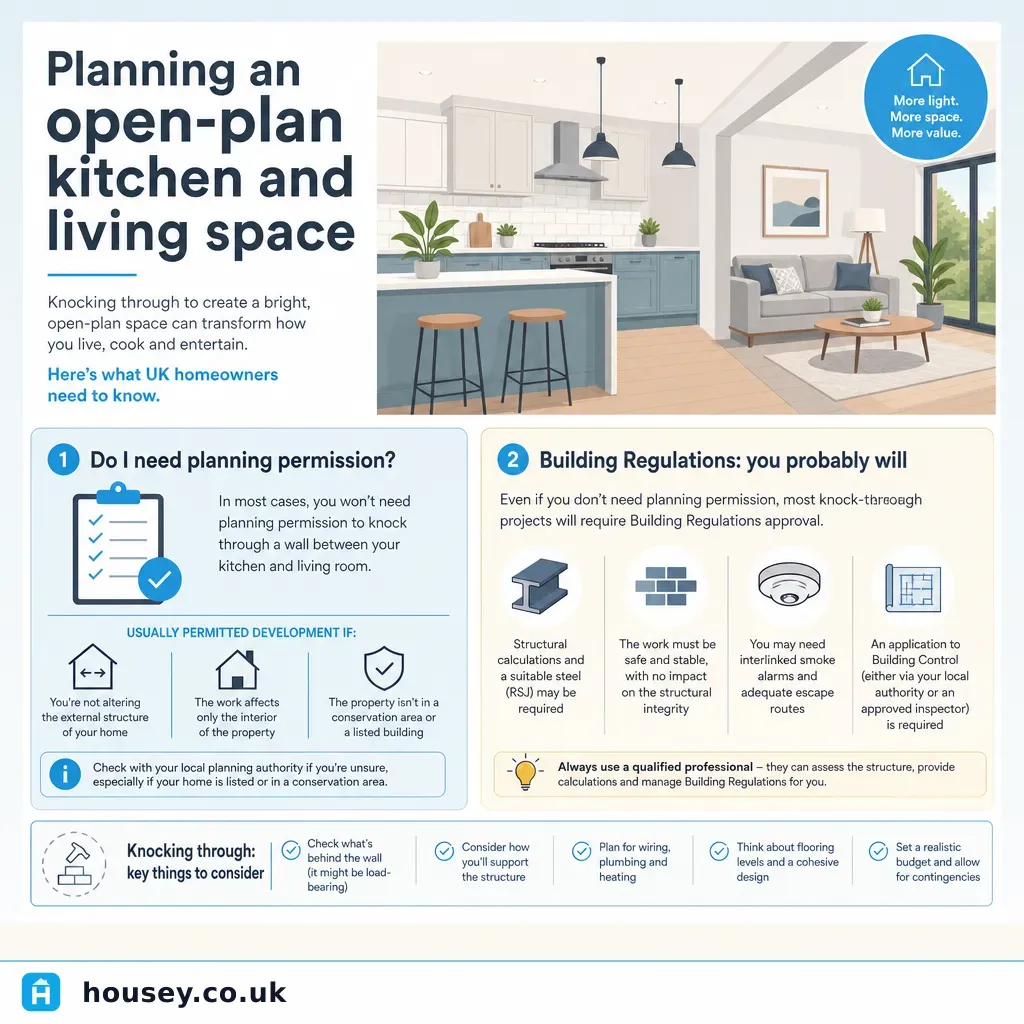
Planning an open-plan kitchen and living space
Creating an open-plan kitchen and living area almost always involves removing a load-bearing wall, which requires structural engineer calculations and Building Regulations approval under Parts A, B, and F in England and Wales.
 Planning & Pre-Build
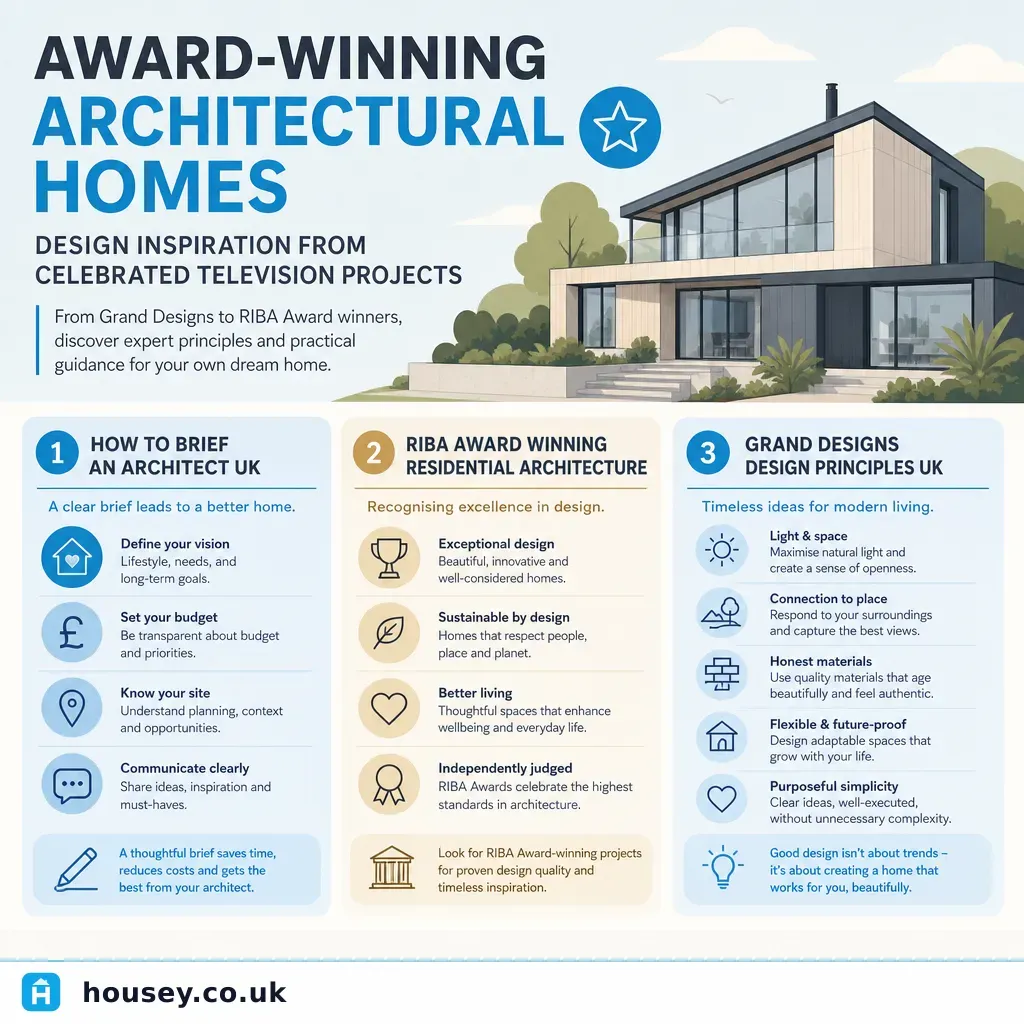
Award-winning architectural homes: design inspiration from celebrated television projects
Award-winning UK residential architecture is defined by a clear design concept, quality of execution, and thoughtful response to site and context.