Detecting Foundation and Structural Drainage Problems in Residential Properties
By Housey · Last reviewed 30th of May 2026
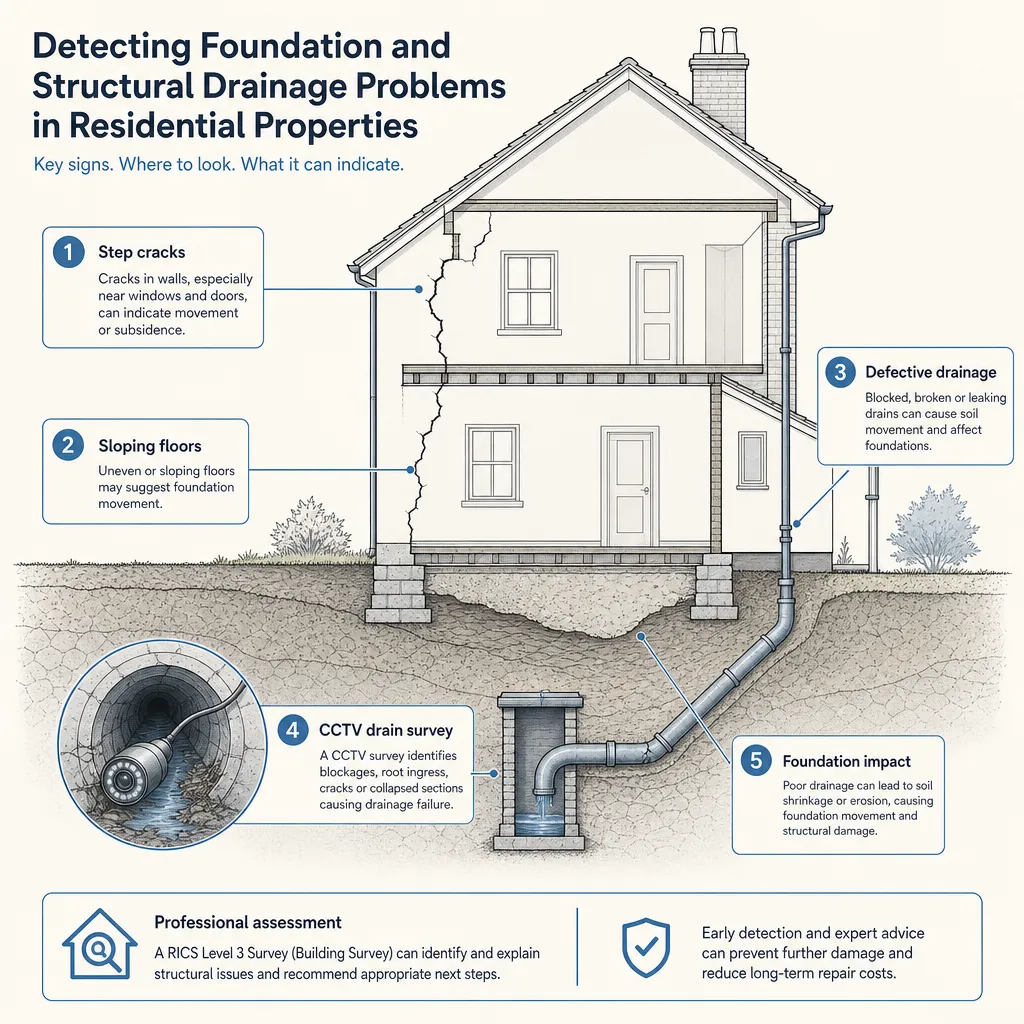
Detecting Foundation and Structural Drainage Problems in Residential Properties
Foundation and drainage faults are among the most expensive defects a homeowner can encounter — and among the most easily missed until they become serious. They often come to light during a RICS Level 3 Building Survey, before an insurance renewal, or when a solicitor requests further investigation during conveyancing. Early detection gives owners far more remediation options: intervention costs rise steeply once movement has progressed or drainage collapse has undermined load-bearing ground over a prolonged period.
Key points
- Subsidence — ground movement that causes a building's foundations to sink unevenly — affects an estimated 5,000 UK homes per year, according to the Association of British Insurers (ABI).
- Clay-rich soils across London, Essex, the East Midlands, and parts of the south-east shrink significantly during dry summers, making properties on those geological formations more susceptible to seasonal ground movement.
- A RICS Level 3 Building Survey is the appropriate inspection for any property where structural movement is suspected; a RICS Level 2 Home Survey may not investigate structural defects in sufficient depth to identify the cause.
- CCTV drain surveys can identify cracked or collapsed pipes, root ingress, displaced joints, and fractured connections that wash away fine soil particles and undermine bearing ground — conditions invisible in a standard visual inspection.
- You are legally required to notify your home insurer promptly if you suspect subsidence; delayed notification can invalidate or significantly reduce a claim.
Distinguishing settlement, subsidence, and heave
These terms are often used interchangeably, but they have distinct causes and very different implications for remediation and insurance.
Settlement is the gradual, usually uniform compression of ground beneath new foundations as the structure's weight is absorbed. Most buildings settle within the first few years after construction or a major extension. Settlement cracks tend to be hairline-fine, taper from top to bottom, and appear shortly after the building is completed.
Subsidence is uneven downward movement caused by changes in the ground — clay shrinkage during drought, leaking drains washing away fine particles (a process called soil washout), tree root activity drawing moisture from clay soils, or underlying geology such as old mining voids. Subsidence cracks tend to be wider, stepped through brickwork following mortar courses, and may open and close seasonally.
Heave is the upward movement of clay soils, often triggered by tree removal (which allows moisture-depleted clay to re-absorb water and expand). It can be as damaging as subsidence but is less commonly discussed.
Type | Primary cause | Typical crack pattern | Seasonal variation? | Insurance coverage? |
|---|---|---|---|---|
Settlement | New load on ground | Fine, tapers at base, appears early in building's life | Unlikely | Usually excluded |
Subsidence | Clay shrinkage, drain failure, tree roots | Wider at top, stepped brickwork, diagonal from openings | Often yes — worse in dry summers | Typically covered |
Heave | Clay expansion after tree removal | Upward pressure, floor lifting | Yes — worse after wet periods | Often covered |
Soil washout | Leaking or collapsed drain undermining soil | Progressive, localised near drain runs | Can worsen after rainfall | Depends on policy |
Red flags: signs that warrant urgent investigation
The following symptoms, individually or in combination, are grounds for a professional structural or drainage inspection:
External signs:
- Cracks that are stepped diagonally through mortar courses from corners of windows or doors
- Cracks wider than approximately 5 mm (a 50p coin is around 4 mm thick — a practical on-site gauge)
- Visible gaps between the main structure and an attached outbuilding, extension, or garage
- Distorted or bowing bay windows, particularly at the base
- Sunken, uneven, or cracked paths, patios, or driveways adjacent to the building
Internal signs:
- Doors or windows sticking or binding that cannot be explained by normal seasonal timber movement
- Diagonal cracks running from the corners of door frames or window reveals
- Noticeably sloping or springy floors, particularly in older homes with ground-floor suspended timber construction
- Cracks that have been filled repeatedly but keep reopening over successive seasons
- Damp patches at skirting level, particularly near inspection chambers or drain runs
Drainage signs:
- Persistent slow drainage from sinks, baths, or WCs that does not clear with standard drain cleaning
- Soft spots, minor sinkholes, or persistently wet patches in the garden near drain lines
- Gurgling sounds in one fixture when another drains elsewhere in the property
- An inspection chamber that regularly fills above the invert level between uses
What not to assume
- A hairline crack is not always cosmetic. Many surface plaster cracks are harmless, but a crack in external masonry that is tapered, diagonal, and running through multiple mortar courses should be monitored and assessed before being dismissed.
- A new crack is not automatically more serious than an old one. Cracks that have been stable for decades are generally lower risk than recently opened or rapidly widening cracks. Age alone is not the measure.
- Building on clay does not inevitably cause problems. Most clay-soil properties across London and the south-east perform well throughout their lifespans. The elevated risk is triggered by specific conditions: prolonged drought, large tree proximity, recent tree removal, or drain failure near foundations.
- Drainage and structural problems are frequently linked. A failed drain running beneath or adjacent to foundations is a common cause of structural movement that superficially appears unrelated to drainage. A CCTV drain survey alongside a structural inspection often reveals the complete picture.
- A clean previous survey does not rule out movement since. Foundation problems can develop or worsen after a survey, particularly following an exceptionally dry summer or a significant drain failure. Check when the survey was conducted and whether conditions have changed.
How investigations are carried out
Structural inspection
A RICS Level 3 Building Survey includes visual inspection of the structure, roof, walls, and foundations, with crack mapping, movement-type assessment, and recommendations for further investigation or remediation. Where a surveyor suspects active movement, they will typically recommend specialist structural engineering input. The RICS Level 3 report identifies concerns and their likely cause; a chartered structural engineer diagnoses the mechanism and specifies any remediation scheme.
Crack monitors (tell-tales) are sometimes installed to establish whether movement is active or historic over a monitoring period, which can range from several weeks to many months depending on the case and the seasonal cycle involved.
CCTV drain survey
A CCTV drain survey involves inserting a remotely operated camera into the drainage system, typically from an accessible inspection chamber. The camera records the condition of the pipework, identifying cracked or collapsed pipe sections, root ingress (particularly from trees with adjacent pipework), offset or open joints that allow ground-water infiltration, and partial blockages contributing to hydraulic surcharge. A full report with video footage and a plan showing defect locations and severities is produced.
CCTV drain surveys are routinely requested by conveyancing solicitors for older properties and are increasingly included as a standard pre-purchase check — particularly for Victorian and Edwardian terraces where original clay-pipe drainage may be 100 or more years old.
Important limitations
This article provides general guidance on identifying potential warning signs of foundation and drainage problems. Only a qualified surveyor or structural engineer inspecting your specific property can determine the cause, severity, and appropriate response to apparent structural movement or drainage failure. Drainage surveys require specialist equipment and trained operatives — do not enter, probe, or disturb drainage infrastructure yourself. Responsibility for shared drains and sewers may involve your water company; since sewer adoption provisions under the Water Industry Act 1991, many lateral drains and shared sewers are the responsibility of the relevant water and sewerage company.
What to ask a qualified professional
Before instructing a surveyor, structural engineer, or drainage contractor, ask:
- Based on what you can see, does the movement appear active or historic, and how would you establish definitively which it is?
- Do you recommend installing crack monitors, and over what period?
- Should a CCTV drain survey be commissioned alongside the structural investigation, or can one be ruled out at this stage?
- Is there any tree on or near the site that could be contributing to seasonal soil moisture changes and ground movement?
- What does remediation typically involve for this type and scale of movement, and what is a realistic indicative cost range?
- Should I notify my insurer before instructing you, and will your report need to be submitted directly to them?
When to get professional help
Do not delay seeking professional advice if:
- A crack is widening, stepped through brickwork, or is wider than 5 mm
- Multiple cracks have appeared simultaneously across different parts of the building
- Doors or windows are sticking across the house, not only in one isolated room
- There is a persistent soft spot, depression, or sinkhole in the garden
- A drain survey during conveyancing has revealed collapsed or significantly displaced pipework near the foundations
- Your insurer has requested a structural report before renewing or continuing your buildings insurance policy
How Housey can help
Housey connects homeowners with professionals who carry out structural surveys covering crack assessment, movement analysis, and recommendations for further specialist investigation. Where drainage is suspected as a contributing factor, our network of drainage surveys specialists can carry out CCTV inspections and produce the documentation needed for conveyancing, insurance, or remediation planning.
Frequently asked questions
What is the difference between settlement and subsidence for insurance purposes?
Insurers treat them differently. Settlement is considered a normal part of a building's life and is usually excluded from standard buildings insurance. Subsidence — ongoing ground movement causing damage — is typically covered, but subject to a significant excess (often £1,000 or more) and may affect future premiums. Always check your policy schedule and notify your insurer promptly if subsidence is suspected.
How much does a CCTV drain survey cost?
Indicative UK costs, last reviewed 2026-05-30. A standard residential CCTV drain survey typically costs £150–£400, depending on property size, number of drain runs, and access conditions. A report with footage and a defect location plan is included. Some drainage contractors offer a free survey when quoting for remediation, but an independent survey is preferable for conveyancing or insurance purposes. Always obtain at least two quotes.
Should I commission a structural survey before buying a property with visible cracks?
Yes. If you can see cracks in external brickwork — particularly diagonal or stepped cracks — a RICS Level 3 Building Survey is strongly advisable before exchange of contracts. The surveyor can assess whether movement appears active or historic, advise on further specialist investigations, and provide a basis for renegotiating the purchase price or requesting remediation from the vendor.
Sources and further reading
- Subsidence — what you need to know — Association of British Insurers
- RICS Home Survey Standard — RICS
- Shrink-swell susceptibility of superficial deposits — British Geological Survey
- Water Industry Act 1991 — legislation.gov.uk
Useful next reads
 Surveys & Inspections
Understanding Rodent Infestations and Property Damage
Rats and mice can cause significant property damage in UK homes, including gnawed electrical cables that create fire risk, damaged pipework causing hidden leaks, and burrowing near foundations in older properties.
 Surveys & Inspections
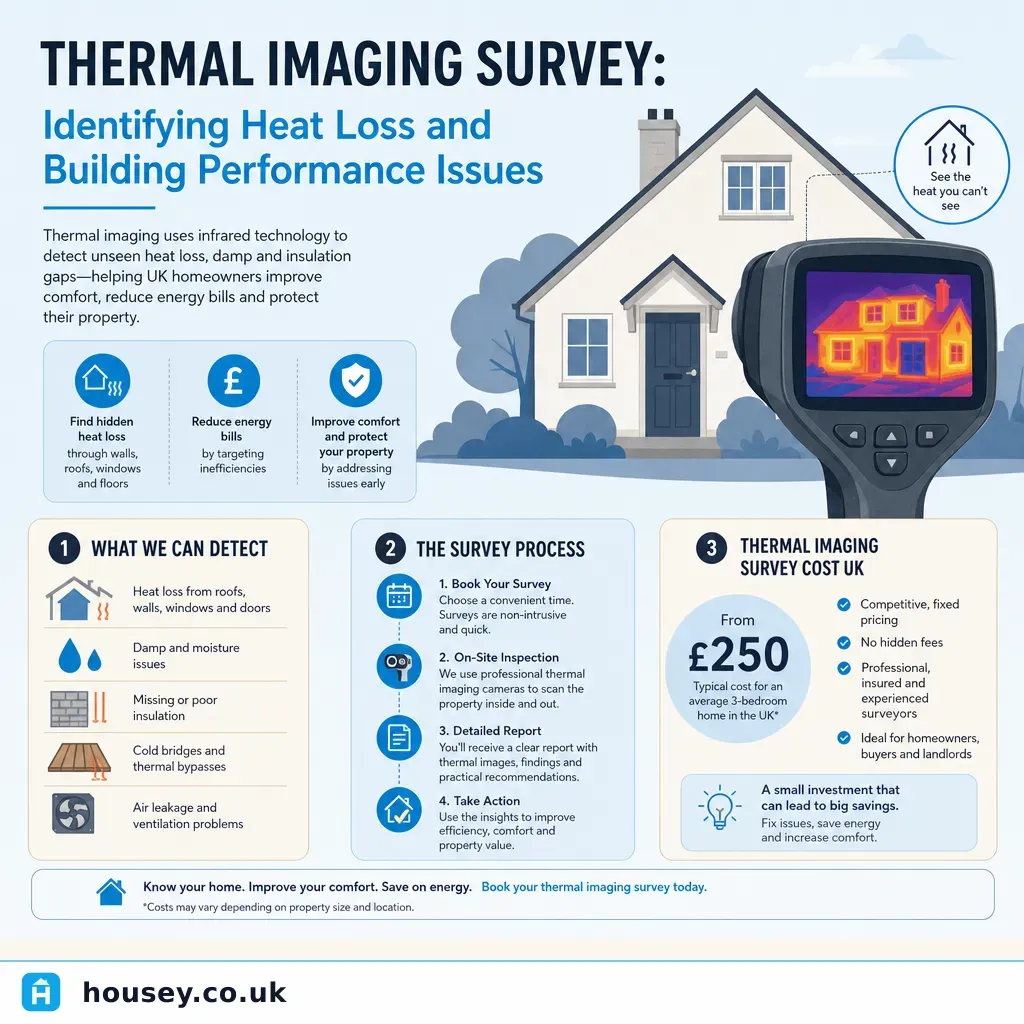
Thermal Imaging Survey: Identifying Heat Loss and Building Performance Issues
A thermal imaging survey uses an infrared camera to show temperature differences across walls, ceilings, and floors, revealing insulation gaps, cold bridges, and air leakage.
 Surveys & Inspections
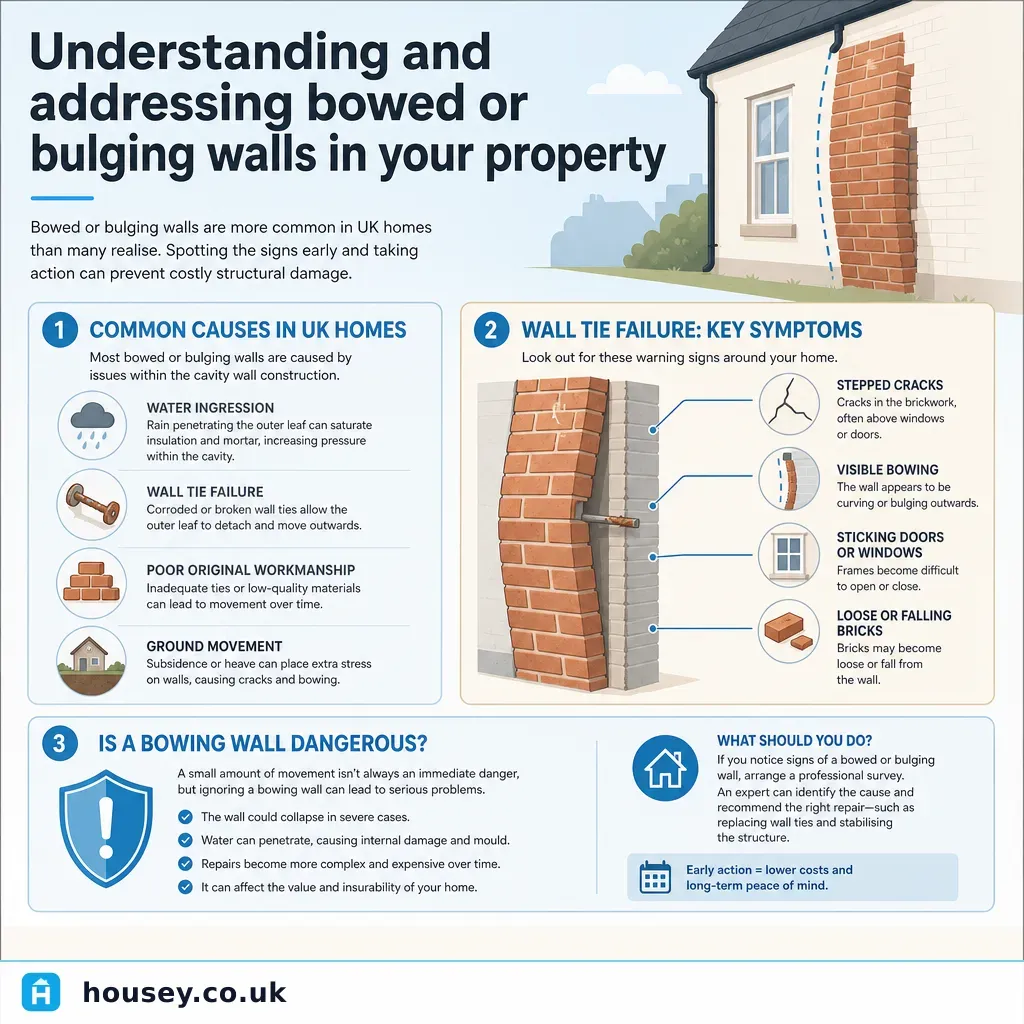
Understanding and addressing bowed or bulging walls in your property
A bowed or bulging wall may indicate wall tie failure, foundation movement, or overloading.
 Surveys & Inspections
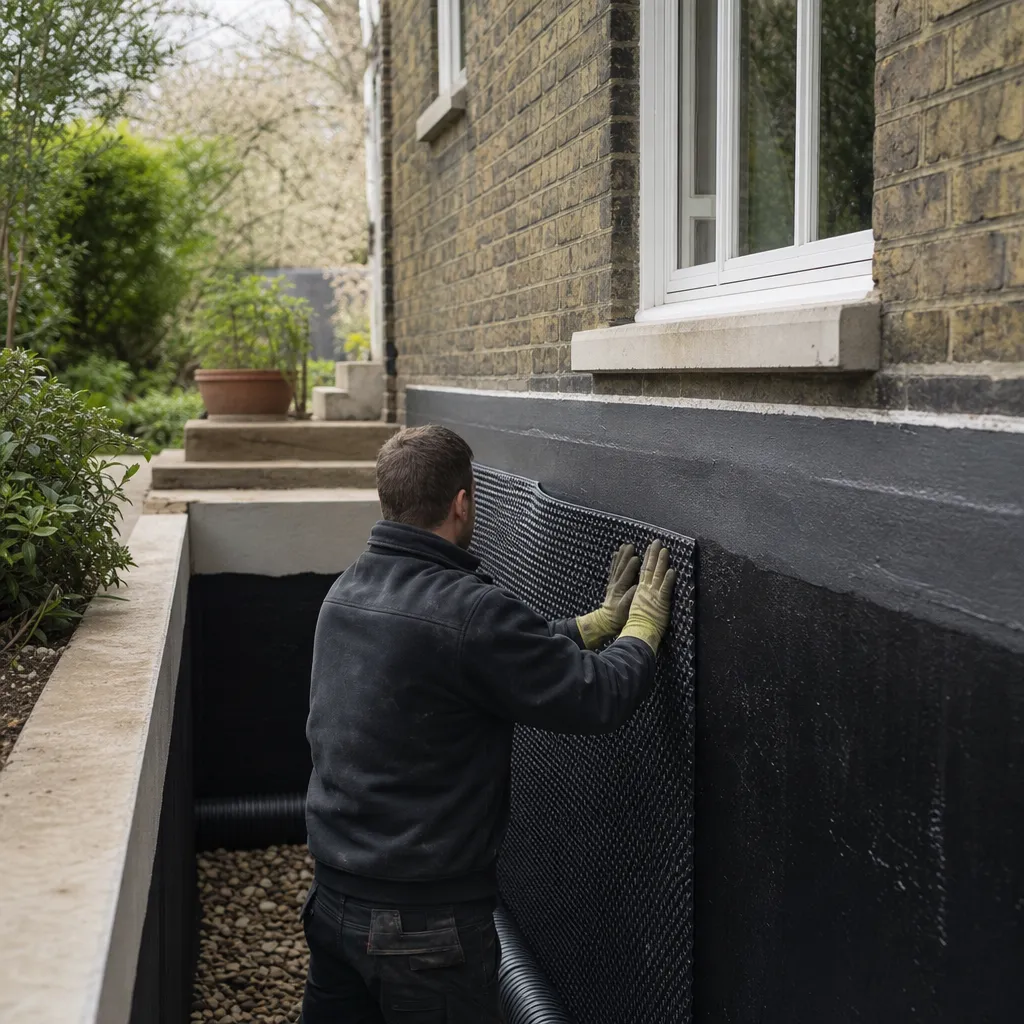
Basement Waterproofing Solutions for Damp Prevention
Basement waterproofing in the UK is governed by BS 8102:2022, which defines three system types: Type A (barrier coatings), Type B (structurally integral concrete), and Type C (cavity drain membrane with sump pump).
 Surveys & Inspections
Managing Property and Contents After Damp Treatment
After damp treatment in a UK home, allow walls to dry fully before re-plastering or decorating — this typically takes six months to two years depending on construction and damp severity.