Distinctive Garden Designs: Creating Unique Outdoor Spaces
By Housey · Last reviewed 8th of May 2026
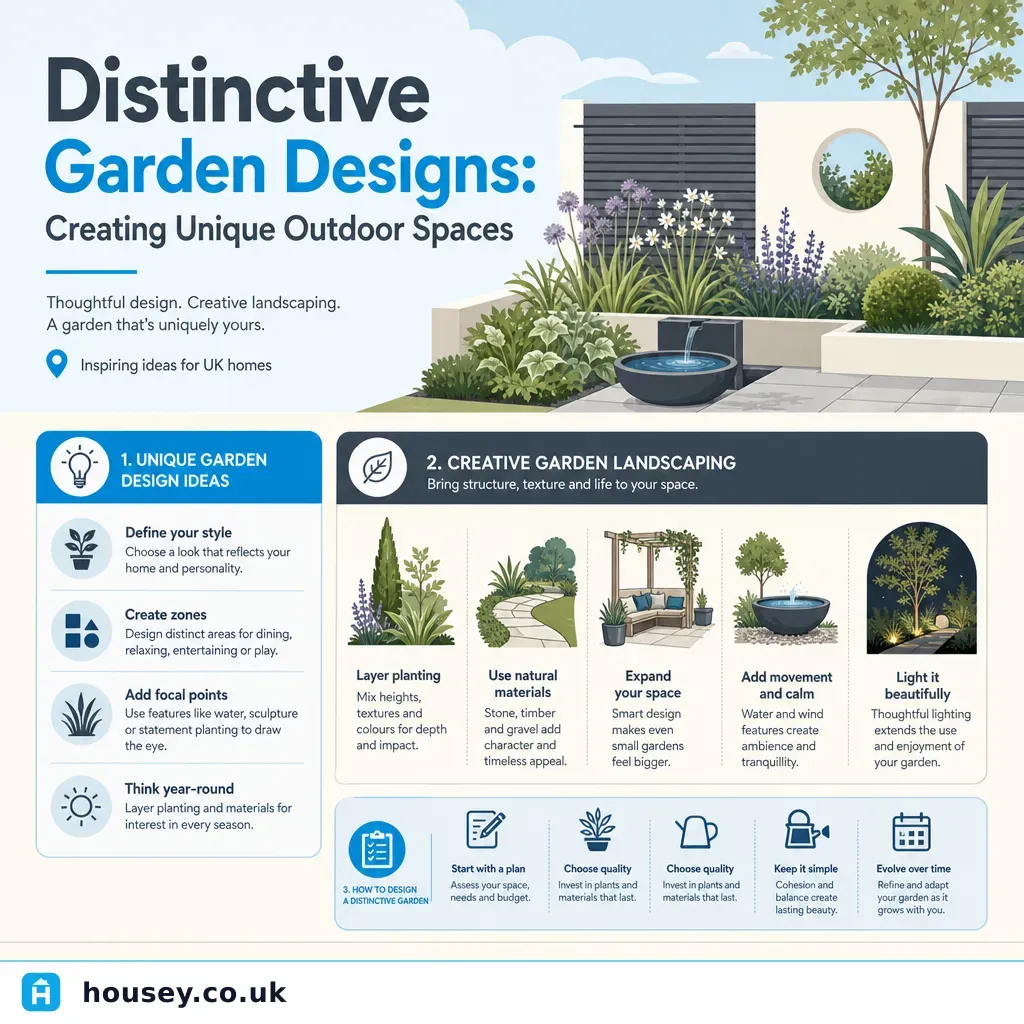
Distinctive Garden Designs: Creating Unique Outdoor Spaces
Transforming an outdoor space from a generic plot into something genuinely individual is one of the most satisfying home improvements a UK homeowner can make — and one of the most frequently underestimated. Garden design decisions tend to arise after moving into a new property, following an extension project that has disrupted the garden, or when an existing layout simply stops working for how the household lives. Getting those decisions right involves far more than plant selection: site levels, drainage, soil type, planning constraints, and material continuity all shape what is achievable and what will last.
Key points
- Impermeable front-garden surfacing over 5m² requires planning permission or permeable materials under Schedule 2, Part 1, Class F of the Town and Country Planning (General Permitted Development) Order 2015 (England).
- Any fence or wall adjacent to a highway that exceeds 1m in height, or exceeds 2m elsewhere, generally requires planning permission under the same GPDO framework.
- Trees with a Tree Preservation Order (TPO) cannot be pruned, felled, or significantly altered without prior consent from the local planning authority; councils maintain a public register of protected trees.
- Soil type — clay, chalk, loam, or sandy — directly determines which plants will establish successfully; a basic soil test (approximately £10–£40 from garden centres or specialist labs) before planting can prevent costly failures.
- Members of the Society of Garden Designers (SGD) and the Landscape Institute (LI) carry professional indemnity insurance and follow a recognised design process; the British Association of Landscape Industries (BALI) accredits landscape contractors.
What makes a garden genuinely distinctive?
A distinctive garden has a legible concept — a single coherent idea governing material choices, planting palette, and spatial layout. That concept does not need to be unusual; it needs to be consistent. A Victorian terrace garden planted entirely in a naturalistic cottage style feels considered; the same garden combining tropical specimens, formal box hedging, and a resin-bound surface feels fragmented.
The most satisfying UK gardens tend to share several characteristics:
- Site responsiveness: they work with aspect, soil type, and existing features rather than against them.
- Year-round structure: deciduous planting is supplemented by evergreens, structural grasses, or hard landscaping that provides form in winter.
- Practical layering: seating areas, circulation routes, and storage are resolved before planting begins, not added as afterthoughts.
- Material continuity: paving, edging, and built features share a material language — typically two or three complementary materials rather than five or six.
Which design approach suits your garden?
Use this decision tree to identify the right starting point for your project:
- Choose a naturalistic planting-led design if your garden has good depth (typically 8m+), you prefer lower chemical maintenance, and you are comfortable with seasonal variation in appearance.
- Choose a formal or structured layout if the garden is small or heavily overlooked, you want year-round tidiness, or the house is Georgian, Edwardian, or Regency with strong architectural lines worth echoing.
- Choose a contemporary hard-landscaping-led design if the garden is heavily shaded, has poor or contaminated soil, or will be used primarily for entertaining rather than growing.
- Ask a garden designer if the garden has significant level changes, persistent drainage problems, trees with TPO protection, or boundary features that need resolving before design begins.
- Check with your local planning authority before significant works if the property is listed, in a conservation area, or if you plan front-garden changes involving hard surfacing over 5m².
Garden designer vs landscaper: which do you need?
Approach | Best for | Not ideal for | Typical output | Main risk if wrong |
|---|---|---|---|---|
Garden designer only | Generating a tested concept, planting plans, detailed drawings | Those wanting a single contractor relationship start to finish | Detailed planting plan, hard-landscaping drawings, specification | Design that exceeds budget or cannot be built as drawn |
Landscaper only | Straightforward hard landscaping — patios, paths, fencing, lawns | Complex planting schemes or spaces needing a coherent design brief | Installed garden to a rough brief or sketch | No coherent concept; piecemeal result |
Garden designer + separate landscaper | Larger or complex projects where design quality matters | Smaller budgets where combined fees are disproportionate | Designed and built to specification | Coordination gaps if the two parties do not communicate well |
Design-and-build firm | Single point of accountability; simpler project management | When independent design review is important | Full project from concept to completion | Less design rigour; built to the firm's preferred palette |
UK planning and regulatory considerations
Most domestic garden works fall within Permitted Development rights and need no formal application. Several common situations do, however, require attention:
Front-garden surfacing: Any hard surfacing over 5m² in a front garden must use permeable materials (gravel, permeable block paving, or similar) or direct runoff to a lawn or border. Non-permeable surfacing over 5m² requires planning permission under Part 1, Class F of the GPDO 2015.
Fences and walls: A fence or wall adjacent to a highway exceeding 1m in height, or exceeding 2m elsewhere, generally requires planning permission. This catches many homeowners aiming for screening or privacy.
Trees with TPOs: Any works to a tree with a Tree Preservation Order — including pruning — require prior consent from the local planning authority. An arboriculturalist can check TPO status before a landscaper is instructed.
Listed buildings and conservation areas: Permitted Development rights are restricted or removed for listed properties and often for conservation area properties. Check with the local authority conservation officer before any significant external works.
What to ask a garden designer or landscaper before accepting a quote
- What is your design process, and how many revisions are included in the fee?
- Are you a member of the SGD, Landscape Institute, or BALI, and do you hold professional indemnity and public liability insurance?
- Will you check for planning constraints — TPOs, permitted development limits, listed building or conservation area restrictions — before the design is finalised?
- What does the quoted price include and exclude: materials, labour, waste removal, planting, aftercare?
- What are the payment milestones, and what happens if unexpected issues (drainage runs, buried rubble, tree roots) are found during the build?
- Can you provide references from completed projects of similar scale and style?
- Is VAT included in your quoted price?
Red flags when reviewing quotes or designers
Watch out for the following during any procurement process:
- A designer who provides a finalised planting plan before visiting the site in person.
- A landscaper who quotes for hard landscaping without asking about existing drainage or drainage runs.
- Any contractor who suggests removing a tree without first confirming there is no TPO.
- Quotes that exclude waste removal — skip hire for a medium garden clearance typically adds £300–£600 to project costs.
- A contract requesting full payment upfront with no phased milestone structure.
- No written contract or specification document provided before work begins.
When to get professional help
Most garden design and landscaping work is low-risk and within the capability of a competent contractor. Certain situations do warrant specialist input:
- Significant level changes or retaining walls: walls over approximately 0.6m retaining soil should be checked or designed by a structural engineer or qualified landscape architect to ensure stability and adequate drainage.
- Trees with TPOs: instruct a qualified arboriculturalist — ideally a Registered Consultant from the Arboricultural Association — rather than relying solely on a landscaper's assessment.
- Persistent drainage problems: waterlogging may indicate an infrastructure issue beneath the surface; a drainage contractor or civil engineer should investigate before a new surface is laid.
- Listed buildings: external works to a listed property — including garden walls and paved areas — may constitute listed building works and require consent. Check with the local authority conservation officer before proceeding.
How Housey can help
If you are ready to move a garden project forward, Housey connects you with vetted garden designers and landscapers in your area. Submit a single brief and receive comparable quotes from local professionals — without cold-calling directories.
Frequently asked questions
Do I need planning permission to landscape my back garden?
In most cases, no. Domestic garden works in back gardens — patios, paths, raised beds, pergolas under 2.5m, and fences under 2m — typically fall within Permitted Development rights and need no application. Exceptions apply for listed buildings, conservation areas, and Article 4 Direction areas. Front-garden surfacing over 5m² using non-permeable materials does require planning permission under GPDO 2015.
How much does garden design cost in the UK?
Indicative UK costs, last reviewed 2026-05-08. A garden design service typically costs £500–£3,000+ for a medium residential garden depending on the designer's experience and project complexity. Full landscaping build costs vary widely — a simple patio and lawn for a 30m² garden might cost £3,000–£8,000, while a comprehensive redesign with hard landscaping and planting can reach £20,000–£50,000+ for larger plots. Always request itemised quotes from at least three contractors.
What is the difference between a garden designer and a landscaper?
A garden designer creates the concept, planting plans, and detailed drawings. A landscaper physically builds the garden — laying paving, constructing structures, and planting. Many projects use both separately. SGD and Landscape Institute members are typically designers; BALI members are typically landscape contractors. Some design-and-build firms offer both services under one contract.
How long does a garden design project take?
A design-only commission for a medium garden typically takes 4–8 weeks from the initial site visit to final drawings. A full design-and-build project commonly takes 3–6 months, depending on complexity, material lead times, and contractor availability. Projects started in autumn for spring completion are common and allow time for new planting to establish.
Can I make a garden distinctive on a small plot?
Yes. Small gardens often benefit from a stronger, simpler concept — less room to hide inconsistencies means every decision matters more. Vertical planting, a single well-chosen paving material, built-in seating, and outdoor lighting can transform a 20–30m² urban plot. A professional garden designer is often especially valuable on small or awkward sites where spatial decisions are tightly interdependent.
Sources and further reading
- Permitted development rights for householders: technical guidance — GOV.UK
- Planning Portal: Fences, gates and garden walls — Planning Portal
- Society of Garden Designers: Find a garden designer — Society of Garden Designers
- BALI: Find a BALI member — British Association of Landscape Industries
- Arboricultural Association: Find an arborist — Arboricultural Association
- RHS: Soil types and improving your soil — Royal Horticultural Society
Useful next reads
 Improvement & Build
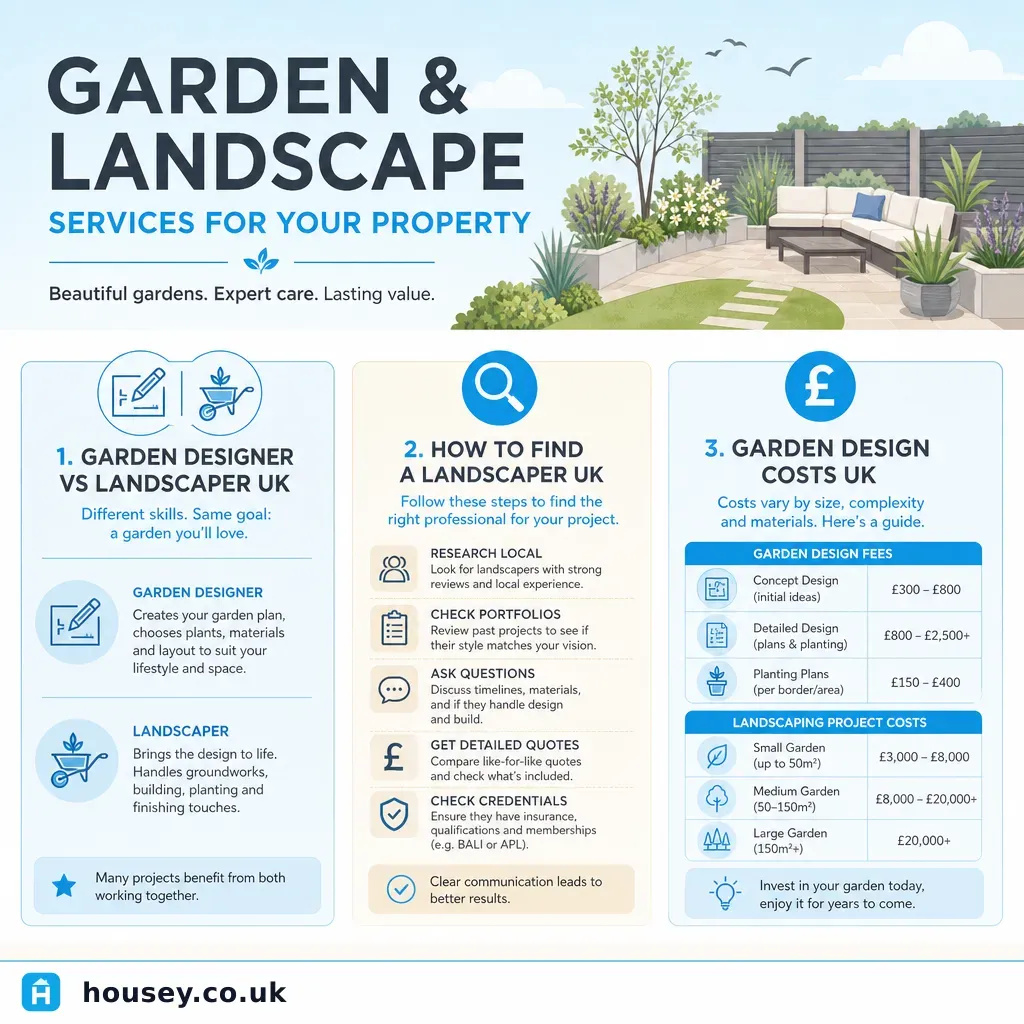
Garden and Landscape Services for Your Property
Garden designers and landscapers both improve outdoor spaces but offer different services.
 Improvement & Build
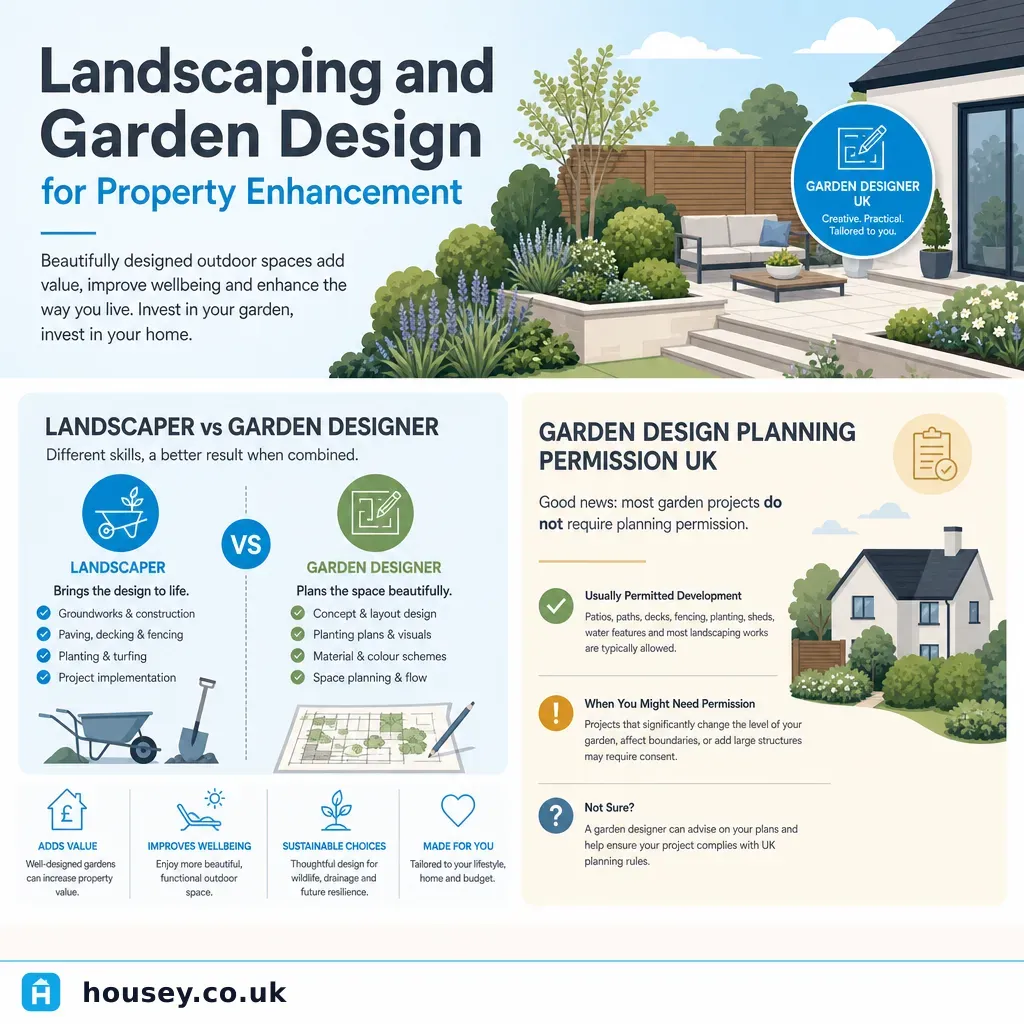
Landscaping and Garden Design for Property Enhancement
Landscaping and garden design involve planning and building outdoor spaces — from patios and raised beds to planting schemes and drainage.
 Improvement & Build
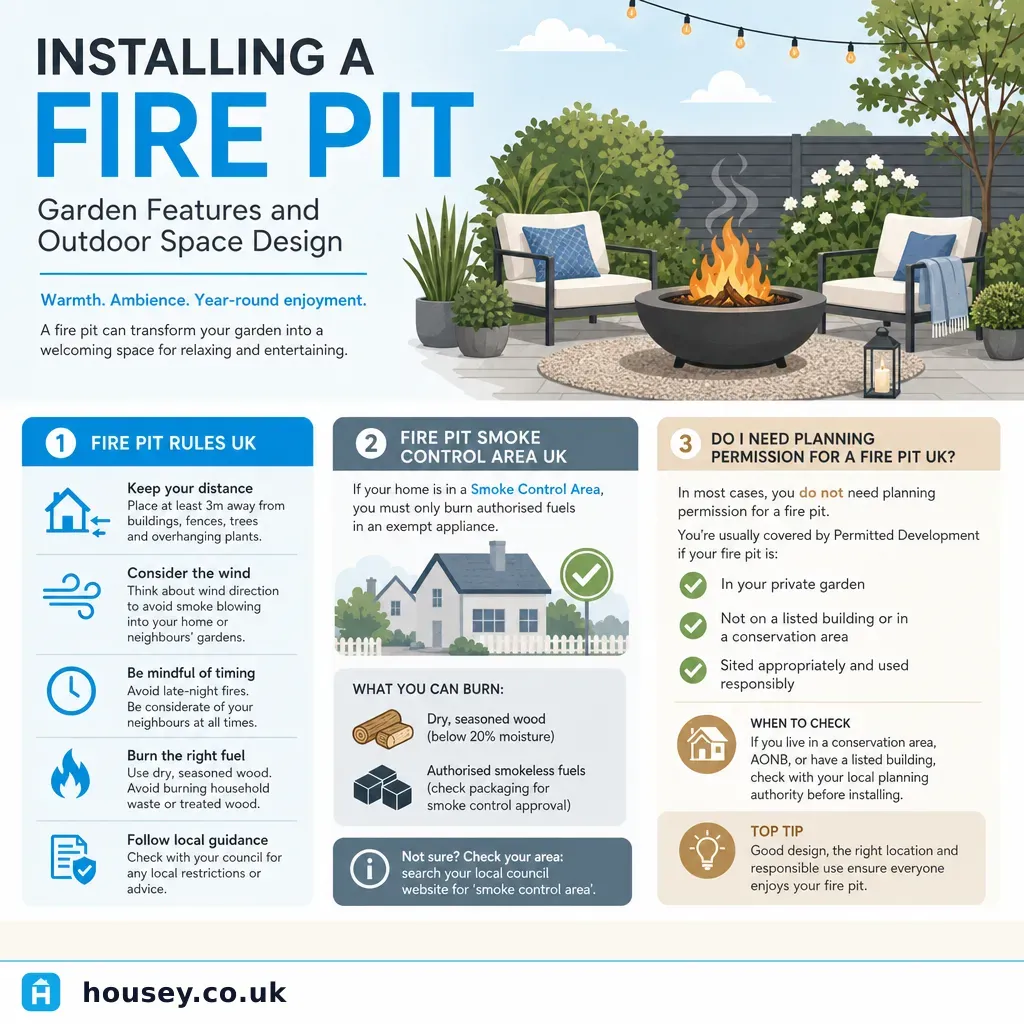
Installing a Fire Pit: Garden Features and Outdoor Space Design
Installing a garden fire pit in the UK is generally permitted, but Smoke Control Area rules prohibit open wood-burning in most towns and cities.
 Improvement & Build
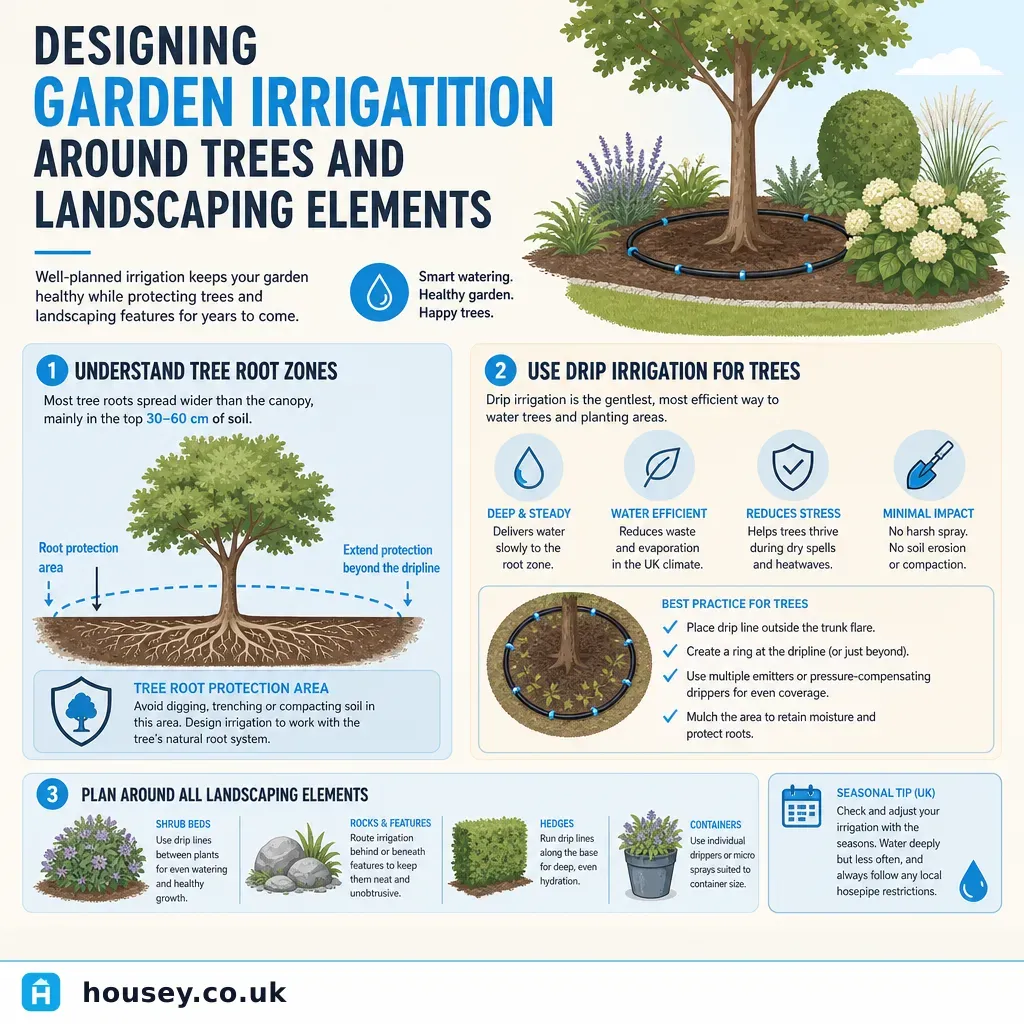
Designing Garden Irrigation Around Trees and Landscaping Elements
Design irrigation around trees by respecting the root protection area defined under BS 5837:2012, using drip or leaky pipe delivery rather than spray heads, and putting the tree zone on its own circuit.
 Improvement & Build
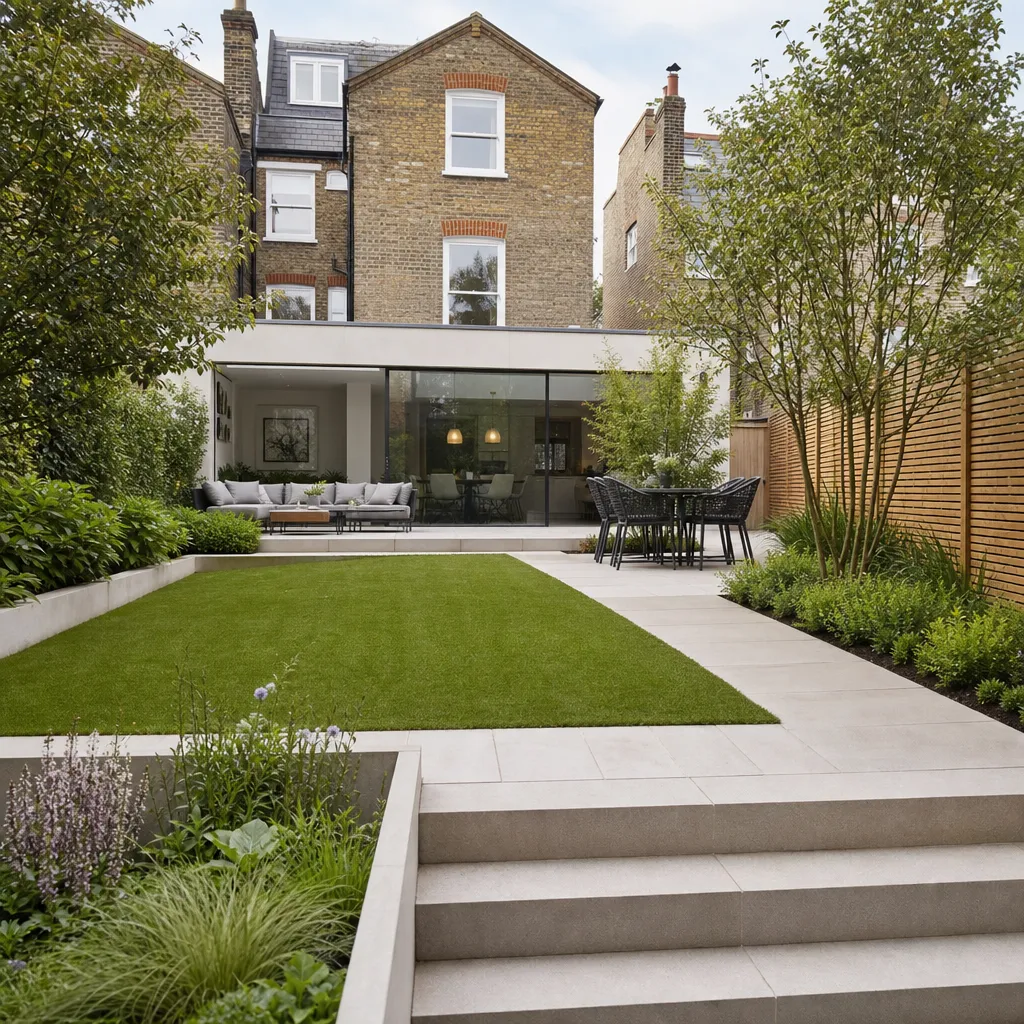
Garden Design Trends and Contemporary Landscaping Ideas
Contemporary UK garden design centres on low-maintenance naturalistic planting, multi-functional outdoor spaces, sustainable hard landscaping materials, and wildlife-friendly rewilded areas.