Do you need planning permission to add a balcony?
By Housey · Last reviewed 11th of May 2026
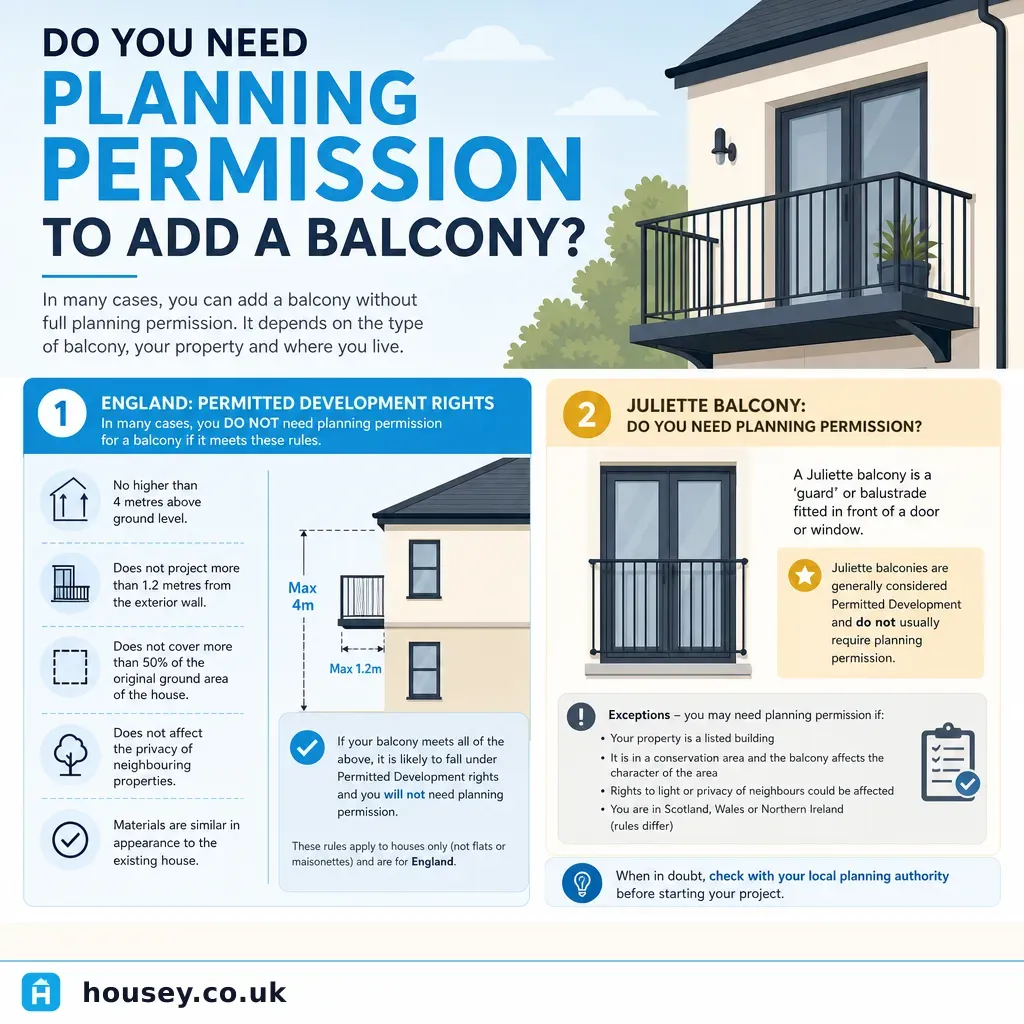
Do you need planning permission to add a balcony?
Adding a balcony can transform how you use your home — opening up outdoor space where a conventional garden may be limited, or making the most of a first-floor view. The planning position is something many homeowners discover only when a build is already underway, or when a property sale uncovers an earlier addition that was never formally approved. Whether you are planning a new balcony, converting an existing dormer opening, or buying a property with one already in place, understanding the consent requirements before work starts can save significant time, cost, and legal difficulty.
Key points
- In England, balconies and raised platforms are explicitly excluded from permitted development rights under Schedule 2, Part 1, Class A of the Town and Country Planning (General Permitted Development) (England) Order 2015.
- A full planning application is therefore required for almost all balconies on dwellinghouses in England — regardless of size, height, or position on the property.
- Flats and maisonettes do not benefit from Class A permitted development rights at all; all balcony additions to flats require planning permission.
- Building regulations approval is required in addition to planning permission, covering structural integrity (Part A), safe guarding from falling (Part K), and fire safety (Part B) where applicable.
- Scotland, Wales, and Northern Ireland each operate separate planning regimes with their own permitted development rules — check with your local planning authority before starting any work.
Why balconies need planning permission in England
The Town and Country Planning (General Permitted Development) (England) Order 2015 — the GPDO — gives homeowners automatic rights to extend and alter their homes without applying for planning permission. These rights cover many common works: rear extensions, loft conversions, dormer windows, and outbuildings. However, the GPDO explicitly excludes any addition or alteration that results in a balcony, verandah, or raised platform.
The policy rationale is privacy and overlooking. A walkable balcony at first-floor level or above creates a permanent new vantage point that can significantly affect the amenity of neighbouring properties — something local planning authorities are entitled to assess case by case, and to refuse where the impact is considered material.
This exclusion applies equally whether the balcony is at the front, rear, or side of the property. Size does not grant permitted development status. A modest 1 m² platform and a full-width wraparound terrace both require the same planning application in England.
Juliette balconies vs full balconies: which rules apply?
Feature | Full (walkable) balcony | Juliette balcony |
|---|---|---|
Walkable platform | Yes — usable floor area at height | No — French doors open onto a fixed guardrail only |
Planning permission | Almost always required in England | Likely required — confirm with your LPA |
Permitted development? | No — explicitly excluded under GPDO 2015 | Unclear; depends on local planning authority interpretation |
Building regulations | Yes — Part A (structure), Part K (fall prevention) | Yes — Part K guardrail height and strength requirements |
Privacy impact on neighbours | High — direct overlooking potential | Lower — no standing area at height |
Typical LPA concern | Overlooking, loss of amenity, change of character | Generally lower, but still assessed on design and character grounds |
A Juliette balcony — a guardrail fitted across full-height French doors with no walkable platform — is sometimes treated differently from a full balcony. Some local planning authorities consider it a window alteration rather than a balcony addition, which may fall within permitted development. Others consider any raised platform element to be excluded from PD rights. Always seek a pre-application enquiry from your LPA before assuming no permission is needed.
Which option should you choose?
- Apply for full planning permission if you want any walkable balcony — this is the standard and expected route for dwellinghouses in England.
- Seek a pre-application enquiry before installing a Juliette balcony, to confirm whether your local authority treats it as a window alteration or a raised platform requiring consent.
- Obtain listed building consent (in addition to planning permission) if your property is a listed building — balconies on listed buildings are rarely approved where they would alter the historic character or fabric of the structure.
- Check your local development plan if your property is in a conservation area, national park, or Area of Outstanding Natural Beauty (AONB), where Article 4 Directions may have removed permitted development rights entirely.
- Check your lease if you own a leasehold flat — your freeholder's written consent will almost certainly be required before any structural alteration, entirely independently of the planning position.
- Consult a planning consultant or chartered architect if the design is particularly sensitive, the local authority has informally indicated it is minded to refuse, or you are unsure of your property's planning history.
What happens if you build without permission?
Building a balcony without planning permission creates an unauthorised development. Your local planning authority can issue an enforcement notice requiring removal of the structure. Crucially, there is no reliable immunity period: the usual four-year limitation for operational development does not apply where works have had a material effect on the use or character of a dwelling, and recent enforcement case law makes it unwise to rely on the passage of time as protection.
The position at sale is equally problematic. Your conveyancer must disclose unauthorised works, and buyers' solicitors routinely request evidence of planning permission for visible external alterations. An unresolved enforcement risk can delay or undermine a sale, and indemnity insurance — while sometimes acceptable to buyers — is not a substitute for lawful consent and does not prevent enforcement action by the local authority.
Important limitations
This article covers the planning regime in England and provides general information only. Planning decisions depend on the specific property, its planning history, the policies of the relevant local planning authority, and the interpretation of national planning policy. Rules in Scotland, Wales, and Northern Ireland differ materially. Nothing in this article constitutes planning or legal advice — consult a qualified planning consultant or chartered architect for advice specific to your property and situation.
When this becomes urgent
- You have already started or completed a balcony without planning permission and are concerned about potential enforcement action.
- You are in the process of buying a property with an existing balcony and need to confirm it was lawfully approved before exchange of contracts.
- Your local planning authority has issued a pre-enforcement letter or planning contravention notice.
- You are a leaseholder who has made or is planning structural alterations without freeholder consent and may be at risk of lease forfeiture.
What to ask a qualified professional
- Does my property benefit from any remaining permitted development rights, or have they been removed by a planning condition or an Article 4 Direction?
- Is my property in a conservation area, listed building designation, or other area with heightened planning restrictions?
- What is the local authority's published policy and recent decision record for first-floor balconies in my area?
- Will you prepare and submit the full planning application, including architectural drawings and a design-and-access statement?
- What are the likely grounds on which a neighbour might object, and how can the design be adjusted to address them?
- If permission is refused, what are my options — amendment and resubmission, or appeal to the Planning Inspectorate?
When to get professional help
Seek professional advice before proceeding if:
- You are unsure whether your property or local area has planning restrictions beyond the standard GPDO rules.
- You own a leasehold flat and need to understand both planning consent and lease obligations before committing to a design.
- Your local authority has declined a pre-application enquiry or indicated it is minded to refuse a balcony application.
- You are buying a property with an existing balcony and want to confirm it was lawfully consented before exchange.
How Housey can help
Housey connects homeowners with experienced planning consultants who can advise on balcony planning applications, review your permitted development position, handle pre-application enquiries with the local authority, and prepare and submit a full application on your behalf. A well-prepared application submitted by a qualified professional significantly improves the likelihood of approval at first attempt.
Frequently asked questions
Is a Juliette balcony treated the same as a full balcony for planning purposes?
Not always. A Juliette balcony — French doors with a fixed guardrail and no walkable floor area — may be treated as a window replacement by some local planning authorities, potentially falling within permitted development. However, others consider it a raised platform requiring planning permission. Always seek a pre-application opinion from your LPA before assuming no permission is needed — interpretations vary significantly between authorities.
How long does a balcony planning application take?
A standard householder planning application in England has an eight-week determination target. In practice, balcony applications may take longer if the authority requests additional information or receives neighbour objections. Factor in approximately four to six weeks of preparation time before submission, and allow for potential negotiation or design amendments during the determination period.
What happens if I build a balcony without planning permission?
Your local planning authority can issue an enforcement notice requiring removal of the unauthorised structure. The standard four-year immunity period for operational development may not protect you where works have materially affected the character of a dwelling. The matter must also be disclosed during any future property sale, which can complicate conveyancing and may require indemnity insurance.
Do balconies need building regulations approval as well as planning permission?
Yes — planning permission and building regulations are entirely separate processes with different applications and different approval bodies. A balcony requires building regulations approval to confirm the structure is safe under load (Part A), that guardrails meet minimum height and strength requirements (Part K), and — for certain configurations in flats — that fire safety is not compromised (Part B). Your designer or contractor should apply to the relevant building control body before structural work begins.
Sources and further reading
- Town and Country Planning (General Permitted Development) (England) Order 2015, Schedule 2 — legislation.gov.uk
- Planning Portal: Balconies, verandahs and raised platforms — Planning Portal
- GOV.UK: Planning permission — GOV.UK
- Building Regulations Approved Document K: Protection from falling, collision and impact — GOV.UK
- Historic England: Listed buildings and development — Historic England
Useful next reads
 Planning & Pre-Build
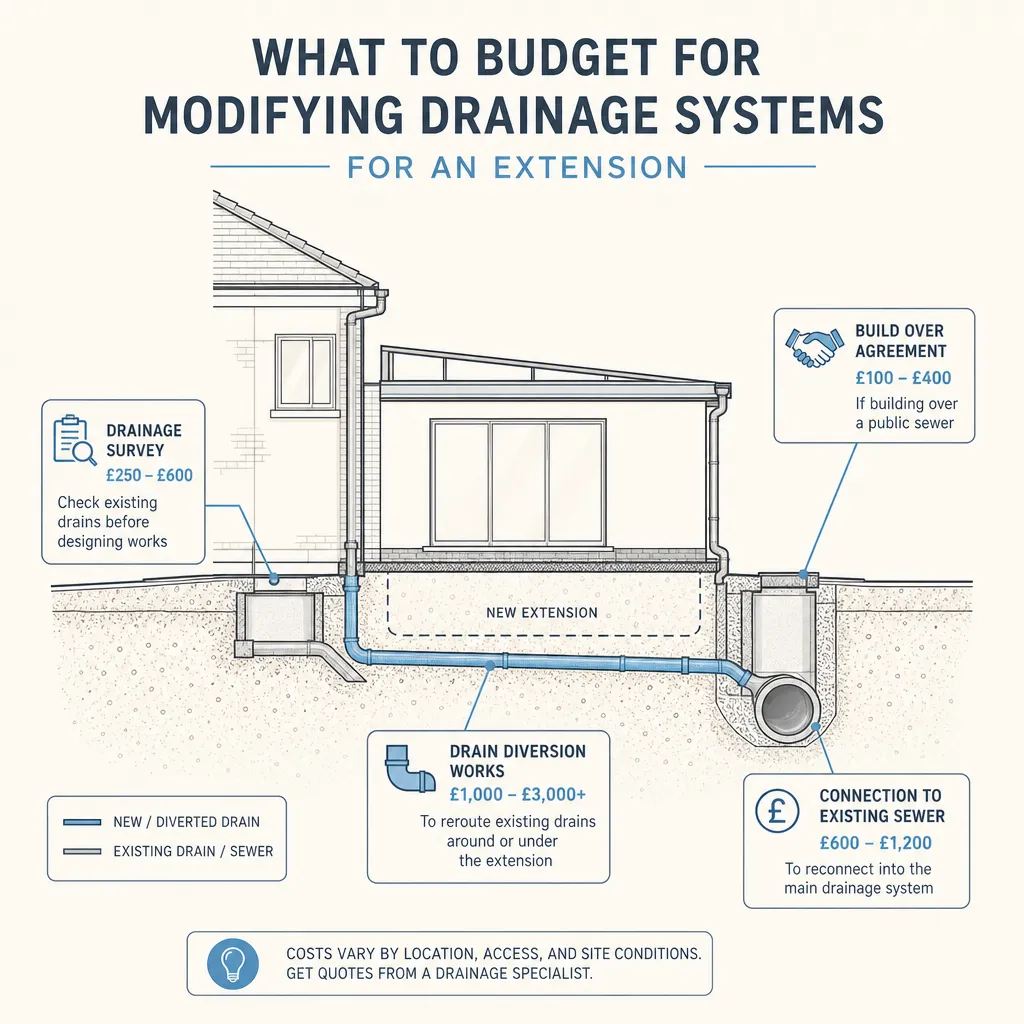
What to budget for modifying drainage systems for an extension
Modifying drainage for a house extension can cost from a few hundred pounds for a Build Over Agreement application to £40,000 or more for diverting a public sewer.
 Planning & Pre-Build
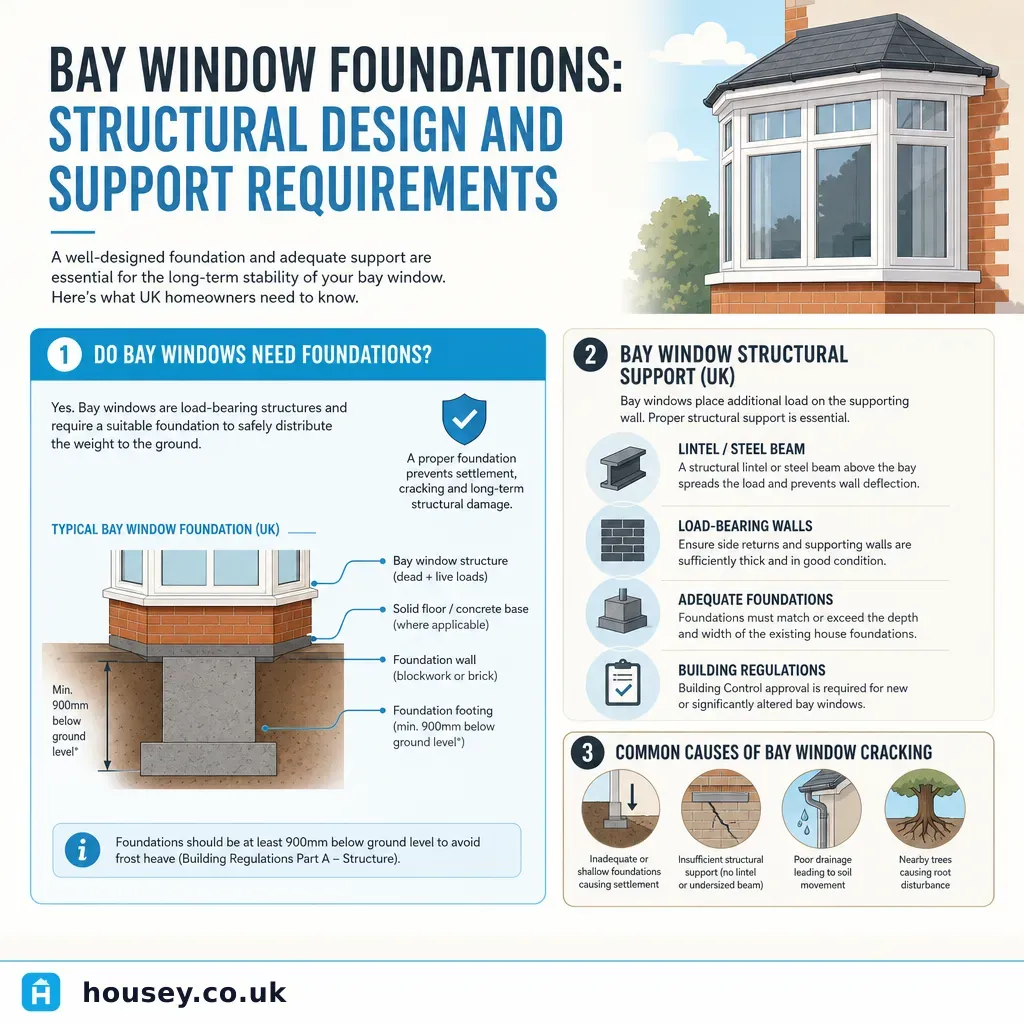
Bay Window Foundations: Structural Design and Support Requirements
Bay window foundations must transfer the bay's structural load to the ground independently of the main wall.
 Planning & Pre-Build
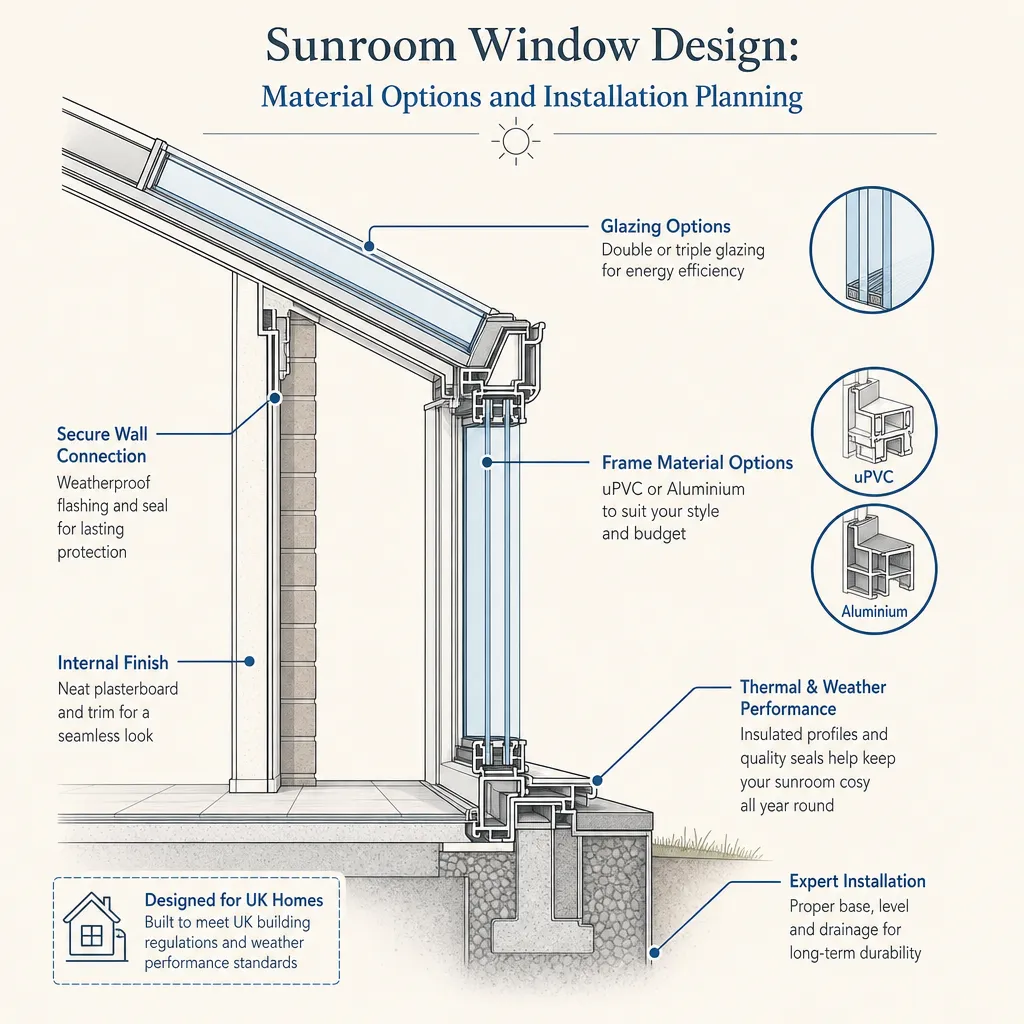
Sunroom Window Design: Material Options and Installation Planning
Sunroom windows in the UK typically use double or triple glazing in uPVC, aluminium, or timber frames.
 Planning & Pre-Build
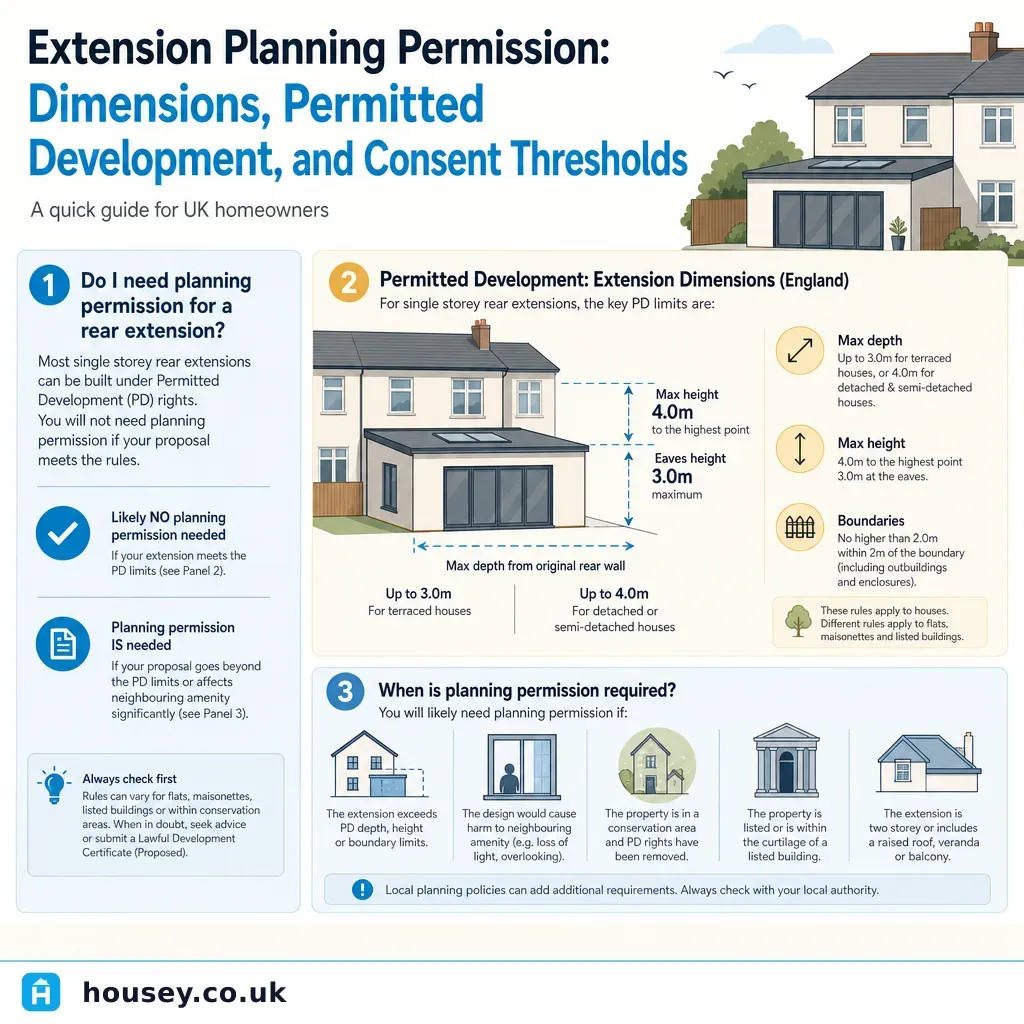
Extension Planning Permission: Dimensions, Permitted Development, and Consent Thresholds
Single-storey rear extensions up to 4m (detached) or 3m (other houses) are usually permitted development in England without planning permission.
 Planning & Pre-Build
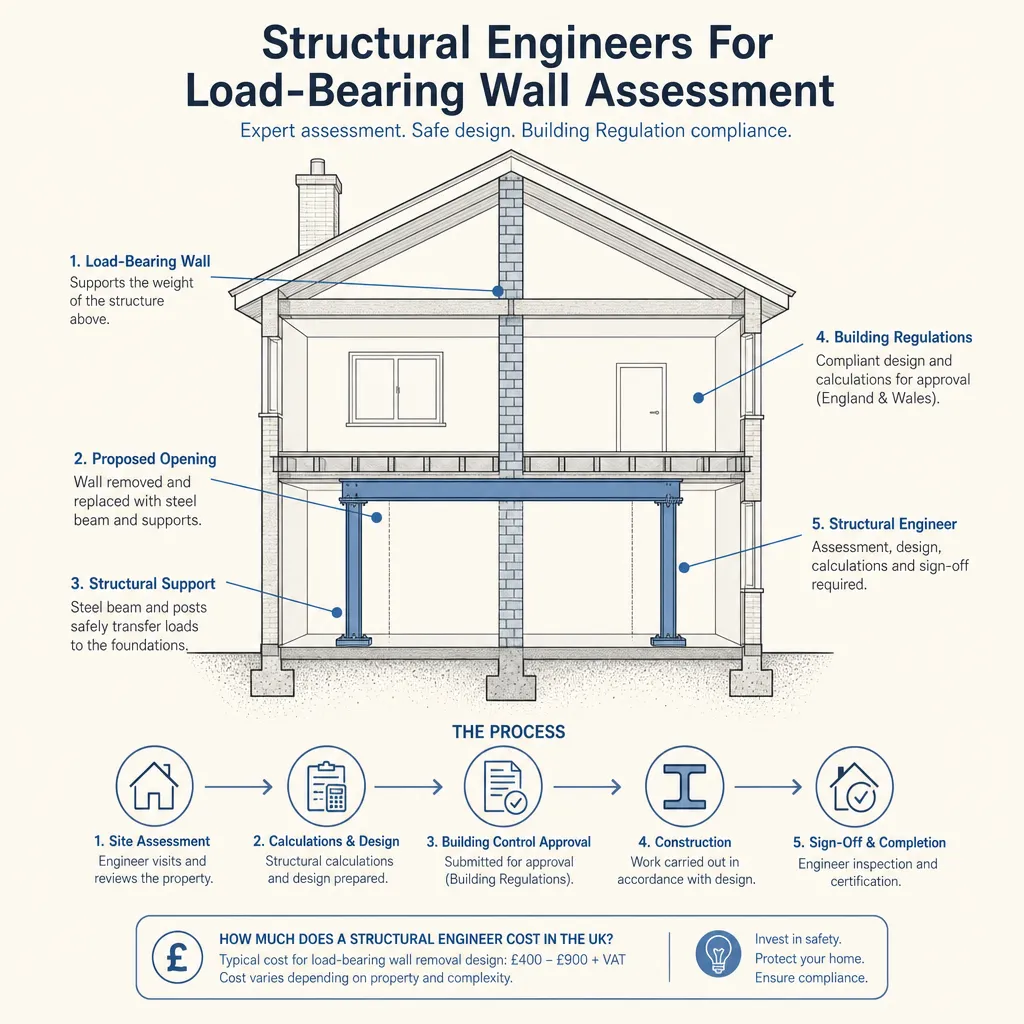
Structural Engineers For Load-Bearing Wall Assessment
A structural engineer assesses whether a wall is load-bearing, designs the replacement beam or support required, and produces drawings for Building Regulations approval.