Structural Engineers For Load-Bearing Wall Assessment
By Housey · Last reviewed 31st of May 2026
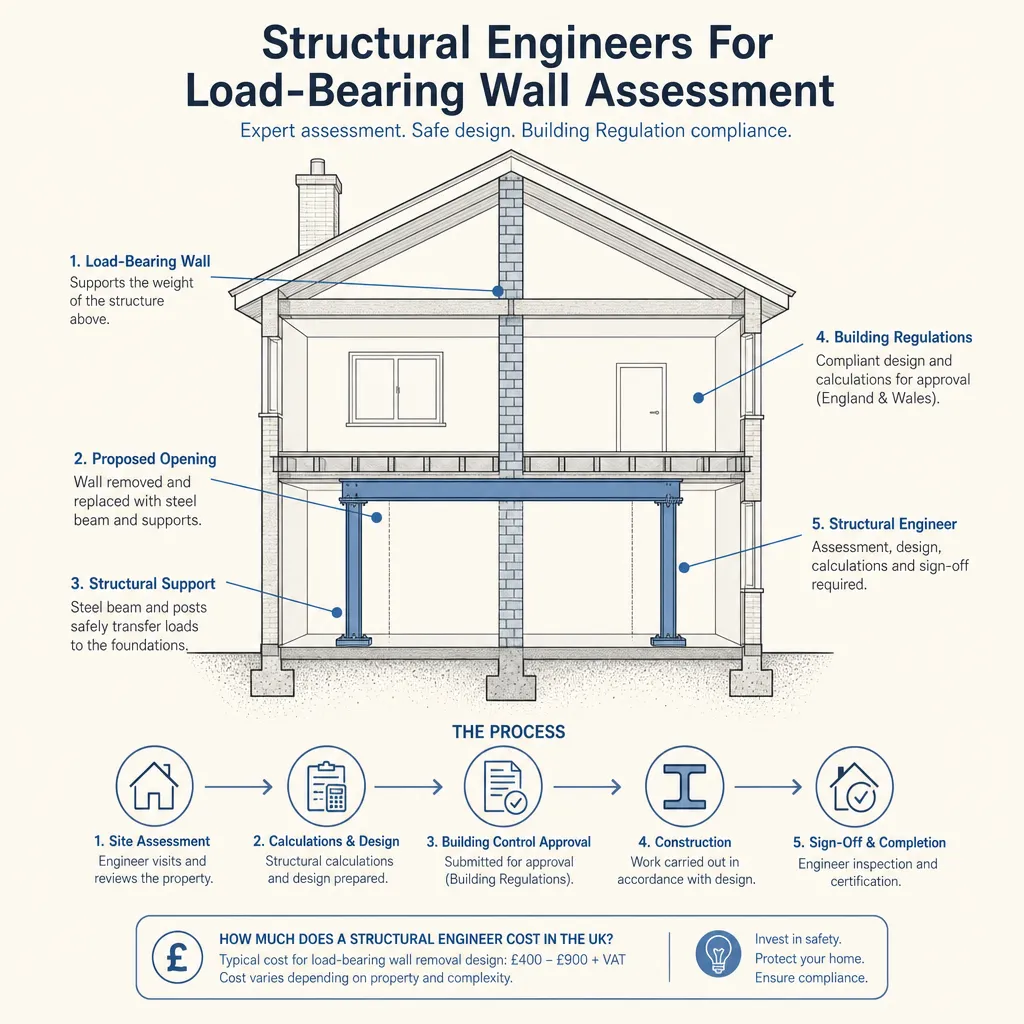
Structural Engineers For Load-Bearing Wall Assessment
Opening up a room by removing an internal wall is one of the most transformative changes you can make to a UK home, but it carries real structural and legal risk if the wrong wall is targeted without professional assessment. Whether you are planning a kitchen-diner merger in a 1930s semi or creating a through-room in a Victorian terrace, the question of who carries out the structural assessment — and what formal approval is needed before work begins — shapes your entire project timeline and budget.
Key points
- Building Regulations Part A (Structure) requires a structural engineer's calculations and building control approval before any load-bearing wall is removed or significantly altered in England and Wales.
- Only a chartered structural engineer (MIStructE, or CEng registered with the Engineering Council) can certify structural designs for building control — a general builder or RICS building surveyor cannot fill this role.
- Steel universal beams (RSJs) for residential wall openings typically cost £800–£2,500 supplied and installed; structural engineer fees for a straightforward residential assessment are typically £300–£900 (indicative UK costs, last reviewed 2026-05-31).
- Unremedied structural alterations without a building control completion certificate can block a property sale — conveyancers will ask for documentation before exchange.
- The Party Wall etc. Act 1996 may also apply if the wall sits on or close to a boundary shared with an adjoining owner, requiring a separate party wall agreement.
What does a load-bearing wall assessment involve?
A load-bearing wall assessment by a structural engineer typically includes a site visit to inspect the wall in question, the floors and structure above, the foundations below, and the load path through the building. The engineer examines the property's age and construction type, checks the direction of floor joists (which often run at right angles to load-bearing walls), inspects any existing beams or steelwork, and reviews available drawings or prior building control records.
Following the visit, the engineer produces structural calculations and drawings specifying the size and bearing length of the required steel beam, the temporary propping arrangement during works, and any padstones or connections needed. These documents form the structural submission to building control.
In older properties — Victorian terraces, Edwardian houses, solid-wall 1930s semis, and 1960s crosswall-construction houses — load paths can be complex and not immediately obvious. A professional assessment is especially important when walls run parallel to floor joists, when the property has been previously altered, or when there is any visible cracking, settlement, or movement before works begin.
Do you always need a structural engineer?
For most residential wall removals in England and Wales, Building Regulations approval is required, and the structural engineer provides the calculations that enable building control to approve the work. Not every situation demands the same level of input:
- Small, clearly non-load-bearing stud partitions: Lightweight timber stud walls running parallel to the joists above and not supporting upper structure may not require structural calculations — but confirm this with a professional rather than assume.
- Chimney breast removal: Almost always involves structural work to the floor and chimney above; a structural engineer and building control are required.
- Minor openings in non-load-bearing partitions: Generally covered by standard building practice and may not require engineer involvement.
Decision guide — which professional do you need?
- Choose a chartered structural engineer if you are removing a potentially load-bearing wall, installing a steel beam, removing a chimney breast, or forming any new structural opening.
- Engage building control (via your local authority building control or an approved inspector) to inspect and formally approve the works once the engineer has produced the design.
- Consult a RICS building surveyor if you suspect existing structural movement or need an assessment before purchasing a property where structural alterations may already have been made.
- Check with your local planning authority if the property is listed or in a conservation area — additional consents may be needed alongside building regulations.
- Ask a party wall surveyor if the wall sits on or near a shared boundary before any works begin.
Structural engineer versus other professionals
Professional | What they do | Can they certify structural design? | When to use them |
|---|---|---|---|
Chartered structural engineer (MIStructE or CEng) | Calculates loads, specifies beams, produces drawings | Yes — this is their core function | Load-bearing wall removal, beam design, chimney breast removal |
RICS building surveyor | Inspects condition, identifies structural concerns | No | Pre-purchase surveys, defect investigation |
General builder | Carries out physical works to the engineer's drawings | No | Installation of beam and temporary propping |
Building control surveyor (LABC or approved inspector) | Reviews plans, inspects works, issues completion certificate | No — approves but does not design | Formal approval and inspection of structural works |
Party wall surveyor | Administers the Party Wall etc. Act 1996 procedure | No | Walls on or near shared boundaries |
What to check before starting work
Before appointing an engineer or beginning any wall removal, confirm the following:
- Tenure and lease terms: Leaseholders typically require the freeholder's licence to alter in addition to building regulations approval. Check your lease before committing to the project.
- Party wall implications: Walls on or straddling a boundary with a neighbour may trigger the Party Wall etc. Act 1996, requiring a party wall award. A structural wall that is also a party wall needs both engineering sign-off and the party wall procedure to be completed.
- Listed building consent: If your property is listed (Grade I, II*, or II in England), structural alterations require listed building consent from your local planning authority in addition to building regulations.
- Previous alteration records: Obtain existing building control records from your local authority to establish whether prior structural works have altered the original load path.
When this becomes urgent
Stop work and contact a structural engineer without delay if you observe any of the following during or after wall removal:
- Cracks appearing in ceilings, plasterwork, or adjoining walls that were not present before works began.
- Floors feeling springy, bouncy, or noticeably uneven near the altered wall.
- Temporary props showing signs of stress, tilting, or displacement from their original position.
- Doors or windows sticking or failing to close flush that previously operated freely — a sign of structural movement.
- Stepped cracking through brickwork or mortar joints visible on an external wall face.
Important limitations
This article provides general information only. Structural safety depends on the specific construction, condition, loading, and alteration history of your individual property. Rules under Building Regulations Approved Document A, the Party Wall etc. Act 1996, and listed building legislation vary by property, local authority, and tenure. Do not rely on this guide to make structural decisions. Always instruct a qualified structural engineer and obtain building control approval before carrying out or commissioning structural work.
What to ask a qualified professional
Before instructing a structural engineer for a load-bearing wall assessment, ask:
- Are you chartered — MIStructE or CEng registered with the Engineering Council?
- What does your fee include — site visit, structural calculations, drawings, and building control submission?
- Do I need a full plans application or a building notice for this project, and which would you recommend?
- Will your calculations cover the temporary propping arrangement as well as the permanent beam specification?
- Are there any early indications from your assessment that party wall, listed building, or conservation area issues apply?
- What happens if the works reveal unexpected structure, hidden defects, or a more complex load path than anticipated?
- Do you work with a building control body directly, or do I need to appoint one separately?
When to get professional help
Instruct a structural engineer before any work begins if you plan to remove or alter any internal wall in a property built before 2000. Also seek professional advice if cracks or movement are already visible in the building, if previous structural works lack building control documentation, or if you are uncertain whether the Party Wall etc. Act 1996 applies to your proposed works.
How Housey can help
Housey connects you with vetted professionals offering structural engineering services and building control consultants in your area. Describe your project and receive quotes from chartered engineers experienced in residential structural assessment — without having to search and vet them independently.
Frequently asked questions
Do I need a structural engineer if my builder says the wall is not load-bearing?
Builders can offer useful practical knowledge, but only a chartered structural engineer can certify structural design for building control purposes. If there is any uncertainty, commissioning a professional assessment is advisable. The cost is modest compared with the risk and remedial expense of removing a structural element without proper authorisation.
Can building control tell me if my wall is load-bearing?
Building control surveyors inspect and approve structural works against submitted designs — they do not carry out structural assessments for homeowners. You need to appoint a structural engineer to assess the situation and specify the works. Building control then reviews the engineer's drawings and inspects the completed works on site.
What is a building control completion certificate and why does it matter when selling?
A completion certificate confirms that structural works were inspected and signed off as compliant with Building Regulations. Without one, conveyancers acting for buyers may require indemnity insurance or refuse to proceed without retrospective sign-off, potentially delaying or complicating a sale. Retrospective building control inspection is sometimes available but is not guaranteed.
How long does the structural engineer and building control process take?
A structural engineer can typically visit and produce calculations within one to three weeks for a straightforward residential project. Building control approval via a full plans application can take four to eight weeks; a building notice allows work to start sooner but is inspected as works proceed. Timelines vary by local authority workload and project complexity.
Sources and further reading
- Building Regulations Approved Document A: Structure — GOV.UK
- Party Wall etc. Act 1996 — legislation.gov.uk
- Find a Structural Engineer — Institution of Structural Engineers
- Building regulations approval — GOV.UK
- Listed buildings and building consent — Historic England
Useful next reads
 Planning & Pre-Build
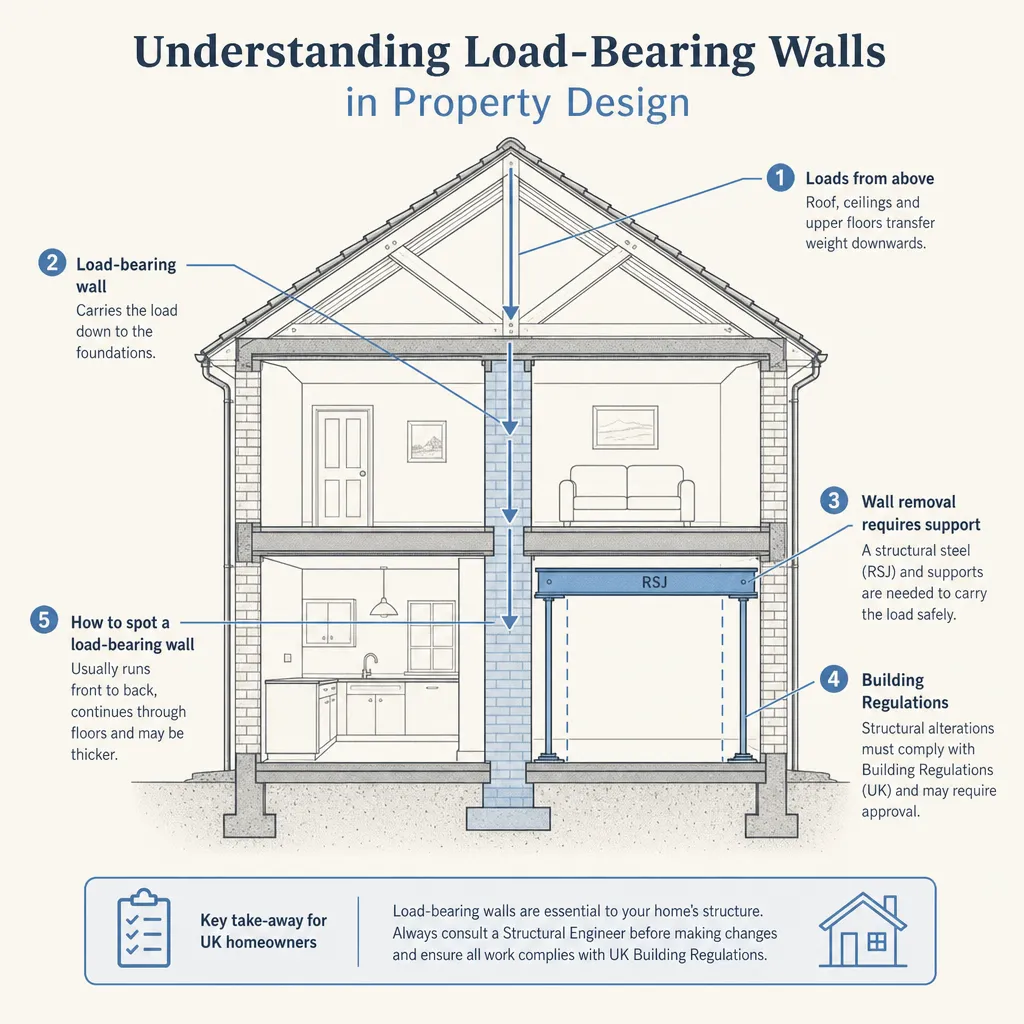
Understanding Load-Bearing Walls in Property Design
A load-bearing wall carries the weight of floors, roofs, or other walls above it down to the foundations.
 Planning & Pre-Build
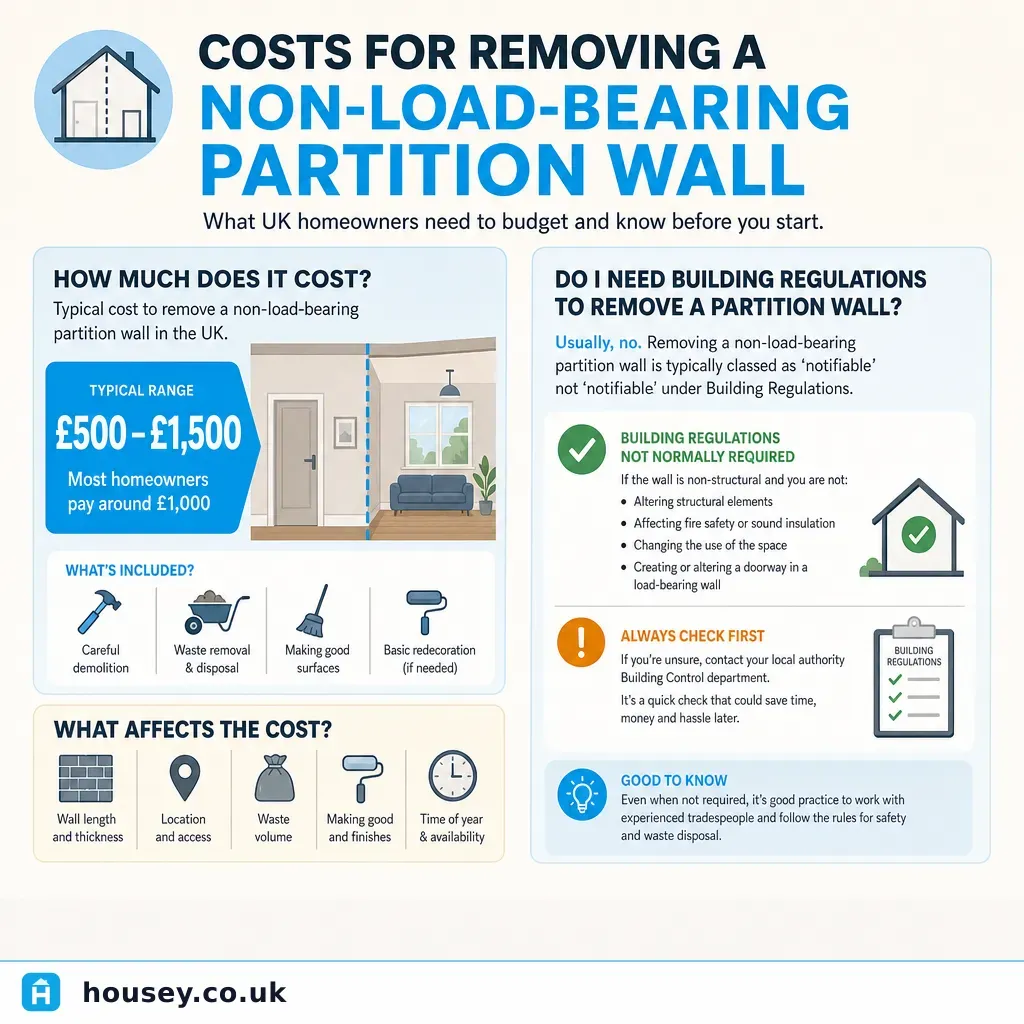
Costs for removing a non-load-bearing partition wall
Removing a non-load-bearing partition wall in a UK home typically costs £300–£1,500 in labour, plus £200–£600 or more for replastering and making good.
 Planning & Pre-Build
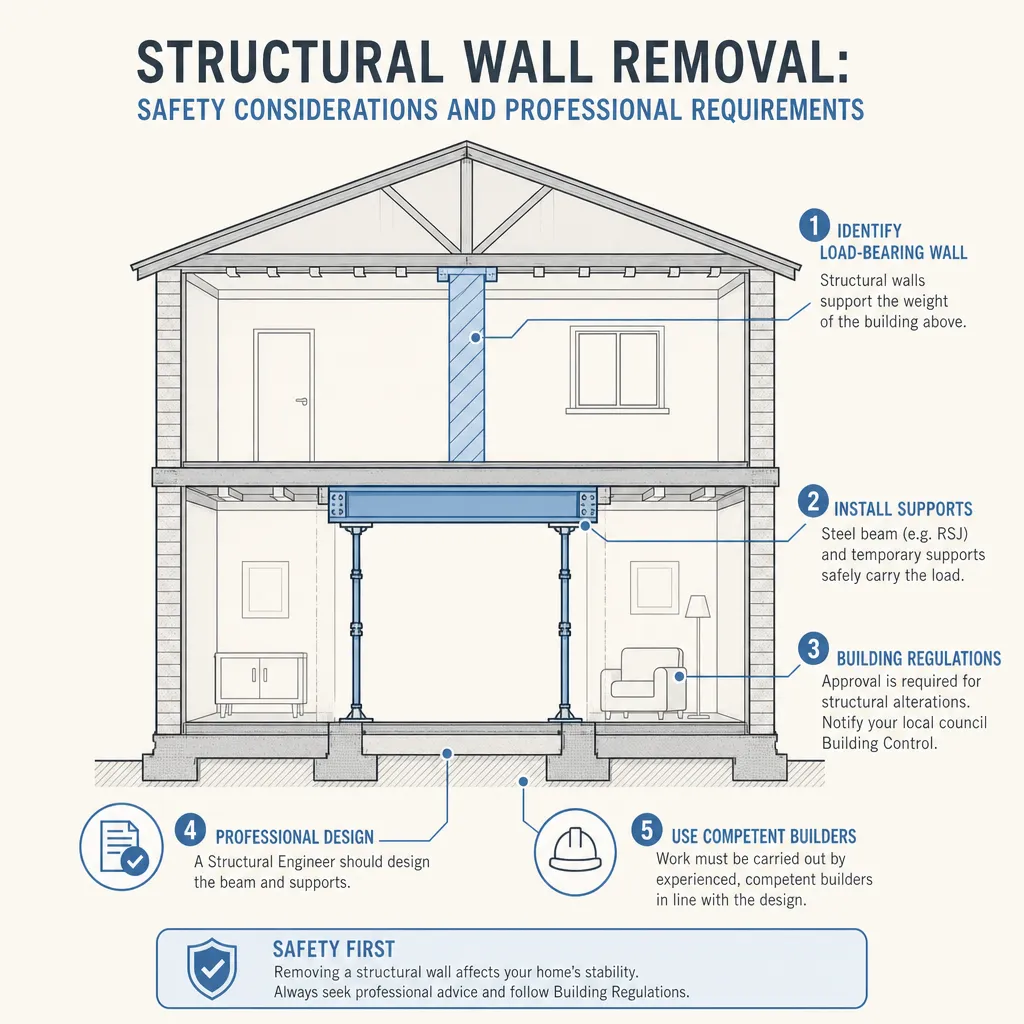
Structural Wall Removal: Safety Considerations and Professional Requirements
Removing a load-bearing wall in the UK always requires Building Regulations approval under Approved Document A, plus a structural engineer's beam calculation before any demolition begins.
 Planning & Pre-Build
Structural Engineering Consultation and Survey Costs
A structural engineer consultation in the UK typically costs £300–£800 for a specific defect report or pre-purchase assessment.
 Planning & Pre-Build
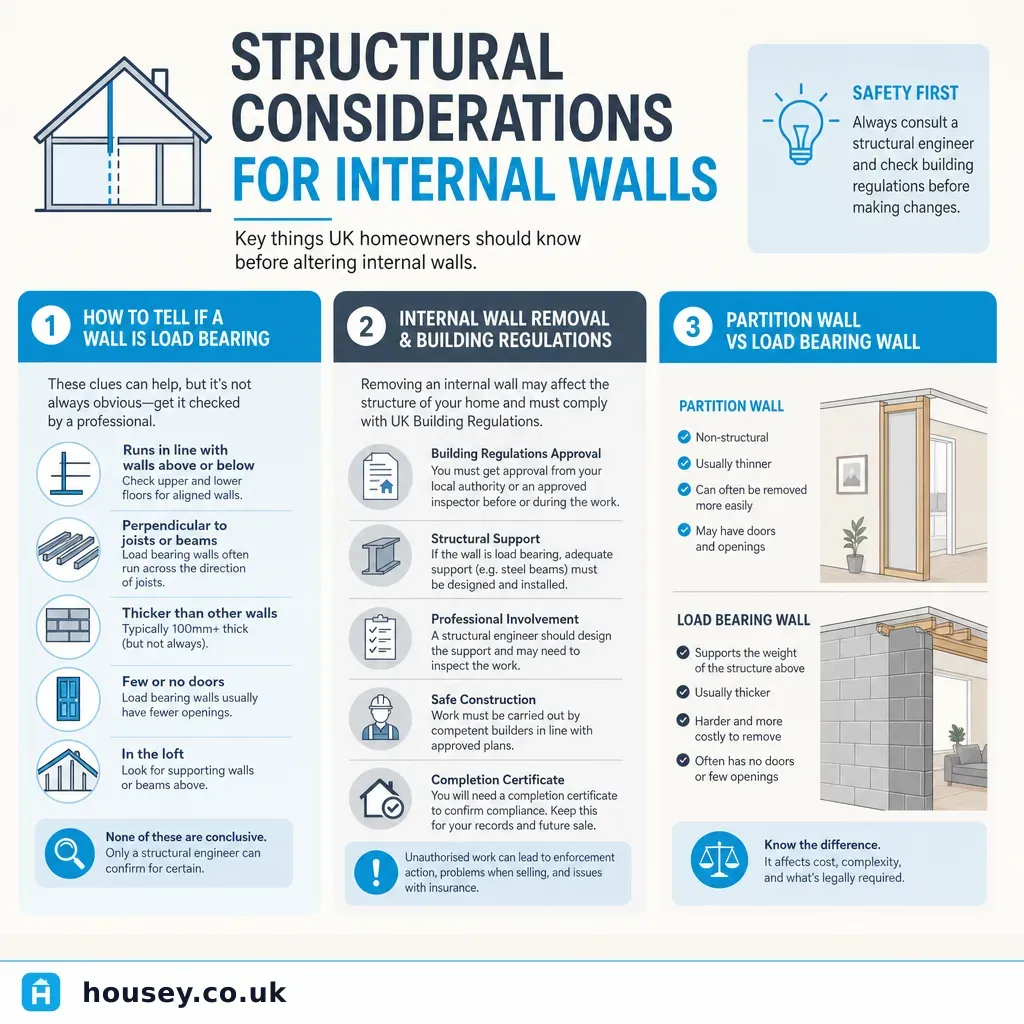
Structural considerations for internal walls
Whether a wall is load-bearing depends on its position, orientation relative to floor joists, and the property's construction.