Door Installation Services: How to Find a Window and Door Contractor
By Housey · Last reviewed 31st of May 2026
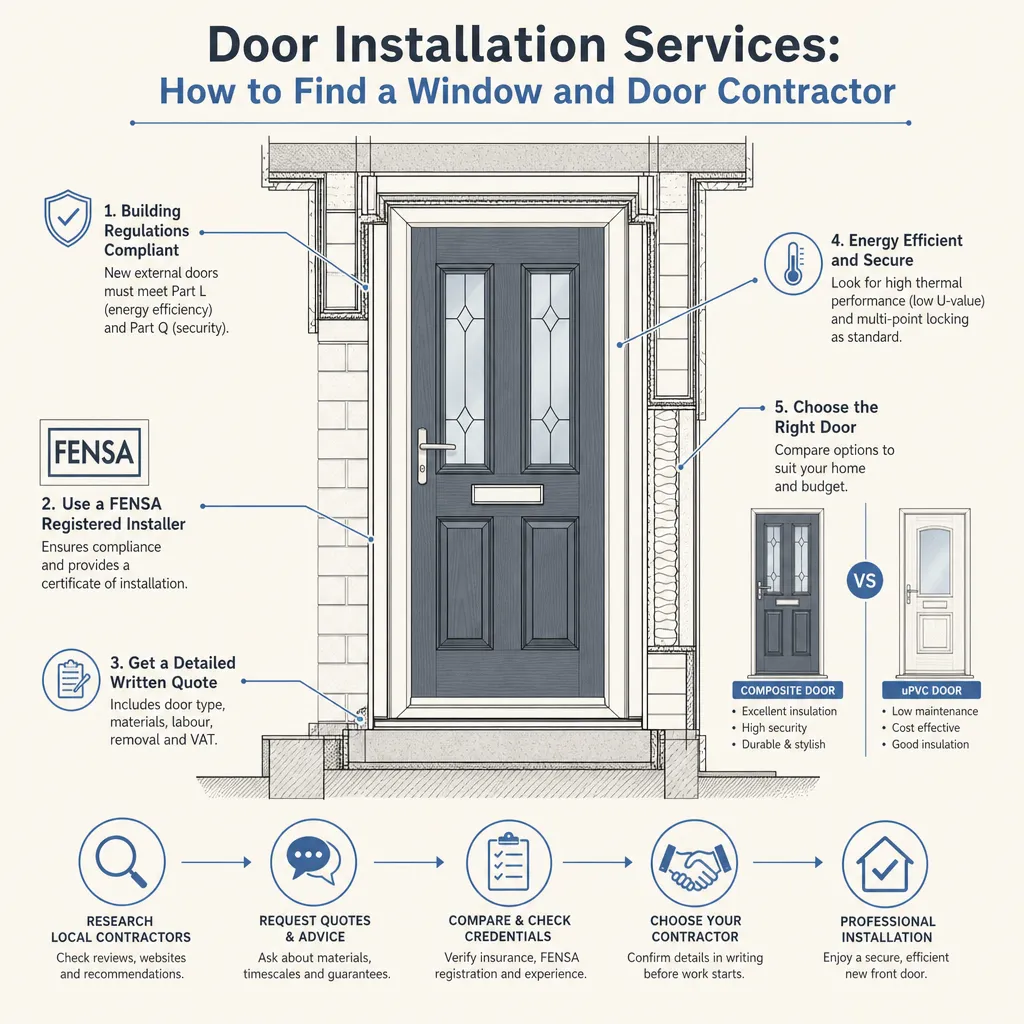
Door Installation Services: How to Find a Window and Door Contractor
New and replacement external doors sit at the intersection of UK building law, energy performance obligations, and security standards. Replacing a front door, fitting a composite back door, or upgrading to French doors on a 1930s semi all trigger building regulations that many homeowners are unaware of until their conveyancer asks for certification that does not exist. Choosing a registered contractor and understanding what compliance looks like before you commit to a quote will save time, money, and complications at the point of sale.
Key points
- Replacing an external door in England and Wales triggers Building Regulations Part L — the replacement must achieve a U-value of 1.4 W/m²K or better where less than 50% of the door is glazed.
- FENSA- and CERTASS-registered contractors can self-certify compliance with Building Regulations, avoiding a separate local authority building control application and fee.
- A FENSA or CERTASS completion certificate is a legal document you will need when selling the property; conveyancers and mortgage lenders routinely request it.
- In conservation areas or for listed buildings, external door changes may require planning permission or listed building consent regardless of how compliance is handled.
- Approved Document Q requires doors in new dwellings to meet PAS 24 enhanced security standard; many registered installers supply PAS 24-compliant doors as default for existing homes too.
What building regulations apply to door replacement?
When you replace an external door in England and Wales — whether a front entrance door, back door, patio door, or French doors — Building Regulations apply. You do not normally need planning permission for a like-for-like replacement, but the thermal performance and security requirements of the replacement must be met. Scotland follows the Technical Handbook standards, and Northern Ireland its own Building Regulations 2012.
Part L: thermal performance
Approved Document L sets a maximum U-value of 1.4 W/m²K for a replacement external door where less than 50% of the door leaf is glazed. Where more than 50% of the door is glazed, the glazed area must meet the window U-value requirement instead. Most composite, modern uPVC, and thermally broken aluminium doors achieve this comfortably; older solid timber doors frequently do not.
Part Q: security
Approved Document Q applies to new dwellings and material changes of use — not to straightforward like-for-like replacements in existing homes. That said, many installers supply PAS 24-compliant doors (Enhanced Security Performance Requirements) as standard because it satisfies insurer requirements and is expected across much of the residential market.
Comparing external door materials
Material | Typical U-value | Maintenance | Indicative fitted cost | Best for |
|---|---|---|---|---|
Composite | 0.8–1.3 W/m²K | Very low | £900–£2,500 | Most standard residential replacements |
uPVC | 1.0–1.5 W/m²K | Low | £600–£1,800 | Budget-conscious replacements |
Timber (softwood) | 1.5–2.0 W/m²K | Medium–high | £800–£3,000 | Period properties, heritage aesthetics |
Aluminium | 1.0–1.4 W/m²K | Low | £1,500–£4,000 | Contemporary or commercial-style homes |
Indicative UK costs, last reviewed 2026-05-31. Quotes vary by specification, supplier, and region. Obtain at least three written quotes.
Finding and vetting a contractor
FENSA and CERTASS: why they matter
FENSA (Fenestration Self-Assessment Scheme) and CERTASS are the two government-authorised competent person schemes for window and door installation in England and Wales. A registered contractor can self-certify that their installation complies with Building Regulations, issue a completion certificate, and notify your local authority — all without a separate building control application. The certificate is registered on a national database accessible to conveyancers.
Verify FENSA registration at fensa.org.uk and CERTASS at certass.co.uk before instructing any contractor.
What to ask before accepting a quote
- Are you registered with FENSA or CERTASS, and will you provide a completion certificate on installation?
- Does the door meet Part L (U-value of 1.4 W/m²K or better) and does it carry PAS 24 certification?
- Does the price include supply, installation, removal of the old door, and making good — and is VAT included?
- Who will physically carry out the installation — your directly employed fitters or subcontractors?
- What is the separately stated warranty on the door leaf, frame, hardware, and glazing?
- What is the lead time from order to installation?
- What happens if the existing frame, lintel, or threshold is found to need repair?
Red flags to watch for
- A contractor who states building regulations do not apply to a door replacement.
- No written quotation or no verifiable business address.
- A request for a deposit greater than 25–30% before materials are confirmed.
- Pressure to sign on the day without a survey visit to measure the opening.
- No public liability insurance documentation provided on request.
- A FENSA or CERTASS number that does not appear on the scheme's online register.
Which situation applies to you?
- Standard replacement in an ordinary house: use a FENSA- or CERTASS-registered installer; no separate building control application needed.
- New opening or enlarged opening: requires a structural assessment (lintel sizing) and a full Building Regulations application — appoint a building control body before work starts.
- Listed building: listed building consent is required for any external door change regardless of whether it is like-for-like; contact your local planning authority.
- Conservation area: external alterations visible from a public highway may require planning permission — check with your local planning authority before ordering.
- Dispute with an installer: if a registered FENSA or CERTASS contractor fails to provide a certificate or the work is defective, the scheme offers a complaints and remediation process.
When to get professional help
Door replacement is low risk when carried out by a registered installer, but escalate to additional professionals if:
- The existing frame shows signs of structural movement, significant rot, or persistent water ingress — a surveyor should identify the cause before new doors are fitted.
- The opening is to be widened or a new opening created.
- The property is listed and you are uncertain what consent is required.
- An installer has become unresponsive after payment; contact FENSA, CERTASS, or your local Trading Standards office.
How Housey can help
Housey makes it straightforward to find and compare qualified window and door installers covering your area. All contractors on the platform are vetted for scheme membership, so you can gather competing quotes with confidence that compliance certification will follow the job.
Frequently asked questions
Do I need planning permission to replace my front door?
Usually no. In England, replacing a front door is normally permitted development. However, in conservation areas, on properties subject to an Article 4 Direction, or for listed buildings, you may need planning permission or listed building consent. Check with your local planning authority if your property falls into any of these categories.
What is a FENSA certificate and why do I need it?
A FENSA certificate confirms that a replacement window or external door was installed in compliance with Building Regulations. When you sell your property, your solicitor and the buyer's mortgage lender will usually ask for it. Missing certificates can require a retrospective Local Authority Building Regulation (LABR) certificate, which adds cost and can delay a sale.
Can I install an external door myself?
Technically yes, but a self-installation cannot be certified under FENSA or CERTASS — you would need to apply for building control approval separately and arrange a compliance inspection. For structural alterations, glazed door systems, or frameless configurations, professional installation is strongly recommended.
How long does door installation take?
A standard single door replacement typically takes two to four hours once the contractor arrives on site. French doors or a set of bi-folding doors may take most of a day. Allow additional time if frame repairs, lintel work, or threshold adjustments are needed.
Sources and further reading
- Approved Document L — conservation of fuel and power — thermal performance requirements for replacement doors — GOV.UK
- Approved Document Q — security — security requirements for new dwellings — GOV.UK
- FENSA — competent person scheme — scheme register and certificate checker — FENSA
- CERTASS — competent person scheme — alternative scheme for window and door installers — CERTASS
- Planning Portal — permitted development for doors — guidance on when planning permission is and is not needed — Planning Portal
Useful next reads
 Improvement & Build
Building in the UK: A Contractor's Perspective on Modern Construction Challenges
UK construction projects in 2026 are shaped by a skilled labour shortage, volatile material costs, and tightened Building Regulations including updated Part L requirements.
 Improvement & Build
Greenhouse Construction: Glass Versus Polycarbonate Materials
Glass transmits around 90% of available light and lasts indefinitely if unbroken, but insulates poorly and shatters into sharp fragments.
 Improvement & Build
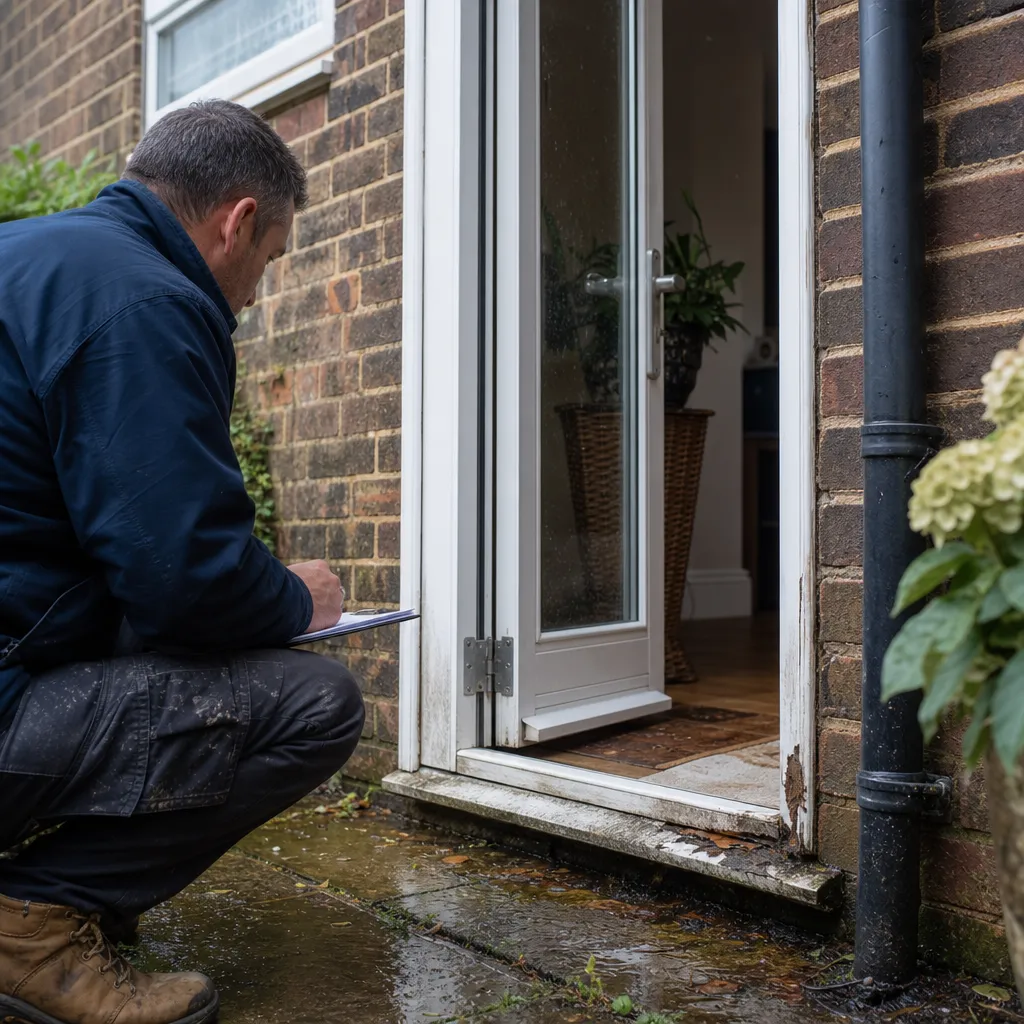
Fixing Leaking Back Doors and Water Ingress
Most leaking back doors in UK homes fail at one of three points: the threshold or door sill joint, the frame-to-masonry mastic seal, or the door weatherstrip.
 Improvement & Build
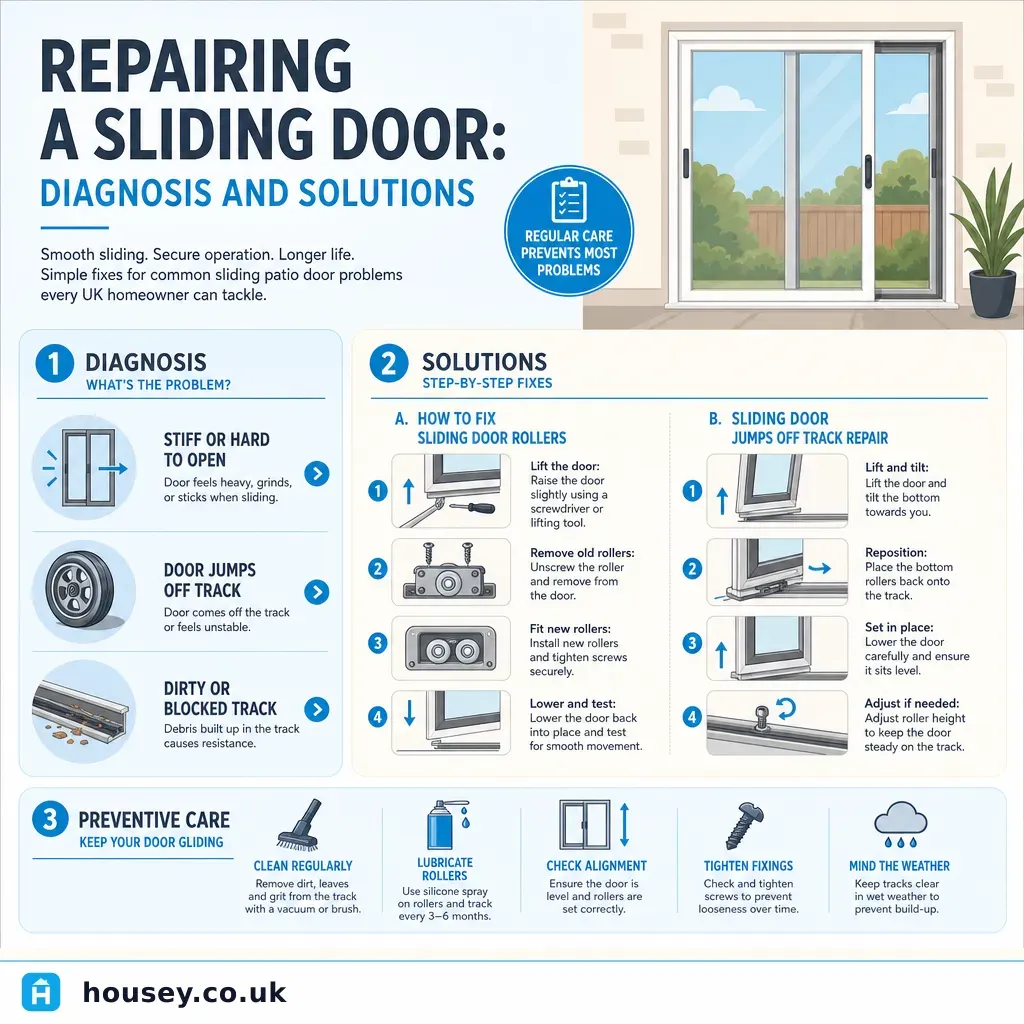
Repairing a Sliding Door: Diagnosis and Solutions
Most sliding door problems — stiffness, jumping off track, or draughts — are caused by dirty tracks, worn rollers, or misaligned guides.
 Improvement & Build
Who Provides House Demolition Services
House demolition in the UK is carried out by specialist demolition contractors, often members of the National Federation of Demolition Contractors (NFDC).