Building in the UK: A Contractor's Perspective on Modern Construction Challenges
By Housey · Last reviewed 31st of May 2026
Building in the UK: A Contractor's Perspective on Modern Construction Challenges
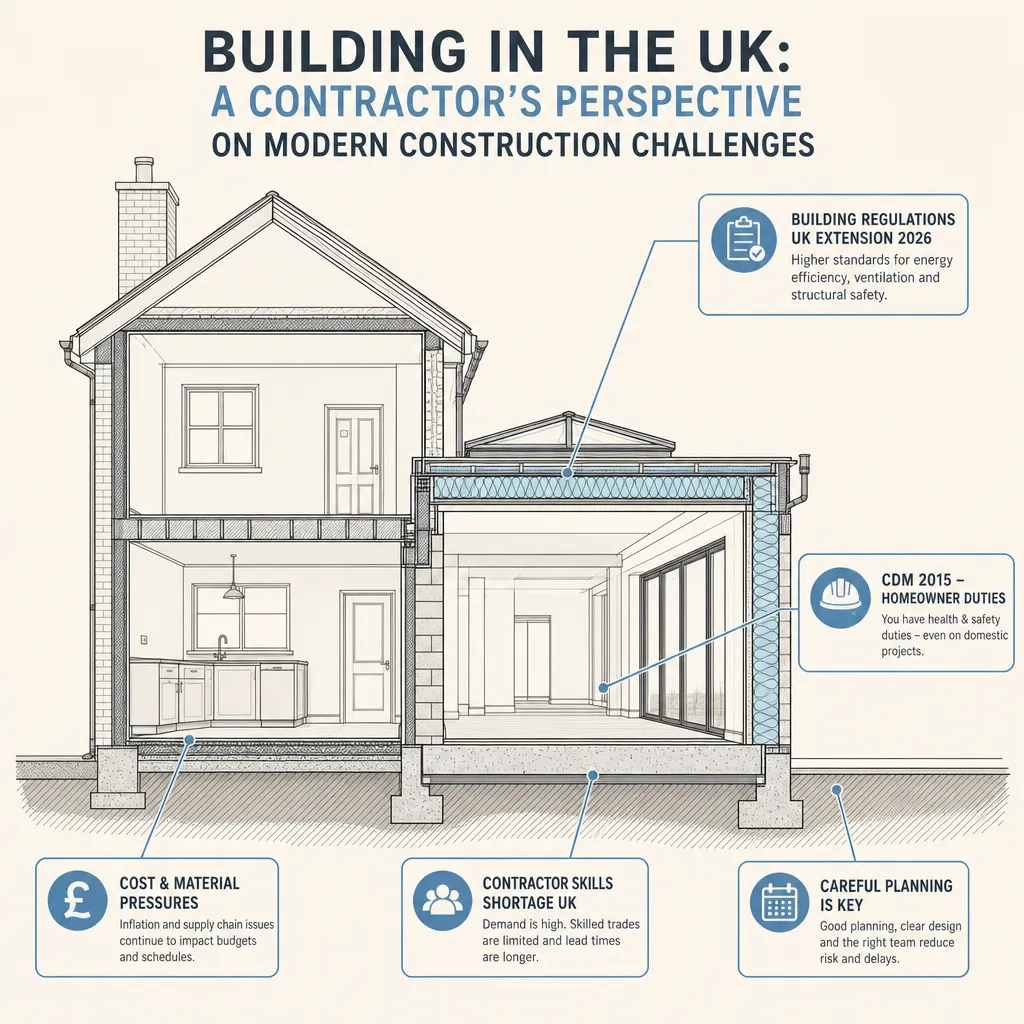
Modern UK residential construction is under sustained pressure — from volatile material costs and an increasingly stretched skilled labour pool to tightened Building Regulations and new legal duties on homeowners. Whether you are commissioning a rear extension on a 1930s semi or a full design-and-build project on a new plot, understanding what contractors are navigating helps you plan more realistically, write better briefs, and avoid expensive surprises.
Key points
- The Construction Industry Training Board (CITB) projects the UK will need around 251,500 additional construction workers by 2028, with bricklayers, plasterers, and roofers among the most stretched trades.
- Building Regulations Part L (Conservation of Fuel and Power) was updated in 2022, tightening U-value requirements for new extensions; non-compliance can block a completion certificate and create problems at resale.
- The Construction (Design and Management) Regulations 2015 (CDM 2015) place legal duties on homeowners as domestic clients when more than one contractor is involved in a project.
- Fixed-price contracts protect against material cost inflation but typically carry a contingency premium; cost-plus contracts may be cheaper when markets are stable but expose you to price movements.
- A reputable contractor should name their building control body — either the local authority or an approved inspector — before work starts; this is a legal requirement for most structural projects, not an optional extra.
Why material costs remain unpredictable
Supply chain disruptions since 2021 have made material procurement one of the most complex aspects of running a UK construction project. Structural timber, rigid insulation board, and copper-based wiring have all seen significant price volatility, and while some categories have stabilised, forecasting remains difficult over the course of a longer project.
For homeowners, the practical consequence is that a quote received in January may not reflect costs by April. Reputable contractors explain how their quotes handle this risk — some include a fixed contingency (5–10% is typical for residential extensions), others tie validity to a 30-day window, and some propose cost-plus arrangements for complex or long-running projects.
What to ask about any contractor quote
- Validity period — most quotes are valid for 30–60 days; ask what happens if your programme slips beyond that window.
- Procurement basis — is the contractor buying materials to order, or speculatively? Speculative purchasing locks in prices earlier but requires storage or staging.
- Contingency clause — understand whether the contingency covers materials, labour, or both, and what triggers its release or return.
- Variation procedure — how are scope changes and unforeseen conditions costed, documented, and approved before work proceeds?
- VAT position — confirm whether the quoted sum is inclusive of VAT, and at which rate; most residential renovation attracts 20% VAT.
The skills shortage and realistic timelines
The UK construction sector has faced a sustained shortage of skilled tradespeople. CITB data consistently identifies bricklayers, plasterers, roofers, and groundworkers as hard-to-fill occupations. An ageing workforce, reduced post-Brexit migration from EU countries, and relatively low apprenticeship uptake in some trades have compounded the problem.
For homeowners, this translates into longer lead times from established contractors. A well-resourced firm may be booked six to twelve months ahead. A contractor who can start immediately is not automatically a red flag — demand varies by region and season — but it is worth understanding why they have availability before committing.
Worked UK property scenario
A homeowner in Leeds contacts three contractors to quote for a two-storey side extension on a 1950s semi-detached house. Contractor A can start in three months; Contractor B has a slot in seven months; Contractor C is available immediately at 15% below Contractor B's price.
Rather than defaulting to the cheapest or fastest, the homeowner:
- Asks each contractor for references from comparable recent projects in the same area.
- Checks Companies House for trading history and confirms the business is solvent.
- Verifies each carries Employers' Liability and Public Liability insurance.
- Asks which building control body each intends to use and whether they have used them before.
Contractor B turns out to be a long-established firm whose current project is finishing ahead of schedule — explaining the apparent availability gap. The homeowner chooses Contractor B and agrees a JCT Minor Works contract with a staged payment schedule.
Building Regulations compliance in 2026
The 2022 updates to the Building Regulations Approved Documents tightened standards across several parts relevant to residential extensions and improvements. Understanding these before appointing a contractor helps you ask the right questions and spot omissions in a proposal.
Approved Document | What it covers | Key residential requirement |
|---|---|---|
Part L (2022) | Thermal performance and energy efficiency | U-value ≤0.18 W/m²K for new external walls in extensions; whole-building improvement target for new dwellings |
Part F (2022) | Ventilation and indoor air quality | Extract ventilation in kitchens and bathrooms; whole-house ventilation strategy for new dwellings |
Part A | Structural safety | Foundations, loadbearing walls, stability of existing structure after alteration |
Part B | Fire safety | Means of escape, fire-stopping, smoke alarm provision |
Part O (2022) | Overheating mitigation | New dwellings and some extensions — passive shading and natural ventilation measures |
A contractor who does not raise Building Regulations compliance during the estimating phase is a potential concern. Building control sign-off is a legal requirement for most structural work, and missing it creates complications at resale and remortgage.
CDM 2015: your duties as a homeowner
Under the Construction (Design and Management) Regulations 2015, domestic clients — homeowners commissioning work on their own property — have legal obligations. Specifically, if more than one contractor is involved, a principal designer and a principal contractor must be formally appointed and documented in writing.
A design-and-build firm typically accepts both CDM roles as part of their service contract. Where you engage a builder directly alongside a separate architect or structural engineer, document clearly who holds each role. The HSE provides free guidance for domestic clients, available at hse.gov.uk.
Red flags when evaluating a contractor
Before signing any contract, watch for these warning signs:
- No written contract offered, or pressure to sign before you have had adequate time to read it.
- Cannot provide proof of Employers' Liability insurance — a legal requirement for businesses with employees under the Employers' Liability (Compulsory Insurance) Act 1969.
- Quote contains no VAT clarification; most registered contractors charge 20% VAT, and some projects attract a 5% reduced rate — always confirm in writing.
- No previous clients willing to provide references for comparable work.
- Requests a deposit greater than 25–30% of the contract value before materials are procured or work has begun.
- Cannot name the building control body they plan to use or is vague about who will carry out inspections.
- No written explanation of how variations and cost overruns will be managed and approved.
When to get professional help
For any extension or structural project, you will typically need an architect or architectural technologist for drawings, a structural engineer for loading calculations, and a building control body for inspections. Compressing these roles to reduce cost risks producing non-compliant work that is expensive to rectify after the fact.
Seek independent advice if:
- You are asked to waive building control inspections to save time or money.
- A contractor proposes starting before planning permission has been granted.
- Structural alterations outside the original scope are being made without your written approval.
- Suspected asbestos-containing materials are disturbed during demolition — stop work immediately and commission an asbestos survey from a licensed contractor before allowing work to resume.
How Housey can help
Housey connects you with vetted extension builders and design-and-build firms who understand Building Regulations compliance, CDM responsibilities, and the realities of UK construction timelines. Submit your brief to compare quotes from local professionals.
Frequently asked questions
Do I need planning permission for a rear extension in England?
Many single-storey rear extensions fall within permitted development and do not require a planning application, provided they meet the dimensional criteria in the Town and Country Planning (General Permitted Development) (England) Order 2015. Restrictions apply for conservation areas, listed buildings, flats, and properties with previous extensions. Always check with your local planning authority or apply for a Lawful Development Certificate before starting work.
What is the difference between planning permission and building control?
Planning permission considers whether a project is appropriate in land-use terms — its scale, appearance, and impact on neighbours. Building control checks whether the construction meets the technical standards of the Building Regulations for safety, structural integrity, and energy performance. Many extension projects require both, though building control applies to most structural work even where planning permission is not needed.
How much deposit should I pay a contractor?
The Federation of Master Builders advises an initial deposit of no more than 10–25% of the contract value, with stage payments linked to measurable milestones. Avoid paying large sums upfront before work begins. Use a written contract — a JCT Minor Works or Home Owner Contract suits most domestic projects — that clearly sets out the payment schedule and the procedure for agreed variations.
What is CDM 2015 and does it apply to home renovations?
The Construction (Design and Management) Regulations 2015 apply to all construction projects, including domestic work. If you engage more than one contractor, you must ensure a principal designer and a principal contractor are formally appointed in writing. A design-and-build firm covering all trades typically accepts both roles. The HSE provides free guidance for domestic clients at hse.gov.uk.
Sources and further reading
- CITB Construction Skills Network Forecasts — Construction Industry Training Board
- Building Regulations Approved Documents — GOV.UK
- CDM 2015 — Guidance for domestic clients — Health and Safety Executive
- JCT Home Owner Contracts — Joint Contracts Tribunal
- Federation of Master Builders — Finding a builder — Federation of Master Builders
Useful next reads
 Improvement & Build
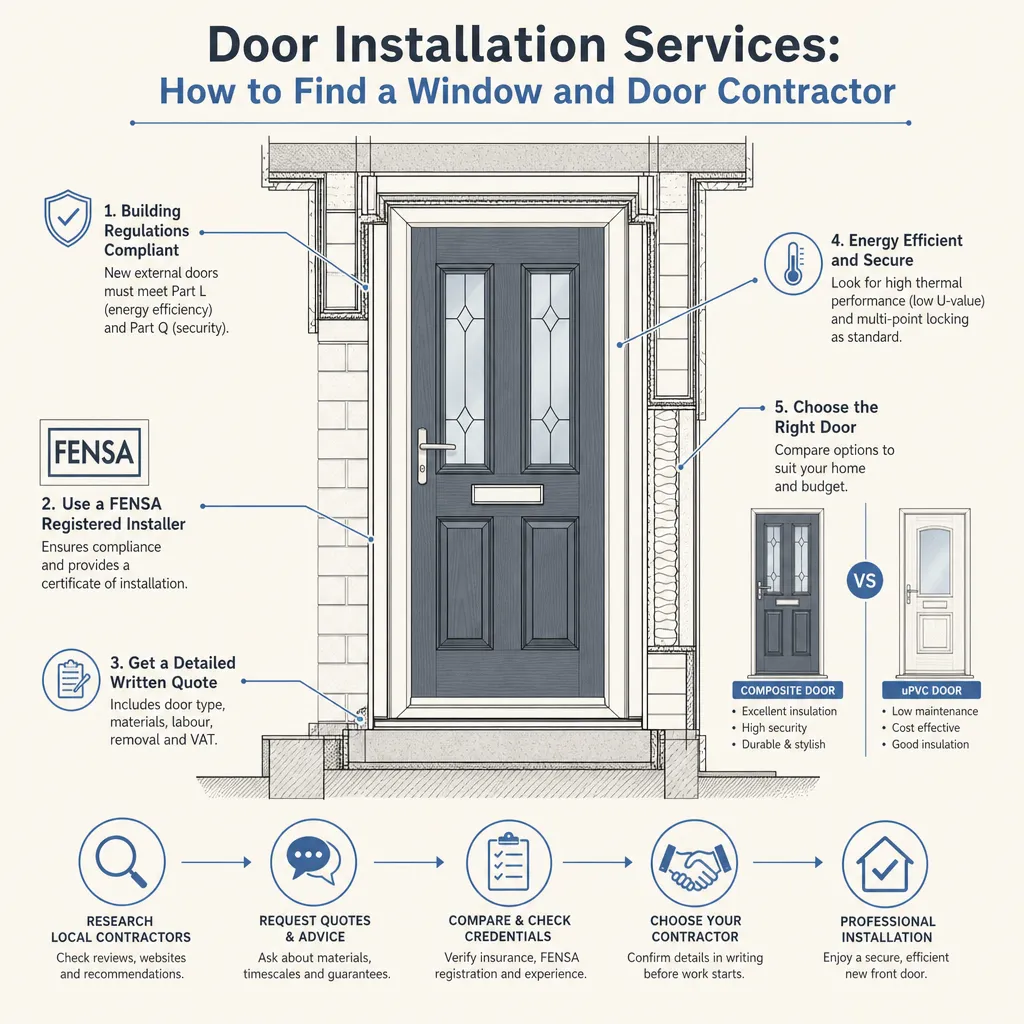
Door Installation Services: How to Find a Window and Door Contractor
Replacing an external door in England and Wales triggers Building Regulations Part L, requiring a U-value of 1.
 Improvement & Build
Greenhouse Construction: Glass Versus Polycarbonate Materials
Glass transmits around 90% of available light and lasts indefinitely if unbroken, but insulates poorly and shatters into sharp fragments.
 Improvement & Build
Fixing Leaking Back Doors and Water Ingress
Most leaking back doors in UK homes fail at one of three points: the threshold or door sill joint, the frame-to-masonry mastic seal, or the door weatherstrip.
 Improvement & Build
Who Provides House Demolition Services
House demolition in the UK is carried out by specialist demolition contractors, often members of the National Federation of Demolition Contractors (NFDC).
 Improvement & Build
Tree Branch Removal and Tree Surgeon Services
Tree surgery — from deadwooding and crown reduction to branch removal and felling — must be carried out by qualified, insured contractors in the UK.