Interior Door Installation Costs and Options
By Housey · Last reviewed 7th of May 2026
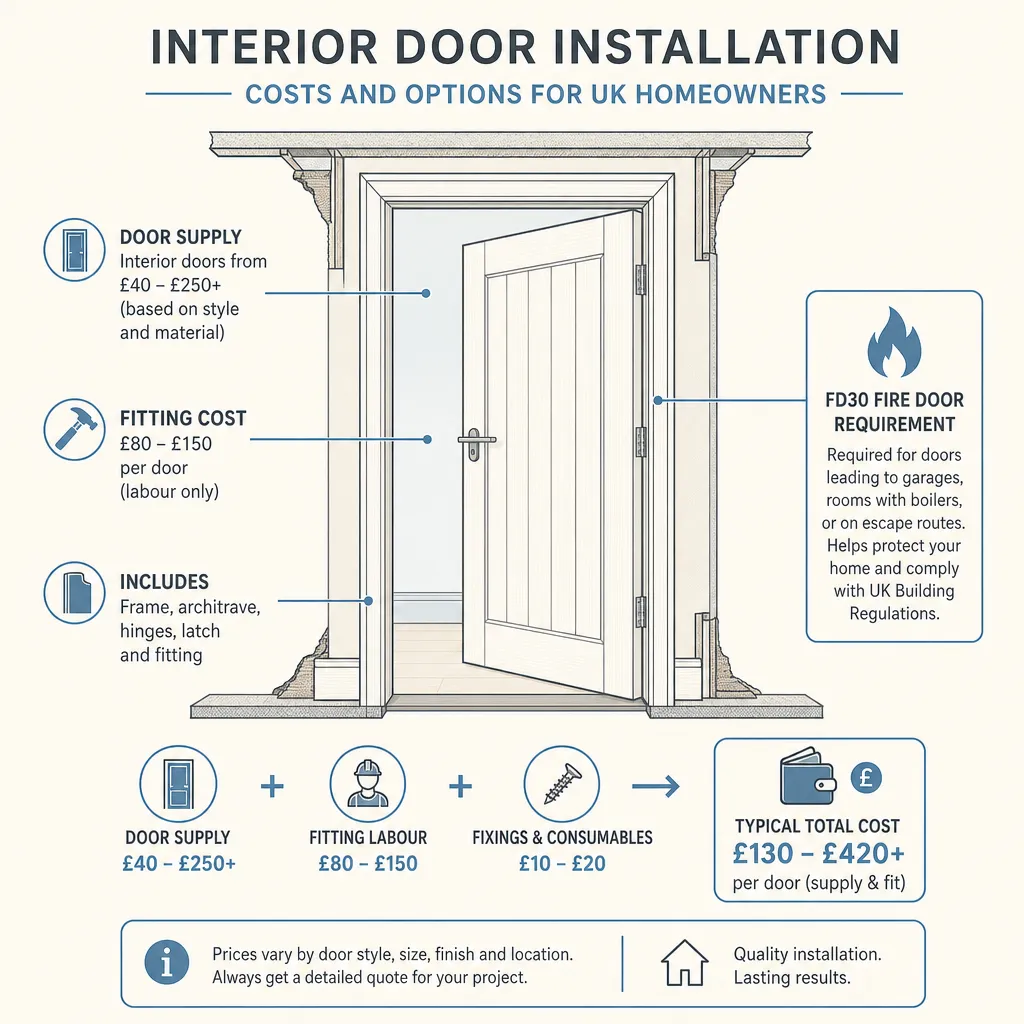
Interior Door Installation Costs and Options
Replacing or fitting interior doors is one of the more achievable home improvement tasks, yet costs and technical requirements vary more than most homeowners expect. The type of door — hollow-core, solid-core, or fire-rated — affects both price and performance. Building Regulations Part B also imposes specific fire door requirements in situations that are frequently overlooked: most commonly between integral garages and habitable rooms, and in loft conversions where the staircase serves as the only fire escape route. Understanding these requirements before ordering saves money and avoids having to redo the work.
Key points
- Fitting a standard interior door (homeowner-supplied) typically costs £80–£200 in labour per door; supply-and-fit including lining and ironmongery ranges from £150–£350 for hollow-core to £300–£700 or more for solid timber panel doors (indicative UK costs, last reviewed 2026-05-07).
- FD30 fire doors — 30-minute fire-rated, with intumescent strips and a certificated self-closer — are required under Approved Document B of the Building Regulations between an integral garage and any habitable room, and on escape routes in converted flats and HMOs.
- A pre-hung door (supplied already mounted in its frame) reduces installation time and is generally preferred by carpenters; a door blank fitted into an existing lining is cheaper but requires the lining to be sound and square.
- Fire door performance depends on the complete door set — leaf, frame, intumescent strips, smoke seals, and certificated hinges and closer — being installed as a tested, compatible assembly; substituting non-certificated ironmongery invalidates the fire rating.
- Interior doors do not normally require planning permission in a standard dwelling, but listed buildings and properties with Article 4 Directions may have restrictions on materials or style.
What types of interior door are available?
Hollow-core flush doors
The most common and affordable option. A cardboard honeycomb core is faced with MDF or hardboard. Lightweight, easy to hang, and suited to bedrooms and low-traffic rooms. They offer minimal acoustic or fire performance unless specifically rated.
Solid-core flush doors
Denser composite or timber infill gives better sound insulation and a higher-quality feel. Heavier to hang and more expensive, but well suited to bathrooms, home offices, or anywhere acoustic privacy matters.
Panel doors
One-to-six raised or flat panels in timber or MDF suit period and traditional interiors. Available in hollow-core and solid-core variants. Solid hardwood panel doors are durable and at the premium end of the market; MDF panel doors take paint well and offer a practical middle ground.
FD30 fire doors
Externally similar to solid doors but tested and certified to resist fire spread for 30 minutes. Must be fitted as a complete tested assembly with intumescent strips, cold smoke seals, and a self-closing device. Never substitute a non-certified door where a fire door is required by Building Regulations.
Glazed, bifold, and pocket doors
Glazed doors allow borrowed light between rooms. Bifold doors fold flat and suit wider openings. Pocket doors slide into a wall cavity requiring a dedicated steel-framed pocket — typically installed during major renovation. All carry higher supply and installation costs than standard hinged doors.
How much does interior door installation cost?
Door type | Supply only | Fit only (labour) | Supply and fit |
|---|---|---|---|
Hollow-core flush door | £30–£80 | £80–£150 | £150–£280 |
Solid-core flush door | £80–£200 | £100–£180 | £200–£400 |
Solid timber panel door | £150–£600+ | £120–£250 | £300–£800+ |
FD30 fire door (standard) | £80–£200 | £120–£250 | £250–£500 |
Bifold door (pair) | £100–£400+ | £150–£300 | £300–£700+ |
Indicative UK costs, last reviewed 2026-05-07. Prices vary by region, installer, and whether new linings, architrave, and ironmongery are included. Always request itemised quotes.
Standard door sizes are 1981 mm × 762 mm or 686 mm wide. Non-standard heights, wider openings, or older properties with unlevel floors cost more to supply and fit. Bespoke hardwood doors can run to several thousand pounds per door.
Do I need a fire door?
Fire door requirements under Approved Document B (Volume 1: Dwellings, England) apply in specific defined situations — not throughout a standard house. The most common cases for homeowners:
- Integral garage to habitable room: an FD30 self-closing fire door is required.
- Loft conversions: where the loft is a new habitable room and the escape route passes through the lower floors, FD30 self-closing doors are required on rooms off the escape staircase on each floor.
- Change of use (flats and HMOs): fire doors required on escape routes as a condition of building regulations approval.
Decision tree: do you need a fire door?
- Is this door between an integral garage and a habitable room? → Yes: FD30 fire door required.
- Is this door in a loft conversion on the escape route? → Likely yes: check your building regulations completion certificate.
- Is the property an HMO or converted flat? → Check your fire risk assessment — fire doors on escape routes are likely required.
- Is this a bedroom, bathroom, or living room door in a single-family house with no integral garage and no loft conversion? → Standard door permitted.
- Unsure about the property's history or classification? → Consult a building control officer before specifying.
What affects the cost of interior door installation?
Lining condition: If the existing door lining is square, undamaged, and the right size for the new door, fitting is straightforward. A damaged or out-of-square lining needs replacing — add roughly £80–£200 for a new lining and associated labour.
Ironmongery: Handles, hinges, latches, and door stops are often quoted separately. For fire doors, all ironmongery must be certificated as part of the tested assembly. Non-certificated hardware on an FD30 door invalidates its fire rating.
Décor: Fitting a door disturbs surrounding decoration. Budget for repainting or re-papering around the architrave.
Multiple doors: Carpenters usually offer a reduced per-door rate for several doors in a single visit. Ask for a combined quote if you are replacing doors throughout the property.
Non-standard situations: Doors adjacent to staircases, in narrow corridors, or in properties with unlevel floors take longer to fit. Opening a new doorway in a load-bearing wall requires a structural engineer and building regulations approval before any work begins.
What to ask before accepting a quote
- Is the door included or is this labour only — and what exactly is covered (lining, architrave, handles, hinges)?
- For fire doors: are the door leaf, frame, intumescent strips, smoke seals, and ironmongery all part of a tested, certified assembly?
- Will the existing lining be assessed before the door is ordered?
- How will damage to existing decoration around the frame be handled?
- Is VAT included?
- Can you provide a copy of the fire certificate on completion for any FD30 doors fitted?
When to get professional help
Fitting a standard interior door into a sound existing lining is within the capability of a competent DIYer. Professional installation is recommended when:
- A fire door is required — incorrect fitting or wrong ironmongery can make the door completely ineffective as a fire barrier.
- The lining needs replacing or the opening requires structural modification.
- A pocket or bifold system requires new framing within the wall.
- You are working in a listed building where consent conditions may govern materials and finishes.
- You are uncertain whether the property's history means a fire door is required in that location.
How Housey can help
If you need a skilled carpenter or joiner to supply and fit interior doors — including FD30 fire doors where Building Regulations require — Housey can connect you with local window and door installers who can provide itemised, written quotes for your project.
Frequently asked questions
How long does it take to fit an interior door?
An experienced carpenter can typically fit a standard door into a sound existing lining in one to two hours. Replacing the lining, fitting a fire door with an automatic closer, or working with non-standard openings usually takes three to four hours per door. Fitting multiple doors in a single visit is more efficient and typically reduces the per-door rate.
Can I fit an interior door myself?
Yes, for a standard hollow-core or solid-core door into a square, sound existing lining — basic carpentry skills and careful measurement are sufficient. Where a fire door is required, DIY fitting is not recommended unless you are confident of meeting all the installation requirements of Approved Document B: an incorrectly fitted fire door may offer no fire protection at all.
Do interior doors need to match the existing doors in a house?
There is no legal requirement to match existing doors in a private dwelling. In a leasehold flat, the lease may restrict alterations to internal finishes — check your lease before proceeding. In a listed building, listed building consent may require like-for-like replacement; consult your local planning authority or Historic England guidance before replacing period joinery.
What is the difference between a pre-hung door and a door blank?
A pre-hung door is supplied already mounted in its frame (lining), making installation quicker and easier. A door blank is the door leaf alone, which must be trimmed and fitted into an existing or separately supplied lining. Pre-hung sets cost more to supply but save installation time and are generally more reliable for getting clearances right first time.
Does replacing an interior door need building regulations approval?
Like-for-like replacement of an interior door in a standard dwelling does not generally require building regulations notification. Opening a new doorway in a load-bearing wall requires structural assessment and approval. Where a fire door is required, compliance with Approved Document B is a building regulations matter — retain the door's fire certificate and any inspection records.
Sources and further reading
- Approved Document B: Fire safety — Volume 1 (dwellings) — GOV.UK
- Building regulations approval guidance — GOV.UK
- Fire door guidance — Fire Safe (BAFE)
- Listed buildings: what you need consent for — Historic England
Useful next reads
 Improvement & Build
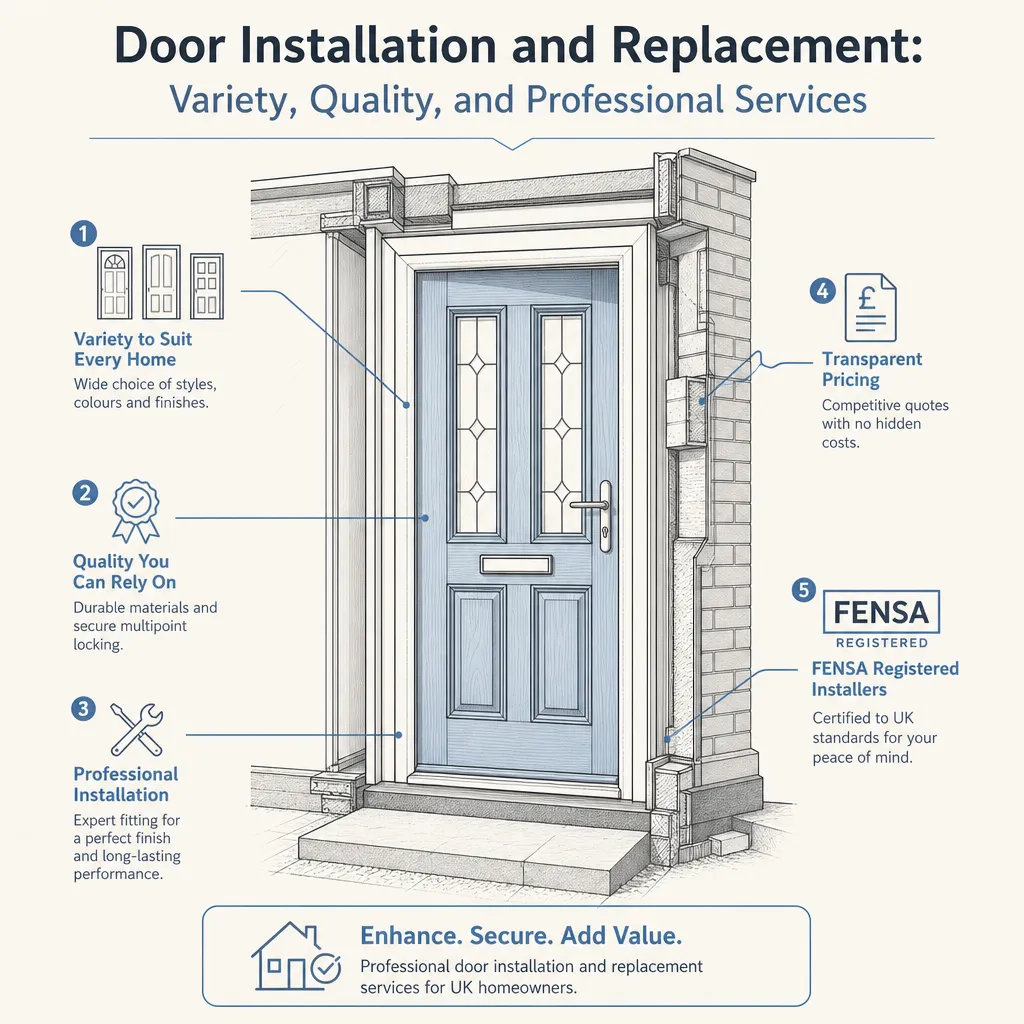
Door Installation and Replacement: Variety, Quality, and Professional Services
Door installation in UK homes ranges from straightforward interior hanging, which requires few regulations, to external replacements subject to Building Regulations Part L.
 Improvement & Build
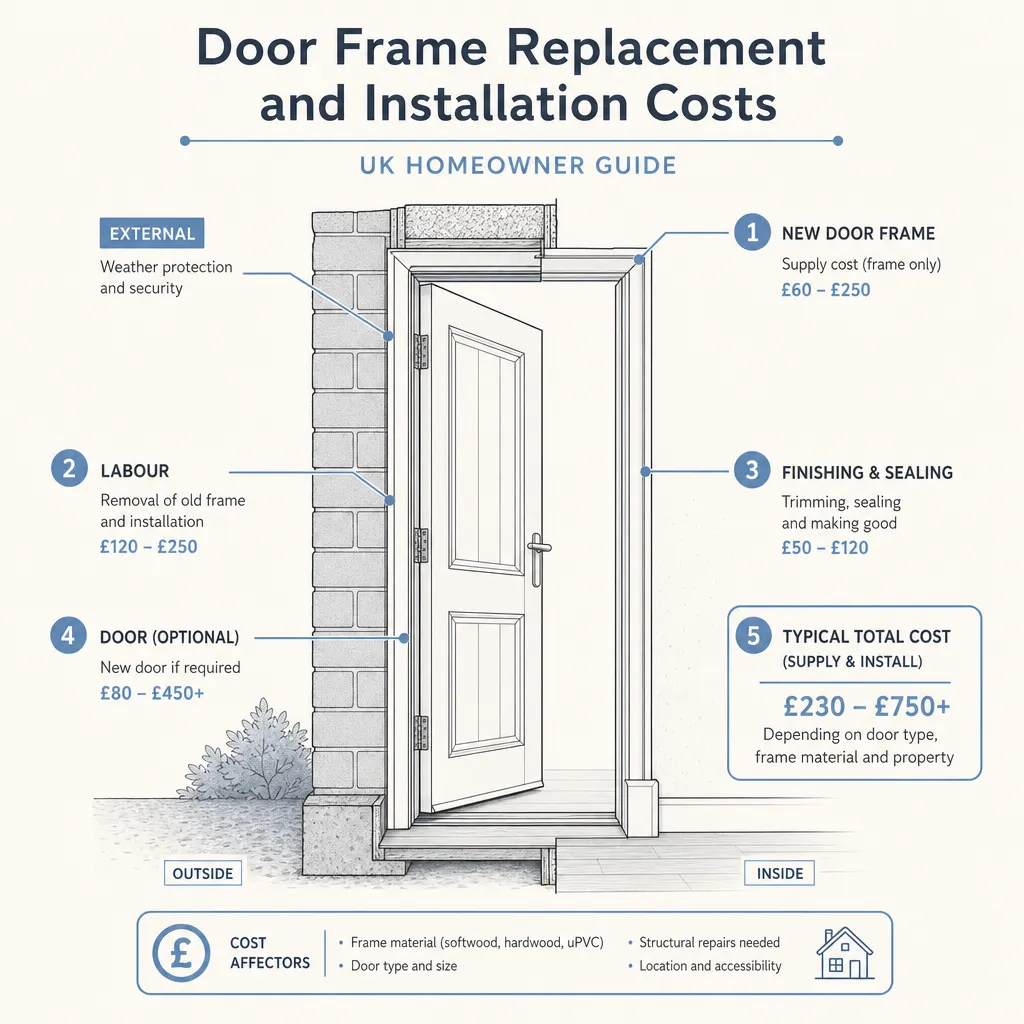
Door Frame Replacement and Installation Costs
Replacing an internal door lining in the UK typically costs £100–£300 including labour; an external door frame costs £300–£800 for softwood or UPVC and £600–£1,500 or more for hardwood or composite.
 Improvement & Build
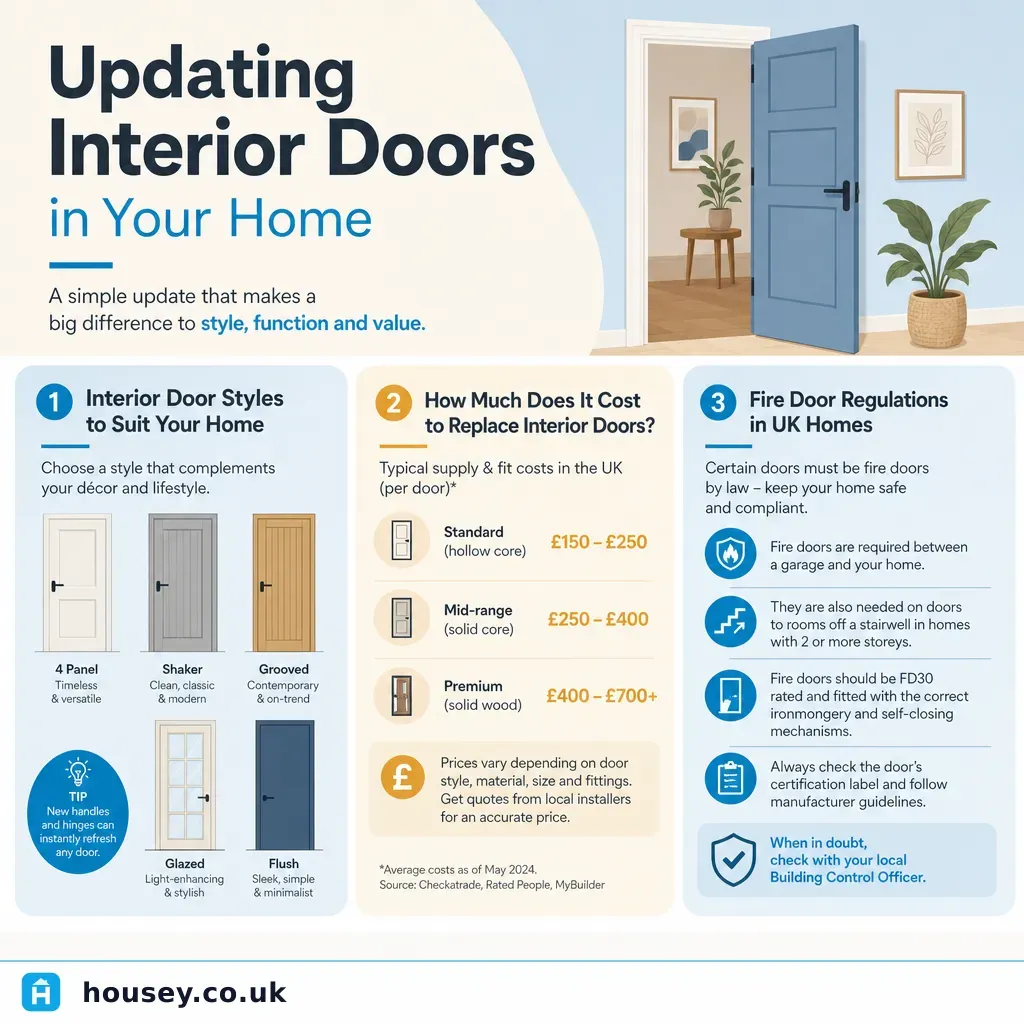
Updating Interior Doors in Your Home
Replacing interior doors is one of the more impactful home upgrades a UK homeowner can make without building regulations approval.
 Improvement & Build
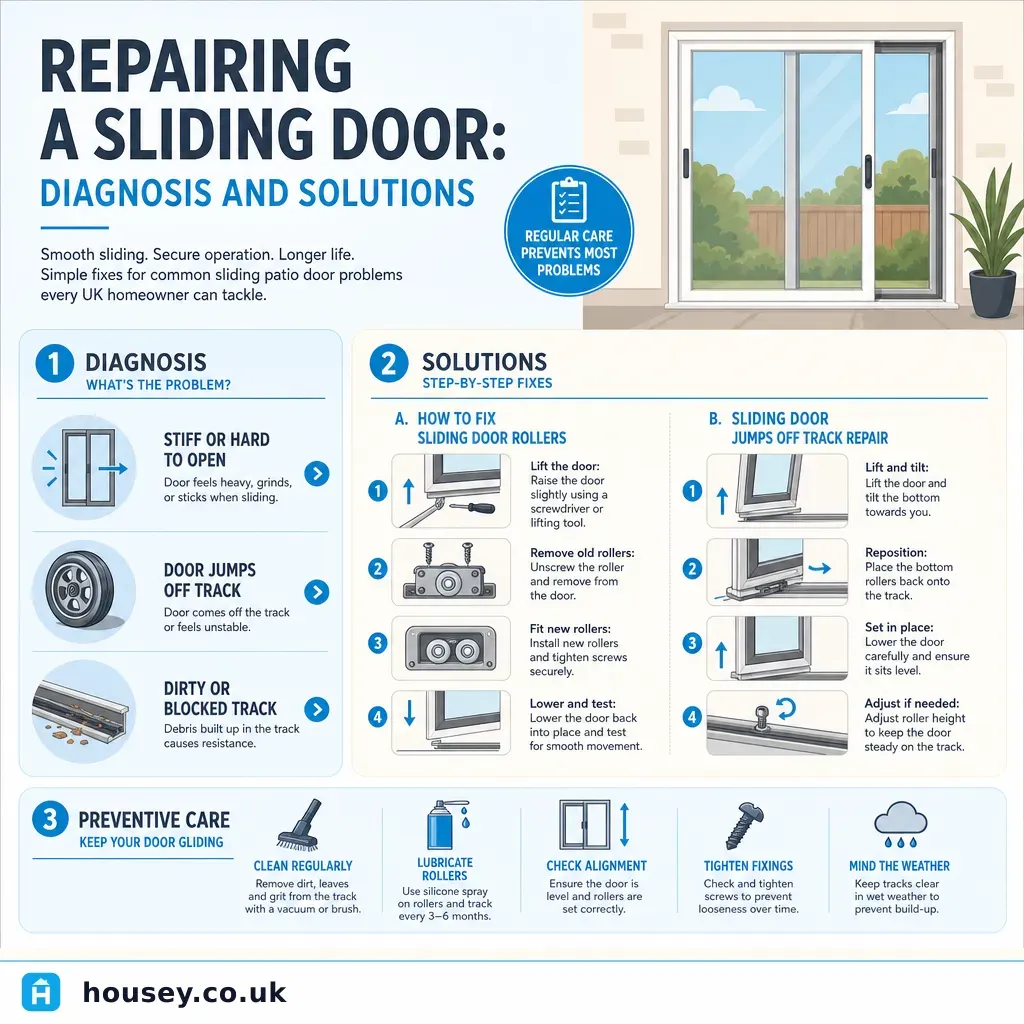
Repairing a Sliding Door: Diagnosis and Solutions
Most sliding door problems — stiffness, jumping off track, or draughts — are caused by dirty tracks, worn rollers, or misaligned guides.
 Improvement & Build
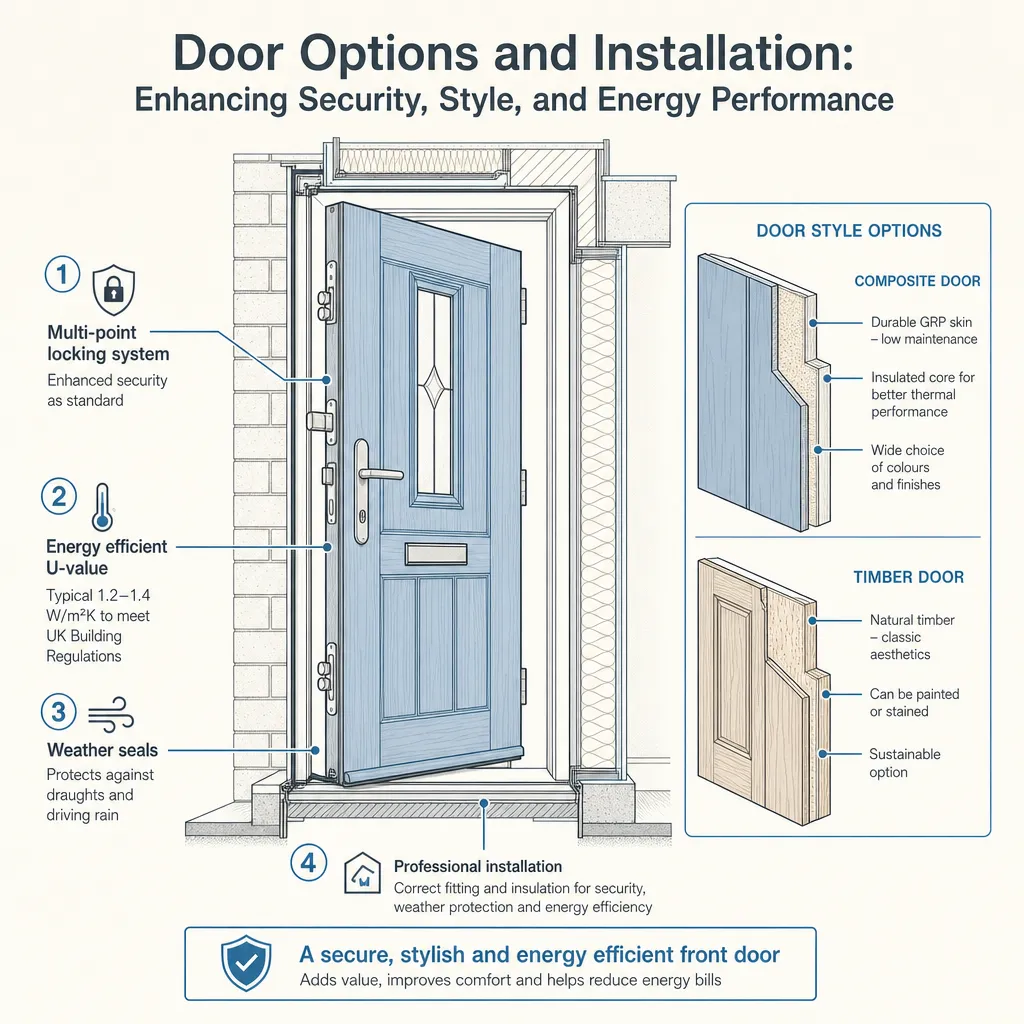
Door Options and Installation: Enhancing Security, Style, and Energy Performance
Choosing a new external door involves balancing security ratings, thermal performance, and style.