Updating Interior Doors in Your Home
By Housey · Last reviewed 19th of May 2026
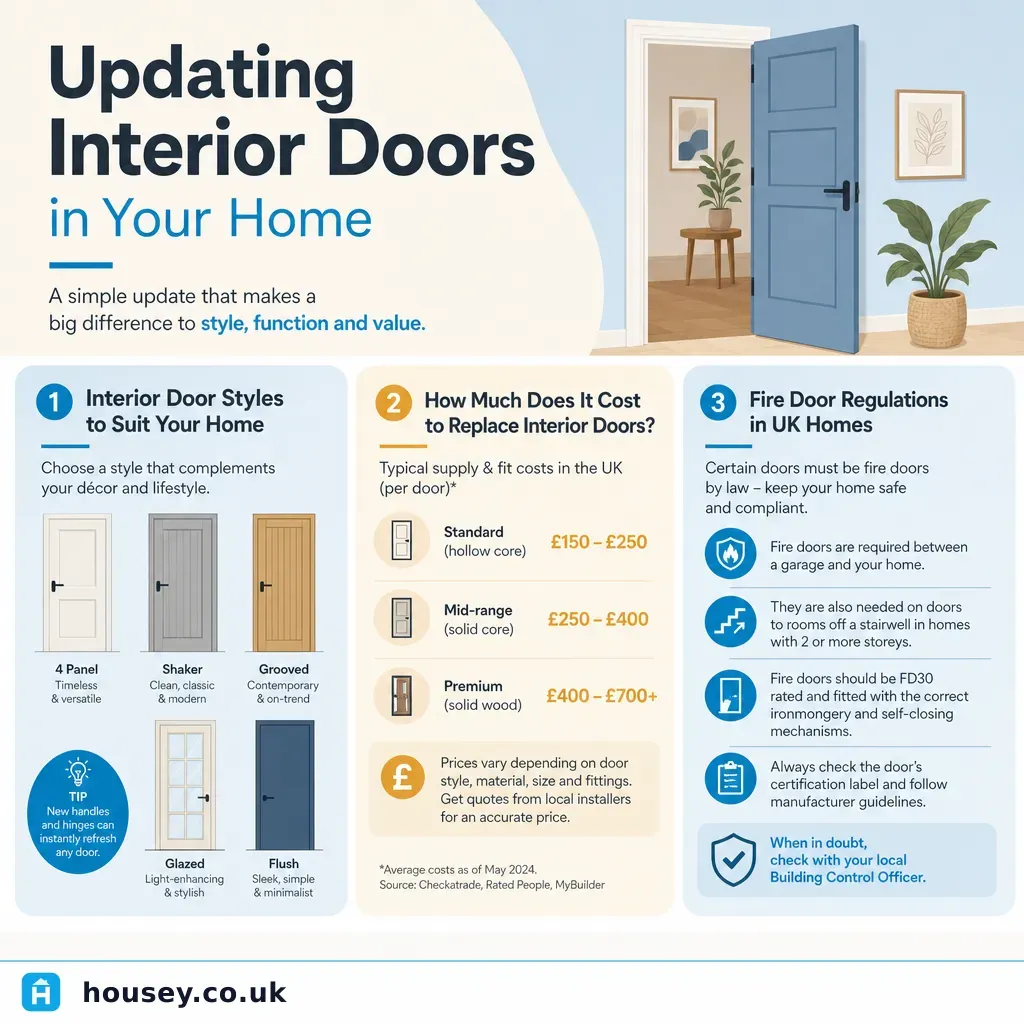
Updating Interior Doors in Your Home
Interior doors shape both the aesthetics and day-to-day practicality of a home, yet they are often the last thing homeowners consider during a renovation. Questions about which style suits a Victorian terrace or whether a solid-core door needs a new frame typically arise during a kitchen remodel, loft conversion, or whole-house refresh — moments when existing doors suddenly look out of place or simply no longer function properly.
Key points
- Standard UK internal door sizes are 1981 mm × 762 mm and 1981 mm × 686 mm, but pre-1970s properties frequently have non-standard openings that need made-to-measure doors.
- Fire doors rated FD30 are required under Building Regulations Approved Document B in specific locations — including between an integral garage and a habitable room, and on escape routes in flats on upper floors.
- Solid-core internal doors typically weigh 35–45 kg; hollow-core equivalents weigh around 10–15 kg. Heavier doors need correctly rated hinges (usually three 76 mm or 100 mm hinges) and a structurally sound lining.
- Door linings often need replacement when upgrading from hollow-core to solid-core, as original linings in older homes may be too slim or damaged to carry the additional load.
- Replacing standard interior doors does not require building regulations approval in most cases, but installing or replacing fire doors on an escape route must comply with Approved Document B.
Hollow-core, solid-core, or glazed: choosing the right door type
The three common interior door constructions each suit different situations. Understanding the trade-offs before purchasing avoids costly returns or a poor result.
Door type | Best for | Not ideal for | Typical weight | Key notes |
|---|---|---|---|---|
Hollow-core (honeycomb fill) | Bedrooms, cupboards, lower-traffic rooms | Soundproofing, durability, fire separation | 10–15 kg | Most affordable; standard in new-builds |
Solid-core (engineered or solid timber) | Living rooms, home offices, hallways | Budget installs; older slim linings | 35–45 kg | Better acoustics; requires correct hinge count |
Glazed (part or full glass panel) | Hallways, open-plan layouts, darker rooms | Bedrooms requiring privacy | 20–40 kg (varies) | Safety glazing may be required under Part N in critical locations |
Fire door (FD30 or FD60 rated) | Garage-to-house links, flat escape routes | General rooms unless legally required | 30–50 kg | Must be a complete system: door, frame, intumescent strip, and door closer |
If you are unsure whether a location legally requires a fire door, check Building Regulations Approved Document B or consult a qualified installer before purchasing.
How to measure for a replacement door
Measuring accurately before ordering is the most common point of failure in door upgrades. Measure the frame opening (the reveal), not the existing door leaf.
- Measure the width at the top, middle, and bottom of the opening — use the narrowest figure.
- Measure the height on both sides — use the shorter measurement.
- Note the thickness of the existing door (typically 35 mm for standard doors, 44 mm for fire doors).
- Check the door lining rebate depth — standard UK linings are typically 107 mm or 133 mm depending on wall thickness.
- If measurements fall between standard sizes, order made-to-measure rather than over-trimming. Check the manufacturer's data sheet — some engineered doors have a trim allowance of just 6 mm per side, and some cannot be trimmed at all.
For pre-1919 terraces and inter-war properties, door openings are often out of square. Made-to-measure or custom-trimmed doors are frequently the only practical solution.
Door styles and what suits your property
Style choices work best when they reflect the property era and the existing architectural details.
- Victorian and Edwardian homes: four- or six-panel moulded doors or original period-style hardwood. Flush doors can look out of place alongside original cornicing and skirting.
- 1930s semi-detached: three- or four-panel doors with gentle Art Deco lines, or glazed doors to complement original picture rails.
- 1960s to 1980s estates: flush doors or simple contemporary styles suit the architecture. Replacing with panel doors can appear mismatched unless the whole interior is being updated at the same time.
- New-build flats: flush, contemporary, or slim-framed glazed doors. Standard metric sizes usually fit without modification.
Ironmongery — handles, hinges, latches — should be consistent throughout an open-plan floor and ideally match other metals in the space such as taps, light switches, and radiator valves.
Homeowner checklist: before you buy or install
When to get professional help
Most interior door replacements are manageable for a competent DIYer or general handyperson. Professional help is advisable when:
- The work involves fire doors on an escape route or between a garage and living space — incorrect installation can void the fire rating and create a safety risk.
- The opening requires structural adjustment such as widening or raising, which may need structural engineer input and building regulations approval.
- The lining or frame shows signs of rot or structural damage, particularly in solid-wall or timber-frame constructions.
- You are fitting doors in a listed building — even internal alterations may require listed building consent from your local planning authority.
- You have several doors to hang and lack the tools or experience to achieve a consistent, gap-free fit throughout the property.
How Housey can help
If you need a professional to supply and fit new interior doors — particularly fire doors, made-to-measure installations, or a full programme of replacements across the property — Housey connects you with vetted window and door installers in your area. Submit a request to receive quotes from qualified local professionals.
Frequently asked questions
Do I need building regulations approval to replace interior doors?
No, in most cases replacing like-for-like interior doors does not require building regulations approval. The exception is fire doors on escape routes — replacing these must comply with Approved Document B, and the installation may be subject to building control inspection if it is part of a wider regulated project such as a loft conversion.
How much does it cost to replace interior doors in the UK?
A hollow-core door leaf typically costs £30–£80; a solid-core or engineered door usually costs £80–£250. Professional installation adds roughly £60–£120 per door for a straightforward fit, rising for made-to-measure doors or lining replacement. Indicative UK costs, last reviewed 2026-05-19. Always obtain at least two quotes before proceeding.
Can I hang interior doors myself?
Yes, if you have basic DIY skills, the right tools — a plane, saw, drill, and spirit level — and accurate measurements. Fire doors should only be fitted by someone familiar with the relevant requirements; a gap of more than 3 mm around the door leaf can compromise the fire rating and render the door non-compliant.
What is the difference between a pre-hung door and a door leaf?
A pre-hung door is supplied already fitted into its frame or lining, making installation simpler where the existing lining is damaged or non-standard. A door leaf is the door alone, fitted into an existing lining. Pre-hung doors are often more practical for replacements where the original frame cannot be reused.
Sources and further reading
- Building Regulations Approved Document B — Fire Safety — GOV.UK
- Building Regulations Approved Document N — Glazing Safety in Relation to Impact — GOV.UK
- British Woodworking Federation — Door Guidance — British Woodworking Federation
Useful next reads
 Improvement & Build
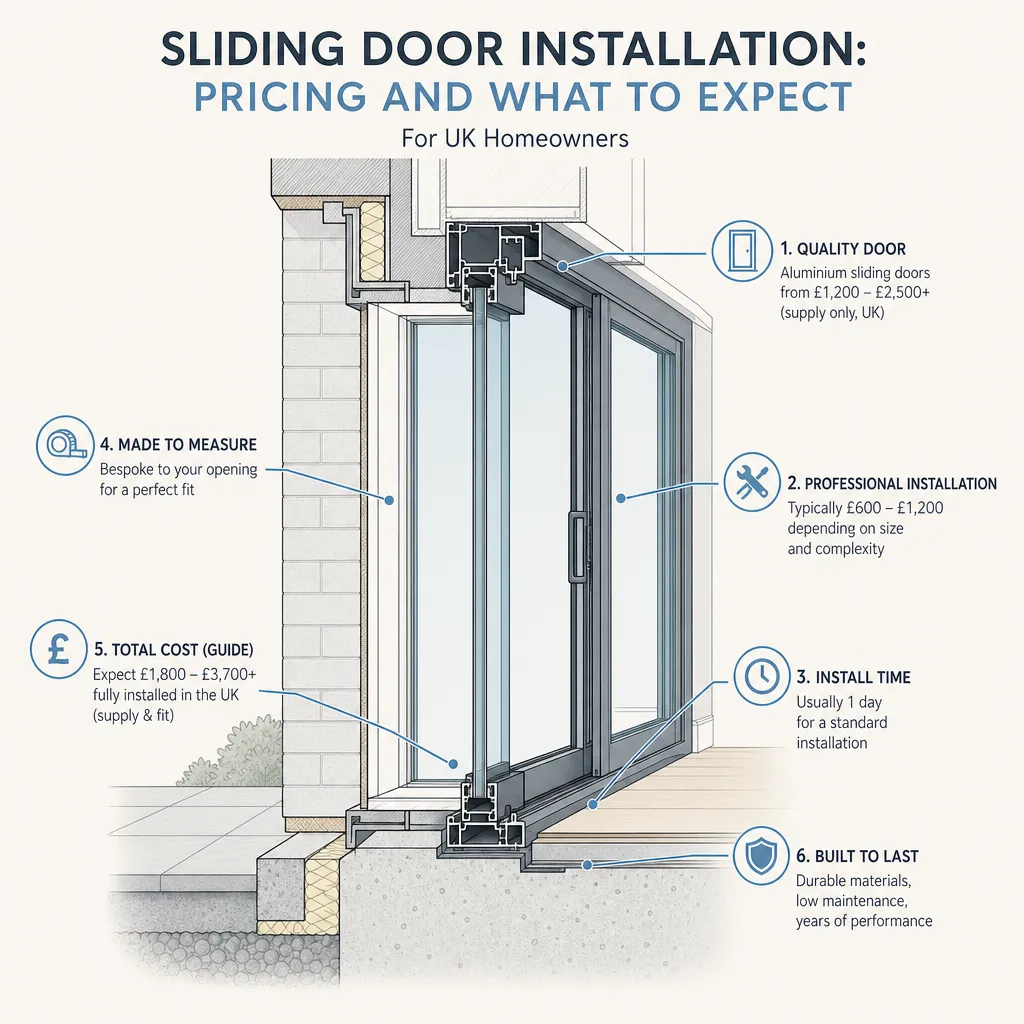
Sliding door installation: pricing and what to expect
A new sliding patio door in the UK typically costs £800–£3,000 fully installed, depending on size, material, and glazing specification.
 Improvement & Build
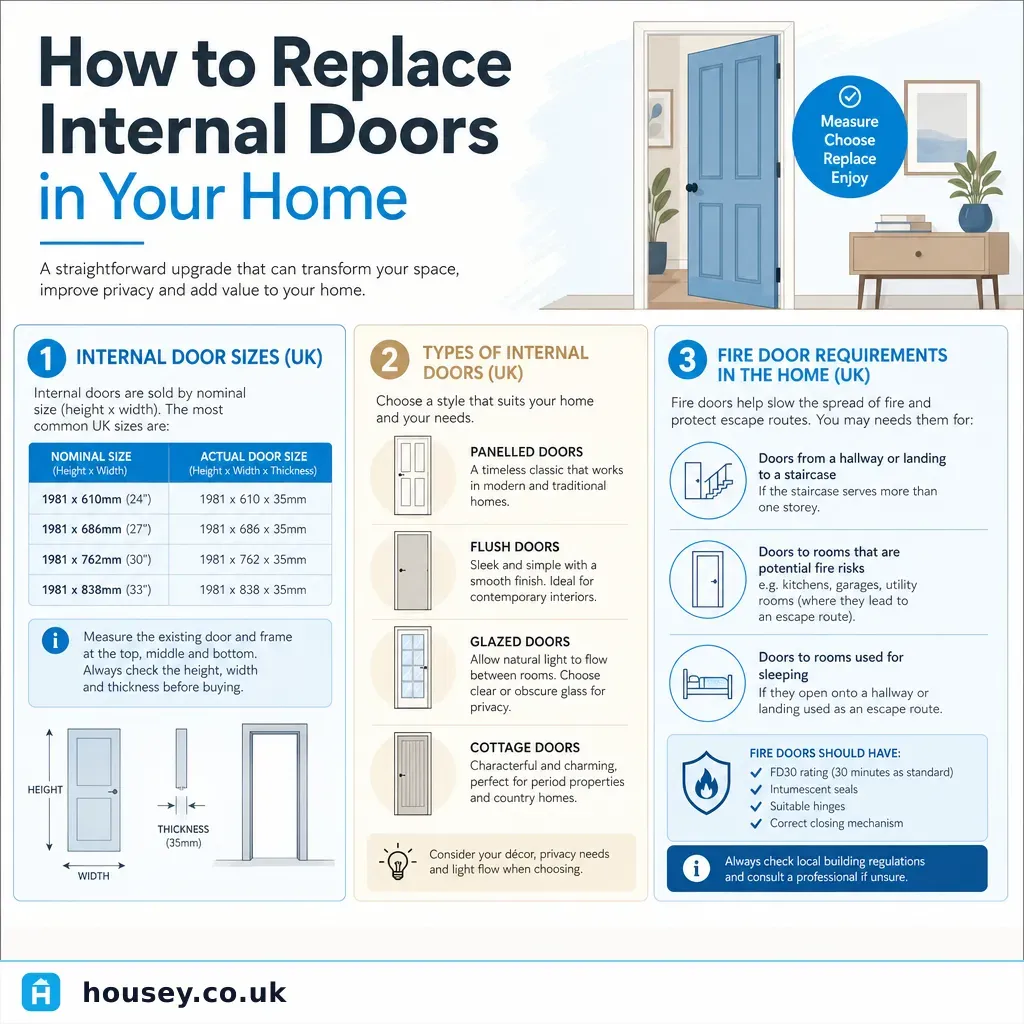
How to Replace Internal Doors in Your Home
Replacing internal doors is a straightforward home improvement that most competent DIYers or a joiner can complete.
 Improvement & Build
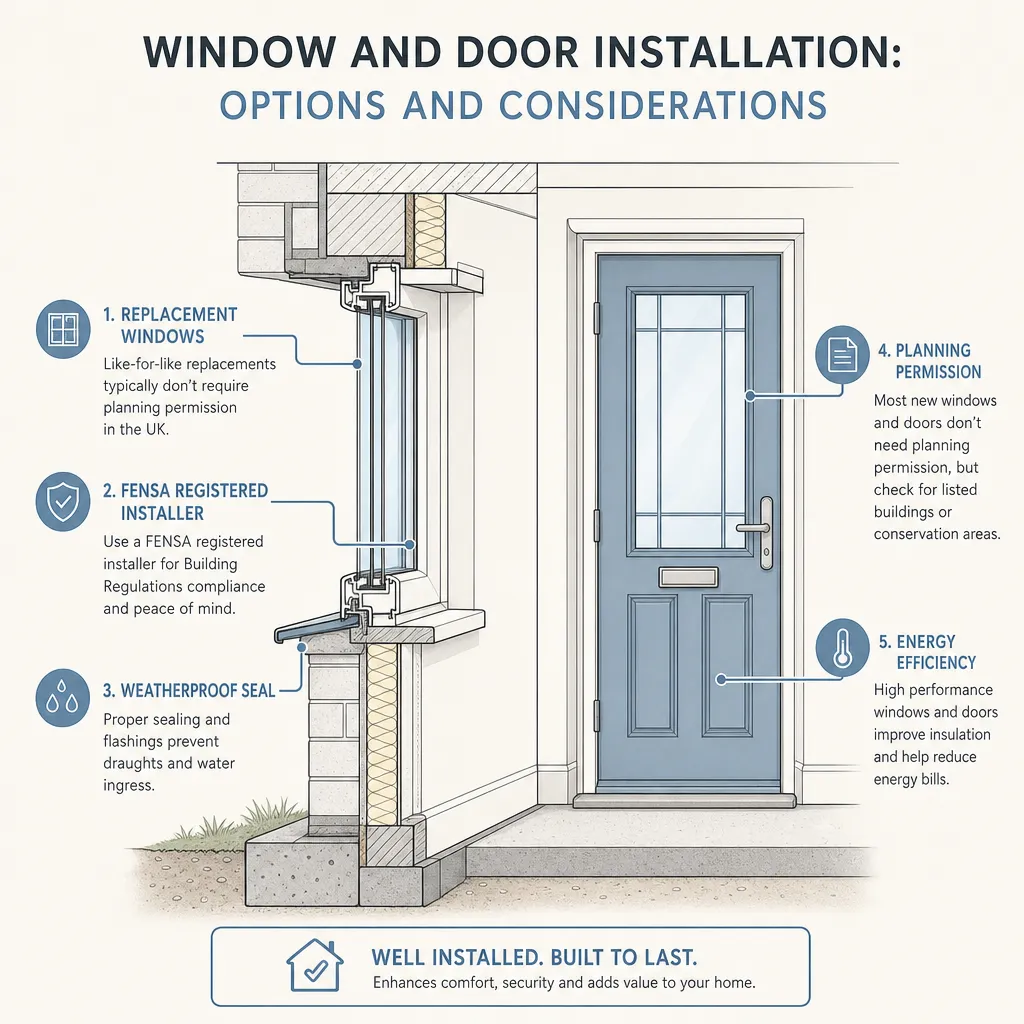
Window and Door Installation: Options and Considerations
Replacing windows and external doors in the UK requires compliance with Building Regulations Part L (thermal performance) and Part K (safety glazing).
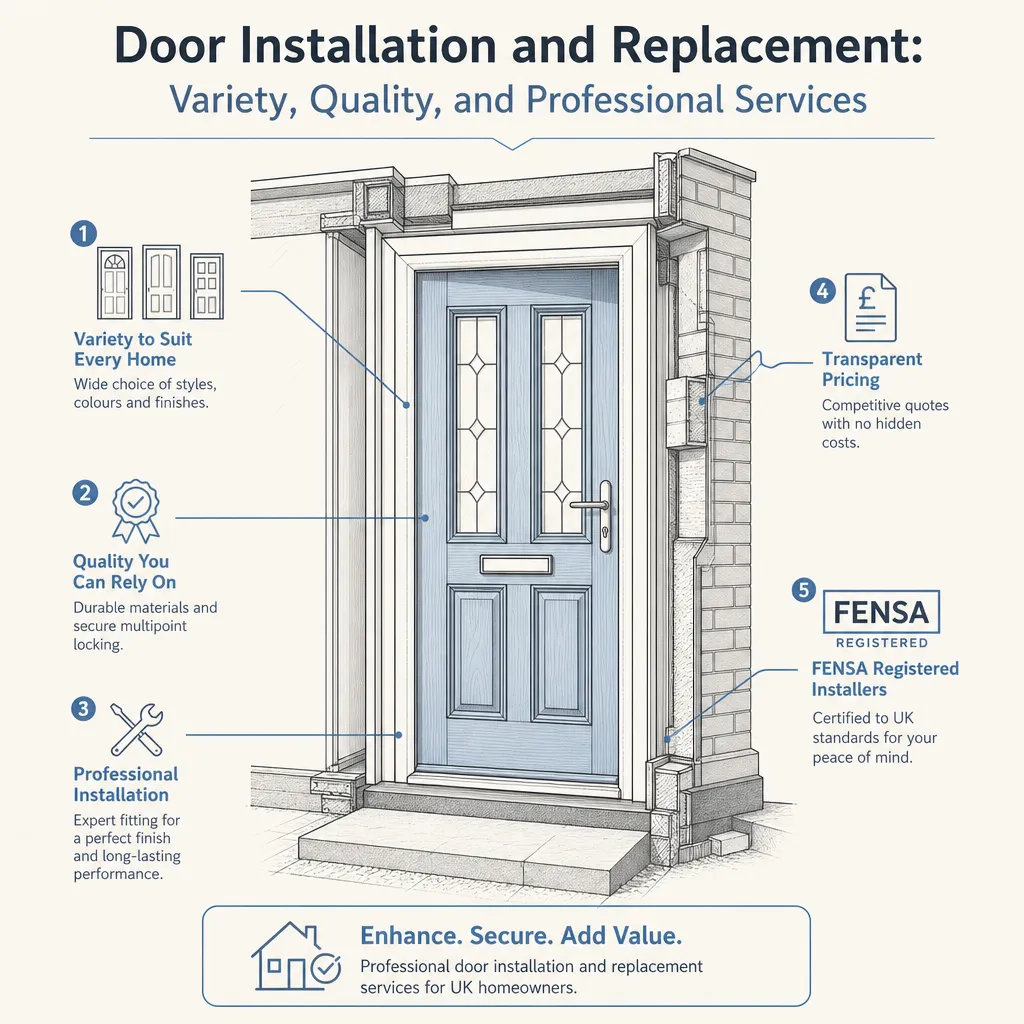 Improvement & Build
Door Installation and Replacement: Variety, Quality, and Professional Services
Door installation in UK homes ranges from straightforward interior hanging, which requires few regulations, to external replacements subject to Building Regulations Part L.
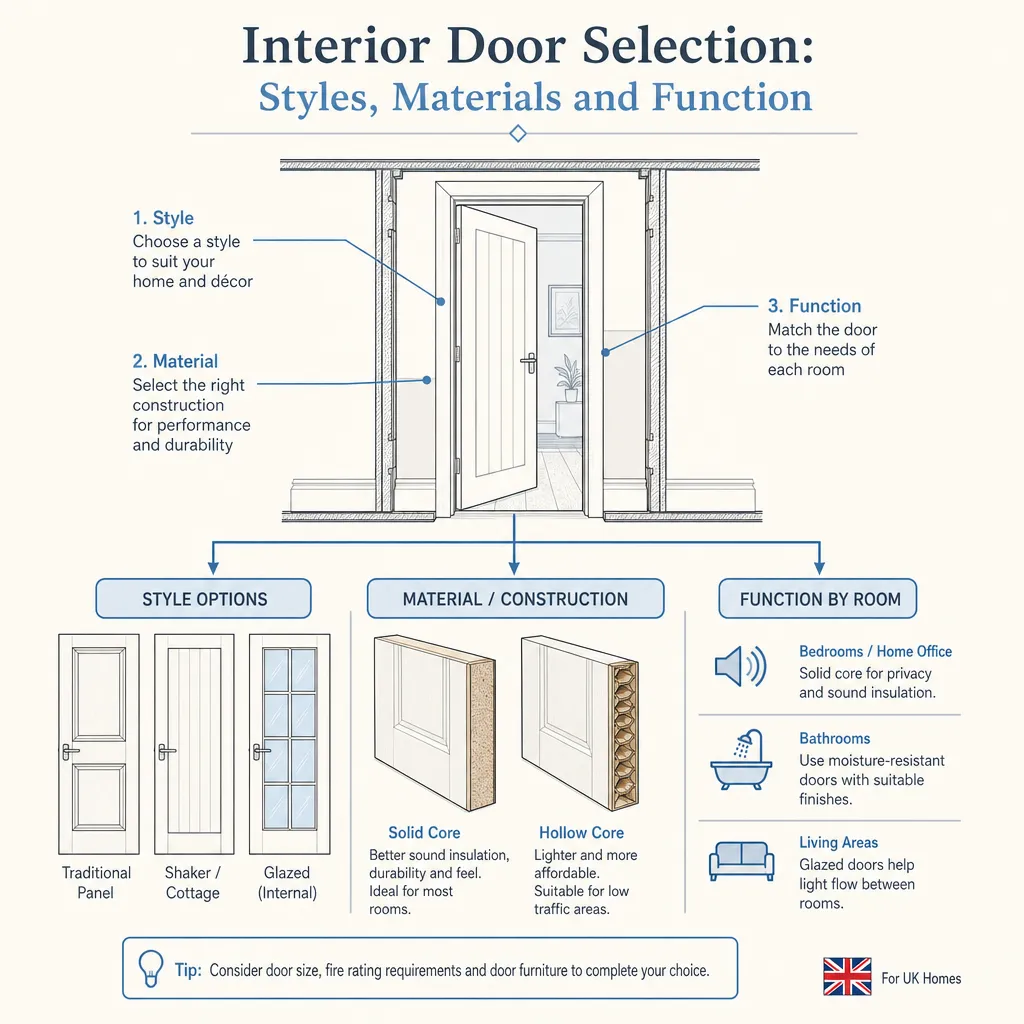 Improvement & Build
Interior Door Selection: Styles, Materials and Function
Interior doors in UK homes come in solid core, hollow core, and glazed varieties, with styles from flush and panelled to bifold and pocket.