Door Sills: Purpose, Maintenance, and Replacement Guidance
By Housey · Last reviewed 1st of June 2026
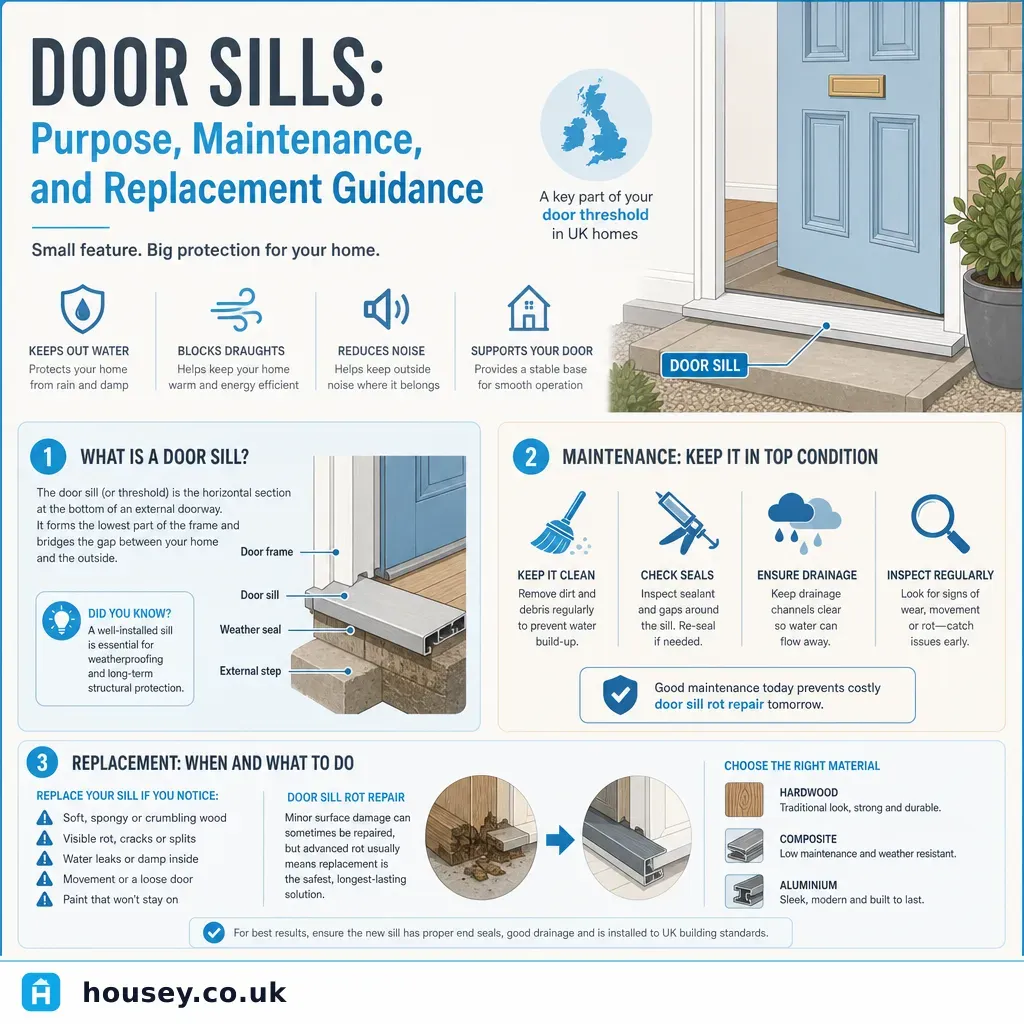
Door Sills: Purpose, Maintenance, and Replacement Guidance
An external door sill rarely receives attention until it fails — and by the time a homeowner notices rot, cracking, or persistent draughts at the base of the door, the sill may have been deteriorating for years. Sill condition directly affects weatherproofing, thermal performance, and accessibility, and in an older UK property with a timber sill, replacement is a routine but time-sensitive maintenance task.
Key points
- A door sill (threshold) is the horizontal base component of an external door frame, sealing the junction between the door leaf and the floor against water and draughts.
- Timber sills on Victorian, Edwardian, and mid-20th-century properties are susceptible to wet rot, particularly where end grain is exposed or the bottom weatherseal has failed.
- Approved Document M (Building Regulations, 2015 edition) requires a maximum 15 mm threshold upstand for new Category 1 (visitable) dwellings — relevant when replacing a door set on a new build or extension.
- Aluminium and composite thresholds are more durable than timber and are available in low-threshold or flush designs for accessibility compliance under Part M.
- Replacing the door's bottom weatherstrip or brush seal is considerably cheaper than full sill replacement and should be tried first when the only symptom is a draught at the base of the door.
What does a door sill do?
The door sill — also called the threshold or cill — is the horizontal component at the base of an external door frame. It serves several functions simultaneously:
- Weatherproofing: it creates a sealed junction between the bottom of the door leaf and the floor, preventing rain, wind, and cold air from entering beneath the door.
- Structural base: it ties the two vertical jambs at their foot, helping to maintain the shape of the frame.
- Floor transition: it bridges any height difference between the interior floor level and the exterior surface — a step, patio, or path.
- Accessibility: in new or refurbished dwellings, the sill design must meet threshold height requirements under Approved Document M to allow level or near-level entry.
Types of door sill: a comparison
Sill type | Typical lifespan | Accessibility options | Main weakness |
|---|---|---|---|
Hardwood timber (oak, iroko) | 15–30 years | Limited; usually upstand | Wet rot, especially at end grain |
Aluminium (extruded) | 30–50+ years | Low-threshold and flush designs available | Thermal bridging if not thermally broken |
Composite / glass-reinforced polymer | 25–40+ years | Low-threshold designs available | Colour fade; less repairable than timber |
Natural or cast stone | 50–100+ years | Usually rebated upstand; not easily made flush | Heavy; difficult to seal perfectly |
Most post-1990s door sets use aluminium or composite thresholds as standard. Timber sills remain common on older properties and on bespoke hardwood door sets.
Maintenance checklist: checking your door sill annually
Carry out this check each year, ideally before the onset of winter:
One or two 'no' answers may be resolved with a new weatherstrip or fresh flexible sealant. Several 'no' answers, or any soft timber, point to more significant repair or replacement.
Red flags: when to replace rather than repair
Repair — such as a new weatherstrip, fresh sealant, or surface treatment — is appropriate for minor wear. Replacement is needed when:
- The timber is soft, crumbling, or shows dark discolouration deeper than the surface. This indicates wet rot that has penetrated the structural section.
- The sill has cracked through its full thickness, allowing water to track underneath.
- The sill has lifted or separated from one or both jambs, breaking the weathertight joint.
- Moisture is consistently appearing inside the door despite a new weatherstrip — this suggests water is tracking through the sill itself, not merely past it.
- Accessibility needs to improve: a property undergoing major refurbishment or material change of use may need to upgrade to a compliant low-threshold design.
- The sill is more than 20–25 years old, made from softwood (a poor choice for external use), and showing early signs of deterioration.
Replacing a door sill: what to expect
Sill replacement is a specialist carpentry or joinery task. The scope depends on whether:
- The entire door set is being replaced — door, frame, and threshold as a pre-hung unit. This is typical for composite or aluminium door replacements and usually includes the threshold as an integrated component.
- Only the sill is being replaced while the existing jambs are retained. This is more complex, requiring careful removal without disturbing frame geometry or the weatherseal at the jamb bases.
For a like-for-like hardwood sill on a traditional door frame, an experienced joiner will cut out the failed sill, prepare the bearing surfaces on the jamb feet, fit the new sill to the jamb housings, apply preservative treatment to all end grain, prime all surfaces before fixing, and seal the joints with flexible exterior sealant.
For a full door set replacement, an aluminium low-threshold is typically integrated into the factory-built composite or aluminium door set and installed following the manufacturer's fixing specification.
Indicative UK costs, last reviewed 2026-06-01. Timber sill-only replacement by a joiner: approximately £150–£400 including materials, depending on door size and access difficulty. Full external door set replacement including threshold: approximately £800–£2,500+ depending on material, size, glazing, and security hardware. Obtain at least two written quotes specifying the sill type, materials, and any associated making-good work.
Accessibility and Building Regulations
Approved Document M (Volume 1: Dwellings, 2015 edition) requires new dwellings in Category 1 (visitable) to have a maximum threshold upstand of 15 mm. Category 2 (accessible and adaptable) and Category 3 (wheelchair user) dwellings have progressively more demanding requirements, moving toward level access.
For existing homes, these requirements are only triggered on new builds, extensions requiring Building Regulations approval, or material change of use — not routine like-for-like maintenance. If you are replacing a door set as part of an approved extension, the new threshold must comply.
Aluminium low-threshold designs common on modern composite door sets (typically 15 mm or less) are generally compliant with Category 1. Fully flush thresholds are more expensive and are usually specified for Category 2 or 3 applications.
When to get professional help
A door sill is part of your home's primary weather defence. Get professional advice or instruction if:
- You can see or probe wet rot in the sill or at the base of either jamb.
- The floor immediately inside the door shows signs of dampness, staining, or movement — suggesting water ingress has been ongoing.
- The door set is a composite or aluminium unit installed as a factory-assembled system — thresholds on these should not be modified without reference to the manufacturer's guidance.
- The property is listed or in a conservation area, and the proposed replacement sill material or profile would alter the character of the original door set.
- You are unsure whether your replacement work triggers a Building Regulations notification obligation.
How Housey can help
For sill repair, threshold replacement, or a full external door set replacement, window and door installers on Housey can assess the condition of your existing frame, advise on compliant threshold designs, and supply and fit a replacement to current standards. Request quotes to compare local specialists.
Frequently asked questions
What is the difference between a door sill and a door threshold?
In everyday use the terms are interchangeable. In technical contexts, 'threshold' often describes the height-transition detail and its accessibility characteristics under Building Regulations, while 'sill' is the term carpenters and joiners use for the physical horizontal component at the base of the frame. Both refer to the same part.
How do I know if my door sill has wet rot?
Probe the surface of a timber sill gently with a bradawl or screwdriver tip. Healthy hardwood resists penetration; wet-rotted timber feels soft, spongy, or fibrous and may crumble under light pressure. Dark brown discolouration and paint bubbling or peeling at the surface are also signs. If the wood beneath the paint is soft, replacement is needed rather than surface treatment.
Does replacing a door sill need Building Regulations approval?
Like-for-like sill replacement on an existing door frame does not typically require Building Regulations approval or a formal notification. However, if you are replacing the full door set as part of an extension or structural alteration, Building Regulations may apply, including threshold accessibility requirements under Approved Document M. Check with your local building control authority if unsure.
Can I use expanding foam to seal around a door sill?
Expanding polyurethane foam can fill installation gaps around door frames but is not suitable as a permanent external weatherseal. It degrades with UV exposure if left uncovered, absorbs moisture, and is not a substitute for a proper brush seal or flexible exterior sealant at the sill-to-floor joint. Use a low-modulus silicone or modified silicone sealant for joints exposed to weather.
Sources and further reading
- Approved Document M: Access to and use of buildings (Dwellings) — GOV.UK
- Draught-proofing your home — Energy Saving Trust
- Do I need building regulations approval? — GOV.UK
- Practical building conservation guidance — Historic England
Useful next reads
 Improvement & Build
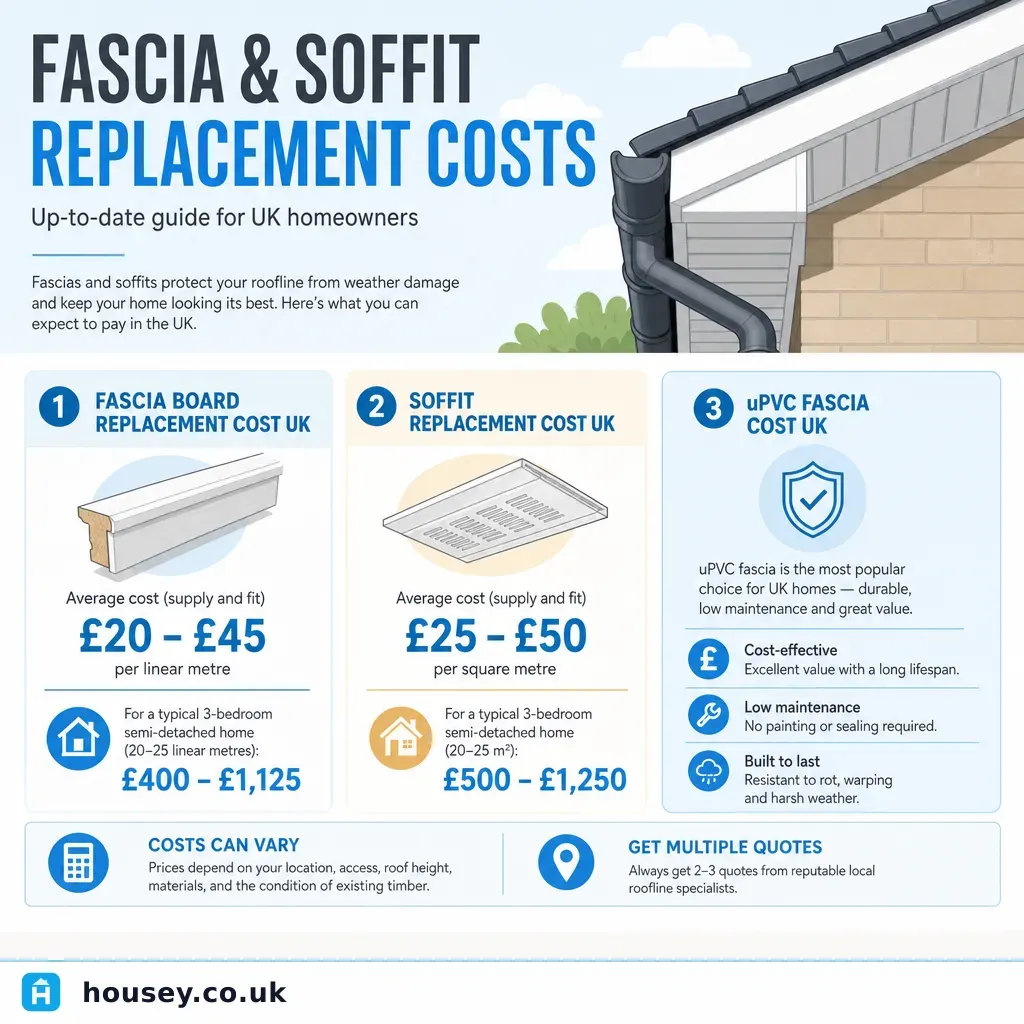
Fascia and Soffit Replacement Costs
Fascia and soffit replacement for a semi-detached house in the UK typically costs £1,800–£4,500 for uPVC boards and new guttering.
 Improvement & Build
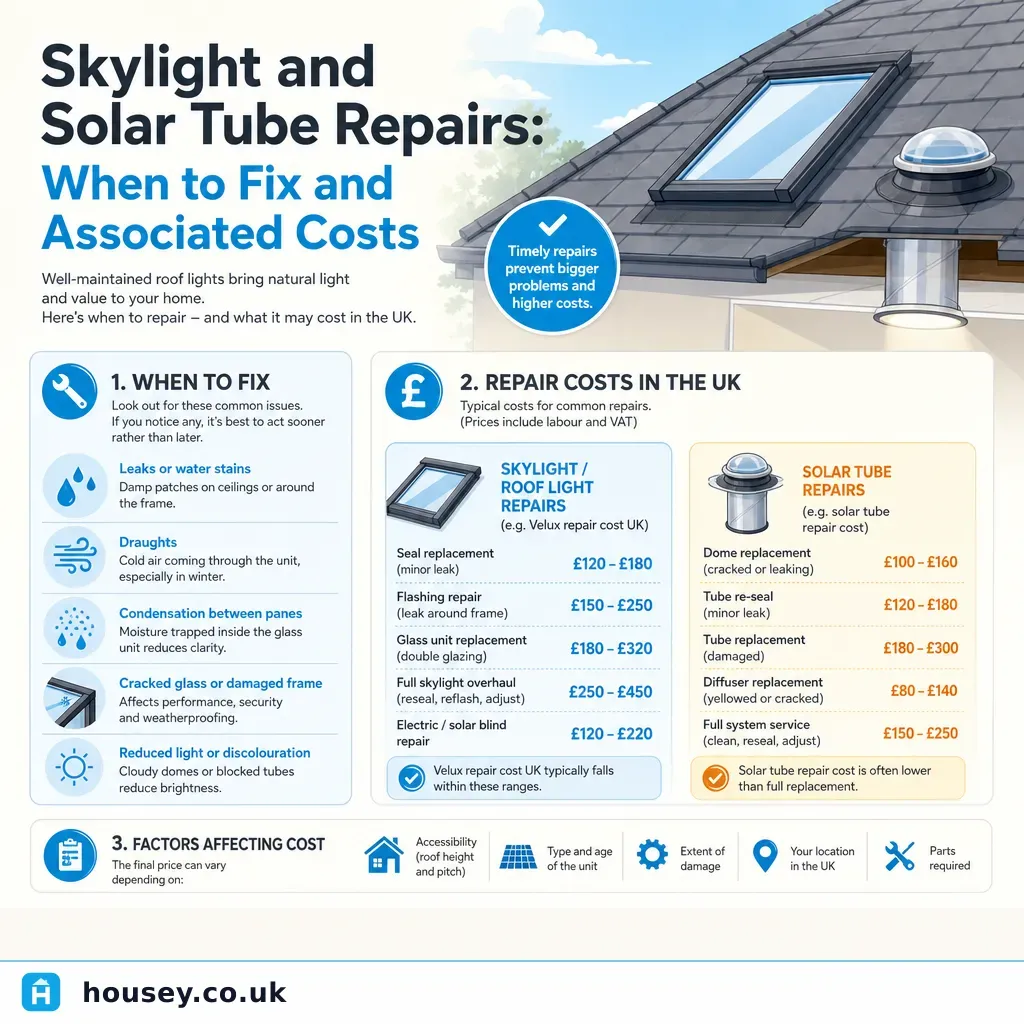
Skylight and solar tube repairs: when to fix and associated costs
Skylight repairs — resealing, reflashing, or replacing a misted glazing unit — typically cost £150–£400 for minor work and £800–£2,500+ for a full replacement in the UK.
 Improvement & Build
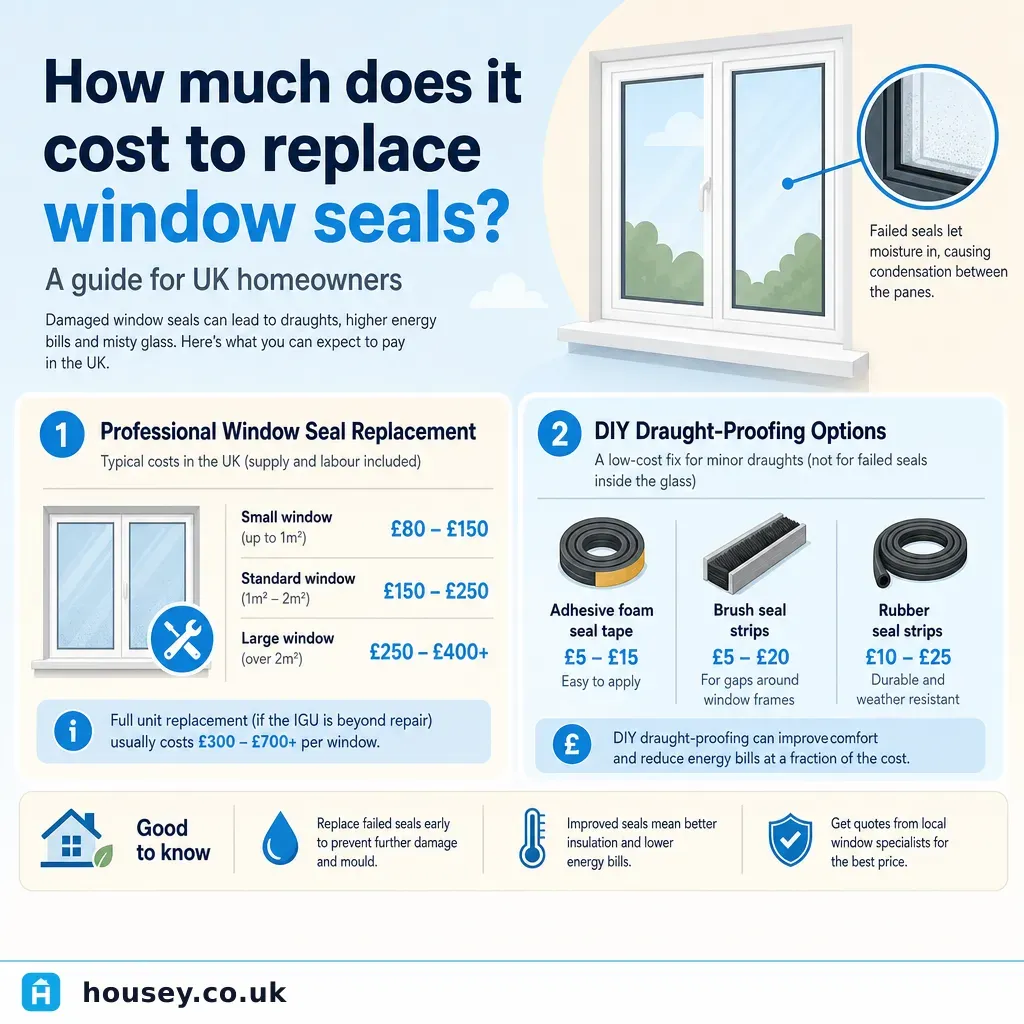
How much does it cost to replace window seals?
Replacing window seals in the UK costs between £40 and £350 per window depending on the repair type.
 Improvement & Build
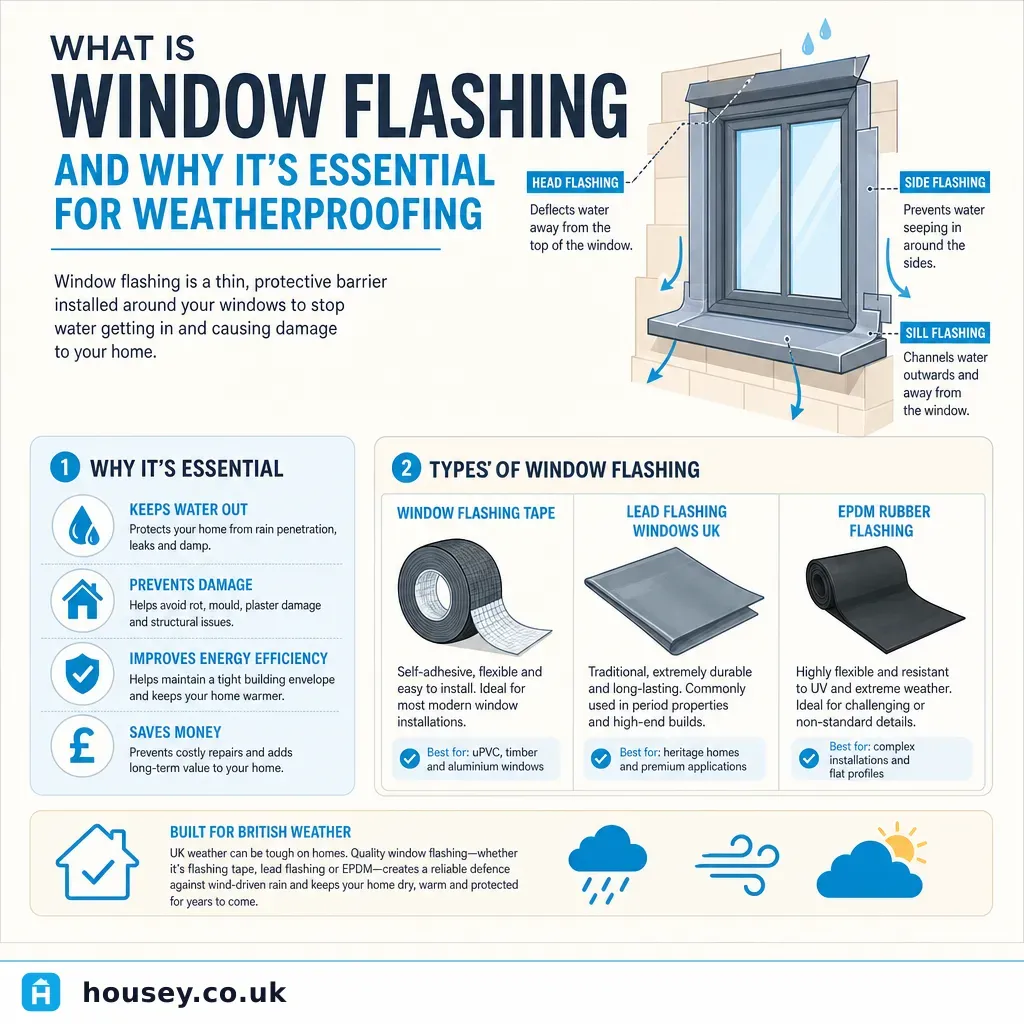
What is window flashing and why it's essential for weatherproofing
Window flashing is a water-resistant material installed at the head, sill, and jambs of a window opening to direct rainwater away from the frame-to-wall junction.
 Improvement & Build
Concrete Sealing: Protecting and Maintaining Your Driveway
Sealing a concrete driveway protects against water ingress, freeze-thaw damage, oil stains, and surface wear.