Drain Repair Costs and Sewage Line Remediation
By Housey · Last reviewed 6th of May 2026
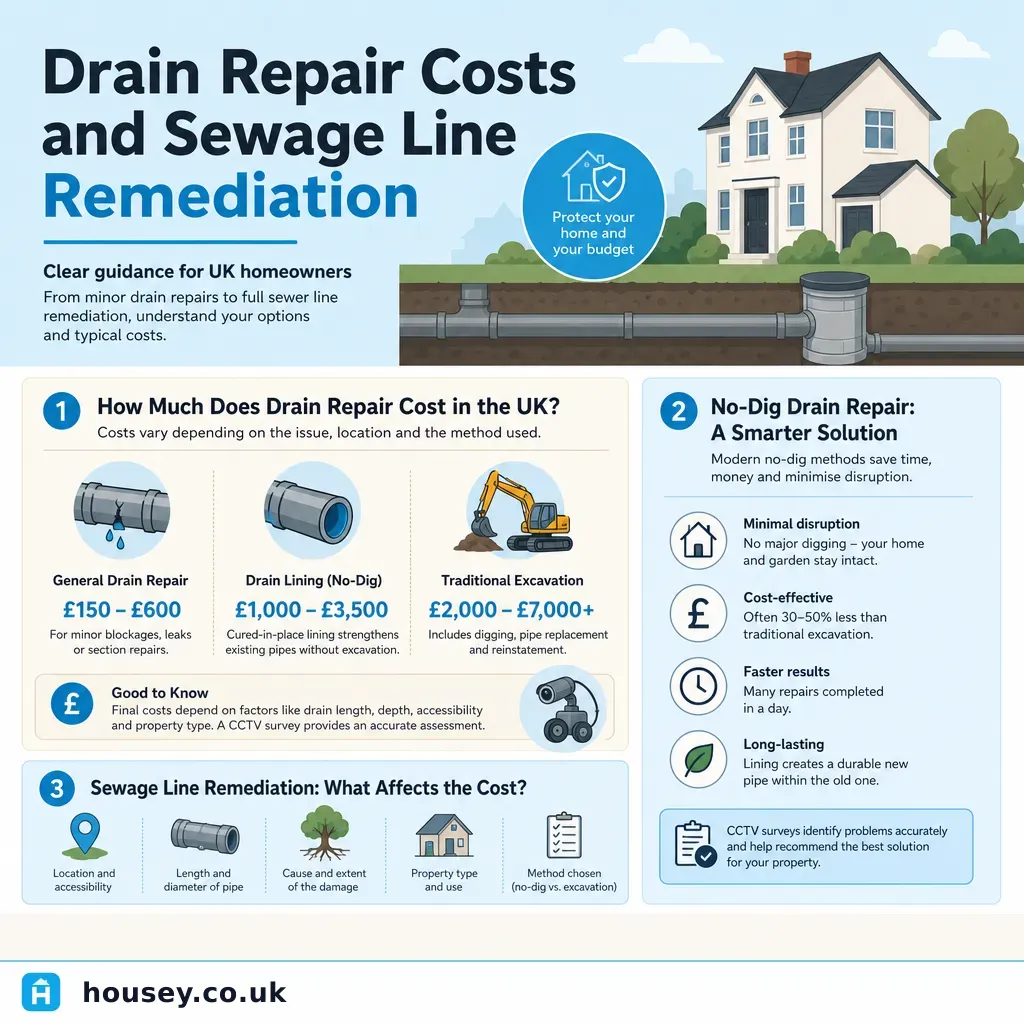
Drain Repair Costs and Sewage Line Remediation
Drainage problems rarely advertise themselves until they become urgent. Whether a CCTV survey has revealed a cracked pipe beneath your garden, you have noticed persistent wet patches near the house, or a pre-purchase survey flagged drainage defects before exchange, understanding what repair options exist — and what they cost — helps you commission the right work without overpaying. Repair decisions in the UK also turn on who legally owns the drain, a question that determines whether you pay at all.
Key points
- A CCTV drain survey (typically £100–£300) is essential before any structural repair — it confirms the defect type, pipe depth, and location using WRc classification codes, which determines whether lining or excavation is appropriate.
- Under the Water Industry Act 1991 (as amended in 2011), homeowners in England and Wales are responsible for drains within their property boundary; lateral drains from the boundary to the public sewer are the water company's responsibility.
- No-dig repair methods — drain lining, patch lining, and pipe bursting — are typically less disruptive and less costly than open-cut excavation for accessible pipe runs.
- Cured-in-place pipe (CIPP) drain lining typically costs £800–£2,500 for a standard domestic run; full excavation and pipe replacement can reach £1,500–£8,000+ depending on depth, pipe diameter, and access.
- VAT at 20% applies to most drainage contractor work; always confirm whether quoted prices are inclusive or exclusive before authorising work.
Which repair method is right for your drain?
The method your contractor recommends depends on the defect type, pipe material, diameter, depth, and access. A CCTV survey report will classify defects using WRc (Water Research Centre) codes — common findings include root ingress (IG/IE codes), pipe fractures (FB/FO), displaced joints (OJ), and pipe deformation (D codes). The severity and extent of these defects determines which repair technique is viable.
Repair method | Best for | Not ideal for | Indicative cost (domestic) | Disruption level |
|---|---|---|---|---|
Patch lining | Localised crack, fracture, or root ingress in otherwise sound pipe | Widespread collapse or severe deformation | £500–£900 per patch | Low — no dig |
Full drain lining (CIPP) | Long run of cracked, corroded, or leaking pipe in sound host pipe | Very tight bends, fully collapsed sections | £800–£2,500 | Low — no dig |
Pipe bursting | Clay or cast-iron pipe needing upsizing or full replacement | Ground that cannot accept burst head movement | £1,200–£3,500 | Low — minimal dig |
Open-cut excavation | Collapsed or severely misaligned pipe; deep or offset sections | Urban settings with nearby services or made-up ground | £1,500–£8,000+ | High — full excavation |
Patch repair (dig and mortar) | Minor joint displacement accessible near the surface | Deep or confined pipe runs | £400–£1,200 | Moderate |
Indicative UK costs, last reviewed 2026-05-06. Prices vary significantly by region, depth, pipe diameter, ground conditions, and reinstatement requirements. Obtain at least three quotes before committing to any method.
Who is responsible for the repair?
This question matters before you spend anything.
- Private drains — pipes that serve only your property and lie within your boundary — are your responsibility to maintain and repair.
- Lateral drains — the section of pipe from your property boundary to the public sewer — became the responsibility of water and sewerage companies in England and Wales in October 2011, following amendments to the Water Industry Act 1991.
- Public sewers — shared pipes serving more than one property — are maintained by the relevant water company (for example Thames Water, Severn Trent, Anglian Water, or Yorkshire Water).
In Scotland, drains and sewers are managed under Scottish Water's statutory responsibilities under the Sewerage (Scotland) Act 1968. Northern Ireland is covered by Northern Ireland Water under the Water and Sewerage Services (Northern Ireland) Order 2006.
If you are unsure whether the affected section is private or public, contact your water company. They hold sewer maps and can confirm responsibility from your address. Do not commission private repair work on any section that may be the water company's liability — they should carry out the work without charge to you.
Does drain repair need building regulations approval?
Most like-for-like drain repairs do not require building regulations approval. However, Building Regulations Part H (Drainage and Waste Disposal) applies when you are:
- Installing a new drain or making a new connection to the public sewer
- Significantly altering the drainage layout of the property
- Carrying out excavation within 3 metres of a public sewer (or within 1 metre for a sewer over 225 mm diameter), which requires building control notification under Schedule 2 of the Building Regulations 2010
If in doubt, check with your local building control authority before work begins. A competent drainage contractor will advise whether notification is needed for the specific works proposed.
Red flags: when to act quickly
Some drainage defects escalate fast and can cause structural or environmental harm. Do not delay if you notice any of the following.
- Sewage backing up into the property — a public health risk; act the same day and contact your water company before calling a private contractor.
- Persistent wet or sunken patches in the garden — may indicate a broken sewer exfiltrating effluent into the surrounding ground.
- Foundation cracks close to a drain run — saturated ground from a leaking drain can undermine footings or cause clay soils to shrink and swell.
- CCTV report showing pipe collapse or severe deformation — lining may not be viable; open-cut excavation could be urgent.
- Foul smell inside the property without a visible blockage — can indicate a cracked drain below the floor slab or a failed trap.
- Root ingress reducing the pipe bore by more than 50% — significantly increases the risk of a complete blockage during heavy rainfall.
What to ask before accepting a quote
- Is the CCTV survey included in the price, or charged separately?
- Which WRc defect codes does the survey report show, and how do those findings justify the proposed repair method?
- Will the repair be carried out to BS EN 13380 (general requirements for rehabilitation of drain and sewer systems) or the BS EN ISO 11296 series for plastic pipe lining?
- What guarantee period applies to the repair, and is it backed by an insurance-backed warranty?
- Who is responsible for reinstatement of driveway, garden, or road surfaces — is this included in the quoted price?
- Is VAT included in the quoted price?
- What happens if the survey reveals additional defects once work has started, and how are variations agreed and priced?
When to get professional help
Drain repair is not DIY territory beyond clearing a simple surface blockage with a plunger or short drain rods. Engage a qualified drainage contractor — ideally a member of the National Association of Drainage Contractors (NADC) — when:
- A CCTV survey has identified a structural defect in the pipe
- Sewage is backing up or overflowing at ground level
- There is evidence of ground movement, subsidence, or foundation damp linked to the drain
- Any excavation will approach within 3 metres of a public sewer
- The repair involves public highway reinstatement, which requires a Section 50 licence under the New Roads and Street Works Act 1991
For disputes about sewer ownership or water company responsibilities, contact the Consumer Council for Water (CCWater).
How Housey can help
Housey connects homeowners with qualified drainage contractors who carry out CCTV surveys, no-dig drain lining, and full pipe excavation and replacement. Request quotes through Housey to compare prices from local, vetted contractors without managing multiple phone calls yourself.
Frequently asked questions
Who pays for drain repair — me or the water company?
It depends on where the drain is. Private drains within your property boundary are your responsibility. In England and Wales, lateral drains from your boundary to the public sewer became the water company's responsibility in October 2011 under changes to the Water Industry Act 1991. Contact your water company with your address and they can confirm ownership from their sewer records.
How long does drain lining last?
Cured-in-place pipe (CIPP) lining is generally expected to last 50 years or more when correctly installed, depending on ground conditions and pipe diameter. Reputable installers should provide a guarantee of at least 10 years on the installation. Ask whether the guarantee is backed by an insurance-backed warranty before committing to the work.
Can I claim drain repair on home insurance?
Some home insurance policies cover sudden accidental damage to underground drains. Gradual deterioration, root damage, and wear and tear are commonly excluded. Check your policy wording for underground services or home emergency cover sections. An NADC member contractor can provide a written report suitable for insurance purposes if a claim is being considered.
Do I need planning permission for drain repair?
Like-for-like repair work does not normally require planning permission. New drainage connections or excavation within 3 metres of a public sewer may require building regulations notification under Part H of the Building Regulations 2010. If in doubt, check with your local building control authority before starting any excavation or pipework.
Sources and further reading
- Water Industry Act 1991 — legislation.gov.uk
- Building Regulations Approved Document H: Drainage and Waste Disposal — GOV.UK
- Sewer adoption and responsibility — Ofwat
- National Association of Drainage Contractors (NADC) — NADC
- Consumer Council for Water — CCWater
Useful next reads
 Improvement & Build
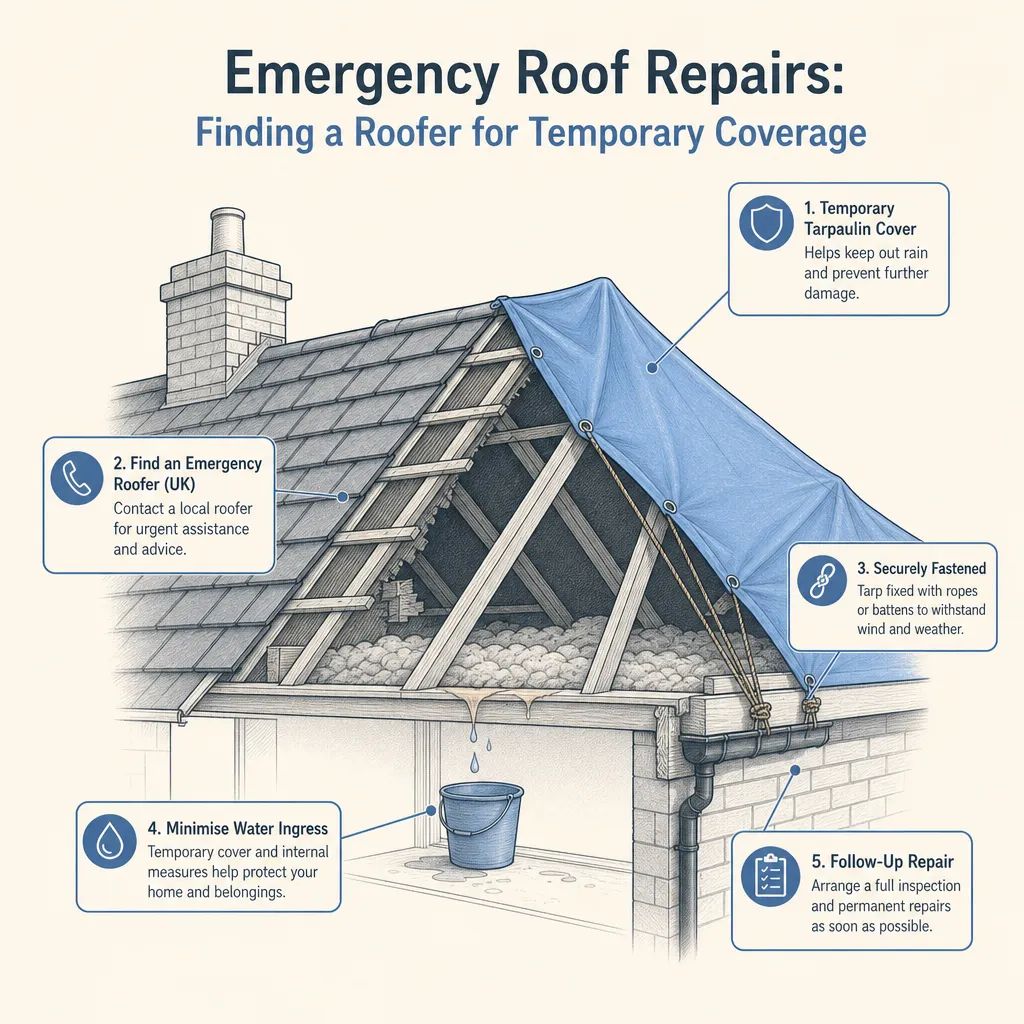
Emergency Roof Repairs: Finding a Roofer for Temporary Coverage
After storm or impact damage, the immediate priority is weatherproofing, not a permanent repair.
 Improvement & Build
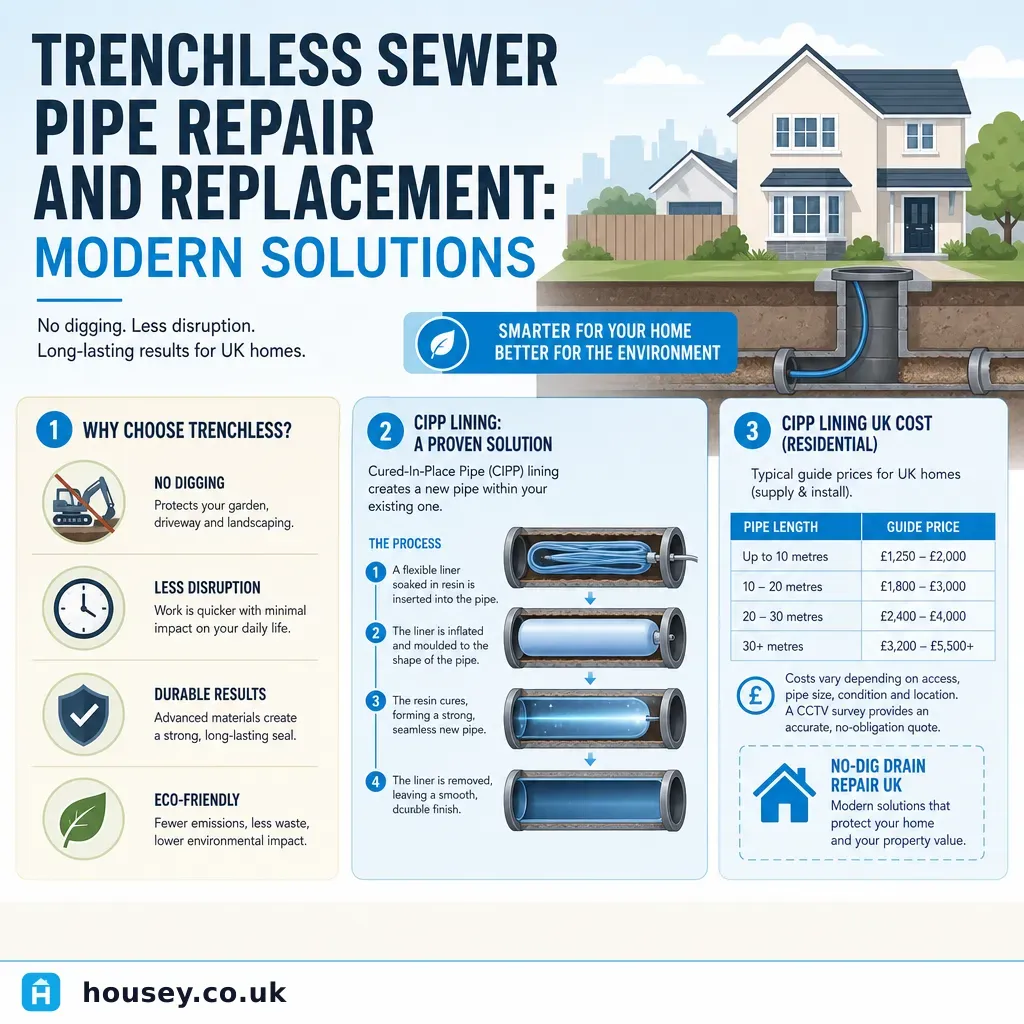
Trenchless Sewer Pipe Repair and Replacement: Modern Solutions
Trenchless sewer pipe repair uses methods such as CIPP (cured-in-place pipe) lining and pipe bursting to rehabilitate or replace underground drain pipes with minimal excavation.
 Improvement & Build
Storm Damage Repair and Weather Protection Costs
Storm damage repair costs in the UK range from around £200–£600 for emergency weatherproofing to £3,000–£15,000 or more for full roof reinstatement.
 Improvement & Build
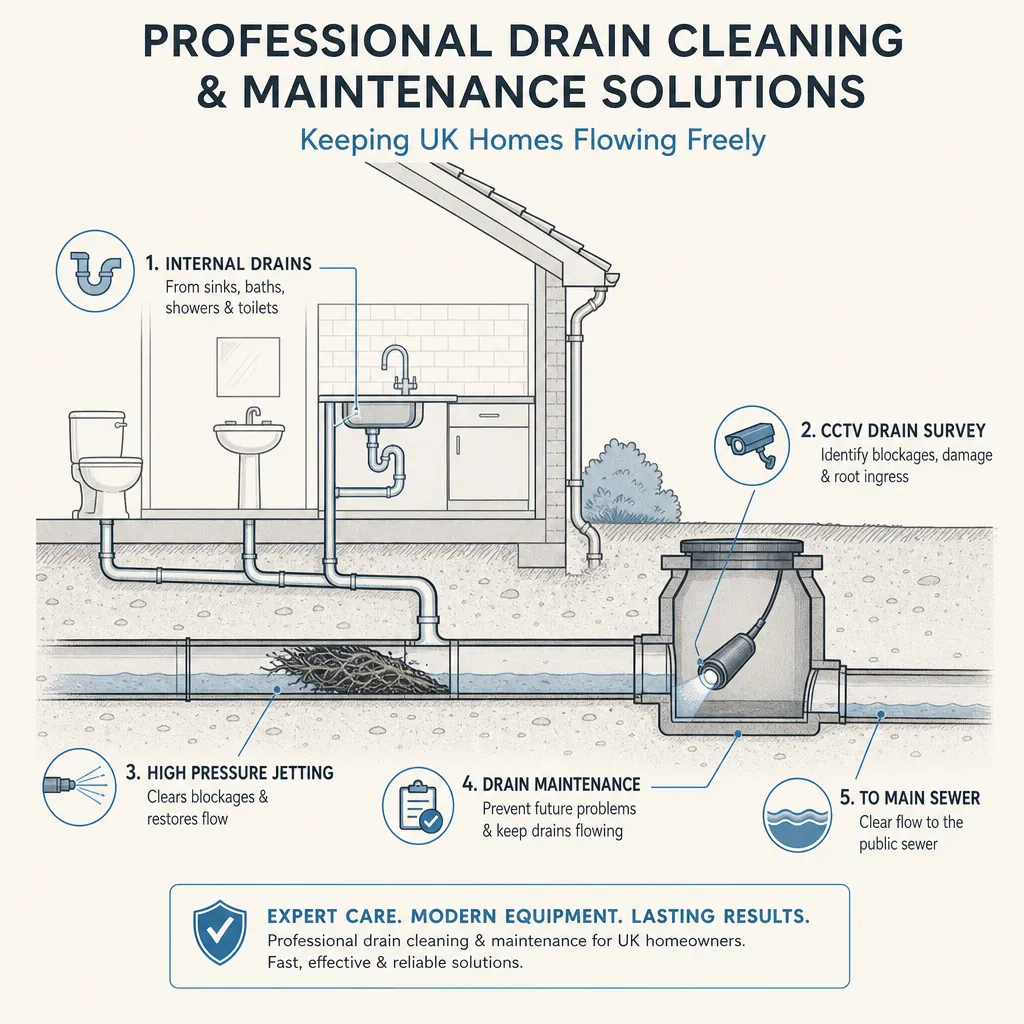
Professional Drain Cleaning and Maintenance Solutions
Professional drain cleaning uses methods including high-pressure water jetting, electromechanical rodding, CCTV surveys, and no-dig lining repairs.
 Improvement & Build
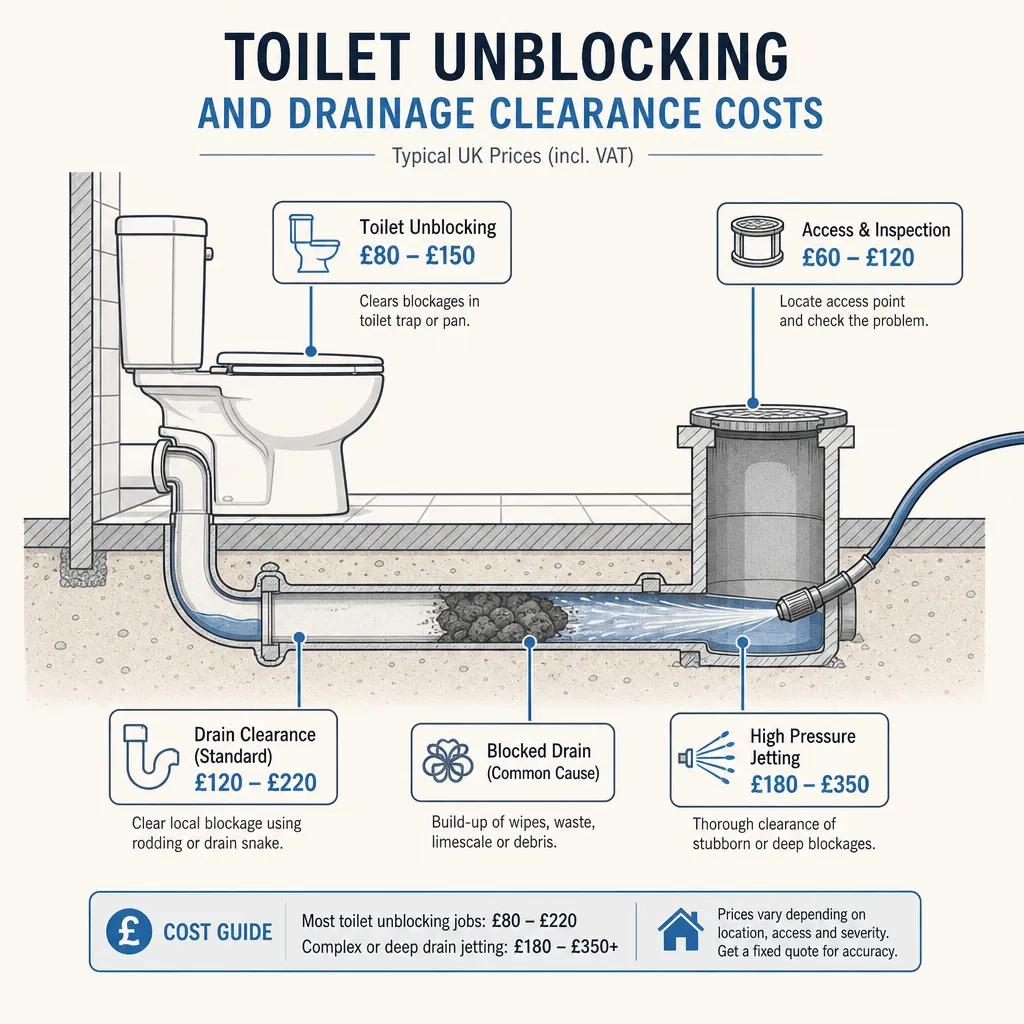
Toilet Unblocking and Drainage Clearance Costs
Having a blocked toilet or drain professionally cleared typically costs £80–£350 in the UK, depending on the method used.