Storm Damage Repair and Weather Protection Costs
By Housey · Last reviewed 11th of May 2026
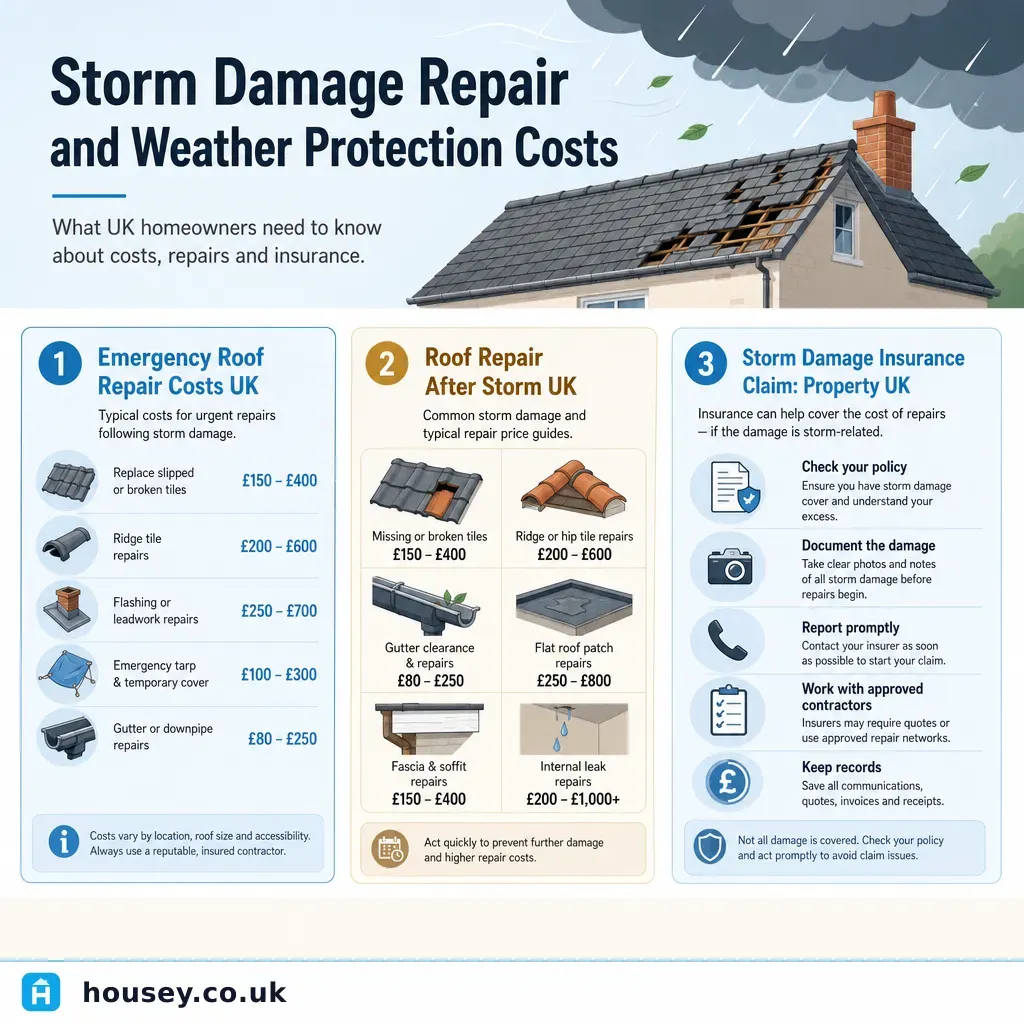
Storm Damage Repair and Weather Protection Costs
Named storms tracked by the Met Office's National Severe Weather Warning Service cause significant damage to UK residential properties every year, from blown roof tiles on 1930s semis to collapsed chimney stacks on Victorian terraces. When a storm event strikes, homeowners face simultaneous pressure to make the property safe, protect their insurance position, and commission repairs — often without a clear sense of what the work should cost or which professionals to instruct. Getting the sequence wrong can invalidate a claim, delay settlement, or leave the property exposed to further damage.
Key points
- Emergency roof repairs — temporary tarping, boarding, or tile replacement — typically cost £200–£600 as an immediate call-out; permanent re-roofing following extensive storm damage ranges from £3,000 to £15,000+ depending on roof size, pitch, and materials (indicative UK costs, last reviewed 2026-05-11).
- The Association of British Insurers (ABI) advises homeowners to document damage fully with photographs before commissioning any permanent repairs — failure to do so may complicate or reduce an insurance settlement.
- Building Regulations Part A (Structure) is relevant when structural elements — walls, roofs, chimneys — are reinstated following storm damage; reinstatement of more than 25% of a roof covering may also trigger current thermal performance requirements under Part L.
- The Met Office's National Severe Weather Warning Service issues Yellow, Amber, and Red alerts for named storms — a Red warning indicates conditions likely to cause widespread property damage, and preventive action before storm arrival is substantially cheaper than post-storm repair.
- Chimney stacks and gable end walls are disproportionately represented in storm insurance claims in the UK, particularly on properties built before 1919, where lime mortar joints may already have deteriorated.
What storm damage looks like — and how urgent each type is
Damage type | Typical signs | Urgency | Indicative repair cost | Who to instruct |
|---|---|---|---|---|
Missing or broken roof tiles | Visible gaps; ceiling stains; internal dripping | High — arrange temporary weatherproofing immediately | £200–£1,500 (partial); £3,000–£15,000 (full re-roof) | NFRC-registered roofer |
Chimney stack damage | Fallen mortar; leaning or collapsed stack; debris | High — structural and falling risk | £500–£5,000+ (repair); higher if collapse | Roofer + structural engineer if collapsed |
Guttering and downpipe failure | Overflowing water; fascia damage; damp patches | Medium | £200–£800 | Roofer or guttering contractor |
Fallen tree on structure | Visible roof penetration; structural impact | High — may need temporary propping | Variable; can exceed £10,000 | Structural engineer + roofer + arborist |
Window or door frame damage | Broken seals; blown-in frames; difficulty closing | Medium to High (security risk) | £300–£2,500 per opening | Glazier or fenestration contractor |
Garden walls and fences | Collapsed or leaning sections | Low to Medium | £200–£3,000 | Builder or groundwork contractor |
Flood ingress after storm | Internal water; saturated floors or walls | High | Variable — specialist drying required | Drying specialist; then decorator |
Indicative UK costs, last reviewed 2026-05-11. Costs vary by region, access, extent of damage, and materials used.
What to do immediately after storm damage
The sequence matters — particularly for protecting your insurance claim.
- Make the property safe first. If a leaning wall, collapsed chimney, or major roof penetration creates structural risk, do not re-enter the affected area. Contact your insurer immediately and, if there is immediate danger to life, call 999.
- Document everything before clean-up. Photograph and video all visible damage before any debris is cleared or temporary repairs are made. Include wide-angle context shots and close-up detail images.
- Arrange emergency temporary weatherproofing only. Tarping, boarding, and securing of loose elements is reasonable mitigation that insurers expect. Do not commission full permanent repairs before your insurer's loss adjuster has inspected or given written approval.
- Notify your insurer promptly. Most policies require notification within 24–48 hours of storm damage. Check your specific policy wording for the notification window.
- Keep all receipts for emergency works. Reasonable emergency mitigation costs are typically recoverable under most buildings policies as mitigation expenditure.
- Request a loss adjuster visit for significant claims. You are entitled to appoint an independent loss assessor — a member of the Chartered Institute of Loss Adjusters (CILA) — to represent your interests if you believe the insurer's assessment undervalues the damage.
Weatherproofing improvements to prevent future storm damage
Many homeowners use post-storm repair as an opportunity to improve the property's resilience to future events. Common improvements and indicative costs:
Improvement | Description | Indicative cost |
|---|---|---|
Roof tile re-bedding and ridge or verge repointing | Secures loose tiles and ridge cappings before they are lost in the next storm | £500–£2,000 |
Lead valley and flashing repair | Seals vulnerable junctions at chimneys, dormers, and abutments | £300–£1,500 |
Guttering upgrade | Improves capacity and reduces overtopping in high-rainfall events | £600–£3,000 |
Chimney pot securing or unused stack removal | Reduces wind loading and collapse risk, especially on pre-1919 properties | £400–£1,500 |
External wall crack repair and repointing | Seals moisture ingress points before the next winter season | £500–£3,000 |
Secondary glazing or upgraded window seals | Improves resilience in high-wind or exposed locations | £500–£2,500 per opening |
Indicative UK costs, last reviewed 2026-05-11. Obtain at least three quotes; costs vary significantly by property size, access, and location.
Storm damage preparation checklist
Carried out in advance of named storm warnings:
Red flags after storm damage
Seek structural professional advice immediately — do not wait for a general contractor's quote — if:
- You notice a visible lean, bow, or bulge in an external wall or chimney stack following the storm.
- Cracks have appeared or widened suddenly in structural walls or around window and door openings.
- Doors or windows that previously operated smoothly are now sticking or binding — this can indicate frame distortion or structural movement.
- The roofline appears to sag or deflect when viewed from ground level.
- Structural roof timbers are exposed following tile loss — open roof structures deteriorate rapidly with further rainfall.
- There is a smell of gas following structural damage — evacuate the property immediately and call the National Gas Emergency Service on 0800 111 999.
Important limitations
This article provides general information about storm damage repair and weather protection in the UK. The suitability of any repair method, the Building Regulations compliance implications of reinstatement works, and the terms of any specific insurance policy depend entirely on the individual property and its circumstances. Cost ranges are indicative only. This article does not constitute structural, legal, or insurance advice. A structural engineer, NFRC-registered roofer, or CILA-registered loss assessor should be consulted for any significant storm damage affecting structural elements.
When this becomes urgent
Act immediately if:
- Any part of the structure — a roof section, external wall, or chimney — is at risk of further or imminent collapse.
- Water is actively entering the property through a failed roof or wall and cannot be contained by temporary measures.
- Doors or windows are structurally compromised, leaving the property unsecured overnight.
- You can smell gas following structural damage to the building.
- A crack in a structural wall or chimney has widened since the storm or is accompanied by newly sticking internal doors.
What to ask a qualified professional
Before instructing a roofer, structural engineer, or loss assessor following storm damage:
- Can you provide a written emergency weatherproofing report that I can submit to my insurer before permanent repairs are carried out?
- Are you a member of the NFRC (National Federation of Roofing Contractors) or an equivalent recognised trade body?
- Will the reinstatement work comply with Building Regulations Parts A and L, and will you notify building control if required?
- What warranty do you provide on the completed repair work and the materials used?
- Is your quotation based on visible damage only, or have you allowed for additional defects that might be found once work begins?
- Are you familiar with my insurer's preferred documentation and repair specifications?
When to get professional help
Always instruct a qualified professional if:
- Any structural element — wall, roof structure, or chimney — has been affected. A structural engineer should assess the situation before any contractor begins reinstatement work.
- Roof access of any kind is required — roof work is inherently high-risk and must not be attempted as DIY. Use an NFRC-registered roofer with appropriate access equipment and insurance.
- You are making an insurance claim of significant value — consider appointing a CILA-registered loss assessor to represent your interests.
- Electrical fittings, the consumer unit, or wiring may have been affected by water ingress — do not use electrical circuits in affected areas until inspected by a NICEIC-registered electrician.
How Housey can help
After storm damage, speed and quality of response matter. Housey connects you with qualified local roofers who can carry out emergency weatherproofing and permanent reinstatement, provide the written documentation your insurer typically requires, and advise on weatherproofing improvements that reduce your property's vulnerability to future storm events.
Frequently asked questions
Does buildings insurance cover storm damage in the UK?
Most standard UK buildings insurance policies cover storm damage to the structure, including roofs, walls, and windows. However, policies differ on what constitutes a qualifying storm — some require evidence of minimum wind speeds or a Met Office warning. Gradual deterioration and pre-existing poor condition are typically excluded. Check your specific policy wording and notify your insurer promptly after any storm event.
Can I carry out storm damage repairs myself?
Minor ground-level tasks — clearing debris, temporarily securing a garden gate — are generally safe for homeowners. Any work involving the roof, at height above two metres, or on structural elements must be carried out by a qualified professional. Working at height is one of the leading causes of fatal accidents in the UK, and roofs are particularly hazardous after storm events due to hidden damage and wet surfaces.
How long does storm damage repair typically take?
Emergency weatherproofing can usually be arranged within 24–48 hours of a storm. Full reinstatement for significant roof or structural damage may take two to six weeks, depending on materials availability and contractor capacity. After a widespread named storm, demand for roofers surges across affected postcodes — booking a specialist promptly is important to avoid prolonged exposure.
Will making a storm damage claim affect my insurance premium?
Making a claim may affect your premium at renewal and will typically appear on your insurance history. If the repair cost is modest and close to your excess, it may be worth funding repairs privately. Speak to your insurer or an independent broker before deciding, and keep documentation of all damage and repairs whether or not you make a formal claim.
Sources and further reading
- GOV.UK: Building Regulations Approved Document A — Structure — GOV.UK
- Association of British Insurers: Storm damage and insurance guidance — Association of British Insurers
- Met Office: National Severe Weather Warning Service — Met Office
- National Federation of Roofing Contractors: Find a member — National Federation of Roofing Contractors
- HSE: Working at height — guidance for workers and employers — Health and Safety Executive
Useful next reads
 Improvement & Build
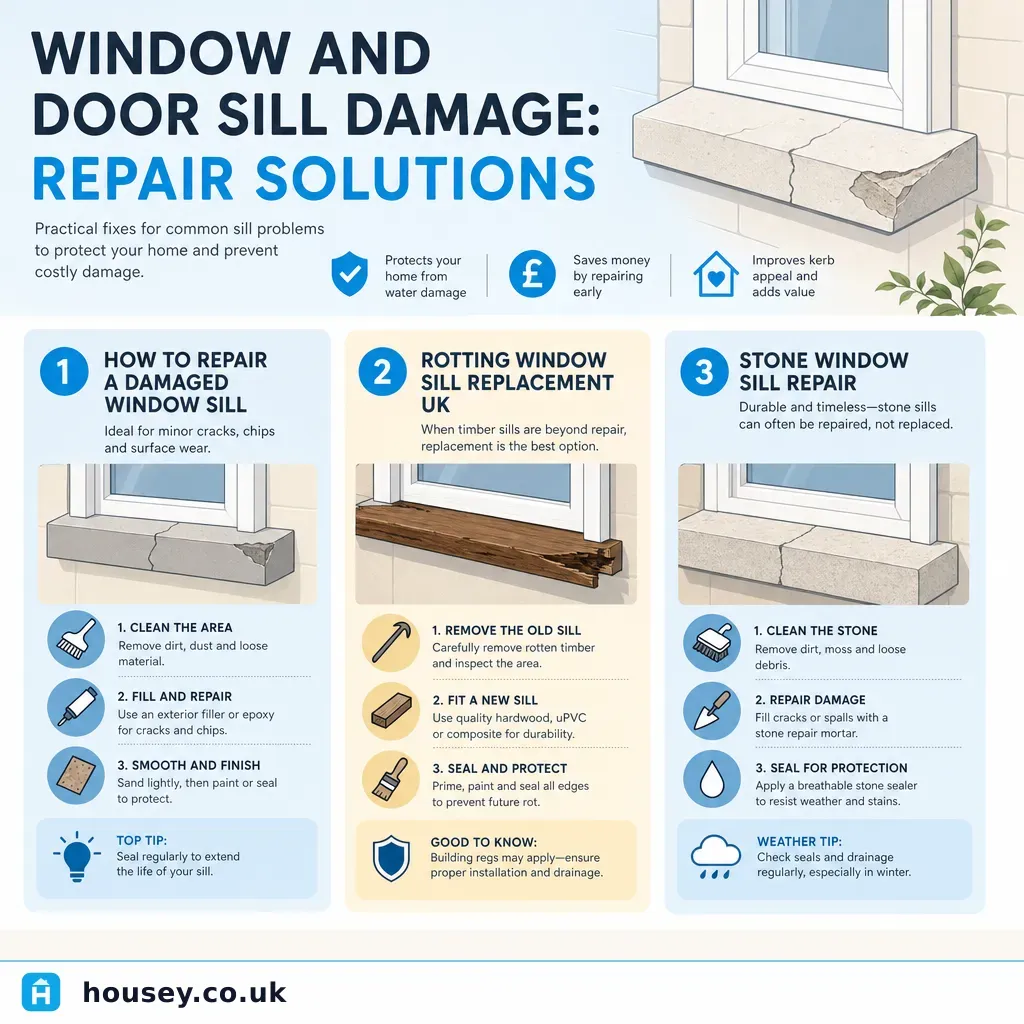
Window and Door Sill Damage: Repair Solutions
Window and door sill damage ranges from surface cracking and peeling paint to structural rot, spalling stone, or broken concrete.
 Improvement & Build
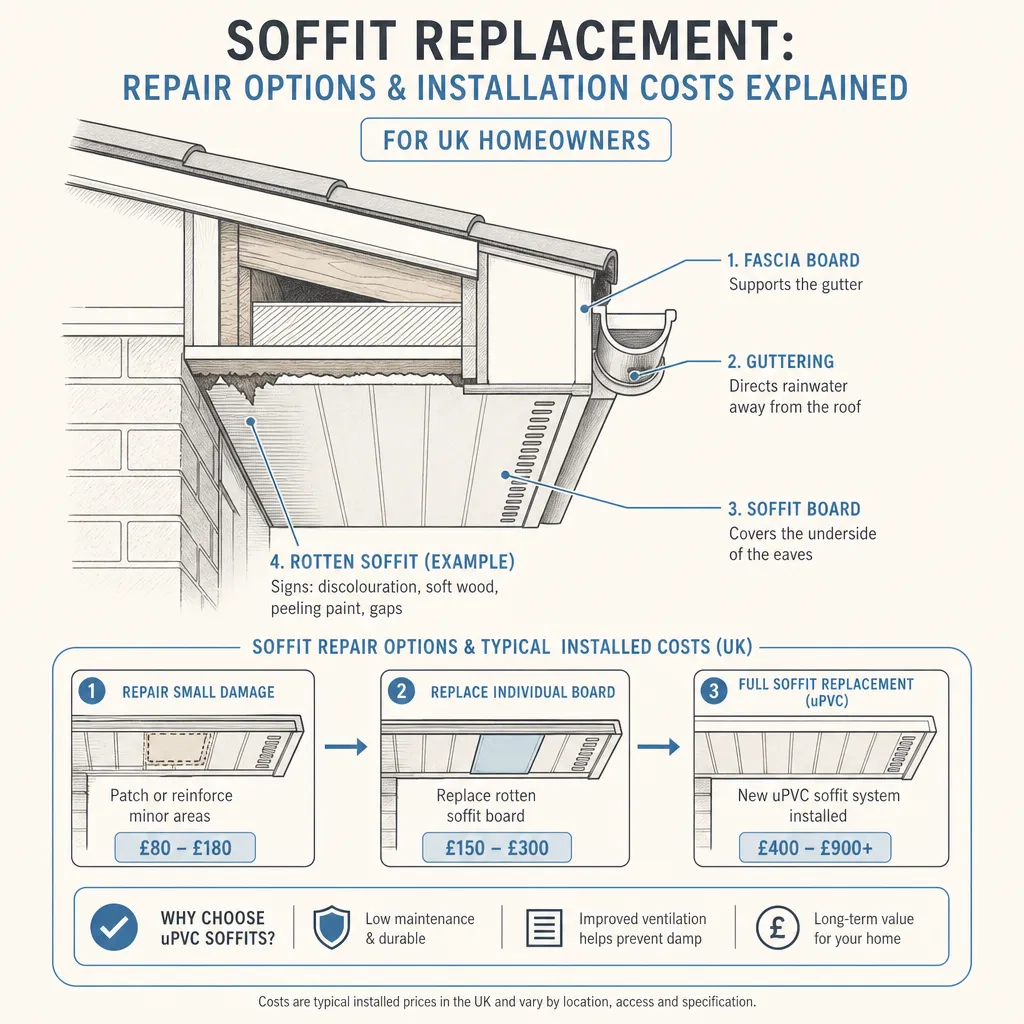
Soffit replacement: repair options and installation costs explained
Soffit replacement typically costs £500–£1,200 for a semi-detached home in the UK, depending on material choice and the extent of work.
 Improvement & Build
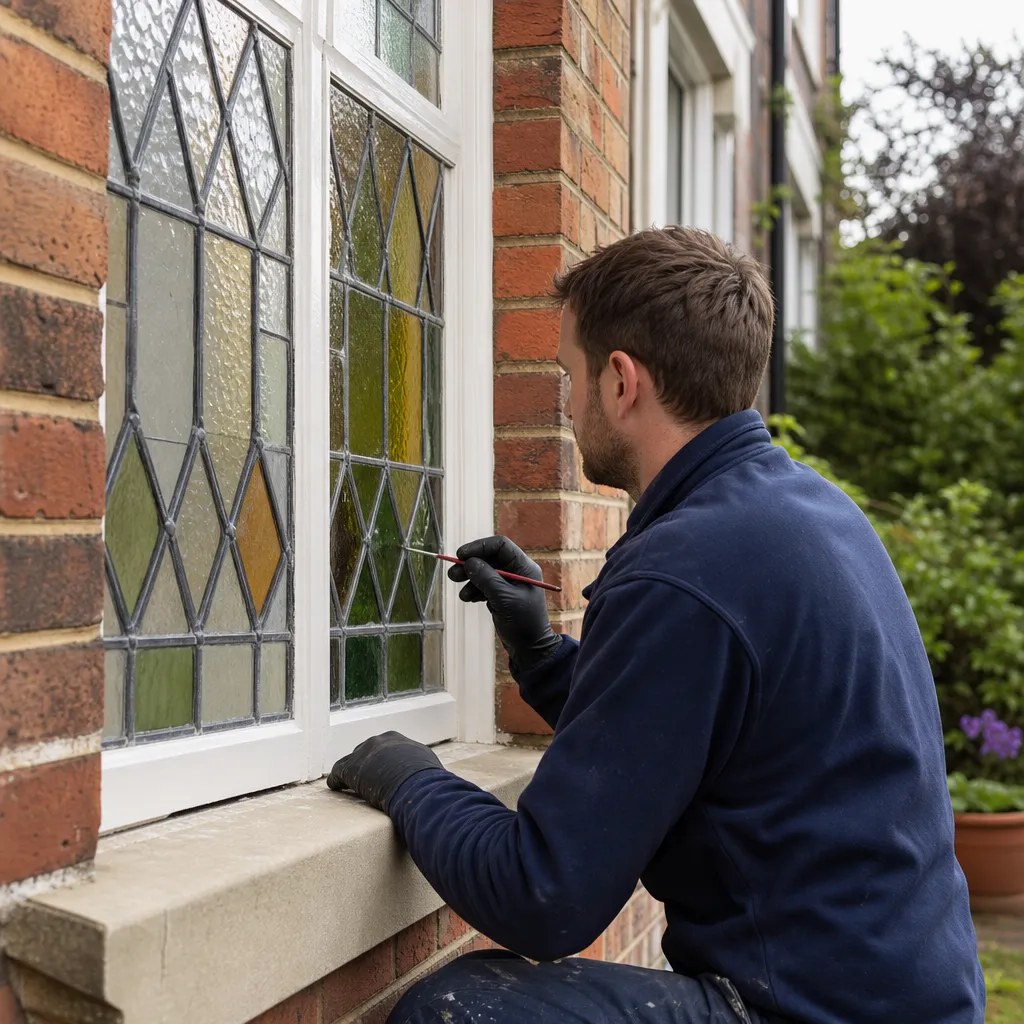
Sealing and Maintaining Historic Leaded Glass Windows: Preservation and Performance
Leaded glass windows are maintained using traditional linseed oil cement — not silicone or modern sealants, which prevent natural movement in the lead came.
 Improvement & Build
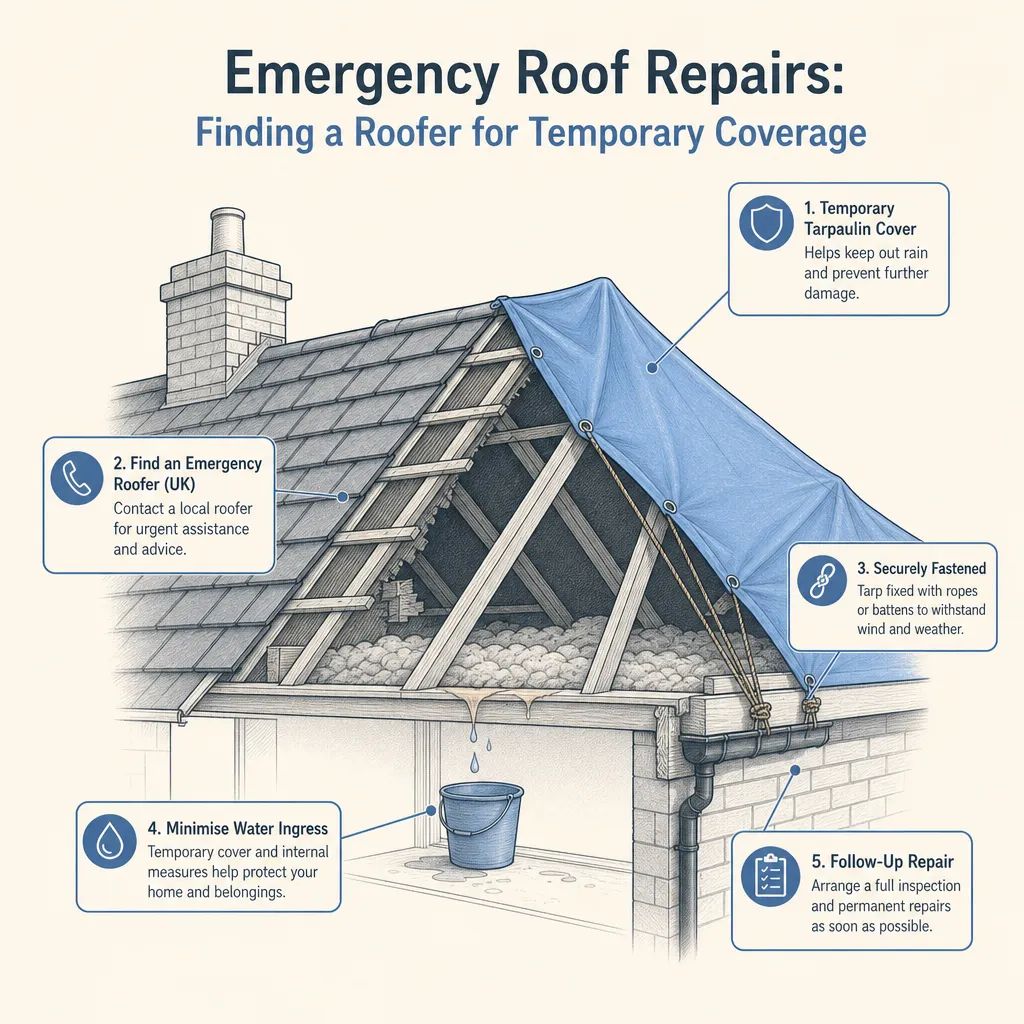
Emergency Roof Repairs: Finding a Roofer for Temporary Coverage
After storm or impact damage, the immediate priority is weatherproofing, not a permanent repair.
 Improvement & Build
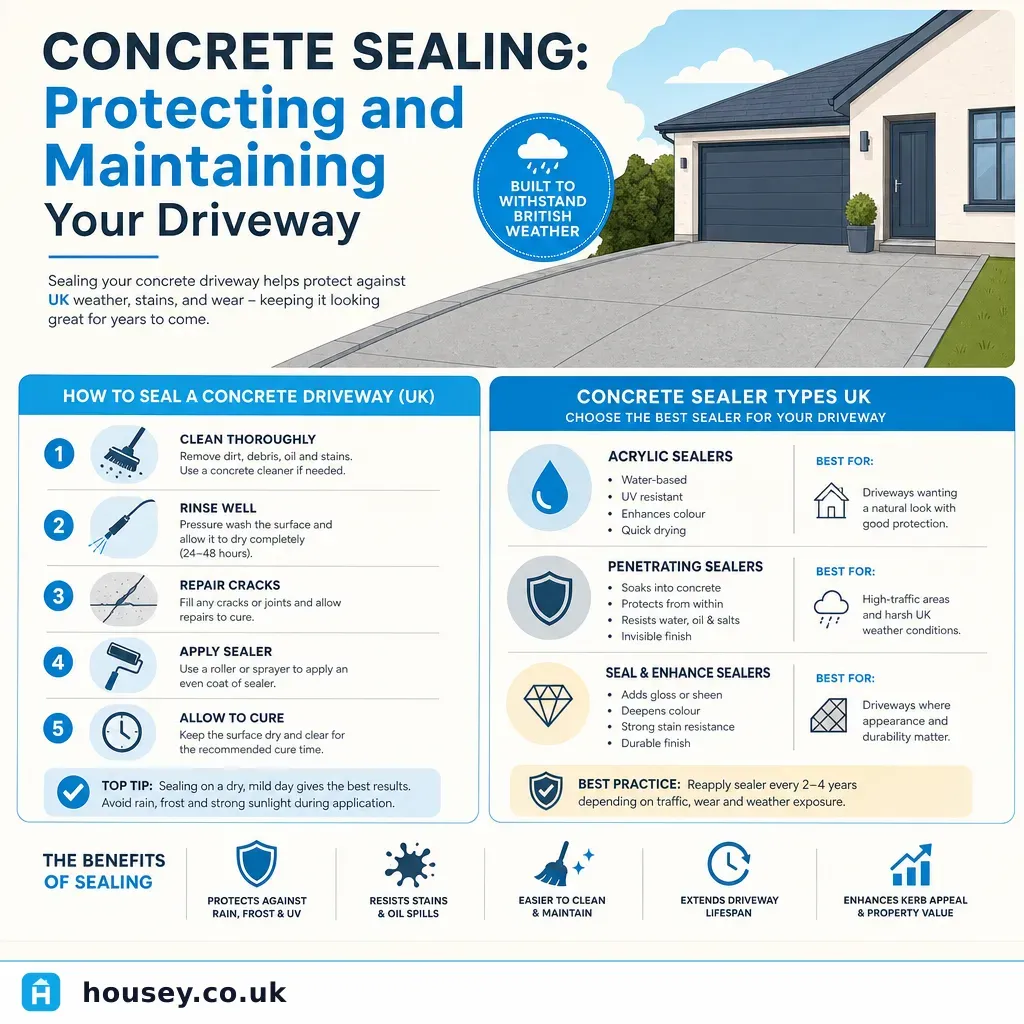
Concrete Sealing: Protecting and Maintaining Your Driveway
Sealing a concrete driveway protects against water ingress, freeze-thaw damage, oil stains, and surface wear.