Emergency Roof Repairs: Finding a Roofer for Temporary Coverage
By Housey · Last reviewed 31st of May 2026
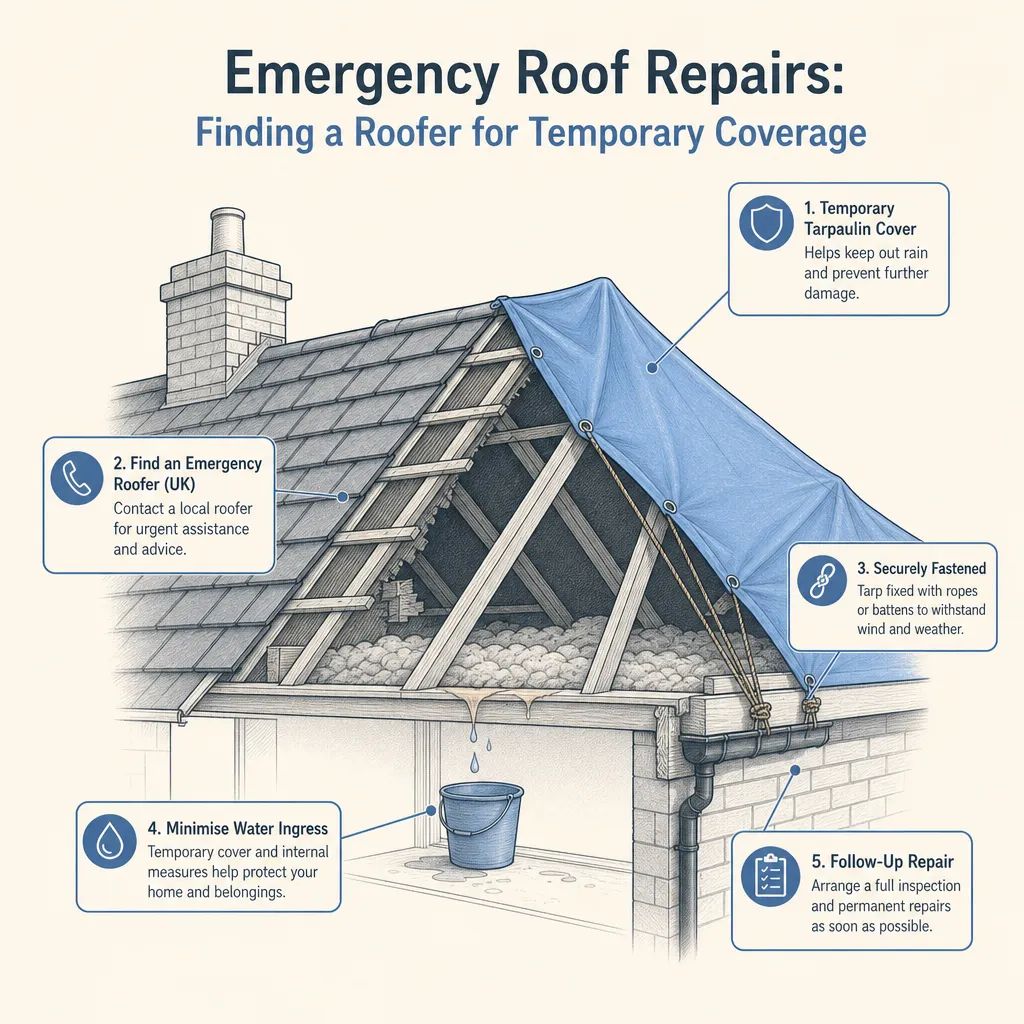
Emergency Roof Repairs: Finding a Roofer for Temporary Coverage
Storm damage, a fallen branch, or sudden failure of an ageing roof covering can leave a property exposed to water ingress within hours. For UK homeowners — particularly those with older properties where roofs may already be near the end of their service life — the challenge is finding a qualified roofer quickly, before the situation worsens and secondary damage to ceilings, timbers, and electrics adds significantly to the final repair bill.
Key points
- Temporary roof repairs — typically a heavy-duty tarpaulin secured over the damaged area — can usually be arranged within 24 to 48 hours by a local roofing contractor.
- Never attempt to access a damaged roof yourself; working at height on a compromised structure is extremely dangerous and must only be done by trained roofers with appropriate safety equipment.
- The National Federation of Roofing Contractors (NFRC) operates a member directory; members are vetted for competence, insurance, and professional standards, and many offer emergency callout services.
- Notify your buildings insurer before authorising any repair work — most policies require prior authorisation above a cost threshold, and unauthorised work may affect your claim.
- Post-storm cold-calling by unqualified roofers is common after major weather events; always verify credentials using NFRC or TrustMark before agreeing to any work.
How urgent is your roof situation?
Not every roof problem requires immediate emergency action. Use this to assess how quickly you need to respond:
- Act within hours: large area of missing roof covering, visible open hole in the roof structure, active water ingress through the ceiling, fallen chimney stack, or major impact from a tree or debris.
- Act within 24–48 hours: isolated missing tiles with no visible ingress yet, lead flashing lifted but not yet causing a leak, small crack in a flat roof membrane discovered after heavy rain.
- Schedule a repair (not an emergency): individual cracked tiles with no missing section, minor mortar loss around a chimney stack, hairline cracks in lead flashing without any active ingress.
If you are uncertain, treat any situation involving exposed roof structure or active water ingress as requiring urgent professional attention.
What to do immediately after roof damage: homeowner checklist
Follow these steps in order while waiting for a roofer to attend:
How to find an emergency roofer quickly
When you need a roofer urgently, use these routes:
- NFRC member search — the National Federation of Roofing Contractors lists members by region, and many offer emergency callout services. NFRC membership requires evidence of insurance and assessed competence.
- TrustMark-registered roofers — the Government-endorsed quality scheme; search the online register by postcode for verified local contractors.
- Your buildings insurer — many insurers operate a 24-hour emergency claims line and an approved contractor panel; using their panel contractor may simplify authorisation and claims settlement.
- Housey — submit your location and details to receive quotes from vetted local roofers who offer emergency callout services.
Red flags when hiring an emergency roofer
Be cautious of any contractor who:
- Approaches you door-to-door unsolicited following storm damage — storm-chasing cold-callers are a well-documented problem after major weather events
- Demands full cash payment upfront before any work begins
- Cannot provide evidence of public liability insurance (a minimum of £2 million is standard practice for roofing contractors)
- Refuses to put a scope of work and cost in writing before starting
- Quotes only for a full re-roof when a temporary repair is clearly what is needed immediately
- Cannot supply a verifiable business address or any contact details beyond a mobile number
- Pressures you to sign an insurance assignment form handing over management of your insurance claim to them
If you have any doubt about a contractor's credentials, use the NFRC or TrustMark directories to verify before authorising any work.
What does a temporary roof repair involve?
The most common temporary repair is the installation of a heavy-duty reinforced polyethylene tarpaulin over the damaged area. A competent roofer will:
- Assess the accessible damage safely from a ladder or scaffold — never by walking on an unstable or compromised roof structure
- Clear loose debris including tiles, mortar, and branches that could cause further damage or injury
- Lay a heavy-duty tarpaulin extending at least one metre beyond the damaged area on all sides
- Secure it mechanically using battens, straps, or ballast to prevent wind uplift
- Provide a written record of findings and work carried out, suitable for your insurer
A temporary repair reduces further water ingress and buys time for a permanent repair to be properly scoped and quoted. It does not guarantee weatherproofing in extreme wind conditions — check it is still secure after high winds.
What to ask before accepting an emergency quote
Before a contractor starts work, ask:
- What is the scope of the temporary repair, and what does the quote include and exclude?
- Can you confirm the quote in writing before starting — even a brief email or text summary?
- What is your public liability insurance limit, and can you provide the certificate?
- Are you NFRC-registered or TrustMark-registered, and can you evidence this?
- When can you return to carry out the permanent repair, and will you provide a separate detailed quote for that?
- Will you produce a written report for my insurer detailing the cause and extent of the damage?
- Is VAT included in the emergency callout quote?
When to get professional help
Always use a qualified roofing contractor for any roof access — never attempt this yourself. Additionally:
- If the damage involves a party wall, shared roof (as in a terrace or block of flats), or a neighbouring property, other parties or professionals may need to be consulted before any repair begins.
- If the property is listed or in a conservation area, contact your local planning authority before any repair that might alter original materials — even a temporary fix.
- If the roof structure — rafters, purlins, or ceiling joists — appears compromised, ask a structural engineer to assess before the permanent repair is scoped and priced.
- If a significant volume of rainwater has entered the building, a survey of electrical installations and structural timbers may be advisable before permanent reinstatement works proceed.
How Housey can help
Housey connects you with vetted roofers across the UK, including contractors who offer emergency callout services. Submit your details and location to receive quotes from local, insured roofing professionals — so you can focus on protecting your home rather than searching under pressure.
Frequently asked questions
Should I use my insurer's contractor or find my own roofer?
Using your insurer's approved contractor can simplify the claims process and removes the need to separately agree costs. However, you are generally entitled to choose your own contractor, provided the work is carried out to an equivalent standard and cost. If using an independent contractor, confirm the scope with your insurer before work begins and keep all documentation and photographs.
How much does emergency roof repair cost in the UK?
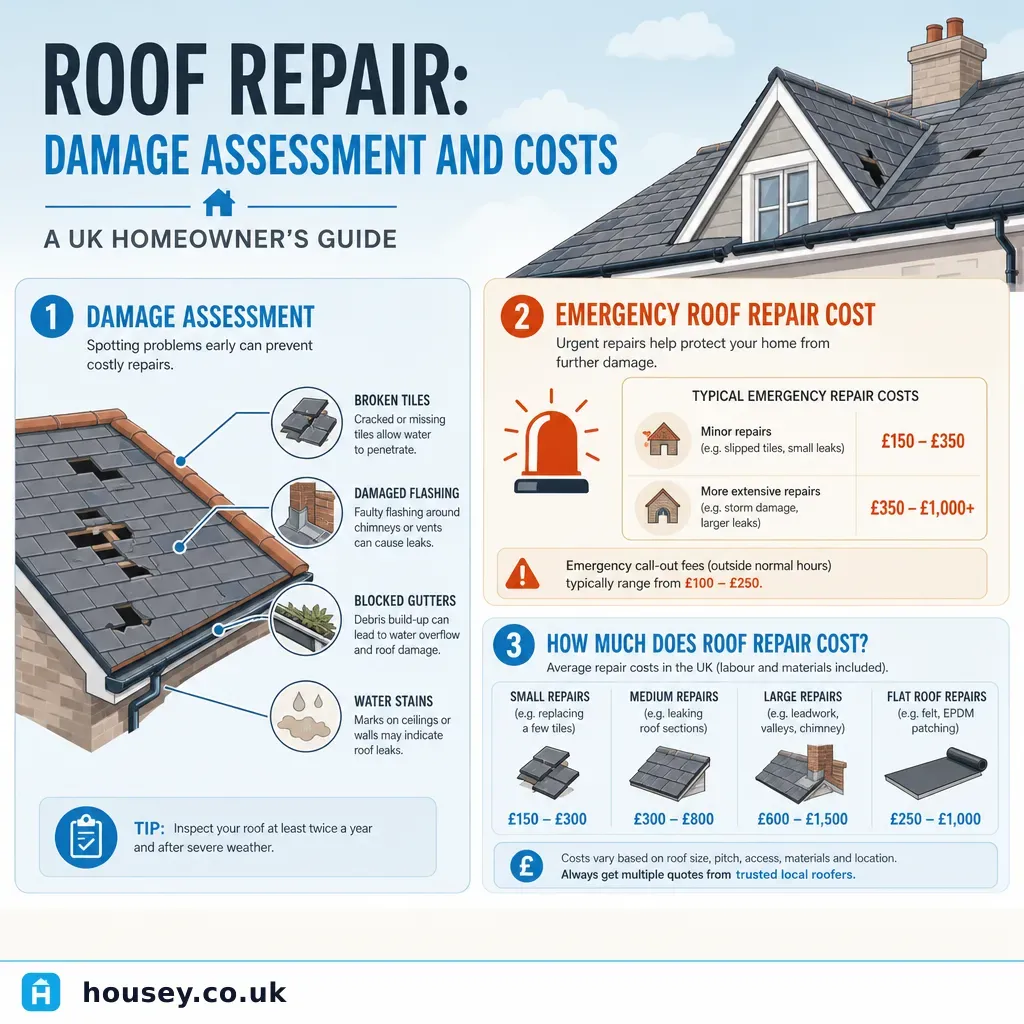
Emergency callout and temporary tarpaulin installation typically costs £200–£600 depending on roof pitch, access requirements, extent of damage, and location. If scaffolding is needed, costs rise considerably. Permanent repair costs depend on damage type and roof covering. Indicative UK costs, last reviewed 2026-05-31. Always obtain a written quote before authorising work.
Will my home insurance cover emergency roof repairs?
Most buildings insurance policies cover storm damage to roofs, including emergency temporary repairs to prevent further damage. However, gradual deterioration, wear and tear, and maintenance failures are generally excluded. Check your policy wording carefully, photograph all damage, and notify your insurer promptly. Keep receipts for all emergency expenditure as evidence for your claim.
Can I put a tarpaulin on my own roof?
Working at height on a damaged roof is extremely dangerous and should not be attempted without professional training and appropriate safety equipment. Even a single-storey roof presents a serious fall risk. Never attempt DIY roof access — contact a qualified roofing contractor immediately and wait for a professional.
Sources and further reading
- National Federation of Roofing Contractors: member search — National Federation of Roofing Contractors
- TrustMark: find a registered contractor — TrustMark
- Association of British Insurers: property insurance and claims — Association of British Insurers
- HSE: work at height — what you must do — Health and Safety Executive
Useful next reads
 Improvement & Build
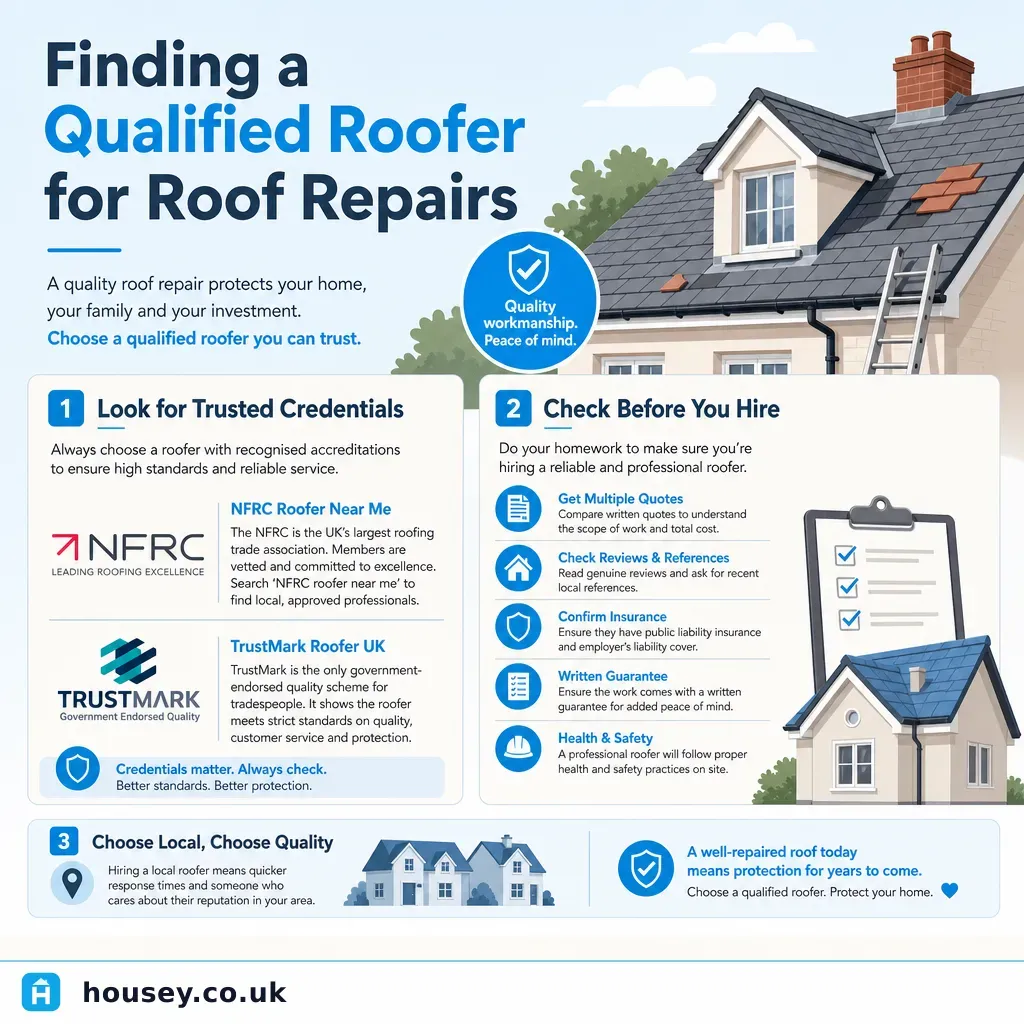
Finding a Qualified Roofer for Roof Repairs
Finding a qualified roofer means checking for NFRC membership, TrustMark registration, or CompetentRoofer accreditation and requesting at least three written, itemised quotes.
 Improvement & Build
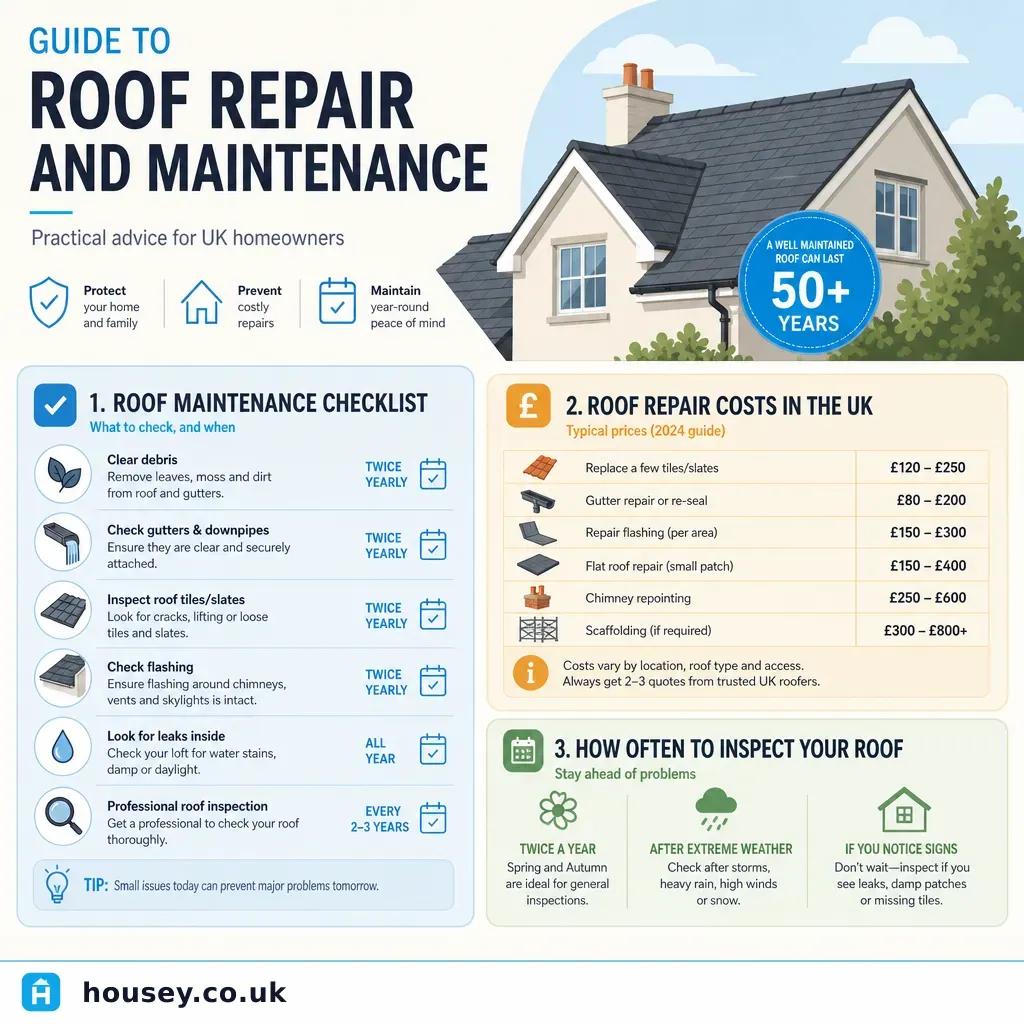
Guide to Roof Repair and Maintenance
Regular roof inspections every 3–5 years, prompt repair of damaged tiles and failed flashings, and annual gutter clearance are the core of effective UK roof maintenance.
 Improvement & Build
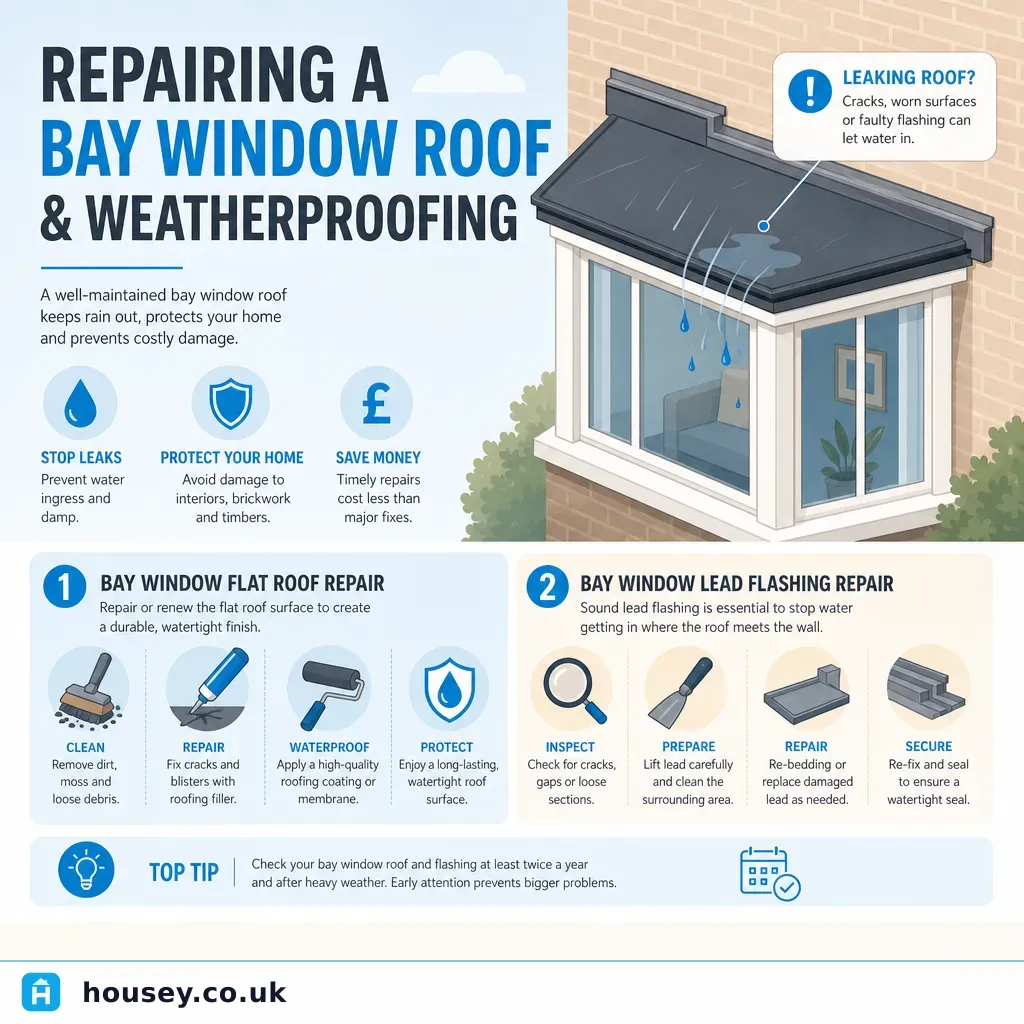
Repairing a Bay Window Roof and Weatherproofing
A bay window roof typically uses felt, lead, or EPDM rubber as its waterproof covering.
 Improvement & Build
Why incorrect roof repairs lead to masonry water damage
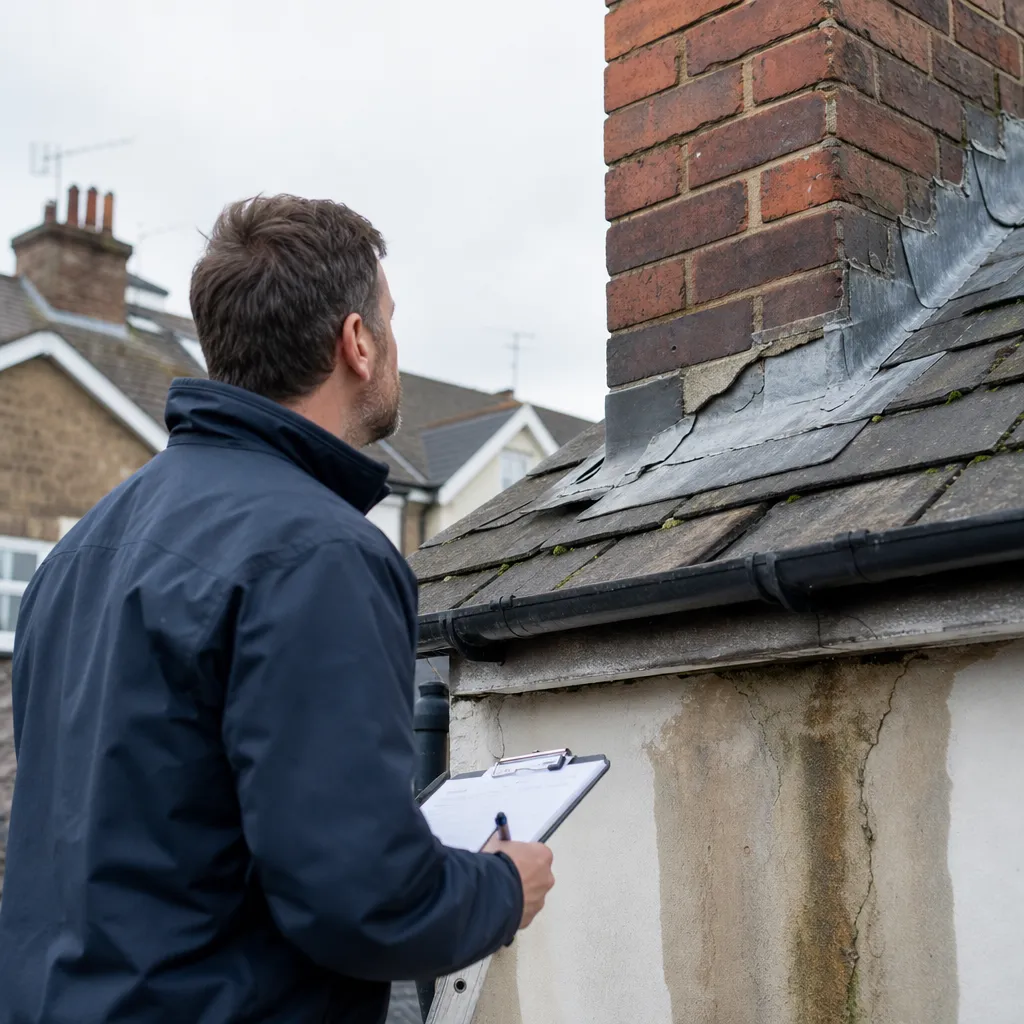
Poorly executed roof repairs — including failed flashing, incorrect mortar on chimney stacks, and unrestored weathering details — allow water to track behind masonry, causing damp patches, spalling, and timber decay, often months after the original work.
 Improvement & Build
Roof Repair: Damage Assessment and Costs
Most roof repairs — replacing slipped tiles, re-bedding ridge tiles, or patching flashing — are straightforward maintenance jobs that do not require planning permission.