Trenchless Sewer Pipe Repair and Replacement: Modern Solutions
By Housey · Last reviewed 25th of May 2026
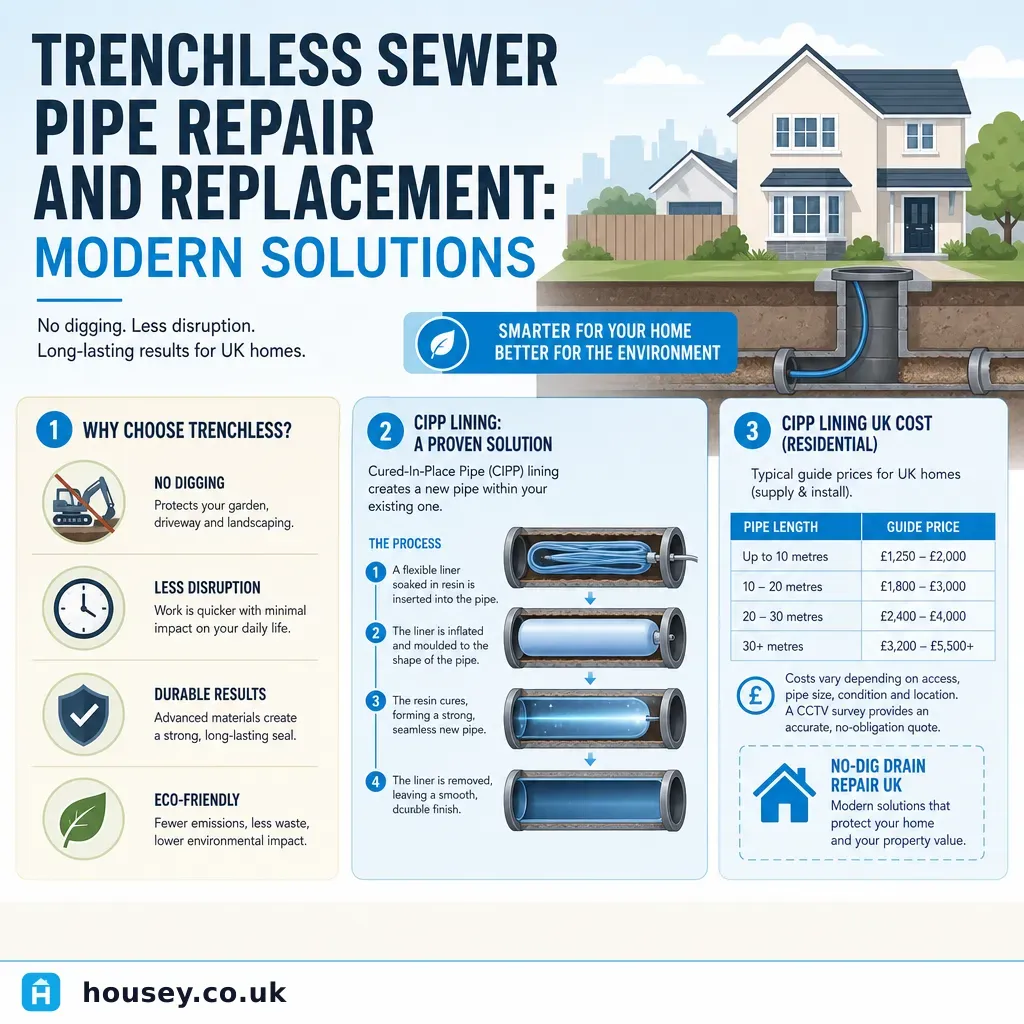
Trenchless Sewer Pipe Repair and Replacement: Modern Solutions
When a buried drain or sewer pipe cracks, becomes root-invaded, or partially collapses, the traditional response was to excavate a trench — often through a paved driveway, landscaped garden, or ground-floor slab — to reach and replace the failed section. Trenchless technology has changed what is possible: in many cases the same outcome can be achieved from existing manholes, with minimal surface disruption and a shorter programme on site. UK homeowners are increasingly encountering these methods when obtaining quotes for drainage surveys and repairs, but comparing CIPP lining, pipe bursting, and spray lining without clear guidance on when each method applies can make specification difficult.
Key points
- CIPP (cured-in-place pipe) lining — the most widely used no-dig method in the UK — installs a resin-impregnated felt or fibreglass liner inside the existing host pipe; once cured, the liner forms a structurally independent new pipe with a rated service life of 50 years or more.
- Trenchless methods are generally unsuitable for pipes with more than approximately 50% cross-sectional deformation, severely misaligned joints, or where a significant change in pipe diameter is required.
- A CCTV drain survey is an essential prerequisite for any trenchless repair: it identifies the defect type, pipe material, diameter, gradient, and access points — all of which determine which method (if any) is technically feasible.
- Under the Water Industry Act 1991, private drains serving a single property are the homeowner's responsibility up to the point they join a public sewer; the sewerage undertaker is responsible for adopted public sewers.
- Drainage work serving a new or extended building is notifiable under Approved Document H of the Building Regulations regardless of whether trenchless or open-cut methods are used.
What is trenchless pipe repair?
Trenchless, or no-dig, technology rehabilitates or replaces underground pipework from inside the pipe using one or more access points — typically existing manholes, rodding eyes, or small excavated pits at each end of the affected run. The three methods most commonly used in UK residential and light-commercial drainage are:
CIPP lining (cured-in-place pipe)
A resin-saturated felt or fibreglass tube is pulled or inverted into the host pipe, then inflated with a bladder and cured — using hot water, steam, or UV light — to form a hard, smooth new pipe inside the old one. The finished liner is typically 4–8 mm thick, slightly reducing the internal bore but often improving flow characteristics due to its smoother Hazen-Williams coefficient. CIPP can accommodate bends up to approximately 45 degrees and is suitable for pipes from 100 mm to over 300 mm in diameter.
Best suited to: circumferential or longitudinal cracks, root intrusion, joint gaps, minor corrosion, or leaking joints in clay, PVC-u, cast iron, or pitch fibre pipes.
Pipe bursting
A cone-shaped bursting head is drawn through the existing pipe, fragmenting it outward into the surrounding soil while simultaneously pulling a new pipe — typically high-density polyethylene (HDPE) — through the void created. This method replaces rather than rehabilitates the host pipe and can slightly increase the pipe diameter in the process.
Best suited to: pipes with structural failure that cannot accept a liner, where full replacement is required but open excavation is not practical — for example, under an established driveway or garden feature.
Spray lining and patch lining
A structural epoxy or polyurethane resin is spray-applied to the pipe interior, or a short patch is inserted and inflated at a specific defect location. This is typically used for isolated joint repairs, localised cracking, or small-section pinholes rather than full-length rehabilitation.
Best suited to: isolated defects in an otherwise sound pipe, individual leaking joints, or pinhole failures where lining the entire run would be disproportionate.
Trenchless methods compared: choosing the right approach
Method | Best for | Not ideal for | Typical disruption | Indicative UK cost* | Expected lifespan |
|---|---|---|---|---|---|
CIPP full-length lining | Cracks, root intrusion, leaking joints along a run | Severely deformed or collapsed pipes | Access pit only; surface largely undisturbed | £100–£200 per metre | 50+ years |
Pipe bursting | Structural failure requiring full replacement | Pipes adjacent to services that could be displaced | Small entry and exit pits required | £150–£300 per metre | 50+ years (HDPE) |
Spray or patch lining | Isolated joint defects or small cracks | Pipes needing rehabilitation along their full length | Access via manhole; minimal disruption | £300–£800 per isolated repair | 25–50 years |
Traditional open-cut | Total collapse, diameter change, surface-laid pipe | Under buildings, established drives, or mature landscaping | Full trench; significant surface disruption | £200–£500 per metre plus reinstatement | Depends on pipe material |
Indicative UK costs, last reviewed 2026-05-25. Prices vary significantly by access difficulty, pipe depth, diameter, and location. Obtain at least three quotes from qualified drainage contractors.
Which trenchless method is right for your situation?
- Choose CIPP full-length lining if the pipe is cracked, root-invaded, or has multiple leaking joints across a run of 3 metres or more, and retains at least 50% of its original cross-sectional area.
- Choose pipe bursting if the pipe is structurally failed or requires full replacement but excavation is impractical — for example, beneath a tarmac drive, patio, or building slab.
- Choose patch or spray lining if a CCTV survey has identified one or two discrete defects (such as a single cracked joint) and the remainder of the pipe is in sound condition.
- Choose open-cut excavation if the pipe has collapsed completely, a change in pipe diameter is required, or the depth and access configuration make trenchless methods unworkable.
- Commission a CCTV drain survey first if you do not yet know the nature or extent of the defects — it is the only reliable basis for specifying the correct repair method and avoiding abortive work.
What a CCTV drain survey needs to establish
Before any trenchless repair contractor can quote accurately, a CCTV survey report should confirm:
- Pipe material — clay, PVC-u, pitch fibre, cast iron, or concrete. Some materials require surface preparation before CIPP resin will bond reliably.
- Pipe diameter and gradient — CIPP works within specific diameter ranges; Approved Document H requires a minimum 1:40 fall for 100 mm gravity drainage pipes.
- Defect type and severity — root intrusion, crack orientation (circumferential, longitudinal, spiral), joint displacement percentage, or ovality.
- Access points — existing manholes, rodding eyes, or the need for a small excavated access pit at one or both ends.
- Lateral connection locations — branch connections must be physically re-opened after lining; their positions and depths need to be logged before works begin.
A CCTV survey for a typical residential drain run costs approximately £150–£350 depending on the length and access configuration. Many drainage contractors include the survey within a combined survey-and-repair package.
Understanding your legal responsibilities
Knowing who owns which section of a drain matters before commissioning any repair.
- Private drain: the pipe run from your property serving only your home, up to the point it joins the public sewer or a shared private sewer — your responsibility to maintain and repair.
- Private sewer: a drain serving more than one property that has not been adopted by the sewerage undertaker — shared responsibility, potentially governed by historic easement agreements.
- Public sewer: a sewer adopted and maintained by the sewerage undertaker (Thames Water, Severn Trent, Anglian Water, etc.) — their responsibility to repair. Report the defect to the undertaker; you are not normally required to fund works on adopted sewers.
The 2011 transfer of private sewers under the Water Industry Act 1991 (as amended) moved many shared private drains into the adopted public sewer network. If you are unsure whether a pipe is private or public, your drainage contractor can check with the relevant water company or access the publicly available sewer records.
Red flags that need urgent attention
Certain symptoms indicate a drainage problem serious enough to require professional investigation without delay:
- Sewage smell inside or outside the property: indicates a failure in the foul drainage system — do not attempt to locate or investigate the defect yourself.
- Drains backing up repeatedly after rodding or jetting: rodding clears blockages; if flow does not restore, a structural defect is likely.
- Unexplained damp patches on ground floors or in a basement with no obvious above-ground cause: a fractured drain may be leaching water into the substructure.
- Localised ground subsidence or sinkhole formation in a garden or driveway: a collapsed drain can cause significant voids in the surrounding soil.
- Problems involving a public sewer: contact your sewerage undertaker before commissioning private repair work — in some cases the repair is their responsibility.
When to get professional help
Trenchless drain repair is specialist work that requires trained operatives, CCTV equipment, and correct specification of lining resins and pipe materials. Always use a qualified drainage contractor with demonstrable experience in no-dig methods. If the defect involves a gas pipe, structural element, or public sewer, additional specialists will be required before any drainage work can proceed.
How Housey can help
Housey connects UK homeowners with experienced drainage contractors who carry out CCTV surveys, trenchless lining, and pipe repair. Where open excavation is unavoidable — for example, a collapsed drain under a path that cannot be burst — our groundworkers can provide comparable quotes for the excavation and reinstatement work.
Frequently asked questions
Does CIPP pipe lining reduce the internal diameter of my drain?
Yes, but usually only by 4–8 mm depending on liner thickness. For a 100 mm drain, the finished bore may be 92–96 mm. In most cases this is sufficient for domestic flows, and the smoother CIPP surface can partially offset the diameter reduction by improving flow velocity. Your drainage contractor should confirm that flows remain adequate before proceeding with lining.
Will buildings insurance cover trenchless drain repair?
Buildings insurance policies vary considerably. Drain failure caused by tree root intrusion is often excluded, while sudden accidental damage may be covered. Some home emergency cover policies include drainage works. Check your policy schedule carefully and speak to your insurer before commissioning repairs — some insurers require you to use their approved contractor network, and commissioning independent work first can complicate a claim.
How long does a CIPP lining job take on a residential drain?
A full-length CIPP lining job on a typical domestic run of 10–15 metres can usually be completed in a single working day, including curing time. Hot-water curing takes 2–4 hours; UV curing is faster. The drain will be out of service for most of the working day. Lateral connections must be re-opened after the liner has cured, which adds a short additional step.
Can trenchless repair be used under a house slab or basement floor?
Yes — this is one of the primary advantages of no-dig methods. Access is gained through an existing manhole or rodding eye, and the liner is fed through without breaking through the floor. Pipe bursting under a slab requires careful assessment to avoid disturbing adjacent services. A CCTV survey should always confirm access feasibility before specifying a trenchless method under a building.
Sources and further reading
- Approved Document H: Drainage and Waste Disposal — GOV.UK
- Water Industry Act 1991 — legislation.gov.uk
- Water UK: private drains and sewers guidance — Water UK
- WRc Sewerage Rehabilitation Manual — WRc Group
Useful next reads
 Improvement & Build
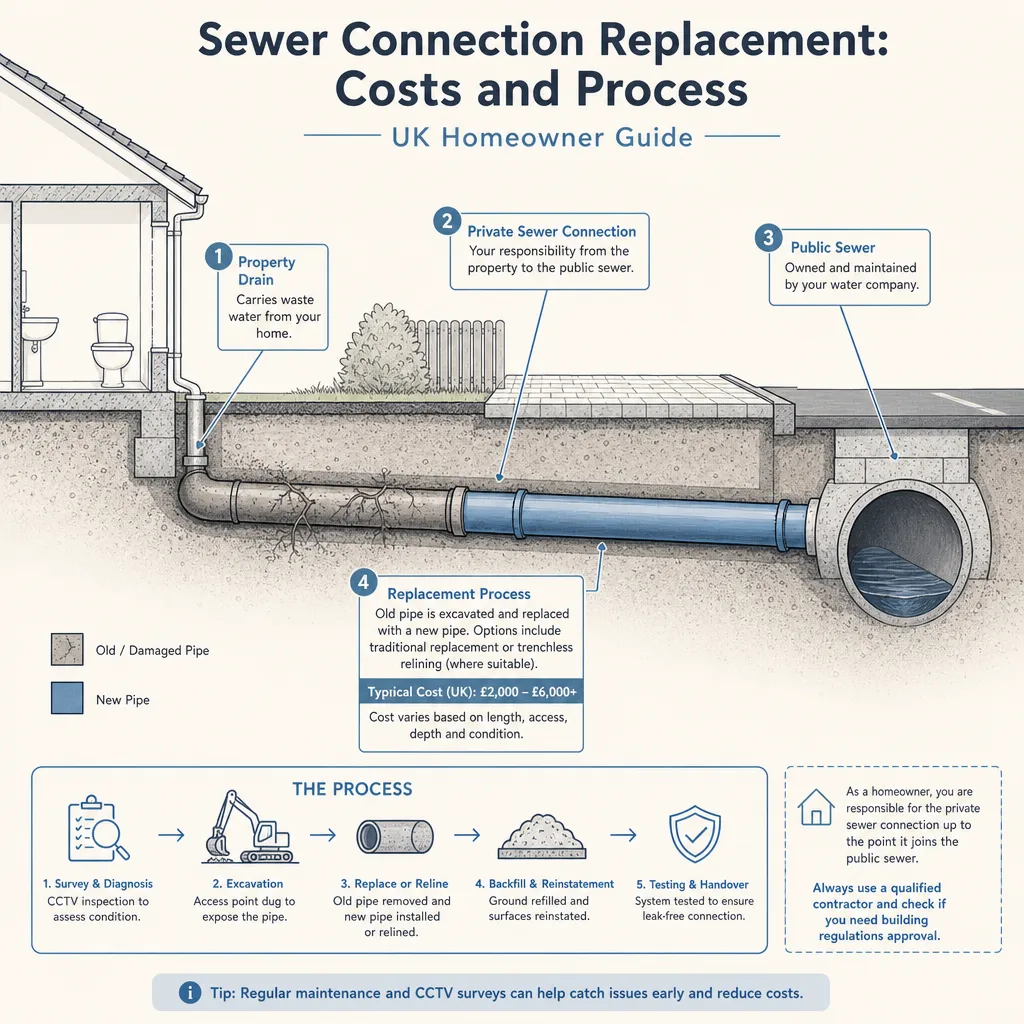
Sewer Connection Replacement: Costs and Process
Replacing a sewer connection typically costs £3,000–£20,000 in the UK depending on pipe length, depth, and access.
 Improvement & Build
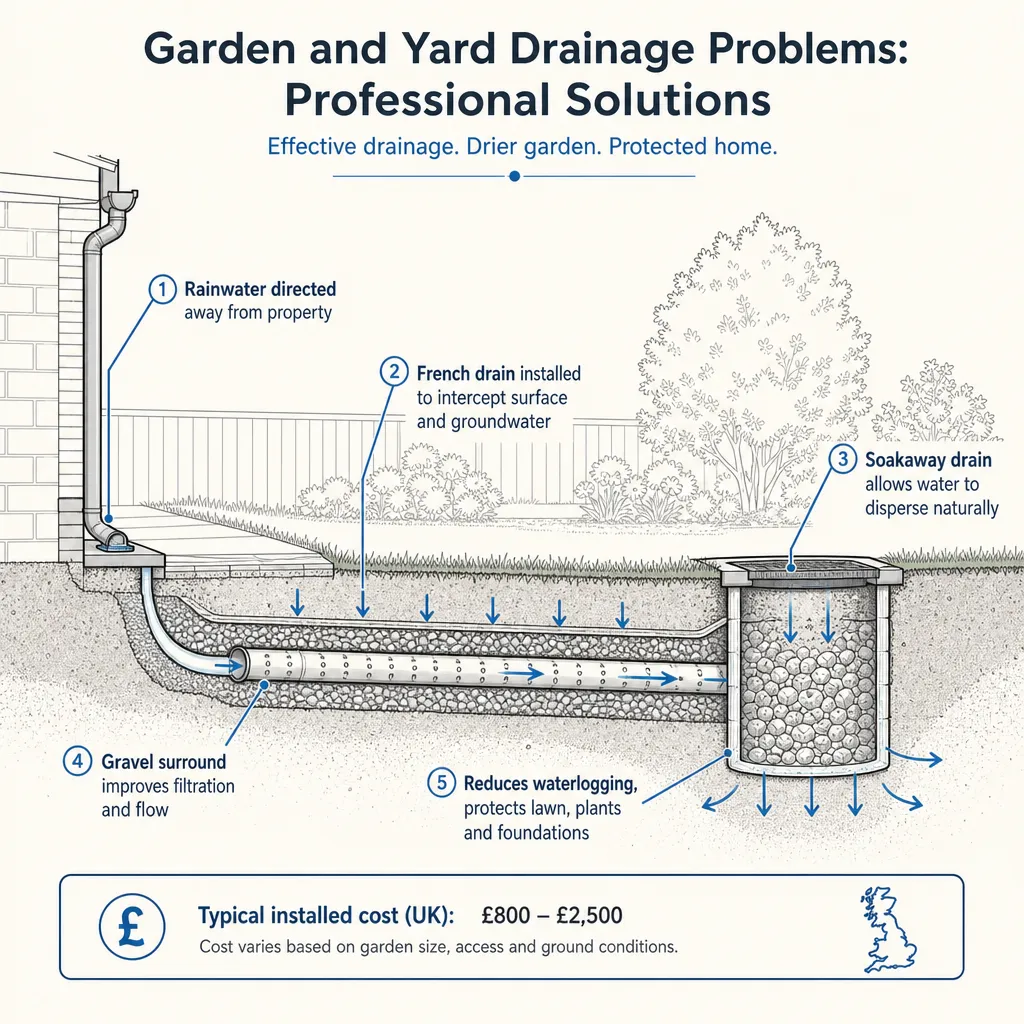
Garden and Yard Drainage Problems: Professional Solutions
Garden drainage problems in the UK are most often caused by clay soil, impermeable surfacing, or insufficient ground fall.
 Improvement & Build
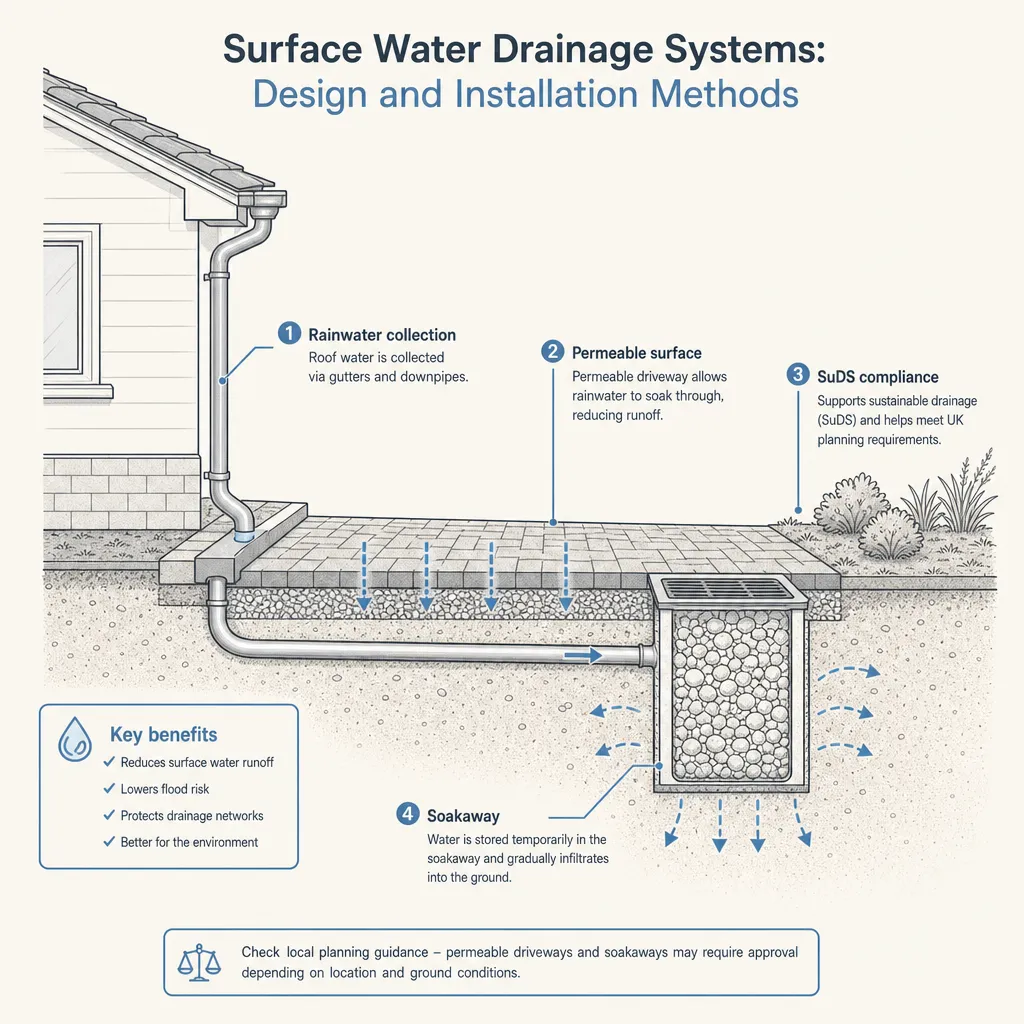
Surface Water Drainage Systems: Design and Installation Methods
Surface water drainage manages rainwater run-off from roofs, driveways, and hard standing.
 Improvement & Build
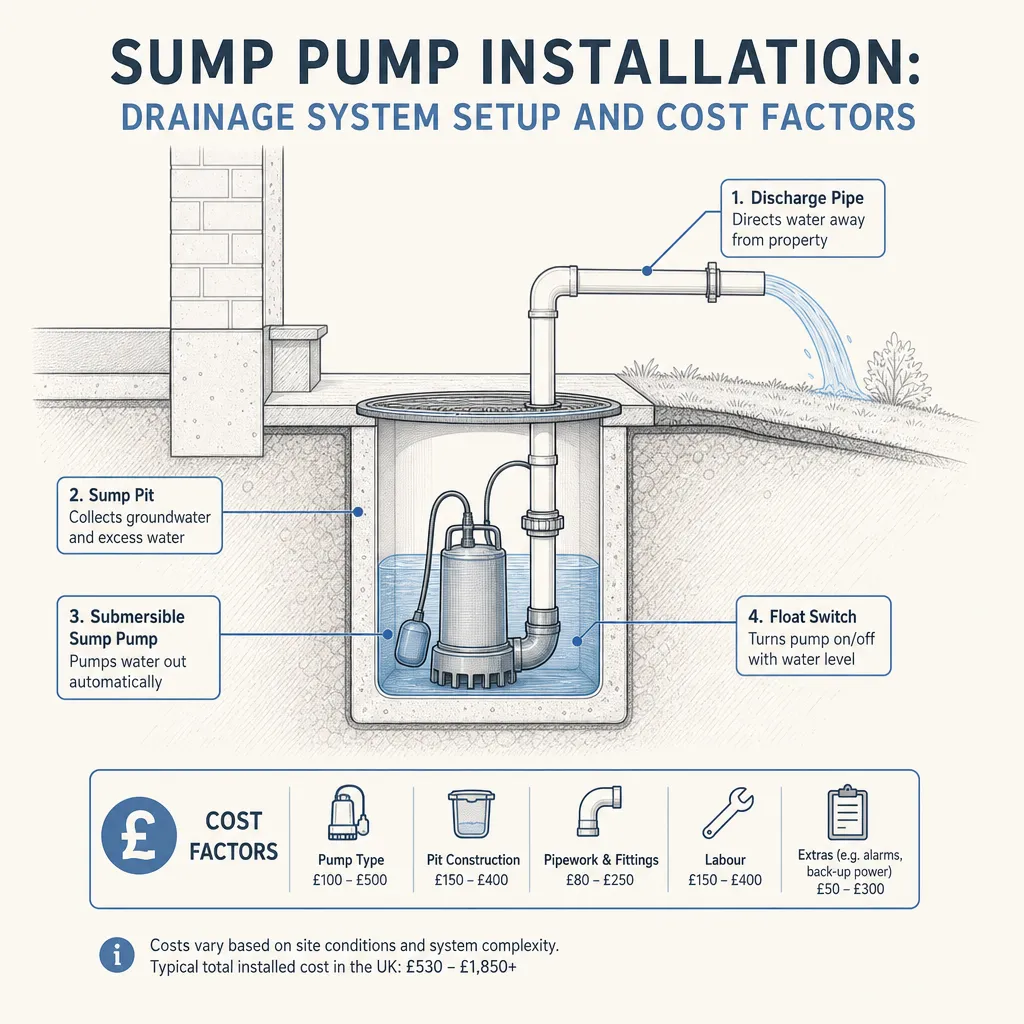
Sump Pump Installation: Drainage System Setup and Cost Factors
Sump pump installation in the UK typically costs £800–£2,500 for a submersible pump in a new or existing pit, including excavation, liner, discharge pipework, and connection to a suitable outlet.
 Improvement & Build
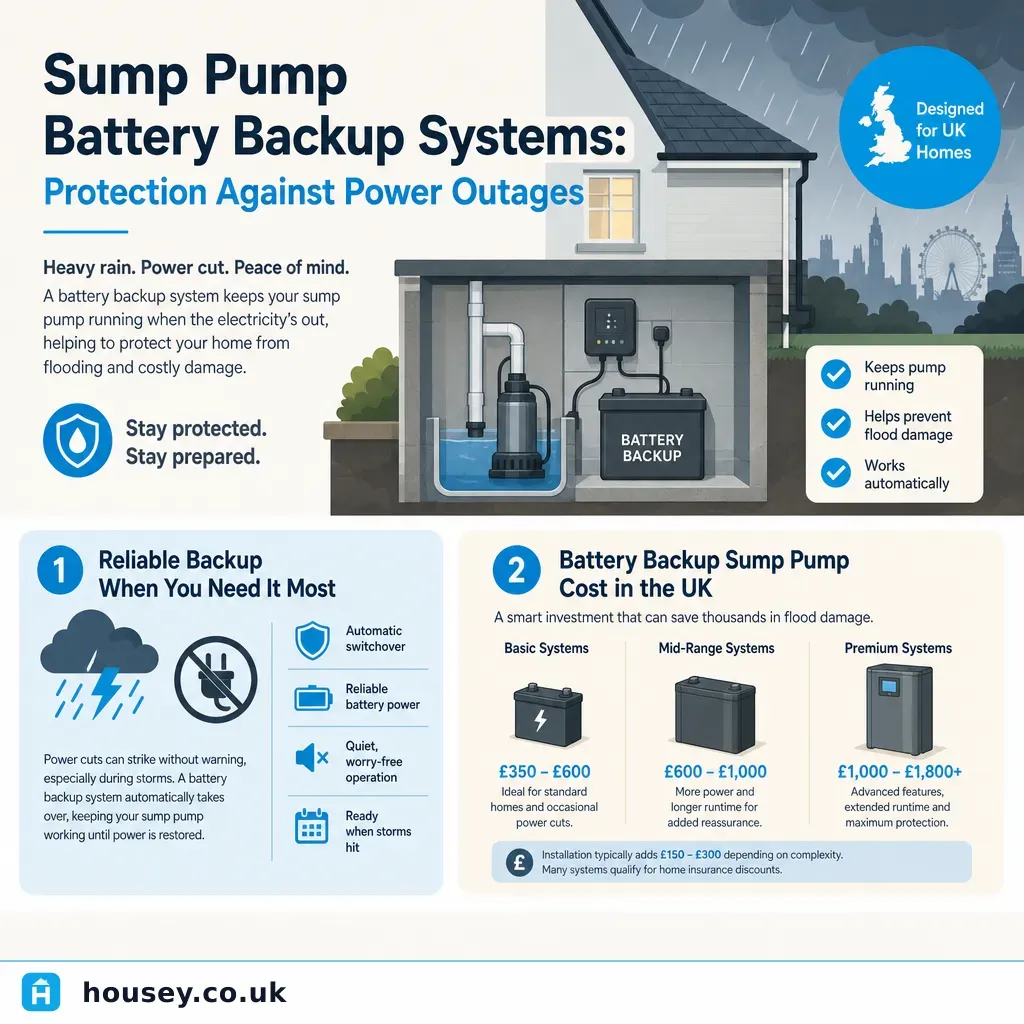
Sump Pump Battery Backup Systems: Protection Against Power Outages
A sump pump battery backup activates automatically when mains power fails, continuing to pump water from your sump pit to protect against flooding.