Drainage Field Installation and Septic System Costs
By Housey · Last reviewed 7th of May 2026
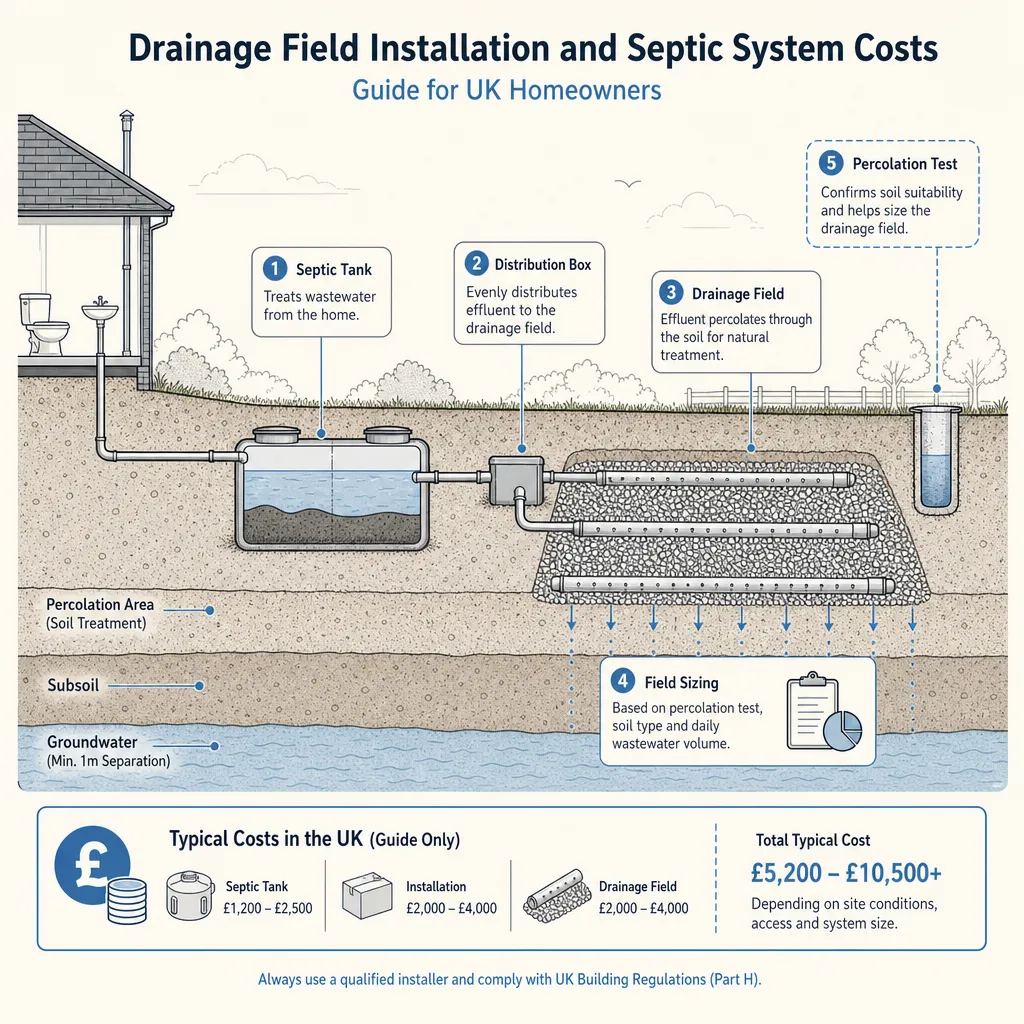
Drainage Field Installation and Septic System Costs
A drainage field — sometimes called a percolation field or soakaway field — is the essential ground-discharge component of many off-mains drainage systems, dispersing treated effluent from a septic tank or sewage treatment plant safely into the subsoil. For rural homeowners replacing a failing system, extending a property, or building a new off-grid dwelling in England, Wales, or Scotland, understanding whether your ground can support a drainage field, how large it needs to be, and what it costs to install correctly is critical. An undersized or poorly sited field is one of the most common causes of off-mains drainage failure.
Key points
- A percolation test measuring the Vp value (seconds per millimetre of drop) is required before a drainage field can be designed — the test method is specified in Building Regulations Approved Document H.
- BS 6297:2007 (Code of Practice for the Design and Installation of Drainage Fields for Use in Wastewater Treatment) provides the technical standard for trench sizing, pipe depth, and spacing.
- Drainage fields cannot be installed within 10 m of any watercourse, 50 m of a drinking water borehole or spring, or within Source Protection Zone 1 (SPZ1) where ground infiltration is prohibited.
- New drainage field installations receiving effluent from a septic tank must be registered as a free exemption with the Environment Agency under the General Binding Rules before works begin.
- Indicative installed costs range from £2,000 to £6,000 for a domestic drainage field under standard conditions — replacement of a failed field can cost significantly more if contaminated material must be excavated and removed.
What is a drainage field?
A drainage field is a network of perforated pipes laid in gravel-filled trenches below ground. Settled or treated effluent is distributed along the pipes and seeps out through the perforations into the surrounding soil, where physical, chemical, and biological processes further treat the liquid before it reaches groundwater.
The term "drainage field" is used in Approved Document H and by the Environment Agency. "Soakaway" is sometimes used interchangeably but more precisely refers to a surface water disposal structure (typically a rubble pit or precast ring). It is worth being clear on terminology when speaking to contractors to avoid confusion between rainwater and foul drainage systems.
Drainage fields function only where the subsoil has adequate percolation capacity. Sandy loams, chalk, and well-structured soils are generally suitable. Heavy clay, waterlogged ground, and areas with a high seasonal water table are often unsuitable or borderline, and should be assessed professionally before any commitment is made.
Percolation testing: the essential first step
Before a drainage field can be designed or accurately quoted for, the soil must be percolation tested on site. The test described in Approved Document H involves:
- Digging test holes to the proposed drainage trench depth — typically 300–900 mm below the finished surface.
- Saturating the soil by repeatedly filling the holes with water over a 24-hour period.
- On the third or subsequent fill, timing how long it takes for the water level to fall by 25 mm.
- Calculating the Vp value: time in seconds divided by the drop in millimetres.
A Vp value between 12 and 100 is generally considered suitable for a drainage field under Approved Document H. Values below 12 suggest the soil is too free-draining (a possible contamination risk to groundwater). Values above 100 indicate the soil is too slow, and the drainage field may flood in wet weather. If the Vp falls outside this range, a drainage field may not be viable and alternatives — such as a sewage treatment plant with a surface water discharge permit — should be explored with a drainage engineer.
Tests should be carried out in spring when the water table is at or near its seasonal high, to give a realistic worst-case result. A drainage contractor or civil engineer should conduct and interpret the test against Approved Document H requirements.
How drainage field size is calculated
Once the Vp value is known, the required drainage trench area (A) is calculated using the formula set out in Approved Document H:
A = p × Vp × 0.25
Where p is the number of people the system serves. For a four-person household with a Vp of 40, the minimum drainage trench area is:
A = 4 × 40 × 0.25 = 40 m²
The actual land area required is greater — to accommodate pipe spacing, inspection access, and buffer zones between runs. The table below gives indicative trench areas for common household sizes and soil types.
Household size | Vp 20 (sandy soil) | Vp 50 (medium soil) | Vp 100 (slow soil) |
|---|---|---|---|
2 people | 10 m² trench | 25 m² trench | 50 m² trench |
4 people | 20 m² trench | 50 m² trench | 100 m² trench |
6 people | 30 m² trench | 75 m² trench | 150 m² trench |
Trench area only — total land area required will be greater due to pipe spacing and exclusion zones. Based on Approved Document H formula. Vp values above 100 indicate the site may be unsuitable.
Regulatory requirements
Environment Agency General Binding Rules
For a new drainage field receiving effluent from a septic tank (discharging to ground), the installation must comply with the General Binding Rules (GBRs) under the Environmental Permitting (England and Wales) Regulations 2016. Key conditions include:
- The system must serve fewer than 10 people.
- Maximum discharge volume of 2 m³/day.
- Minimum siting distances from watercourses, buildings, boundaries, and water sources must be met.
- A new or replacement drainage field must be registered as an exemption with the Environment Agency before works begin — registration is free via the GOV.UK portal.
In Scotland, SEPA (Scottish Environment Protection Agency) operates a separate authorisation regime. In Wales, Natural Resources Wales (NRW) administers the equivalent rules.
Building Regulations Part H
Drainage field installation is subject to Building Regulations Approved Document H (Drainage and Waste Disposal). Work must either be carried out by a registered competent person, or a Building Regulations application must be submitted to your local building control body. Omitting this step can cause complications when selling the property.
Minimum siting distances
Receptor | Minimum distance |
|---|---|
Any watercourse (stream, ditch, river) | 10 m |
Drinking water borehole or spring | 50 m |
Any building | 5 m minimum (15 m from habitable rooms often recommended) |
Any site boundary | 2 m |
Source Protection Zone 1 (SPZ1) | Not permitted |
How much does a drainage field cost to install?
Costs depend on the drainage field area required (calculated from percolation test results), ground conditions, access for machinery, and whether existing failed material must be removed and disposed of as contaminated waste.
Cost element | Indicative range |
|---|---|
Percolation testing | £200–£500 |
Excavation and groundworks | £1,000–£3,000 |
Perforated pipe and gravel aggregate | £500–£1,500 |
Inspection chambers and distribution unit | £200–£600 |
Reinstatement (topsoil, grass seed) | £200–£500 |
Environment Agency exemption registration | Free |
Building control fee | £150–£400 |
Typical total (new install, standard conditions) | £2,000–£6,000 |
Replacement with contaminated material removal | £4,000–£10,000+ |
Indicative UK costs, last reviewed 2026-05-07. Ground conditions, field size, access, and regional contractor rates vary significantly. Always obtain at least three itemised quotes.
Pre-installation checklist for homeowners
Before instructing a contractor, confirm the following:
What not to assume
Common misunderstandings that lead to drainage field problems:
"My garden drains well, so a drainage field will work." Surface drainage and subsoil percolation are very different. A garden that dries out quickly in summer may have a clay subsoil with a high seasonal water table in winter. Always percolation test in spring.
"I can build or park over the drainage field area." Any structure, compacted surface, or hard standing over the drainage field will damage the pipes and prevent percolation. The area must remain as permeable ground cover — lightly managed grass is ideal.
"A drainage field lasts forever." Most drainage fields have a functional lifespan of 15–30 years. Root ingress, silt build-up from a poorly maintained tank, and biomat formation are the principal failure mechanisms.
"I don't need to register a like-for-like replacement." Even replacing an existing drainage field requires registering a new Environment Agency exemption if you are laying new pipework or changing the system layout.
"The exemption registered by the previous owner still covers me." Exemptions are not automatically transferred on property sale. If you have recently purchased a property with an off-mains system, check with the Environment Agency that the registration reflects the current owner and system configuration.
Red flags when choosing a contractor
- No percolation test carried out or proposed before quoting — sizing without test data is guesswork.
- Field sized using "standard" dimensions rather than a Vp-based calculation from Approved Document H.
- No mention of Environment Agency exemption registration or Building Regulations compliance.
- Quote does not separately itemise excavation, aggregate, pipework, inspection chambers, and reinstatement.
- Contractor proposes siting the drainage field within the exclusion distances from buildings, watercourses, or boundaries.
- No inspection chamber or distribution unit included — these are essential for even effluent distribution and maintenance access.
- No vacuum tanker access route planned for future septic tank desludging — if the tanker cannot reach the tank, the system cannot be maintained.
When to get professional help
A drainage field installation should always be designed and installed by a qualified drainage contractor. Instruct a professional if:
- A percolation test is required — test interpretation against Approved Document H requires specialist knowledge.
- Your ground conditions are unknown, there is evidence of seasonal waterlogging, or your site is near a Source Protection Zone.
- You are replacing a failed drainage field and are unsure whether the failure originated in the tank or the field.
- Your property has been extended or occupancy has increased, which may require a larger field than was originally installed.
- You are buying a property with an existing off-mains system and want a condition and compliance assessment before exchange.
How Housey can help
Housey connects homeowners with qualified drainage contractors who can carry out percolation testing, design a compliant drainage field to Approved Document H and BS 6297:2007, handle Environment Agency exemption registration, and complete the installation to Building Regulations standard. Submit a request to compare quotes from vetted local specialists.
Frequently asked questions
What is a percolation test and do I always need one?
A percolation test measures how quickly water drains through your subsoil, producing a Vp value used to size the drainage field. It is required by Building Regulations Approved Document H before a drainage field can be designed. Without it, there is no reliable basis for sizing. Some contractors use desktop soil data for initial screening, but a physical on-site test is required before installation.
How big does a drainage field need to be?
Size is calculated using the Approved Document H formula: A = p × Vp × 0.25, where p is the number of people served and Vp is the percolation test result. For a four-person household with a Vp of 50, the minimum drainage trench area is 50 m². The actual land area needed is greater — typically 80–150 m² or more — to accommodate pipe spacing, exclusion zones, and access for maintenance.
Can I build over a drainage field?
No. Structures, hard standings, driveways, and heavy compaction must not be placed over a drainage field. Any of these would damage the perforated pipework, compact the gravel bed, and severely reduce or eliminate the system's ability to function. The area should remain as lightly managed grass or similarly permeable ground cover, kept clear of trees and shrubs whose roots could infiltrate the pipes.
How long does a drainage field last?
Most drainage fields last 15–30 years under normal operating conditions. The main failure mechanisms are root ingress from nearby trees or shrubs, silt accumulation caused by inadequate septic tank desludging, and biomat formation — a clogging layer of biological material that builds up in the gravel. Using a sewage treatment plant rather than a conventional septic tank can extend drainage field life by discharging cleaner effluent.
Sources and further reading
- Approved Document H: Drainage and Waste Disposal — GOV.UK / MHCLG
- Septic tanks and treatment systems: permits and exemptions — GOV.UK / Environment Agency
- Small sewage discharge to ground — GOV.UK / Environment Agency
- Environmental Permitting (England and Wales) Regulations 2016 — legislation.gov.uk
- BS 6297:2007 Code of practice for the design and installation of drainage fields for use in wastewater treatment — BSI Group
Useful next reads
 Improvement & Build
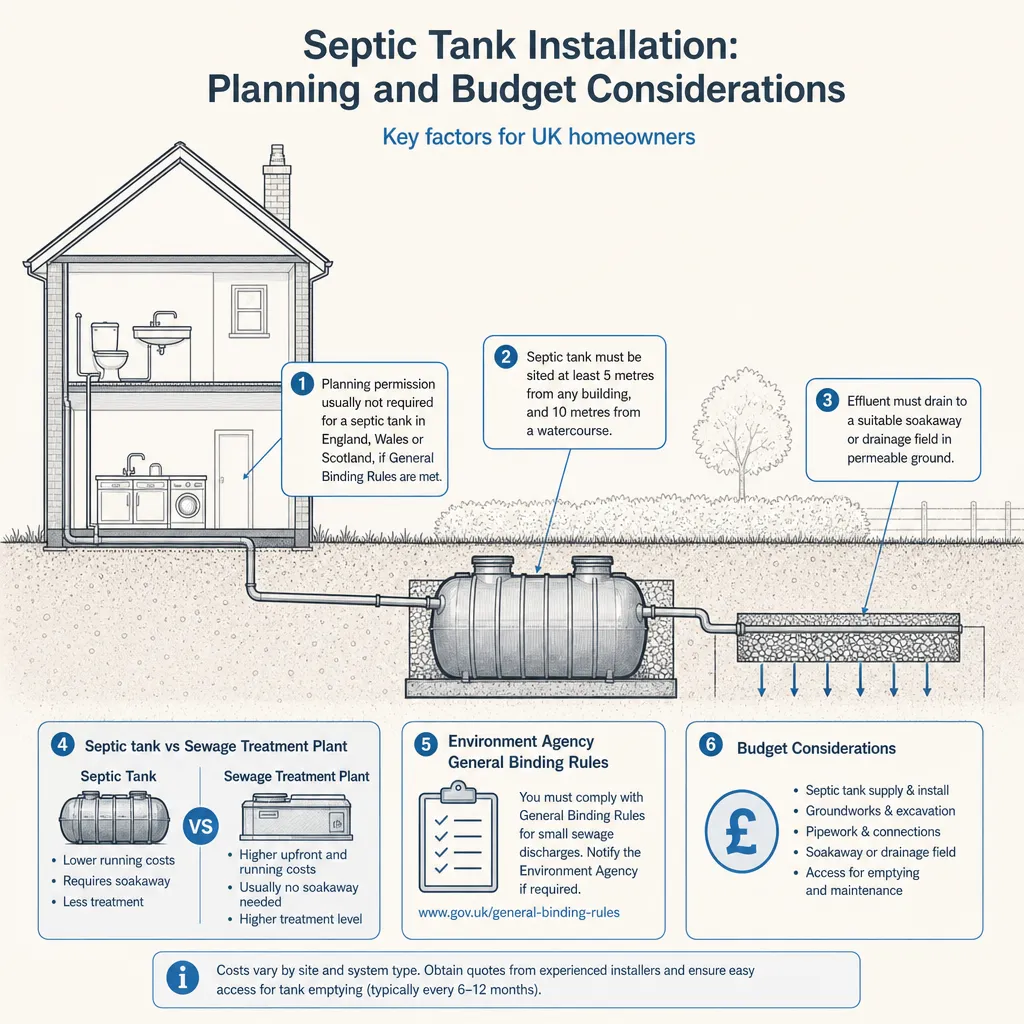
Septic Tank Installation: Planning and Budget Considerations
Installing a septic tank or sewage treatment plant in England requires Environment Agency registration or a permit, plus Building Regulations approval under Approved Document H.
 Improvement & Build
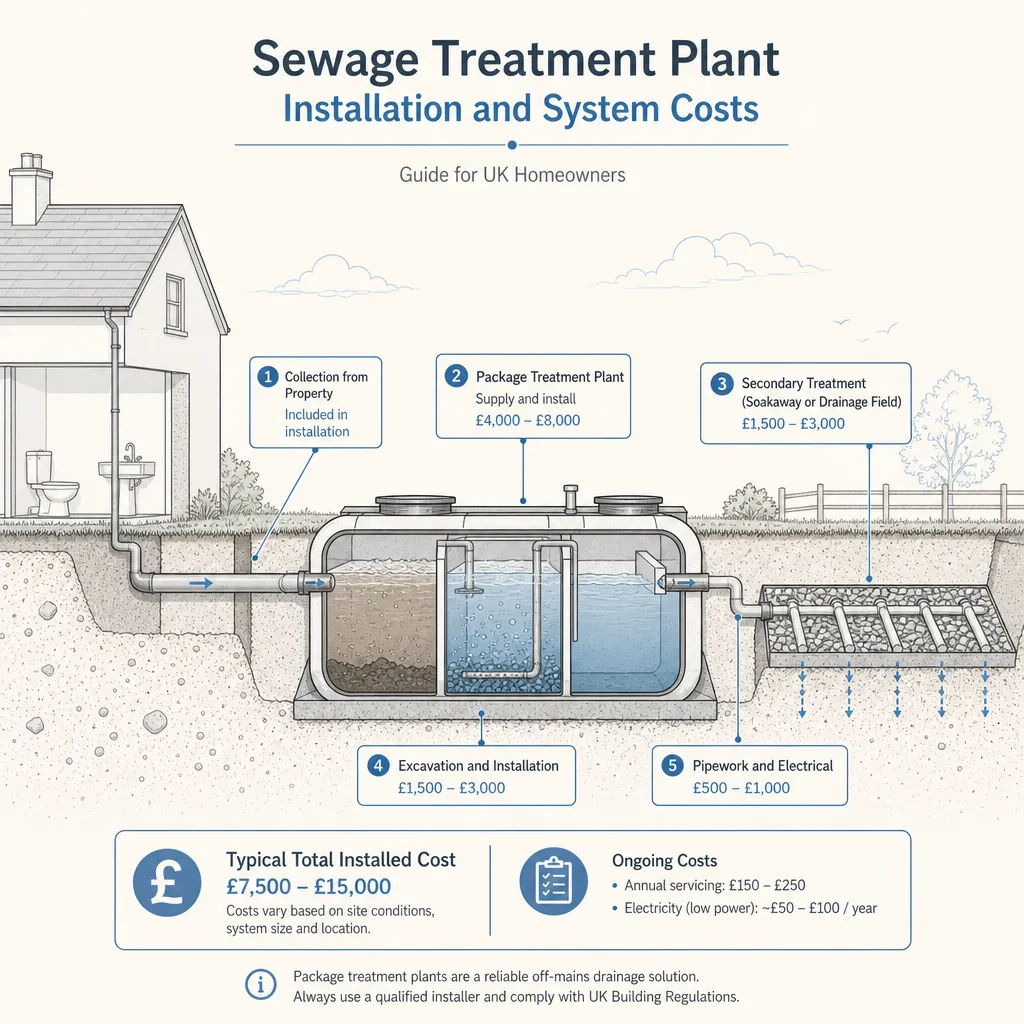
Sewage Treatment Plant Installation and System Costs
A domestic sewage treatment plant typically costs £5,000–£12,000 installed in the UK, depending on capacity, site conditions, and discharge route.
 Improvement & Build
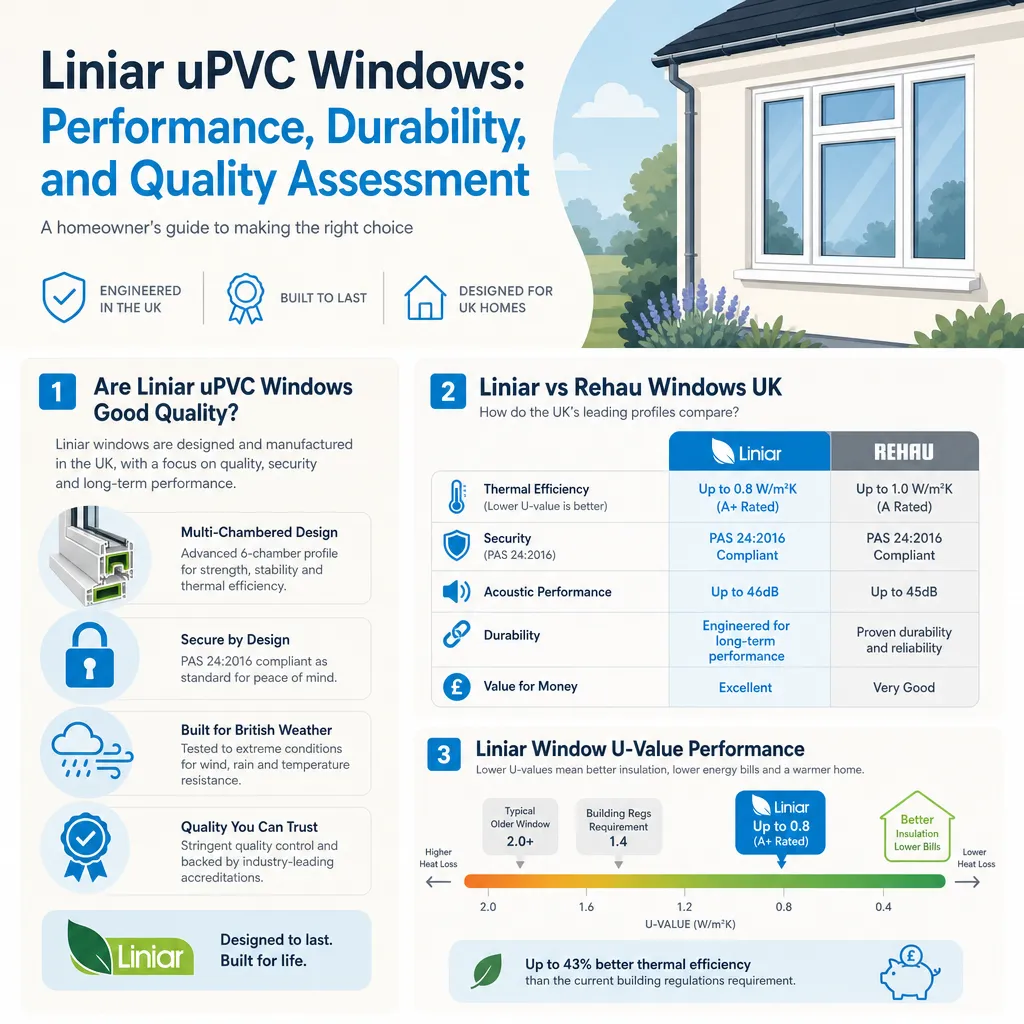
Liniar uPVC Windows: Performance, Durability, and Quality Assessment
Liniar uPVC window profiles are manufactured in the UK using multi-chambered, foamed frames.
 Improvement & Build
Garden Tap Installation with Hot and Cold Water: Plumbing Options
Adding a cold garden tap is a common DIY project, but routing hot water outdoors requires a plumber to connect to your domestic hot water system and comply with the Water Supply (Water Fittings) Regulations 1999.
 Improvement & Build
Sealing and Maintaining Historic Leaded Glass Windows: Preservation and Performance
Leaded glass windows are maintained using traditional linseed oil cement — not silicone or modern sealants, which prevent natural movement in the lead came.