Sewage Treatment Plant Installation and System Costs
By Housey · Last reviewed 7th of May 2026
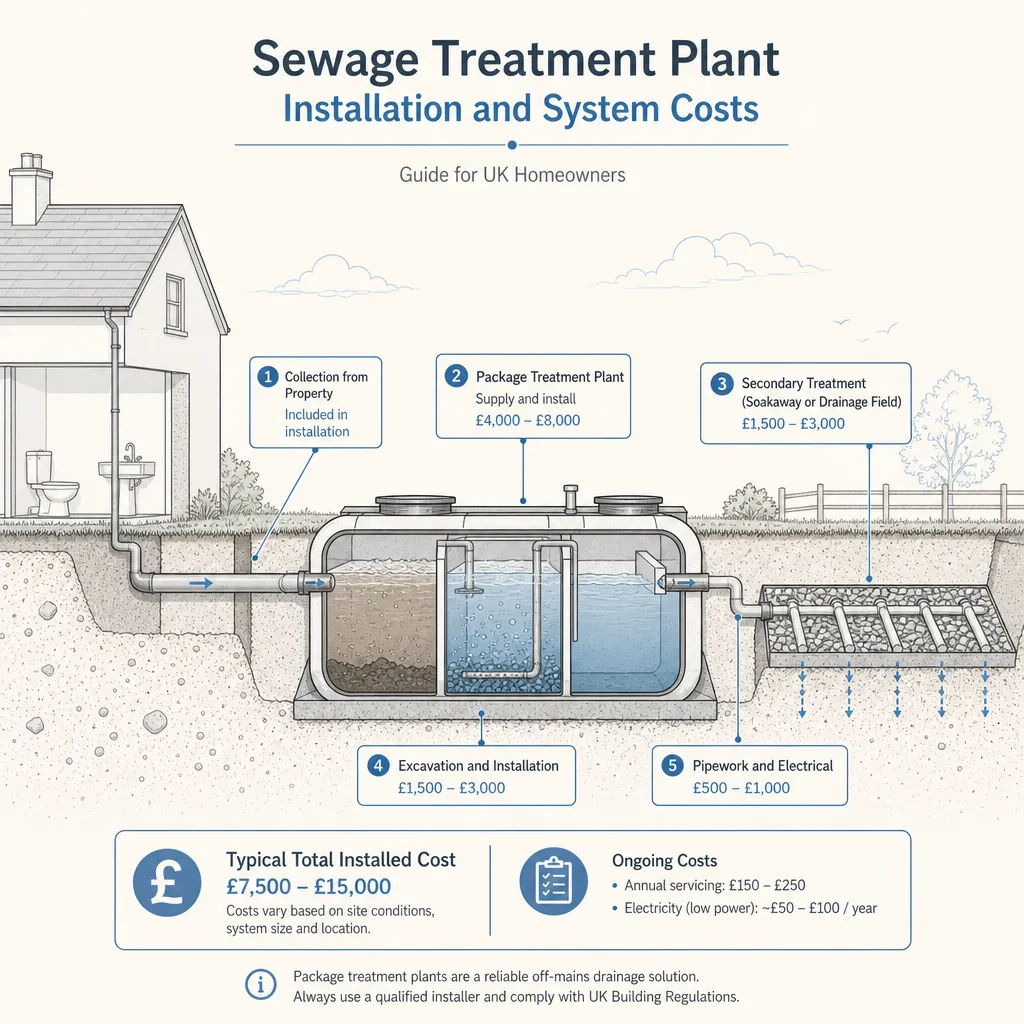
Sewage Treatment Plant Installation and System Costs
Properties that cannot connect to the public sewer network — common in rural areas of England, Wales, and Scotland — require their own wastewater treatment solution. Whether you are buying a remote farmhouse, building a new dwelling off-grid, or replacing a failing septic tank, installing a sewage treatment plant (also called a package treatment plant) carries significant regulatory, environmental, and financial implications. Getting the installation right from the outset avoids costly remediation and potential enforcement action from the Environment Agency.
Key points
- Sewage treatment plants must be registered with or permitted by the Environment Agency under the Environmental Permitting (England and Wales) Regulations 2016 — the requirement depends on whether treated effluent discharges to ground or to a surface watercourse.
- Since 1 January 2020, existing septic tanks that discharge directly to surface water (streams, ditches, rivers) must be upgraded or replaced with a compliant system.
- Building Regulations Approved Document H sets minimum siting distances: at least 10 m from any watercourse, 50 m from a drinking water borehole or spring, and 7 m from any building.
- Domestic package treatment plants are sized in population equivalent (PE); a standard four-bedroom house typically requires a 6 PE unit, but correct sizing depends on occupancy and daily flow calculations.
- Indicative UK installed costs range from £5,000 to £12,000+, depending on unit capacity, ground conditions, access, and whether a drainage field or watercourse discharge is used — always obtain at least three itemised quotes.
What is a sewage treatment plant?
A sewage treatment plant is a self-contained unit that processes household wastewater through a biological treatment process — typically using an air pump to introduce oxygen, enabling aerobic bacteria to break down waste to a much higher standard than a conventional septic tank. The treated effluent can then be discharged either to a drainage field (soakaway) or, with the appropriate Environment Agency permit, to a surface watercourse.
The key distinction from a septic tank is the quality of output. A correctly functioning sewage treatment plant produces cleaner effluent that can meet the standard required for many surface water discharges. A conventional septic tank produces partially settled wastewater only suitable for ground infiltration via a drainage field.
Sewage treatment plant vs septic tank
Feature | Sewage treatment plant | Conventional septic tank |
|---|---|---|
Treatment standard | Aerobic biological — cleaner output | Anaerobic settlement only — lower quality |
Discharge options | Drainage field or permitted watercourse | Drainage field only (no surface water since Jan 2020) |
Environment Agency registration | Exemption or permit required | Exemption to ground only |
Power requirement | Yes — typically 50–100 W continuously | None |
Annual running cost | £80–£200/yr electricity plus servicing | Lower running cost; maintenance still required |
Desludging frequency | Every 1–3 years (settlement chamber) | Every 1–3 years |
Indicative installed cost | £5,000–£12,000+ | £3,000–£7,000+ |
Lifespan | 20–30 years with maintenance | 20–40 years (concrete tanks) |
Indicative UK costs, last reviewed 2026-05-07. Quotes vary significantly by site and region.
Which off-mains drainage system do you need?
Use this decision tree before instructing a contractor or engineer.
- Choose a sewage treatment plant if you need to discharge treated water to a watercourse because the ground has poor percolation or insufficient drainage field area is available.
- Choose a sewage treatment plant if you are replacing a failing septic tank that previously discharged directly to surface water and cannot comply with the 2020 rules.
- Consider a septic tank with drainage field if a percolation test (Vp value) confirms the soil is suitable for infiltration and you have sufficient land clear of buildings, boundaries, and watercourses.
- Ask a drainage contractor or civil engineer if your land has high groundwater, heavy clay, or falls within a Source Protection Zone (SPZ1 or SPZ2), as ground infiltration may not be permitted by the Environment Agency.
- Check with the Environment Agency and your local planning authority if your property is near a Site of Special Scientific Interest (SSSI), within a Nitrate Vulnerable Zone (NVZ), or in Scotland where SEPA operates a separate licensing regime.
Permits and regulations you must comply with
Environment Agency registration or permit
Under the Environmental Permitting (England and Wales) Regulations 2016, small sewage discharges are regulated through two routes:
General Binding Rules (GBRs): If your sewage treatment plant discharges to ground via a drainage field, you may be able to self-certify compliance with the GBRs and register a free exemption with the Environment Agency rather than applying for a full permit. Key GBR conditions cover maximum discharge volume (up to 2 m³/day for domestic systems), minimum siting distances, and proximity to sensitive water receptors.
Environmental Permit: Required if discharging to a surface watercourse, or if your site does not meet the GBRs. The application involves submitting site details and evidence that the system meets the required effluent quality standard — typically expressed as BOD, suspended solids, and ammonia concentrations.
In Scotland, SEPA administers equivalent authorisation. In Wales, Natural Resources Wales (NRW) is the relevant authority.
Building Regulations Part H
Approved Document H (Drainage and Waste Disposal) requires that any new or replacement drainage system meets minimum siting distances and does not cause nuisance. Installation must either be carried out by a registered competent person or be subject to a formal Building Regulations application to your local building control body.
Planning permission
Installing a sewage treatment plant is generally considered permitted development for a single dwelling, but this is not universal. Listed buildings, conservation areas, National Parks, and Areas of Outstanding Natural Beauty may have restrictions. Always check with your local planning authority before committing to a system.
Installation process and timescales
A typical domestic sewage treatment plant installation involves these stages:
- Site assessment — a drainage contractor or civil engineer visits to assess ground conditions, siting constraints, distances from boundaries and watercourses, and tanker access for future desludging.
- System design and sizing — the unit is sized in population equivalent (PE) based on occupancy, daily flow, and any peak demand. Most domestic units are 4–10 PE.
- Permit or exemption registration — the contractor or homeowner registers with the Environment Agency before installation begins.
- Excavation and installation — the tank is lowered into a prepared excavation, inlet and outlet pipework connected, and the drainage field or discharge pipework laid.
- Commissioning and seeding — the unit is filled with water, the air pump started, and biological seeding material added to accelerate bacterial colonisation.
- Building regulations sign-off — either via a competent person scheme or local building control inspection and certificate.
From site survey to commissioning, allow 4–10 weeks for a straightforward domestic installation, longer if a full Environment Agency permit application is required.
How much does installation cost?
Cost element | Indicative range |
|---|---|
Package treatment plant unit (4–6 PE) | £2,500–£6,000 |
Excavation and groundworks | £1,500–£3,500 |
Inlet pipework from property | £500–£1,500 |
Drainage field (if required) | £2,000–£5,000+ |
Environment Agency permit application fee | £135–£2,960 (varies by permit type) |
Building control fee | £150–£400 |
Total installed (without drainage field) | £5,000–£12,000+ |
Total installed (with drainage field) | £7,000–£17,000+ |
Indicative UK costs, last reviewed 2026-05-07. Ground conditions, access, regional contractor rates, and unit specification vary significantly. Always obtain at least three itemised quotes.
Annual running costs typically include electricity for the air pump (£80–£180/yr), a maintenance service contract (£150–£400/yr), and periodic desludging by a licensed waste carrier (£150–£300 per visit).
Red flags: what to watch out for
- No site visit before quoting — a contractor who quotes without visiting cannot reliably assess excavation depth, access constraints, or ground conditions.
- No mention of Environment Agency registration — any discharge from a new system must be registered or permitted; omitting this is a compliance risk.
- Undersized unit — a unit specified only for current occupancy with no headroom for guests or household growth will struggle in peak periods and may fail effluent quality standards.
- Tank positioned too close to buildings or watercourses — failure to meet the Approved Document H minimum siting distances creates an enforcement risk and can cause problems at resale.
- No building regulations notification — if the installation company is not a registered competent person, the homeowner must apply for building control approval separately; omitting this can cause complications when selling the property.
- Discharge to ground within SPZ1 — ground infiltration is not permitted within Source Protection Zone 1 (the innermost zone around a drinking water abstraction point); check the Environment Agency's Groundwater Source Protection Zones map before proceeding.
What to ask before accepting a quote
- What size unit are you recommending, and how have you calculated this?
- Is this price based on a physical site visit or a desktop estimate?
- Will you handle the Environment Agency exemption registration or permit application, or is this my responsibility?
- Are you a registered competent person under a building regulations scheme for this type of installation?
- What happens if ground conditions are harder, wetter, or more complex than expected — how is this costed?
- Is VAT included in this figure?
- What maintenance contract and desludging service do you offer after installation?
- What is the manufacturer's warranty on the unit, and what does it cover?
When to get professional help
A sewage treatment plant installation is not a DIY project. Excavation, regulatory compliance, and commissioning all require specialist knowledge and equipment. Instruct a qualified drainage contractor or civil engineer if:
- You are replacing a failing or non-compliant septic tank, particularly one that discharges to surface water.
- Your site is near a watercourse, drinking water source, or within a groundwater Source Protection Zone.
- Ground conditions are unknown, clay-heavy, or subject to seasonal flooding or high water tables.
- Your property is listed, in a conservation area, or in a National Park.
- The Environment Agency has previously issued a notice regarding your drainage arrangements.
How Housey can help
Housey connects you with qualified drainage contractors and civil engineers who can assess your site, recommend the right system, handle Environment Agency registration, and complete installation to Building Regulations standard. Submit a request to compare quotes from vetted local specialists.
Frequently asked questions
Do I need planning permission for a sewage treatment plant?
In most cases, installing a sewage treatment plant is considered permitted development and does not require planning permission. However, you should always check with your local planning authority, particularly for listed buildings, conservation areas, National Parks, or Areas of Outstanding Natural Beauty. You will still need to comply with Building Regulations Part H and register or obtain an Environment Agency permit for the discharge.
How long does a sewage treatment plant last?
A well-maintained sewage treatment plant typically lasts 20–30 years. Electromechanical components such as air pumps and diffusers may need replacing every 5–10 years. Annual servicing by a competent engineer and regular desludging — usually every one to three years depending on occupancy — are essential to achieve this lifespan and maintain regulatory compliance.
Can a sewage treatment plant discharge into a ditch or stream?
Discharge to a surface water watercourse requires an Environmental Permit from the Environment Agency (or Natural Resources Wales). Since January 2020, septic tanks discharging directly to surface water must be upgraded or replaced. Sewage treatment plants meeting the required effluent standard can apply for a permit, but this involves a site assessment and formal Environment Agency approval process.
How often does a sewage treatment plant need emptying?
Most domestic sewage treatment plants need desludging every one to three years, depending on occupancy and unit size. Sludge accumulates in the primary settlement chamber and must be removed by a licensed waste carrier. Annual servicing should also check the air pump, diffuser, and any other mechanical or electrical components to maintain treatment performance.
Sources and further reading
- Septic tanks and treatment systems: permits and exemptions — GOV.UK / Environment Agency
- Small sewage discharge to ground water — GOV.UK / Environment Agency
- Approved Document H: Drainage and Waste Disposal — GOV.UK / MHCLG
- Environmental Permitting (England and Wales) Regulations 2016 — legislation.gov.uk
- Groundwater Source Protection Zones map — Environment Agency
Useful next reads
 Improvement & Build
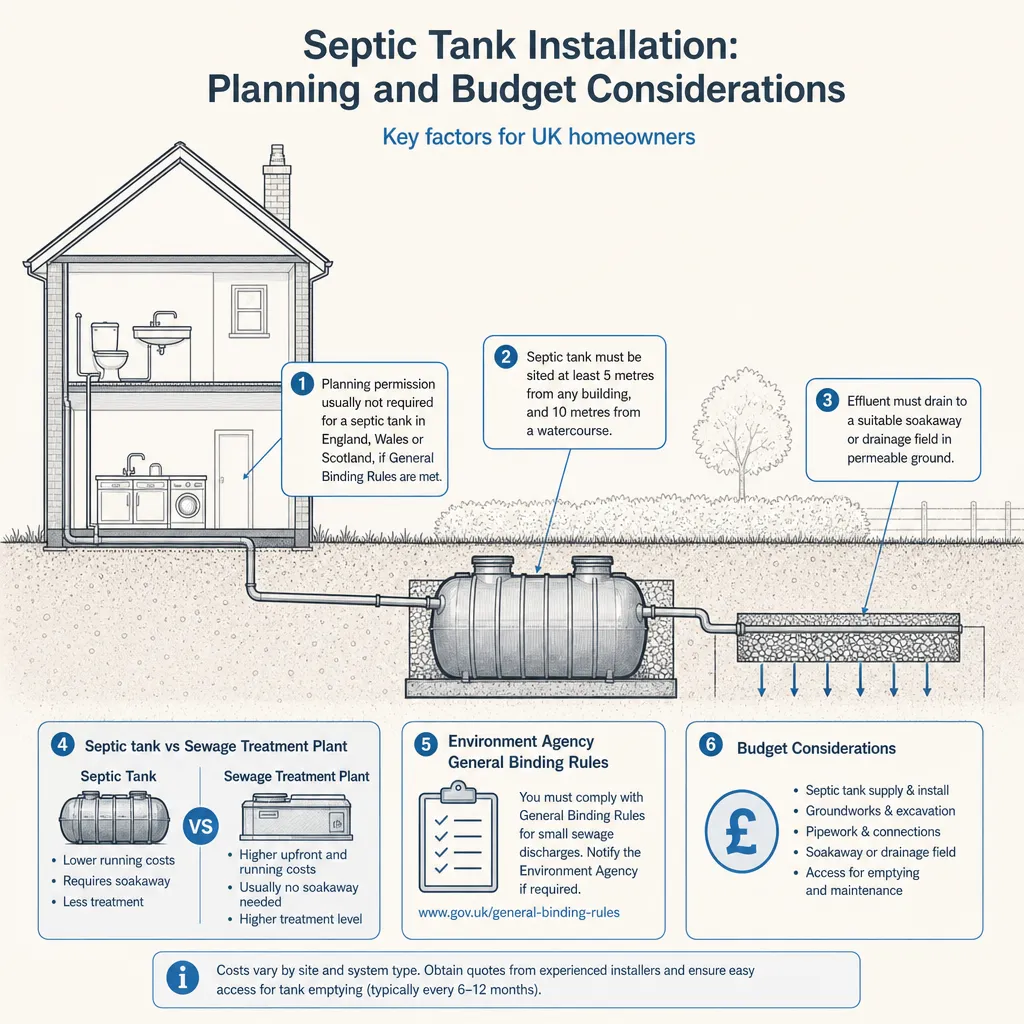
Septic Tank Installation: Planning and Budget Considerations
Installing a septic tank or sewage treatment plant in England requires Environment Agency registration or a permit, plus Building Regulations approval under Approved Document H.
 Improvement & Build
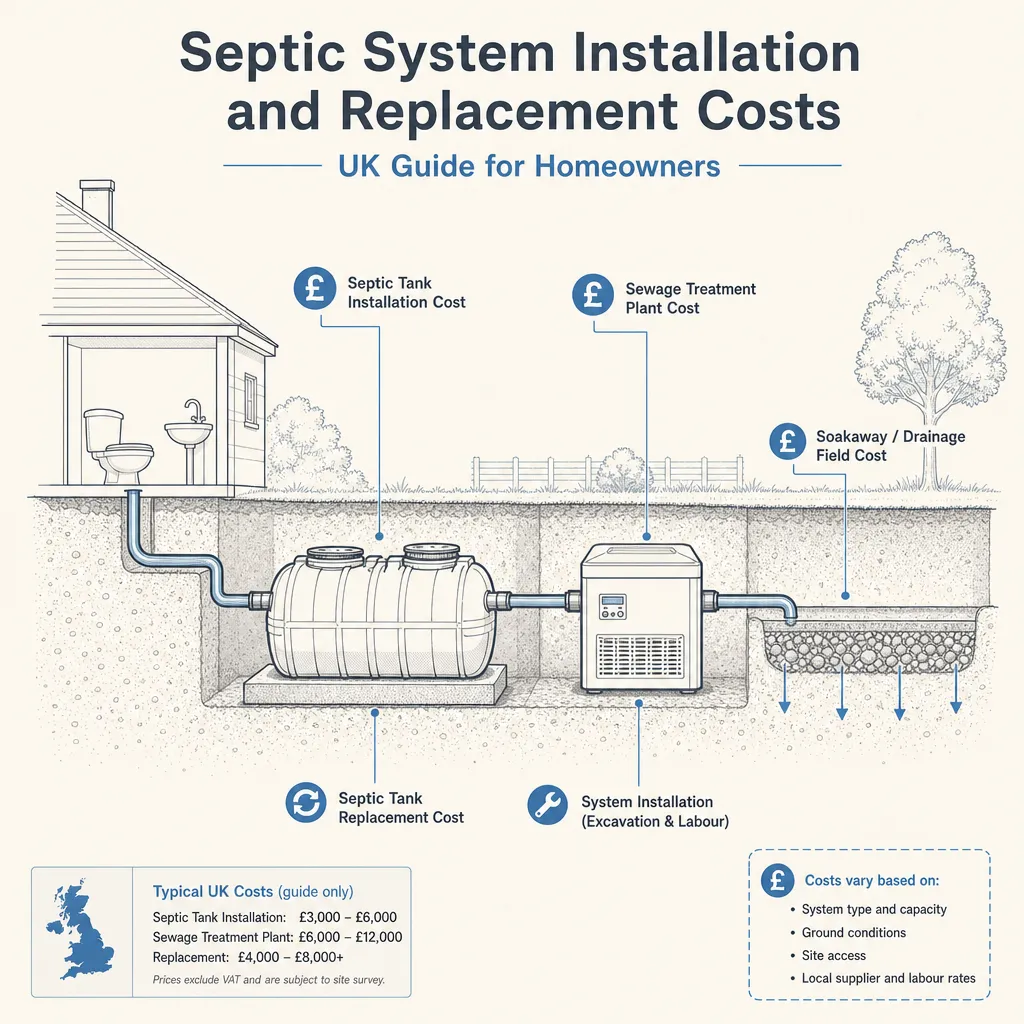
Septic System Installation and Replacement Costs
New and replacement off-mains drainage in the UK requires a percolation test, Building Regulations Part H sign-off, and compliance with the Environment Agency's General Binding Rules.
 Improvement & Build
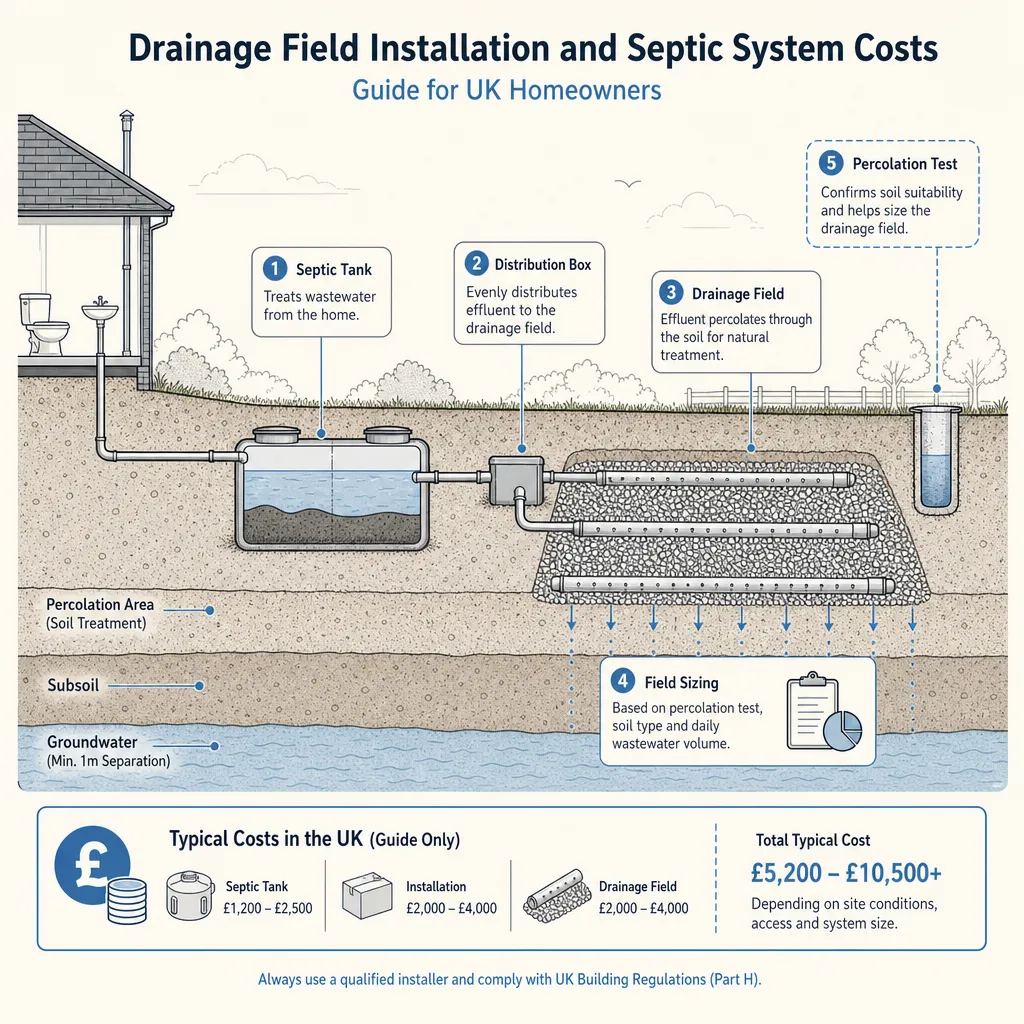
Drainage Field Installation and Septic System Costs
A drainage field disperses treated effluent from a septic tank or sewage treatment plant into the ground via perforated pipes in gravel-filled trenches.
 Improvement & Build
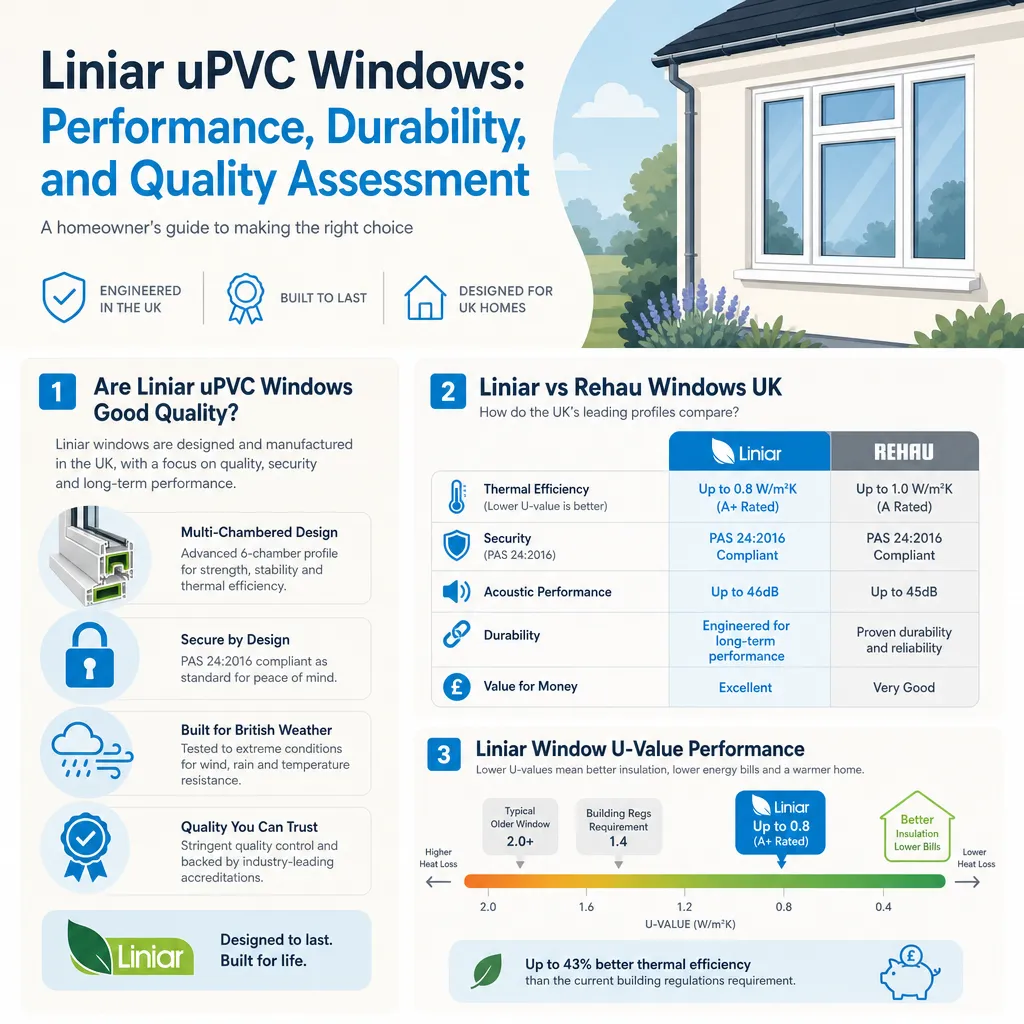
Liniar uPVC Windows: Performance, Durability, and Quality Assessment
Liniar uPVC window profiles are manufactured in the UK using multi-chambered, foamed frames.
 Improvement & Build
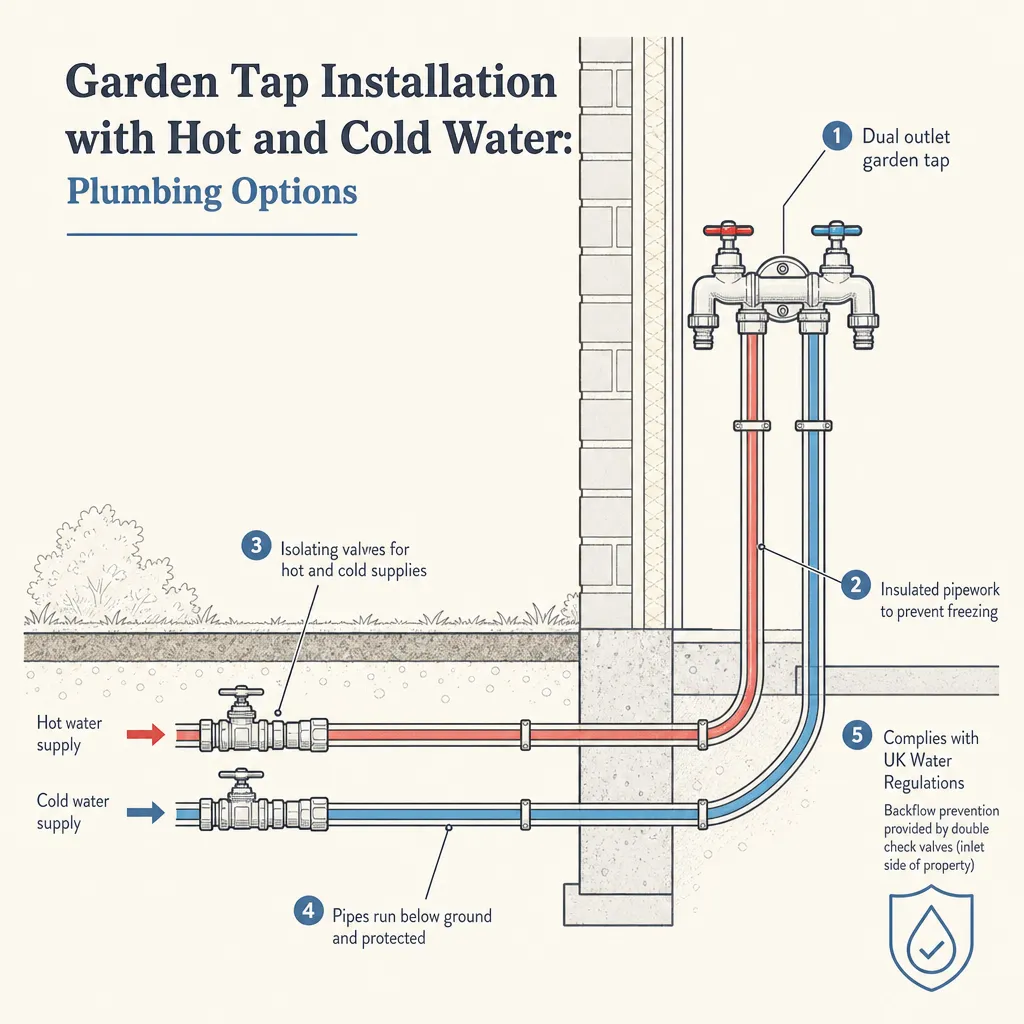
Garden Tap Installation with Hot and Cold Water: Plumbing Options
Adding a cold garden tap is a common DIY project, but routing hot water outdoors requires a plumber to connect to your domestic hot water system and comply with the Water Supply (Water Fittings) Regulations 1999.