Drainage System Layout and Design Principles
By Housey · Last reviewed 11th of May 2026
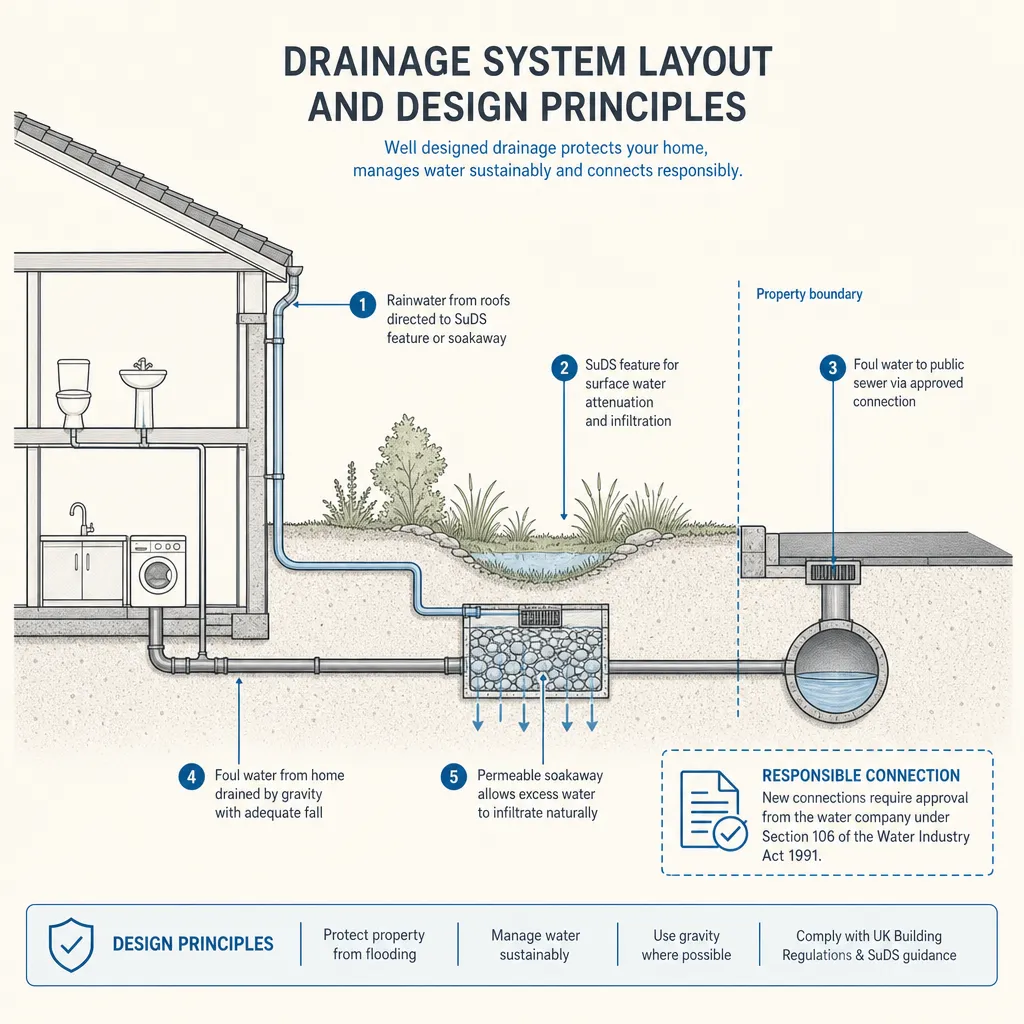
Drainage System Layout and Design Principles
Drainage decisions made early in a project have a lasting impact on build cost, long-term maintenance, and compliance with planning conditions. Whether you are commissioning a new dwelling, a significant extension, or a large hard-landscaping scheme, understanding how surface and foul water will leave your site is a prerequisite — not an afterthought. In England and Wales, drainage strategy is embedded in both the planning and building regulations processes, so getting it right before groundwork begins protects your budget and programme.
Key points
- Approved Document H of the Building Regulations sets out minimum requirements for foul water drainage, surface water drainage, rainwater drainage, and on-site sewage treatment in England and Wales.
- Surface water and foul water must be kept separate in new drainage installations; combined connections to the public sewer are not permitted for new builds under Water Industry Act 1991 guidance.
- Minimum pipe gradient for 100 mm foul-water drains is typically 1:40 under BS EN 752 and Approved Document H, though 1:80 may be permissible where at least one WC discharges to the run.
- Sustainable Drainage Systems (SuDS) became a planning requirement for most new development in England following the commencement of Schedule 3 of the Flood and Water Management Act 2010 in April 2024.
- A Section 106 notice to the sewerage undertaker is required before connecting a new drain to the public sewer; making a connection without consent is a criminal offence under the Water Industry Act 1991.
What a drainage layout involves
A drainage layout sets out how both foul water (from WCs, sinks, baths, and washing machines) and surface water (rainfall from roofs, driveways, and paved areas) are collected, transported, and discharged from a site.
At design stage, a civil or drainage engineer typically produces a drainage layout drawing that shows:
- Pipe routes, diameters, materials, and gradients
- Inspection chamber positions and cover levels
- Connection points to the public sewer or private treatment system
- Soakaway positions and specification, where surface water drains to ground
- Catchment areas and calculated flow rates
For larger schemes, hydraulic calculations accompany the drawing to demonstrate that pipe sizes and gradients will handle design storm events — typically the 1-in-100-year storm plus a climate change allowance, in line with current Environment Agency planning guidance.
Types of drainage system
UK drainage generally falls into four categories. The right choice depends on site geology, proximity to the public sewer, local authority requirements, and the planning authority's SuDS preferences.
System type | How it works | Best for | Limitations |
|---|---|---|---|
Gravity foul sewer connection | Foul water flows by gravity to the public sewer | Most urban and suburban sites near an existing sewer | Requires Section 106 consent; invert levels must allow gravity flow |
Soakaway (surface water) | Surface water percolates through a gravel-filled pit or geocellular crate into the ground | Permeable soils away from foundations and boundaries | Unsuitable in clay or high water table; percolation test required |
Attenuation with controlled discharge | Surface water stored underground then released to sewer or watercourse at a restricted rate | Urban redevelopment; areas at risk of sewer flooding | Requires volume calculations; ongoing maintenance of flow restrictor |
Package sewage treatment plant or septic tank | On-site biological treatment of foul water; discharge to watercourse or soakaway | Rural sites with no public sewer access | Requires Environment Agency permit or general binding rules compliance; regular desludging |
Key design principles: gradients, pipe sizing, and materials
Gradients
Pipe gradient determines flow velocity. Too shallow and solids settle; too steep and the water outruns the solids — both causing blockages over time. For 100 mm diameter foul drainage, Approved Document H recommends a minimum gradient of 1:40 and notes that 1:80 may be acceptable if at least one WC is connected to the run. Surface water pipes can drain at shallower gradients because they carry clean water without solids.
Pipe materials
Common materials in UK domestic and small-commercial drainage include:
- uPVC — lightweight, cost-effective, and widely used for domestic runs
- Vitrified clay — durable, preferred for adoptable sewers and in chemically aggressive ground conditions
- HDPE — used in areas of ground movement or where chemical resistance is needed
- Ductile iron — specified at highway crossings and under high-load areas
Material selection should match the ground conditions report and any requirements from the adopting authority if the sewer is intended to become publicly maintained.
Access and inspection chambers
Inspection chambers are required at every change of direction, change of gradient, junction, and at maximum intervals set out in Approved Document H — typically 45 m on straight runs for rodding-access chambers. Inadequate access provision is one of the most common reasons drainage fails a building control inspection.
Sustainable Drainage Systems (SuDS) in England
Since April 2024, Schedule 3 of the Flood and Water Management Act 2010 has been in force in England, requiring SuDS to be incorporated in drainage schemes for new development where reasonably practicable. The lead local flood authority (LLFA) — typically the county or unitary council — approves SuDS features and may adopt them for ongoing maintenance.
The SuDS design hierarchy in the CIRIA C753 SuDS Manual requires designers to consider, in order:
- Prevention — minimise impermeable area; use permeable paving
- Source control — green roofs, rainwater harvesting, rain gardens
- Site control — swales, detention basins, ponds
- Regional control — off-site attenuation and treatment
Even for minor residential works, local planning authorities may impose conditions requiring permeable driveways or limiting the overall impermeable area within the curtilage.
Which professional do you need?
Scenario | Professional to appoint |
|---|---|
New dwelling or multi-unit scheme — full drainage design and calculations | Civil or drainage engineer |
Blocked or damaged drain — investigation, CCTV survey, or repair | Drainage contractor |
Rural site — ground conditions assessment for soakaway or treatment plant | Geotechnical engineer or drainage engineer |
Major development — SuDS design for LLFA approval | Civil engineer with SuDS experience |
Building regulations application — Part H drainage drawings | Civil engineer or experienced architectural technologist |
When to get professional help
Drainage design should always involve a qualified civil or drainage engineer when:
- The site is on clay, made ground, or in a flood zone
- Ground levels make gravity connection difficult and a pumped system may be needed
- The scheme involves more than a single dwelling
- A public sewer adoption (Section 104 agreement with the sewerage undertaker) is anticipated
- Previous investigations have revealed contamination, tree-root ingress, or collapsed pipes
- Your planning consent includes drainage conditions imposed by the LLFA
Connecting a new drain to the public sewer without a Section 106 agreement is a criminal offence under the Water Industry Act 1991. Do not carry out this work without prior written consent from your sewerage undertaker.
How Housey can help
Housey connects you with civil engineers experienced in residential and small-commercial drainage design, as well as drainage contractors for investigation, CCTV survey, and groundworks. If your site geology is uncertain, geotechnical and soil investigation specialists can provide the percolation and ground assessment data your drainage engineer needs to finalise the design.
Frequently asked questions
Do I need building regulations approval for new drainage?
Yes. New foul and surface water drainage installations require building regulations approval under Approved Document H. You must submit an application to your local authority building control or an approved inspector before work starts, and arrange inspections at key stages including the connection to the public sewer.
What is a Section 106 application and when do I need one?
A Section 106 notice under the Water Industry Act 1991 is the formal application to connect a new drain to the public sewer. Submit it to your sewerage undertaker before making the connection. Allow at least 21 days for a response and do not carry out the physical connection until the point and method have been confirmed in writing.
Can surface water go into the foul sewer?
In almost all cases, no. Discharging surface water into the foul or combined sewer is not permitted for new connections and may constitute an offence under the Water Industry Act 1991. Surface water should be directed to a soakaway, an approved watercourse, or a SuDS feature. Check with your sewerage undertaker if you are uncertain about the nature of your local sewer.
What is a percolation test and do I need one?
A percolation test measures how quickly water drains into the subsoil, using the method in BRE Digest 365. It is required to design a soakaway for surface water or for effluent discharge from a package treatment plant. The test involves digging trial holes to the proposed soakaway depth and timing the rate at which water is absorbed over a series of test runs.
Sources and further reading
- Approved Document H: Drainage and waste disposal — GOV.UK / Ministry of Housing, Communities and Local Government
- Flood and Water Management Act 2010, Schedule 3 — legislation.gov.uk
- CIRIA C753: The SuDS Manual — CIRIA
- Water Industry Act 1991 — legislation.gov.uk
- BRE Digest 365: Soakaway design — BRE Group
Useful next reads
 Planning & Pre-Build
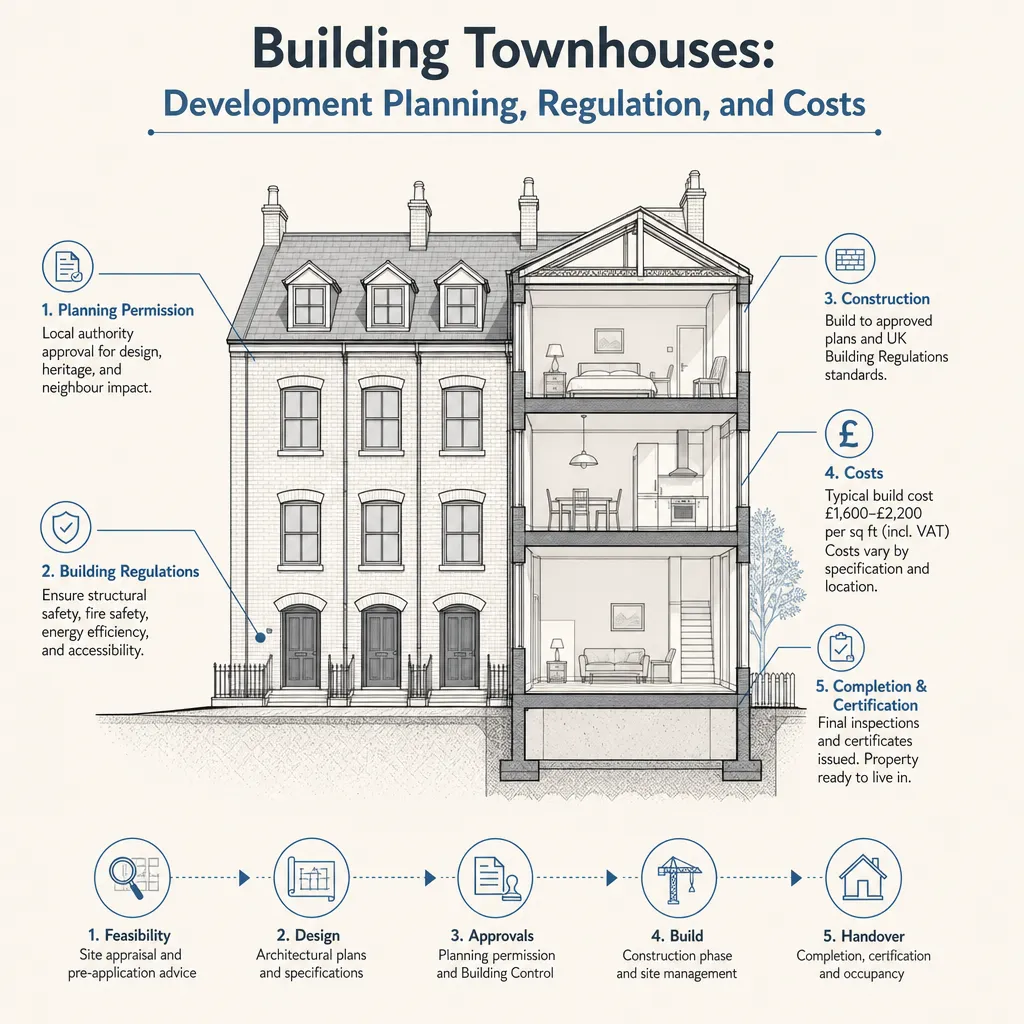
Building Townhouses: Development Planning, Regulation, and Costs
Building townhouses in the UK requires full planning permission for all new dwellings — permitted development rights do not apply to new residential construction.
 Planning & Pre-Build
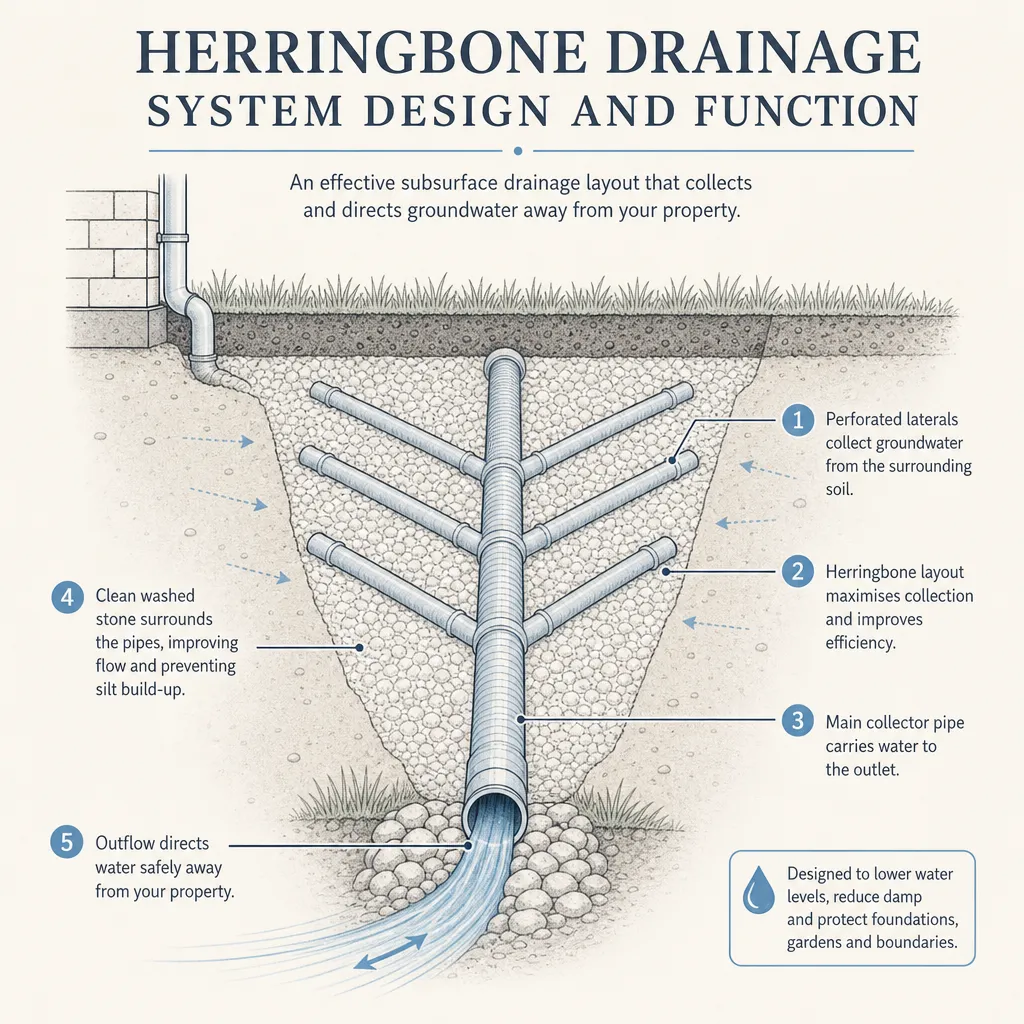
Herringbone Drainage System Design and Function
A herringbone drainage system uses a central collector drain with angled lateral branches — like a fishbone — to carry subsurface water away from a site by gravity.
 Planning & Pre-Build
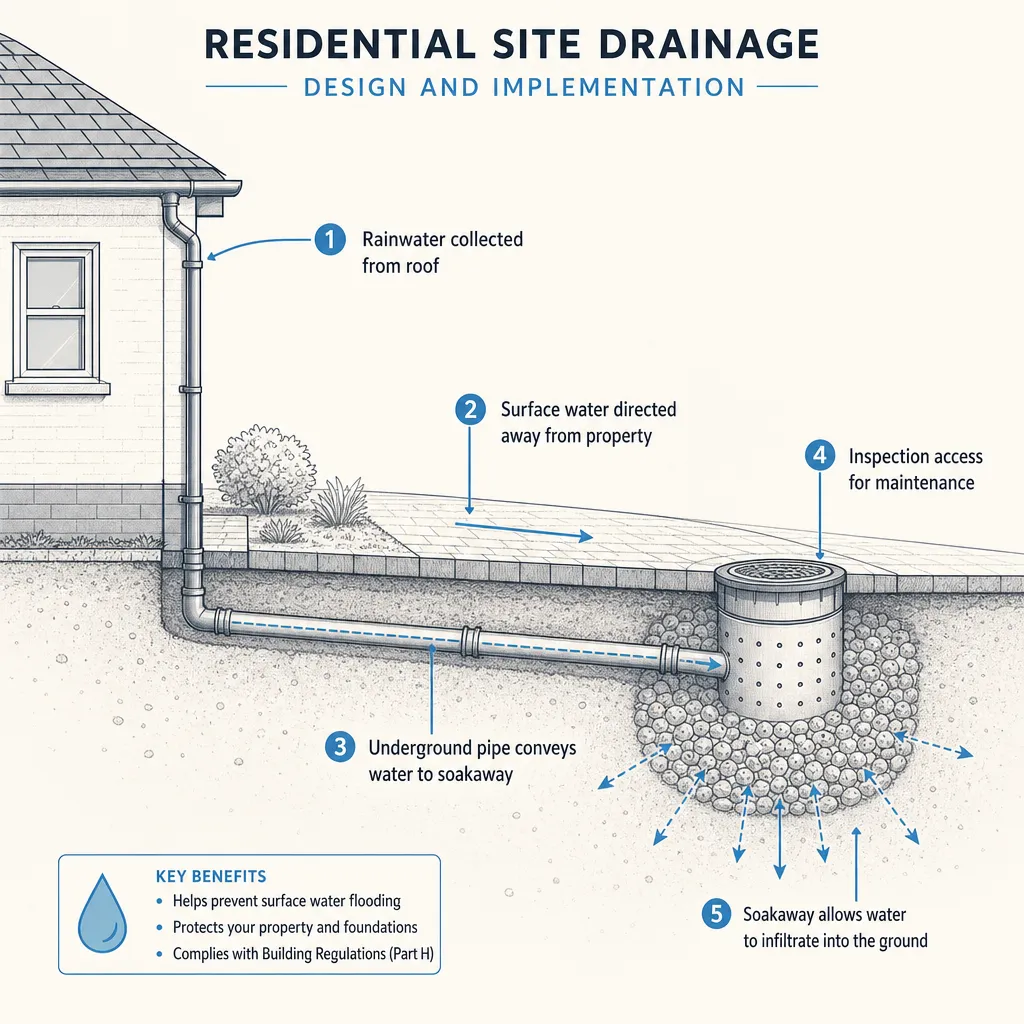
Residential Site Drainage Design and Implementation
Residential site drainage covers three distinct systems — surface water, subsoil water, and foul water — each requiring separate design and regulatory compliance.
 Planning & Pre-Build
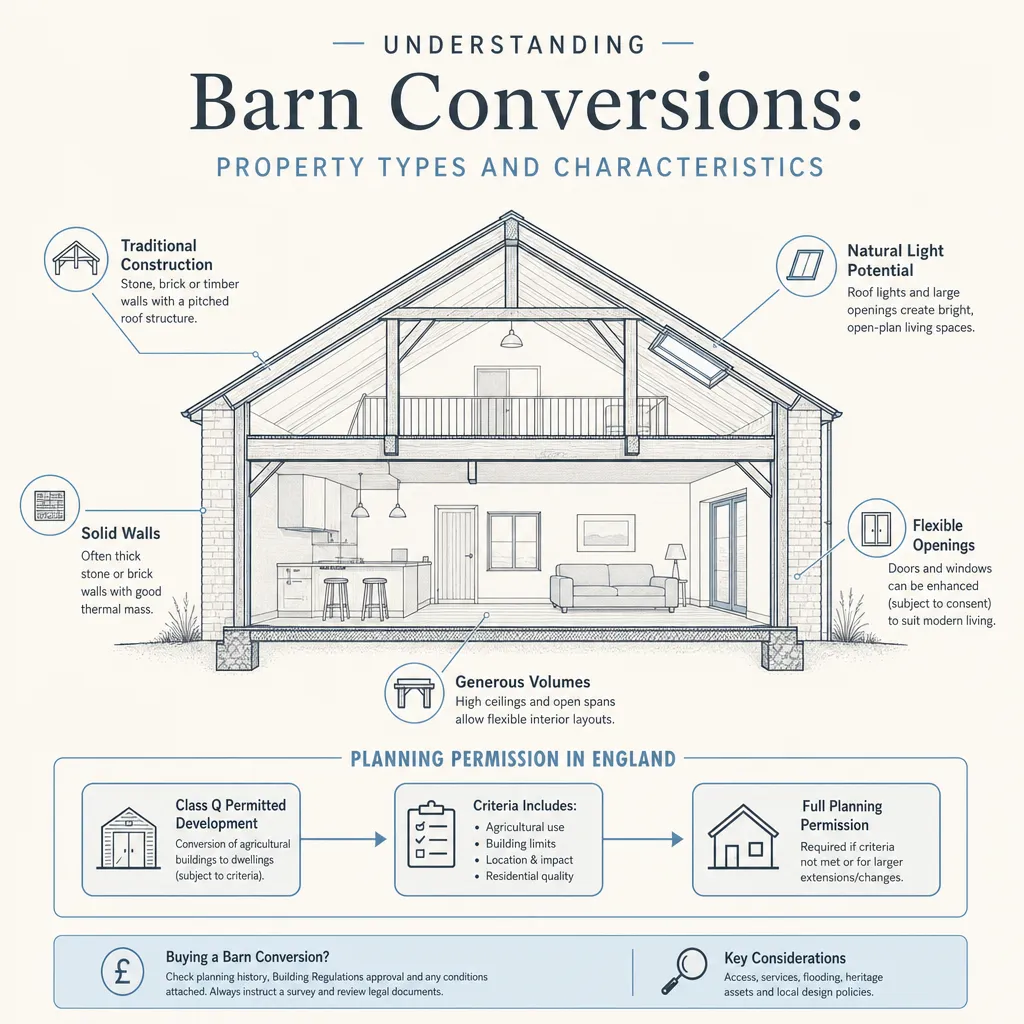
Understanding Barn Conversions: Property Types and Characteristics
A barn conversion is an agricultural building — typically a former threshing barn, cattle shed, or granary — converted into residential use.
 Planning & Pre-Build
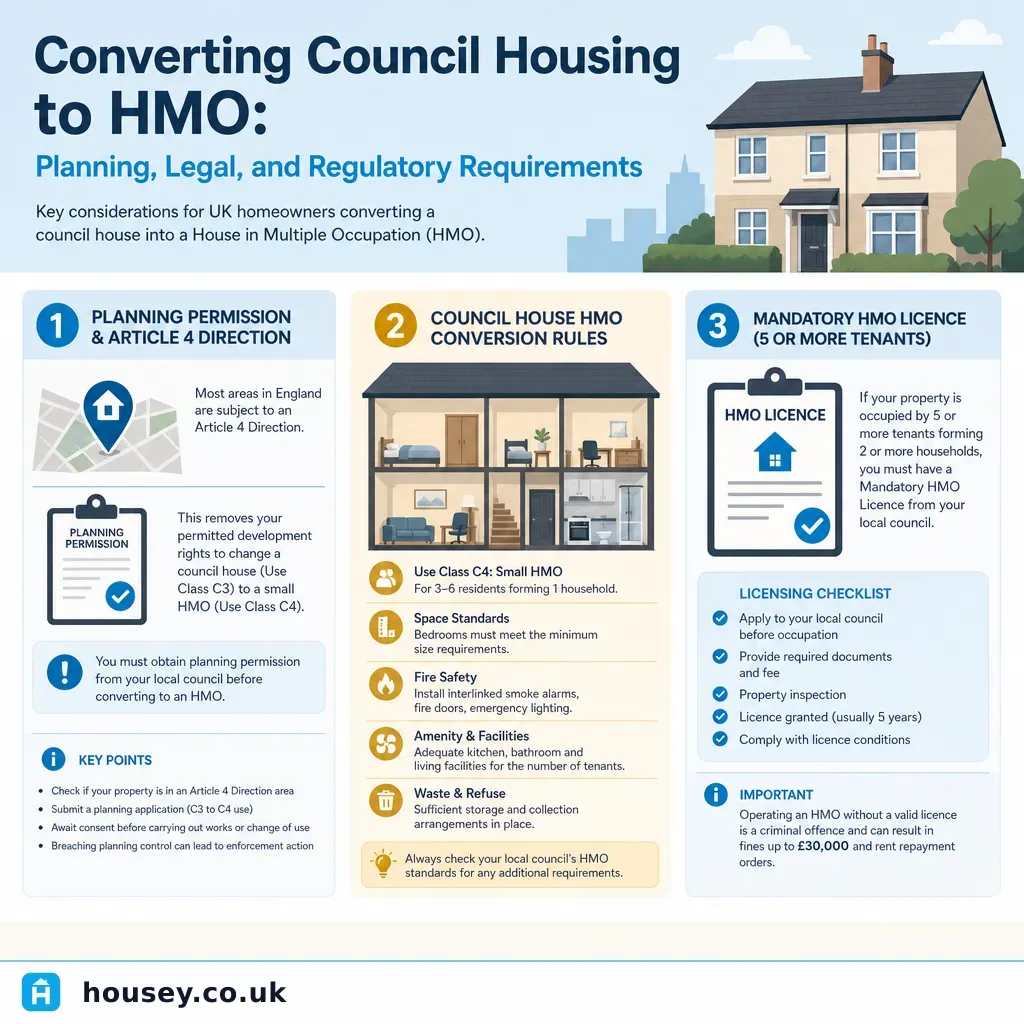
Converting Council Housing to HMO: Planning, Legal, and Regulatory Requirements
Converting a former council home to an HMO typically requires mandatory HMO licensing for properties with 5 or more occupants, and planning permission if the property falls within an Article 4 Direction area or you plan for 7 or more tenants.