Residential Site Drainage Design and Implementation
By Housey · Last reviewed 25th of May 2026
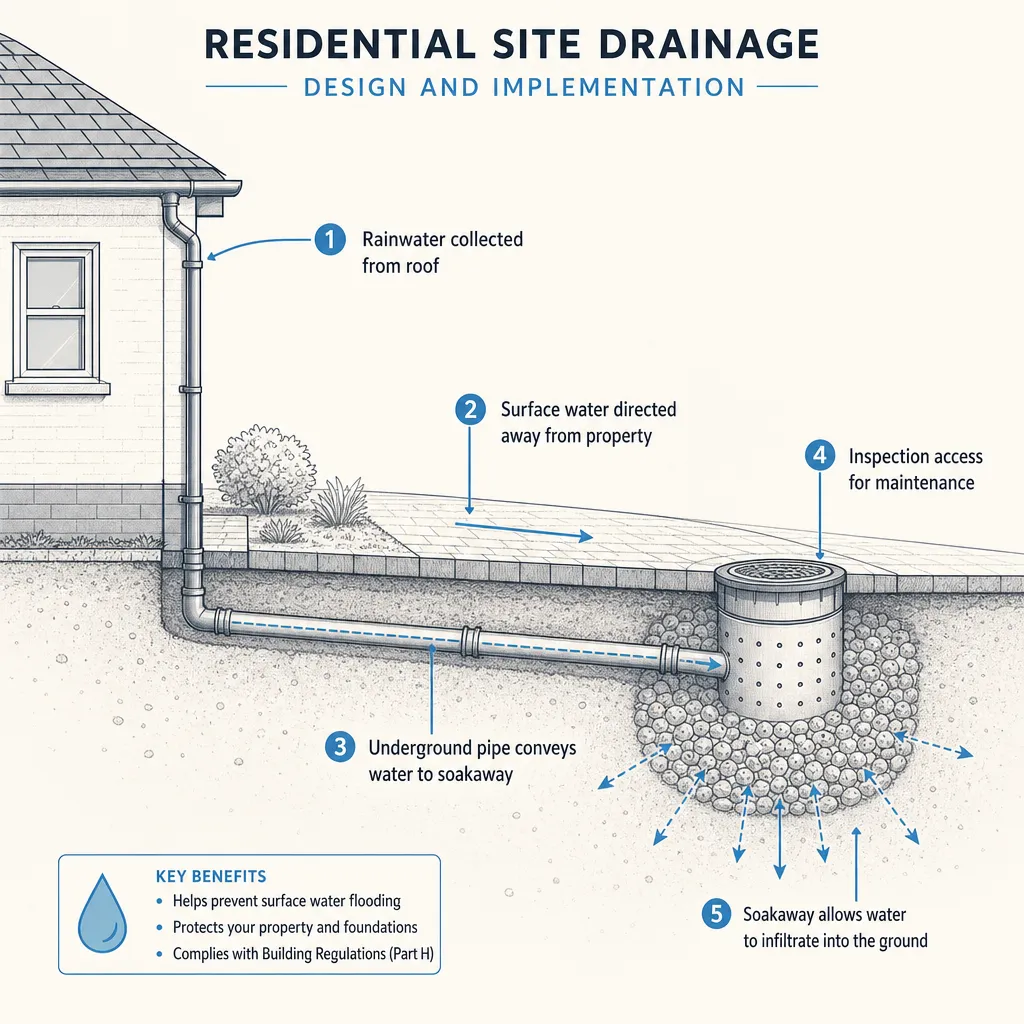
Residential Site Drainage Design and Implementation
When you are planning a new build, extension, or significant landscaping project in the UK, getting the drainage right before a single block is laid can save thousands in remediation costs later. Poor site drainage is one of the most common causes of foundation problems, saturated ground, and flooding complaints in residential construction — issues that can emerge months or years after work is complete, making them expensive and disruptive to fix.
Key points
- Building Regulations Approved Document H sets out the minimum requirements for drainage from roofs, surfaces, and subsoil in England and Wales.
- Schedule 3 of the Flood and Water Management Act 2010 made Sustainable Drainage Systems (SuDS) mandatory for new developments in Wales from 2018; in England, National Planning Policy Framework guidance requires SuDS consideration from local planning authorities for most major developments.
- Soakaways must be located at least 5 metres from any building foundation and 2.5 metres from a boundary, following BRE Digest 365 methodology.
- A percolation test is required before designing a soakaway — the result determines whether the ground can support this drainage method at all.
- Attenuation systems, swales, and permeable paving are SuDS alternatives where ground conditions make soakaways unsuitable.
What residential site drainage actually covers
Site drainage on a residential project typically encompasses three distinct systems that must each be considered separately.
Surface water drainage — rainwater falling on roofs, paths, driveways, and patios. This cannot legally be discharged to a foul sewer without consent, and in most cases should be managed on site or directed to a storm sewer or watercourse.
Subsoil (ground) drainage — managing groundwater, perched water tables, and lateral water movement through the ground. Unmanaged subsoil water is a leading cause of rising damp, foundation heave in clay soils, and poor structural performance over time.
Foul water drainage — waste water from bathrooms, kitchens, and utilities. This must connect to the public foul sewer or a compliant private treatment system such as a septic tank or sewage treatment plant.
Each system has different regulatory obligations and different design approaches. For straightforward residential work, a drainage contractor experienced in domestic projects will usually handle surface and subsoil drainage design and installation. Foul drainage connection arrangements may also involve your local sewerage undertaker.
Which drainage approach is right for your site?
Choosing the right method depends on your soil type, plot size, proximity to watercourses, and local planning requirements.
Method | Best for | Not ideal for | Key requirement |
|---|---|---|---|
Soakaway | Sites with permeable subsoil (sandy or gravelly ground) | Clay soils, high water tables, proximity to foundations | Percolation test; at least 5m from buildings |
Attenuation tank | Sites with impermeable ground or space constraints | Very large impervious areas without an adoption agreement | Calculated storage volume; controlled outflow |
Swale or infiltration basin | Larger plots, rural or semi-rural settings | Small urban plots | Planning agreement; SuDS approval |
Permeable paving | Driveways and paths — reduces runoff at source | High-load areas without specialist reinforcement | Permeable sub-base drainage layer required |
Connection to highway drain | Where a local authority storm sewer is available | Not available on all sites; may require formal adoption | Local authority adoption agreement |
Which drainage solution should you explore first?
- Carry out a percolation test first. If the ground infiltration rate supports it, a soakaway is often the simplest and lowest-cost solution.
- If the soakaway fails the percolation test, consider attenuation with restricted discharge to a watercourse or storm drain — this requires Environment Agency or local authority approval.
- If no storm drain or watercourse is available nearby, speak to your local lead local flood authority (LLFA) and a drainage contractor about on-site storage or infiltration SuDS options.
- If your project is a major development (10 or more dwellings or equivalent), SuDS Approval Body (SAB) approval is mandatory in Wales and strongly expected in England via the local planning authority.
- If you have a high groundwater table, subsoil drainage with perimeter drains and a sump pump may be needed in addition to surface water management.
Percolation tests and soil investigation
Before any drainage design can be finalised, you need to understand what the ground beneath your site is doing with water. A percolation test (conducted to BRE Digest 365 methodology) involves digging trial pits, saturating the soil, and measuring how quickly water drains away. The result — expressed in seconds per millimetre — determines whether a soakaway is viable and, if so, how large it needs to be.
For anything beyond straightforward surface drainage, a geotechnical investigation can identify soil bearing capacity, groundwater levels, and soil chemistry — information that affects not just drainage design but foundation specification and subbase requirements. A geotechnical and soil investigation typically includes boreholes, trial pits, and laboratory analysis of samples taken from your specific site.
Building Regulations and approval requirements
Approved Document H covers drainage and waste disposal for buildings in England and Wales. For new dwellings and extensions, compliance is not optional — building control will inspect drainage installations as part of their site inspections throughout the build.
Key requirements include:
- Surface water should be discharged in this order of preference: soakaway or infiltration first, then watercourse, then surface water sewer (never foul sewer).
- Foul and surface water systems must be kept entirely separate.
- Drain gradients must achieve self-cleansing velocity — a minimum of 1:80 for 100mm pipes, with 1:40 preferred where falls allow.
- Access points (inspection chambers and rodding points) must be provided at all junctions and at appropriate intervals along pipe runs.
For SuDS, Wales requires pre-construction approval from the local SuDS Approval Body. In England, the National Planning Policy Framework requires developments to incorporate SuDS unless there is clear justification why they are inappropriate. A building control consultant can clarify exactly which notifications and approvals are needed for your specific project and local authority area.
Homeowner checklist: before your drainage contractor starts
When to get professional help
Site drainage design errors affect structural integrity, neighbour relations, and legal compliance. Seek qualified professional input if:
- Your site is in or near a flood zone (check the Environment Agency Flood Map for Planning before work starts).
- The ground is clay-heavy, waterlogged, or on a slope with water tracking towards the proposed building.
- You are within 3 metres of a public sewer — you may need a build-over or diversion agreement with your water authority.
- Your local planning authority or SuDS approval body has imposed drainage conditions on your planning consent.
- You are connecting to a watercourse — this requires consent from the Environment Agency or the relevant Internal Drainage Board.
- Existing drainage is visibly failing on site before or during groundworks.
How Housey can help
Housey connects you with experienced drainage contractors and groundworkers who can assess your site, carry out percolation tests, produce compliant drainage designs, and install systems to Building Regulations standards. If your project needs soil investigation before drainage design can be finalised, we can also connect you with geotechnical and soil investigation specialists who cover residential and light commercial sites across the UK.
Frequently asked questions
Do I need planning permission for site drainage works?
Generally, drainage works within your property boundary do not need planning permission in themselves, but your drainage design must comply with any conditions attached to an existing planning consent. In Wales, SuDS approval from the local SuDS Approval Body (SAB) is a statutory requirement before construction begins. In England, check your planning conditions and consult your local planning authority if you are unsure.
Can I connect new surface water drainage to the foul sewer?
No — in virtually all cases this is prohibited. Surface water and foul water must be kept in entirely separate systems. Connecting surface water to the foul sewer can cause sewage flooding and is an offence under the Water Industry Act 1991. Your water authority or drainage contractor can advise on the correct discharge point for your specific site and circumstances.
How deep should a soakaway be?
Soakaway depth depends on your percolation test results, the volume of water to be handled, and ground conditions. A typical domestic soakaway might be 1–3 metres deep, but the design must be calculated following BRE Digest 365 methodology. A drainage contractor or civil engineer will size it correctly based on your site-specific data and the total catchment area draining to it.
What is the difference between a drainage contractor and a groundworker?
Groundworkers carry out physical ground preparation — excavation, subbase laying, and levelling. Drainage contractors specialise in the design and installation of drainage systems. On many residential projects the same company provides both services, but for complex drainage design look for contractors with specific experience in SuDS and residential civil engineering drainage work.
Sources and further reading
- Building Regulations Approved Document H: Drainage and Waste Disposal — GOV.UK
- Flood and Water Management Act 2010 — legislation.gov.uk
- Sustainable Drainage Systems guidance — GOV.UK
- Environment Agency Flood Map for Planning — Environment Agency
- Sustainable drainage in Wales — Welsh Government
Useful next reads
 Planning & Pre-Build
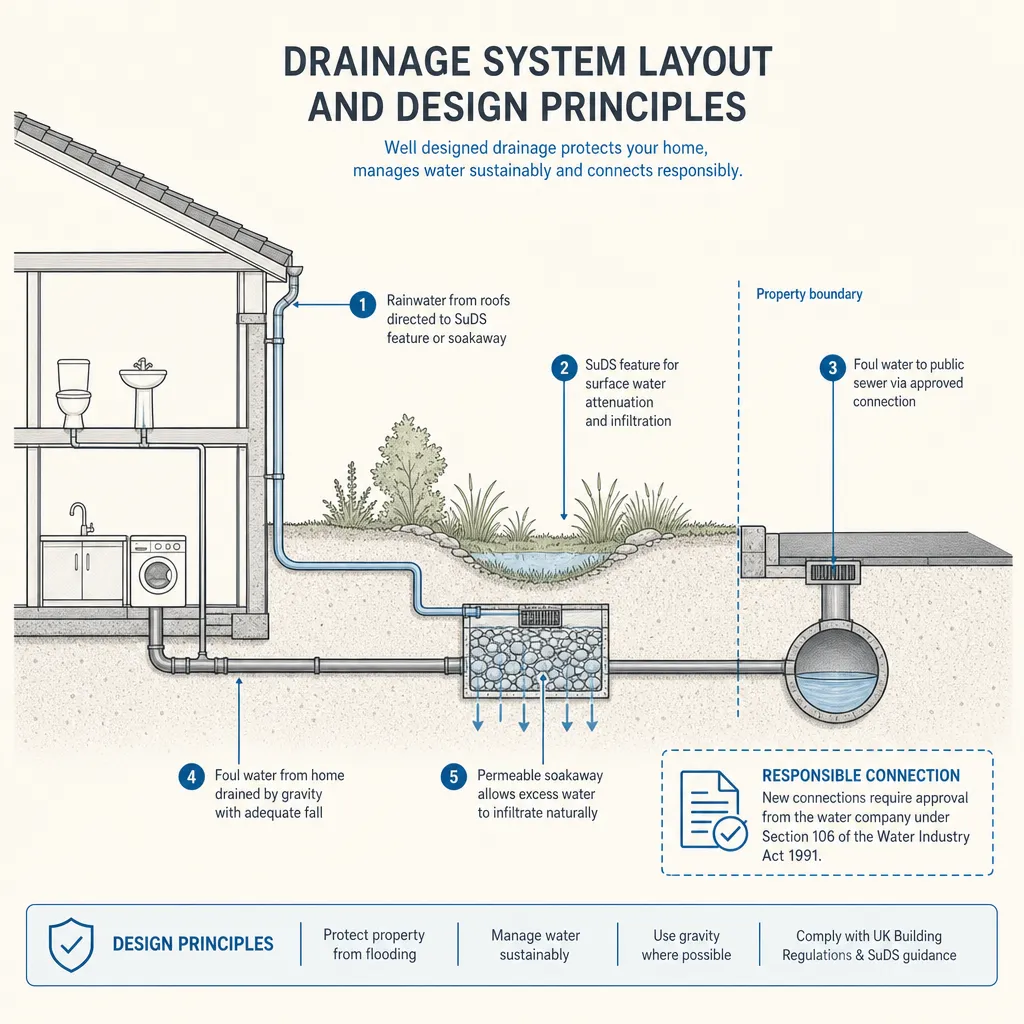
Drainage System Layout and Design Principles
A UK drainage layout separates foul water from surface water, routes both via correctly graded pipes to the public sewer, a soakaway, or a treatment plant, and incorporates Sustainable Drainage Systems where required.
 Planning & Pre-Build
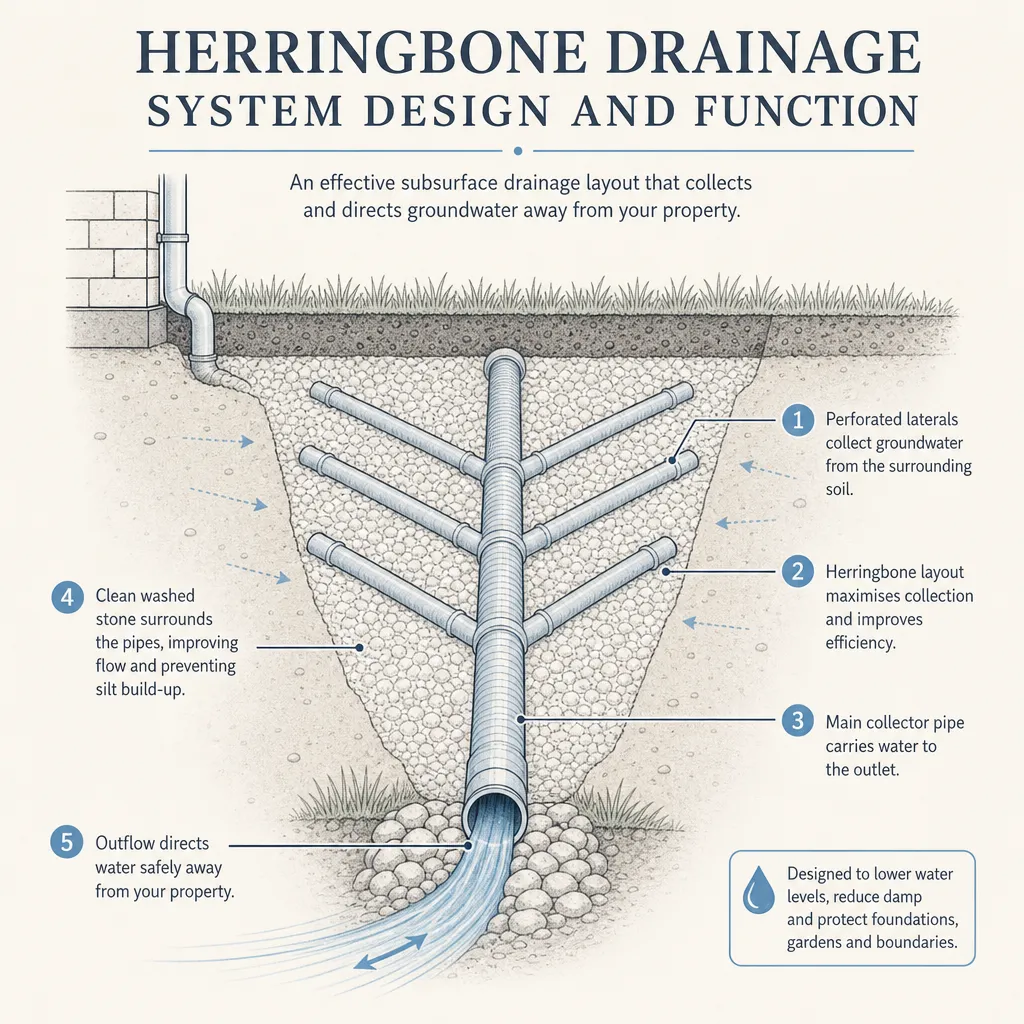
Herringbone Drainage System Design and Function
A herringbone drainage system uses a central collector drain with angled lateral branches — like a fishbone — to carry subsurface water away from a site by gravity.
 Planning & Pre-Build
Native Plants for Rain Gardens: Ecological Design and Installation
Native UK plants are ideal for rain gardens because they tolerate the country's seasonal wet-dry rainfall cycle, support local pollinators and invertebrates, and align with Biodiversity Net Gain objectives.
 Planning & Pre-Build
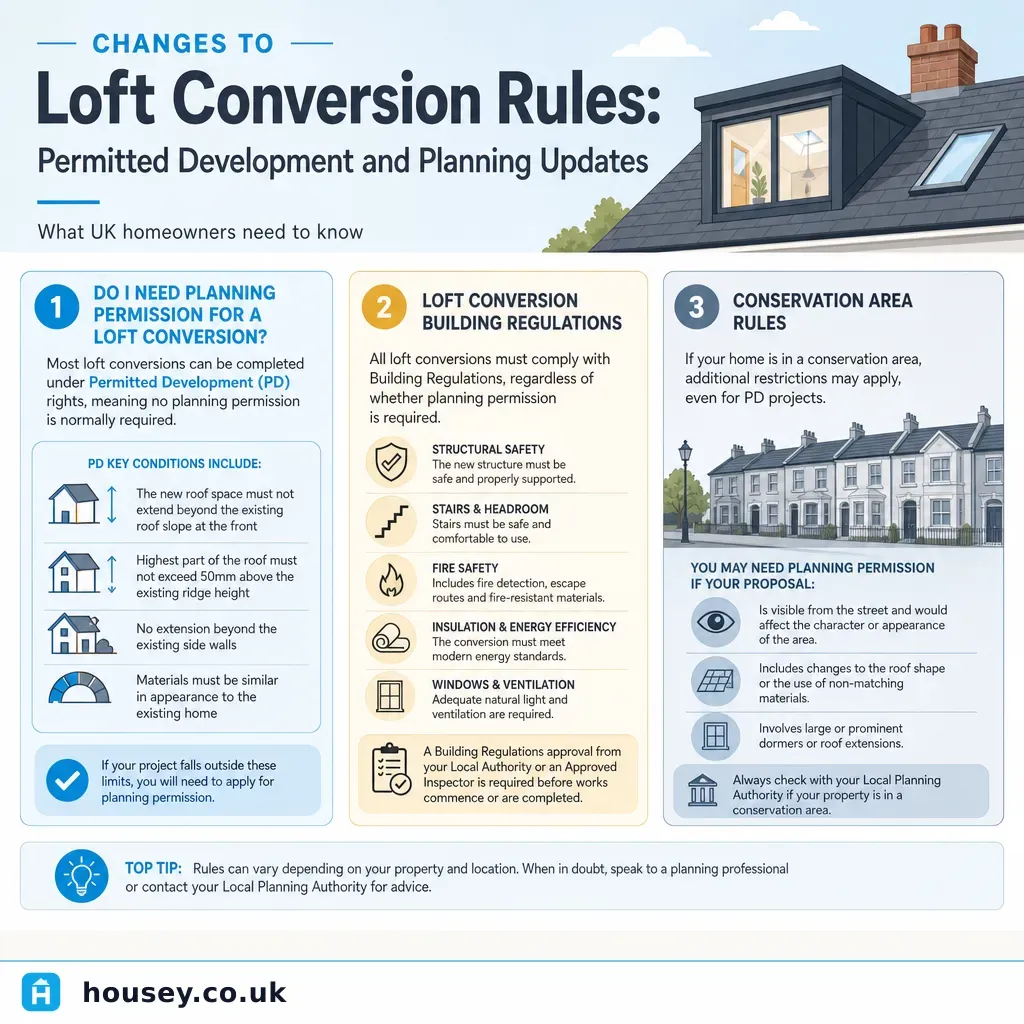
Changes to Loft Conversion Rules: Permitted Development and Planning Updates
In England, most loft conversions on standard houses qualify as Permitted Development under Class B of the GPDO 2015, allowing up to 40 cubic metres (terraced) or 50 cubic metres (detached or semi-detached) without a planning application — if conditions are met.
 Planning & Pre-Build
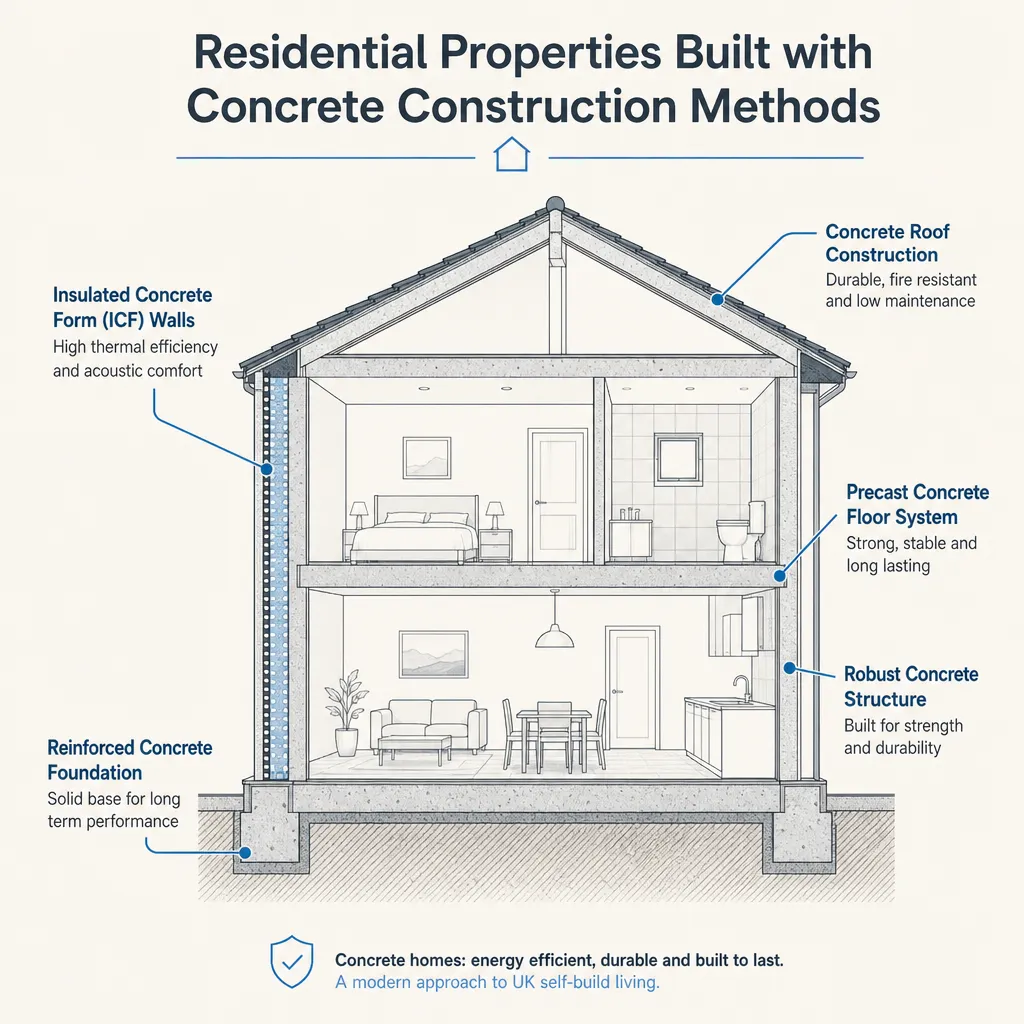
Residential Properties Built with Concrete Construction Methods
UK homes are built using several concrete methods: in-situ cast concrete, precast panel systems, insulating concrete formwork (ICF), and older non-traditional types such as Wimpey No-Fines and Laing Easiform.