Drainage Systems: Understanding Your Property's Water Management and Maintenance
By Housey · Last reviewed 19th of May 2026
Drainage Systems: Understanding Your Property's Water Management and Maintenance
Drainage problems tend to announce themselves at the worst possible moment — a blocked gully before heavy rain, a slow-draining sink that worsens over winter, or a soakaway that has failed after decades of service. UK properties carry a mix of drainage responsibilities that sit with homeowners, water companies, and local authorities, and understanding which system is which can save you from expensive emergency call-outs or, worse, damage to foundations and neighbouring properties. Whether you're buying an older house, planning an extension, or simply trying to prevent future problems, knowing how your drainage works is a practical necessity.
Key points
- Surface water (rain) and foul water (sewage) run in separate pipes in most UK properties built after the early 1970s; older properties may have a combined system.
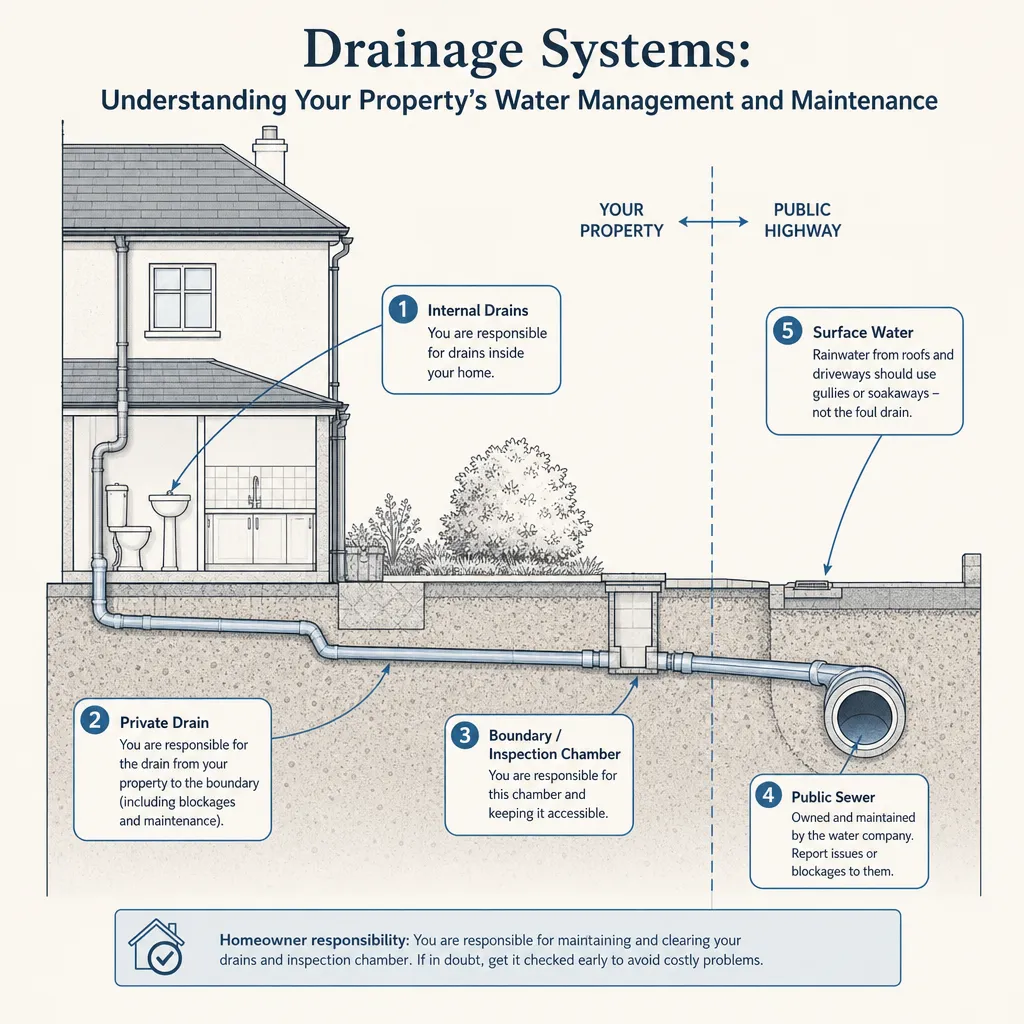
- Under the Water Industry Act 1991 (as amended in 2011), water companies in England and Wales became responsible for private sewers and lateral drains beyond the property boundary; drains within your boundary remain your responsibility.
- Building Regulations Approved Document H governs drainage and waste disposal for new builds and alterations in England and Wales.
- Sustainable Drainage Systems (SuDS) are mandatory for new major developments in England under Schedule 3 of the Flood and Water Management Act 2010.
- A CCTV drain survey — typically costing £150–£400 — can identify blockages, root ingress, collapsed sections, and misaligned joints before they escalate.
The two main drainage systems in a UK home
Most UK homes built after roughly 1970 operate two entirely separate drainage systems.
Foul water drainage carries waste from toilets, sinks, baths, and appliances to the public sewer. Surface water drainage directs rainwater from roofs, paths, and driveways either to a surface water sewer, a soakaway, or a watercourse.
Older properties — particularly Victorian and Edwardian terraces — may have a combined system where both foul and surface water share the same pipes. This increases sewer load during heavy rainfall and can mean sewage surcharges (backflow) in storms. If you're buying a Victorian terrace or planning drainage works on an older property, a CCTV drain survey is worth commissioning to establish exactly what you have.
Who owns what?
Drain section | Typical ownership | Responsibility |
|---|---|---|
Drain within your boundary (serving your property only) | Homeowner | Maintenance and repair |
Lateral drain (from your boundary to the public sewer) | Water company (since 2011) | Water company responsible |
Shared private sewer (serving more than one property) | Water company (since 2011) | Water company responsible |
Public sewer | Water company | Water company responsible |
Private treatment plant or septic tank | Property owner | Homeowner responsible |
The 2011 change under the Water Industry Act 1991 amendment transferred a significant portion of the private sewer network to water companies. If you have been maintaining a drain beyond your boundary under the impression it was your responsibility, it is worth contacting your water company to clarify ownership.
Common drainage problems and what causes them
Blockages
The most frequent drainage complaint in UK homes. Common culprits include:
- Fat, oil, and grease accumulation in kitchen drains.
- Fatbergs — congealed fat combined with wet wipes, sanitary products, and other non-flushable items in the sewer.
- Leaf debris and silt in gullies and surface water drains.
- Root ingress from trees and shrubs into clay or concrete pipes.
Blockages in the pipe serving only your property are your responsibility to clear. If the blockage is in a shared sewer or lateral drain, contact your water company.
Soakaway failure
A soakaway disperses surface water into the surrounding ground. They have a finite lifespan — typically 20–30 years — and can become saturated or clogged with silt. Signs of failure include standing water around the soakaway, water pooling on lawns after rain, or gully drains that run slowly.
Replacing a soakaway requires a percolation test to confirm the ground can accept water; British Standard BS EN 752 and Approved Document H provide guidance on sizing. In clay-heavy soils, soakaways may not be suitable and alternative disposal routes — such as attenuation tanks or connection to a surface water sewer — may be needed.
Drain collapse or misalignment
Older clay pipes are prone to cracking, root intrusion, and joint failure. Concrete pipes can deteriorate with age. A CCTV survey is the most reliable way to assess pipe condition without excavation, and should be a standard step when buying an older property or investigating persistent blockages.
Surface water and planning considerations
If you're building an extension, paving a driveway, or carrying out other works that increase the hard-standing area of your property, you'll need to consider where the additional surface water goes.
Under Approved Document H (Section H3), surface water from new development must be managed in a way that does not increase flood risk to others. The preferred hierarchy for surface water disposal is:
- Soakaway or infiltration device.
- Watercourse.
- Surface water sewer.
- Combined sewer (last resort; check with the sewerage undertaker).
Connecting surface water to the foul sewer is not permitted under building regulations. Your local water company or local authority may need to approve any new connections.
Maintenance checklist for homeowners
Good drainage maintenance prevents most expensive emergencies. Check and carry out the following at least once a year:
- Clear gully pots — remove leaf debris and silt from surface water gullies, particularly in autumn.
- Check downpipes and gutters — blockages cause overflow to walls and can saturate ground around foundations.
- Avoid pouring fat down drains — let fat cool and dispose of it in the bin.
- Do not flush non-flushable products — wet wipes, cotton buds, sanitary items, and nappies should go in a bin.
- Monitor soakaway areas after heavy rain — standing water or slow drainage suggests reduced capacity.
- Check inspection chambers — lift accessible manholes periodically for signs of blockage, root growth, or structural damage.
- Know your sewer layout — request a drainage search (CON29DW) when buying a property to understand what is connected to the public sewer and where.
Red flags that need urgent attention
The following signs suggest a drainage problem that warrants prompt professional investigation:
- Sewage smell inside the property — could indicate a dry trap, a cracked pipe, or a blocked soil stack.
- Multiple fixtures draining slowly at the same time — suggests a blockage in the main soil drain rather than an individual trap.
- Gurgling sounds from toilets or drains when others are in use — partial blockage in shared pipework.
- Sewage or foul water backing up — a public sewer issue or a collapsed lateral drain; report to the water company immediately.
- Sinkholes or ground subsidence near drain runs — can indicate a collapsed pipe or a long-running void.
- Damp patches on internal walls close to underground drain routes — a cracked foul drain can saturate the ground and wick moisture through foundations.
When to get professional help
A qualified drainage contractor or drainage surveyor should be involved when:
- You have persistent blockages that respond temporarily to jetting but return within weeks.
- You are buying a property and want to understand the condition of underground drainage.
- You are planning an extension, new driveway, or significant landscape works.
- You suspect a collapsed pipe, root intrusion, or structural failure.
- Ground settlement, sinkholes, or unexplained damp is present near drain routes.
- Your septic tank or private treatment plant is overflowing or not functioning correctly.
For septic tanks and private sewage treatment plants, the Environment Agency's general binding rules apply, and any permit requirements should be checked before replacement or new installation.
How Housey can help
Housey connects you with vetted local drainage contractors for blockage clearance, soakaway replacement, and drain repairs, as well as professionals offering drainage surveys including CCTV inspection — particularly useful before buying a property or before undertaking major groundworks.
Frequently asked questions
Who is responsible for a shared drain between two houses?
Since October 2011, shared private sewers and lateral drains serving more than one property became the responsibility of the relevant water company under the Water Industry Act 1991, as amended by the Water Industry (Schemes for Adoption of Private Sewers) Regulations 2011. Report shared drain problems to your water company rather than attempting to arrange joint repairs with neighbours.
Do I need planning permission to install a soakaway?
A soakaway serving a single house is generally permitted development and does not require planning permission, provided it is correctly sited — typically at least 5 metres from any building or boundary. Building regulations may still apply, and you should carry out a percolation test and follow the sizing guidance in Approved Document H before installation.
How often should I have my drains surveyed?
There is no regulatory requirement for routine CCTV drain surveys on residential property. Most homeowners commission a survey when buying a property, when experiencing persistent drainage problems, or before undertaking works that might affect underground drainage. Properties with mature trees close to drain runs may benefit from a survey every 5–10 years to check for root intrusion.
Can I connect my extension's surface water to the foul sewer?
No. Building Regulations Approved Document H prohibits connecting surface water drainage to the foul sewer, except where no alternative exists and the sewerage undertaker consents. Surface water should be disposed of through a soakaway, discharge to a watercourse, or connection to a dedicated surface water sewer — in that order of preference.
Sources and further reading
- Building Regulations Approved Document H — GOV.UK
- Water Industry (Schemes for Adoption of Private Sewers) Regulations 2011 — legislation.gov.uk
- Flood and Water Management Act 2010 — legislation.gov.uk
- General binding rules: small sewage discharges to the ground — Environment Agency / GOV.UK
- Sustainable drainage systems guidance — GOV.UK
Useful next reads
 Improvement & Build
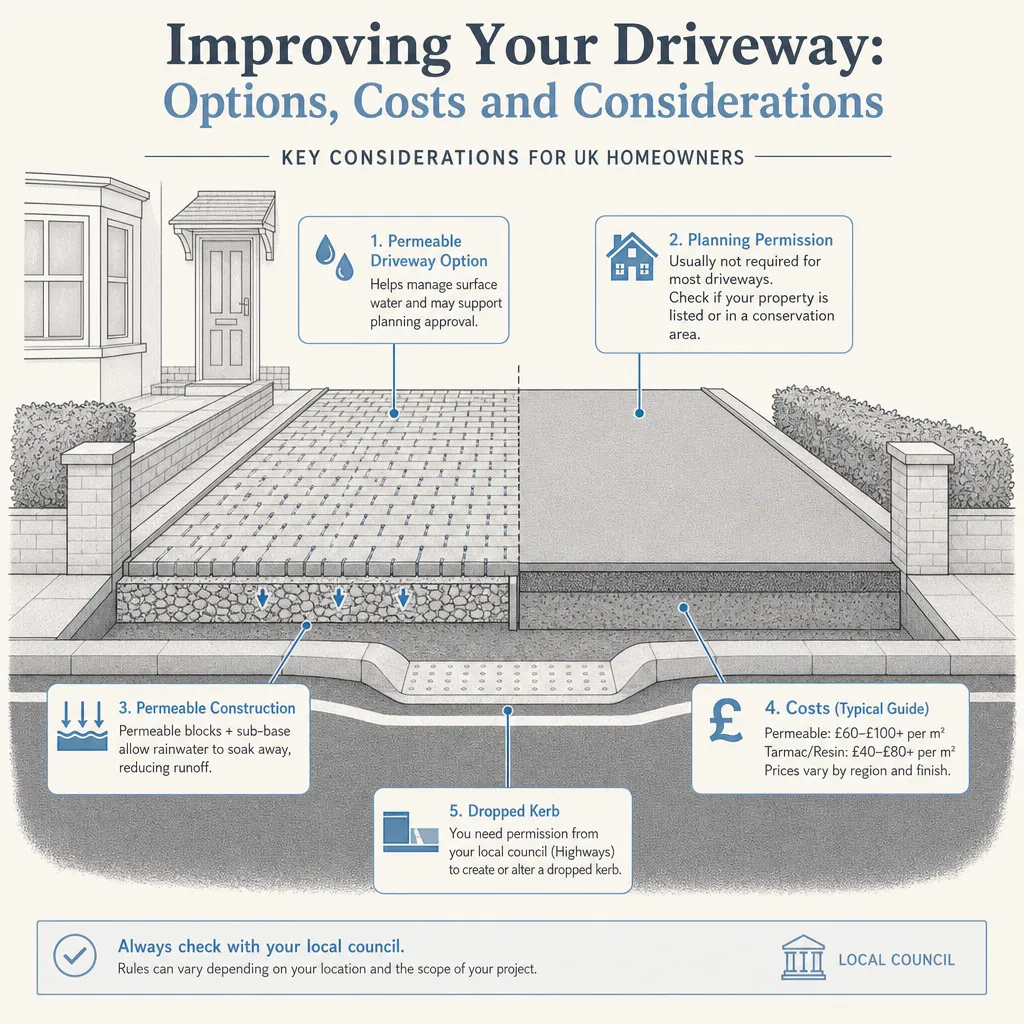
Improving Your Driveway: Options, Costs and Considerations
Installing a new driveway with a non-permeable surface larger than 5m² over a front garden in England requires planning permission unless water drains to a permeable area.
 Improvement & Build
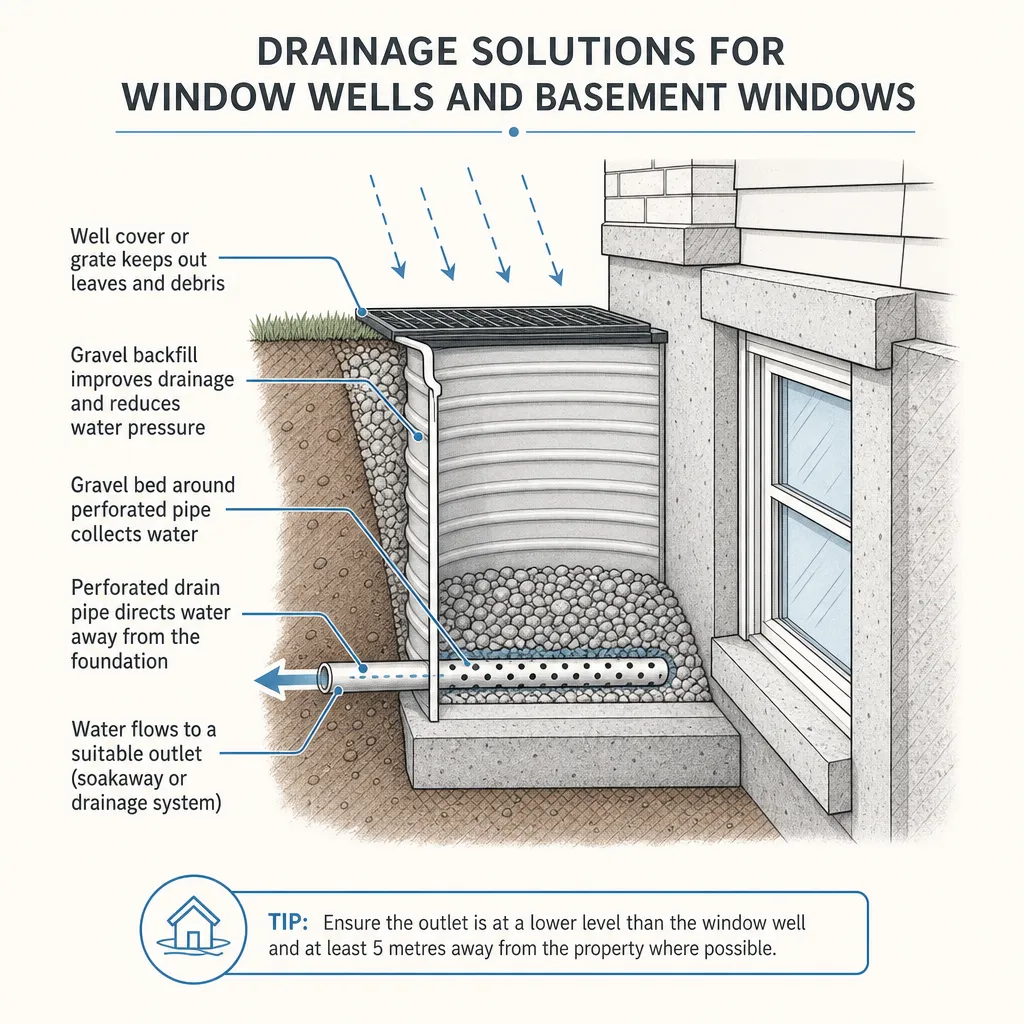
Drainage solutions for window wells and basement windows
Most UK window wells manage water through a gravel-filled sump at least 200 mm deep or a plastic liner fitted with a drain outlet connected to a soakaway or drainage system.
 Improvement & Build
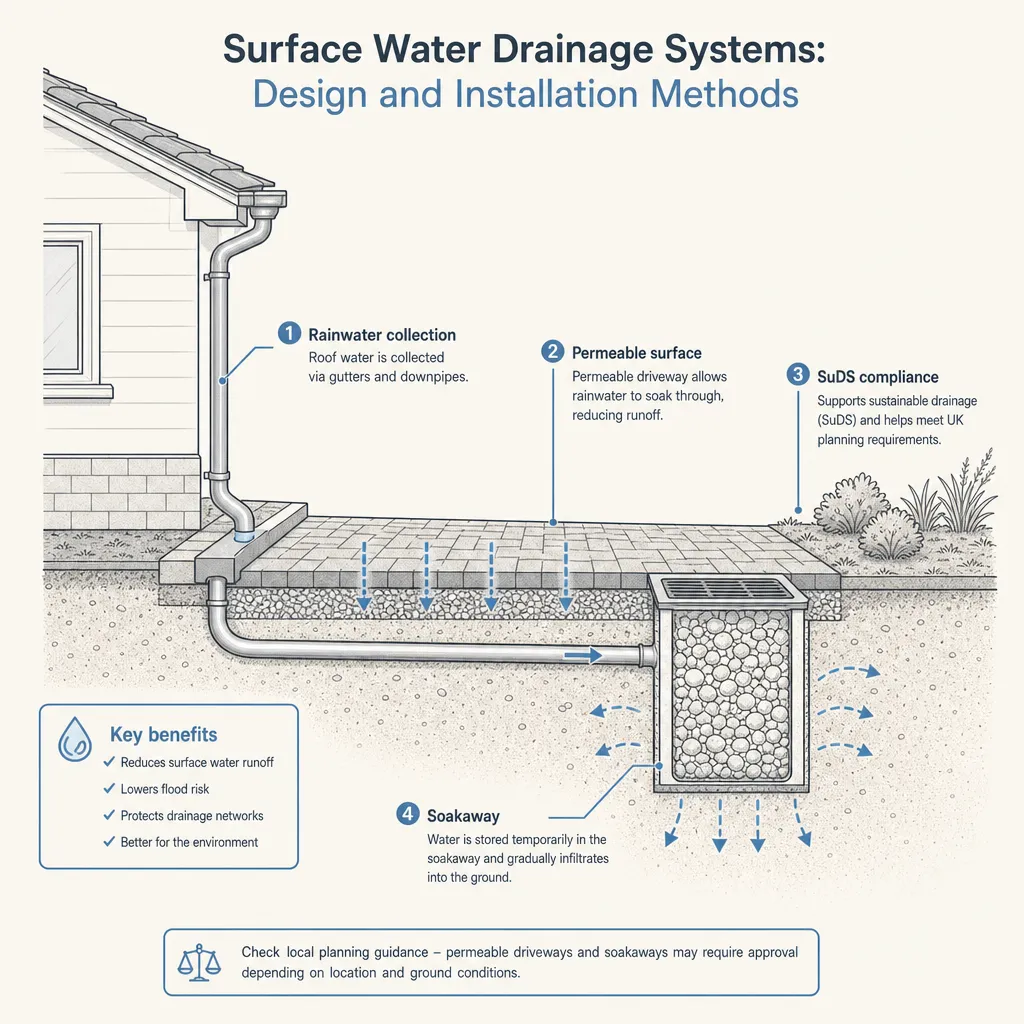
Surface Water Drainage Systems: Design and Installation Methods
Surface water drainage manages rainwater run-off from roofs, driveways, and hard standing.
 Improvement & Build
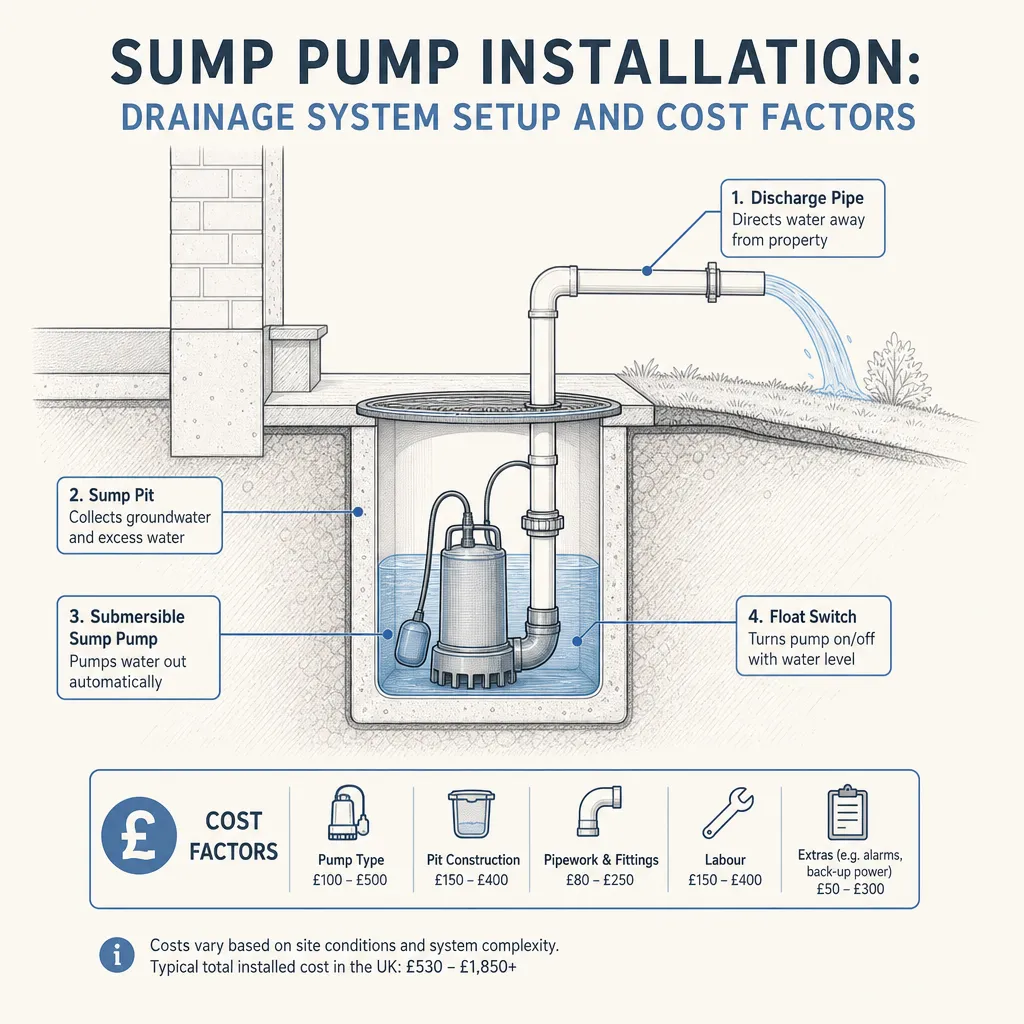
Sump Pump Installation: Drainage System Setup and Cost Factors
Sump pump installation in the UK typically costs £800–£2,500 for a submersible pump in a new or existing pit, including excavation, liner, discharge pipework, and connection to a suitable outlet.
 Improvement & Build
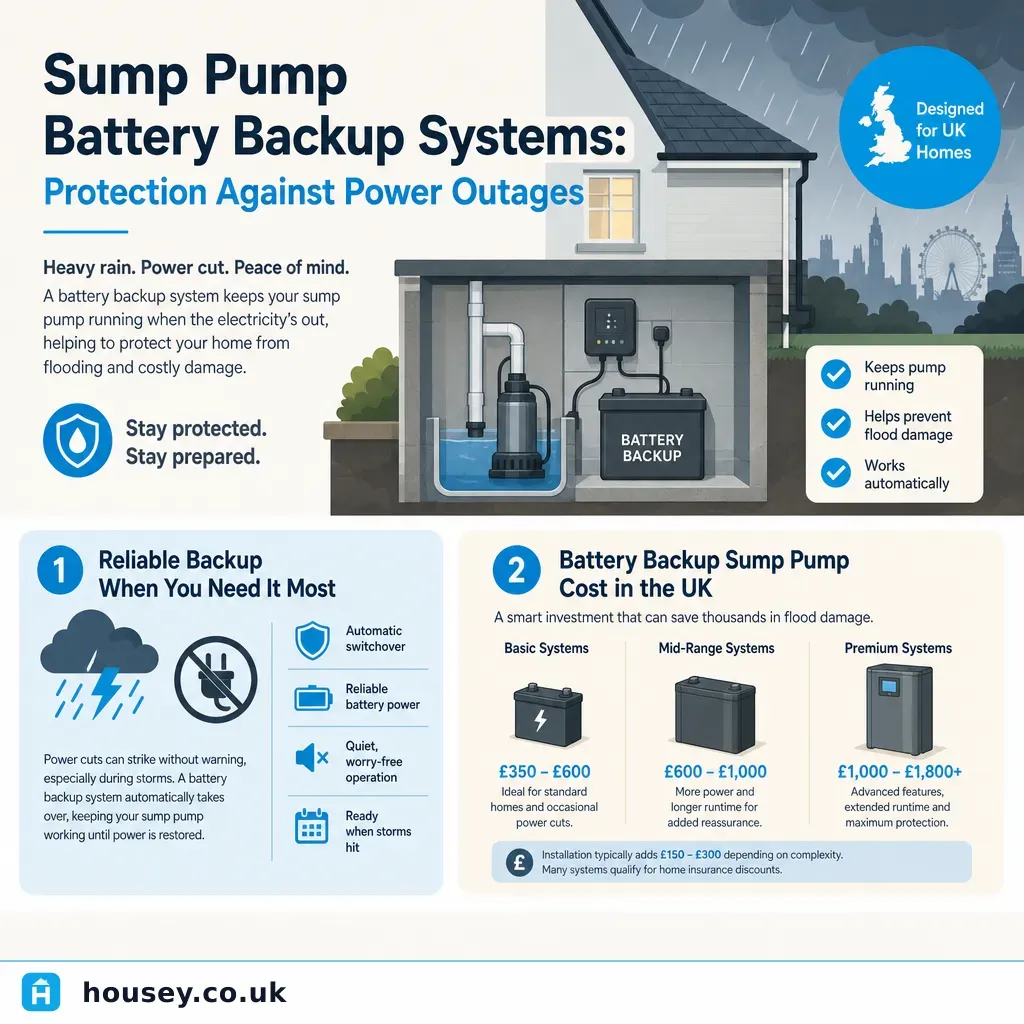
Sump Pump Battery Backup Systems: Protection Against Power Outages
A sump pump battery backup activates automatically when mains power fails, continuing to pump water from your sump pit to protect against flooding.