Surface Water Drainage Systems: Design and Installation Methods
By Housey · Last reviewed 26th of May 2026
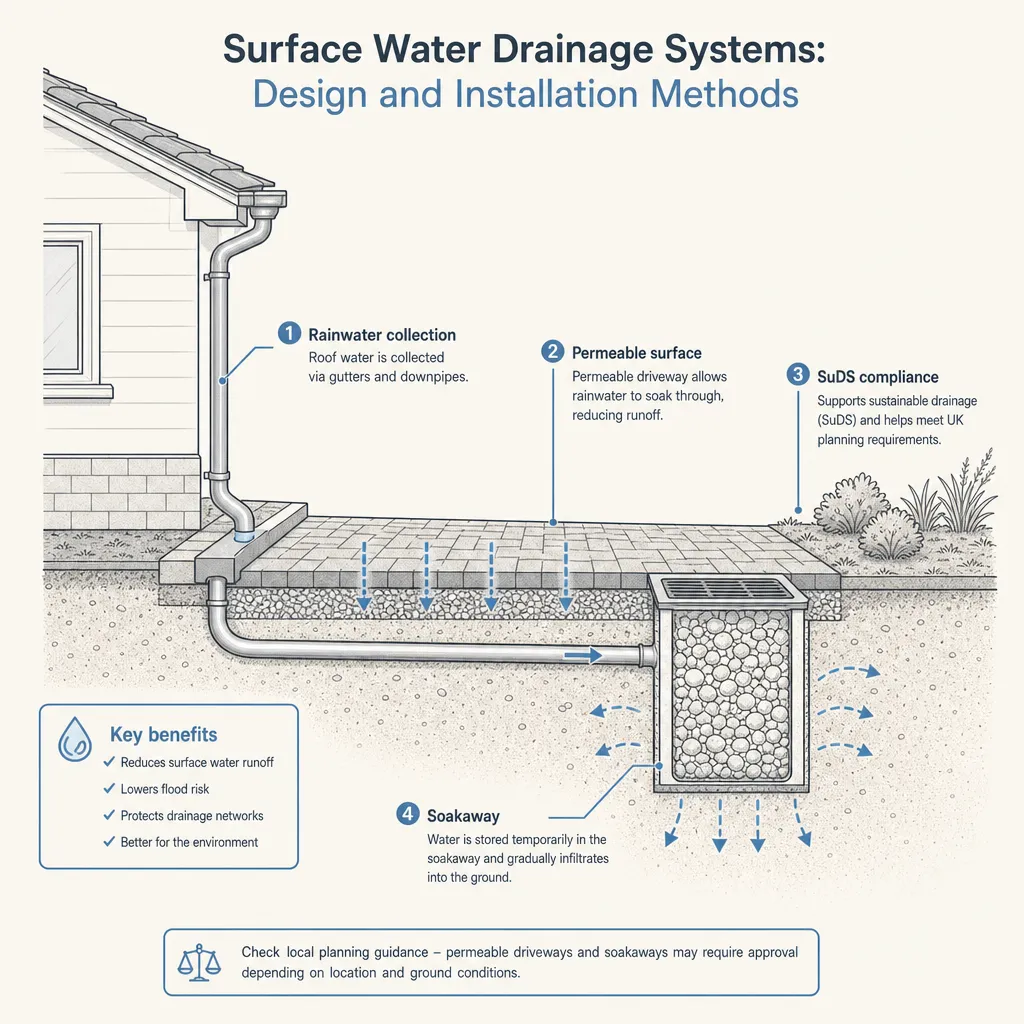
Surface Water Drainage Systems: Design and Installation Methods
Managing surface water run-off effectively is an increasingly urgent concern for UK homeowners, particularly as hard standing replaces garden space and rainfall events become more intense. Whether you are installing a new driveway, extending your home, or tackling persistent waterlogging, understanding how surface water drainage works — and what regulatory consents are required — prevents costly mistakes, enforcement action, and potential flood risk to neighbouring properties.
Key points
- Building Regulations Approved Document H (Drainage and Waste Disposal) covers surface water drainage for new and altered drainage systems in England and Wales.
- In England, the National Planning Policy Framework (NPPF) requires local planning authorities to ensure new developments incorporate sustainable drainage systems (SuDS); in Wales, SuDS approval is mandatory for most new construction under Schedule 3 of the Flood and Water Management Act 2010.
- Connecting surface water to a public sewer without written water company consent is a criminal offence under the Water Industry Act 1991.
- Soakaway design must follow BRE Digest 365, which requires a percolation test to confirm the ground can accept water at the required rate before sizing calculations begin.
- Permitted development rights in England require driveways over 5 m² fronting a public road to use permeable surfacing or to drain to a lawn or border — not to discharge directly to the public sewer.
How surface water drainage works
Surface water drainage collects and conveys rainwater from roofs, driveways, patios, and other hard surfaces, then routes it to an acceptable discharge point. The hierarchy of preferred discharge points under current UK planning policy is:
- Infiltration to ground (soakaways, infiltration trenches, permeable paving) — preferred where ground conditions allow.
- Discharge to a watercourse — requires consent from the Environment Agency (for main rivers) or the lead local flood authority (LLFA) (for ordinary watercourses).
- Discharge to a surface water sewer — requires water company agreement and is not always available.
- Discharge to a combined sewer — last resort; water companies increasingly restrict this to reduce combined sewer overflow (CSO) pollution events.
The preference for infiltration reflects national SuDS policy: keeping water close to where it falls, slowing its flow, and reducing pressure on downstream drainage infrastructure.
Sustainable drainage systems (SuDS) — what they require
SuDS encompasses a range of techniques designed to manage rainfall more naturally than traditional piped drainage. The four core SuDS objectives are water quantity management, water quality treatment, amenity, and biodiversity. Common SuDS components for domestic projects include:
SuDS component | Typical domestic use | Key design requirement | Maintenance need |
|---|---|---|---|
Soakaway (rubble or plastic crate) | Roof and small paved area run-off | Percolation test and BRE Digest 365 sizing | Annual inspection, clear inlet |
Permeable paving | Driveways and paths | Must infiltrate or drain to lawn or border | Annual joint clearing |
Rain garden or bio-retention cell | Front garden drainage | Minimum 5–10% of contributing catchment area | Seasonal planting maintenance |
Green roof (sedum or extensive) | Roof run-off attenuation | Structural capacity check required | Inspection every 1–2 years |
Swale (shallow vegetated channel) | Larger sites and new developments | Gradient and sizing by drainage engineer | Periodic vegetation management |
For most domestic projects, soakaways and permeable paving are the most practical and cost-proportionate SuDS options.
Soakaway design and installation
A soakaway is an underground pit that allows water to percolate slowly into the surrounding soil. Design must follow BRE Digest 365 (Soakaway Design), which involves three steps:
- Percolation testing — a field test measuring how quickly water drains through the soil at the proposed location.
- Sizing calculation — based on catchment area, design rainfall intensity (using Environment Agency FEH data or similar), and test results.
- Location constraints — at least 5 m from any building foundation, 2.5 m from a property boundary, above the winter groundwater table, and away from public sewers.
Two common construction types are used in the UK:
- Traditional rubble-filled soakaways — lower upfront cost, shorter lifespan, harder to inspect or rehabilitate.
- Plastic crate soakaways — typically 95% void ratio, longer lifespan, and more accurately sized to design. Products such as Wavin Azura crates or equivalent are commonly specified; crates are wrapped in geotextile before backfilling.
Failure most often results from insufficient percolation testing, poor siting (too close to structures or in high groundwater areas), or undersizing for the actual catchment area.
Linear drainage channels — how they work and when to specify them
Linear drainage channels collect surface water along their full length rather than at a single point, making them well suited to driveways, patios, and paths where sheet-flow drainage is required. Key selection criteria:
- Channel material: polymer concrete (durable, chemical-resistant), HDPE (lightweight), or galvanised steel.
- Grating load class: A15 for pedestrian areas, B125 for light vehicles, D400 for vehicular roads and car parks. Specifying the wrong load class risks grating failure.
- Channel fall: a minimum gradient of 1:200 is generally needed for self-cleansing; pre-sloped (internally inclined) channels avoid the need to lay the channel body on a gradient.
- Outlet connection: channels must connect to a soakaway, surface water sewer, or watercourse with appropriate consent.
Channel invert levels must be set to intercept surface water before it reaches the building.
Decision tree: which surface water drainage approach should you use?
- Is the project a new or replacement driveway over 5 m² fronting a public road? → Permitted development in England requires permeable surfacing or drainage to a lawn or border; no planning permission needed if this condition is met.
- Can ground conditions support infiltration? → Commission a BRE Digest 365 percolation test; if results indicate very slow-draining ground, a soakaway may be impractical and an alternative discharge route will be needed.
- Is there a nearby surface water sewer? → Apply to your water company for connection rights before committing to pipe runs; agreement is not guaranteed.
- Is the site in a flood zone or area of high groundwater? → Check the Environment Agency flood map and consult your LLFA; infiltration may be unsuitable.
- Is this a new extension, outbuilding, or change of use? → Building Regulations Approved Document H applies; a building control application will typically be required.
- Does run-off need to discharge to a watercourse? → An ordinary watercourse consent from the LLFA (or Environment Agency consent for a main river) is legally required before any connection is made.
Important limitations
This article provides general information about surface water drainage design and installation methods. Drainage solutions are highly site-specific: soil permeability, groundwater depth, topography, catchment area, existing drainage infrastructure, proximity to buildings and boundaries, and local planning or LLFA requirements all affect what is appropriate and how it must be designed. Nothing in this article constitutes engineering, planning, or legal advice. Rules and consent requirements vary by location and project scope. Always have a qualified drainage engineer, chartered civil engineer, or experienced drainage contractor assess your site before committing to any design or installation.
What to ask a qualified professional
Before instructing a drainage contractor, civil engineer, or groundworker, ask:
- Will you carry out a site percolation test, and will the soakaway be sized in accordance with BRE Digest 365?
- Does this project require a building regulations application? If so, who is responsible for submitting it and managing building control sign-off?
- Will any consent from the water company, Environment Agency, or LLFA be needed, and will you manage that process on my behalf?
- How will the drainage connect to existing infrastructure, and what investigation or CCTV survey is needed before the design is finalised?
- What as-built drawings, test results, and completion certificates will I receive at the end of the project?
- Are you a member of a relevant trade body — for example, CIPHE, WaterSafe, or NADC?
- Does the design comply with any local SuDS requirements or planning conditions attached to the site or property?
When to get professional help
Always seek professional advice if any of the following apply:
- The project involves connecting to a public sewer, ordinary watercourse, or any shared drainage infrastructure.
- There is existing flooding, persistent waterlogging, or damp to buildings that the drainage is intended to address.
- The ground is heavy clay, made ground, or is known to have a high water table.
- Building Regulations approval or a watercourse consent is required for the works.
- The site is within or adjacent to a flood zone, a designated environmental area, or within 8 m of a main river.
- The project is part of a new development subject to planning conditions referencing SuDS compliance.
How Housey can help
Our drainage contractors can carry out percolation testing, design compliant surface water drainage systems, and install soakaways, linear channels, and permeable paving connections to a Building Regulations standard. For projects where drainage is part of a broader groundworks programme — such as a driveway, extension base, or site clearance — our groundworkers can integrate drainage design and installation into a single coordinated package.
Frequently asked questions
Do I need building regulations approval for a new soakaway?
It depends on what the soakaway serves. A soakaway installed as part of a new extension drainage system will usually require a building regulations application under Approved Document H. Simply replacing a like-for-like soakaway serving an existing roof may not trigger formal notification requirements, but it is advisable to confirm with your local building control authority before starting work rather than assume an exemption applies.
Can I connect surface water to the foul sewer?
Making a new connection of surface water to a foul sewer without written water company consent is a criminal offence under the Water Industry Act 1991. Even with consent, water companies are increasingly reluctant to permit such connections because of the impact on combined sewer capacity and sewage treatment works. Sustainable drainage alternatives should always be explored and exhausted first.
What is a lead local flood authority?
The lead local flood authority (LLFA) is typically your county council or unitary authority. It manages local flood risk from surface water and ordinary watercourses, approves SuDS for qualifying new developments in Wales, and grants ordinary watercourse consents in England and Wales. Contact your LLFA at the earliest stage of design, particularly if run-off needs to discharge to an ordinary watercourse.
How do I know if my ground is suitable for a soakaway?
A percolation test carried out in accordance with BRE Digest 365 is the only reliable way to assess suitability. The test involves digging trial holes, filling them with water, and recording the drainage rate. Very slow-draining results, a high groundwater table, or made ground may disqualify a site. A drainage engineer or contractor should interpret the results and advise on alternative discharge routes if infiltration is not feasible.
Sources and further reading
- Approved Document H: Drainage and Waste Disposal — GOV.UK
- Sustainable drainage systems — planning practice guidance — GOV.UK
- Flood and Water Management Act 2010 — legislation.gov.uk
- Water Industry Act 1991 — legislation.gov.uk
- BRE Digest 365: Soakaway Design — Building Research Establishment
- Environment Agency: check your flood risk — GOV.UK
Useful next reads
 Improvement & Build
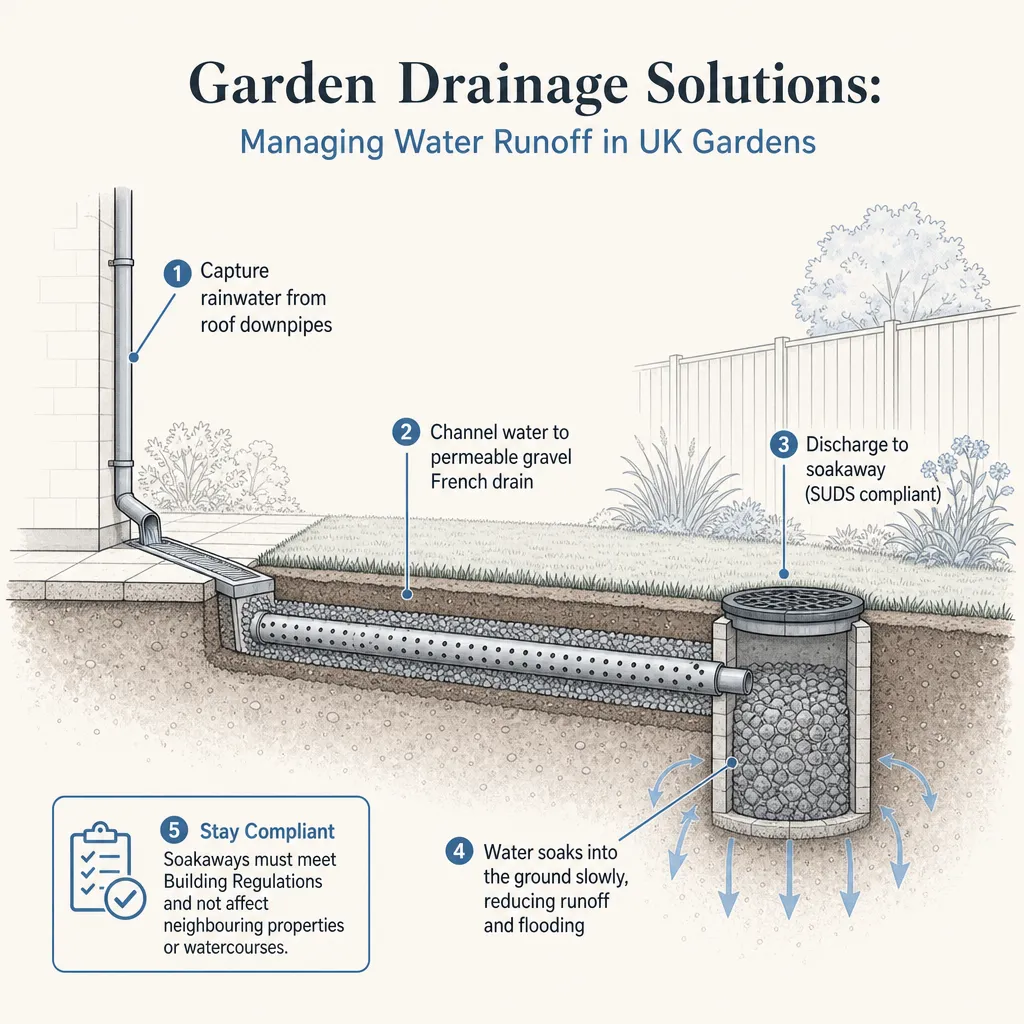
Garden Drainage Solutions: Managing Water Runoff in UK Gardens
Poor garden drainage in the UK is usually caused by clay soil, surface compaction, or too much hard-standing.
 Improvement & Build
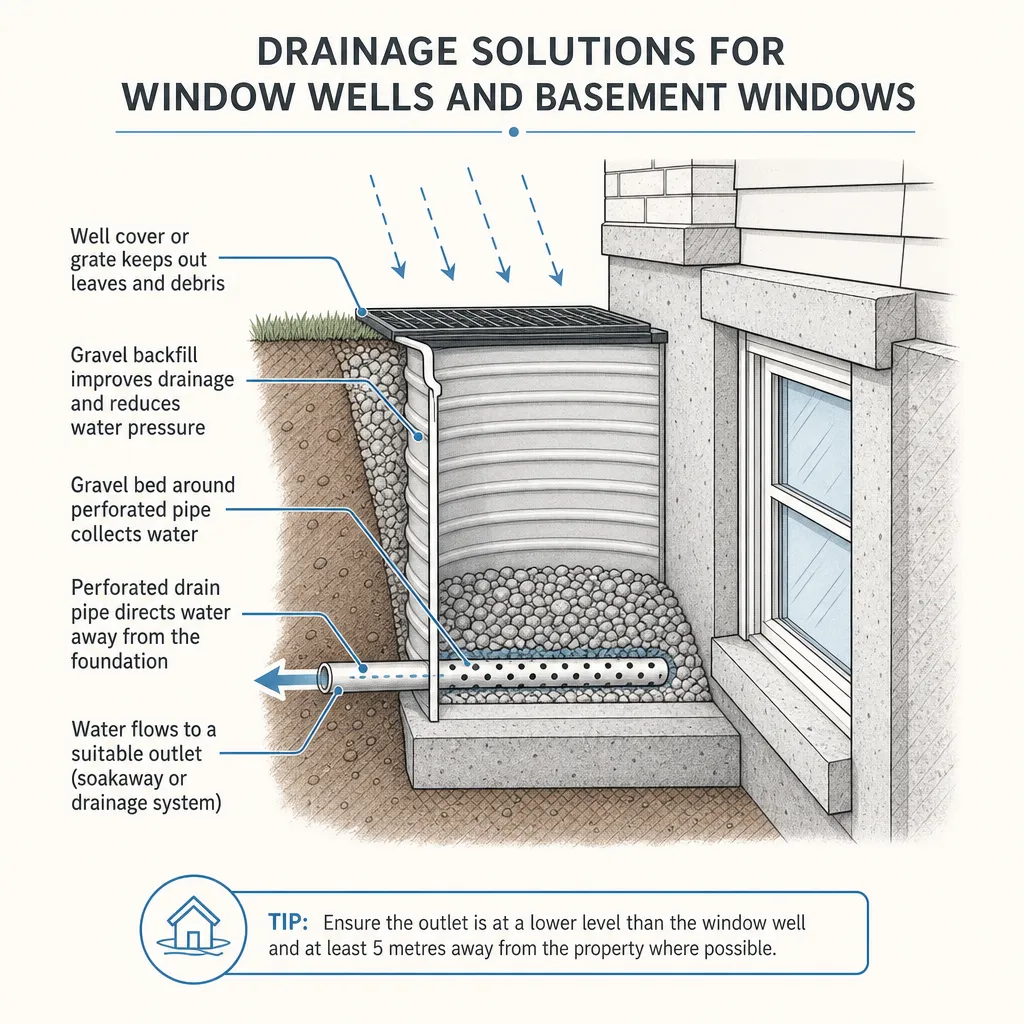
Drainage solutions for window wells and basement windows
Most UK window wells manage water through a gravel-filled sump at least 200 mm deep or a plastic liner fitted with a drain outlet connected to a soakaway or drainage system.
 Improvement & Build
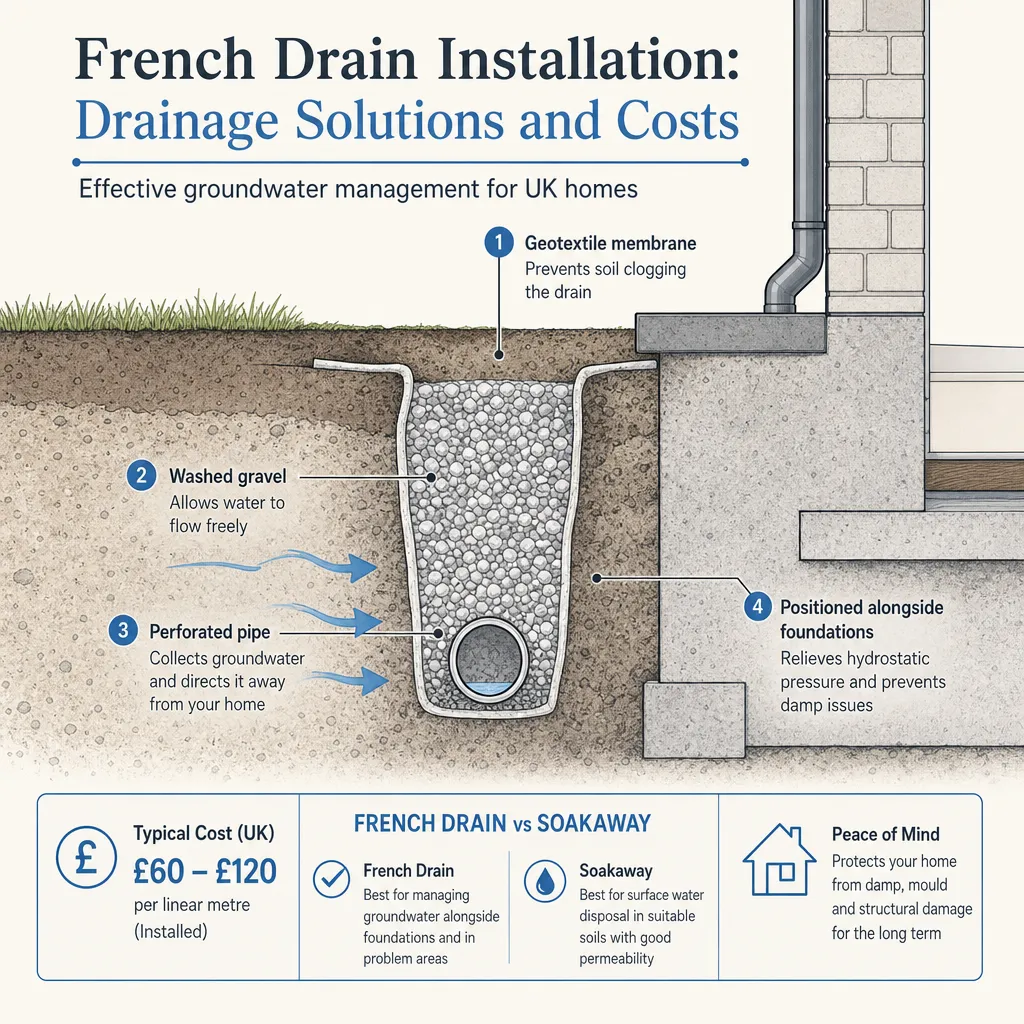
French Drain Installation: Drainage Solutions and Costs
A French drain is a gravel-filled trench containing a perforated pipe that channels subsurface water away from problem areas.
 Improvement & Build
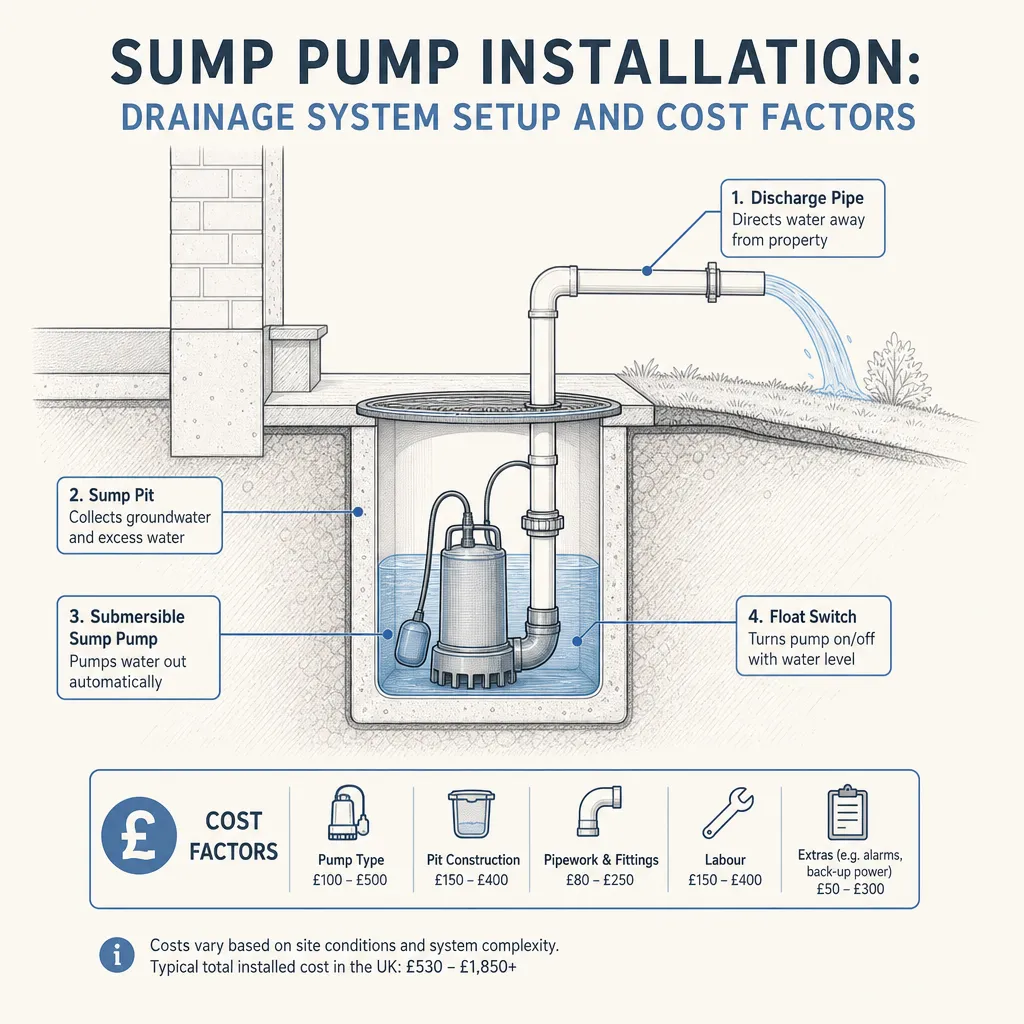
Sump Pump Installation: Drainage System Setup and Cost Factors
Sump pump installation in the UK typically costs £800–£2,500 for a submersible pump in a new or existing pit, including excavation, liner, discharge pipework, and connection to a suitable outlet.
 Improvement & Build
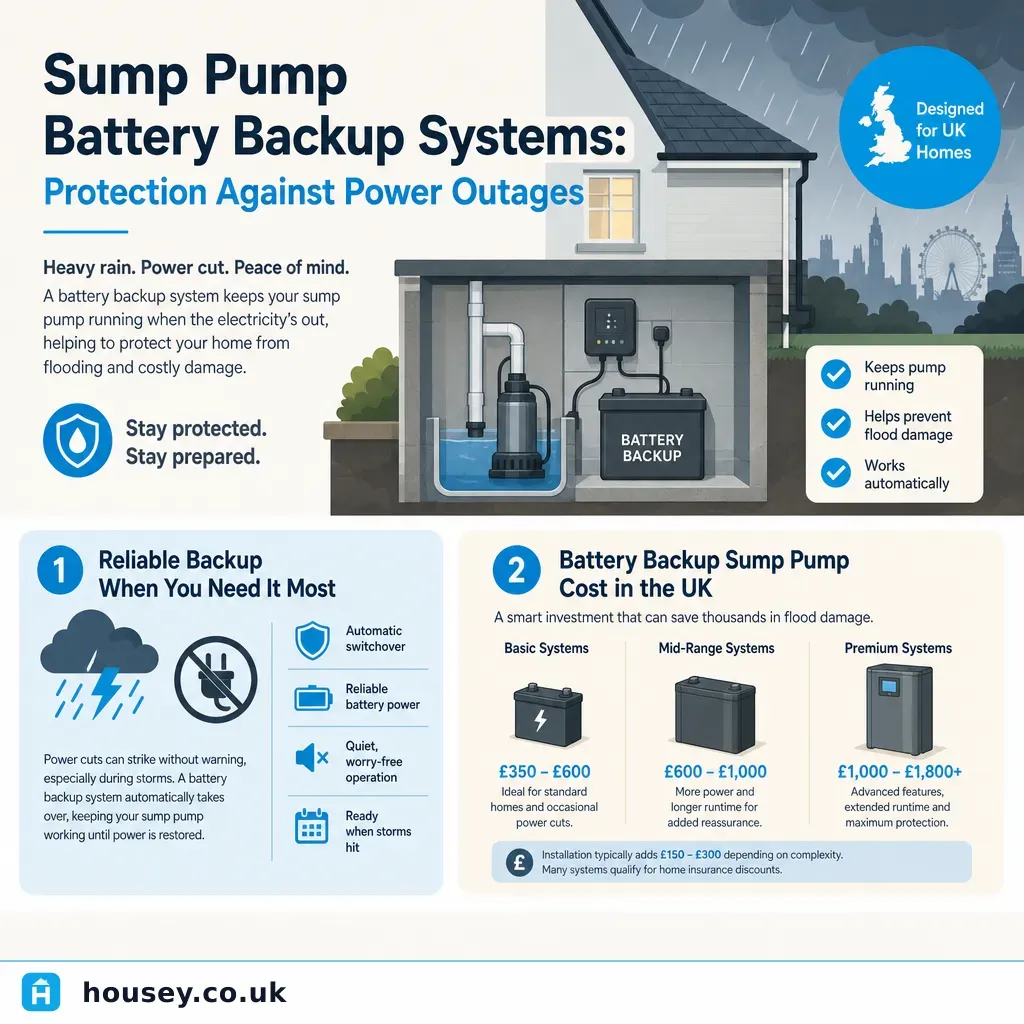
Sump Pump Battery Backup Systems: Protection Against Power Outages
A sump pump battery backup activates automatically when mains power fails, continuing to pump water from your sump pit to protect against flooding.