Draught Exclusion and Air Sealing for Thermal Efficiency
By Housey · Last reviewed 11th of May 2026
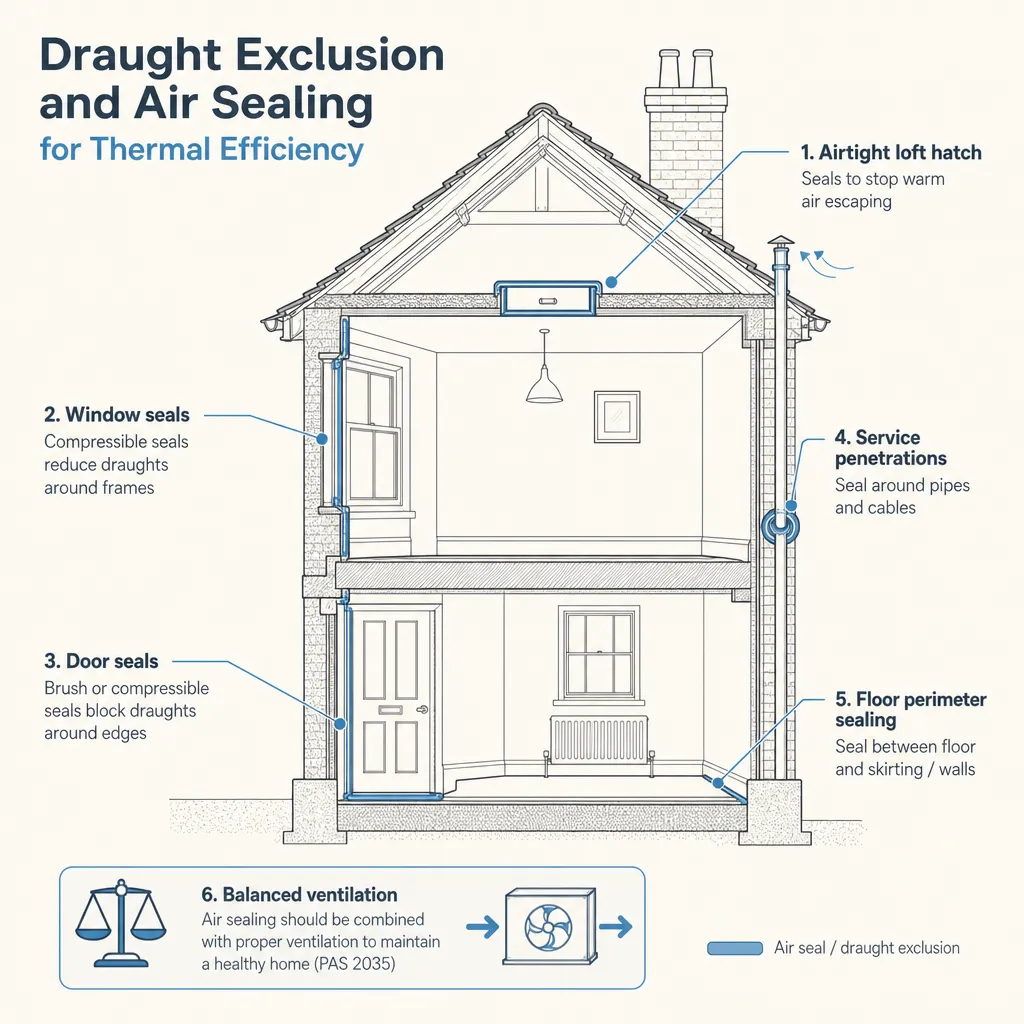
Draught Exclusion and Air Sealing for Thermal Efficiency
Uncontrolled air movement through gaps, cracks, and poorly sealed junctions is responsible for a significant proportion of heat loss in UK homes — particularly in pre-1980 properties built before airtightness featured in the building regulations. Draught proofing and air sealing offer some of the best cost-to-benefit ratios of any thermal improvement measure, but in older or solid-wall homes they must be approached carefully: sealing a building too tightly without a ventilation strategy can trap moisture, encourage mould growth, and degrade indoor air quality. Understanding the balance is the starting point for any meaningful retrofit.
Key points
- The Energy Saving Trust estimates that draughts account for approximately 15–25% of heat loss in a typical UK home, with the figure higher in older, uninsulated properties.
- Building Regulations Part F (ventilation) and Part L (conservation of fuel and power) work together: air sealing on an existing dwelling should not reduce the minimum ventilation rates set out in Approved Document F.
- PAS 2035:2023 — the UK standard for domestic retrofit — requires a retrofit assessment and coordinator-led design before significant air sealing in homes receiving government-funded improvements such as ECO4 or the Great British Insulation Scheme.
- The airtightness design target for new builds under Part L (2021) is 5 m³/(h·m²) at 50 Pa (notional dwelling); many well-executed retrofits can achieve 5–8 m³/(h·m²) in practice.
- Background ventilators — trickle vents in window frames and purpose-provided airbricks — must not be permanently blocked as part of a draught proofing scheme without a compensating ventilation strategy.
Where draughts enter UK homes
Draughts rarely come from one source. In a typical pre-1980 UK semi or terrace, the main infiltration paths are:
- Suspended timber floors — gaps between floorboards and at skirting boards; the void beneath is open to outside air via airbricks
- Loft hatches — often uninsulated and poorly sealed at the frame
- Window and door frames — gaps between frame and masonry, and worn or absent draught seals on the closing edge
- Chimney flues — an open, unused flue can lose the equivalent of leaving a window permanently open
- Service penetrations — pipes, cables, and extract fans passing through external walls or floors
- Letterboxes and cat flaps
- Wall junctions — particularly where solid external walls meet internal partitions in older properties
In homes built after 2006, the main weaknesses are typically around window reveals, roof-wall junctions, and service penetrations.
Draught proofing vs air sealing: what is the difference?
These terms are often used interchangeably but describe different scopes of intervention.
Measure | Scope | Typical products | Who carries out the work | Cost range (indicative) |
|---|---|---|---|---|
Draught proofing | Sealing visible, accessible gaps around doors, windows, letterboxes, and chimneys | Strip seals, brush seals, chimney balloons, expanding foam | Homeowner or general builder | £100–£500 DIY; £200–£800 professionally fitted |
Air sealing | Systematic sealing of the building envelope including hidden junctions, floor/wall interfaces, and penetrations | Airtightness membrane, mastic, acoustic sealant, foam | Specialist retrofit contractor, often to PAS 2030 standard | £500–£3,000+ depending on scope |
Pressure testing (blower door) | Measures whole-building airtightness in m³/(h·m²) at 50 Pa — required for new builds, optional for retrofit | Blower door fan and data logger | ATTMA-accredited tester | £300–£600 per test |
Indicative UK costs, last reviewed 2026-05-11. Costs vary with property size, condition, and access. Obtain at least three quotes.
The moisture risk: why ventilation must not be ignored
This is the most important caution for air sealing work in the UK. Older UK homes — particularly solid-wall Victorian and Edwardian properties — were designed as "breathing" buildings. Vapour moved through walls, floors, and ceilings, carrying moisture out of the property. When this movement is significantly reduced by air sealing without introducing controlled mechanical ventilation, moisture accumulates.
The consequences can include:
- Surface condensation and mould — visible on cold spots such as external corners and behind furniture
- Interstitial condensation — moisture condensing within wall or floor build-ups, causing long-term structural decay
- Elevated indoor CO₂ and pollutant levels — particularly relevant in homes with gas boilers or solid-fuel stoves still in use
PAS 2035:2023 requires that a retrofit coordinator assess the whole-house ventilation strategy before recommending airtightness improvements. In practice, this often means upgrading from background ventilators to continuous mechanical extract ventilation (MEV) or, in higher-performance retrofits, whole-house mechanical ventilation with heat recovery (MVHR).
Decision tree: choosing the right approach for your home
- Choose basic draught proofing if your home was built after 2000, is in reasonable condition, and you are dealing with obvious gaps around doors, windows, and the loft hatch. DIY-appropriate.
- Commission a professional draught proofing survey if you have a pre-1980 home, solid walls, or a suspended timber ground floor, and want to identify all infiltration paths before acting.
- Appoint a PAS 2035-qualified retrofit coordinator if you are planning significant air sealing alongside other retrofit measures (insulation, heating upgrades), or if any measure is funded through ECO4 or the Great British Insulation Scheme.
- Carry out a pressure test if you want a baseline airtightness measurement before works, or if your building control or lender requires evidence of airtightness compliance.
- Consult a ventilation specialist before air sealing if you have a gas boiler, open-flue appliance, solid-fuel stove, or existing mechanical extract fans, to assess combustion air supply and extract balance.
Important limitations
The guidance in this article is general information only. The correct approach to draught proofing and air sealing depends on your specific property — its age, construction type, existing ventilation provision, heating system, and occupancy. Rules and risks vary. A qualified retrofit coordinator or energy-efficiency consultant should assess your home before significant air sealing, particularly in pre-1940 properties or where existing ventilation provision is uncertain.
Nothing in this article constitutes advice about combustion safety, structural matters, or compliance with specific planning or building regulations conditions. If you have any doubt about combustion appliance safety following draught works, contact a Gas Safe registered engineer or a HETAS-registered solid-fuel installer.
When this becomes urgent
Stop and seek professional advice before proceeding if:
- You have an open-flue gas appliance (boiler, fire, or water heater) and are planning to seal the room it occupies
- Condensation or mould has appeared or worsened after air sealing work has started
- You have an existing whole-house ventilation system and are unsure how sealing will affect its performance
- Your home has had a fire, flood, or significant structural repair and the building fabric condition is uncertain
- You live in a listed building or conservation area, where works to windows and external fabric may require listed building consent
What to ask a qualified professional
Before commissioning air sealing or draught proofing beyond basic measures, ask your retrofit coordinator or energy-efficiency consultant:
- What is the current estimated airtightness of my home, and what target is appropriate for this property type?
- How will air sealing affect my existing ventilation provision?
- Do I need to upgrade ventilation before or alongside sealing?
- Is my heating system compatible with a significantly tighter building envelope?
- Which specific infiltration paths will you treat, and how?
- Will any work require building regulations notification under Part F or Part L?
- Are you PAS 2035 / PAS 2030 certified, and will the work be covered by a TrustMark-registered organisation?
When to get professional help
Always involve a qualified professional if you are:
- Claiming government funding (ECO4, GBIS) — PAS 2035/2030 compliance is mandatory
- Sealing a room containing an open-flue or room-sealed gas or solid-fuel appliance
- Working in a pre-1919 solid-wall property where vapour management is complex
- Planning to install MVHR or MEV alongside air sealing
A retrofit coordinator registered with TrustMark and holding PAS 2035 certification is the appropriate professional for whole-house retrofit design.
How Housey can help
Housey connects you with energy-efficiency consultants who can carry out a whole-house assessment and identify the highest-impact draught proofing measures for your specific property. If ventilation concerns arise — or if condensation is already a problem — an insulation assessment or a ventilation and condensation assessment can provide the diagnostic evidence you need before committing to works.
Frequently asked questions
Can I draught proof my chimney myself?
You can fit a chimney balloon or removable draught excluder in a disused flue yourself. However, never permanently block a flue that serves a working or potentially working appliance. If the flue is confirmed as redundant, a ventilated cap at the top and a ventilated plate at the fireplace opening are recommended by the Solid Fuel Association to prevent moisture accumulation in the flue.
Will draught proofing make my home damp?
It can, if carried out without reviewing ventilation. Homes rely on background air movement to control indoor humidity. If you seal all obvious gaps without ensuring adequate trickle ventilation, you may notice increased condensation on windows and cold walls. A whole-house approach is recommended in older properties before significant air sealing is undertaken.
Does draught proofing require building regulations approval?
Basic draught proofing — fitting brush seals to doors and compression strips to windows — does not require building regulations notification. More significant works that affect Part F ventilation provision may need to be considered under a building regulations application. Check with your local building control body if you are planning works that would reduce background ventilation in the property.
Is draught proofing eligible for any government grants?
Draught proofing as a standalone measure is not currently funded under ECO4 or the Great British Insulation Scheme, which focus on insulation and heating upgrades. It may be included as part of a broader whole-house retrofit funded by those schemes. Check the Energy Saving Trust guidance for current eligibility rules, as scheme criteria can change.
Sources and further reading
- Approved Document F: Ventilation (2021) — GOV.UK
- Approved Document L: Conservation of fuel and power (2021) — GOV.UK
- PAS 2035:2023 — Retrofitting dwellings for improved energy efficiency — BSI / BEIS
- Draught proofing guidance — Energy Saving Trust
- ECO4 scheme information — GOV.UK / Ofgem
Useful next reads
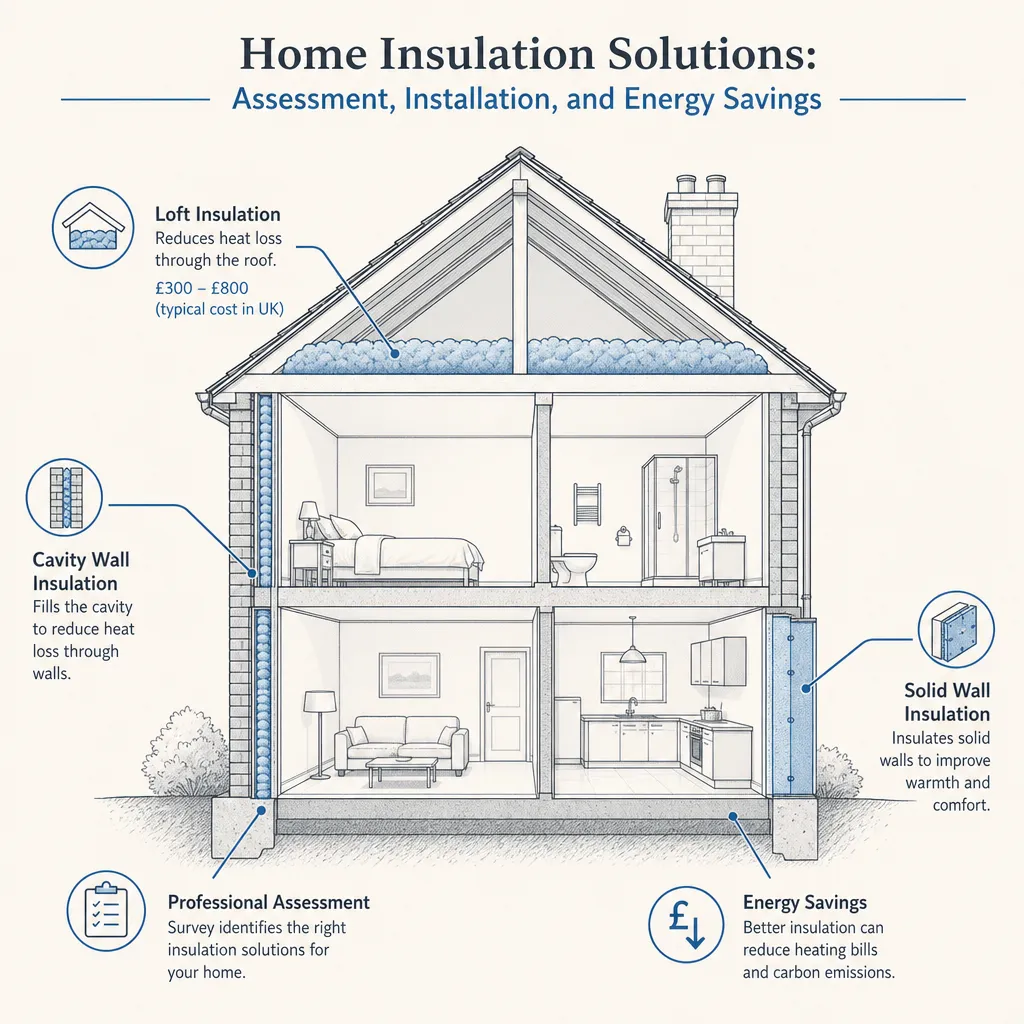 Energy & Retrofit
Home Insulation Solutions: Assessment, Installation, and Energy Savings
Home insulation in the UK covers loft, cavity wall, solid wall, and floor insulation.
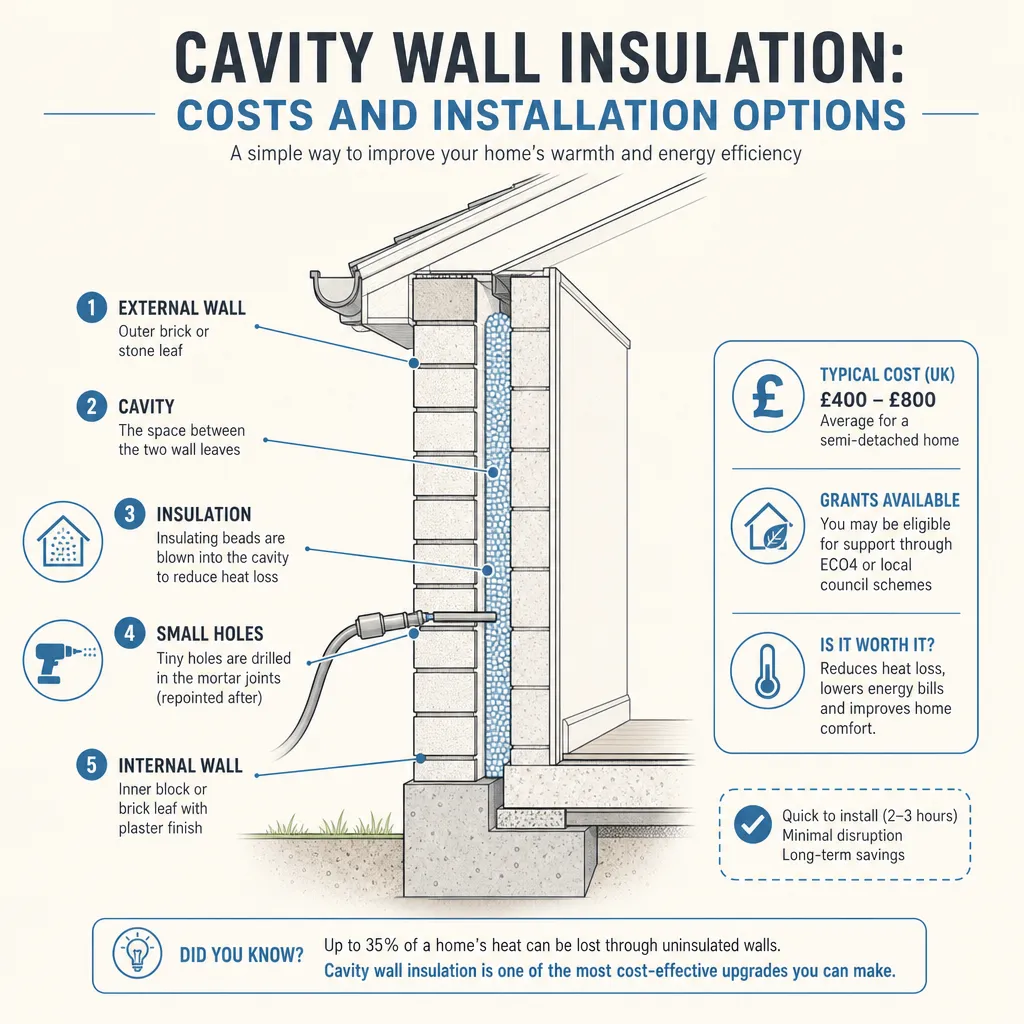 Energy & Retrofit
Cavity Wall Insulation: Costs and Installation Options
Cavity wall insulation typically costs £400–£1,200 for a standard UK semi-detached home, though eligible households may pay nothing under ECO4.
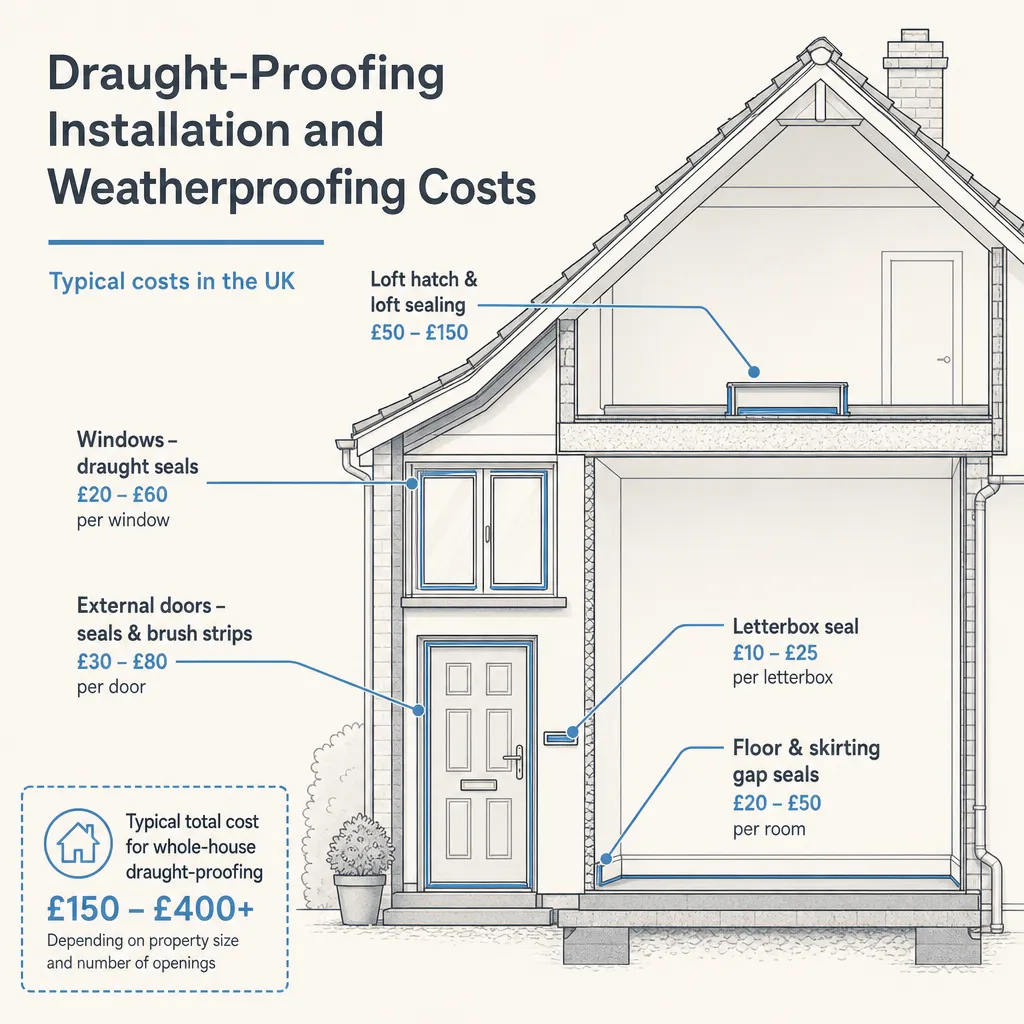 Energy & Retrofit
Draught-Proofing Installation and Weatherproofing Costs
Professional draught proofing for a typical UK semi-detached home usually costs £150–£450, depending on property size and the number of gaps treated.
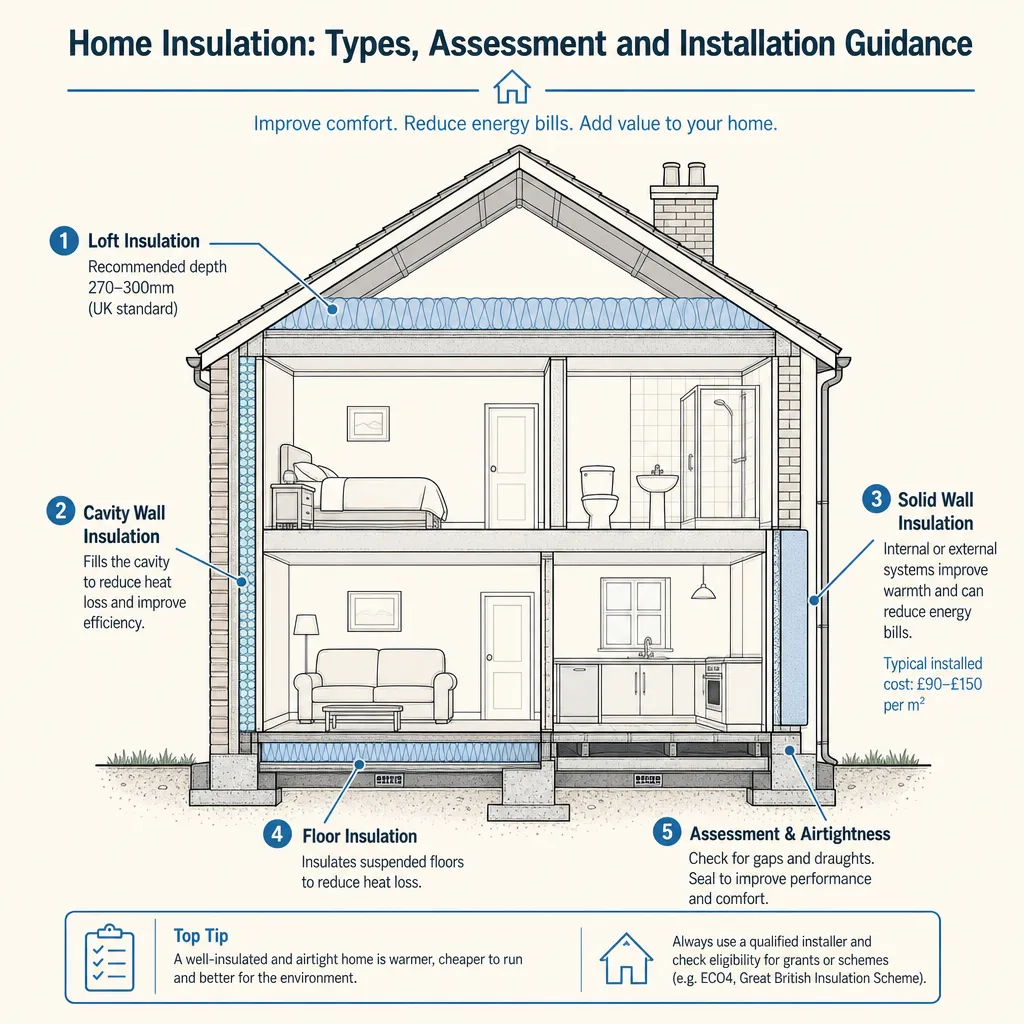 Energy & Retrofit
Home Insulation: Types, Assessment and Installation Guidance
Home insulation reduces heat loss through walls, roofs, and floors.
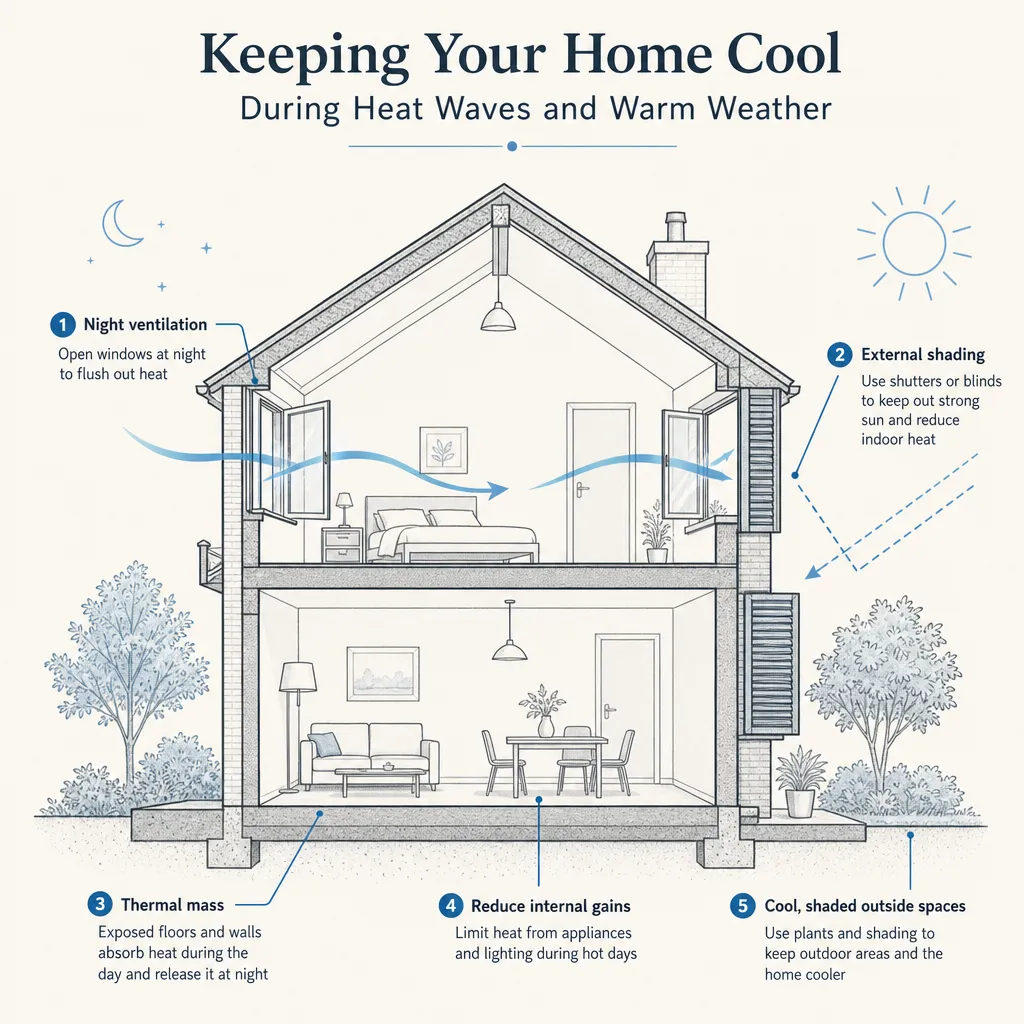 Energy & Retrofit
Keeping Your Home Cool During Heat Waves and Warm Weather
The most effective free strategy for cooling a UK home during hot weather is night-time cross-ventilation: open windows on opposite sides of the house once outdoor temperatures fall, then close them in the morning to trap cooler air.