Home Insulation: Types, Assessment and Installation Guidance
By Housey · Last reviewed 19th of May 2026
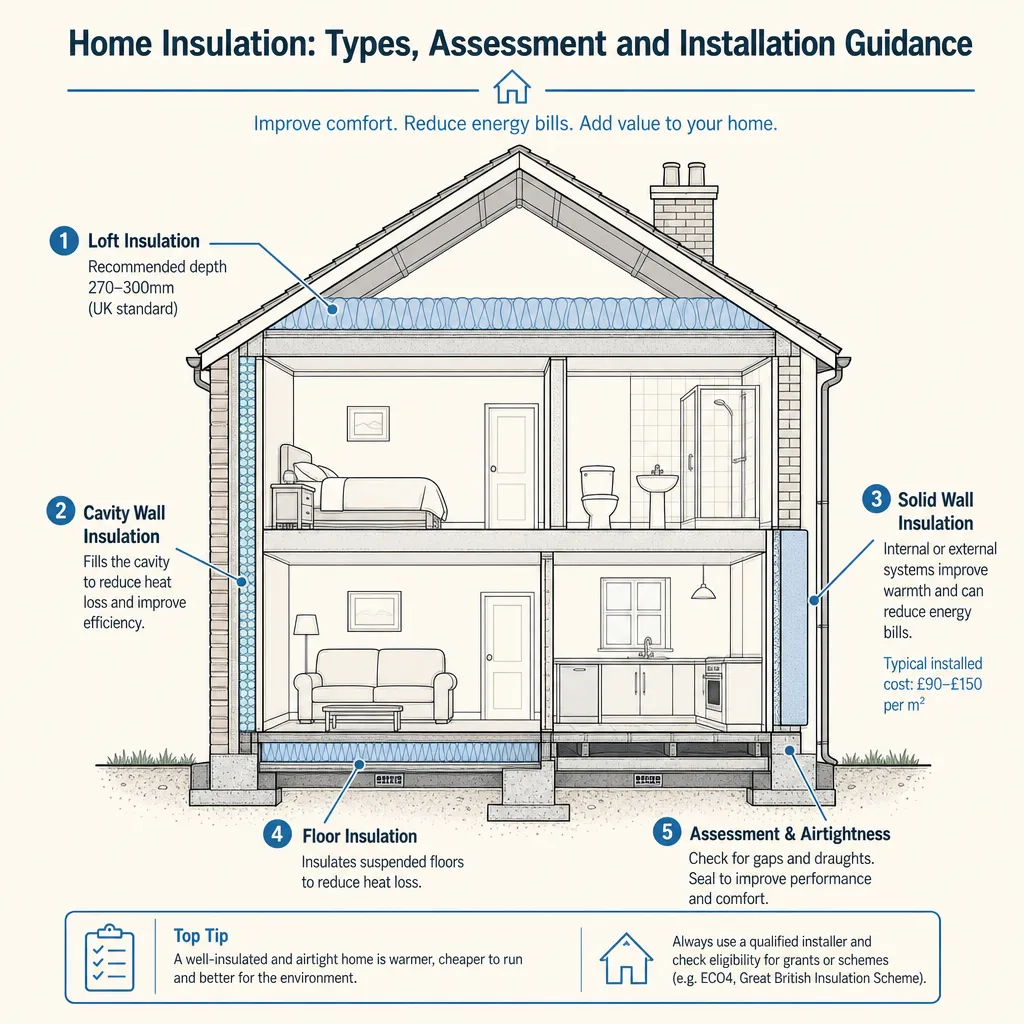
Home Insulation: Types, Assessment and Installation Guidance
Poorly insulated homes account for a significant share of domestic energy waste in the UK, with heat escaping through walls, roofs, floors, and gaps around windows and doors. Whether you are trying to reduce energy bills, meet minimum energy-efficiency standards for a rental property, or make a broader retrofit project cost-effective, understanding which insulation product suits your property's construction type is the essential first step. The right choice varies considerably between a 1930s solid-wall semi and a 1980s cavity-wall estate house.
Key points
- Building Regulations Approved Document L (Conservation of Fuel and Power, England 2021 update) sets minimum U-values for upgraded elements: 0.18 W/m²K for roofs, 0.30 W/m²K for walls, and 0.22 W/m²K for floors.
- Cavity wall insulation suits most homes built from roughly 1920 onwards with a masonry cavity; CIGA (Cavity Insulation Guarantee Agency)-registered installers inject blown mineral fibre, EPS beads, or polyurethane foam through small drilled holes.
- Solid-wall homes — typically pre-1920 brick, stone, or timber frame — require external wall insulation (EWI) or internal wall insulation (IWI), both of which cost significantly more than cavity fill.
- PAS 2035 is the UK standard governing domestic retrofit; any project claiming funding through ECO4 or the Great British Insulation Scheme must involve a qualified Retrofit Coordinator.
- The Energy Saving Trust recommends 270 mm total loft insulation depth, which can reduce heat loss through the roof by approximately 25% compared to an uninsulated loft.
Types of home insulation and where they apply
Different parts of a house lose heat differently, and each area calls for a specific insulation approach.
Loft and roof insulation
For accessible pitched lofts, mineral wool — glass or rock wool — laid between and across joists is the most common and cost-effective option. The Energy Saving Trust recommends 270 mm total depth (typically 100 mm between joists, 170 mm laid across at right angles). If the loft is used as a habitable room, insulating the rafters with rigid boards is necessary instead; this requires careful detailing to avoid condensation at rafter level and is more expensive than simple joist-level installation.
Flat roofs require a cold deck or warm deck approach using rigid insulation boards, normally combined with planned roofing works.
Cavity wall insulation
Most UK homes built between roughly 1920 and 1995 have a cavity between inner and outer masonry leaves. A CIGA-registered installer can inject mineral fibre, expanded polystyrene (EPS) beads, or polyurethane foam through small drilled holes, usually completing the work in a single day. Cavity wall insulation is generally unsuitable for walls with a history of water penetration, for exposed coastal or high-altitude locations, or where the cavity is narrower than 50 mm. A pre-installation survey should confirm suitability before any work begins.
Solid wall insulation
Pre-1920 solid brick or stone walls have no cavity and are harder and more expensive to insulate.
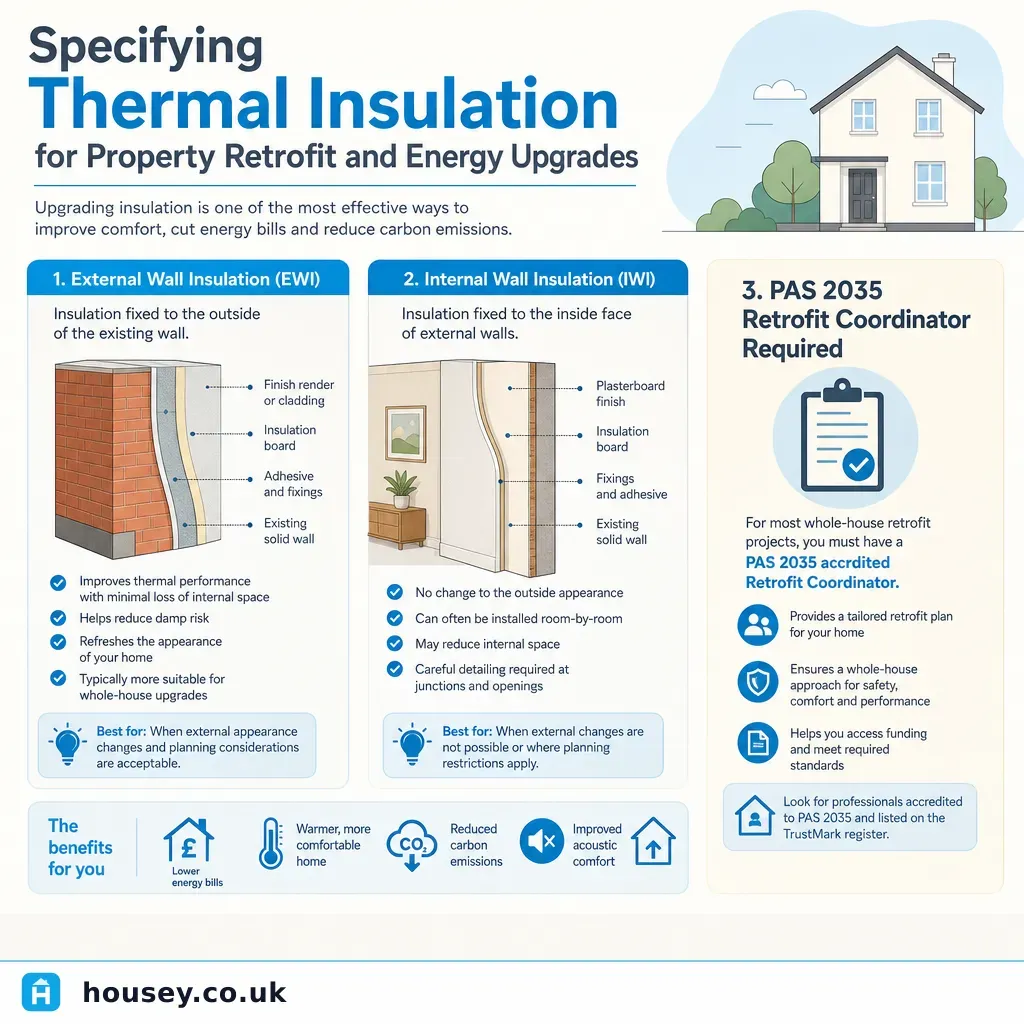
External wall insulation (EWI) fixes rigid boards or mineral wool to the outside of the building and applies a render or cladding finish. It avoids reducing internal floor area and can improve U-values substantially, but it alters the external appearance and may require planning consent in conservation areas or for listed buildings.
Internal wall insulation (IWI) uses rigid boards or a studwork-and-insulation build-up on the inner face of external walls. It typically reduces room dimensions by 80–100 mm per treated wall and requires careful vapour control and ventilation detailing to avoid interstitial condensation. A professional moisture risk assessment before installation is strongly advisable.
Floor insulation
Suspended timber ground floors can be insulated by fitting mineral wool or rigid boards between joists — sometimes from below via a crawl space, avoiding the need to lift floorboards. Solid concrete floors require a screed overlay incorporating rigid insulation, which raises the floor level and may affect door thresholds and skirting boards.
Comparison: main insulation types
Type | Typical application | Indicative installed cost (UK semi-detached) | Key limitation |
|---|---|---|---|
Mineral wool (loft) | Accessible pitched loft | £300–£600 | Not suitable for occupied loft rooms |
Cavity wall (blown fibre or bead) | 1920–1995 masonry cavity walls | £400–£1,200 | Unsuitable for exposed or water-damaged walls |
External wall insulation | Solid-wall homes | £8,000–£20,000+ | May need planning consent; alters appearance |
Internal wall insulation | Solid-wall homes | £5,000–£15,000 | Reduces floor area; requires moisture management |
Rigid board (flat roof or solid floor) | Flat roofs, solid ground floors | Varies widely | Must integrate with roofing or flooring works |
Indicative UK costs, last reviewed 2026-05-19. Quotes vary by property size, access, specification, and region. Always obtain at least three comparable quotes.
Which insulation is right for your home?
Use this guide before commissioning any work:
- Choose loft mineral wool if you have an uninsulated or under-insulated accessible pitched loft (below 270 mm total depth).
- Choose cavity wall injection if your home was built between roughly 1920 and 1995, has untreated cavity walls, and shows no signs of water ingress through the outer leaf.
- Choose external wall insulation if you have solid walls, want to preserve internal floor area, and planning consent is feasible for your property and location.
- Choose internal wall insulation if EWI is not viable — for example, on a mid-terrace with no rear access or where external appearance restrictions apply.
- Commission a PAS 2035 Retrofit Assessment before proceeding with wall insulation on any pre-1919 solid-wall home — moisture and ventilation risks require professional evaluation under this standard.
- Check grant eligibility via the ECO4 scheme or Great British Insulation Scheme before obtaining quotes; funding can significantly reduce out-of-pocket costs for eligible households.
- Ask a qualified professional if you are unsure whether your cavity is suitable for injection or whether a previous installation has caused damp.
Grant funding and financial support
The ECO4 scheme (Energy Company Obligation 4) funds insulation and heating upgrades for low-income and fuel-poor households, administered through energy suppliers. The Great British Insulation Scheme (GBIS) extends support to a wider band of homes rated EPC D–G. Eligibility criteria for both schemes include income, benefits, EPC rating, and property type.
Some local authorities run area-based insulation programmes — check your council's website or contact a TrustMark-registered retrofit installer for local options. The Energy Saving Trust at energysavingtrust.org.uk maintains up-to-date guidance on both schemes.
Building Regulations and installation standards
Insulation work often triggers Building Regulations approval:
- Adding insulation to a roof that forms part of habitable space requires compliance with Approved Document L (thermal performance) and Approved Document F (ventilation).
- External wall insulation on a habitable building in England and Wales requires notification to building control.
- Work in conservation areas or on listed buildings may need Listed Building Consent or planning permission in addition to building control approval.
Installers working on government-funded schemes must be TrustMark-registered and, for PAS 2035 projects, work under a qualified Retrofit Coordinator who assesses the property, designs the improvement sequence, and monitors quality throughout.
What to ask before accepting a quote
- Is the installer CIGA-registered (for cavity wall) or TrustMark-registered (for government-funded schemes)?
- Has a pre-installation survey been carried out to check cavity condition, moisture levels, or any existing insulation?
- Does the quote cover building control notification where required?
- What guarantee is offered and by which body is it backed?
- Is VAT included, and does the quote separate material costs from labour?
- What is the projected U-value after installation?
- What could change the price or timeline — and what happens if access issues or unexpected defects arise during installation?
When to get professional help
A professional insulation assessment is advisable before any wall insulation project, and is mandatory under PAS 2035 for government-funded works. Seek professional advice if:
- Your home is pre-1920 solid brick, stone, or timber frame — moisture and vapour management are complex and vary by construction type.
- You have had previous insulation installed and have since noticed damp or condensation problems.
- Your loft shows signs of condensation, inadequate ventilation, or existing structural defects.
- You are a landlord seeking to meet Minimum Energy Efficiency Standards (MEES) — most privately rented properties in England and Wales must achieve EPC E or above.
- The property is listed or in a conservation area, where additional consents may apply.
How Housey can help
Housey connects homeowners with vetted professionals for insulation assessments and insulation installers across the UK. If you are planning a broader retrofit, find retrofit assessors who can manage PAS 2035 compliance and design the most cost-effective improvement sequence for your home. For complex older properties, an energy-efficiency consultant can help model the options before you commit to a specification.
Frequently asked questions
Do I need planning permission for home insulation in the UK?
Most loft and cavity wall insulation work does not require planning permission. External wall insulation that alters the external appearance of a home may need prior approval or full planning consent, particularly in conservation areas, Article 4 Direction areas, or for listed buildings. Always confirm with your local planning authority before starting any external insulation work.
What U-value does loft insulation need to meet under Building Regulations?
Under England's 2021 update to Approved Document L, a newly upgraded roof element should achieve at least 0.18 W/m²K. In practice, 270 mm of mineral wool between and across joists typically exceeds this target. Scotland, Wales, and Northern Ireland have their own technical standards that may differ slightly from the English requirements.
Are there grants available for home insulation in the UK?
Yes. The ECO4 scheme funds insulation upgrades for eligible low-income households through energy suppliers. The Great British Insulation Scheme targets homes rated EPC D–G more broadly. Eligibility depends on benefits, income, EPC rating, and property type. The Energy Saving Trust at energysavingtrust.org.uk maintains up-to-date guidance on current schemes and eligibility criteria.
How long does cavity wall insulation last?
Cavity wall insulation installed by a CIGA-registered contractor typically carries a 25-year guarantee backed by the Cavity Insulation Guarantee Agency. The material — mineral fibre or EPS beads — can last the life of the building provided there is no water ingress into the cavity. If damp develops after installation, arrange a professional inspection promptly.
Sources and further reading
- Approved Document L: Conservation of Fuel and Power (2021) — GOV.UK
- PAS 2035: Retrofitting dwellings for improved energy efficiency — BSI
- Great British Insulation Scheme — GOV.UK
- ECO4 scheme guidance — Ofgem
- Home insulation guidance — Energy Saving Trust
- Cavity Insulation Guarantee Agency — CIGA
Useful next reads
 Energy & Retrofit
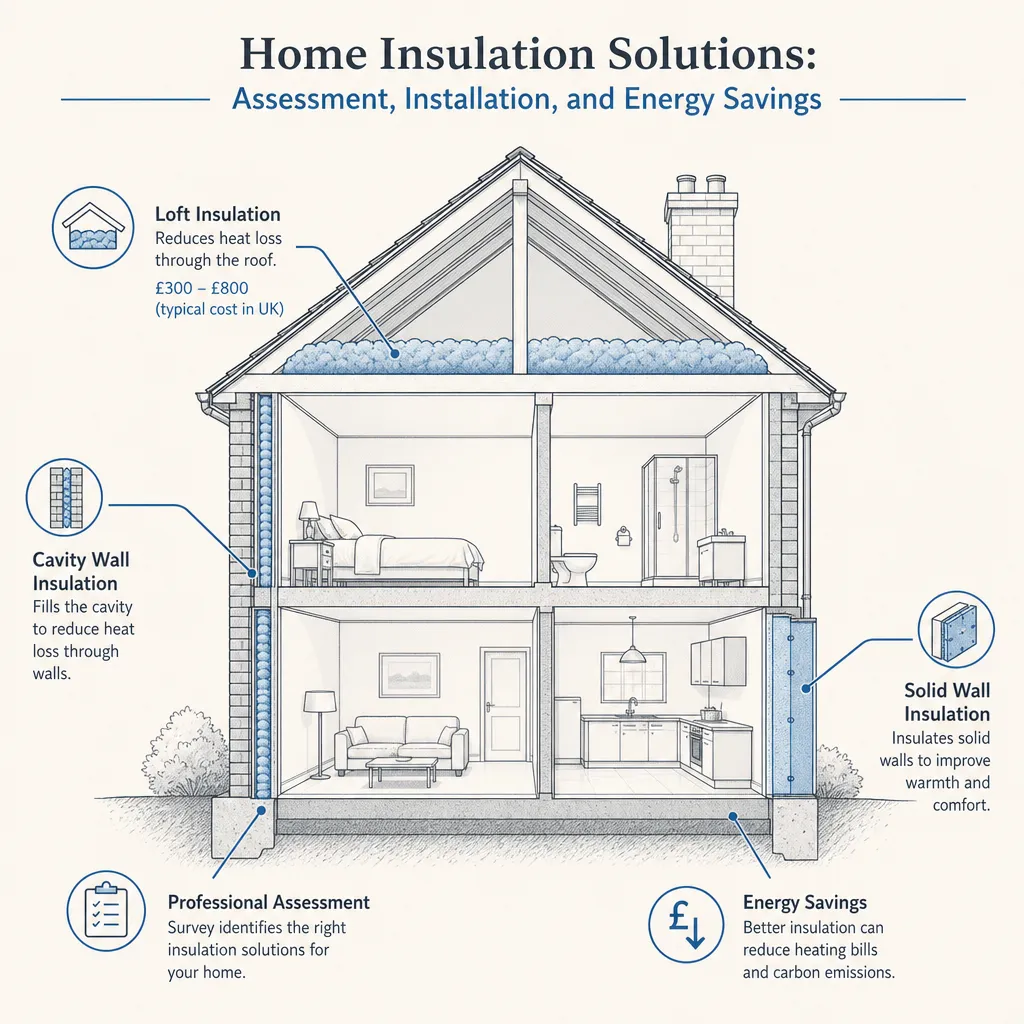
Home Insulation Solutions: Assessment, Installation, and Energy Savings
Home insulation in the UK covers loft, cavity wall, solid wall, and floor insulation.
 Energy & Retrofit
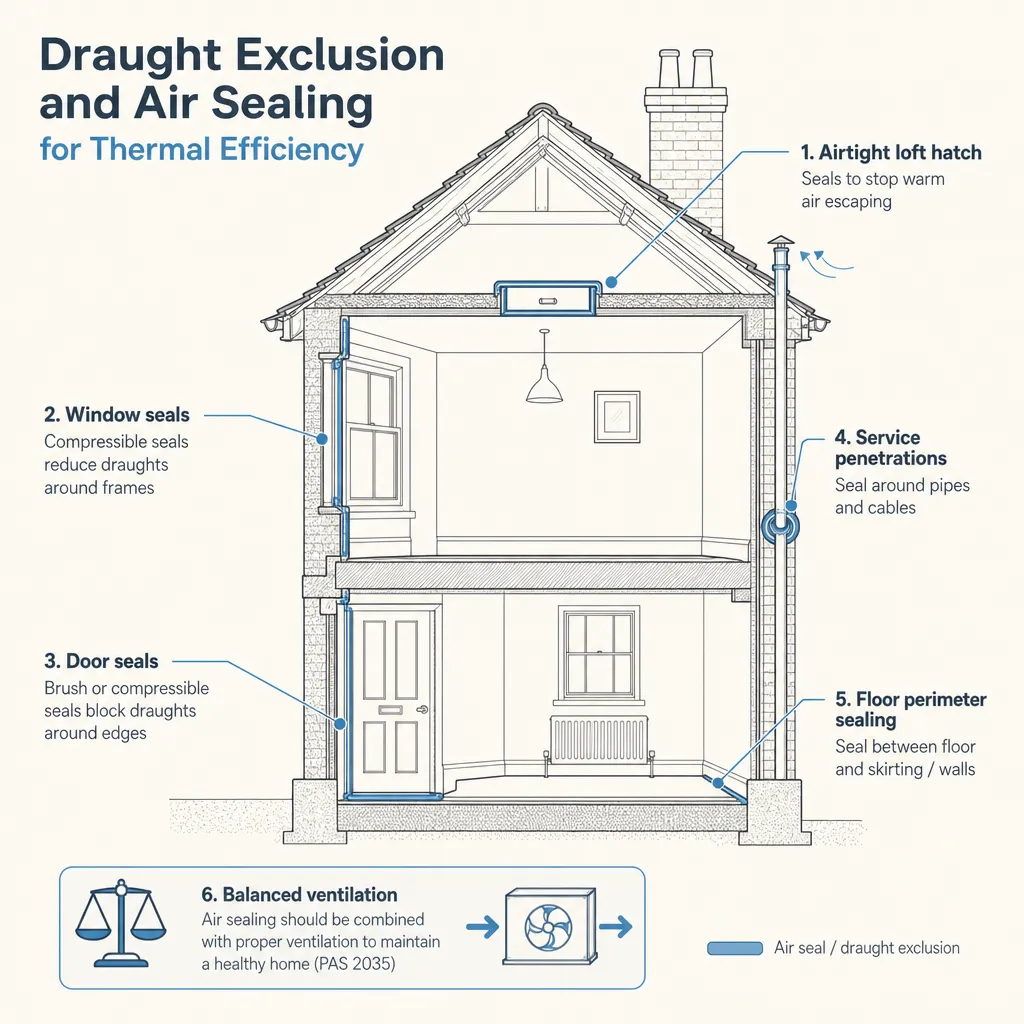
Draught Exclusion and Air Sealing for Thermal Efficiency
Draught proofing and air sealing can cut uncontrolled heat loss by 15–25% in a typical UK home, but sealing a building too tightly without reviewing ventilation risks condensation, mould, and poor air quality.
 Energy & Retrofit
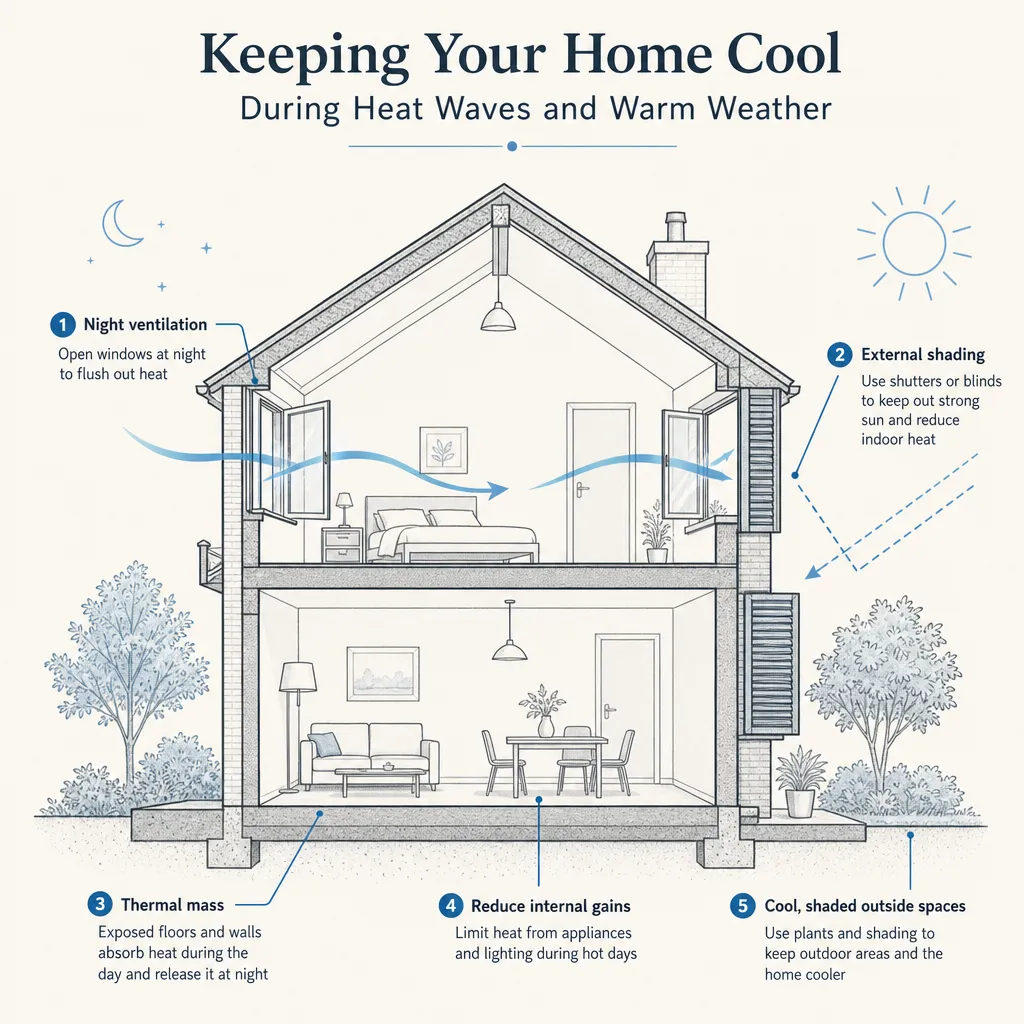
Keeping Your Home Cool During Heat Waves and Warm Weather
The most effective free strategy for cooling a UK home during hot weather is night-time cross-ventilation: open windows on opposite sides of the house once outdoor temperatures fall, then close them in the morning to trap cooler air.
 Energy & Retrofit
Specifying Thermal Insulation for Property Retrofit and Energy Upgrades
Specifying thermal insulation for UK retrofit requires matching the product to your property's construction, moisture conditions, and heating system.
 Energy & Retrofit
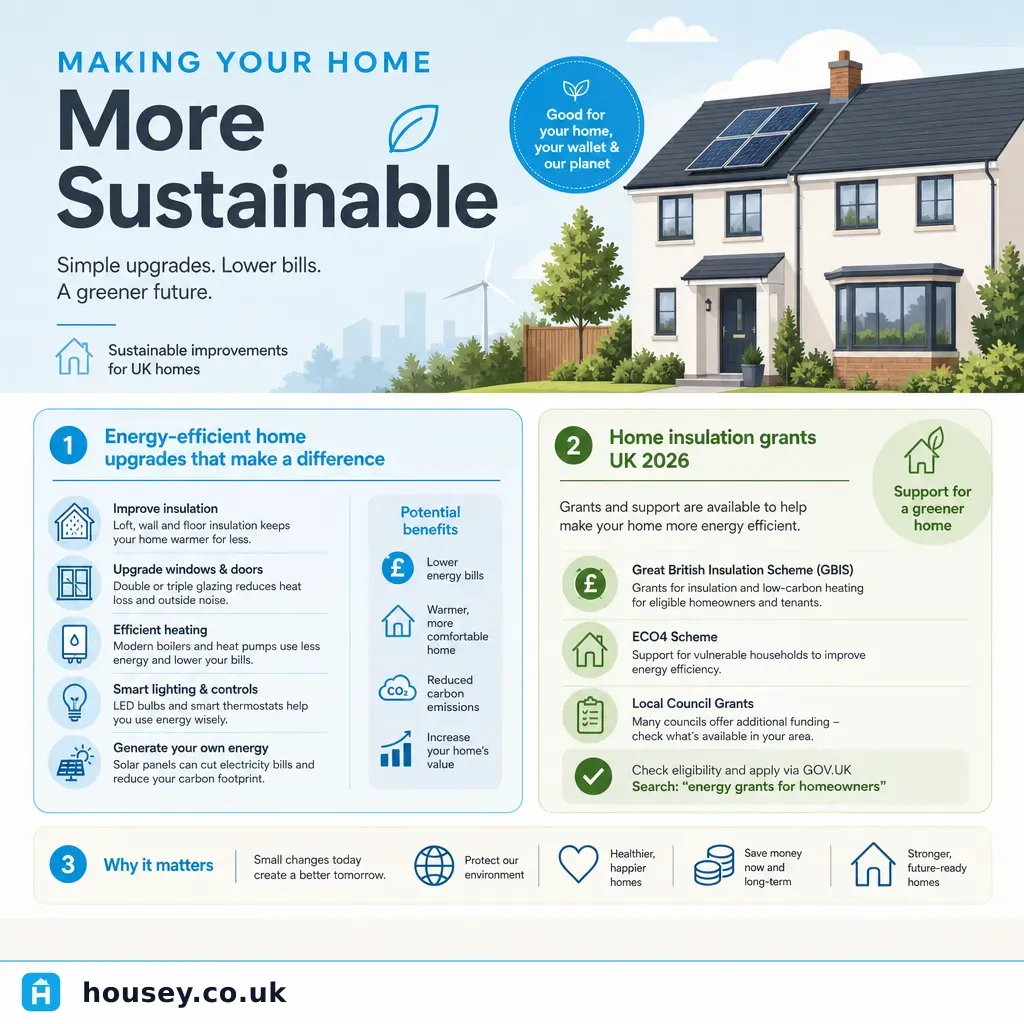
Making your home more sustainable
Making a UK home more sustainable usually starts with fabric-first improvements such as insulation, draught-proofing, and efficient glazing before adding renewable energy systems like solar panels or a heat pump.