What to expect when drilling a borehole for groundwater access
By Housey · Last reviewed 6th of May 2026
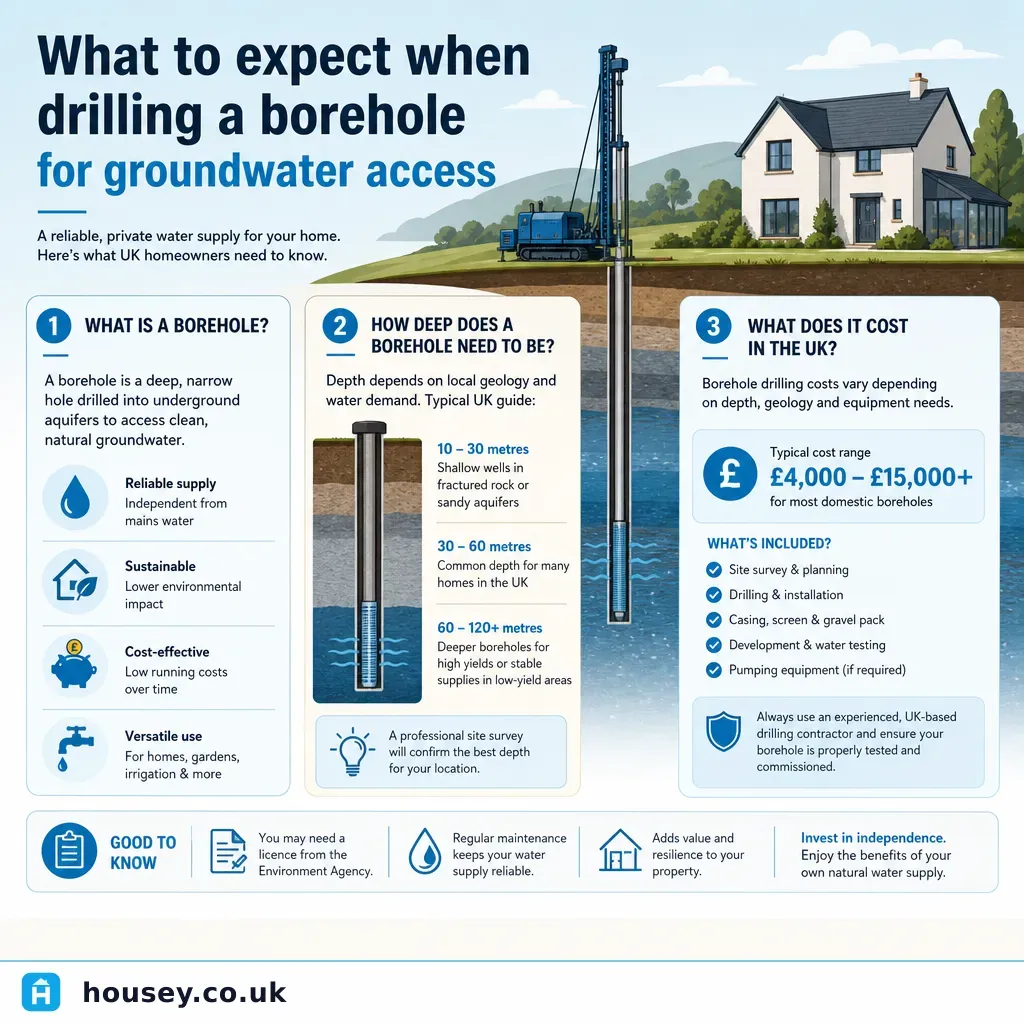
What to expect when drilling a borehole for groundwater access
Boreholes for private water supply are increasingly common in rural and semi-rural UK properties where mains water is unavailable, unreliable, or expensive to connect. Whether you are developing a rural plot, running a smallholding, or looking to reduce water bills on an isolated property, understanding the full process — from initial feasibility through to ongoing maintenance — helps you plan realistically and avoid costly surprises.
Key points
- Most abstractions of more than 20 cubic metres of groundwater per day require an abstraction licence from the Environment Agency under the Water Resources Act 1991; many domestic boreholes fall below this threshold and are exempt, but always confirm with the Environment Agency before drilling.
- The Private Water Supplies Regulations 2016 require water quality testing before a borehole supply is used for drinking, cooking, or food preparation; your local authority regulates private water supplies in England.
- Domestic boreholes in the UK typically reach 30–150 metres depth, depending on local geology and the depth of the target aquifer.
- A British Water Well and Borehole Drillers Association (BWPDA)-registered or equivalent contractor should carry out drilling and installation; groundwater drilling is a specialist trade requiring dedicated equipment and geological knowledge.
- Indicative UK borehole drilling costs range from £5,000 to £20,000 or more, depending on depth, geology, location, and casing specification (Indicative UK costs, last reviewed 2026-05-06).
Is borehole water a viable option for your property?
Groundwater availability varies significantly across the UK. Some areas overlie productive sandstone, chalk, or gravel aquifers capable of supplying a household reliably year-round; others sit on impermeable clay or crystalline basement rock where borehole yields are low or seasonal.
Before committing to a drill, a desk-based hydrogeological assessment is strongly advisable. A qualified hydrogeologist or experienced borehole driller can review British Geological Survey (BGS) aquifer maps, local borehole records, and Environment Agency data to give you a realistic indication of likely depth, yield, and seasonal variability. BGS groundwater data and the Environment Agency's data services are accessible online for preliminary research.
Signs your location may support a productive borehole:
- Neighbouring properties already use private boreholes successfully
- Your site overlies a known productive aquifer such as chalk, sandstone, limestone, or river gravel
- BGS borehole records show good yields at similar depths nearby
Signs viability may be uncertain or restricted:
- Predominantly clay, peat, or made ground with no known nearby boreholes
- Located within a Groundwater Source Protection Zone (SPZ1 or SPZ2), which may impose additional restrictions on drilling or water use
- Site has a known contamination history or is adjacent to intensive agricultural land with high nitrate inputs
The borehole drilling process step by step
Understanding the sequence helps you manage contractors, timescales, and decisions at each stage.
1. Feasibility and desk study
A hydrogeologist or experienced driller reviews published aquifer data, local records, and your site conditions. Expect this stage to take one to two weeks; some drillers include a basic desk study in their overall quote, while others charge separately.
2. Regulatory checks and notifications
Notify the Environment Agency (in England), Natural Resources Wales, or SEPA (Scotland) before drilling. Even where an abstraction licence is not required for your intended volume, notification may still be legally required depending on the aquifer designation and location. If your site falls within a Source Protection Zone, additional assessment or consent may apply — check with the relevant regulator before proceeding.
3. Mobilising the drilling rig
Borehole rigs require firm vehicle access — typically a 3.5–7.5 tonne lorry-mounted unit for domestic boreholes. You will need a level working area of approximately 4–6 metres wide by 10 metres long. Tight rural tracks, steep slopes, soft ground, or overhead cables can affect access, add cost, or rule out certain drilling methods.
4. Drilling and casing installation
Most domestic boreholes use rotary percussion or rotary drilling techniques. As drilling progresses, steel or uPVC casing is installed to the required depth to prevent borehole collapse and to exclude surface water contamination. A grout seal at the surface is essential to stop surface water tracking down outside the casing. Drilling speed varies with geology — soft chalk may progress quickly, while hard granite or flint may slow progress to a few metres per hour. A typical domestic borehole takes one to three days on-site.
5. Development and yield testing
Once at depth, the borehole is developed — water is pumped or surged to clear drilling debris from around the borehole screen and aquifer — and a yield test is conducted to confirm how much water the borehole can reliably supply per hour. A well-sited domestic borehole may yield 0.5–5 m³ per hour, though many households require considerably less.
6. Pump installation and headworks
A submersible pump is installed at depth — typically 10–20 metres below the standing water level. The headworks — surface equipment including the pump controller, pressure vessel, and wellhead cover — are installed above ground or in a small pump house to protect the system from weather and contamination.
7. Water quality testing
Before the supply is used for drinking, cooking, bathing, or food preparation, water must be tested for a range of microbiological and chemical parameters under the Private Water Supplies Regulations 2016. Your local authority is responsible for regulating private water supplies and can advise on the required test parameters. Failed tests may require water treatment — UV sterilisation, filtration, chlorination — before the supply can be used safely.
Borehole vs mains water: a comparison
Factor | Borehole supply | Mains connection |
|---|---|---|
Upfront cost | £5,000–£20,000+ (drilling, pump, headworks) | £1,000–£15,000+ depending on distance to main |
Ongoing cost | Electricity for pump, maintenance, annual testing (~£500–£1,000/yr indicative) | Water bills (average UK household approximately £450/yr in 2025 per Ofwat) |
Water quality control | Owner's responsibility; regular testing required under 2016 Regulations | Regulated by water company; meets statutory standards |
Reliability | Subject to drought, aquifer levels, and pump condition | High for most UK areas |
Regulatory burden | Possible abstraction licence; notification to regulator; annual testing | None for the user |
Best suited to | Rural plots, off-grid properties, smallholdings where mains is absent or costly | Urban and suburban properties with accessible mains |
Indicative UK costs, last reviewed 2026-05-06. Mains connection costs from Ofwat and water company published tariffs; vary significantly by proximity to the mains network.
Abstraction licences: when you need one
Under the Water Resources Act 1991, most abstractions of more than 20 cubic metres of water per day from a surface or groundwater source require an abstraction licence from the Environment Agency in England. A domestic household relying on a borehole as its sole supply typically uses 300–500 litres per day (0.3–0.5 m³), well below the 20 m³ threshold, so many domestic boreholes are exempt from licensing.
However, exemptions are not universal:
- Abstraction from certain designated aquifers or in Source Protection Zones may require notification or consent regardless of volume.
- Agricultural irrigation or commercial use almost always exceeds the 20 m³ threshold and requires a licence.
- Some abstractions below 20 m³/day may still require registration rather than a full licence in specific circumstances.
Always confirm your position with the Environment Agency before drilling. The GOV.UK guidance on water abstraction sets out current thresholds, notification requirements, and application processes.
Homeowner checklist: before you commission a borehole
What to ask a borehole drilling contractor
- What hydrogeological data have you reviewed for this site, and what yield do you expect?
- What drilling technique will you use, and why is it suited to the local geology?
- What casing material is specified, and what is the expected borehole lifespan?
- Does the grout seal and surface headworks design meet Environment Agency guidance?
- What does the yield test cover, and will I receive written results showing litres per hour?
- Is water quality testing included, and which parameters will be tested?
- What warranty do you offer on the borehole itself and on the pump installation?
- Are you BWPDA-registered, and can you provide proof of public liability insurance?
- What happens contractually if the target yield is not achieved?
When to get professional help
A borehole is a long-term infrastructure investment that requires specialist equipment and geological knowledge. Always use a qualified, registered contractor — no part of the drilling or casing process is suitable for DIY.
Seek professional advice promptly if:
- Initial pump tests suggest yield is lower than your projected daily demand
- Water quality test results fail microbiological or chemical standards
- The standing water level in your borehole drops significantly during dry periods, suggesting over-abstraction or aquifer depletion
- You notice discolouration, odour, or taste changes in the supply
- You are considering sharing the borehole supply with a neighbouring property, which carries additional legal and technical implications
How Housey can help
Housey connects UK homeowners and landowners with verified service providers for groundwater assessments, borehole drilling, and private water supply testing. Use Housey to compare quotes from specialists with experience in your local geology and regulatory area before committing to any groundwater works.
Frequently asked questions
Do I need planning permission to drill a borehole?
In most cases, drilling a domestic borehole in England does not require planning permission and is treated as permitted development. However, if your property is listed, in a conservation area, or near a scheduled monument or designated site, you should check with your local planning authority before proceeding. Rules can differ in Wales and Scotland, so always verify locally.
How long does a borehole last?
A well-constructed borehole with appropriate steel or uPVC casing can last 25–50 years or more with correct maintenance. Submersible pump equipment typically needs replacement or servicing every 10–15 years. Annual water quality testing and periodic pump inspection under the Private Water Supplies Regulations 2016 are essential to maintaining both yield and water safety throughout the borehole's life.
Is borehole water safe to drink?
Borehole water can be safe to drink, but it must be tested before first use and regularly thereafter under the Private Water Supplies Regulations 2016. Depending on local geology and land use, groundwater may contain elevated nitrates, iron, manganese, arsenic, or microbial contamination. Treatment systems such as UV sterilisation or filtration are often required before the supply is considered safe for human consumption.
Do I need an abstraction licence for a domestic borehole?
Most domestic boreholes fall below the 20 m³ per day threshold that triggers the need for an abstraction licence under the Water Resources Act 1991, so many are exempt. However, exemptions depend on location, aquifer type, and intended use. Always confirm your specific position with the Environment Agency before drilling, particularly if any agricultural or commercial water use is planned alongside domestic supply.
Can I share a borehole supply with a neighbour?
Sharing a borehole supply with a neighbouring property is legally possible but creates additional complexity around liability, maintenance responsibilities, water quality duties, and conveyancing implications. Both parties should seek specialist legal and technical advice before establishing a shared supply arrangement, and any agreement should be formally documented to protect all parties.
Sources and further reading
- Water abstraction licensing guidance — Environment Agency / GOV.UK
- Private Water Supplies Regulations 2016 — legislation.gov.uk
- BGS Groundwater resources — British Geological Survey
- Source Protection Zones guidance — Environment Agency / GOV.UK
- British Water Well and Borehole Drillers Association — BWPDA
Useful next reads
 General property advice
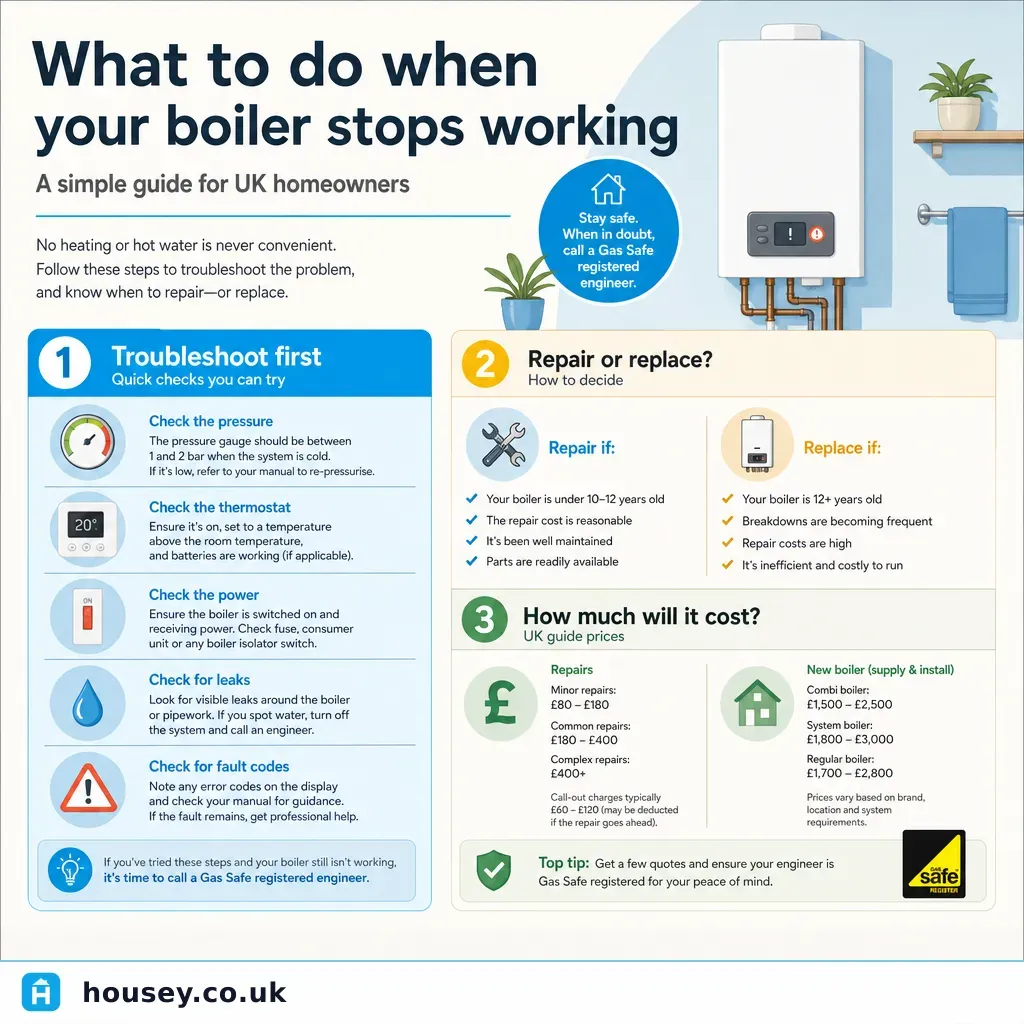
What to do when your boiler stops working
When your boiler stops working, check the pressure gauge (should read 1–1.
 General property advice
Property Market Trends: Activity Growth and Price Movements
UK property market activity is measured through completed sale registrations (HM Land Registry), lender mortgage data, and transaction volumes from HMRC.
 General property advice
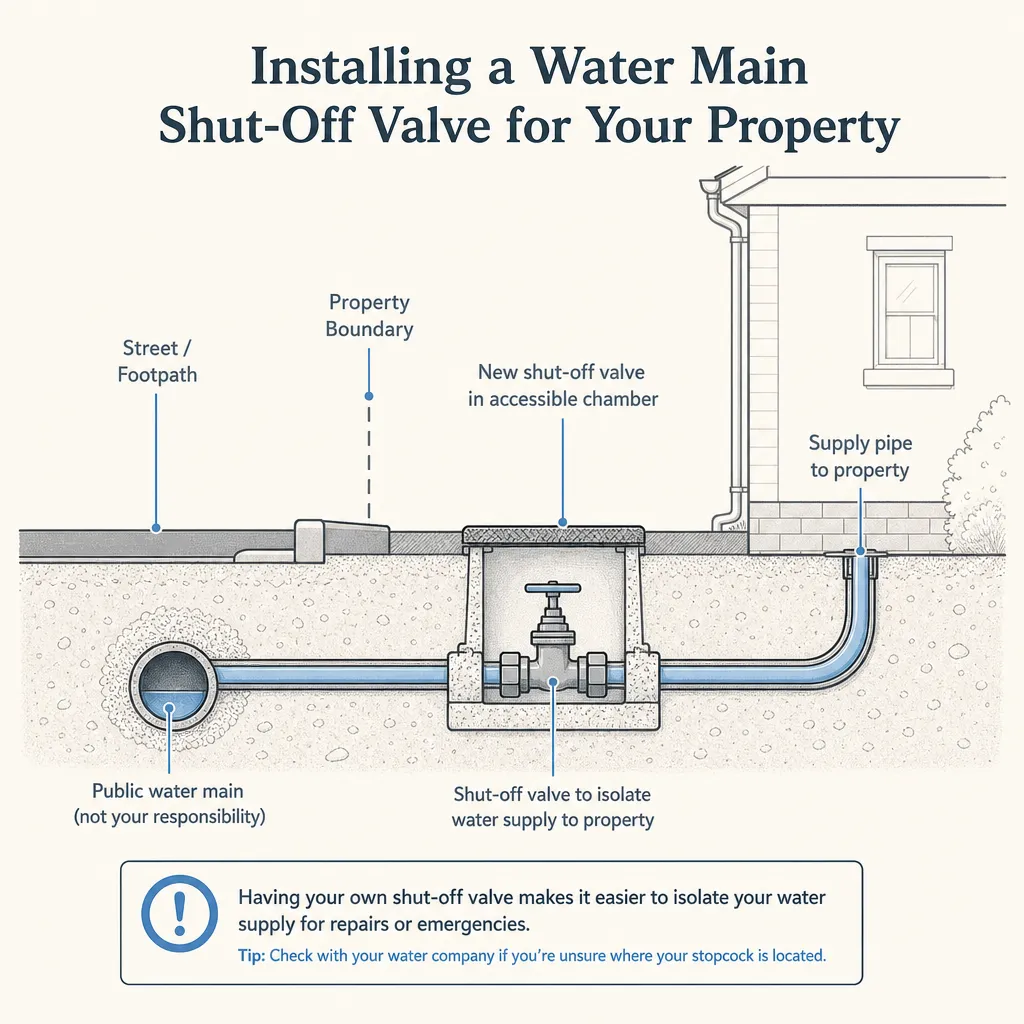
Installing a water main shut-off valve for your property
A water main shut-off valve — commonly called a stopcock — controls all water entering your home from the mains.
 General property advice
Monthly House Price Index: August Market Report and Analysis
The UK House Price Index is published monthly using completed Land Registry transaction data, meaning August figures typically reflect sales agreed months earlier.
 General property advice
Scottish Property Market: Activity and Regional Trends
Scotland's property market operates under distinct legal rules: sellers must provide a Home Report before marketing, transactions become legally binding at conclusion of missives rather than exchange of contracts, and Land and Buildings Transaction Tax replaces Stamp Duty.