Drive-Over Lighting Installation Costs
By Housey · Last reviewed 7th of May 2026
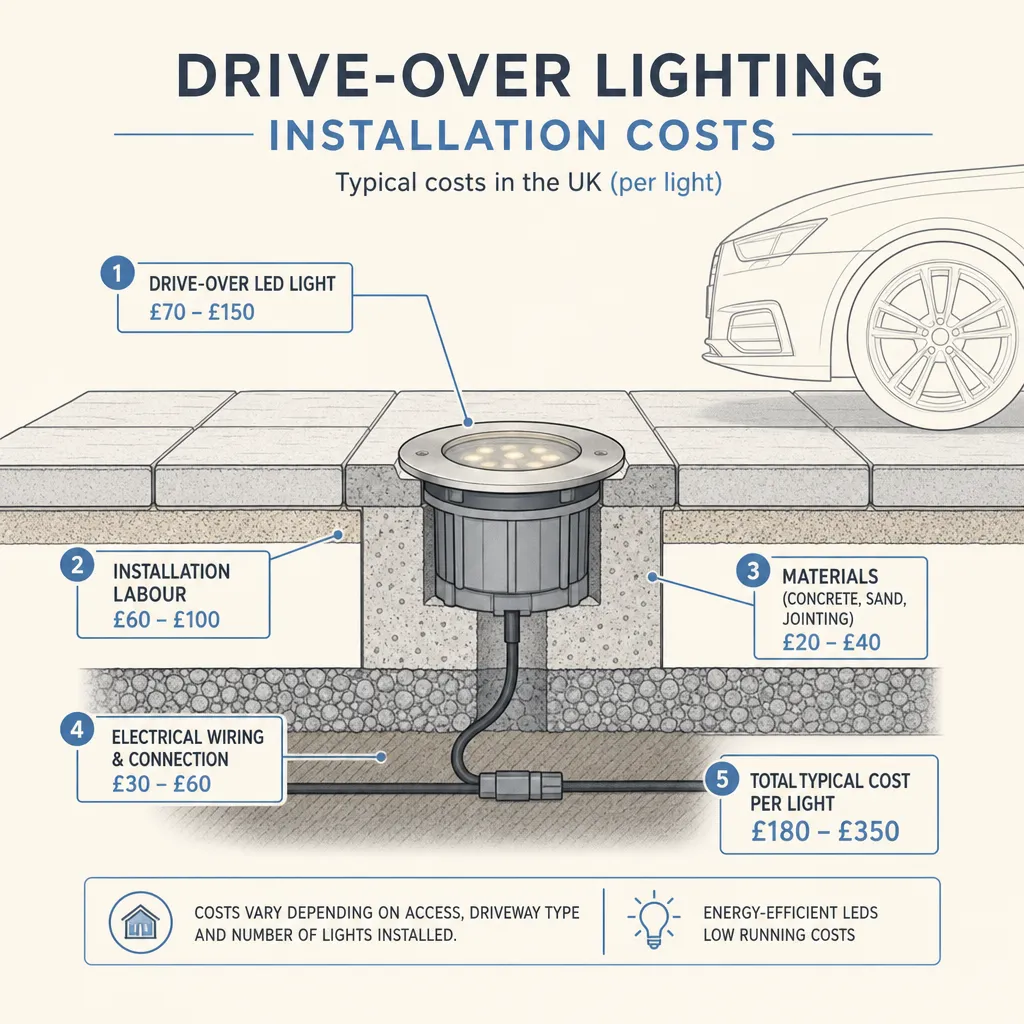
Drive-Over Lighting Installation Costs
Recessed drive-over lights can transform a driveway — improving safety, security, and kerb appeal while keeping the surface flush and unobstructed for vehicles and pedestrians alike. Understanding what installation realistically costs before approaching contractors helps you budget accurately and compare quotes like for like, whether you are lighting a short block-paved frontage or a longer approach to a detached property.
Key points
- Mains-powered drive-over lights require connection by a Part P-registered electrician; new outdoor circuits must be notified under Part P of the Building Regulations and an Electrical Installation Certificate issued on completion.
- Recessed drive-over LED units must be rated IP67 or IP68 for ingress protection and carry an appropriate load rating for vehicles — typically 20 to 40 tonnes for standard private driveway use.
- Supply cost for LED recessed drive-over lights is approximately £15–£80 per unit; professional installation adds £20–£60 per unit plus a fixed charge for cable routing and electrical connection.
- A complete project of 6–12 lights including cabling, electrical connection, and surface reinstatement typically costs £600–£2,000, depending on driveway size, surface type, and cable run length.
- Solar drive-over lights avoid mains cabling costs but charge less reliably in winter, particularly above latitude 53°N (roughly Manchester and north).
What are drive-over lights?
Drive-over lights — also called recessed driveway lights or inground luminaires — are fittings set flush into the driveway surface so that vehicles can pass directly over them. Most use LED technology and are available in mains-powered and solar-powered versions.
Common applications include:
- Edge lighting: lining the sides of a driveway to define its boundary and guide vehicles safely.
- Step and level-change illumination: marking changes in ground level for pedestrians at night.
- Feature lighting: creating symmetrical runs of light along a block-paved or resin-bound approach.
- Security enhancement: illuminating the driveway for cameras and deterrence without visible above-ground fittings that could be vandalised.
They are distinct from surface-mounted bollard lights, which sit above the driveway level and cannot be driven over.
Drive-over lighting cost breakdown
Indicative UK costs, last reviewed 2026-05-07. All figures are approximate and vary with product specification, installer day rates, surface type, and site conditions.
Cost element | Typical range | Notes |
|---|---|---|
Recessed LED drive-over unit (supply only) | £15–£80 per light | Higher-end units have better IP ratings, wider beam angles, and longer warranties |
Solar recessed drive-over unit (supply only) | £20–£60 per light | No wiring cost; performance depends on daylight charging |
Installation per unit (mains-powered) | £20–£60 per unit | Includes cutting aperture, bedding unit, and wiring to cable run |
Electrical connection (fixed charge) | £150–£400 | New outdoor circuit, consumer unit connection, Part P notification fee |
Cable routing and trenching | £50–£200 | Depends on cable run length; harder surfaces cost more to break and reinstate |
Surface reinstatement | £50–£300 | Block paving re-laying, concrete patching, or resin repair |
Typical whole-project (6–12 lights, mains) | £600–£2,000+ | Varies significantly with project scope and cable run length |
Typical whole-project (6–12 lights, solar) | £200–£700 | No electrician or cabling costs required |
For projects with longer cable runs, complex surface types, or where an existing outdoor circuit needs upgrading, costs can exceed the upper figures above. Always request itemised quotes.
Mains vs solar drive-over lights: which is right for you?
Factor | Mains-powered | Solar-powered |
|---|---|---|
Upfront cost | Higher (cabling and electrician required) | Lower (no cabling) |
Running cost | Very low (LED) | Negligible |
Winter reliability in UK | Consistent year-round | Reduced above approx. latitude 53°N |
Installation disruption | Trenching required | Minimal |
Light output | High and controllable | Moderate; varies with battery charge level |
Smart control compatibility | Switches, timers, smart home systems | Typically timer or light-sensor only |
Best for | Long driveways, year-round use, smart integration | Short accent runs, lower-use areas, no mains access nearby |
For most UK driveways where year-round performance matters, mains-powered LED lights offer more predictable output. Solar works well for shorter accent runs or situations where trenching is impractical or the driveway is infrequently used.
What affects the total cost?
- Number of lights: More units increase supply costs; electrical connection charges are largely fixed per project, making the cost per unit fall as numbers increase.
- Surface type: Block paving is easier and cheaper to cut and reinstate than resin-bound gravel or concrete. Tarmac reinstatement requires specialist patching materials and is often more expensive.
- Cable run length: A consumer unit located far from the driveway means more trenching and cable, increasing both material and labour cost.
- Existing outdoor circuit: If a suitable outdoor circuit already exists close to the driveway, the fixed electrical charge is lower.
- Specification: Units with wider beam angles, selectable colour temperatures, or higher IP ratings cost more to supply but often last longer and perform better in UK conditions.
- Regional labour rates: Day rates vary — London and the South East typically run 15–25% above Midlands and northern rates.
What to ask before accepting a quote
Before commissioning drive-over lighting installation, ask every contractor:
- Are you Part P-registered, or will the electrical connection be carried out by a Part P-registered electrician? Will you provide a Building Regulations notification and Electrical Installation Certificate?
- What IP rating and load rating do the specified units carry? Can you provide the manufacturer's technical data sheet?
- Is VAT included in this quote?
- How will the surface be reinstated after cabling — is that included in the price, and who is responsible?
- What warranty do the luminaires carry, and what does it cover?
- What is excluded from this price — are cable routing, trenching, and surface reinstatement included or quoted separately?
- Is this quote based on the current surface condition, or could costs change once digging begins?
- Can you provide photographs or references from a comparable completed installation?
Planning permission and building regulations
Drive-over driveway lighting does not normally require planning permission under permitted development rights for householder works. However, check before proceeding if:
- Your property is a listed building — listed building consent may be required for work affecting the character of the building or its curtilage.
- Your driveway is in a conservation area — some restrictions on hard surfaces and external alterations may apply; check with your local planning authority before ordering materials.
- The installation involves crossing or breaking into a public highway — this requires consent from your local highway authority.
All mains electrical work for new outdoor circuits must comply with BS 7671 (IET Wiring Regulations) and be notified under Part P of the Building Regulations by a registered competent person. An Electrical Installation Certificate must be issued on completion — keep this with your property records, as it will be required on any future sale.
Homeowner planning checklist
Before requesting quotes:
When to get professional help
All mains electrical work for new outdoor circuits must be carried out or supervised by a Part P-registered competent person under UK Building Regulations — this is not a suitable DIY task. Also seek professional advice when:
- Digging anywhere near existing underground services — always locate buried gas, water, drainage, and telecoms runs before any excavation, using a cable avoidance tool (CAT) or a service locator.
- The property is listed or in a conservation area — seek pre-application advice from your local planning authority before ordering materials or breaking ground.
- The surface is resin-bound or existing block paving — incorrect cutting or reinstatement can cause cracking, voids, or visible colour mismatch that is costly to correct.
How Housey can help
Housey helps UK homeowners find and compare vetted local tradespeople for improvement and build projects. You can use the platform to describe your drive-over lighting project and request quotes from relevant local contractors in your area.
Frequently asked questions
Do drive-over lights need planning permission?
Not usually. Under permitted development rules, most driveway lighting does not require planning permission. However, listed buildings and properties in conservation areas may face restrictions. Always check with your local planning authority if your property has any designations, particularly if the work could affect the character or setting of a listed building. For driveways crossing or abutting a public highway, highway authority consent may also be needed.
What load rating do drive-over lights need?
For a standard private driveway used by cars and light vans, units rated to carry at least 20 tonnes are generally considered adequate. For driveways used by heavier vehicles such as HGVs or skip lorries, units rated 40 tonnes or above may be needed. Always check the manufacturer's load rating — domestic lighting units not rated for vehicle traffic will crack or fail quickly under repeated load.
Can I install drive-over lights myself?
You can install solar-powered drive-over lights yourself, as no mains electrical work is involved. For mains-powered lights, the connection to a circuit or consumer unit must be carried out by a Part P-registered electrician under Building Regulations. Completing notifiable electrical work without proper registration is a criminal offence and can invalidate home insurance for any related damage.
How long do recessed LED driveway lights last?
Good-quality mains LED drive-over units typically carry a rated lifespan of 30,000–50,000 hours, equating to roughly 10–20 years at typical use. Solar units depend heavily on battery life — most lithium batteries need replacement after 3–5 years. Look for IP68 ingress protection and UV-stable casing materials as key quality indicators for outdoor longevity in UK weather conditions.
Are solar drive-over lights reliable in the UK?
Solar drive-over lights can perform well in southern England and during summer months. In northern England, Scotland, and Wales — particularly between October and February — shorter days and frequent cloud cover reduce charging efficiency significantly. For reliable year-round performance in these regions, mains-powered units are usually the better choice. Solar suits lower-use accent applications or areas with a good southerly aspect.
Sources and further reading
- Approved Document P: Electrical safety — dwellings — GOV.UK
- Permitted development rights for householders — GOV.UK
- IET Wiring Regulations BS 7671 — IET
- Outdoor electrical safety guidance — Electrical Safety First
- Listed buildings: making changes to your home — Historic England
Useful next reads
 Improvement & Build
Outdoor lighting problems: solutions for common issues in gardens and driveways
Outdoor lighting problems in UK gardens commonly stem from water ingress, incorrect IP ratings, faulty transformers, poor earth connections, or corroded contacts.
 Improvement & Build
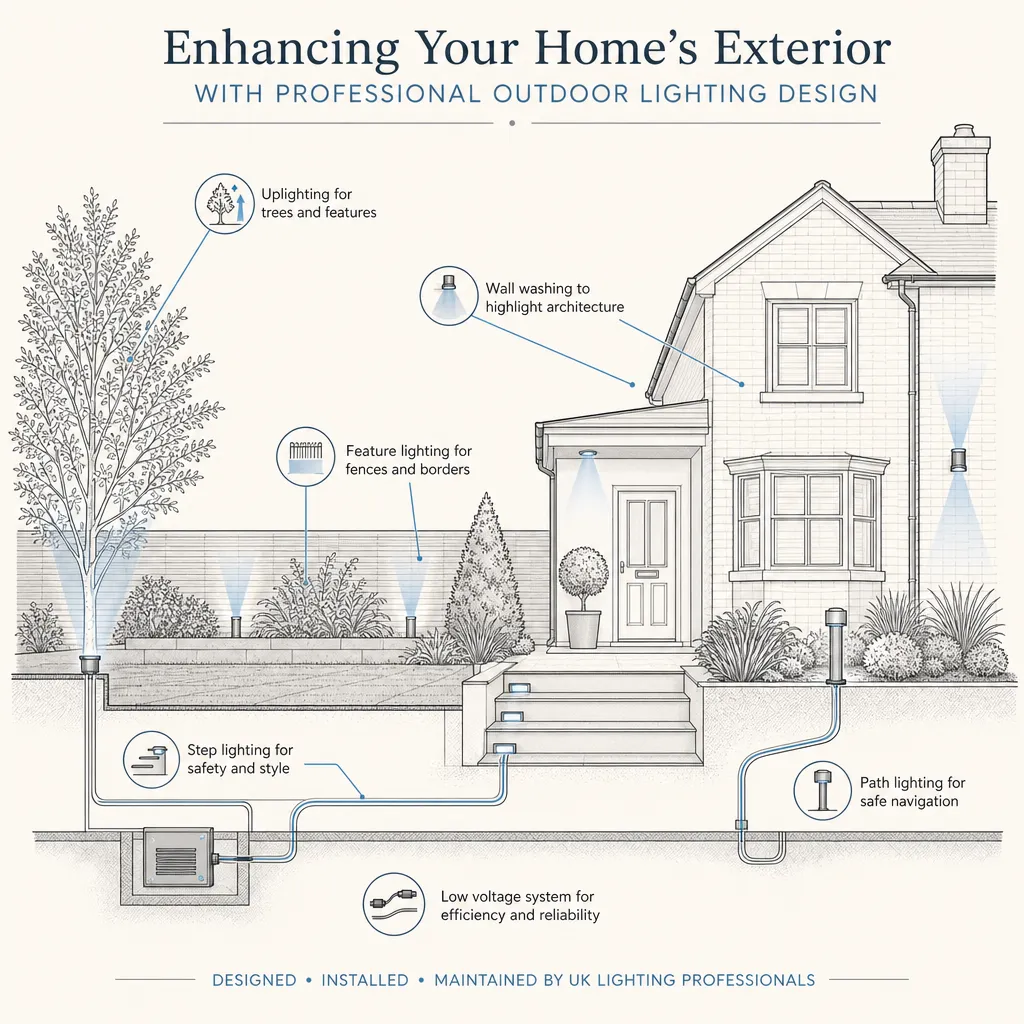
Enhancing Your Home's Exterior with Professional Outdoor Lighting Design
Professional outdoor lighting design improves kerb appeal, extends garden use after dark, and deters intruders.
 Improvement & Build
Solar-powered outdoor lighting: designing efficient garden illumination
Solar-powered outdoor lighting suits most UK gardens and requires no mains wiring, making it a practical, low-disruption option for paths, borders, and security.
 Improvement & Build
Landscape Lighting Design Ideas for Gardens
Effective garden lighting combines task lighting for paths and entrances, accent lighting to highlight trees and borders, and ambient lighting for entertaining areas.
 Improvement & Build
Uplighting for Gardens: Design Techniques and Effects
Garden uplighting uses low-level or in-ground fixtures to project light upward onto trees, walls, and architectural plants.