Uplighting for Gardens: Design Techniques and Effects
By Housey · Last reviewed 30th of May 2026
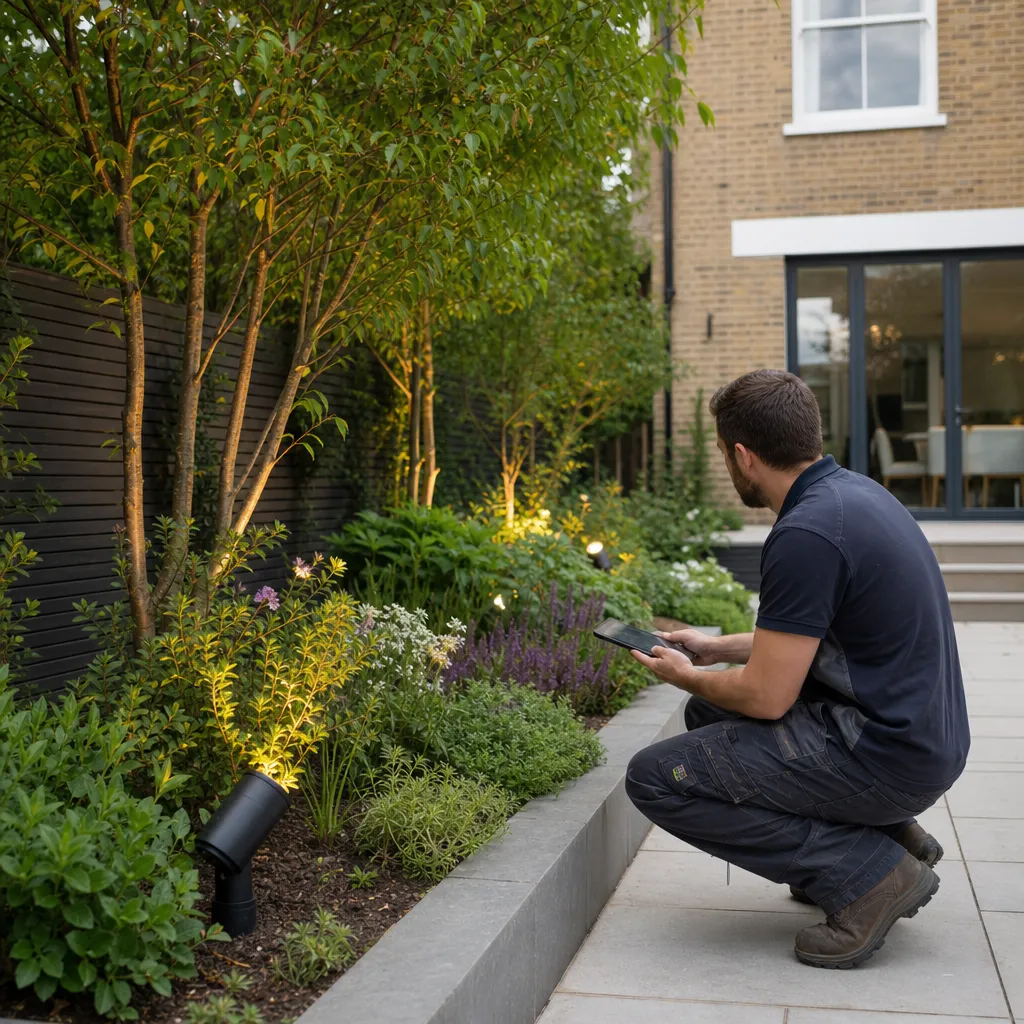
Uplighting for Gardens: Design Techniques and Effects
Garden uplighting has moved from a niche feature to a standard element of residential outdoor design in the UK — driven by longer evening use of gardens, the falling cost of LED technology, and growing interest in how outdoor spaces connect visually with interiors after dark. The question most homeowners face is not whether to add lighting, but which techniques will suit their specific planting scheme, boundary treatment, and electrical setup.
Key points
- All outdoor electrical work in England and Wales must comply with Building Regulations Part P; any new or extended outdoor mains circuit must be carried out by a Part P-registered electrician or notified to local building control.
- IP (Ingress Protection) ratings are essential for outdoor fittings: IP44 is the minimum for sheltered locations; IP65 or higher is required for ground-level spike lights and fittings exposed directly to rain and spray.
- Warm white LED lamps (2700–3000K colour temperature) complement most UK garden planting and create a welcoming evening atmosphere; cool white (4000K+) can appear clinical on foliage at night.
- Low-voltage 12V lighting systems can be connected to an existing outdoor socket by a competent homeowner; any new mains-voltage (230V) outdoor circuit extension requires a Part P-registered electrician.
- Garden lighting on a timer or smart-control system typically reduces energy use by 40–60% compared with a manually controlled installation left on overnight.
How uplighting works and why it matters for garden design
Uplighting — positioning a light source at or below ground level to project light upward onto a plant, wall, tree, or structure — exploits the way plant forms appear in reverse at night. A tree that reads as a canopy shape in daylight becomes a structural sculpture when lit from below; a textured garden wall that disappears into shadow at dusk becomes a focal point with a single well-placed ground fixture.
The technique works because the human eye in low-light conditions focuses on contrast and silhouette rather than colour. Even a modest installation of four to six spike lights can transform how a garden is experienced from inside the house during autumn and winter evenings — a consideration that matters particularly in the UK, where evenings close in early from October onwards and outdoor spaces often go unused rather than under-lit.
Uplighting techniques: a comparison
Technique | Effect | Best suited to | Typical fitting type |
|---|---|---|---|
Single-stem uplighting | Illuminates the structure of a tree or shrub from the base | Specimen trees, standard roses, architectural shrubs | In-ground recessed or spike fixture |
Grazing | Rakes light at a low angle across a surface to emphasise texture | Brick or stone walls, rendered surfaces, bark, dense hedges | Spike or wall-mount at low angle |
Silhouetting | Places light behind a plant to project only its outline against a background | Open, branching plants against a plain wall or fence | Ground spike positioned behind the plant |
Moonlighting | Positions a light high in the tree canopy to project downward through branches | Mature trees with broad canopies | Weatherproof downlight secured in canopy — electrician required |
Wash lighting | Spreads diffuse light evenly across a wall or planted border | Boundary walls, feature beds, long herbaceous borders | Wide-beam spike or in-ground recessed |
Water feature uplighting | Illuminates a pond or fountain from below or the side | Ponds, fountains, water walls, cascades | IP68-rated submersible fitting — mains power requires a qualified electrician |
Which technique suits your garden?
- Choose single-stem uplighting if you have one or two specimen trees or architectural shrubs and want them to serve as focal points in the evening scheme.
- Choose grazing if you have an interesting textured wall or boundary fence that reads as a flat dark surface after dusk.
- Choose silhouetting if your most attractive plants are light and open in form — ornamental grasses, bamboo, multi-stemmed trees — and you have a plain pale background to project against.
- Choose wash lighting if you have a long planted border and want ambient illumination across the full bed rather than individual focal points.
- Choose moonlighting if you have a mature tree and want the most naturalistic night-time effect — but commission a Part P-registered electrician for the installation, as the fitting must be positioned at height.
- Choose water feature uplighting if you have a pond or fountain and want evening reflections — IP68 submersible fittings are essential, and any mains-voltage water installation must be carried out by a qualified electrician.
IP ratings for outdoor garden lighting
Using fittings with insufficient IP ratings is one of the most common and costly mistakes in garden lighting. A fitting rated IP44 installed flush in an exposed lawn will corrode within a growing season.
Location | Minimum IP rating | Notes |
|---|---|---|
Fully enclosed porch or deep canopy | IP44 | Rain protected in most directions |
Open wall or fence mount | IP54 | Dust-protected and splash-proof in all directions |
Ground-level spike light | IP65 | Dust-tight and jet-proof |
In-ground recessed (grass or gravel) | IP65–IP67 | Check manufacturer depth rating for the specific fitting |
Submerged pond or water feature fitting | IP68 | Continuous submersion rating — mains power requires a qualified electrician |
Low-voltage versus mains-voltage systems
A low-voltage (12V DC) garden lighting system uses a plug-in transformer and thin cable runs that are safe to bury at relatively shallow depths. Most are straightforward for a competent homeowner to install from an existing outdoor socket. Practical limitations include total wattage (most domestic transformers top out at 100–200W) and cable run length before voltage drop reduces light quality at the fitting.
Mains-voltage (230V) systems can run longer cable distances, support higher-power fittings, and integrate more readily with smart-home systems and automated controls. However, all mains-voltage outdoor circuit work — new sockets, new circuit runs, new sub-boards — must be carried out by a Part P-registered electrician who will issue a Minor Works Certificate or an Electrical Installation Certificate. This is a legal requirement under Building Regulations, not a recommendation: unpermitted electrical work can affect home insurance validity, mortgage conditions, and the property's sale.
What to ask before hiring a garden lighting installer
Before accepting any quote:
- Are you Part P-registered, and will you provide certification for any mains-voltage work carried out?
- What IP rating will the specified fittings carry, and are those ratings appropriate for their planned locations?
- Will the installation include a timer, passive infrared sensor, or smart-control option?
- How will cable runs be protected — armoured cable, conduit, or direct-burial rated cable?
- What happens if ground conditions make trenching more difficult than expected (buried rubble, drainage runs, tree roots)?
- Is VAT included in the quote?
- What maintenance will the fittings require, and are replacement lamps readily available in the UK?
When to get professional help
Low-voltage spike lighting connected to an existing outdoor socket is within reach of most confident homeowners. For anything involving a new mains circuit, or for uplighting at height, professional installation is both legally required and strongly advisable for safety. Get a Part P-registered electrician if:
- You are adding a new outdoor circuit from the consumer unit.
- Any fitting is to be installed in or near a garden pond, fountain, or water feature.
- Fittings are to be installed at height — above 2 m in trees or on high walls.
- You are integrating garden lighting with a smart-home system or automated irrigation that shares power feeds.
How Housey can help
For a professionally designed lighting scheme, Housey connects you with garden designers who can incorporate uplighting as part of a wider outdoor plan, and with landscapers who can manage installation alongside other garden works. Submit your project details to receive quotes from vetted professionals in your area.
Frequently asked questions
Does garden uplighting need planning permission?
In most cases, no. Domestic garden lighting does not normally require planning permission under permitted development rights in England. However, if your property is listed or in a conservation area, any permanent external fittings may require listed building consent or conservation area consent. Check with your local planning authority if in any doubt before installing fixed outdoor fittings.
How many uplights do I need for a small UK garden?
For a typical UK pocket or courtyard garden under 20 sq m, four to six strategically placed spike lights are usually sufficient to create a well-considered scheme. Overlighting — placing a fitting on every shrub — flattens the effect and removes the drama of contrast between light and shadow. Start with fewer lights and add if needed.
Can I run garden lighting from a standard outdoor socket?
Yes — low-voltage (12V) plug-in transformer systems and IP-rated fittings designed for outdoor sockets can be connected without notifiable Part P work, provided you are using an existing outdoor socket. Adding a new outdoor socket or running a new cable from the consumer unit requires a Part P-registered electrician who will issue the appropriate certification.
What colour temperature is best for garden plants?
Warm white (2700–3000K) is the most widely used and flattering choice for UK garden planting. It enhances the green of foliage and the warmth of stone, bark, and timber without the clinical appearance of cool white. Some designers use a slightly warmer 2200K "amber" tone for a more dramatic effect on structural trees or ornamental grasses.
Sources and further reading
- Building Regulations Approved Document P: Electrical Safety — GOV.UK
- NICEIC: Find a Part P Registered Contractor — NICEIC
- Electrical Safety First: Outdoor and Garden Electrical Safety — Electrical Safety First
- IET Wiring Regulations BS 7671 — Institution of Engineering and Technology
- RHS: Garden Lighting Guidance — Royal Horticultural Society
Useful next reads
 Improvement & Build
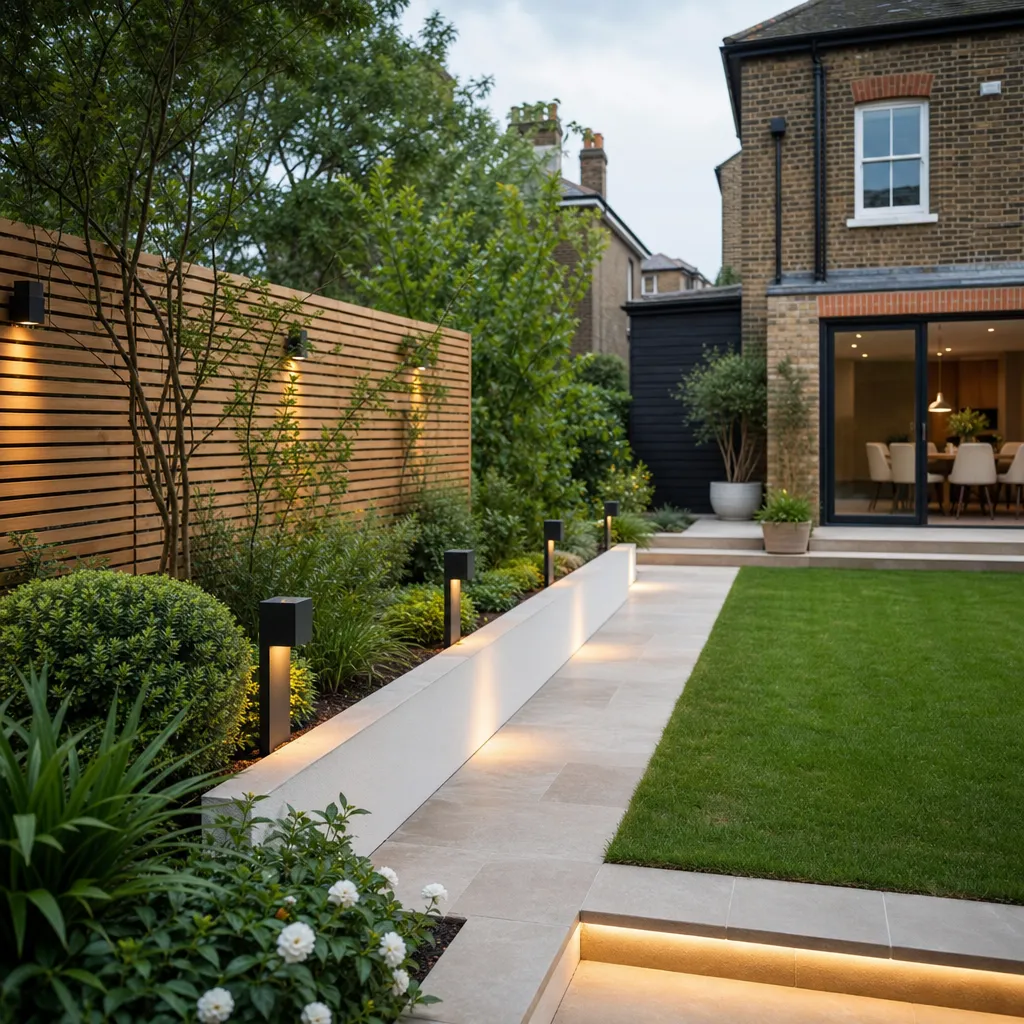
Landscape Lighting Design Ideas for Gardens
Effective garden lighting combines task lighting for paths and entrances, accent lighting to highlight trees and borders, and ambient lighting for entertaining areas.
 Improvement & Build
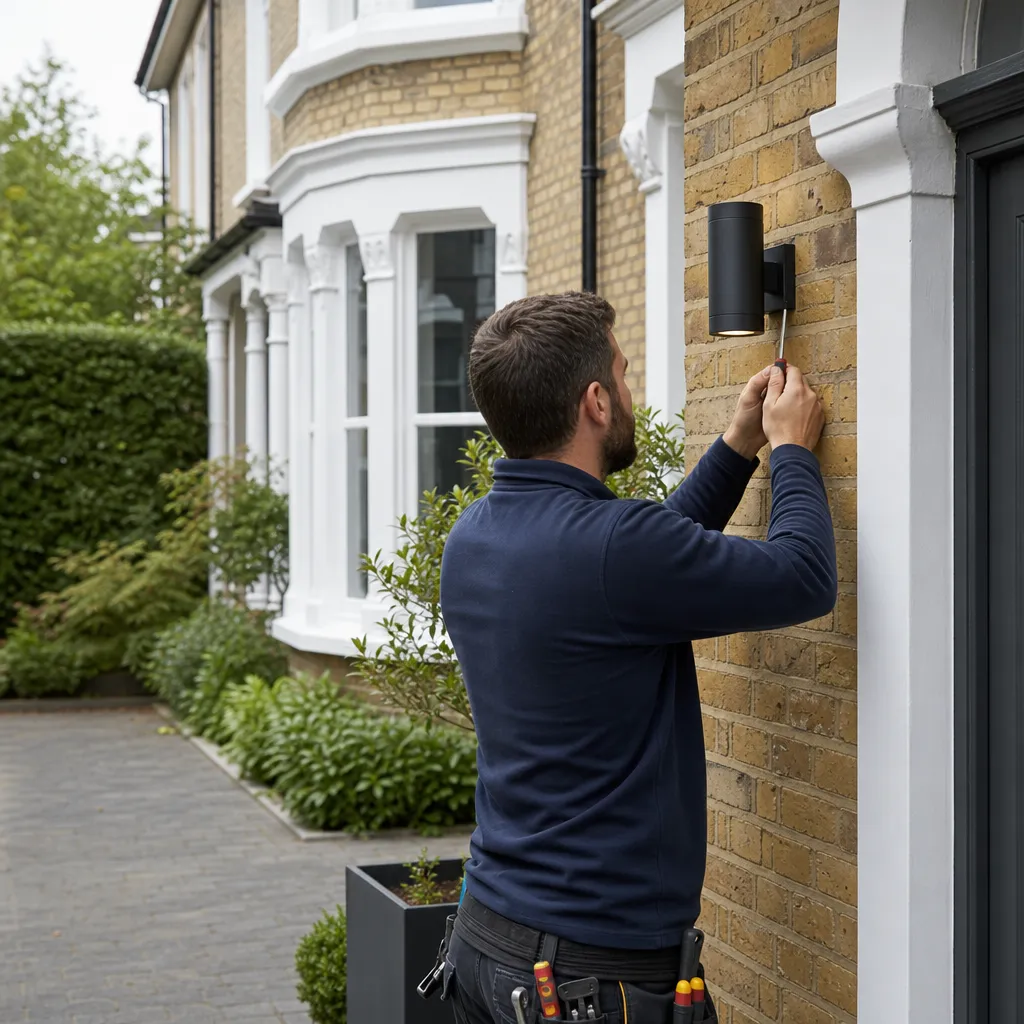
Outdoor lighting problems: solutions for common issues in gardens and driveways
Outdoor lighting problems in UK gardens commonly stem from water ingress, incorrect IP ratings, faulty transformers, poor earth connections, or corroded contacts.
 Improvement & Build
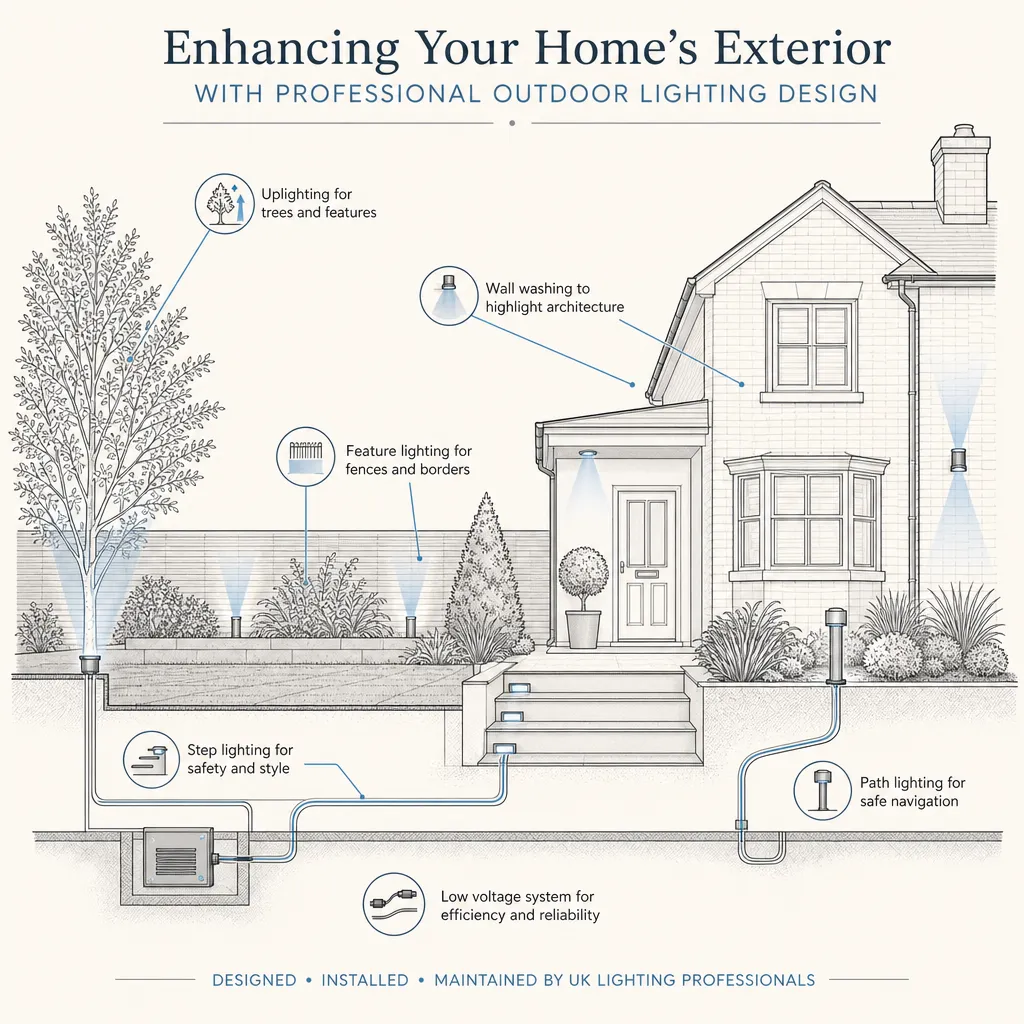
Enhancing Your Home's Exterior with Professional Outdoor Lighting Design
Professional outdoor lighting design improves kerb appeal, extends garden use after dark, and deters intruders.
 Improvement & Build
Solar-powered outdoor lighting: designing efficient garden illumination
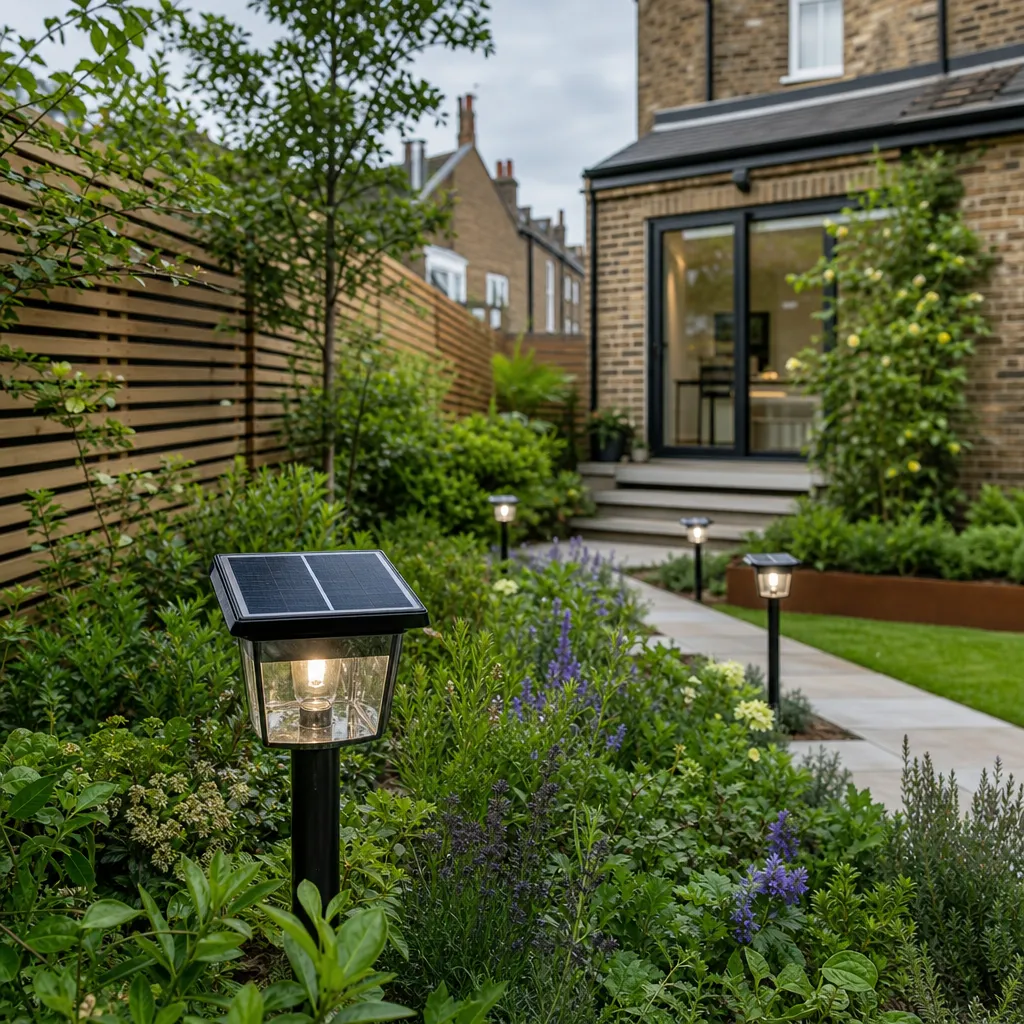
Solar-powered outdoor lighting suits most UK gardens and requires no mains wiring, making it a practical, low-disruption option for paths, borders, and security.
 Improvement & Build
Garden Lighting: Types, Design and Installation for Outdoor Spaces
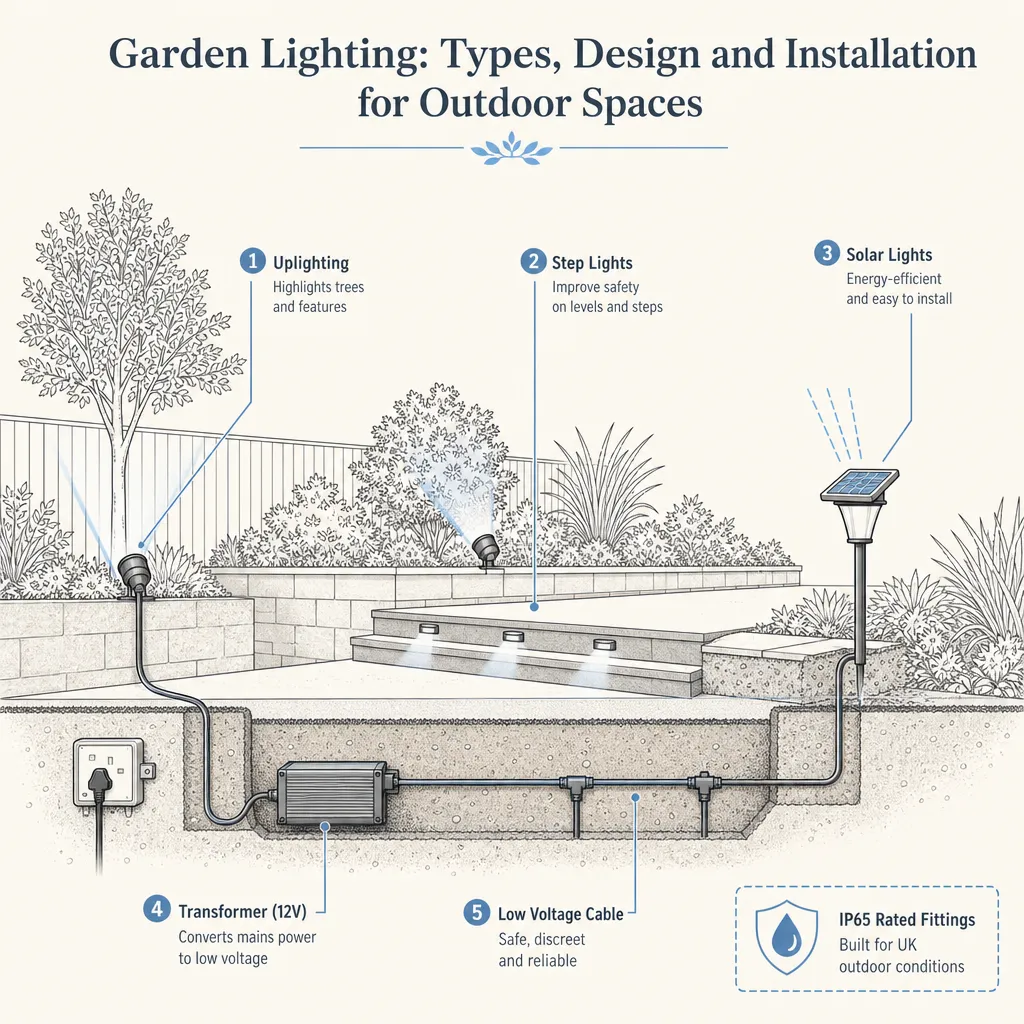
Garden lighting ranges from low-voltage LED path lights and solar-powered fittings to mains-powered floodlights and feature uplighters.