Outdoor lighting problems: solutions for common issues in gardens and driveways
By Housey · Last reviewed 12th of May 2026
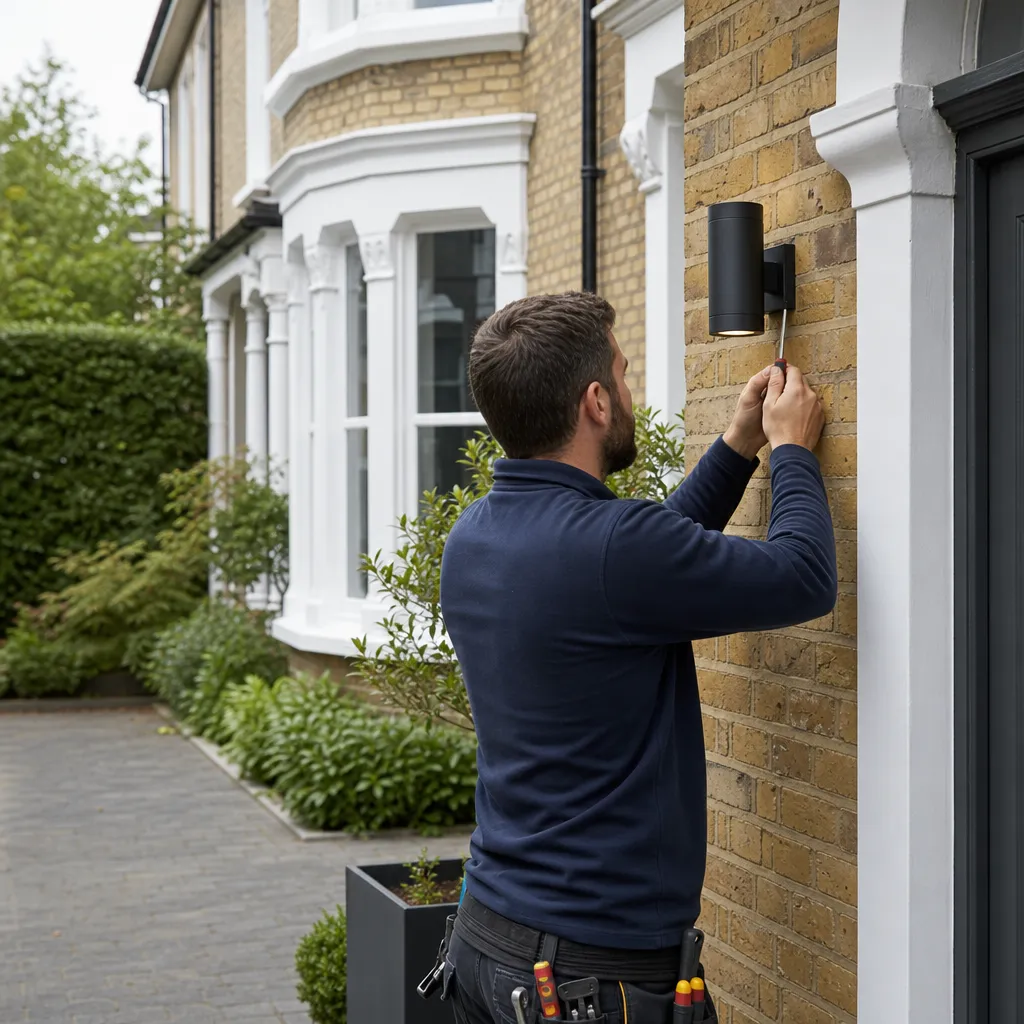
Outdoor lighting problems: solutions for common issues in gardens and driveways
Garden and driveway lighting enhances security, usability, and the appearance of UK outdoor spaces, but it also operates in one of the most demanding electrical environments in any home — exposed to rain, frost, UV, soil moisture, and temperature swings throughout the year. When outdoor lights fail, flicker, trip a circuit breaker, or stop responding to motion sensors, the cause is usually one of a small number of well-understood problems. Identifying which problem you have determines whether a simple bulb swap will solve it or whether a Part P-registered electrician needs to inspect the circuit.
Key points
- Outdoor electrical installations in the UK must comply with BS 7671 (the IET Wiring Regulations) and, where new circuits are added or significantly altered, must be notified under Building Regulations Part P.
- Garden lighting circuits must be protected by a residual current device (RCD) — if yours trips repeatedly, this is a safety signal requiring professional investigation, not a nuisance fault to bypass.
- IP (Ingress Protection) ratings define how well a luminaire resists water and dust; fittings exposed to direct rain should be rated at least IP44, and submersible pond lights require IP68.
- Low-voltage garden lighting systems (typically 12V) run from a transformer; a faulty or undersized transformer is one of the most common causes of lights going dim, flickering, or cutting out entirely.
- Solar-powered garden lights have distinct failure modes — panel shading, battery degradation, and dirty panel surfaces — entirely separate from mains-powered circuit faults.
Diagnosing the problem: a practical decision tree
Work through these checks in order before calling a professional:
- Check the RCD or circuit breaker first. Has it tripped? Reset it once. If it trips again immediately or within a short time, there is a live fault on the circuit — stop and call a Part P-registered electrician.
- Check the bulb. LED garden bulbs have long service lives but do fail. Replace with a like-for-like specification (wattage, cap type, and IP rating where the bulb is exposed).
- Check the transformer on low-voltage systems. Is it warm or buzzing? Is the total wattage of connected lights within the transformer's rated capacity? An overloaded transformer will flicker or shut down.
- Check connections. Outdoor connector blocks and junction boxes corrode over time. Look for green or white oxidation on terminals; clean gently with a dry cloth or replace the connector if badly corroded. Do not work on live circuits.
- Check the motion sensor settings. Most PIR sensors have adjustable sensitivity and time-delay dials. A sensor set to maximum sensitivity will trigger from animals, swaying plants, or passing vehicles.
- Check for water ingress. Remove the fitting carefully and look for condensation or water pooling inside the housing. This indicates a failed gasket or an IP rating insufficient for the installation position.
Common problems and their solutions
Lights keep tripping the RCD
This is the most important fault to take seriously. A tripping RCD means the circuit is detecting a dangerous current imbalance — usually caused by water reaching live conductors, a damaged cable, a failed fitting, or a faulty appliance on the same circuit.
Do not repeatedly reset the RCD and leave it. Disconnect the outdoor lighting circuit at the consumer unit and arrange a fault-finding visit from an NICEIC or NAPIT-registered electrician.
Flickering or dimming lights
On mains-voltage circuits, flickering often points to a loose connection, a failing LED driver, or an incompatible dimmer switch. On 12V low-voltage systems, the most common causes are:
- Transformer output below the total wattage of connected lights (add wattages and compare to the transformer's rated output)
- Corroded cable connectors reducing voltage at distant fittings
- Cable runs that are too long for the cable cross-section — voltage drop increases with distance
Water ingress into fittings
UK gardens expose fittings to prolonged rain, hosepipe spray, and frost-driven moisture. Common causes:
- IP rating too low for the mounting position (IP44 minimum for above-ground fittings exposed to rain)
- Failed or compressed gaskets on aged fittings
- Cable entries not sealed with appropriate gland fittings
Replace fittings that have failed gaskets — there is no reliable long-term repair for compromised IP-rated housings.
Motion sensor not triggering correctly
Symptom | Likely cause | What to check |
|---|---|---|
Never triggers | Sensitivity too low, or PIR obstructed | Adjust sensitivity dial; remove obstructions (plant growth, spider webs) |
Triggers constantly | Sensitivity too high, or heat source nearby | Reduce sensitivity; redirect away from boiler flue or compost heap |
Triggers then cuts off too soon | Time-delay set too short | Adjust the time-delay dial (typically 10 seconds to 15 minutes) |
Light stays on permanently | Override switch engaged or faulty PIR unit | Check override switch; replace PIR module if faulty |
Solar garden lights not working
Solar lights fail differently from mains-powered fittings:
- Shaded panel: Even partial shading from hedges, fences, or seasonal tree growth reduces charging significantly. Reposition the light.
- Dirty panel: A film of lichen, algae, or pollen on the panel surface can reduce output noticeably. Clean gently with a damp cloth.
- Battery degradation: Most solar garden lights use NiMH or LiFePO4 batteries rated for 2–5 years. Reduced run time after dark indicates the battery needs replacing. Many fittings allow battery swapping.
- Winter performance: Solar lights in the UK will have shorter night-time run times from October to February due to reduced daylight hours and lower sun angle. This is normal, not a fault.
Red flags: when to stop troubleshooting and call an electrician
Stop work and arrange a professional inspection if you observe any of the following:
- The RCD trips again after resetting, especially if it trips immediately
- Any outdoor cable shows visible damage, crushing, or signs of rodent chewing
- A fitting or junction box shows scorch marks or melted components
- The outdoor circuit has no visible RCD protection
- You are unsure which circuit feeds the outdoor lights, or the consumer unit is unlabelled
- Any work requires accessing the consumer unit or installing a new outdoor circuit
Any new outdoor circuit, or significant alteration to an existing one, must be notified under Building Regulations Part P by a registered electrician (NICEIC, NAPIT, or another Part P competent-person scheme member) or via your local building control authority.
When to get professional help
For any fault beyond bulb replacement or transformer adjustment, a Part P-registered electrician is the appropriate professional. A fault-finding visit typically takes 1–2 hours, and most electricians can provide a condition report and quote for remedial work at the same visit.
If you are planning a comprehensive garden lighting scheme rather than repairing an existing one, a garden designer or landscaper can specify the layout and materials, after which a registered electrician installs and certifies the circuits.
How Housey can help
Housey connects UK homeowners with qualified landscapers for outdoor lighting schemes who can help plan and install complete garden and driveway lighting, and with garden designers for integrated outdoor design who can incorporate lighting into a wider outdoor scheme. For electrical installation and certification, always use an NICEIC or NAPIT-registered contractor.
Frequently asked questions
Why do my outdoor lights keep tripping the RCD?
A tripping RCD on an outdoor circuit almost always indicates water reaching live conductors, a cable fault, or a failing fitting. It is a protective device doing its job — not a nuisance fault. Do not bypass or override it. Disconnect the outdoor circuit and have a Part P-registered electrician carry out a fault-finding inspection.
What IP rating do outdoor lights need in the UK?
IP44 is the minimum recommended rating for above-ground outdoor fittings exposed to rain in standard garden installations. IP65 or above is appropriate for fittings exposed to hosepipes or heavy rain. Submersible pond or water-feature lights should be rated IP68. Check the IP rating on the fitting's specification plate before installation.
Can I install outdoor garden lighting myself?
Replacing like-for-like fittings on an existing outdoor circuit is permitted as DIY in England and Wales. However, installing a new outdoor circuit, running new cable, or making alterations beyond simple replacement must be carried out by a Part P-registered electrician or notified to building control. Check current rules with your local authority before starting work.
Why are my solar garden lights not working in winter?
UK winter daylight is limited and the sun angle is low, so solar panels charge less efficiently from October to March. Expect shorter run times after dark — this is normal seasonal behaviour. If lights fail to come on at all, check for panel shading, a dirty panel surface, or a degraded battery that needs replacing.
Sources and further reading
- Building Regulations Part P: electrical safety — GOV.UK
- Find a registered electrician — NICEIC
- Garden electrical safety — Electrical Safety First
- BS 7671 Wiring Regulations — Institution of Engineering and Technology
Useful next reads
 Improvement & Build
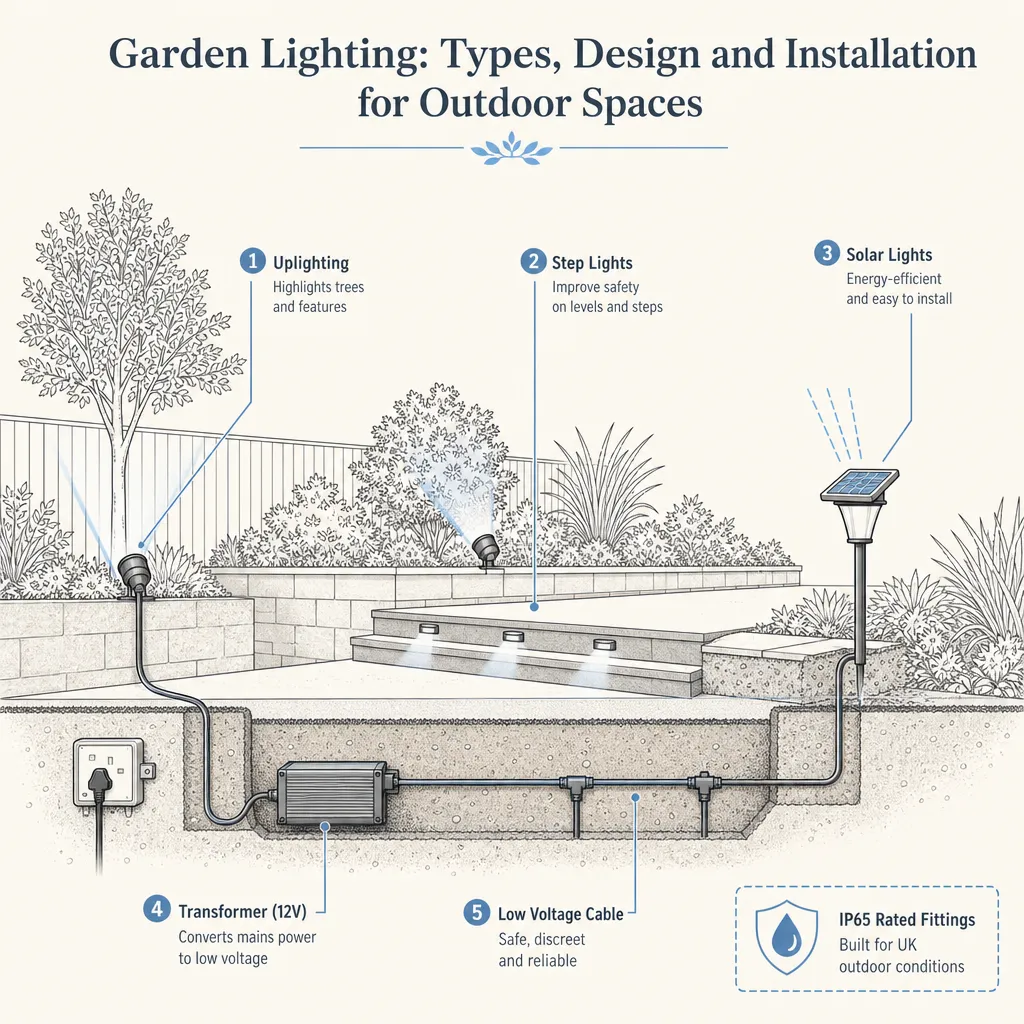
Garden Lighting: Types, Design and Installation for Outdoor Spaces
Garden lighting ranges from low-voltage LED path lights and solar-powered fittings to mains-powered floodlights and feature uplighters.
 Improvement & Build
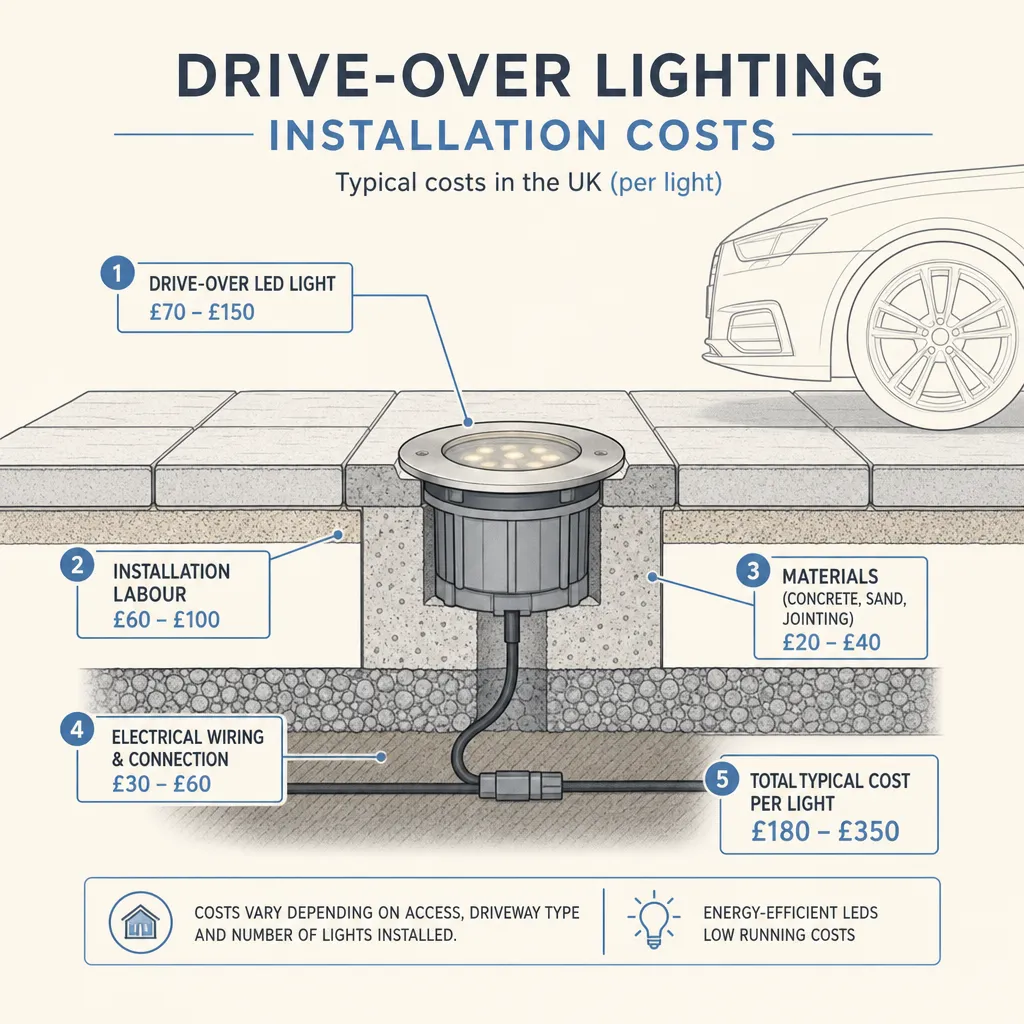
Drive-Over Lighting Installation Costs
Drive-over driveway lighting typically costs £600–£2,000 for a complete mains-powered installation of 6–12 recessed LED units, including electrical connection and surface reinstatement.
 Improvement & Build
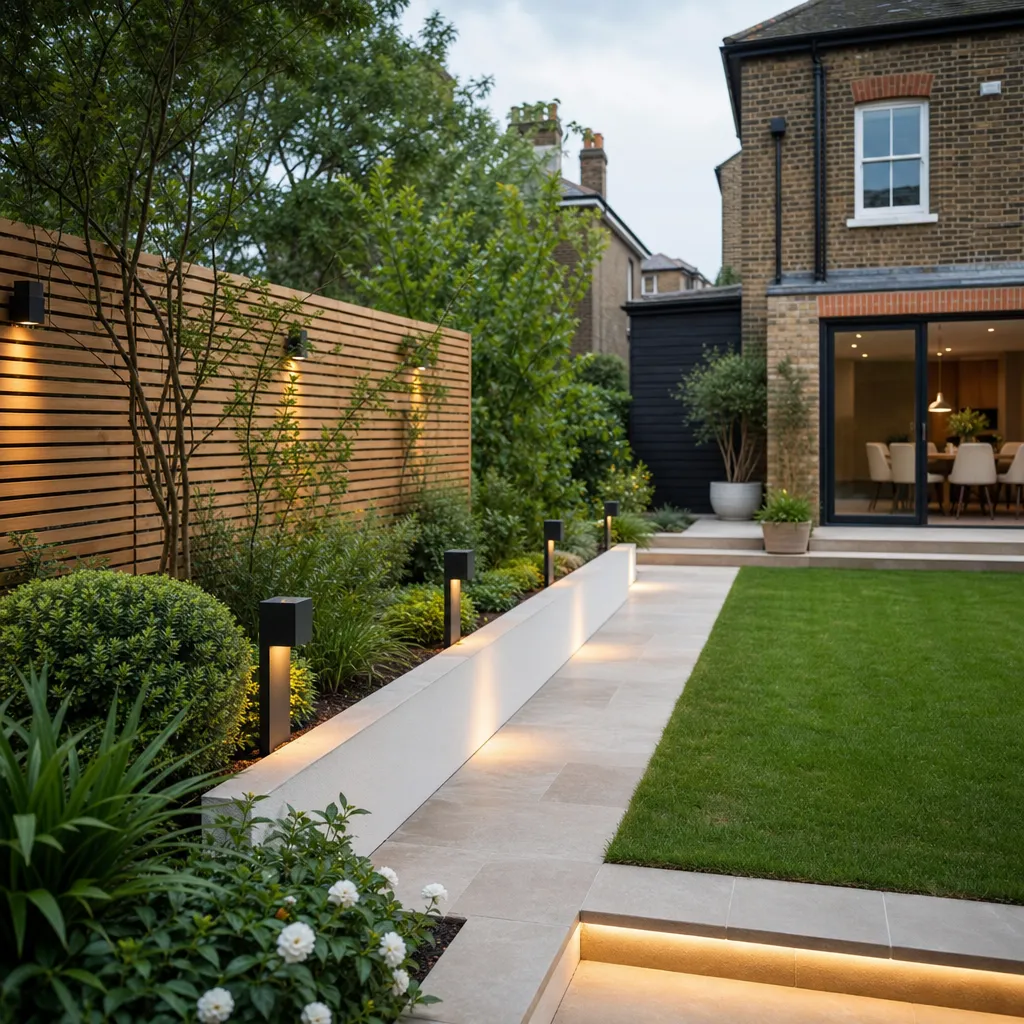
Landscape Lighting Design Ideas for Gardens
Effective garden lighting combines task lighting for paths and entrances, accent lighting to highlight trees and borders, and ambient lighting for entertaining areas.
 Improvement & Build
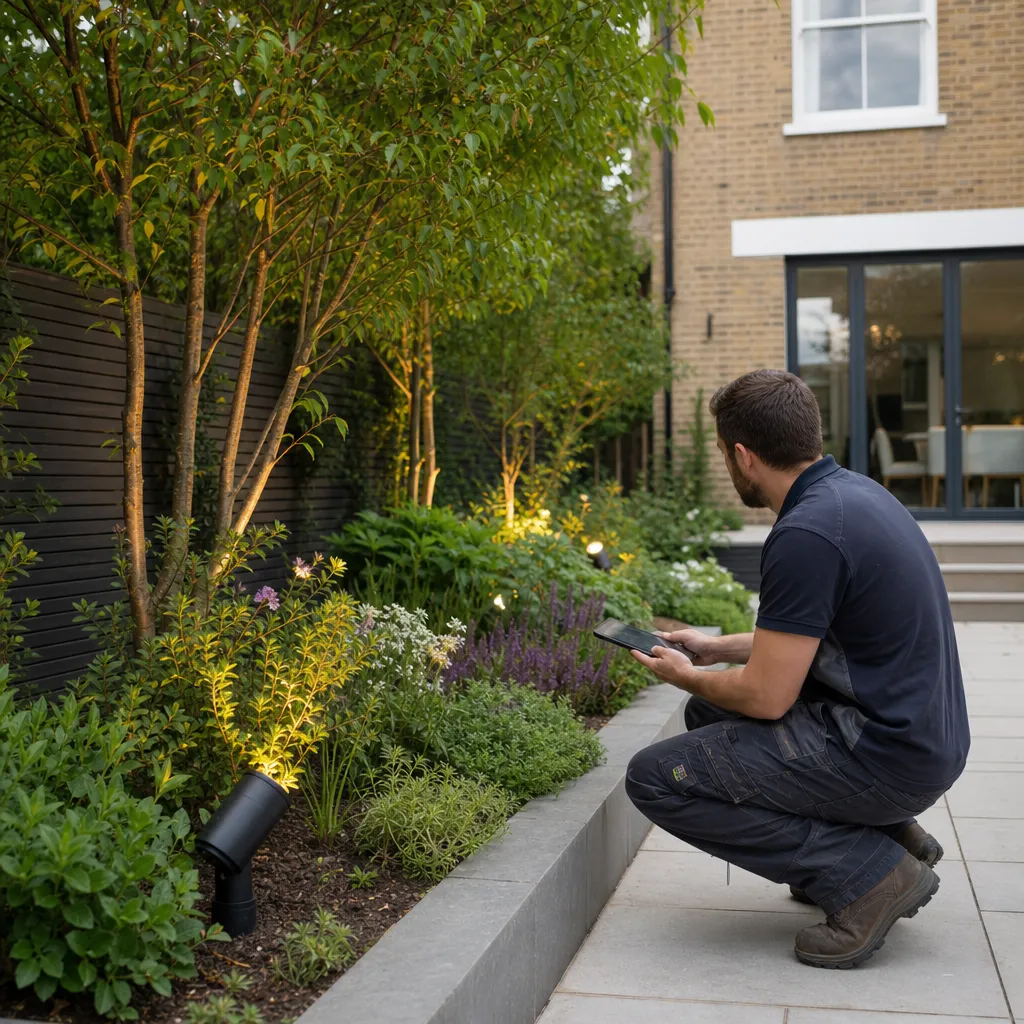
Uplighting for Gardens: Design Techniques and Effects
Garden uplighting uses low-level or in-ground fixtures to project light upward onto trees, walls, and architectural plants.
 Improvement & Build
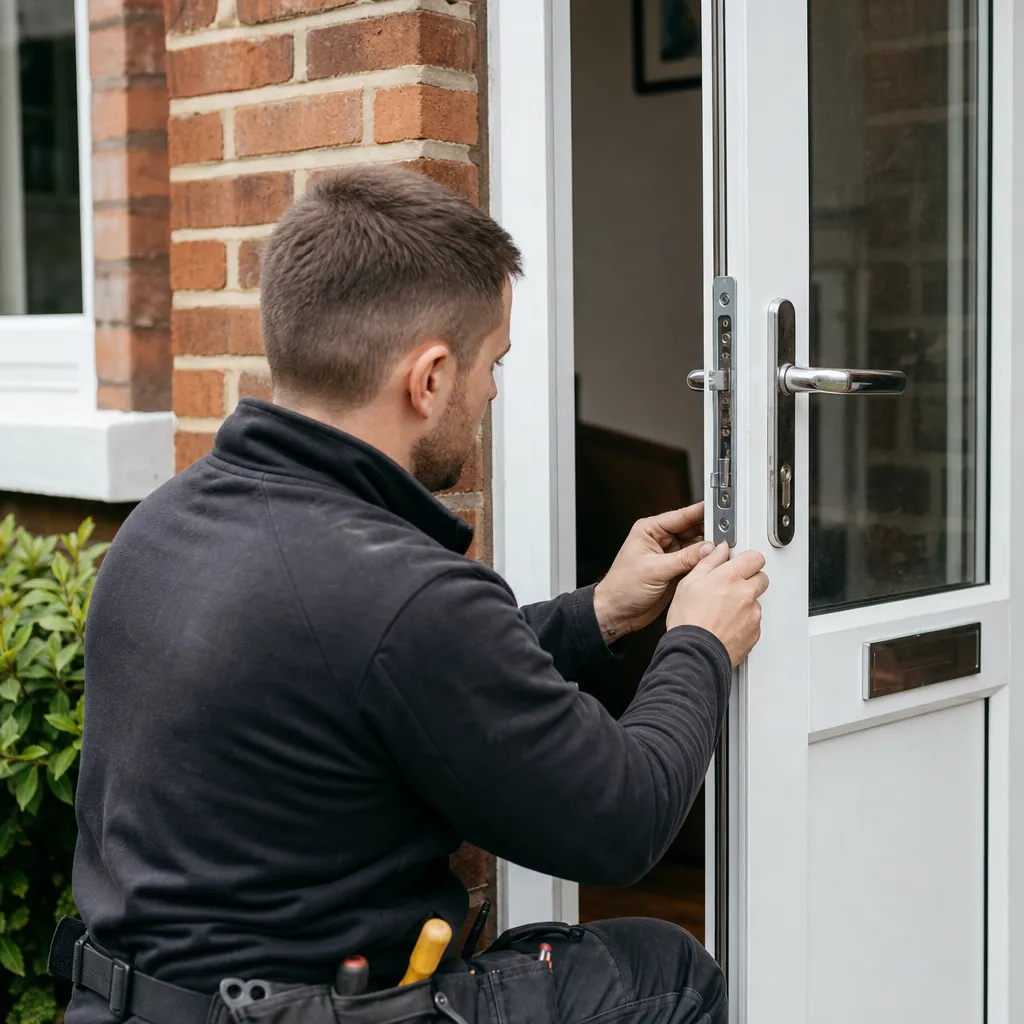
Repairing a Broken uPVC Door Lock: Replacement and Solutions
A broken uPVC door lock usually needs a new cylinder, a replacement multipoint mechanism, or both.