Landscape Lighting Design Ideas for Gardens
By Housey · Last reviewed 30th of May 2026
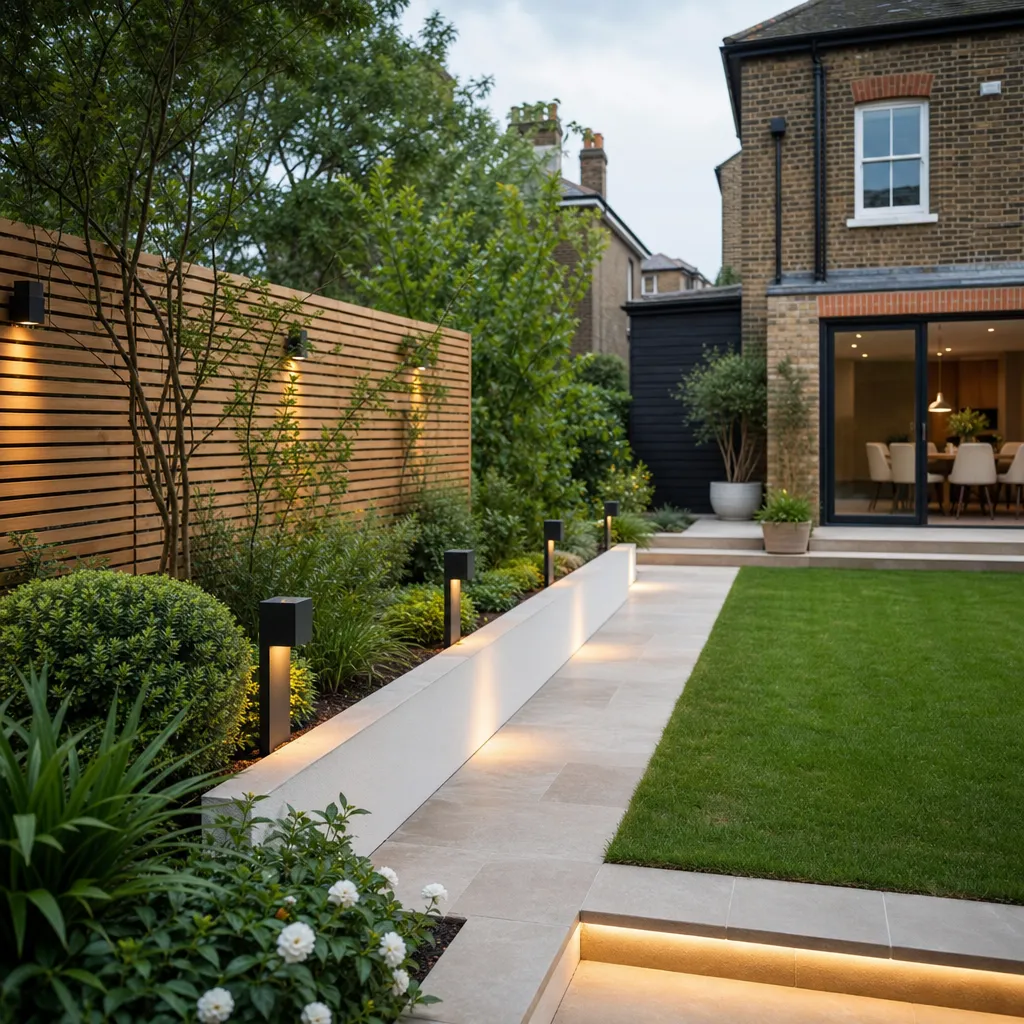
Landscape Lighting Design Ideas for Gardens
Garden lighting is often the finishing touch that transforms an outdoor space from a functional area into somewhere people actually want to spend evenings — but it is also one of the most under-planned elements of a garden project. Homeowners in the UK frequently install lighting as an afterthought, ending up with poorly positioned fittings, mismatched colour temperatures, and cables routed in ways that limit future flexibility. A structured approach to lighting design, taken early in a garden project, avoids most of these common pitfalls.
Key points
- Low-voltage (12V) garden lighting systems are safer and easier to extend than mains (230V) outdoor circuits; any new mains outdoor circuit must be installed by a Part P-registered electrician under Building Regulations in England, Scotland, and Wales.
- Outdoor light fittings in exposed positions should carry at least an IP65 rating (dust-tight and protected against water jets); IP44 is the minimum for sheltered locations such as a covered porch.
- Solar-powered garden lights require at least 4–6 hours of direct sunlight daily to perform reliably — often insufficient in north-facing or heavily shaded UK gardens between October and March.
- LED lamps use approximately 75–80% less energy than equivalent halogen fittings and typically last 15,000–25,000 hours, making them the standard choice for new garden lighting schemes.
- Planning permission is not normally required for garden lighting on a private property, but in conservation areas or on listed buildings external fittings may need prior consent from the local planning authority.
Understanding the three layers of landscape lighting
Professional landscape designers typically work to three lighting layers that together create a coherent, functional, and attractive outdoor scheme:
- Task lighting illuminates functional areas — paths, steps, entrances, and utility zones — where safe navigation matters. Bollard lights, step lights, and low path lights are the typical fittings.
- Accent lighting draws attention to specific features: specimen trees, architectural walls, water features, or sculptures. Spike spotlights, in-ground uplighters, and directional wall-washers achieve this effect.
- Ambient lighting creates the background glow that makes an area feel inviting for entertaining. String lights, lanterns, and low-wattage perimeter fittings work well here.
Most successful UK garden lighting schemes combine at least two of these layers. Relying entirely on task lighting produces a functional but uninspiring result; relying entirely on ambient lighting leaves paths and steps unsafe in the dark.
Comparing garden lighting system types
System type | Best for | Not ideal for | Typical installed cost (indicative, 2026-05-30) | Main consideration |
|---|---|---|---|---|
Low-voltage (12V transformer + cable) | Most UK gardens; flexible and safe to extend | Very large gardens where voltage drop becomes an issue | £200–£800 DIY; £500–£2,000+ professionally installed | Transformer must be weatherproof and correctly rated for total load |
Mains voltage (230V) | Powerful floodlights, long cable runs, large feature lighting | DIY installation (Part P compliance required) | £500–£3,000+ depending on circuit complexity | Must be installed by a Part P-registered electrician |
Solar only | Remote areas without cable access; supplementary accent lights | North-facing gardens, winter use, consistent performance needed | £20–£300 for individual fittings | Performance varies greatly with UK seasonal daylight |
Smart/connected (low-voltage with app control) | Homeowners wanting scenes, dimming, and scheduling | Those preferring simple on/off operation | £400–£2,500 installed | Requires a hub or bridge; brand compatibility varies |
Indicative UK costs, last reviewed 2026-05-30. Costs vary by garden size, number of fittings, and whether groundwork is required for buried cable.
Choosing the right colour temperature
Colour temperature, measured in Kelvin (K), significantly affects the mood of an outdoor space:
- 2,700–3,000 K (warm white): Resembles traditional incandescent light and suits entertaining spaces, dining areas, and planting schemes with warm-toned flowers. The most popular choice for UK residential gardens.
- 4,000 K (neutral/cool white): Crisper and more clinical; better suited to driveways, modern architectural settings, and security lighting.
- 6,000 K+ (daylight/cool): Usually too harsh for garden ambience; typically reserved for task-specific security floodlights.
Mixing warm and cool fittings across the same scheme usually looks confused. Settle on a single colour temperature for the main scheme and reserve cooler fittings for any dedicated security application.
Practical design ideas for UK gardens
Uplighting trees and shrubs: Position a spike spotlight at the base of a tree, angled upward through the canopy. In UK gardens, silver birch, multi-stem amelanchier, and ornamental grasses respond particularly well. A 15–36° beam angle gives focused, dramatic uplighting without excessive light spill into neighbouring properties.
Path and step lighting: Recessed step lights or low bollards spaced 1.5–2 m apart create safe, even illumination without glare. For gravel or loose-stone paths, surface-mounted copper or stainless-steel path lights are more practical than flush recessed fittings.
Wall washing: Positioning a fitting close to a textured stone, brick, or rendered wall and grazing light across the surface creates dramatic shadow and depth — effective on older garden walls common in Victorian and Edwardian townhouse properties.
Water feature lighting: Submersible LED fittings in ponds or fountains need an IP68 rating and should be connected via a low-voltage system for safety. Avoid positioning bright fittings where they shine directly into neighbouring properties or house windows.
Festoon and pergola lighting: String lights strung across a pergola or between posts provide ambient light for outdoor dining without requiring groundwork. Most festoon lighting runs from a weatherproof outdoor socket (13A, IP-rated), which can be installed by a Part P-registered electrician.
What to ask before hiring a lighting designer or installer
If you are appointing a landscape lighting designer, garden designer, or landscaper with lighting experience, use these questions to assess their approach:
- Can you provide a lighting plan showing fitting positions, circuit layout, and transformer location?
- What IP rating are the proposed fittings, and are they rated for direct burial or surface mounting?
- Are all cable connections made in outdoor-rated junction boxes, and will buried cable run in conduit?
- What total watt load will the transformer carry, and what headroom remains for adding fittings later?
- Who will install the electrical elements, and are they Part P-registered?
- What warranty do the fittings carry, and can replacement lamps be sourced in 5–10 years?
- Will any new mains circuit be notified to building control?
When to get professional help
Low-voltage garden lighting is often suitable for a competent DIYer comfortable with basic electrical connections. Seek professional help if:
- You need a new outdoor circuit run from the consumer unit — this is notifiable work requiring a Part P-registered electrician.
- Lighting is being incorporated into a wider landscaping project involving groundworks, raised beds, or a pergola build.
- The garden is on a listed property or in a conservation area.
- You want a designed scheme with multiple zones, dimmers, timers, and smart controls.
How Housey can help
Housey connects UK homeowners with experienced garden designers who can incorporate lighting into a full planting and layout plan, and with landscapers who can manage installation alongside other garden improvements. Get quotes from local professionals familiar with UK garden conditions and Part P requirements.
Frequently asked questions
Do I need an electrician to install garden lights?
For low-voltage (12V) systems powered by an existing outdoor socket, a competent DIYer can usually install fittings and run cables safely. However, installing a new outdoor socket, outdoor circuit, or any mains-voltage (230V) garden circuit is notifiable work under Part P of the Building Regulations and must be carried out by a registered electrician in England, Scotland, and Wales.
What IP rating do I need for outdoor garden lights?
IP65 is the minimum recommended for fittings in exposed outdoor positions — meaning the fitting is dust-tight and protected against water jets. For in-ground or submerged fittings, IP67 or IP68 is required. IP44 may be adequate in sheltered positions such as a covered porch or under a pergola roof.
How much does professional garden lighting installation cost?
A professionally designed and installed low-voltage garden lighting scheme for a medium-sized UK garden typically costs £500–£2,000 (indicative, last reviewed 2026-05-30). Costs vary significantly depending on the number of fittings, cable runs, groundwork required, and whether a new electrical circuit is needed. Always obtain at least three itemised quotes.
Can I use solar lights in a north-facing garden?
Solar garden lights can work in north-facing gardens during summer but often perform poorly from late autumn to early spring, when UK daylight hours are limited and sunlight angles are low. If reliable year-round performance is important, a low-voltage wired system is more dependable for north-facing or heavily shaded gardens.
Sources and further reading
- Approved Document P: Electrical safety — dwellings — GOV.UK
- Outdoor electrical safety guidance — Electrical Safety First
- LED lighting explained — Energy Saving Trust
- Planning permission: listed buildings and conservation areas — Planning Portal
Useful next reads
 Improvement & Build
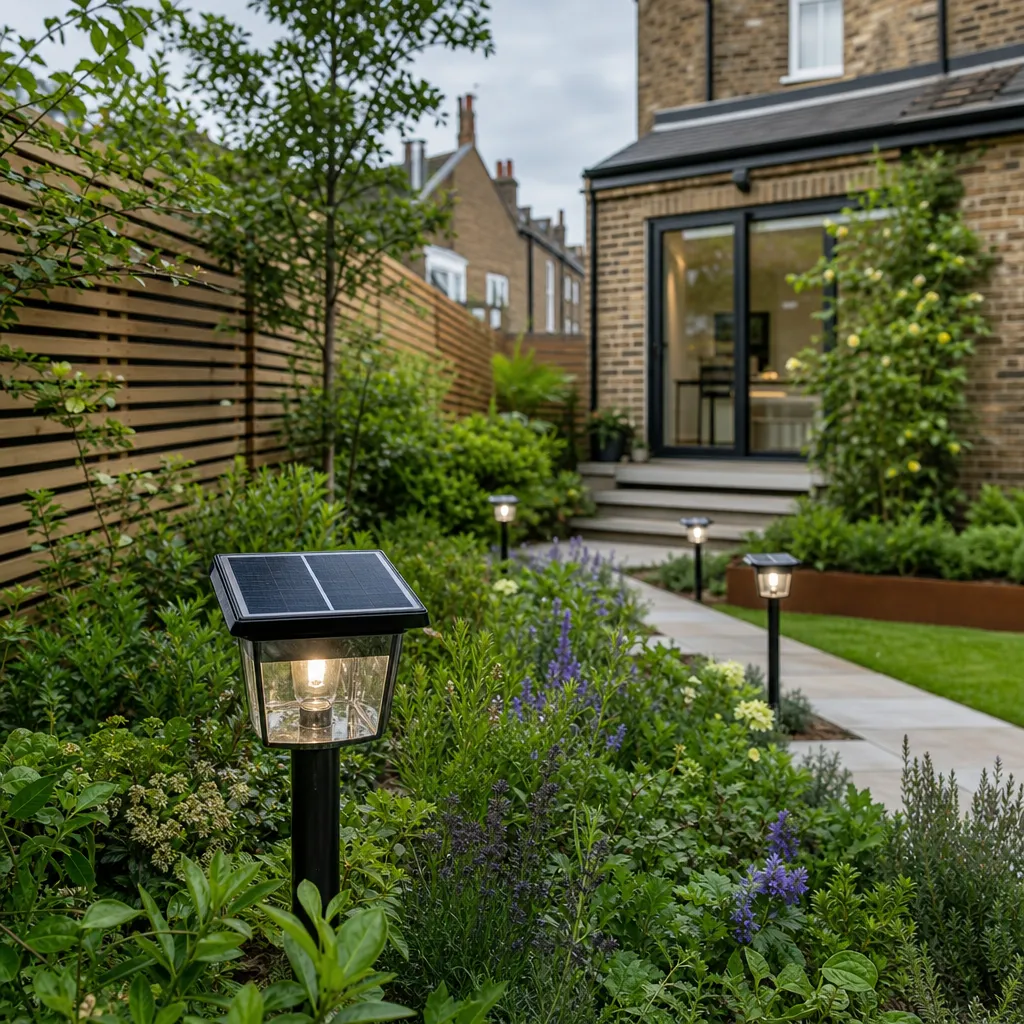
Solar-powered outdoor lighting: designing efficient garden illumination
Solar-powered outdoor lighting suits most UK gardens and requires no mains wiring, making it a practical, low-disruption option for paths, borders, and security.
 Improvement & Build
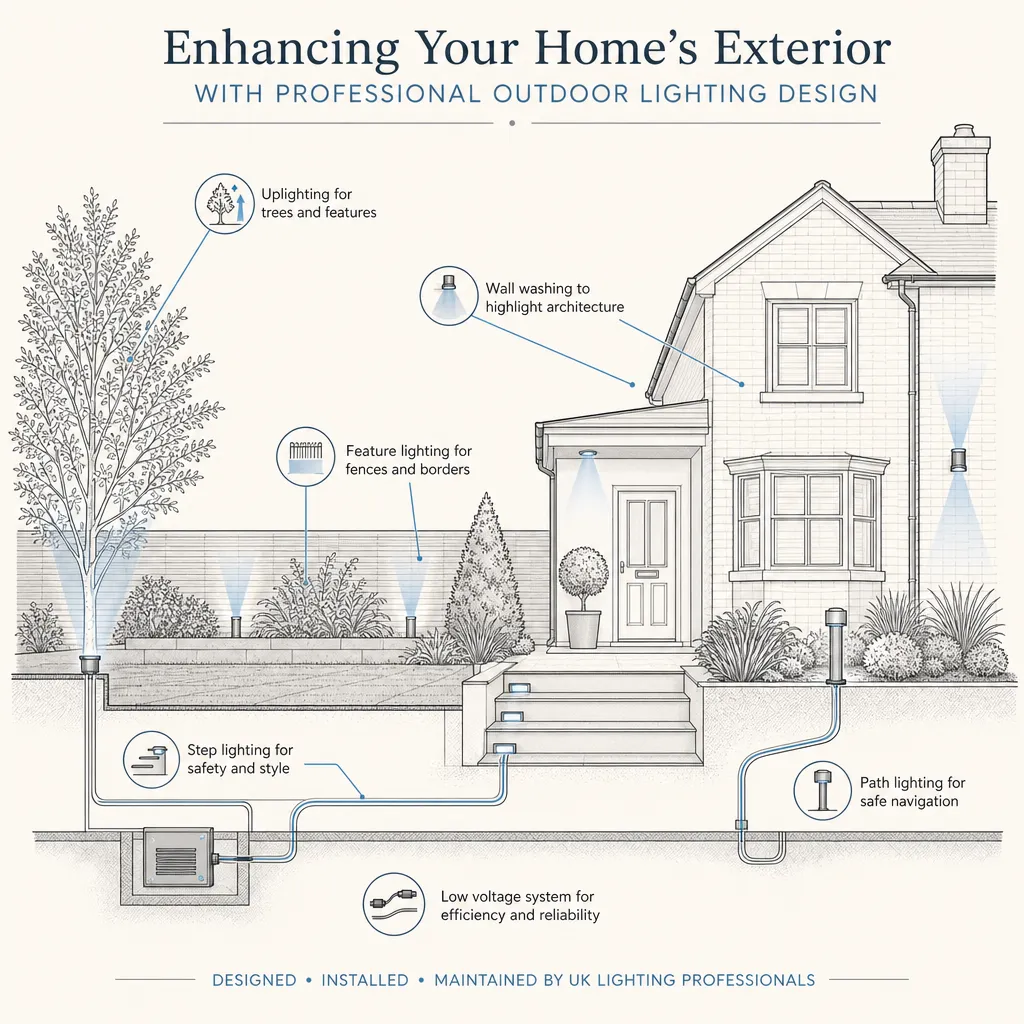
Enhancing Your Home's Exterior with Professional Outdoor Lighting Design
Professional outdoor lighting design improves kerb appeal, extends garden use after dark, and deters intruders.
 Improvement & Build
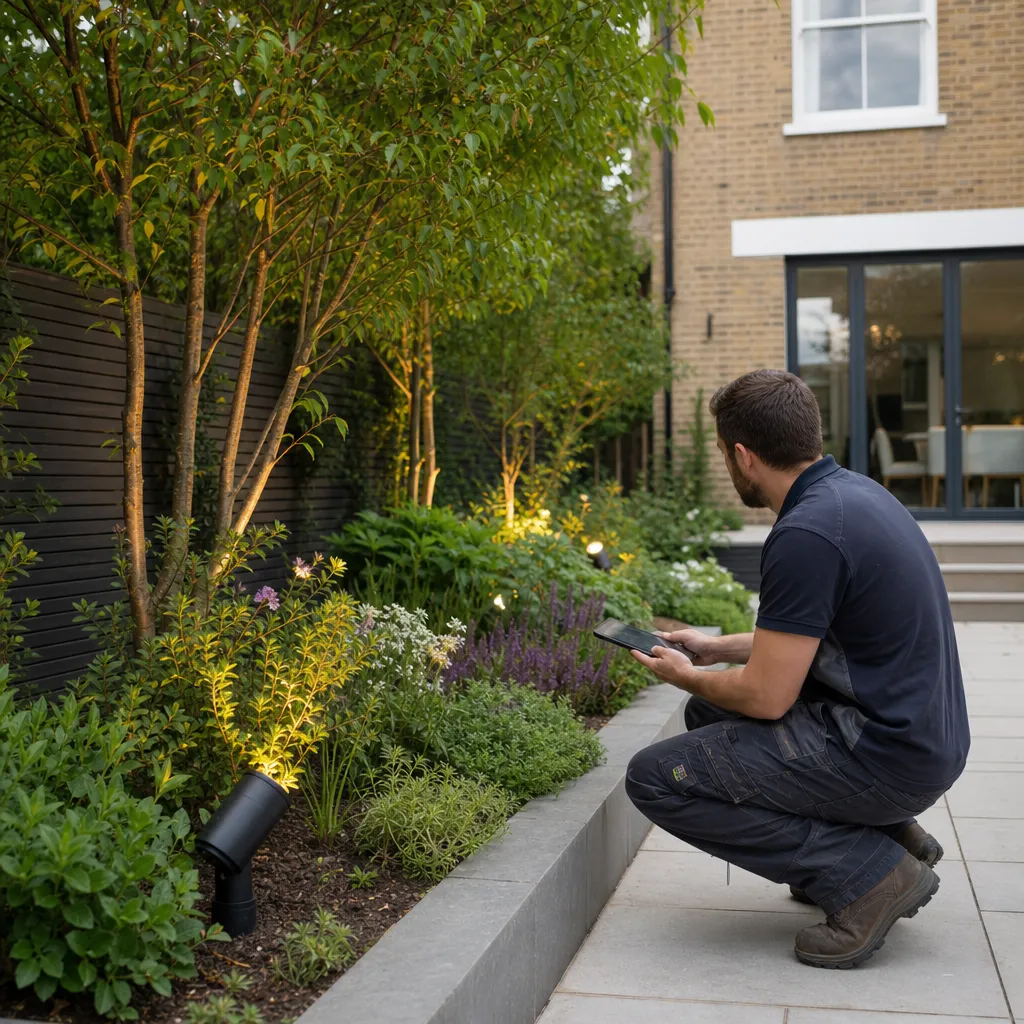
Uplighting for Gardens: Design Techniques and Effects
Garden uplighting uses low-level or in-ground fixtures to project light upward onto trees, walls, and architectural plants.
 Improvement & Build
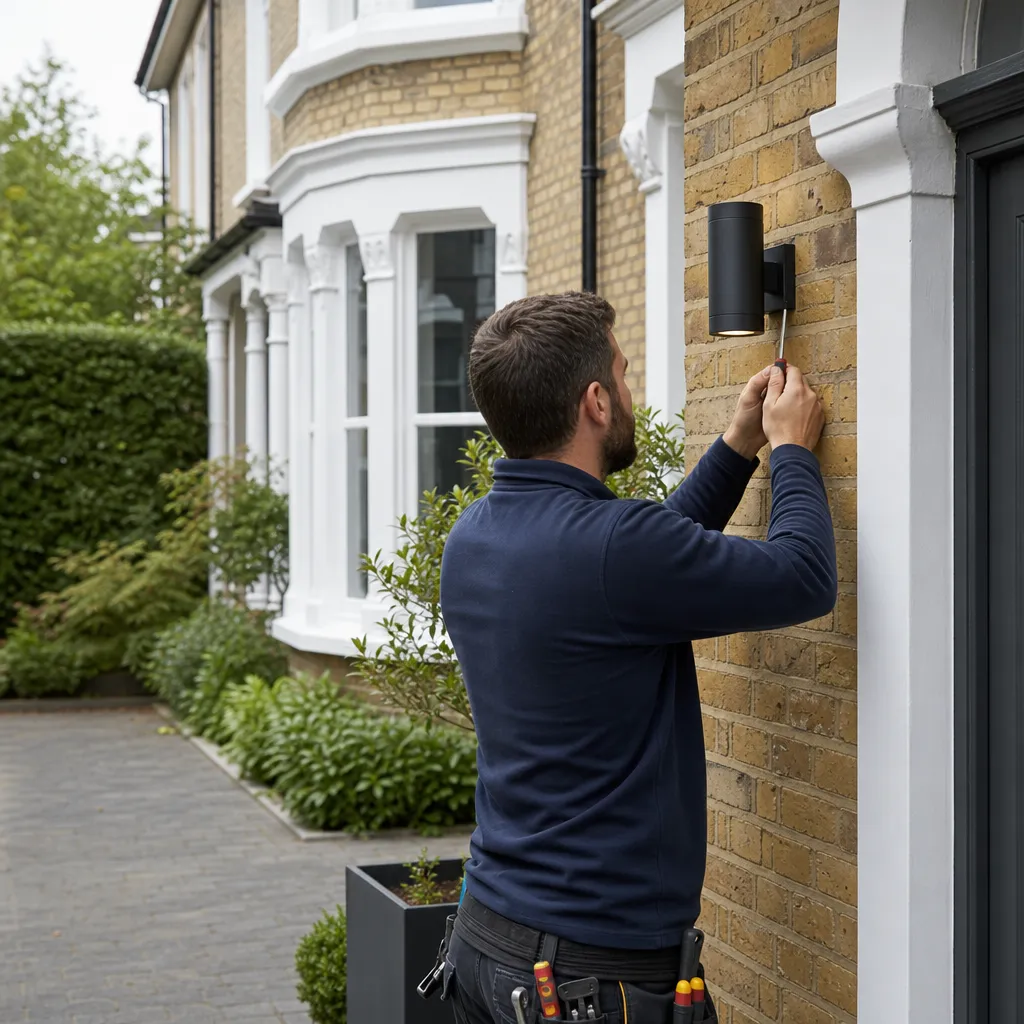
Outdoor lighting problems: solutions for common issues in gardens and driveways
Outdoor lighting problems in UK gardens commonly stem from water ingress, incorrect IP ratings, faulty transformers, poor earth connections, or corroded contacts.
 Improvement & Build
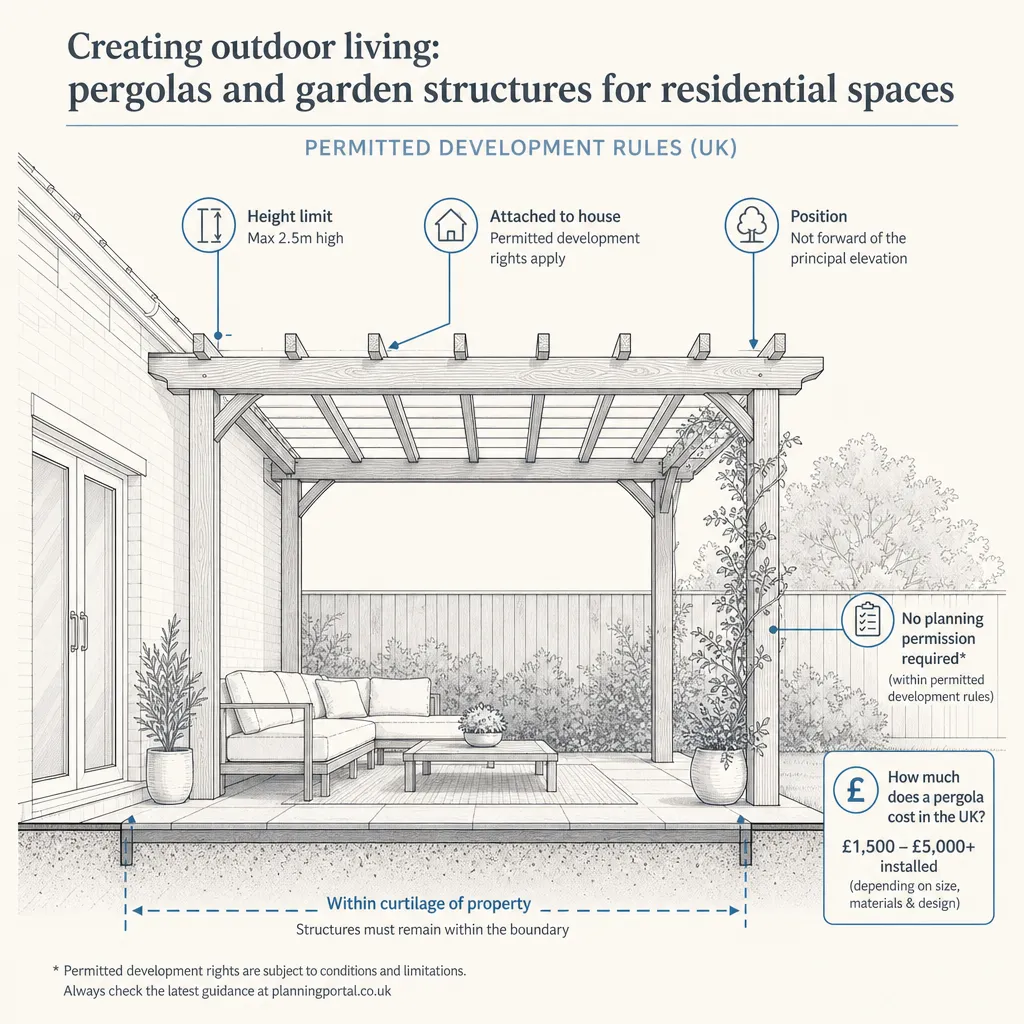
Creating outdoor living: pergolas and garden structures for residential spaces
Most freestanding pergolas in UK rear gardens are permitted development and don't need planning permission, provided they stay within height limits and outbuilding coverage stays below 50% of the original garden.