Driveway Cracks in Concrete and Tarmac: Causes and Repair Options
By Housey · Last reviewed 11th of May 2026
Driveway Cracks in Concrete and Tarmac: Causes and Repair Options
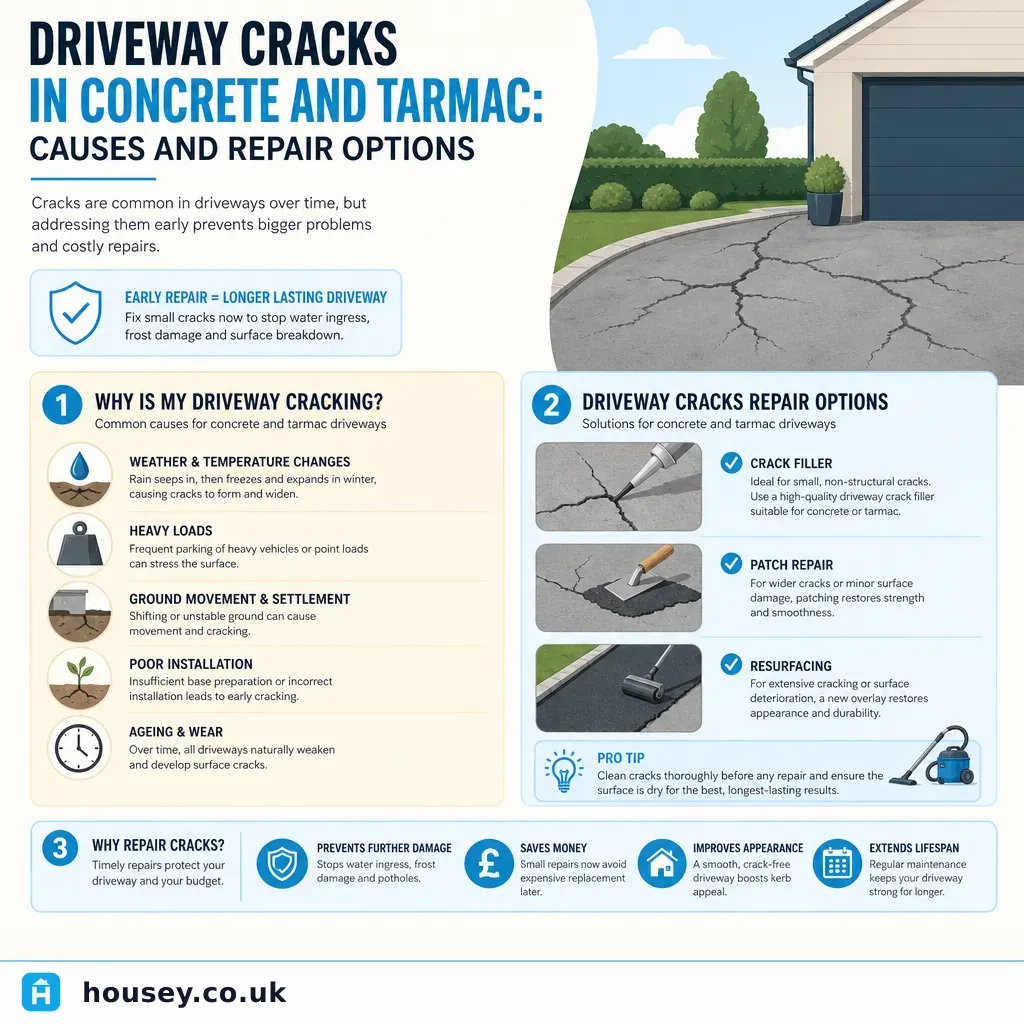
A cracked driveway is one of the most visible signs of deterioration at the front of a UK home, and one of the most common triggers for homeowners to seek resurfacing quotes. The issue is not purely cosmetic — cracks in concrete or tarmac allow water to penetrate the surface, accelerate further deterioration through freeze-thaw cycles, and in some cases signal a problem with the base or drainage beneath the bound surface. Knowing what kind of crack you have, why it has appeared, and what your realistic repair options are helps you spend money in the right place.
Key points
- Hairline surface cracks under 3 mm wide in concrete are usually caused by shrinkage during curing and rarely indicate structural failure; many can be sealed without full resurfacing.
- Tarmac cracks wider than 5 mm, or any crack accompanied by surface depression or heave, suggest substrate movement or drainage failure beneath the bound surface and warrant professional assessment before any repair is attempted.
- Frost damage is the most common cause of accelerating crack growth in UK driveways: water enters an existing crack, expands by approximately 9% when it freezes, and enlarges the crack with each freeze-thaw cycle through winter.
- New driveways of more than 5 m² in England that are not laid with permeable materials — or that do not drain to a lawn or planted border — require planning permission under the Town and Country Planning (General Permitted Development) (England) Order 2015.
- DIY crack sealants are widely available and effective for hairline to 5 mm cracks; full resurfacing or base repair requires specialist plant and is not appropriate as a DIY task.
What causes driveway cracks?
Common causes of concrete driveway cracks
- Shrinkage during curing — concrete shrinks as it dries. Without adequate control joints cut at the time of laying, shrinkage stress creates random surface cracks that are typically shallow and cosmetic.
- Freeze-thaw cycles — water penetrates the surface, freezes, expands, and fractures the concrete. This is common across most of the UK through winter months.
- Tree root pressure — roots growing beneath a slab generate significant upward force, causing surface heaving and cracking.
- Overloading — concrete driveways designed for domestic vehicles (typically a 100–125 mm slab on a compacted subbase) can crack under repeated loading from heavy vehicles such as lorries or skip wagons.
- Subbase failure — if the compacted hardcore or MOT Type 1 subbase beneath the concrete settles unevenly, voids form, and the unsupported slab cracks under load.
- Poor installation — insufficient slab depth, inadequate subbase compaction, incorrect concrete mix design, or failure to cut expansion and control joints at the time of laying.
Common causes of tarmac and asphalt driveway cracks
- Oxidation and surface fatigue — the asphalt binder dries out and becomes brittle over time. A network of surface cracks — sometimes called alligator or fatigue cracking — is a sign of an ageing surface nearing the end of its life.
- Edge cracking — tarmac unsupported at its edges crumbles and cracks, particularly where kerbing or a block edge restraint is absent.
- Freeze-thaw cycles — as with concrete, repeated freezing and thawing worsens existing cracks through winter.
- Rutting and surface depression — concentrated loading (car tyres parked repeatedly in the same position, or heavy vehicles) causes the bound surface to deform where the subbase is soft or insufficiently deep.
- Tree root pressure — roots can lift and crack tarmac as readily as they do concrete.
- Poor installation — insufficient compaction during laying, too thin a wearing course, or an inadequate subbase depth for the vehicle loads the driveway will carry.
Identifying the severity of your cracks
Crack type | Description | Likely cause | Urgency |
|---|---|---|---|
Hairline or surface | Under 3 mm, no depression | Shrinkage, surface oxidation | Low — seal to prevent water ingress |
Moderate | 3–10 mm, no depression | Frost damage, normal ageing | Medium — seal or patch to arrest deterioration |
Wide or structural | Over 10 mm, or with depression | Subbase failure, root damage, poor installation | High — base investigation needed before any repair |
Heaving | Surface lifted and cracked alongside | Tree root pressure, frost in subbase | High — root management and structural repair required |
Edge failure | Crumbling at driveway perimeter | Absent edge restraint | Medium — re-edge, repoint, or resurface edge |
Alligator cracking | Network of interconnected cracks across surface | Asphalt fatigue or overloading | High — surface at end of life; full replacement likely needed |
Repair options: concrete driveways
Hairline to 3 mm cracks: Apply a concrete crack sealant or flexible polyurethane filler. Clean the crack with a stiff brush or wire brush, remove any loose material, and apply sealant in dry conditions above 5°C. Products are available at builders' merchants and are suitable as a DIY task.
3 to 10 mm cracks: Use a bonding agent and a proprietary concrete repair mortar. The crack may need to be chased out slightly to allow the mortar to key in. A flexible repair mortar performs better than a rigid one in freeze-thaw conditions, as it accommodates minor seasonal movement.
Wide cracks and structural failure: Where the slab is moving, heaved, or has lost subbase support, surface repair is a temporary measure at best. Structural options include:
- Polyurethane foam injection — where voids exist beneath the slab, foam injection can fill them and re-level the surface without breaking out the concrete. This is a specialist service, not a DIY option.
- Partial or full slab replacement — break out the affected section, reinstate the subbase to the correct depth and compaction, and pour new concrete with properly cut control joints.
Repair options: tarmac and asphalt driveways
Hairline and surface fatigue cracks: Bitumen crack sealant applied by brush or gun. Clean the crack first. Not a permanent fix, but it prevents water ingress and slows further deterioration.
Moderate cracks and edge failure: Cold-lay asphalt patching is available at builders' merchants for small repair areas. For edge failure, install a concrete haunch or block edge restraint before patching to prevent recurrence.
Alligator cracking and widespread surface failure: These conditions indicate either end-of-life surface or an underlying subbase problem. Options are:
- Overlay or resurfacing — apply a new wearing course over the existing surface. Cost-effective only if the subbase is sound and the existing surface is not badly deformed. Typically 40–60 mm of new asphalt laid over a cleaned and primed base.
- Full replacement — remove the existing tarmac and subbase, re-compact and regrade to the correct levels, then relay from scratch. Required where subbase failure is the root cause.
Indicative repair costs (UK, last reviewed 2026-05-11)
Repair type | Indicative cost | Notes |
|---|---|---|
DIY crack sealant tube | £5–£25 per tube | For hairline to 3 mm cracks; DIY appropriate |
Professional crack sealing | £100–£300 | Professionally applied to larger crack networks |
Tarmac patching (small area) | £150–£400 | Cold or hot-lay asphalt; professional application |
Concrete partial repair | £200–£600 | Section break-out and pour; varies by area |
Tarmac overlay or resurfacing | £40–£70 per m² | New wearing course over sound existing surface |
Full concrete replacement | £70–£130 per m² | Break-out, subbase, concrete, and finish |
Full tarmac replacement | £35–£80 per m² | Break-out, subbase, asphalt, and finish |
Costs vary by region, site access, waste disposal requirements, and contractor. Always obtain at least three comparable, itemised quotes.
Planning rules for driveway replacement in England
Under the Town and Country Planning (General Permitted Development) (England) Order 2015, resurfacing or replacing a front garden driveway of more than 5 m² does not require planning permission if the new surface is:
- Permeable or porous — permeable concrete, gravel, block paving with permeable jointing, or porous asphalt — or
- Designed so that water drains to a lawn or planted border rather than directly to the highway.
If the new surface is impermeable (standard concrete or standard tarmac) and greater than 5 m², planning permission is required. Wales has equivalent provisions under its own GPDO. Scotland and Northern Ireland operate under different rules — check with your Local Planning Authority if you are outside England.
What to ask a driveway installer before accepting a quote
- What is causing the cracking, and have you assessed the subbase condition before quoting?
- Is the proposed repair addressing the root cause, or is it a surface treatment only?
- What thickness of new material are you laying, and what is the subbase specification?
- Will the new or repaired surface comply with the permeable paving rules under permitted development?
- What warranty do you offer on materials and workmanship, and is it provided in writing?
- Is VAT included in the quoted price?
- Who carries out the work — is the installer a member of a trade body, and do they carry public liability insurance?
Red flags that indicate you need professional assessment
Seek professional advice before committing to any repair if you notice:
- Cracks wider than 10 mm, or any crack that has visibly widened over a matter of weeks.
- Surface depression or heave alongside or near the crack.
- Water pooling in areas of the driveway that did not previously pool.
- A soft or spongy feel underfoot near the crack — particularly in tarmac.
- Evidence of tree root activity close to the cracked area.
- Significant cracking appearing within one to two years of a new installation — this may indicate an installation defect and a potential workmanship claim against the contractor.
When to get professional help
Most hairline and surface cracks can be managed with DIY sealants and regular monitoring. Call a professional driveway installer or chartered surveyor if:
- The crack is wide, progressive, or accompanied by surface movement.
- You suspect subsidence, drainage failure, or tree root damage as the underlying cause.
- You are considering a full replacement and need guidance on the correct subbase specification for your soil conditions and vehicle loads.
- A newly installed driveway is already cracking significantly, and the installer has not responded to your concern.
How Housey can help
Housey connects you with vetted driveway installation and repair specialists who can assess the cause of your cracking and provide quotes for the appropriate repair — from a targeted seal to a full base-up replacement.
Frequently asked questions
Why is my new tarmac driveway already cracking?
Cracking in a recently installed tarmac driveway — within one to two years — usually indicates inadequate subbase compaction, too thin a wearing course, or insufficient curing time before vehicle use. This may be a workmanship issue. Document the cracking with photographs, review the original contract for specifications, and contact the installer. If there is a dispute, Citizens Advice and trading standards can advise on your options.
Can I fill driveway cracks myself?
Yes, for hairline to moderate cracks under 5 to 10 mm with no depression or heave. DIY crack sealants for concrete and tarmac are available at builders' merchants. Clean the crack thoroughly, remove loose material, and apply in dry conditions above 5°C. DIY sealants are a maintenance measure — they do not address subbase problems and will not prevent structural cracks from widening over time.
Does a cracked driveway affect home insurance?
A cracked driveway is unlikely to affect a standard home insurance policy directly. However, if the cracking is caused by or indicative of subsidence, you are obliged to notify your insurer. Subsidence is covered under most buildings insurance policies but requires professional assessment. Do not carry out repairs to a subsidence-affected surface before notifying your insurer, as this may complicate any subsequent claim.
How long does a tarmac driveway last before resurfacing?
A properly installed tarmac driveway on a sound subbase typically lasts 15 to 25 years before requiring resurfacing. Surface life depends on traffic loads, UV exposure, drainage quality, and maintenance. Applying a bitumen emulsion sealer every three to five years can extend surface life by reducing oxidation and slowing water ingress into the wearing course.
Sources and further reading
- Paving Your Front Garden — GOV.UK
- Town and Country Planning (General Permitted Development) (England) Order 2015 — legislation.gov.uk
- Driveways and Front Gardens — Planning Portal
- Problems with Tradespeople — Citizens Advice
Useful next reads
 Improvement & Build
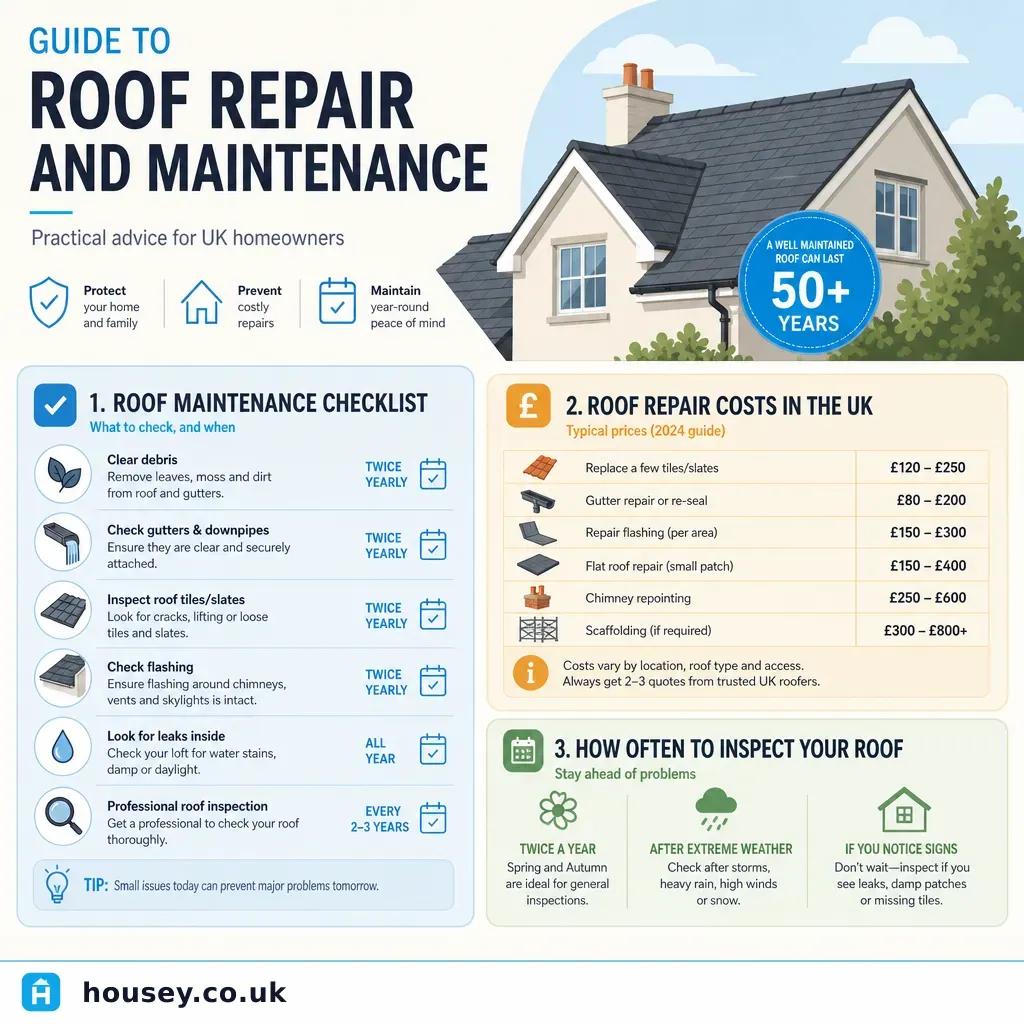
Guide to Roof Repair and Maintenance
Regular roof inspections every 3–5 years, prompt repair of damaged tiles and failed flashings, and annual gutter clearance are the core of effective UK roof maintenance.
 Improvement & Build
Cracks in Driveways: What's Normal and When Should You Worry?
Hairline cracks under 1 mm in concrete driveways are usually normal shrinkage and cosmetic.
 Improvement & Build
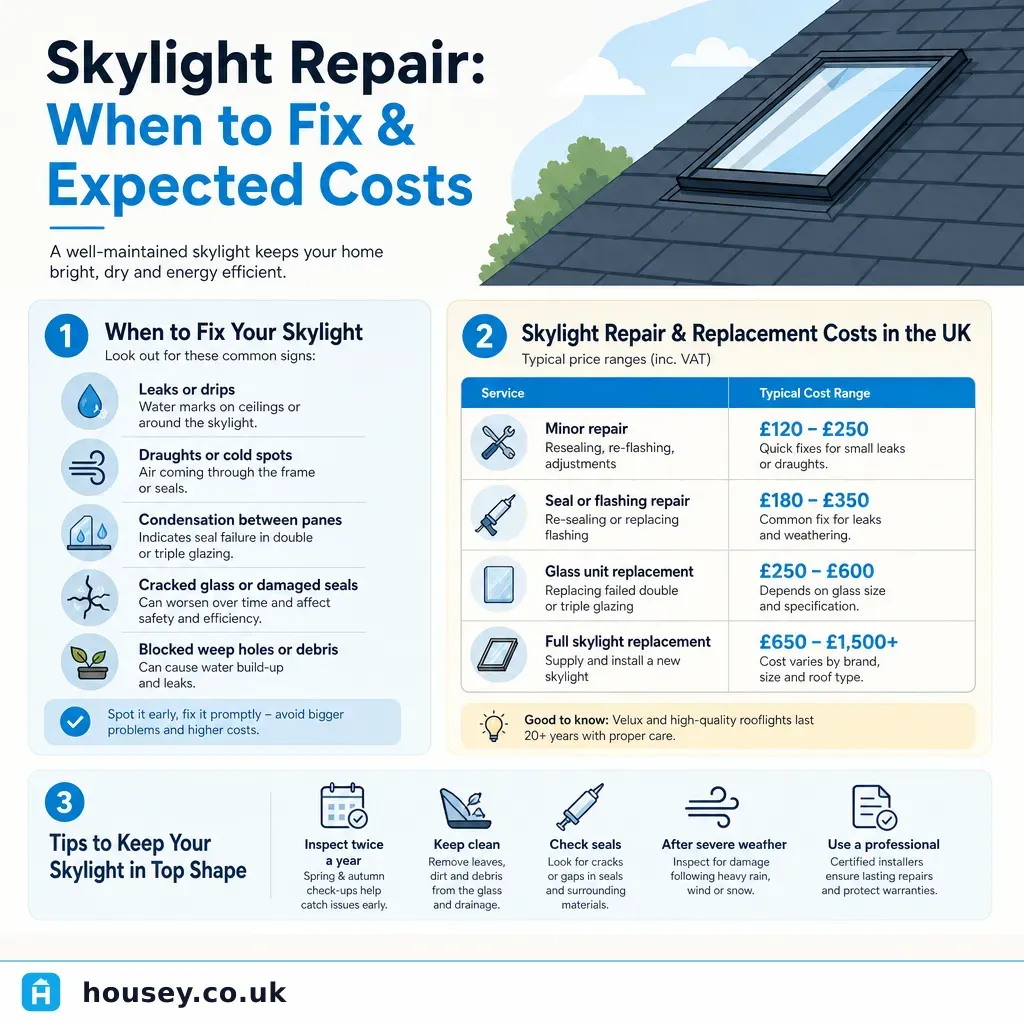
Skylight repair: when to fix and expected costs
Skylight repairs in the UK typically cost £150–£800 depending on the fault, while full replacement usually runs £500–£2,500.
 Improvement & Build
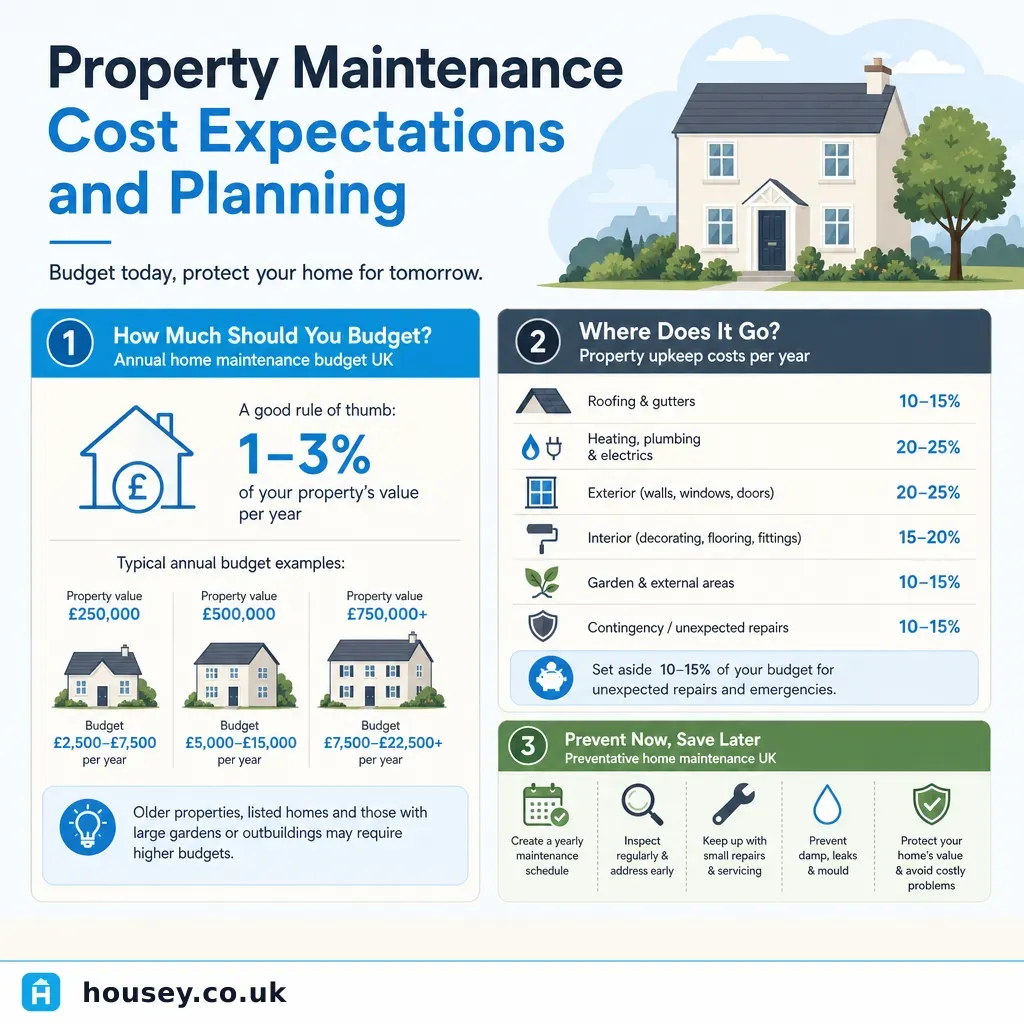
Property Maintenance Cost Expectations and Planning
UK homeowners typically budget between 1% and 3% of their property's value annually for maintenance and repairs.
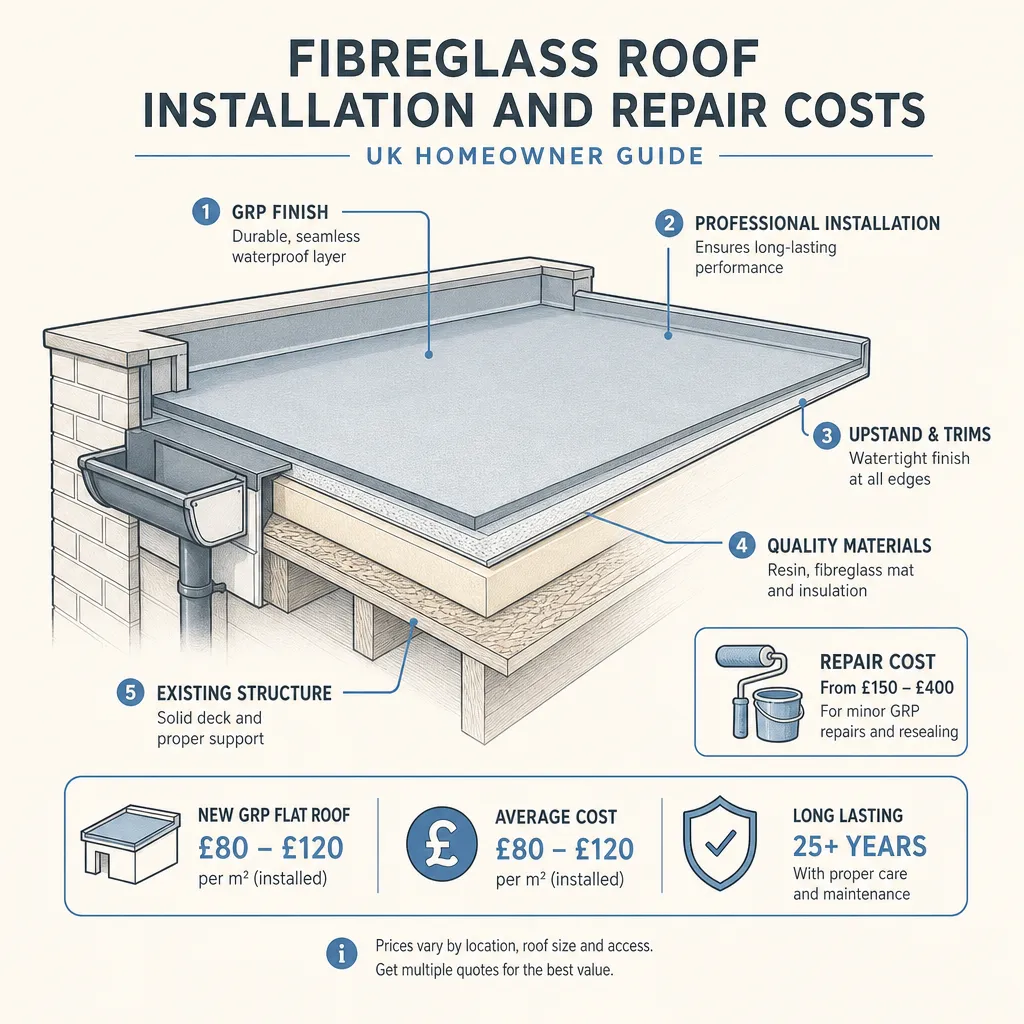 Improvement & Build
Fibreglass Roof Installation and Repair Costs
A fibreglass (GRP) flat roof costs approximately £70–£110 per square metre installed in the UK, with a typical 15 m² garage roof costing £1,200–£2,000.