Property Maintenance Cost Expectations and Planning
By Housey · Last reviewed 7th of May 2026
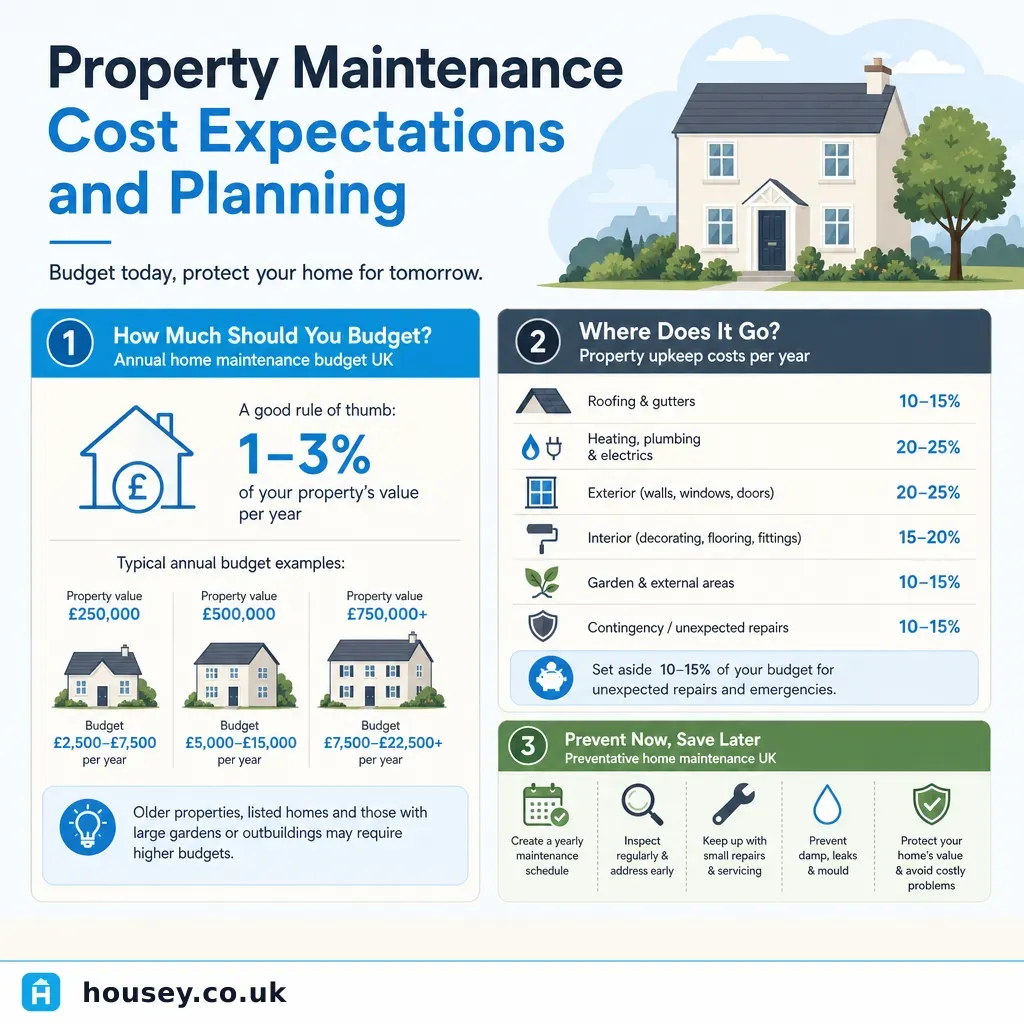
Property Maintenance Cost Expectations and Planning
UK homeowners often underestimate the ongoing cost of keeping a property in good order. Whether you have just exchanged contracts or have owned your home for a decade, understanding what maintenance typically costs — and building a realistic budget around it — can be the difference between a well-preserved asset and an expensive emergency repair bill. Older properties, especially the Victorian and Edwardian terraces that make up a large share of UK housing stock, carry higher upkeep bills than post-war or modern homes.
Key points
- The widely cited "1% rule" suggests budgeting 1% of your property's purchase price each year for maintenance; for a £300,000 home that is approximately £3,000 annually.
- Homes built before 1919 are significantly more likely to present condition problems than newer stock, according to the English Housing Survey 2022–23.
- A full roof replacement for a typical three-bedroom semi costs approximately £5,000–£12,000 (indicative UK costs, last reviewed 2026-05-07); building a sinking fund over 10–15 years smooths this cost.
- Around 4% of homes in England had penetrating or rising damp according to the English Housing Survey 2022–23 — making damp one of the most common and frequently underestimated maintenance problems.
- Gas Safe registered engineers must carry out all boiler servicing and replacement; using an unregistered engineer is illegal and a safety risk.
How much should you budget for home maintenance each year?
The 1% rule is a widely used starting point, but it is a rough guide rather than a precise formula. A Victorian property with original sash windows and a slate roof will require far more attention than a post-2000 new-build flat where external maintenance falls under a service charge.
A more practical approach considers property type:
Property type | Suggested annual budget | Typical cost drivers |
|---|---|---|
New-build or modern (post-2000) | 0.5–1% of property value | Boiler servicing, minor decoration, appliance replacement |
Post-war semi or terrace (1945–1999) | 1–2% of property value | Roof tiles, guttering, windows, boiler, electrics |
Victorian/Edwardian or older (pre-1919) | 2–3%+ of property value | Chimney stacks, sash windows, solid walls, drainage, damp |
Indicative UK figures, last reviewed 2026-05-07. Costs vary by region, property condition, and current labour rates.
Which maintenance items cost the most?
Planning ahead for large-spend items prevents emergency debt. Typical lifespans and indicative costs for common components:
Component | Typical lifespan | Indicative replacement cost (UK, 2026) |
|---|---|---|
Gas boiler | 10–15 years | £1,500–£3,500 fitted |
Flat roof (felt) | 10–20 years | £1,000–£5,000 |
Pitched roof (re-tiling) | 20–70 years depending on material | £5,000–£12,000 for a three-bed semi |
Guttering and downpipes (uPVC) | 20–30 years | £500–£1,500 |
uPVC double-glazed windows | 20–30 years | £400–£700 per window, fitted |
External repointing or render | 20–40 years | £2,000–£8,000 for a typical semi |
Indicative UK costs, last reviewed 2026-05-07. Source: HomeOwners Alliance maintenance guidance.
A worked example: 1930s semi in the East Midlands
Consider a 1930s three-bedroom semi-detached purchased for £260,000. Applying a 1.5% annual maintenance rate suggests setting aside approximately £3,900 per year.
Over 10 years, a realistic spend might include:
- Annual boiler service: £80–£120/year (~£1,000 total)
- Roof inspection and minor tile repairs: £300–£600 once or twice (~£800 total)
- Guttering cleared or partially replaced: £150–£500
- Exterior repointing (partial): £1,500–£3,000
- Window replacement (original timber frames): £3,000–£6,000
- Boiler replacement at year 10–12: £2,000–£3,000
Total indicative spend over 10 years: £8,500–£15,000+, averaging £850–£1,500 per year at the lower end — but with lumpy peaks that a sinking fund smooths out.
Annual home maintenance checklist
Working through this list each year helps catch problems before they escalate.
Spring (post-winter check)
Summer
Autumn (pre-winter)
As needed
Red flags that mean act now
Some issues escalate quickly and must not be deferred:
- Water ingress visible in the loft or on internal ceilings after rain
- Damp patches on ground-floor walls after prolonged wet weather (penetrating damp)
- Tide marks at skirting-board level indicating rising damp
- Condensation visible between the panes of double-glazed units (failed seal)
- Gutters pulling away from the fascia board or overflowing in light rain
- Water pooling around foundations after rainfall
When to get professional help
Most routine maintenance is accessible to a competent DIYer. Call a professional when:
- Roof defects go beyond a surface tile — failed flashing, wet timbers, or suspected structural movement needs a qualified roofer and possibly a structural engineer.
- Damp is persistent or widespread — professional diagnosis is essential before any remediation; misidentification is common and costly.
- Windows need full replacement — a FENSA-registered installer must certify the work under Building Regulations Part L; without a certificate, complications arise on sale.
- Gas or consumer-unit electrical work is needed — Gas Safe and Part P registration are legal requirements, not optional.
How Housey can help
If your annual inspection reveals work that needs a professional, Housey can help you find and compare quotes from qualified local tradespeople. Whether you need a qualified roofer for a roof inspection or repair, a specialist for damp diagnosis and proofing treatment, or replacement windows fitted by a FENSA-registered installer, you can request and compare quotes in one place.
Frequently asked questions
How much should I set aside for home maintenance each year in the UK?
A practical starting point is 1–2% of your property's current value annually, adjusted for age and condition. A post-2000 home may need only 0.5–1%, while a Victorian or Edwardian property could realistically require 2–3% or more in some years. Maintaining a dedicated fund avoids relying on credit when large items such as boilers or roofs fail unexpectedly.
Is preventative home maintenance worth the cost?
Usually, yes. A blocked gutter left uncleared for several seasons can lead to penetrating damp, damaged fascias, and localised structural deterioration — costs that quickly dwarf the price of a gutter clean. Regular boiler servicing extends equipment life and can identify carbon monoxide risks early, making it both a financial and safety priority.
Does a well-maintained property sell for more?
Generally, yes. RICS surveyors note visible maintenance issues in Level 2 and Level 3 home surveys, which can prompt buyers to renegotiate on price or withdraw offers. A property in good condition tends to achieve a stronger sale price and sell more quickly than one with a visible backlog of deferred repairs.
Do I need registered tradespeople for routine home maintenance?
Not for all tasks — painting, basic plumbing such as replacing a tap washer, and minor repairs are accessible to competent DIYers. Gas work requires a Gas Safe registered engineer, consumer-unit electrical work a Part P-certified electrician, and window replacement a FENSA-registered installer to comply with Building Regulations and ensure certificates are in place for future sales.
Sources and further reading
- English Housing Survey 2022–23 — MHCLG
- Building Regulations Approved Document L — GOV.UK
- FENSA: Glazing Certification Scheme — FENSA
- Gas Safe Register: find a registered engineer — Gas Safe Register
- HomeOwners Alliance: home maintenance guide — HomeOwners Alliance
Useful next reads
 Improvement & Build
Guide to Roof Repair and Maintenance
Regular roof inspections every 3–5 years, prompt repair of damaged tiles and failed flashings, and annual gutter clearance are the core of effective UK roof maintenance.
 Improvement & Build
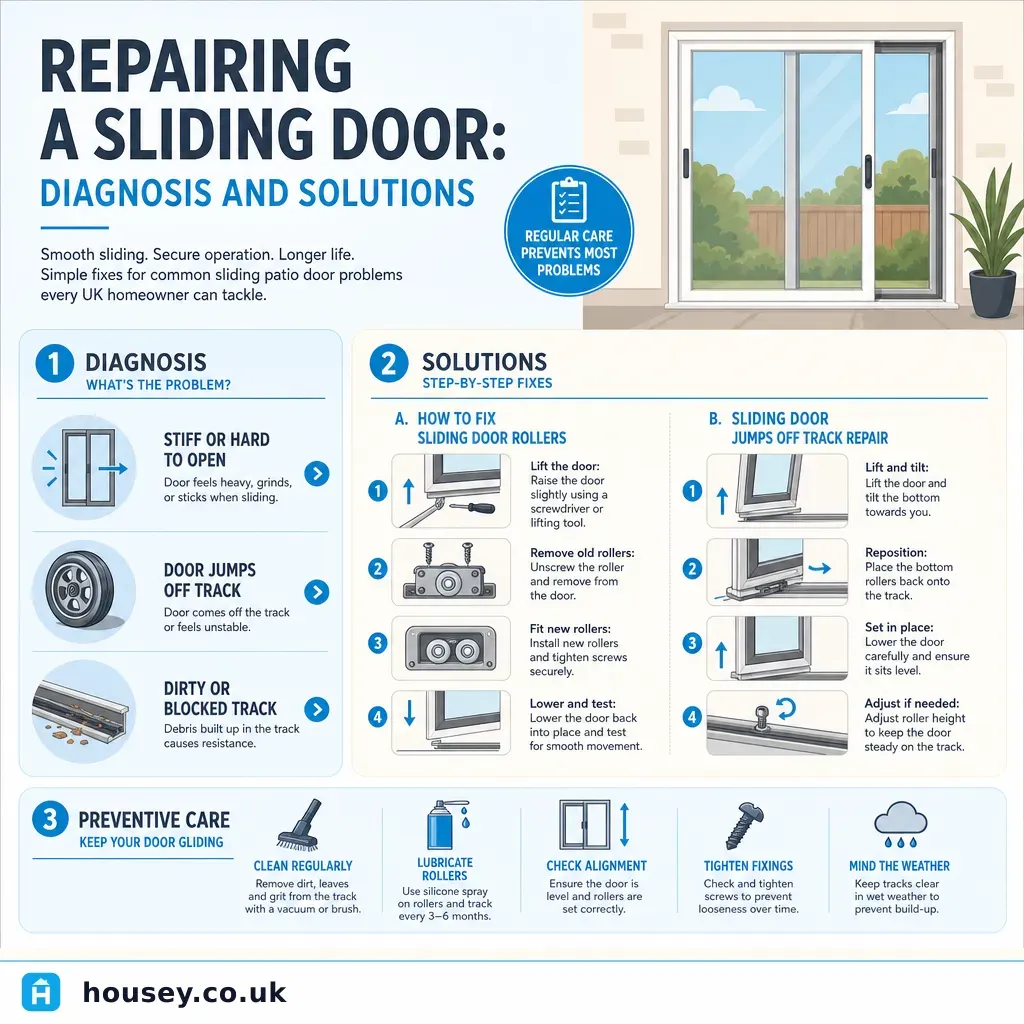
Repairing a Sliding Door: Diagnosis and Solutions
Most sliding door problems — stiffness, jumping off track, or draughts — are caused by dirty tracks, worn rollers, or misaligned guides.
 Improvement & Build
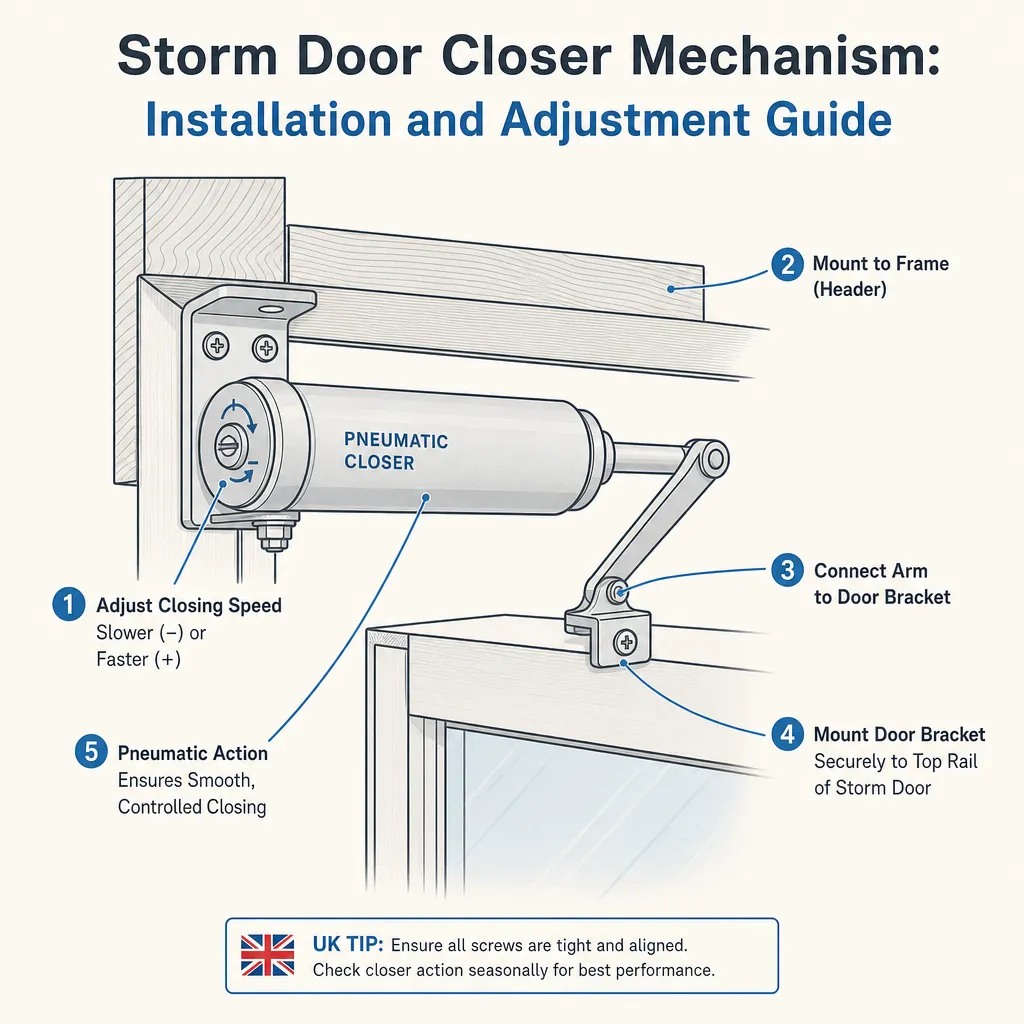
Storm Door Closer Mechanism: Installation and Adjustment Guide
Storm door closers are adjusted via a small screw at the end of the cylinder — clockwise slows the door, anticlockwise speeds it up.
 Improvement & Build
Window cleaning costs: what to budget
Window cleaning in the UK typically costs £5–£15 per visit for a small terraced house and £15–£40 or more for a larger detached property, depending on the number of windows, access difficulty, and frequency.
 Improvement & Build
How to Find and Vet Professional Roofing Contractors
Professional roofing contractors should carry public liability insurance of at least £2m, provide a written workmanship guarantee, and hold accreditation from a recognised body such as the NFRC or the Competent Roofer scheme.