Driveway Heating Systems: Technology and Installation Options
By Housey · Last reviewed 25th of May 2026
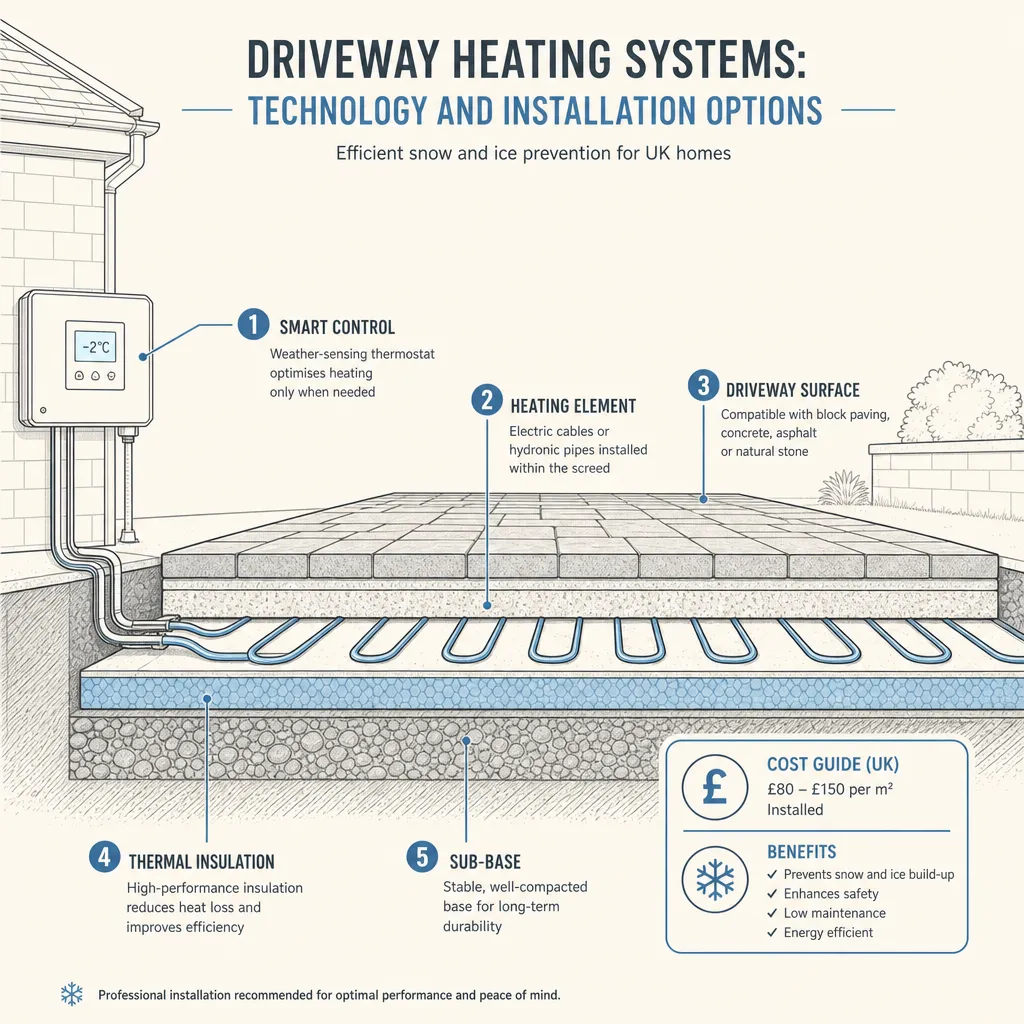
Driveway Heating Systems: Technology and Installation Options
Heated driveways are increasingly considered by UK homeowners who want to reduce winter maintenance — particularly on sloped drives, at properties with elderly or less mobile occupants, or where manual clearing and rock salt are impractical or damaging to the surface. Choosing between electric and hydronic systems involves genuine trade-offs around installation cost, running efficiency, and the suitability of your existing surface and heating plant. Getting the specification right before work begins avoids costly reinstatement and system underperformance in the first cold spell.
Key points
- Electric resistance cable systems are typically cheaper to install than hydronic (water-pipe) systems, but cost more per kilowatt-hour to run at scale.
- Hydronic systems circulate warm water through pipes laid beneath the surface, supplied by a boiler or heat pump — more efficient over larger areas but requiring integration with existing heating plant.
- All driveway heating requires a dedicated electrical circuit installed by a Part P certified electrician (registered with NICEIC, NAPIT, or an equivalent scheme), regardless of system type.
- Indicative installation costs (last reviewed 2026-05-25): electric systems typically range from £100–£200 per m²; hydronic from £150–£300 per m², depending on area, surface type, and plant integration complexity.
- In conservation areas or for listed buildings, changes to a front driveway surface may require planning permission — check with your local planning authority (LPA) before lifting any existing surface.
How electric driveway heating systems work
Electric resistance heating uses cables or mats embedded beneath or within the driveway surface. A thermostat and frost sensor control activation — most modern systems run automatically, switching on when the surface temperature drops to around 3°C and precipitation or high humidity is detected.
Electric system components:
- Heating cables or mats (typically rated at 200–400 W/m²)
- Combined moisture and temperature sensor (surface-mounted or embedded)
- Control thermostat, often with a timer and remote override
- Dedicated circuit from the consumer unit (minimum 16 A, often 32 A or more for larger areas)
Electric systems suit smaller driveways up to roughly 30–40 m², where the simplicity of installation and lower upfront cost outweigh the higher per-unit running cost. They can be retrofitted under resin-bound, block paving, or tarmac surfaces, though most surface types require lifting and relay to embed the cables properly.
How hydronic driveway heating systems work
Hydronic systems circulate heated water through cross-linked polyethylene (PEX) or polybutylene pipes laid in a serpentine pattern beneath the surface. Heat is supplied by a gas or oil boiler, an air source heat pump, or a ground source heat pump. A manifold controls flow across zones.
Hydronic systems are more complex to install — they require connection to a heat source, a circulating pump, and appropriate controls — but running costs per square metre are substantially lower, especially when paired with a heat pump. Air source heat pumps typically achieve a Seasonal Coefficient of Performance (SCOP) above 3.0, delivering more than 3 kWh of heat for every 1 kWh of electricity consumed.
Hydronic is most cost-effective when:
- The driveway area exceeds roughly 40–50 m²
- A compatible heat pump or boiler is already planned or being installed at the same time
- Long-term running cost reduction is a priority over lower upfront simplicity
Comparison: electric vs hydronic driveway heating
Feature | Electric resistance | Hydronic |
|---|---|---|
Best for | Smaller driveways (up to ~40 m²), retrofit projects | Larger driveways, new builds, heat pump integration |
Typical install cost | £100–£200 per m² | £150–£300 per m² |
Running cost | Higher (direct resistance heating) | Lower (especially with heat pump) |
Installation complexity | Lower — electrical circuit only | Higher — plumbing, groundworks, heat source integration |
Surface compatibility | Resin-bound, block paving, tarmac | Block paving, tarmac, concrete |
Controls | Thermostat and frost/moisture sensor | Zone manifold, thermostat, boiler or heat pump controls |
Maintenance | Minimal (no moving parts) | Boiler or pump servicing required |
Warranty (element) | Typically 10–25 years | Pipes typically 25+ years; pump per manufacturer |
Planning considerations | Usually none (unless conservation area) | Usually none (unless conservation area) |
Indicative UK costs, last reviewed 2026-05-25. Costs vary by region, contractor, and site conditions — always obtain at least three quotes.
Driveway surface compatibility
Not all surfaces are equally suited to embedded heating:
- Resin-bound and resin-bonded: Good thermal conductivity; electric mats are commonly specified. Requires careful relay by the resin installer to avoid hot-spot damage.
- Block paving: Blocks can be lifted, cables or pipes installed in the bedding sand, and blocks re-laid. Compatible with both system types.
- Tarmac and asphalt: Heating cables are commonly embedded during installation or laid beneath a new tarmac overlay. Existing tarmac usually requires partial resurfacing.
- Loose gravel: Not suitable for most heating systems — poor thermal mass and surface instability make uniform heat distribution impossible.
- Pattern-imprinted concrete: Usually requires removal and a new concrete pour; heating can be embedded in the new slab.
Always ask the installer to confirm surface compatibility in writing before signing off the specification.
Planning and building regulations
In most cases, driveway heating is not a planning matter — it is subsurface and does not alter the external appearance of the property. However:
- Conservation areas: Any changes to a front driveway surface may require planning permission. Check with your LPA before lifting the surface.
- Listed buildings: Works affecting the character or setting of a listed building may need listed building consent.
- Building Regulations Part P: The electrical installation must comply with Approved Document P (Electrical Safety — Dwellings). The circuit must be designed, installed, and certified by a Part P competent person registered with NICEIC, NAPIT, or an equivalent scheme.
- Permitted development and drainage: Driveway heating itself is permitted development in most cases, but if the project also involves replacing a front garden surface with an impermeable material covering more than 5 m², planning consent may be required unless run-off drains to a permeable area or public drainage. See GOV.UK guidance on when planning permission is required.
What to ask before accepting a quote
A competent installer should answer all of the following before you commit to a contract:
- What is included and excluded (surface lift and reinstatement, electrical circuit, sensor, thermostat, controls, and commissioning)?
- What Part P registration does the electrical installer hold — NICEIC, NAPIT, or equivalent?
- What power output (W/m²) is specified, and how was it calculated for the slope, exposure, and heat-loss profile of this site?
- What warranty covers the heating element, and what is the claims process if the cable fails under the surface?
- Will I receive an Electrical Installation Certificate on completion?
- What assumptions is the quote based on (surface depth, existing circuit capacity, soil conditions, proximity of drains)?
- What could increase the price or delay the programme?
- Is VAT included?
When to get professional help
Driveway heating installation should always involve qualified tradespeople — this is not a suitable DIY project for any element involving the electrical supply:
- A Part P registered electrician is legally required for the dedicated circuit, controls wiring, and Electrical Installation Certificate.
- An MCS-certified heat pump engineer is needed if integrating with a heat pump, to preserve MCS warranty and Boiler Upgrade Scheme eligibility.
- A specialist driveway contractor should handle surface reinstatement — poor reinstatement voids many heating element warranties and can cause premature surface failure.
Never attempt to install or connect heating cables to the consumer unit yourself. This is notifiable work under Building Regulations Part P.
How Housey can help
Housey connects you with specialist driveway installers who can specify and fit heated driveway systems across the UK. If you want to understand how driveway heating interacts with your home's wider energy use — or whether integration with a heat pump makes sense for your property — our energy-efficiency consultants can advise on running cost projections and system compatibility.
Frequently asked questions
How much does a heated driveway cost to run in the UK?
Running costs depend on system type, driveway area, local climate, and energy tariff. An electric system on a 20 m² driveway running roughly 200 hours per winter season may use around 1,600–2,000 kWh at rated output. Hydronic systems connected to a heat pump can cut this significantly. Ask your installer to model estimated running hours for your postcode before committing.
Does a heated driveway need planning permission?
In most cases, no — driveway heating is subsurface and does not alter external appearance. However, conservation area properties or listed buildings may require consent before any surface changes. Always check with your local planning authority before lifting an existing surface, particularly if you are also changing to an impermeable material.
How long do electric driveway heating cables last?
Quality electric heating cables correctly embedded in a stable surface can last 20–30 years with minimal maintenance. Damage typically results from poor installation, surface movement, or accidental penetration during later groundworks. Most reputable products carry a manufacturer warranty of 10–25 years; check this before accepting a quote.
Can I add driveway heating to an existing driveway?
Yes, but the existing surface usually needs to be partially or fully lifted to embed cables or pipes. The complexity depends on surface type and depth. Some thin electric mat systems can be installed under a new overlay, reducing disruption, but always confirm with the installer that the surface type is compatible before specification.
Sources and further reading
Useful next reads
 Improvement & Build
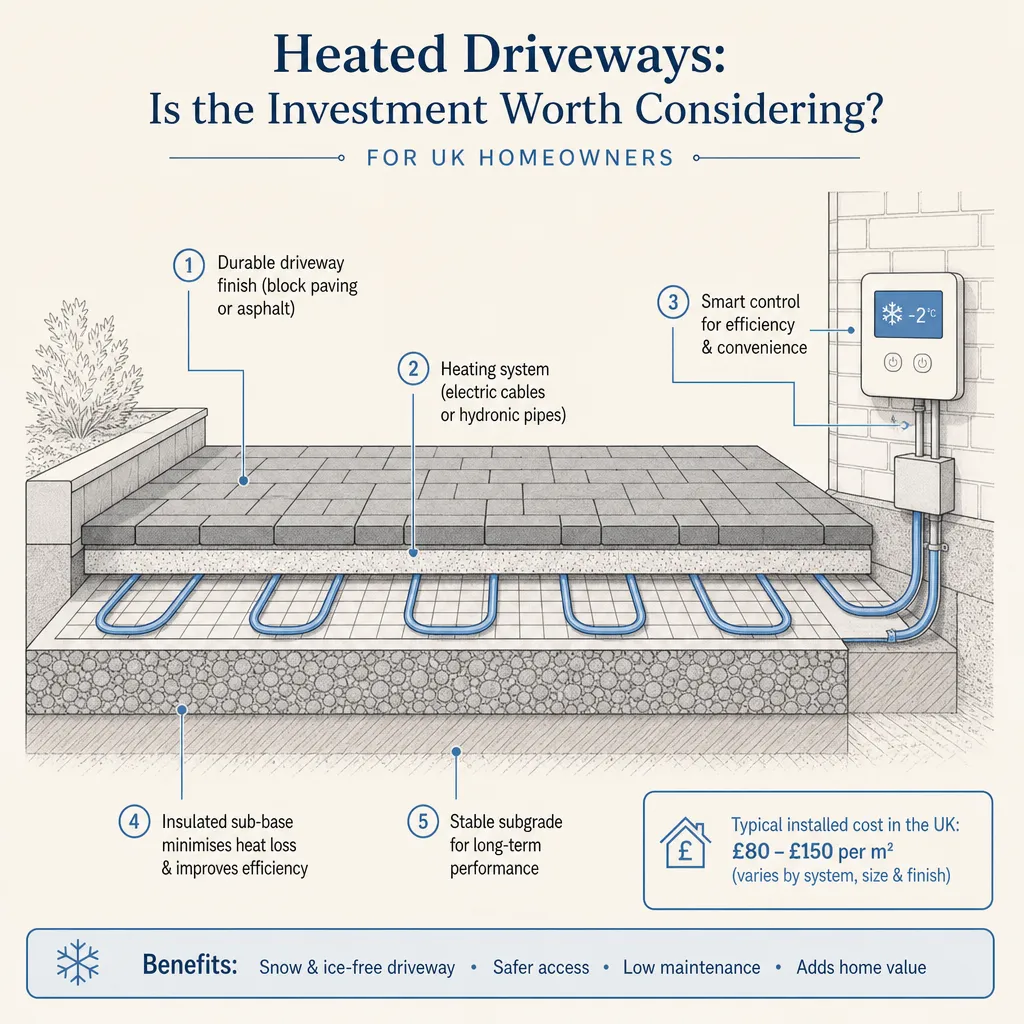
Heated Driveways: Is the Investment Worth Considering?
A heated driveway uses electric resistance cables or hydronic water pipes beneath the surface to prevent ice and snow build-up.
 Improvement & Build
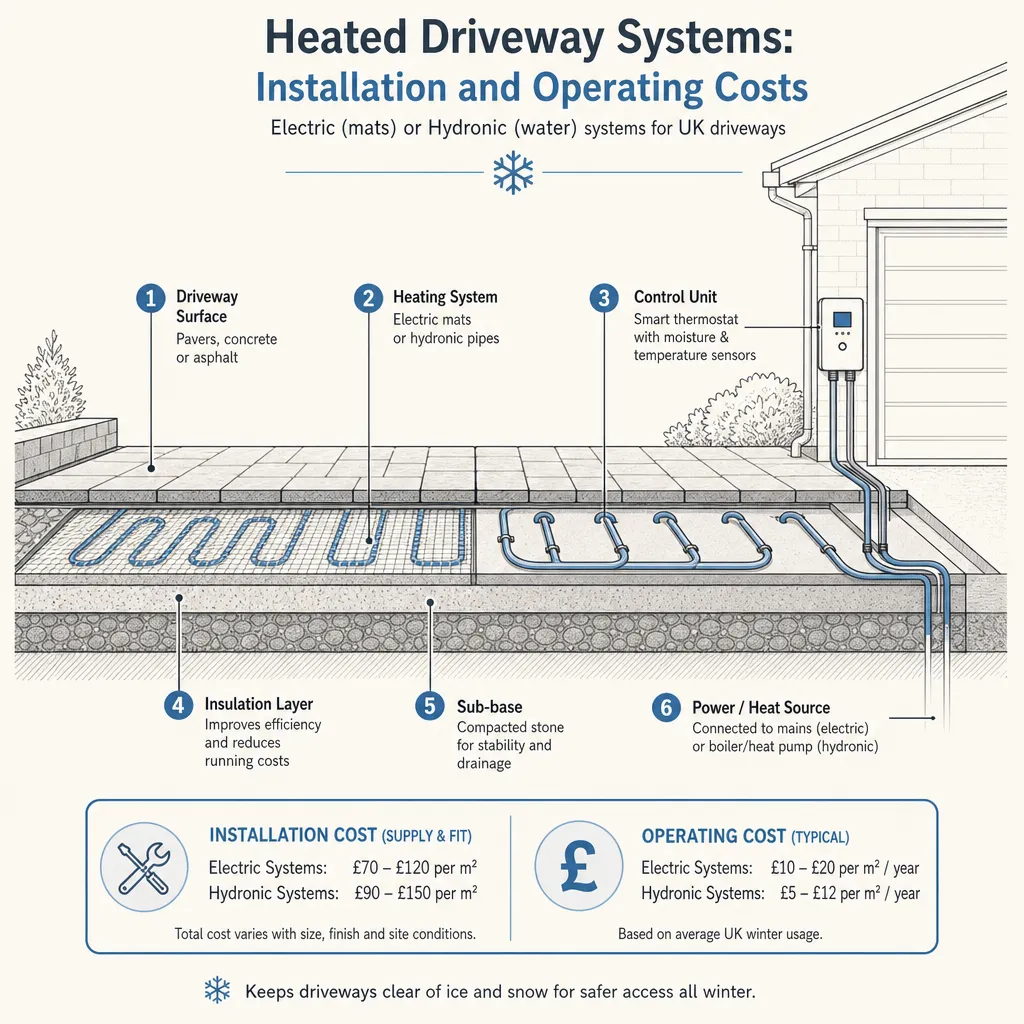
Heated Driveway Systems: Installation and Operating Costs
Heated driveways embed electric cables or hydronic pipes beneath the surface to prevent ice and melt snow.
 Improvement & Build
Aluminium Windows: Benefits, Specifications, and Installation Costs
Aluminium windows typically cost £600–£1,800 per window installed in the UK, depending on size and specification.
 Improvement & Build
Egress Window Repair and Installation
An egress window is a window large enough to serve as an emergency escape route from a habitable room.
 Improvement & Build
Porch Screening: Options and Professional Installation Costs
Porch screening ranges from simple insect mesh on a timber frame to bespoke aluminium-framed glazed enclosures.