Reinforced Driveway Construction: Materials and Structural Durability
By Housey · Last reviewed 24th of May 2026
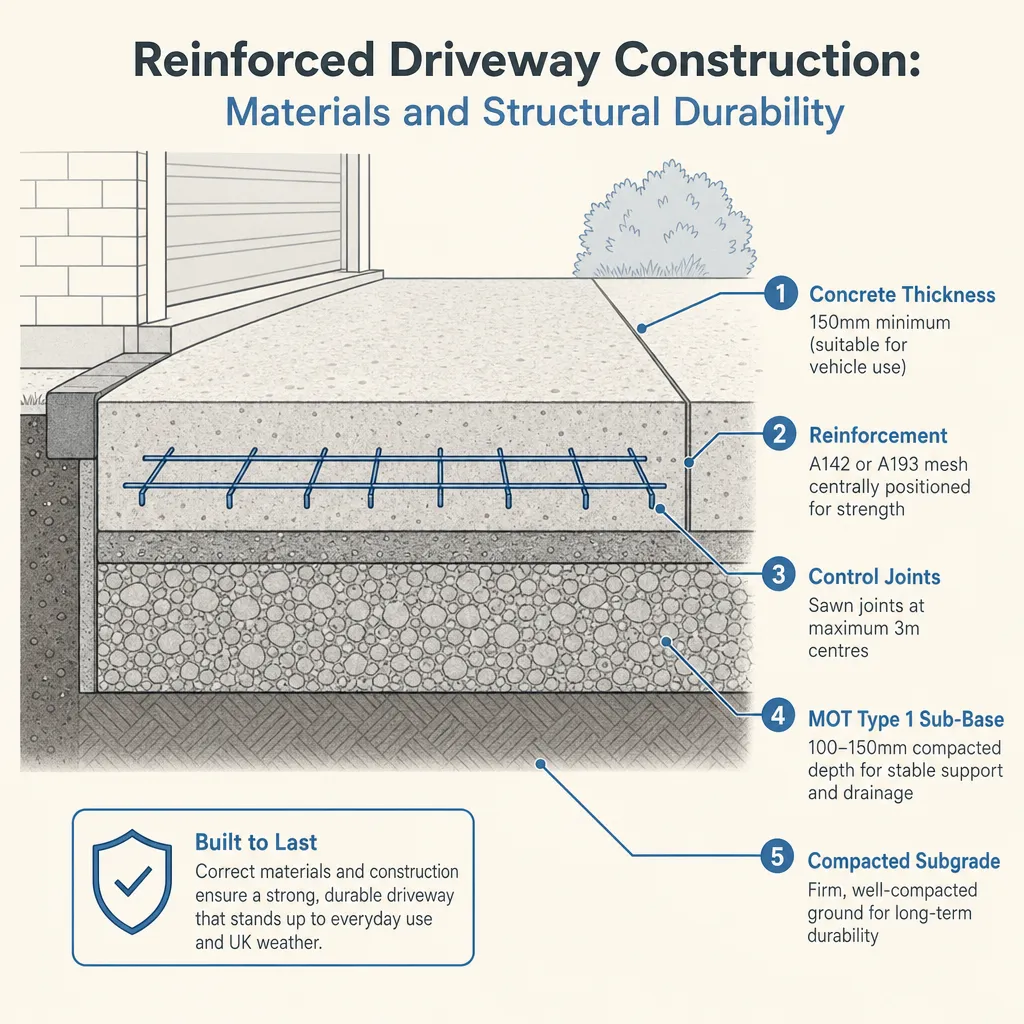
Reinforced Driveway Construction: Materials and Structural Durability
A driveway is one of the most heavily loaded surfaces around a domestic property — subject to repeated vehicle movements, thermal cycling, and seasonal ground moisture — yet it rarely receives the same specification attention as a structural extension or ground floor slab. Getting the reinforcement, sub-base, and joint design right from the outset is the difference between a driveway that performs reliably for three decades and one that begins cracking within five years of laying.
Key points
- Domestic concrete driveways should be at least 100 mm thick for standard car loading; 150 mm is recommended where vans, SUVs, or heavier vehicles regularly use the surface.
- Steel fabric mesh to BS 4483 — typically A142 or A193 grade — should be placed at mid-depth to the upper third of the slab, with a minimum 50 mm cover to the underside.
- A compacted granular sub-base of at least 100 mm of MOT Type 1 crushed stone to BS EN 13242 is required under concrete; 150 mm is preferable on clay or unstable ground.
- Expansion joints at 3–4 m centres are essential in concrete driveways to manage thermal movement and prevent uncontrolled cracking through the slab.
- Impermeable driveways larger than 5 m² serving the front garden of a dwelling require planning permission in England under the General Permitted Development Order 2015; permeable surfaces draining to a garden do not.
Why reinforcement matters in domestic driveways
Unreinforced concrete slabs rely entirely on the tensile strength of the concrete itself — roughly 3–4 N/mm² — to resist bending stresses from vehicle loading. When the sub-base settles unevenly, or a vehicle wheel bridges a soft spot, the stress concentrates at the underside of the slab. Without reinforcement, the slab cracks through cleanly and quickly.
Steel mesh reinforcement changes this fundamentally. The mesh carries the tensile stress in the lower zone of the slab, allowing any crack that does form to be arrested and controlled rather than propagating straight through. In practice, a well-specified reinforced concrete driveway is significantly more tolerant of minor sub-base irregularities, occasional overloading, and frost heave than an unreinforced equivalent.
Fibre reinforcement — polypropylene or steel fibres mixed into the concrete — provides isotropic crack control in all directions and reduces the risk of plastic shrinkage cracking during initial curing. However, fibres are generally less effective than mesh at controlling flexural cracking from imposed vehicle loads and are best used as a supplement to, rather than a replacement for, fabric reinforcement in driveways subject to regular traffic.
Materials: reinforcement options compared
Reinforcement type | Best for | Limitations | Typical specification |
|---|---|---|---|
Steel fabric mesh A142 | Standard domestic driveways, car loading | Must be correctly positioned at mid-depth; low cover risks rusting | 6 mm bars at 200 mm centres each way |
Steel fabric mesh A193 | Heavier loads — vans, SUVs, occasional light commercial | Higher material cost; accurate placement critical | 7 mm bars at 200 mm centres each way |
Polypropylene fibres | Shrinkage crack control during curing | Not a structural substitute for mesh under vehicle loading | 0.9 kg/m³ mixed into concrete |
Steel fibres | Higher-performance finish with improved ductility | Specialist mixing and placing; cost premium | 20–40 kg/m³ mixed into concrete |
Unreinforced concrete | Lightly used pedestrian paths only | Not recommended under any regular vehicle access | 100 mm minimum; joints at 2–3 m centres |
Sub-base: the foundation that determines durability
The most common cause of driveway failure in UK residential properties is not the concrete mix or the reinforcement specification — it is inadequate sub-base preparation. The sub-base transfers vehicle load from the slab down to the natural ground below. On a poorly prepared sub-base, even well-reinforced concrete will eventually crack and settle.
Standard good practice for UK domestic concrete driveways:
- Excavate to the correct depth — typically 250–350 mm total (100 mm slab plus 100–150 mm sub-base plus allowance for finished surface level relative to surrounding ground).
- Remove all topsoil and organic material — never lay concrete over turf, roots, or uncompacted fill.
- Compact the formation level with a vibrating plate compactor.
- Lay MOT Type 1 granular fill in layers — no single layer thicker than 100 mm before compacting.
- Check the finished sub-base level — a tolerance of ±10 mm is typical for residential works.
- Consider a geotextile membrane between the formation and sub-base on clay or water-retentive soils, to prevent mixing and maintain drainage performance over time.
Worked UK property scenario
A homeowner in Lincolnshire is replacing a failed concrete driveway at a 1960s semi-detached. The existing slab is unreinforced, approximately 75 mm thick, and has cracked in multiple places due to a combination of frost heave and a cherry tree root (since removed). The subsoil is clay.
Recommended specification for the replacement driveway:
- Excavation depth: 350 mm total — remove the failed slab, existing sub-base, and 100 mm into the clay formation
- Geotextile: Terram 1000 or equivalent laid between the clay formation and the new sub-base
- Sub-base: 150 mm compacted MOT Type 1 (heavier specification on clay subsoil)
- Concrete slab: 150 mm GEN3 or C25/30 concrete
- Reinforcement: A193 steel fabric mesh positioned at mid-depth with 75 mm cover below
- Joints: Sawn or formed joints at 3 m centres in each direction, sealed with polyurethane joint sealant
- Surface finish: Brushed texture for slip resistance
- Drainage: Falls of 1:80 minimum, draining to a 150 mm channel drain connected to a soakaway — permeable discharge, so no planning permission required
Indicative UK costs for this specification: £80–£130 per m² including materials, labour, and disposal of the existing concrete. Last reviewed 2026-05-24. Always obtain at least two detailed, itemised quotes before proceeding.
Planning and drainage: what to confirm before you start
Before laying any new driveway in England:
- Permeable surface or drainage to a garden or soakaway? No planning permission needed for front garden hardstanding.
- Impermeable surface discharging to a public sewer, over 5 m²? Planning permission required.
- Conservation area or listed building? Permitted development rights may be restricted — check with your local planning authority before starting any work.
- New vehicle access crossing a public footway? A dropped kerb and vehicle crossover licence from the local highways authority is required, separately from any planning permission.
Scotland, Wales, and Northern Ireland have their own planning frameworks — always check locally before proceeding.
Homeowner checklist: questions to ask your driveway contractor
Before accepting a quote for a reinforced concrete driveway, confirm:
When to get professional help
Most domestic driveway installations are straightforward when an experienced contractor is appointed. Seek additional professional input if:
- Ground conditions are unusual — soft clay, made ground, high water table, or suspected contamination from previous uses
- There are established trees within 5 m of the proposed driveway, where root damage and subsidence are a consideration
- The driveway needs to cross a public footway, requiring a vehicle crossover licence from the local highways authority
- The property is in a conservation area or is listed, where permitted development rights may not apply
How Housey can help
Housey connects you with experienced local driveway installers who can advise on the right specification for your ground conditions, propose permeable drainage solutions where appropriate, and provide itemised quotes so you can compare the detail — not just the headline price.
Frequently asked questions
Does a concrete driveway need reinforcement?
For any surface that will carry vehicles, yes. Unreinforced concrete is vulnerable to cracking when the sub-base settles unevenly or when vehicles load the slab between support points. Steel fabric mesh reinforcement significantly improves the slab's ability to carry load and tolerate minor ground movement without cracks propagating through the full depth of the slab.
What concrete mix should be used for a driveway?
At minimum, a GEN3 or C25/30 concrete designation is recommended for domestic driveways. If the driveway is subject to de-icing salt — near an adopted road or on a slope — consider a C28/35 or C32/40 mix with a lower water-cement ratio to reduce salt ingress and freeze-thaw damage. Ask your supplier for a designated concrete to BS 8500-2.
How long should a reinforced concrete driveway last?
A properly specified and constructed reinforced concrete driveway — correct sub-base, appropriate mesh grade, adequate slab thickness, and correctly spaced joints — should last 25–40 years with basic maintenance. Joint sealants will need periodic replacement, typically every 5–10 years, to prevent water infiltration at movement joints and the freeze-thaw damage that follows.
Can I park a caravan or motorhome on a standard concrete driveway?
Heavier vehicles — caravans, motorhomes, and light commercial vehicles — benefit from a heavier specification. For occasional parking, a 150 mm slab with A193 mesh is generally adequate. For daily or permanent parking of vehicles over 3.5 tonnes, ask a structural engineer to confirm the appropriate slab thickness and reinforcement before construction begins.
Sources and further reading
- BS 8500-2: Concrete — Complementary British Standard to BS EN 206 — BSI (British Standards Institution)
- BS 4483: Steel fabric for the reinforcement of concrete — BSI (British Standards Institution)
- Town and Country Planning (General Permitted Development) (England) Order 2015 — legislation.gov.uk
- Paving your front garden: when is planning permission required — GOV.UK
- CIRIA SuDS Manual — CIRIA
- Residential concrete guidance — The Concrete Centre
Useful next reads
 Improvement & Build
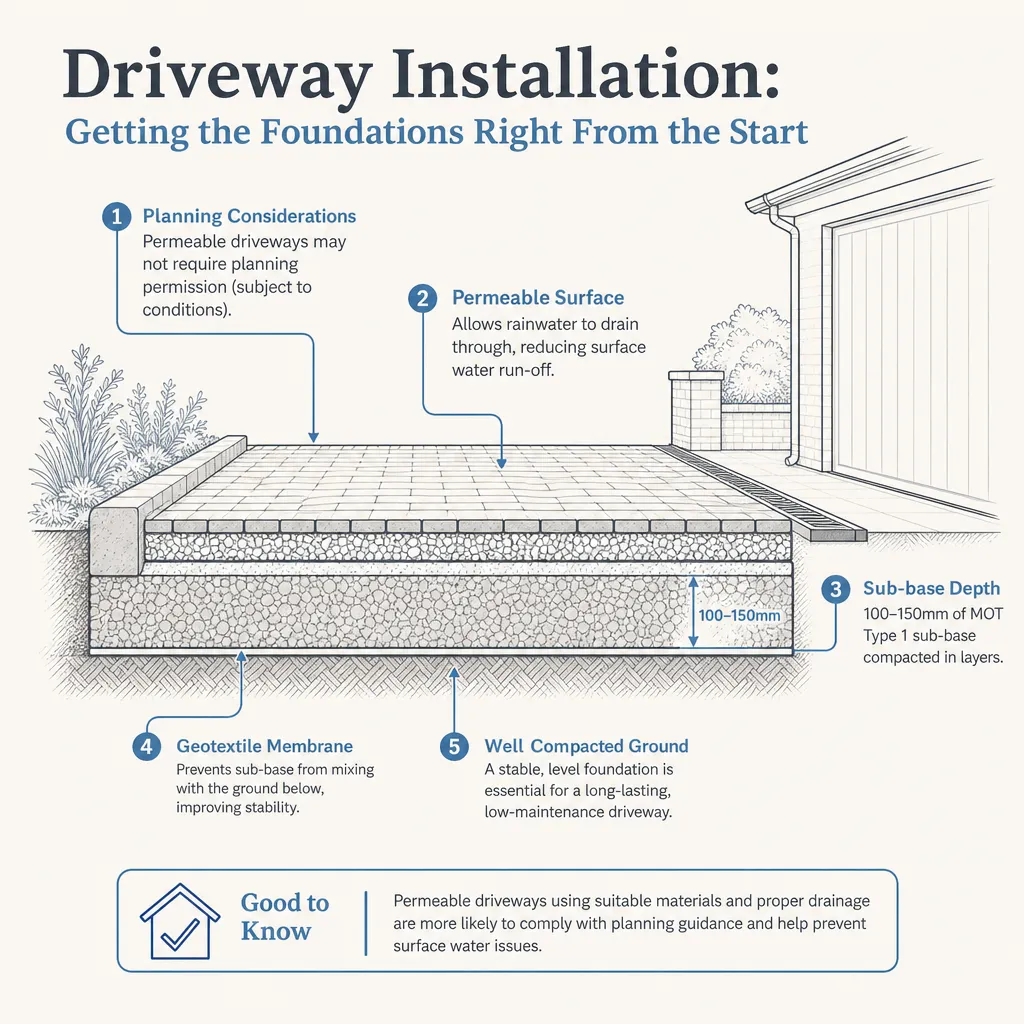
Driveway Installation: Getting the Foundations Right From the Start
A long-lasting driveway depends more on sub-base depth and drainage design than on the surface material chosen.
 Improvement & Build
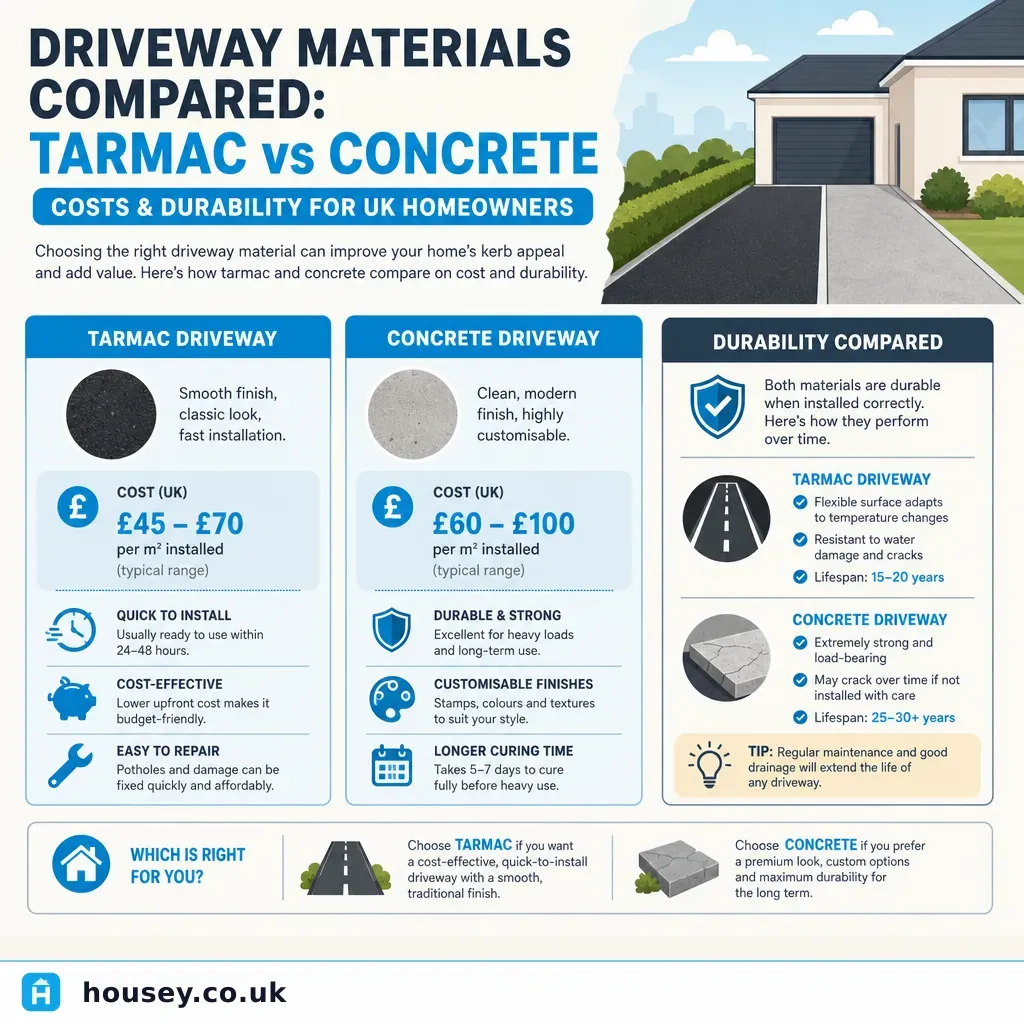
Driveway Materials Compared: Tarmac vs Concrete Costs and Durability
Tarmac driveways typically cost £50–£80 per square metre installed and can be used within 24 hours, while concrete costs £80–£130 per square metre but lasts longer and offers more finish options.
 Improvement & Build
Expert Roofing Installation: Quality Materials and Craftsmanship
A quality roof installation depends on matching materials to your property type, hiring a suitably qualified roofer, and ensuring building regulations are met where required.
 Improvement & Build
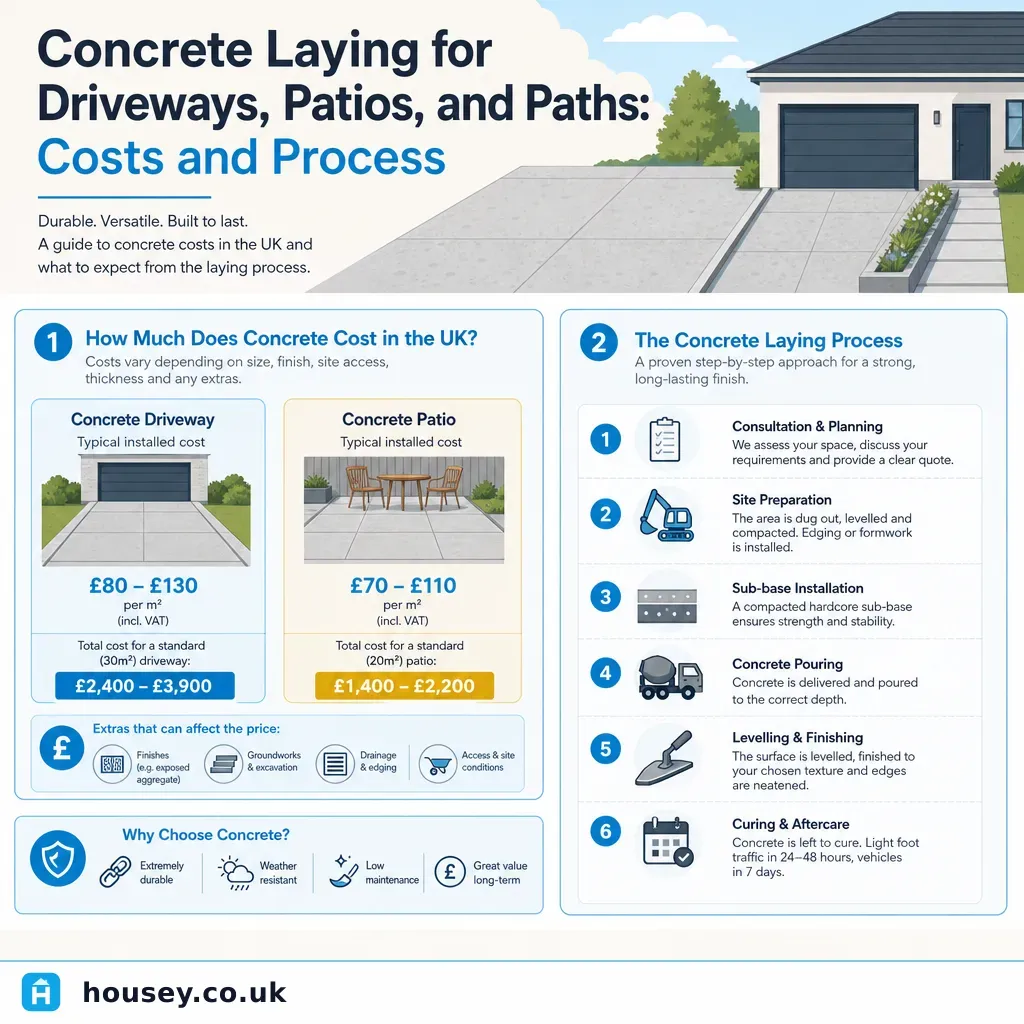
Concrete Laying for Driveways, Patios, and Paths: Costs and Process
Concrete laying for a UK driveway typically costs £65–£110 per square metre, including sub-base, reinforcement, formwork, and finishing.
 Improvement & Build
Driveway Thickness: Achieving the Right Specification for Residential Properties
The correct thickness for a residential driveway depends on the surface material and the traffic it will carry.