Driveway Materials and Construction: Comparing Surface Options
By Housey · Last reviewed 26th of May 2026
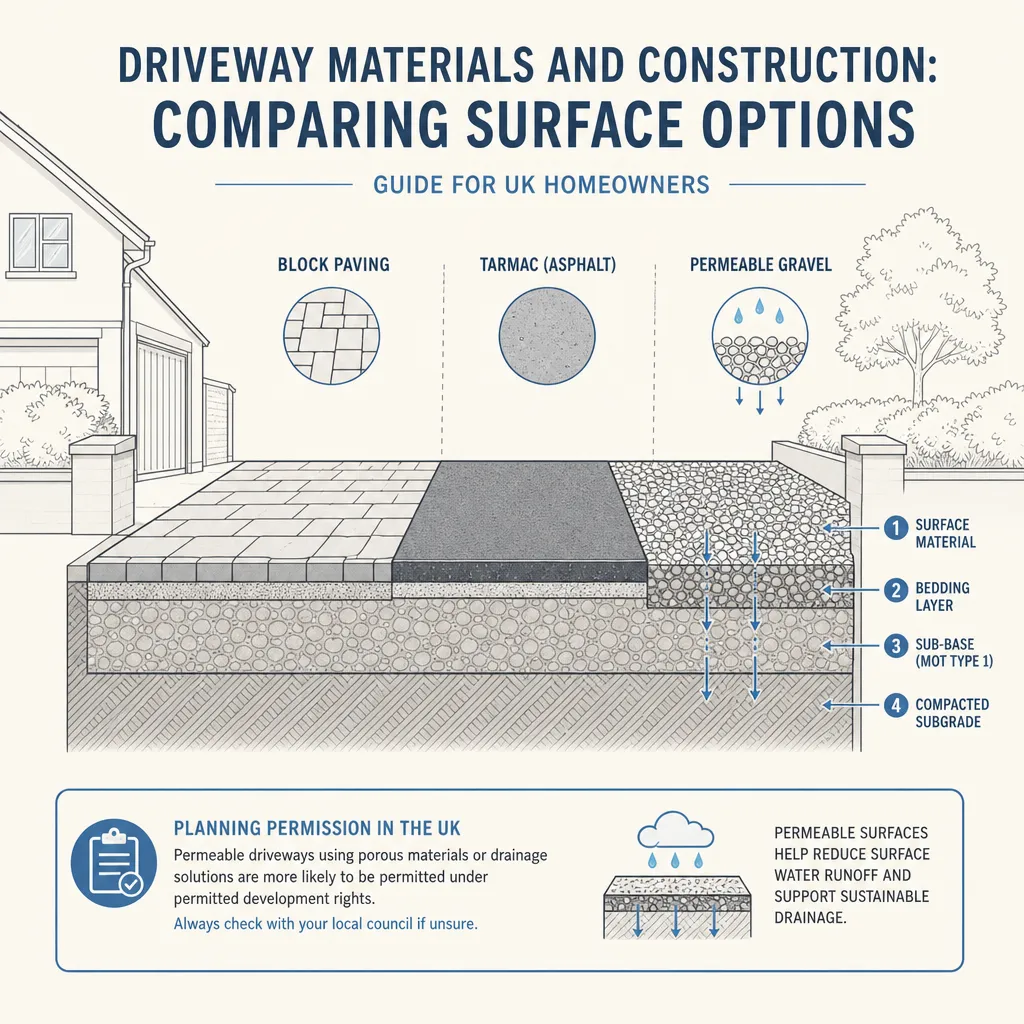
Driveway Materials and Construction: Comparing Surface Options
Choosing a driveway surface is one of the most visible and lasting decisions a UK homeowner makes about their property's exterior. Beyond aesthetics, the choice carries planning, drainage, and maintenance implications that can affect whether you need permission before work starts, your legal liability during heavy rain, and the long-term value of the investment. Many homeowners are unaware that replacing a front garden with a hard surface triggers specific planning rules — and that the drainage method, not the material's appearance, is what usually determines whether permission is needed.
Key points
- Replacing a front garden with a non-permeable hard surface of more than 5m² requires planning permission under householder permitted development rules, amended in 2008 under the Town and Country Planning Act.
- Resin-bound aggregate (not resin-bonded) and permeable block paving allow rainwater to drain through the surface, making them SuDS-compliant and typically exempt from this planning requirement.
- In Wales, Schedule 3 of the Flood and Water Management Act 2010 imposes mandatory SuDS approval from the local SuDS Approving Body (SAB) for most new surface drainage, with stricter thresholds than England.
- A new or widened vehicle access crossing a public footway onto a classified road requires a dropped kerb licence from the local highway authority, regardless of the surface material chosen.
- Block paving installed without adequate sub-base depth — typically 100–150mm compacted MOT Type 1 hardcore — is a leading cause of premature settling, cracking, and surface drainage failure.
Planning permission and drainage rules
The 2008 amendment to householder permitted development rules changed the position for front drives significantly. The key test is permeability, not aesthetics:
- A permeable surface (resin-bound, permeable block paving, gravel, or porous asphalt) of any size can normally be laid without planning permission.
- A non-permeable surface of 5m² or less can also usually be laid without permission.
- A non-permeable surface of more than 5m² requires planning permission unless all surface run-off is directed to a lawn, border, or soakaway within the property boundary.
Side and rear driveways accessed from private roads are less likely to trigger these rules, but check with your local planning authority if you are unsure. In conservation areas, new hard surfacing to the front of a dwelling may be subject to Article 4 Directions or planning conditions regardless of size or permeability.
The dropped kerb is a separate requirement from planning permission. If your driveway involves crossing a public pavement to reach the highway, you will need separate permission from the local highways authority. Many councils have waiting lists of several months; factor this into your project timeline.
Comparing driveway surface materials
Surface | Approx. installed cost/m² | Typical lifespan | Permeable? | Maintenance | Best for |
|---|---|---|---|---|---|
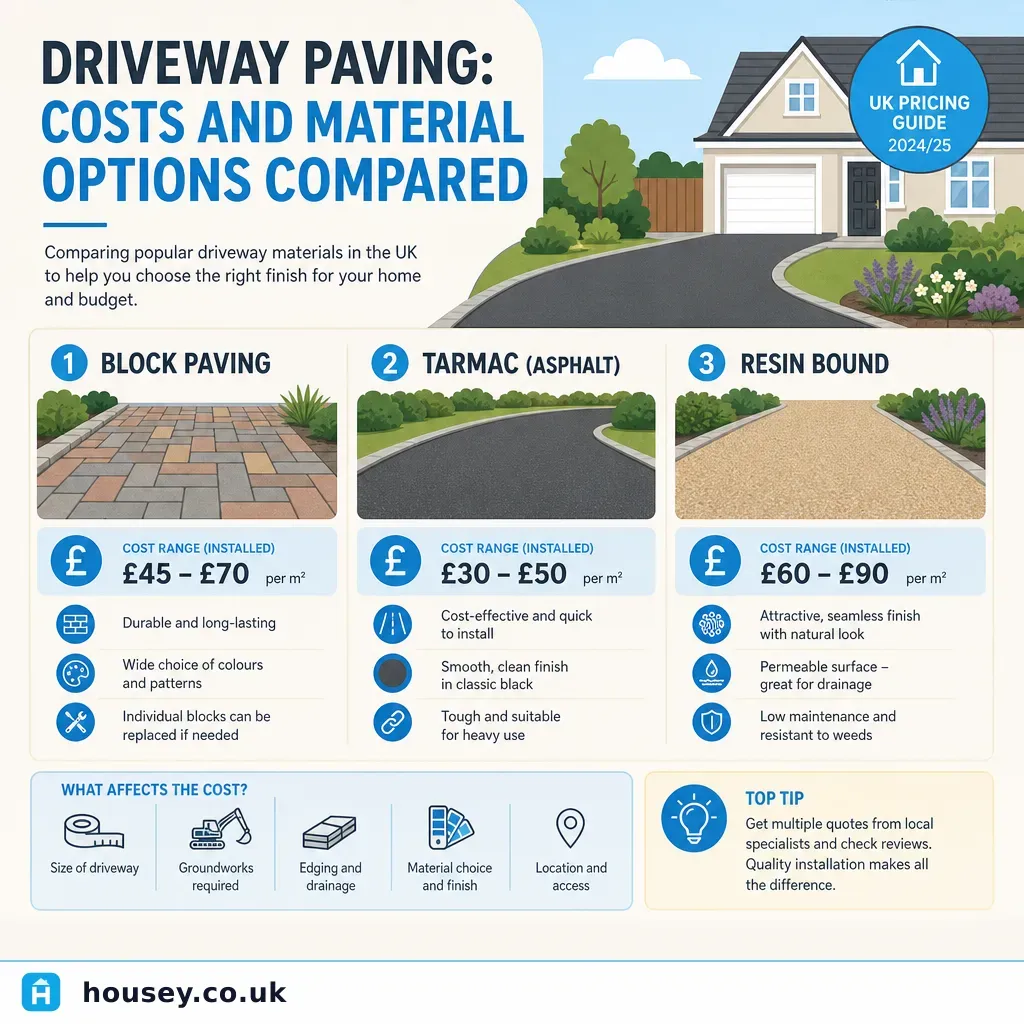
Tarmac (asphalt) | £50–£90 | 20–30 years | Standard: no; porous grade: yes | Occasional crack repair; sealing optional | Large driveways, fast installation, cost-effective |
Block paving (concrete or clay) | £80–£150 | 25–40 years | Permeable versions available | Re-sanding and sealing every 3–5 years; weed control | Repairable, wide style choice, traditional properties |
Resin-bound aggregate | £60–£120 | 15–25 years | Yes | Annual cleaning; UV topcoat may fade over time | Planning-friendly, decorative, smooth accessible finish |
Poured concrete | £60–£100 | 25–40 years | Standard: no | Low; sealing recommended every 5–10 years | Neat modern finish, sloped sites |
Gravel (loose or bound) | £20–£50 | Ongoing top-ups required | Yes | Regular raking, topping up, weed membrane management | Low cost, permeable, easy edging |
Porcelain or natural stone | £100–£200+ | 30–50+ years | Varies by bed and jointing method | Low for the surface; bedding and jointing may need attention | Premium finish, period properties |
Indicative UK costs, last reviewed 2026-05-26. Prices vary by region, access constraints, ground conditions, and cost of removing existing surfaces. Obtain at least three written quotes from qualified installers before committing.
Resin-bound vs resin-bonded: an important distinction
These two products are frequently confused, but they perform differently and have different planning implications:
- Resin-bound: aggregate is mixed thoroughly with resin before laying, producing a smooth, consistently porous surface through which water drains freely. This is SuDS-compliant and does not usually require planning permission for front driveways.
- Resin-bonded: aggregate is scattered onto a resin-coated base after the resin has been applied to the surface; drainage relies on the substrate beneath, not the surface itself. It is not truly permeable, loses aggregate over time with heavy traffic, and does not carry the same planning exemption.
If a contractor quotes for a resin surface without specifying which type, ask explicitly whether the finished surface is porous and whether it meets SuDS compliance requirements. A resin-bonded surface laid as a front driveway over more than 5m² on top of a non-permeable base may require planning permission.
Sub-base and construction: what good installation looks like
The longevity of any driveway surface depends as much on the sub-base as on the surface material. A properly constructed residential driveway typically involves the following sequence:
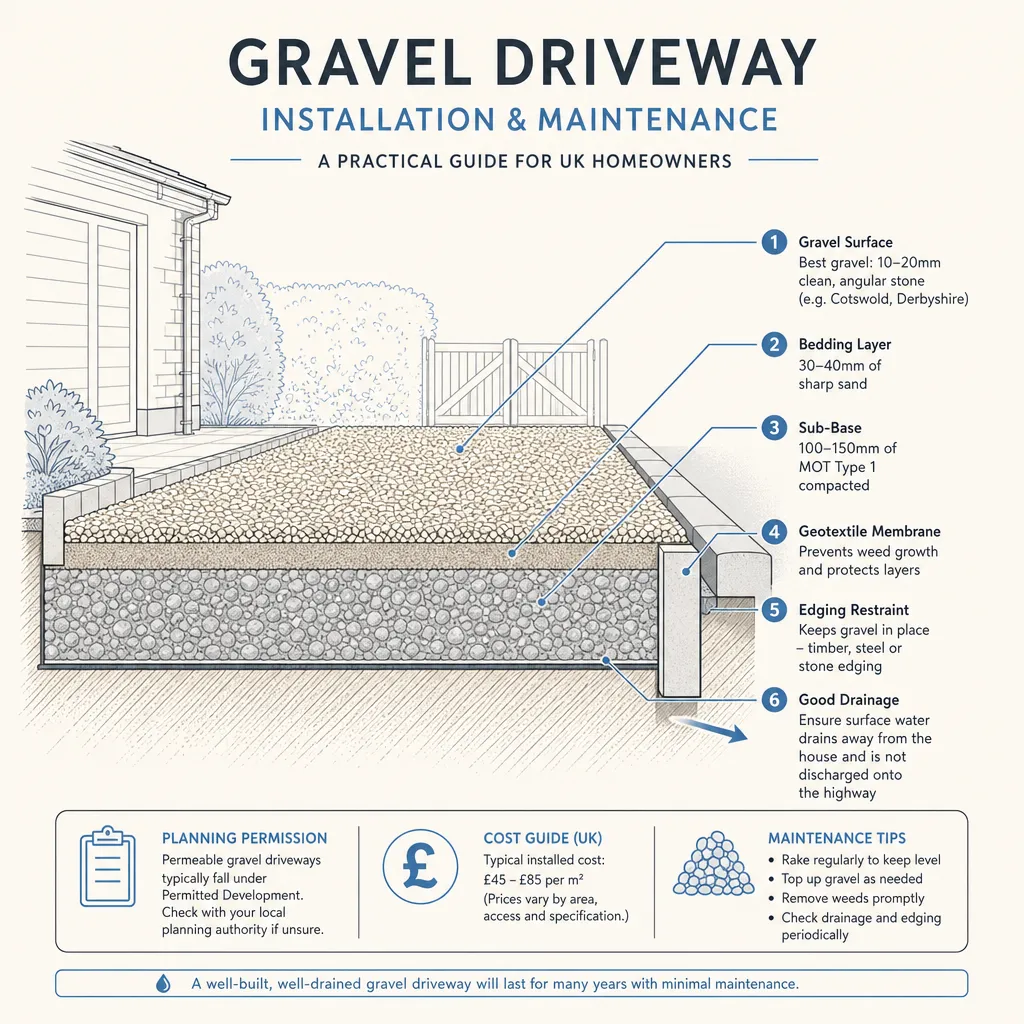
- Excavation to the required depth — typically 200–300mm depending on traffic loading and ground conditions.
- Sub-base layer: 100–150mm of compacted MOT Type 1 granular hardcore, laid and compacted in layers.
- Bedding layer: sharp sand for block paving, or a bonded base layer for resin surfaces.
- Edging restraints: haunched concrete edging to prevent lateral spread of blocks or loose surfaces over time.
- Surface layer: the chosen material, laid to the manufacturer's specification and with appropriate falls.
- Drainage falls: a crossfall of approximately 1:60 directed away from the house towards a drain, soakaway, or permeable border.
Any reputable contractor will provide a written specification detailing sub-base depth and drainage provision before starting work. Be cautious of quotes that describe only the surface material.
Driveway installation homeowner checklist
Use this checklist before commissioning work:
Red flags when getting driveway quotes
- A written quote with no mention of sub-base specification or depth — this is the most reliable indicator of a thin or absent sub-base, which will fail prematurely.
- No written contract or scope of work; verbal agreements are difficult to enforce and lead to disputes about what was included.
- Payment demanded in full before work starts; a reasonable deposit is typically 10–25% of the total value.
- An unusually low price that cannot be explained by a simpler specification or smaller scope.
- A contractor who assures you planning permission is not needed without asking about the size of the surface area or where drainage will go.
When to get professional help
Most driveway installations are handled directly by specialist contractors. However, seek professional advice if:
- Ground conditions appear soft, waterlogged, or potentially contaminated (former garden waste tips, filled areas, or areas with unexplained subsidence).
- The site has a significant slope and drainage needs to be formally engineered.
- The driveway is adjacent to a drainage easement, shared surface, or a party boundary.
- A planning application is required and the planning history of the property is complex.
How Housey can help
Housey connects homeowners across the UK with vetted driveway installers who can advise on materials, plan drainage solutions, and handle all aspects of installation from excavation to finished surface — with written, itemised quotes so you can compare on a like-for-like basis.
Frequently asked questions
Does my new driveway need planning permission?
For front driveways over 5m², the key question is whether the surface is permeable. Permeable materials such as resin-bound aggregate, gravel, or permeable block paving generally do not need planning permission. Non-permeable surfaces over 5m² require planning permission unless surface water is directed to a lawn, flower bed, or soakaway on the property. In conservation areas, any new hard surfacing may be subject to additional controls.
How long does a new driveway last?
Lifespan depends heavily on sub-base quality and surface material. Well-constructed block paving on a compacted MOT Type 1 sub-base typically lasts 25–40 years. Tarmac typically lasts 20–30 years. Resin-bound surfaces typically last 15–25 years before the surface finish requires attention. Poor sub-base preparation — regardless of the surface material — is the single most common cause of premature settling, cracking, and drainage failure.
Can I install a driveway myself?
Gravel and loose-surface driveways can be laid by a confident DIYer with care given to edging restraints and weed membrane. Block paving, tarmac, resin-bound, and poured concrete installations require specialist equipment and accurately prepared sub-bases to achieve the necessary compaction and drainage falls. Tarmac in particular requires plant equipment and is not suitable for DIY installation.
Do I need a dropped kerb for my new driveway?
If your driveway crosses a public footpath to reach the carriageway, you will almost certainly need a dropped kerb licence from the local highway authority. The crossing must usually be constructed by the council or an approved contractor. Driving over an unmodified kerb and footway is illegal and can damage underground services. Apply well in advance — waiting times at many councils run to several months.
Sources and further reading
- Planning Portal — hard surfaces in gardens — Planning Portal
- Permitted development rights for householders: technical guidance — GOV.UK
- Susdrain — SuDS guidance for homeowners — CIRIA
- Flood and Water Management Act 2010 — legislation.gov.uk
- TrustMark — find registered tradespeople — TrustMark
Useful next reads
 Improvement & Build
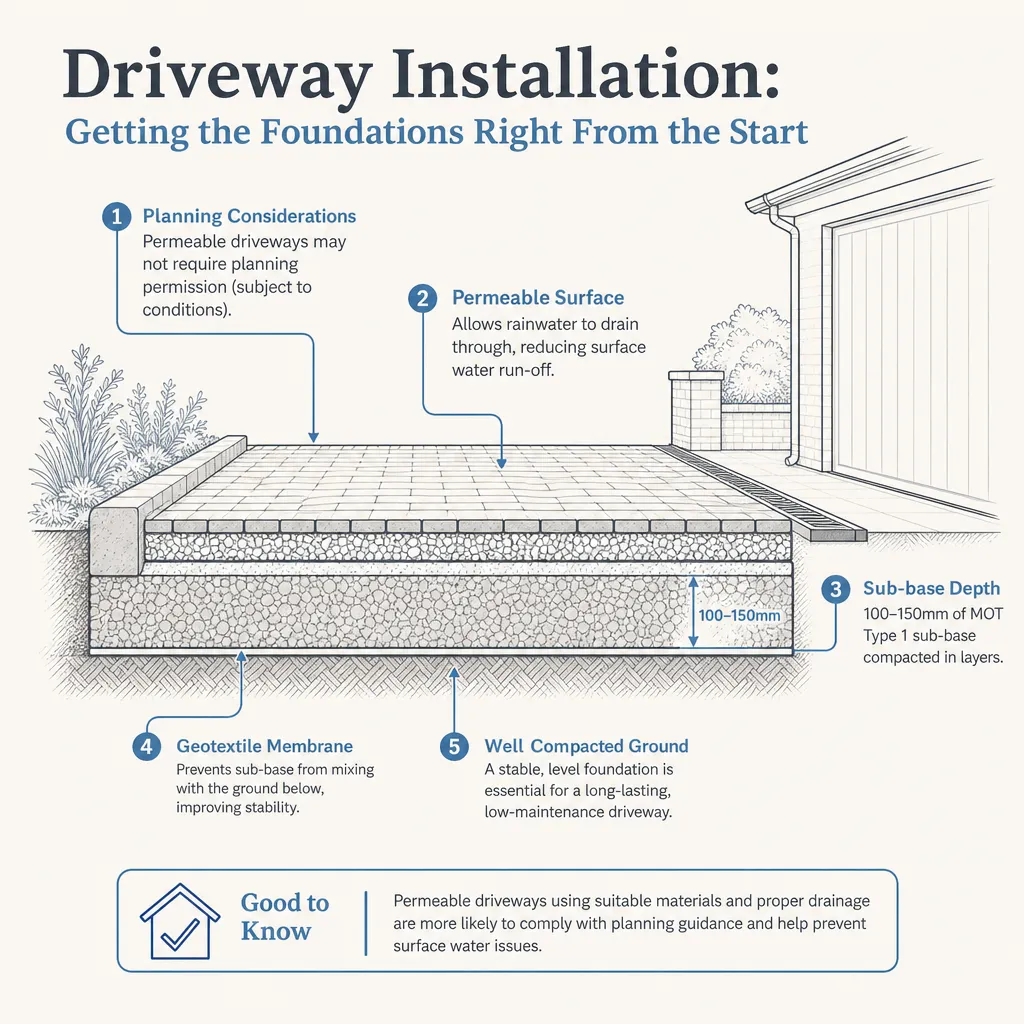
Driveway Installation: Getting the Foundations Right From the Start
A long-lasting driveway depends more on sub-base depth and drainage design than on the surface material chosen.
 Improvement & Build
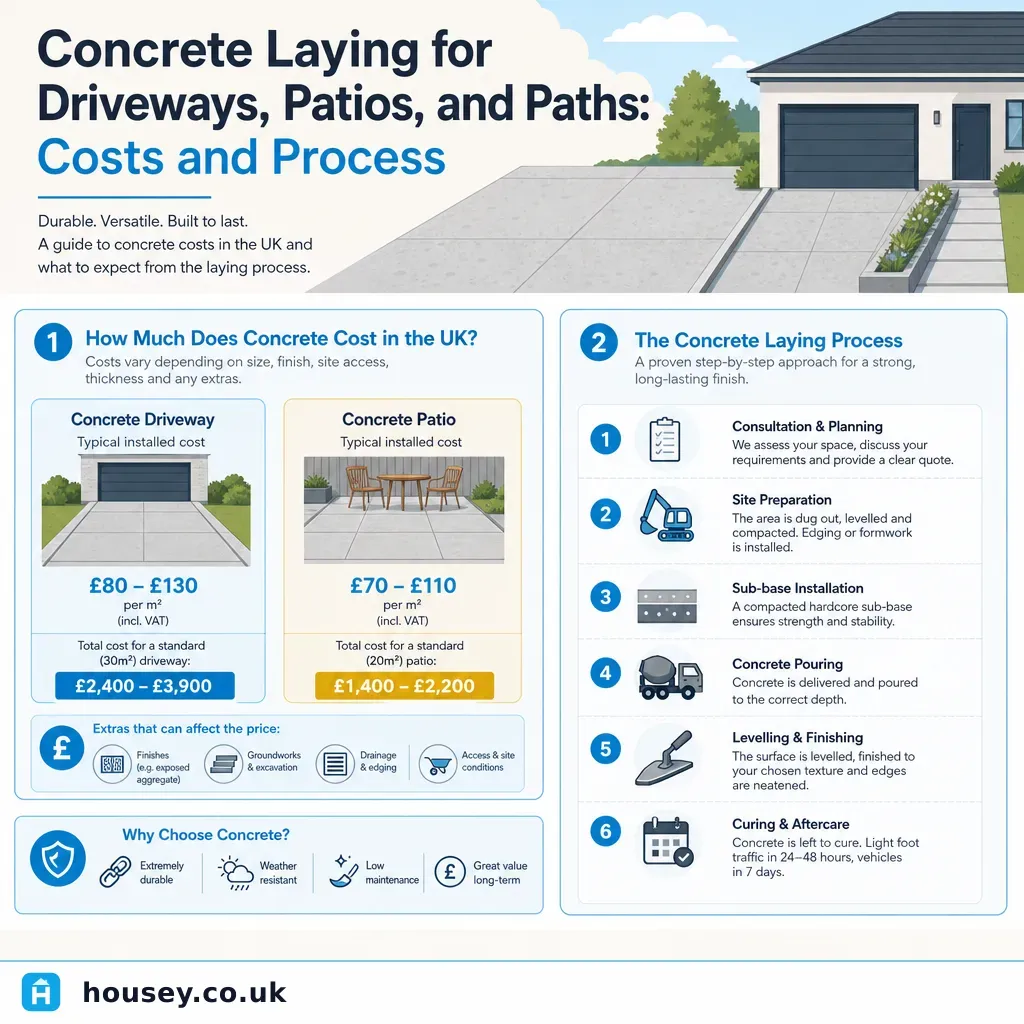
Concrete Laying for Driveways, Patios, and Paths: Costs and Process
Concrete laying for a UK driveway typically costs £65–£110 per square metre, including sub-base, reinforcement, formwork, and finishing.
 Improvement & Build
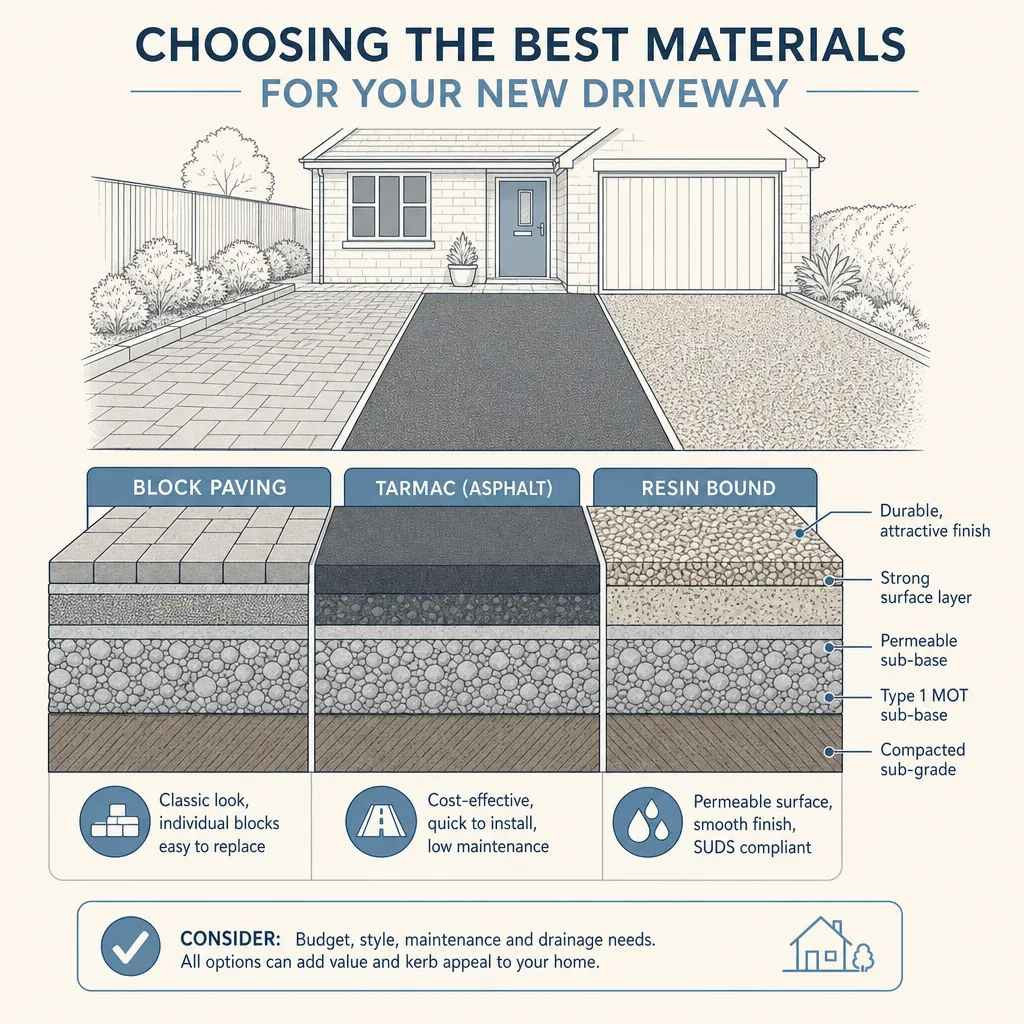
Choosing the best materials for your new driveway
The most common driveway materials in the UK are tarmac, block paving, resin-bound surfacing, concrete, and gravel.
 Improvement & Build
Gravel Driveway Installation and Maintenance
Gravel is one of the most practical and affordable driveway surfaces for UK homes.
 Improvement & Build
Driveway Paving: Costs and Material Options Compared
Driveway installation costs in the UK typically range from £50–£90 per m² for tarmac to £80–£150 per m² for block paving and £70–£120 per m² for resin-bound surfaces.