Driveway Type 1 Base Course: Quantity Calculator and Material Estimates
By Housey · Last reviewed 4th of May 2026
Driveway Type 1 Base Course: Quantity Calculator and Material Estimates
Most driveway failures begin not at the surface but in the layers beneath it. Whether you are laying block paving, resin-bound gravel, tarmac, or concrete, the volume and compaction of your Type 1 sub-base determines whether the finished driveway stays level, drains properly, and supports vehicles without rutting or settlement. Getting the quantity right before you order saves money on second deliveries and avoids costly remedial work down the line.
Key points
- Type 1 MOT aggregate is specified under the Highways England Specification for Highway Works (SHW) Series 800 and BS EN 13285 as a well-graded unbound granular mixture — typically crushed limestone, granite, or recycled concrete — graded from 40 mm down to fine dust.
- The standard compacted sub-base depth for a domestic driveway is 100 mm on firm, well-draining ground, rising to 150 mm on soft clay or where the surface system manufacturer requires it.
- Loose Type 1 compacts by approximately 20–25%, so you must apply a bulking factor of 1.25 to your compacted volume when calculating how much to order.
- Type 1 aggregate has a bulk density of approximately 2.1 tonnes per cubic metre when tipped loose; most suppliers price and sell by the tonne for bulk deliveries.
- In England, impermeable hard surfacing over 5 m² in a front garden may require planning permission under the Town and Country Planning (General Permitted Development) (England) Order 2015, unless run-off drains to a permeable area — check with your local planning authority before starting.
What is Type 1 MOT aggregate?
Type 1 (also called "MOT Type 1", "road base", or "crusher run") is a well-graded crushed aggregate conforming to the Highways England Specification for Highway Works. Graded from 40 mm maximum particle size down to fine dust, it interlocks tightly under compaction to form a stable, load-bearing sub-base layer.
For domestic driveways, Type 1 sits between the prepared soil (the formation) and the surface course or bedding layer. It is not the same as Type 2 aggregate (which has less fine fraction and is more free-draining but less structurally stable), nor single-sized decorative gravel.
How to calculate your Type 1 requirements
Three steps: measure the area, choose the compacted depth, then apply the bulking factor and bulk density to get a weight to order.
Step 1: Measure the area
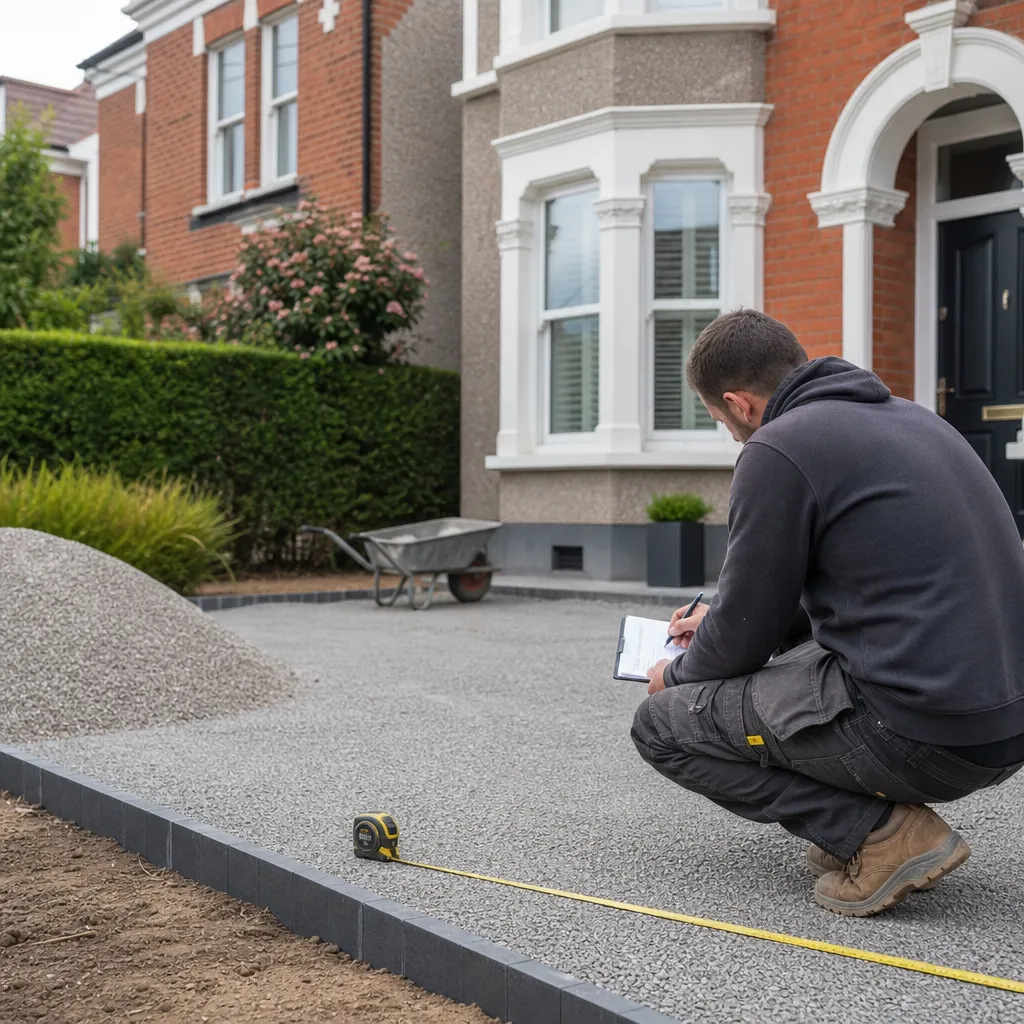
Measure length and width in metres. For irregular shapes, divide into rectangles and add them together. Include turning areas, dropped kerb aprons, and any paths also needing a new sub-base.
Step 2: Choose the compacted depth
Ground conditions | Surface type | Recommended compacted depth |
|---|---|---|
Firm, sandy or gravelly subgrade | Block paving or tarmac, light vehicles | 100 mm (0.10 m) |
Soft clay or poorly drained ground | Block paving or tarmac, light vehicles | 150 mm (0.15 m) |
Any subgrade | Resin-bound gravel | 150 mm minimum (check manufacturer spec) |
Soft or variable subgrade | Motorhome or heavy deliveries | 200 mm (0.20 m) |
If you are uncertain about subgrade conditions, dig a 300 mm test pit. Soil that is wet, dark, or compresses when walked on warrants at least 150 mm and may benefit from a geotextile separation membrane beneath the Type 1.
Step 3: Apply the formula
Loose volume to order (m³) = Area (m²) × Depth (m) × 1.25
Weight to order (tonnes) = Loose volume (m³) × 2.1
Quick-reference quantities per square metre
Compacted depth | Loose volume per m² | Weight per m² |
|---|---|---|
100 mm | 0.125 m³ | ~0.26 tonnes |
150 mm | 0.1875 m³ | ~0.39 tonnes |
200 mm | 0.25 m³ | ~0.53 tonnes |
Indicative material figures, last reviewed 2026-05-04. Bulk density varies by aggregate source; confirm with your supplier before ordering.
Worked UK property scenario
A homeowner in the West Midlands is replacing a crumbling tarmac driveway with block paving. The new driveway measures 5.5 m × 7 m (38.5 m²) on moderately firm clay ground. They select 150 mm compacted depth.
- Loose volume = 38.5 × 0.15 × 1.25 = 7.22 m³
- Weight = 7.22 × 2.1 = approximately 15.2 tonnes
They round up to 16 tonnes to allow for minor waste and an uneven formation. At indicative tipped delivery prices of £30–£55 per tonne (indicative UK costs, last reviewed 2026-05-04; prices vary significantly by region and supplier), the material cost is approximately £480–£880 before delivery charges. They check vehicle access for a 10-tonne tipper before booking.
Which depth should you choose?
Use this decision tree before placing your order:
- Choose 100 mm if the soil is firm and free-draining (sandy or gravelly), the driveway carries only standard passenger cars, and the surface is tarmac or block paving.
- Choose 150 mm if the soil is clay, the formation feels soft underfoot, or the surface system is resin-bound gravel (most manufacturers specify this minimum).
- Choose 200 mm or seek specialist advice if the driveway will regularly carry heavy vehicles — motorhomes, skip lorries, tankers — or if there are signs of made ground or poor load-bearing capacity.
- Add a geotextile membrane beneath the Type 1 on soft clay subgrades to prevent clay migration into the aggregate over time.
Ordering and delivery: homeowner checklist
Common mistakes to avoid
Underordering and placing a second delivery is the most avoidable cost overrun on driveway projects. Delivery charges frequently exceed the cost of a few extra tonnes.
Substituting Type 2 for Type 1 — Type 2 lacks the fine fraction needed for the same structural lock-up. Only substitute if your installer confirms it is appropriate for the application and surface system.
Compacting in one deep pass — for depths over 150 mm, compact in two or more layers of around 100–150 mm each. A vibrating plate compactor typically works effectively to that depth per pass.
Underestimating total excavation depth — a block-paved driveway needs roughly 300–320 mm total excavation below finished level (150 mm Type 1 + 40 mm sharp sand + 60–80 mm block). Plan the full excavation depth, not just the sub-base depth.
When to get professional help
A Type 1 quantity calculation is straightforward for regular driveways on firm ground. Seek professional input if:
- The ground shows signs of subsidence, tree root heave, made ground, or previously filled land
- The driveway serves a listed building or sits within a conservation area
- You need a dropped kerb — local highway authority approval is required and may affect drainage design
- The total impermeable area exceeds 5 m² and you are uncertain whether planning permission applies
How Housey can help
For a driveway that needs professional sub-base preparation and surface installation, Housey can connect you with vetted driveway installers who work in your area. Describe your driveway size, surface preference, and ground conditions, and compare quotes from local contractors.
Frequently asked questions
How much Type 1 do I need for a double driveway?
A typical double driveway is around 48 m² (6 m × 8 m). At 150 mm compacted depth, you need 48 × 0.15 × 1.25 = 9 m³ loose volume, or roughly 18.9 tonnes. Order 19–20 tonnes to allow for waste and an uneven formation. Always confirm bulk density with your supplier, as it varies by aggregate source.
Can I use recycled aggregate instead of virgin Type 1?
Recycled crushed concrete (RC Type 1) can meet the sub-base specification if certified to BS EN 13285. It is often cheaper with a lower carbon footprint. Check that your surface system manufacturer accepts recycled aggregate beneath their product before substituting — some resin-bound gravel systems specify virgin limestone or granite for the sub-base.
Do I need planning permission to lay a driveway?
In England, permeable surfaces in a front garden generally do not require planning permission. Impermeable surfaces over 5 m² do require permission unless run-off drains to a lawn, border, or soakaway rather than the public highway. Rules differ in Wales, Scotland, and Northern Ireland, and may vary for listed buildings and conservation areas. Check with your local planning authority first.
How deep should I excavate for a block-paved driveway?
Total excavation is typically 300–320 mm below finished surface level: 150 mm compacted Type 1 sub-base, plus 40 mm sharp sand bedding, plus 60–80 mm block paver. Adjust upward if the subgrade is soft or if your chosen surface system specifies greater depths.
What is the difference between Type 1 and Type 3 aggregate?
Type 3 is a coarser, open-graded aggregate used mainly in permeable paving construction, allowing water to pass through freely. Type 1's fine fraction gives it superior structural lock-up for standard sub-bases but makes it effectively impermeable. Use Type 3 only where a permeable drainage design specifically requires it.
Sources and further reading
- Specification for Highway Works, Series 800: Unbound Mixtures — National Highways
- Paving your front garden — GOV.UK
- Town and Country Planning (General Permitted Development) (England) Order 2015 — legislation.gov.uk
- BS EN 13285: Unbound Mixtures — Specifications — BSI British Standards
Useful next reads
 Improvement & Build
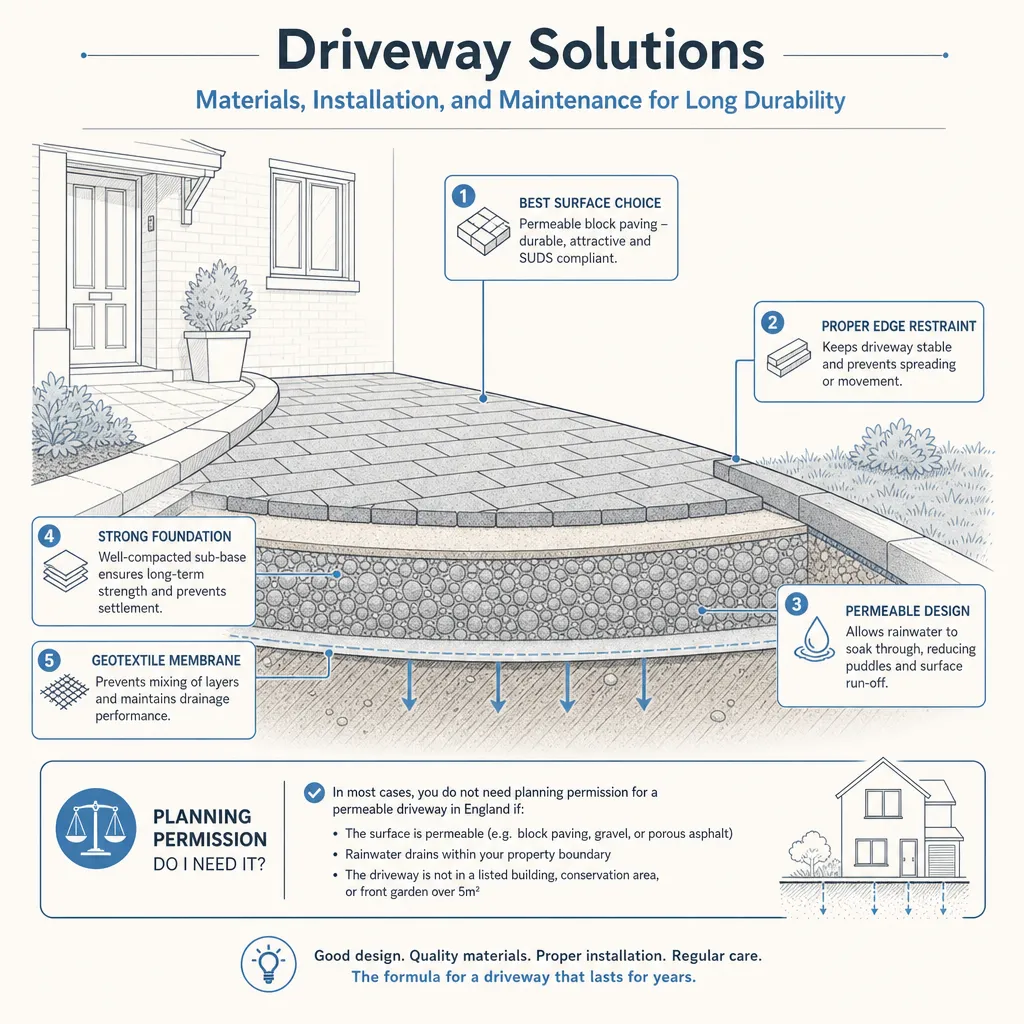
Driveway Solutions: Materials, Installation, and Maintenance for Long Durability
In England, driveways over 5 square metres need planning permission unless they use a permeable surface or drain to a lawn or border.
 Improvement & Build
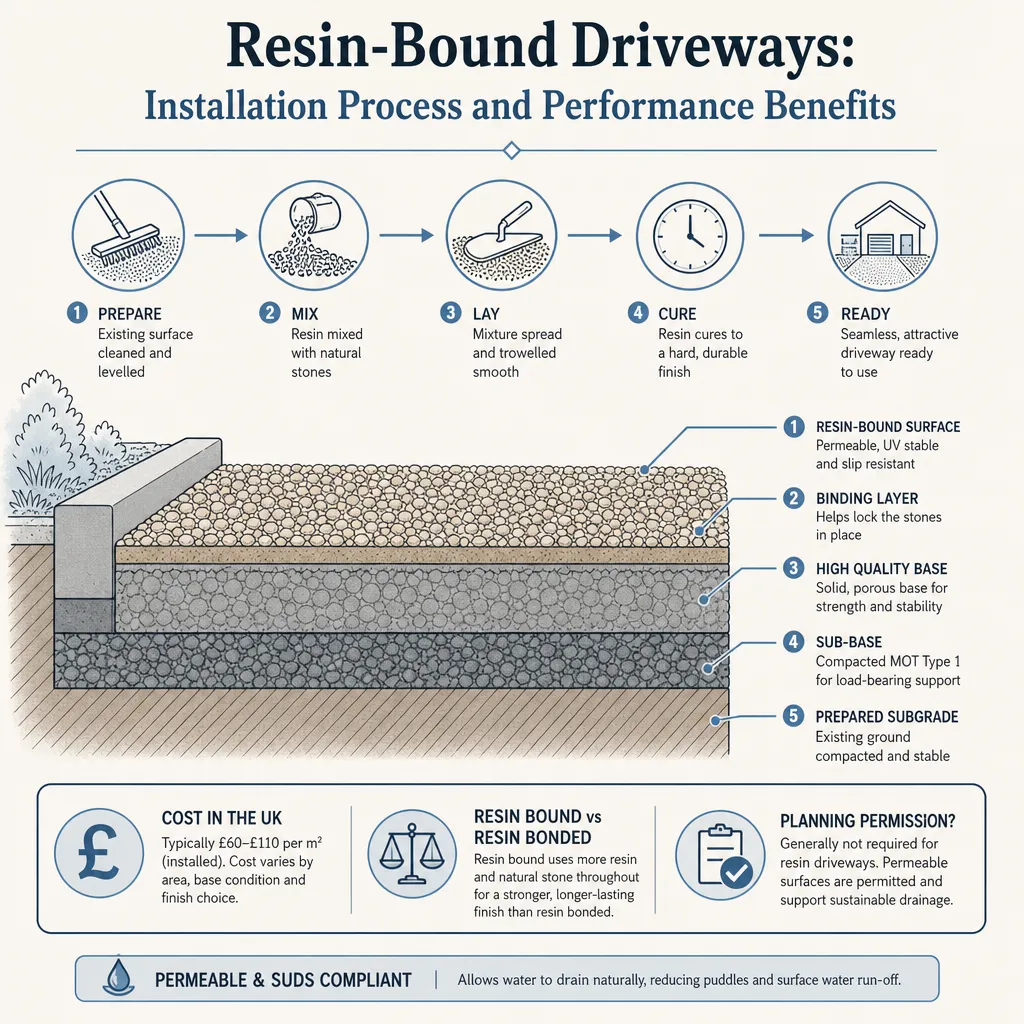
Resin-Bound Driveways: Installation Process and Performance Benefits
Resin-bound surfacing mixes natural aggregate with UV-stable polyurethane resin to create a smooth, porous driveway that drains water through its surface layer.
 Improvement & Build
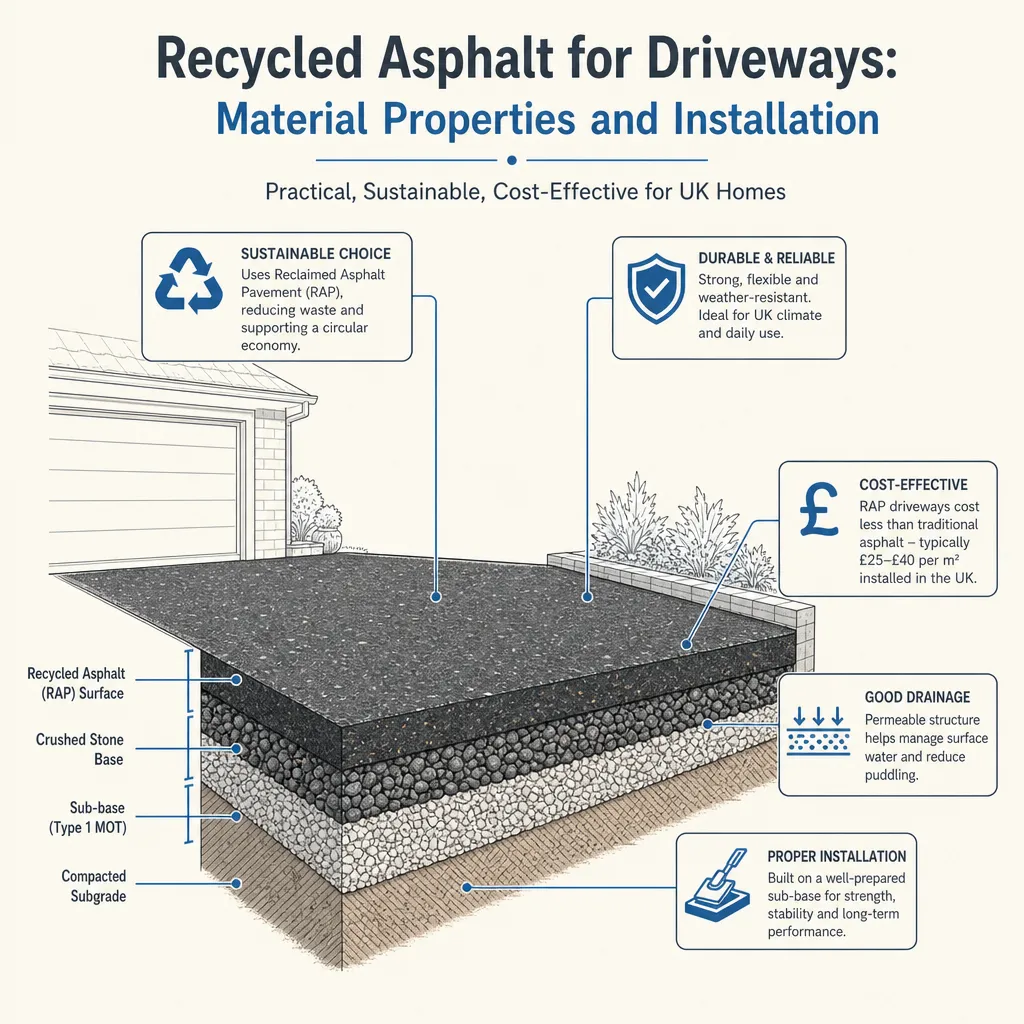
Recycled Asphalt for Driveways: Material Properties and Installation
Recycled asphalt (RAP) uses reclaimed road material and costs less than virgin asphalt, making it a budget-friendly option for UK driveways.
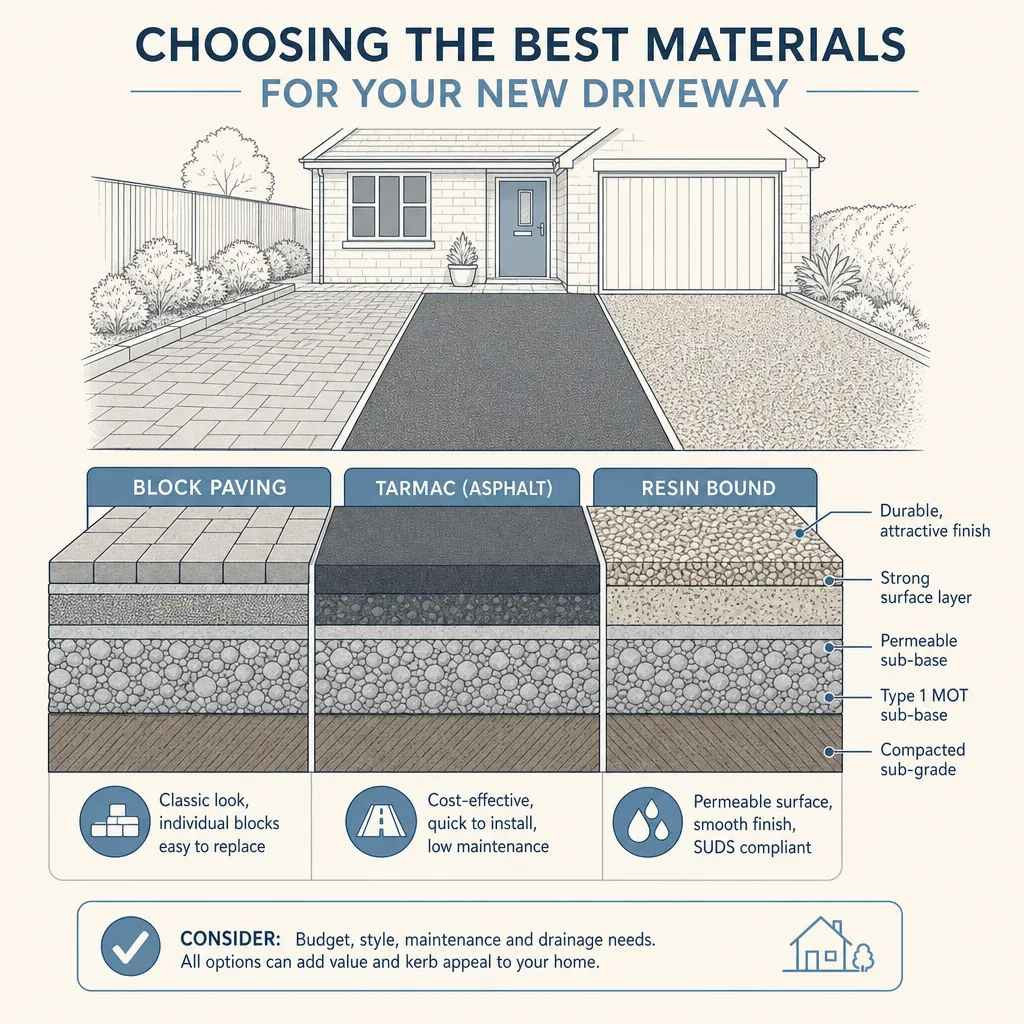 Improvement & Build
Choosing the best materials for your new driveway
The most common driveway materials in the UK are tarmac, block paving, resin-bound surfacing, concrete, and gravel.
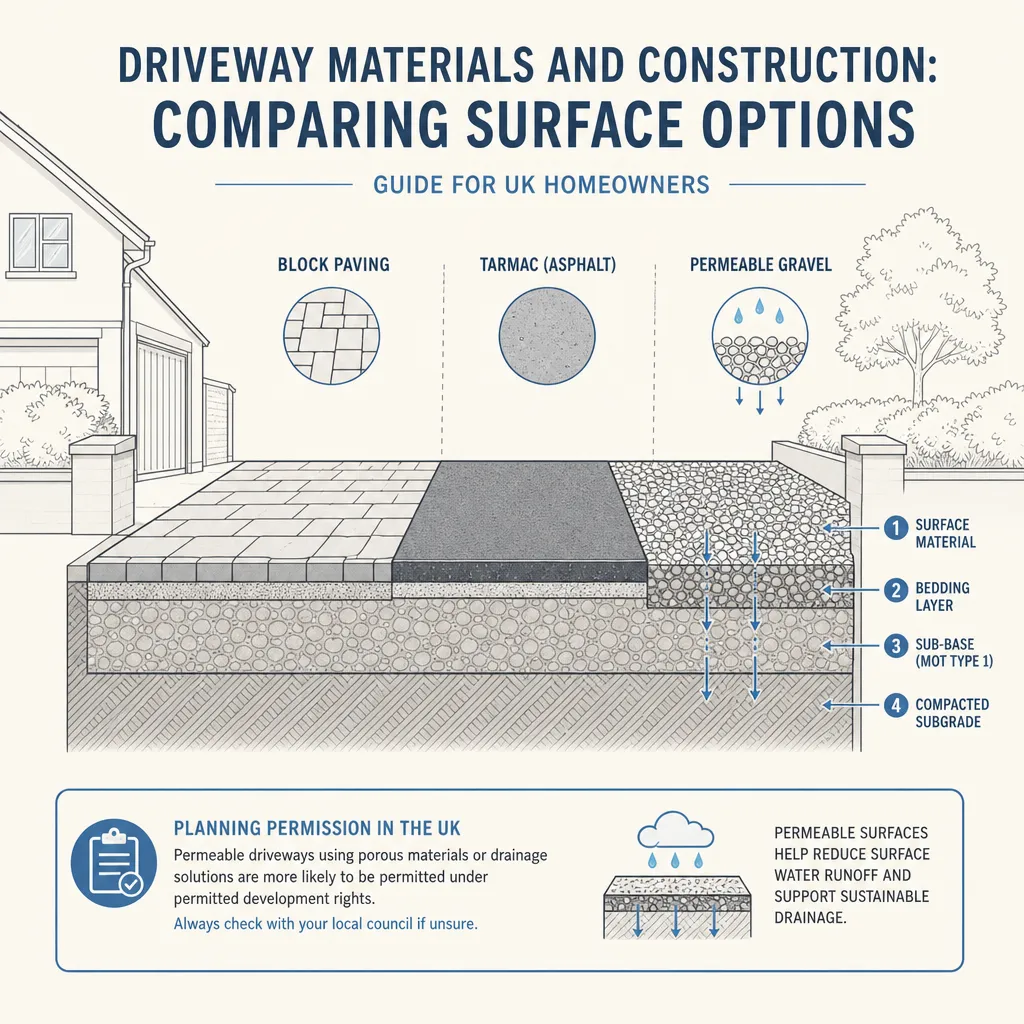 Improvement & Build
Driveway Materials and Construction: Comparing Surface Options
Common driveway surfaces in the UK include block paving, tarmac, concrete, gravel, and resin-bound aggregate.