Dry Rot Repair and Timber Treatment Costs
By Housey · Last reviewed 6th of May 2026
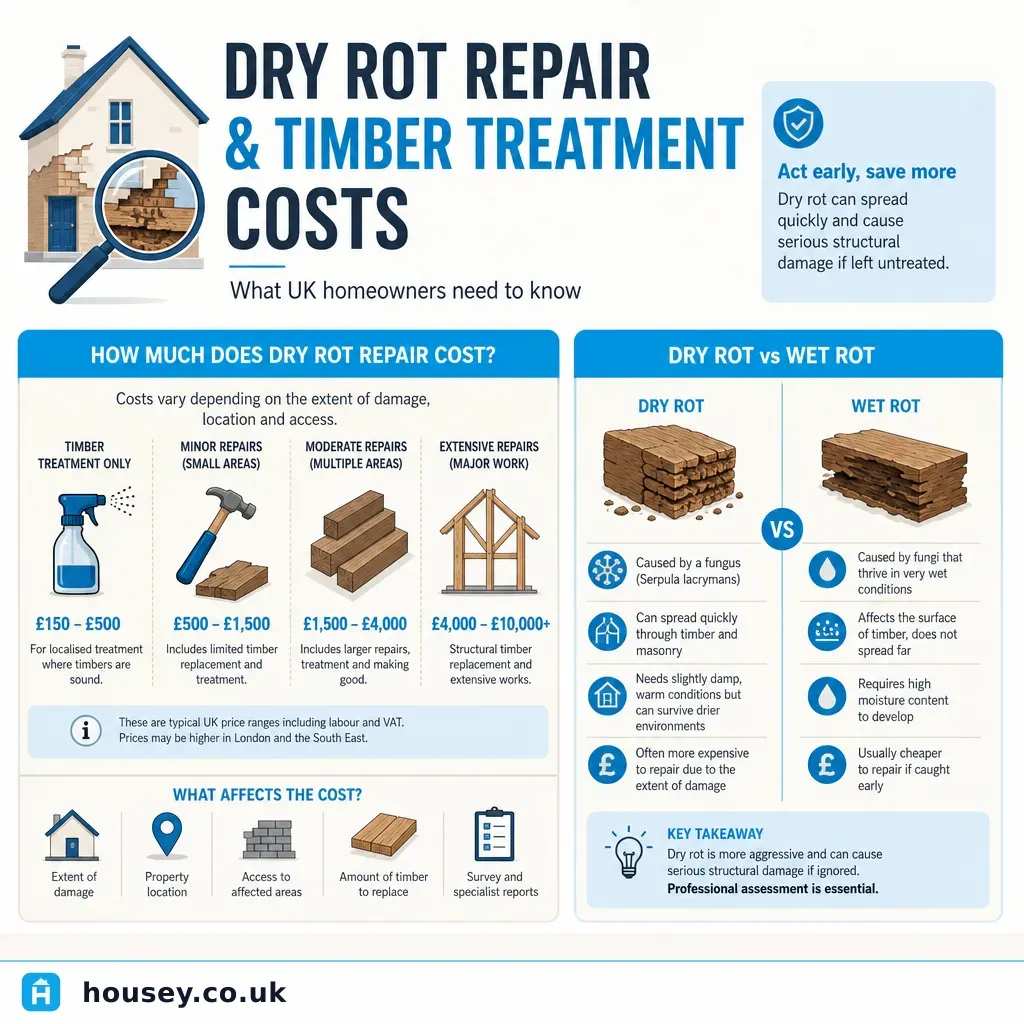
Dry Rot Repair and Timber Treatment Costs
Dry rot is one of the most destructive forms of timber decay a UK homeowner can face, typically coming to light during a damp and timber survey, a building survey, or when visible fruiting bodies appear on skirting boards, floors, or joists. Left untreated, it can spread through structural timbers and masonry alike. Understanding the likely costs and the treatment process helps you approach any diagnosis with clarity.
Key points
- Dry rot is caused by the fungus Serpula lacrymans, which — unlike most timber decay fungi — can spread through masonry as well as timber, making it significantly more complex to contain than wet rot.
- A professional damp and timber survey (typically £200–£500) is the recommended first step before any treatment work begins; it should always precede a treatment quote.
- Treatment costs range from around £500 for a minor localised outbreak to £15,000 or more where structural joists, beams, or floors are extensively affected.
- Chemical treatment alone is rarely sufficient; specialist contractors should remove all infected timber to at least 300–500 mm beyond the last visible signs of decay.
- Reputable contractors typically offer a guarantee of 20–30 years, often backed by an insurance-backed guarantee (IBG) that is transferable to future owners.
What is dry rot and why does it matter structurally?
Dry rot (Serpula lacrymans) is a wood-decaying fungus that breaks down the cellulose in timber, leaving it brittle, cracked, and structurally weakened. Unlike wet rot, its mycelium — fine root-like strands — can penetrate plaster, brick, and mortar, allowing it to travel beyond the original moisture source to reach dry areas of a building.
Dry rot thrives where the moisture content of timber exceeds around 20%, which can occur through leaking roofs, rising damp, defective plumbing, or inadequate ventilation. Once established, the fungus can generate its own moisture supply to continue spreading even after the original source has been resolved.
In older UK properties — Victorian terraces, Edwardian semis, and Georgian townhouses — dry rot commonly affects suspended timber floors, roof timbers, window frames, and structural joists.
Common warning signs include cuboidal cracking in timber (splitting into dark rectangular pieces), orange-brown fruiting bodies at skirting level, white or grey cotton-wool-like mycelium on walls or floors, a musty earthy smell in seemingly dry rooms, and soft or springy flooring that suggests decayed joists beneath.
Dry rot vs wet rot: knowing the difference
Both forms of timber decay require professional attention, but dry rot is generally more expensive to treat because of its ability to spread through masonry well beyond the original moisture source.
Feature | Dry rot (Serpula lacrymans) | Wet rot (various species) |
|---|---|---|
Cause | Single aggressive fungal species | Multiple fungal species |
Spread pattern | Through masonry, beyond moisture source | Confined to persistently wet timber |
Timber appearance | Cuboidal cracking, dark brown | Longitudinal cracking; may feel damp |
Treatment complexity | Higher — masonry usually needs treatment too | Lower — moisture removal often sufficient |
Typical cost range | £500–£15,000+ | £200–£5,000 |
Guarantee typically offered | Yes, 20–30 years with IBG | Sometimes; shorter periods common |
Indicative UK costs, last reviewed 2026-05-06. Costs vary significantly by property type, extent of damage, and region.
How dry rot is treated
Dry rot treatment is a multi-stage process that should only be carried out by a specialist contractor. The typical approach involves:
- Full investigation — identifying the moisture source and the complete extent of the outbreak, using moisture meters and invasive inspection where necessary.
- Moisture source resolution — no treatment will succeed while damp ingress continues; resolving the source is a prerequisite.
- Removal of all infected timber — cut back to at least 300–500 mm beyond the last visible signs of infection, as required by industry best practice.
- Treatment of surrounding masonry — fungicidal solutions applied to brickwork, mortar, and plaster throughout the affected zone.
- Structural timber replacement — new or pre-treated timber is installed. Replacement of load-bearing elements may require Building Regulations notification and Building Control sign-off.
- Ventilation improvement — measures to reduce moisture levels and prevent recurrence.
- Fungicidal surface treatment — applied to all remaining timber in the affected zone.
What affects the cost of dry rot repair?
Key cost drivers include the extent of spread, accessibility of affected timbers, whether structural engineering input is required, the degree of masonry treatment needed, regional labour rates, and the age and complexity of the property.
Typical indicative cost ranges (Indicative UK costs, last reviewed 2026-05-06):
Scope of outbreak | Indicative cost range |
|---|---|
Minor localised area (e.g. single window frame or skirting board run) | £500–£1,500 |
Moderate (e.g. section of suspended floor or staircase timbers) | £1,500–£5,000 |
Extensive (multiple rooms, structural joists, floor replacement) | £5,000–£15,000 |
Major structural involvement (beams, rafters, multiple floors) | £15,000+ |
Always obtain at least three written quotes. Each should specify the investigation scope, treatment method, materials, guarantee period, and what is and is not included.
Red flags: when dry rot needs urgent attention
Contact a specialist without delay if you observe:
- Visible fruiting bodies anywhere in the property, particularly near load-bearing walls, floors, or roof timbers.
- Floors that feel soft or springy in more than one location.
- Dry rot discovered during an active property sale — this typically affects mortgage approvals and exchange timescales.
- A leasehold property where the outbreak may have spread into shared building fabric — early notification of the freeholder or managing agent may be a lease obligation.
- Any sign of mycelium spreading on walls or ceilings beyond the area of visible outbreak.
Important limitations
This article is general guidance only. Dry rot treatment requirements vary significantly depending on property type, construction method, the extent of the outbreak, and local conditions. It is not a substitute for a professional damp and timber survey or a specialist contractor assessment. Cost ranges are indicative UK figures and may not reflect your specific property or location. Structural timber replacement may require Building Control notification. Where shared or party walls are affected, obligations under the Party Wall etc. Act 1996 may also apply.
What to ask a qualified professional
Before instructing a damp and timber specialist or treatment contractor, ask:
- What qualifications and accreditations do you hold? Are you a member of the Property Care Association (PCA) or an equivalent body?
- Will you carry out a full investigation before providing a treatment quote, or is this an estimate based on a visual inspection only?
- What is included in the remediation scope — investigation, timber removal, masonry treatment, replacement timber, and reinstatement of finishes?
- What is the guarantee period, and is the guarantee backed by an IBG transferable to future owners?
- Will any structural replacements require Building Regulations approval or Building Control sign-off, and will you manage this process?
- What will you do to identify and resolve the underlying moisture source to prevent recurrence?
- Is VAT included in the quoted price?
When to get professional help
Professional assessment should always be your first step if you suspect dry rot — not a DIY treatment kit. Unless the full extent of the outbreak is understood, there is a real risk of treating only what is visible while leaving affected timber and masonry in place. Contact a specialist if a RICS Level 2 or Level 3 survey has flagged fungal decay, if you are buying or selling a property with suspected timber decay, or if a recent roof failure or plumbing leak has left structural timber wet for an extended period.
How Housey can help
A damp and timber survey is usually the most efficient first step — it identifies the type, extent, and location of any timber decay before you commit to treatment costs. Housey can help you request quotes from qualified damp and timber surveyors in your area so you can compare credentials, scope, and fees before instructing anyone.
Frequently asked questions
How long does dry rot treatment take?
The investigation and treatment process typically takes between one day and several weeks, depending on the extent of the outbreak. A localised repair affecting a single window or skirting area may be completed in one to two days, while major structural remediation involving floor or roof timbers can take several weeks and may require rooms to be temporarily vacated.
Does dry rot treatment affect a property sale?
Mortgage lenders may require confirmation that dry rot has been professionally treated and that an IBG is in place before approving a loan on the property. Sellers also have disclosure obligations and should inform buyers of known or suspected dry rot. Early treatment and documentation can prevent complications at exchange.
Can I treat dry rot myself?
Dry rot — particularly where it involves structural timber or has spread into masonry — should always be assessed and treated by a specialist contractor. Incomplete treatment frequently leads to recurrence and more costly remediation. Localised wet rot in non-structural timber is a different matter and may be manageable by a competent DIYer.
Is dry rot covered by home insurance?
Most standard home insurance policies exclude gradual deterioration, including dry rot, unless it results directly from a sudden, accidental insured event such as a burst pipe. Check your policy wording carefully and contact your insurer before committing to remediation, as the circumstances of the damage affect whether a claim is possible.
What is a Property Care Association (PCA) contractor?
The PCA is the main UK trade body for damp proofing, timber treatment, and structural waterproofing contractors. Member contractors meet competence standards and may offer PCA-endorsed insurance-backed guarantees. Checking for PCA membership or equivalent accreditation is a sensible starting point when selecting a dry rot specialist.
Sources and further reading
- Dry Rot — Homeowner Guidance — Property Care Association
- Damp and Your Home — Historic England
- Building Regulations Approval — GOV.UK
- Party Wall etc. Act 1996 — legislation.gov.uk
Useful next reads
 Surveys & Inspections
Managing Mould and Timber Damage in Wooden Structures
Mould and timber decay in wooden structures are usually symptoms of excess moisture rather than standalone problems.
 Surveys & Inspections
Why Property Boundaries Matter: Surveying and Dispute Prevention
Property boundaries in England and Wales are recorded as general boundaries by HM Land Registry — not precise measurements.
 Surveys & Inspections
Safe Property Viewing Practices: Protecting Yourself During Inspections
When viewing a property in the UK, always tell someone where you are going and share the full address before you leave.
 Surveys & Inspections
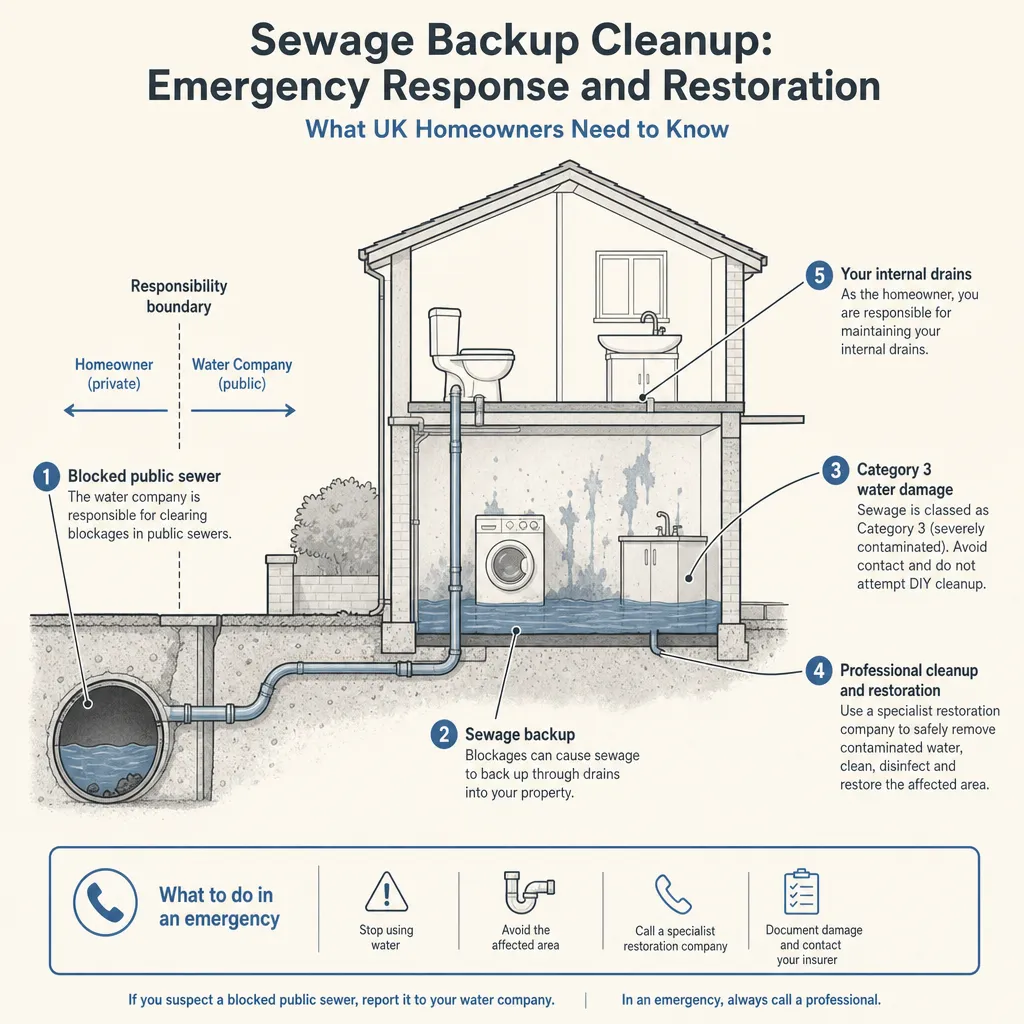
Sewage Backup Cleanup: Emergency Response and Restoration
A sewage backup should be treated as a Category 3 contamination event.
 Surveys & Inspections
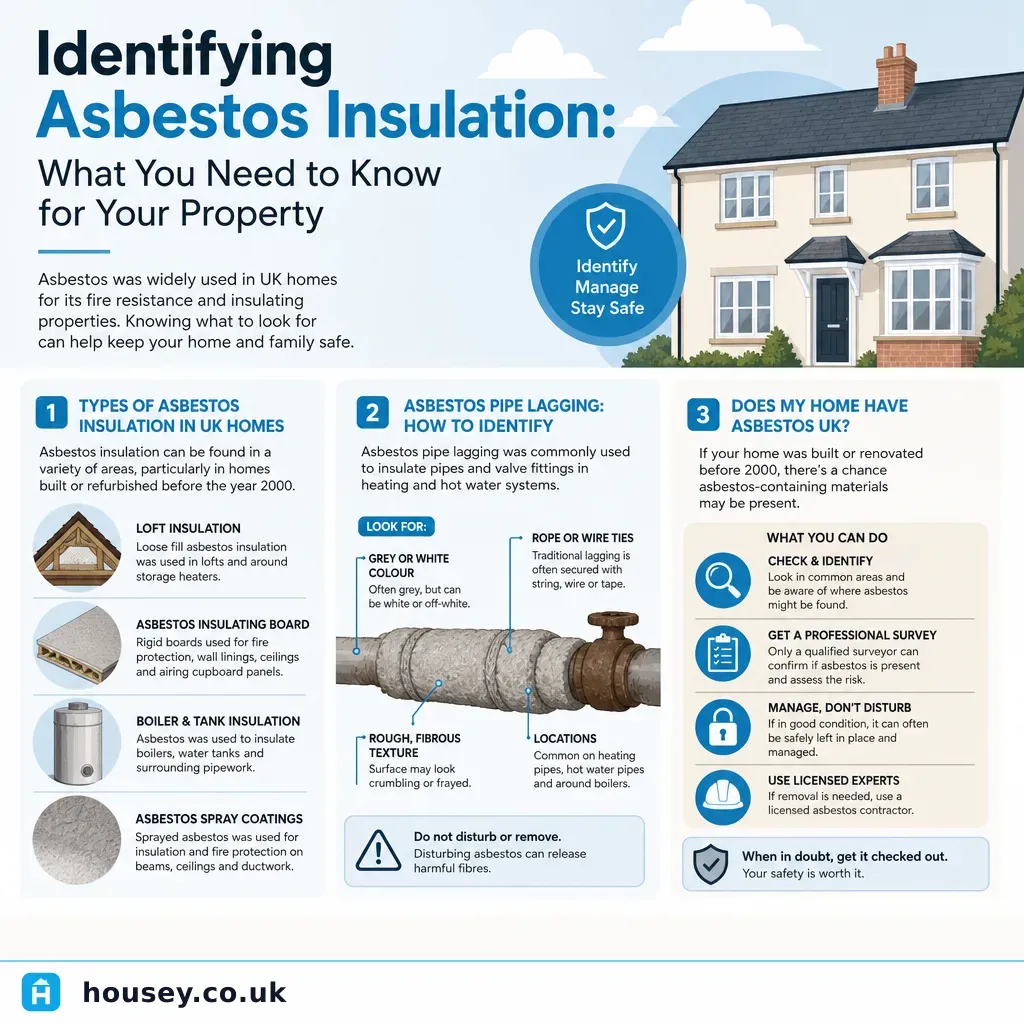
Identifying Asbestos Insulation: What You Need to Know for Your Property
Asbestos insulation was widely used in UK properties built before 2000, commonly found in pipe lagging, ceiling tiles, loose-fill loft insulation, and around boilers.