Dry-Stacked Concrete Masonry: Affordable and Practical Building
By Housey · Last reviewed 11th of May 2026
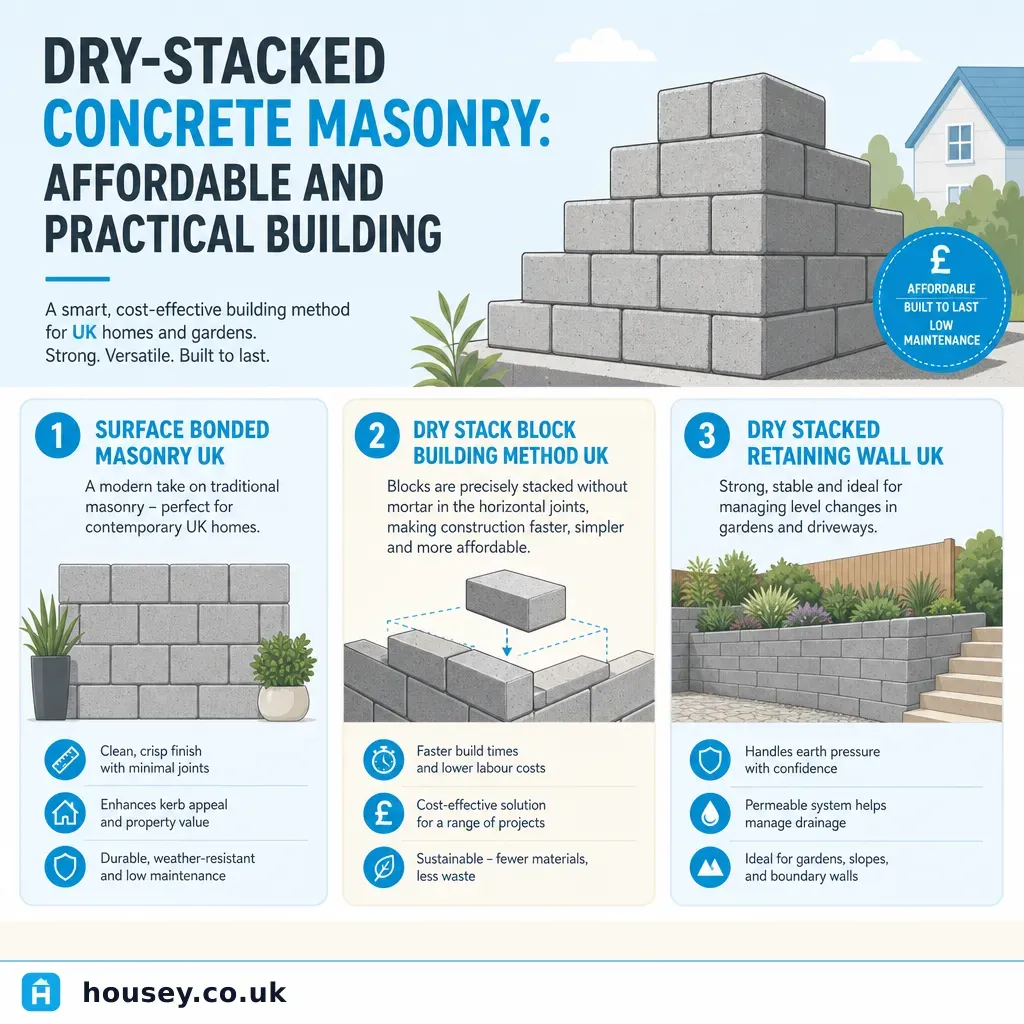
Dry-Stacked Concrete Masonry: Affordable and Practical Building
For homeowners and self-builders looking to reduce costs on garden rooms, outbuildings, boundary walls, and utility structures, dry-stacked concrete masonry offers a labour-efficient alternative to traditionally mortared blockwork. The technique — laying concrete masonry units without mortar joints, then applying a surface bonding compound to both wall faces — is established in agricultural and industrial construction across the UK and is attracting growing interest from budget-conscious homeowners undertaking garden buildings, retaining walls, and single-storey utility structures where cost and speed matter as much as finish.
Key points
- Dry-stacked concrete masonry uses a glass-fibre-reinforced surface bonding compound in place of mortar joints, reducing the skill level required and speeding up construction compared with traditional blockwork.
- The technique is most appropriate for single-storey outbuildings, garden rooms, retaining walls, boundary walls, and agricultural structures — it is not typically used for multi-storey habitable construction in the UK.
- Building Regulations approval is required for any habitable structure regardless of construction method; detached outbuildings under 15 m² without sleeping accommodation may be exempt, subject to specific conditions.
- Garden walls and boundary structures under 2 metres in height (or 1 metre adjacent to a highway) generally do not require planning permission under permitted development in England, though structural responsibility remains with the owner.
- Surface bonding systems must be specified for UK conditions, including freeze-thaw resistance — inferior or unspecified products are a common cause of cracking and delamination in exposed locations.
What is dry-stacked concrete masonry?
Conventional blockwork relies on mortar to bond each course of blocks and fill the joints. Dry-stacked masonry eliminates the mortar joint: concrete masonry units are stacked directly on each other using the block's manufactured dimensional tolerances to achieve alignment, and the complete wall surface is then coated with a glass-fibre-reinforced surface bonding cement or reinforced render applied to both faces.
The result is a wall that:
- Goes up faster than traditionally mortared blockwork because there is no mortar to mix, apply, and allow to cure between courses.
- Requires less specialist pointing skill, since alignment depends on block quality rather than the consistency of mortar beds.
- Has a smooth, rendered appearance on both faces once the surface bonding compound is applied.
- Can achieve comparable structural performance to mortared masonry for low-rise applications when correctly specified and built.
The surface bonding compound typically contains alkali-resistant glass fibres that distribute tensile stress across the wall face, compensating for the absence of mechanical mortar key between the block units.
Where dry-stacked masonry works in the UK
Dry-stacked blockwork is most suitable for certain application types. The table below gives a practical overview for UK homeowners and self-builders:
Application | Suitability | Key considerations |
|---|---|---|
Single-storey garden rooms and outbuildings | Good | Building Regs may apply depending on size and use; check exemption thresholds |
Retaining walls (up to approximately 1.5 m retained height) | Moderate | Engineering assessment recommended; drainage behind wall is essential |
Boundary and garden walls (non-loadbearing) | Good | Permitted development likely to apply; freeze-thaw durability must be specified |
Agricultural and utility buildings | Good | Lower regulatory threshold than domestic habitable space |
Ground-floor extensions (habitable use) | Limited | Must comply with Parts A and L; discuss with a structural engineer and Building Control |
Multi-storey domestic construction | Not recommended | Insufficient lateral load performance for standard UK domestic multi-storey use |
Cost benefits compared with traditional blockwork
The primary financial advantage of dry-stacked masonry is reduced labour time. Because there is no mortar to mix or apply between courses, laying rates are considerably faster than traditional blockwork, which requires a skilled blocklayer working to fine mortar-joint tolerances.
Indicative UK costs, last reviewed 2026-05-11 — obtain quotes for your specific project and location:
- Traditional mortared blockwork: approximately £35–£60 per m² for labour, depending on complexity, access, and region.
- Dry-stacked blockwork with surface bonding compound: approximately £20–£40 per m² for labour, with a modest additional cost for the surface bonding product itself.
The concrete blocks are typically the same material either way, so savings are predominantly in labour. For a garden room footprint of 20–30 m², this can represent a meaningful reduction in overall build cost.
However, dry-stacked masonry requires higher-tolerance, consistent blocks: irregular or damaged units cause alignment problems and stress concentrations in the surface bonding compound. A premium on block specification may offset some of the labour saving and should be factored into any like-for-like budget comparison.
What to ask before accepting a quote
- Has the contractor worked with dry-stacked surface-bonded masonry before, and can they provide completed examples or references?
- What surface bonding compound do you specify, and does it have documented freeze-thaw performance data suitable for UK conditions?
- What block specification — density, dimensional tolerances — will you use, and why is it appropriate for this application?
- Will the finished wall require additional weatherproofing, external render, insulation, or cladding?
- Does the scope include drainage provision behind any retaining section?
- Which building regulations applications or notifications are included within the quoted price?
- Is VAT included, and what factors could change the price or programme?
Red flags to watch for
Before or during a dry-stacked masonry project, be alert if:
- A contractor proposes dry-stacking for a multi-storey structure or a habitable space without engineering calculations — this falls outside standard UK practice and is unlikely to satisfy Building Regulations Part A.
- The surface bonding compound specified has no documented performance data or does not contain glass-fibre reinforcement — inferior products can crack or delaminate under UK freeze-thaw cycling.
- No drainage provision behind a retaining wall is discussed — hydrostatic pressure can cause failure regardless of the construction method if water is allowed to build up against the retained face.
- Building Regulations approval is not mentioned for a project that clearly meets the notification thresholds — any heated or habitable garden room is likely to require approval irrespective of how the walls are built.
- Block tolerances and specification are not discussed — dry-stacked masonry depends on consistent block dimensions, and using reclaimed, variable, or off-specification blocks significantly increases structural and durability risk.
Building regulations and planning: what applies?
Planning permission: Under permitted development in England, boundary walls and garden walls under 1 metre adjacent to a highway (or under 2 metres elsewhere) generally do not require planning permission. Single-storey outbuildings may also be permitted development, subject to conditions covering height, position, and the proportion of the original garden area covered. Conservation areas, listed buildings, and Article 4 Direction areas impose additional restrictions. Always check with your local planning authority before starting work.
Building Regulations: Detached single-storey outbuildings with a floor area not exceeding 15 m², no sleeping accommodation, and sited at least 1 metre from the boundary (or built substantially of non-combustible materials) are generally exempt from building regulations under Schedule 2 of the Building Regulations 2010. Any habitable garden room — even one used occasionally as a home office or spare bedroom — is likely to require Building Regulations approval, as is any structural retaining wall over certain dimensions. The construction method does not alter the threshold for approval.
When to get professional help
Consult a structural engineer or building control consultant before proceeding if:
- The structure will be used as a habitable room, even occasionally.
- Any wall will act as a retaining structure with a retained height of approximately 600 mm or more.
- The site is on a slope, in an area with known ground movement, or has poor natural drainage.
- You are unsure whether building regulations approval or planning permission applies to your project.
- The building will be accessed by anyone other than the occupying household.
How Housey can help
Whether you are planning a garden building, a boundary wall, or a modest single-storey extension, Housey can connect you with extension builders experienced in cost-effective construction, design-and-build firms who can advise on the most practical approach for your site and budget, and groundworkers for foundation and drainage preparation before the first block goes down.
Frequently asked questions
Is dry-stacked concrete masonry structurally sound for UK buildings?
For low-rise single-storey applications within appropriate load limits, dry-stacked surface-bonded masonry can be structurally sound. The glass-fibre-reinforced surface bonding compound redistributes tensile stress across the wall face and compensates for the absence of mortar key between units. It is not suited to multi-storey domestic construction and requires correct block specification and professional design for any structural or retaining application.
Does dry-stacked blockwork need planning permission in the UK?
The construction method does not determine whether planning permission is needed — the height, location, and use of the structure do. Most garden walls under 2 metres do not require permission under permitted development. Garden buildings used as habitable rooms may require planning permission depending on size and position. Always check with your local planning authority, particularly in conservation areas or where Article 4 Directions apply.
Can dry-stacked concrete masonry walls be insulated?
Yes. The most common approach is a cavity configuration with insulation batts between inner and outer leaves, or rigid insulation board fixed to the internal face finished with plasterboard on battens. If the space is heated or used as a habitable room, U-value requirements under Approved Document L apply and the insulation specification must be designed to achieve compliance before Building Control will sign off.
How does dry-stacked masonry perform in UK weather conditions?
UK freeze-thaw cycling can stress unpointed masonry if the surface bonding compound is not correctly specified. A glass-fibre-reinforced compound with documented freeze-thaw performance data is essential. In exposed or coastal locations, an additional external render coat or cladding system may be advisable to provide a supplementary weathering layer and extend the wall's maintenance-free service life.
Sources and further reading
Useful next reads
 Improvement & Build
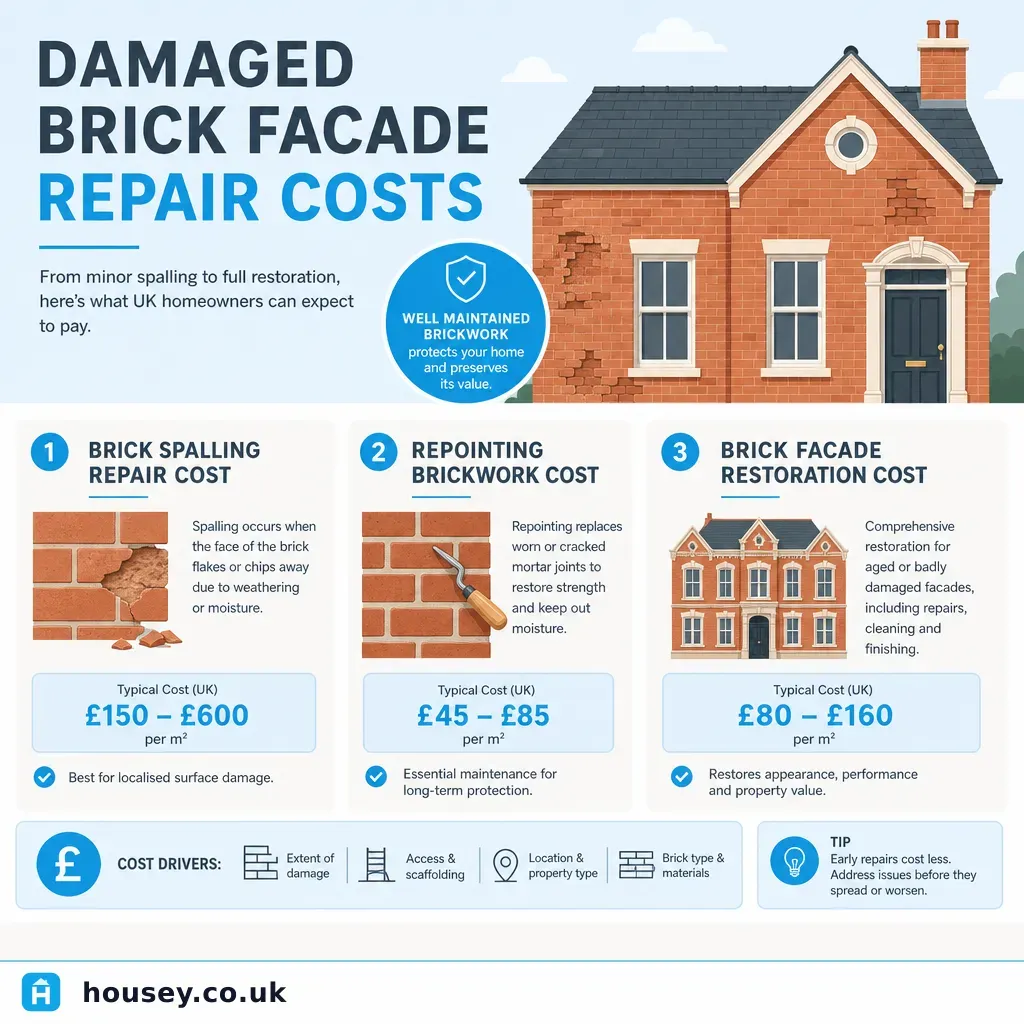
Damaged Brick Facade Repair Costs
Repairing a damaged brick facade in the UK typically involves repointing mortar joints, replacing spalled bricks, or full masonry restoration.
 Improvement & Build
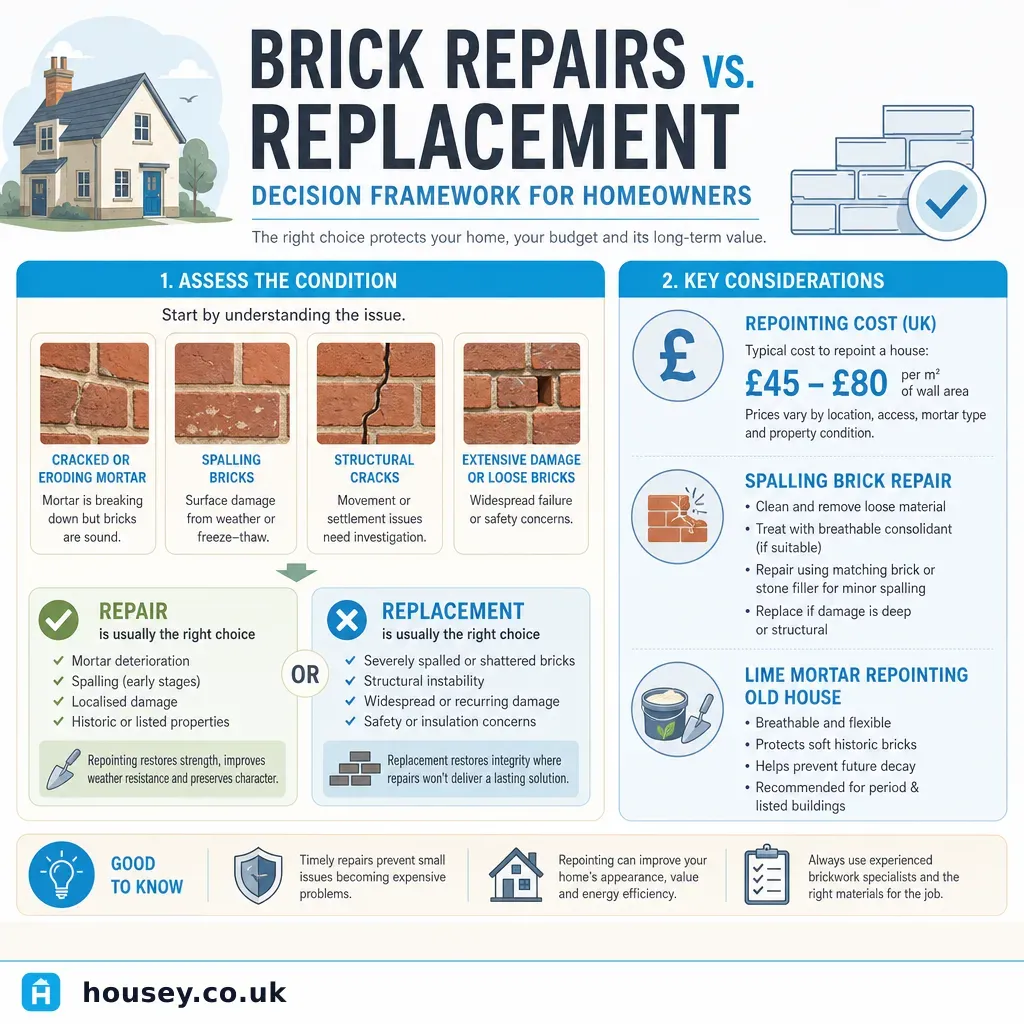
Brick Repairs vs. Replacement: Decision Framework for Homeowners
Whether to repair or replace brickwork depends on the type and extent of damage.
 Improvement & Build
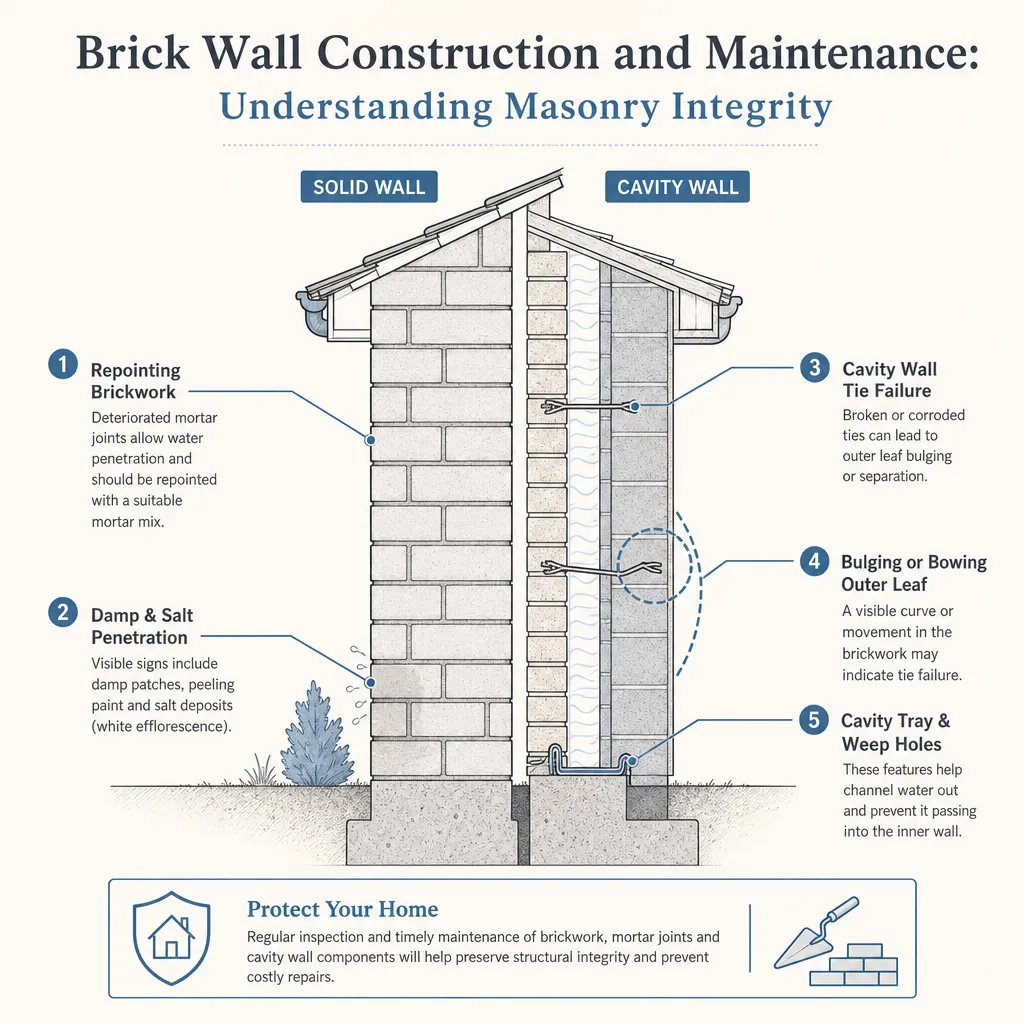
Brick Wall Construction and Maintenance: Understanding Masonry Integrity
Brick walls in UK homes use either solid masonry construction (pre-1920) or cavity construction (post-1920s), with two leaves of brickwork separated by a gap or insulation.
 Improvement & Build
Stacked stone fireplace transformation: renovation and design ideas
A stacked stone fireplace transforms a chimney breast into a striking focal point.
 Improvement & Build
Wall Rendering: Applying Protective and Decorative Finishes to External Surfaces
External wall rendering protects masonry from weather and can improve energy efficiency when combined with an EWI system.