Wall Rendering: Applying Protective and Decorative Finishes to External Surfaces
By Housey · Last reviewed 18th of May 2026
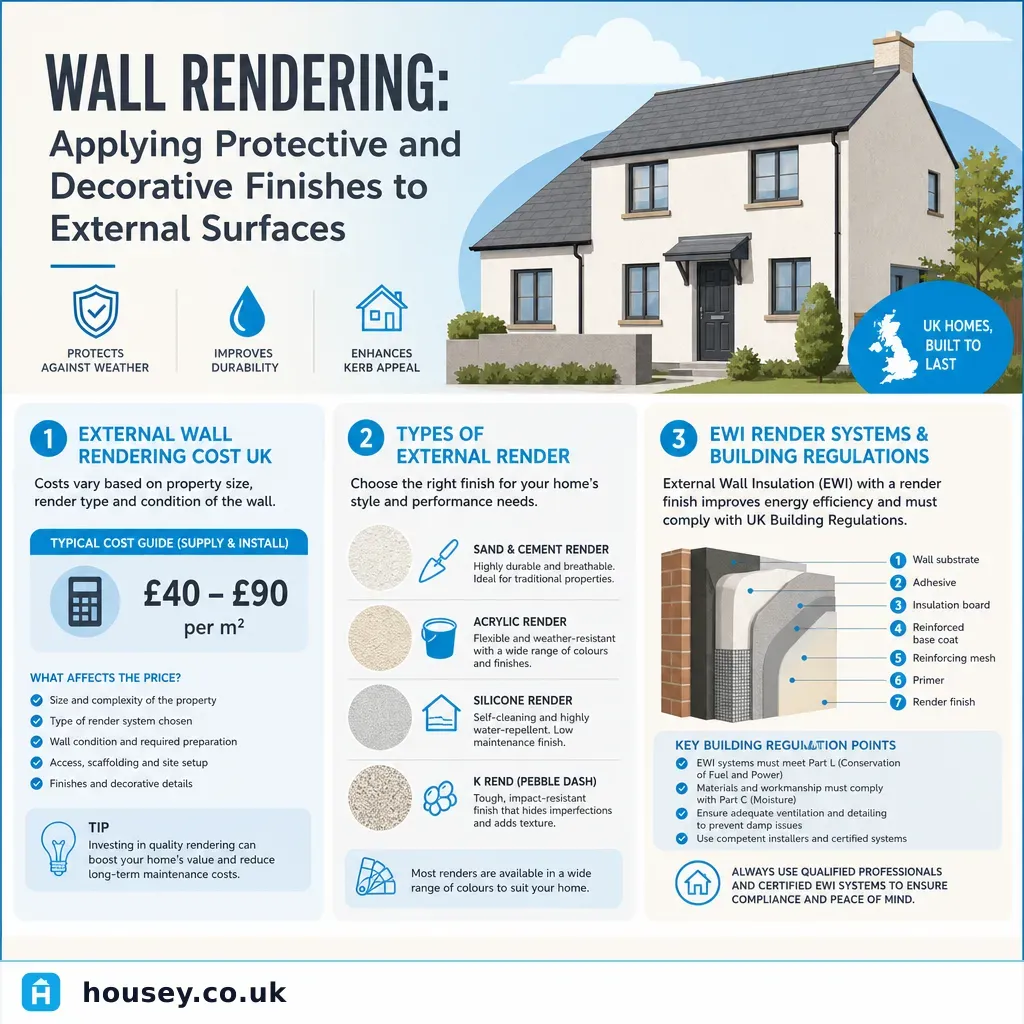
Wall Rendering: Applying Protective and Decorative Finishes to External Surfaces
External wall rendering protects UK homes from wind-driven rain, frost, and the long-term weathering that affects exposed brickwork and blockwork. It arises as a practical question when a homeowner is renovating a solid-wall property, upgrading an extension facade, addressing failing render, or considering external wall insulation to reduce heat loss under current energy-efficiency standards. The choice of render type, the regulatory implications, and the need to match specification to the age and construction of the wall all significantly affect cost, durability, and — in some cases — planning compliance.
Key points
- External wall insulation (EWI) render systems require Building Control approval under Building Regulations Part L (conservation of fuel and power) before work commences; this is a statutory requirement, not a recommendation.
- PAS 2035:2023 (Retrofitting Dwellings for Energy Efficiency) mandates that a Retrofit Coordinator oversee all wall insulation measures — including EWI — funded through ECO4 or the Great British Insulation Scheme.
- Cement render on pre-1919 solid-wall properties carries a real risk of trapping moisture inside the wall because it has significantly lower water vapour permeability than lime; this can accelerate decay of historic fabric and worsen existing damp problems.
- Properties in conservation areas require planning permission before rendering any elevation visible from a public highway; listed buildings require listed building consent for any change to external fabric, including like-for-like re-rendering.
- Silicone render typically costs £40–£70 per m² installed, while an EWI system with 100 mm EPS boards and render typically costs £80–£120 per m² (indicative UK costs, last reviewed 2026-05-18; costs vary by region, access, and specification).
Types of external render compared
Choosing the correct render type for the wall substrate and property age is the single most important technical decision in an external rendering project.
Render type | Best for | Not ideal for | Typical installed lifespan | Main risk if wrong choice |
|---|---|---|---|---|
Cement render (sand and cement) | Modern brick, dense block, concrete | Soft or historic brick, lime-built walls | 20–30 years (if maintained) | Traps moisture; spalling and craze-cracking |
Lime render (NHL 3.5 or NHL 5) | Pre-1919 solid walls, soft brick, stone | High-exposure or high-traffic surfaces | 20–40+ years | Requires specialist application; over-cementing causes early failure |
Polymer/through-colour render | Modern homes, extensions | Listed or heritage properties | 15–25 years | Visual appearance concerns; limited like-for-like repair |
Silicone render | All modern masonry, EWI topcoats | Check compatibility with lime-built walls | 20–30 years | Must be correctly applied to achieve warranted lifespan |
EWI render system | Solid-wall homes needing insulation | Cavity-wall homes (insulate the cavity instead) | 25–30+ years | DPC bridging; poor junctions cause thermal bypass and damp |
When is planning permission required?
Rendering a house changes its external appearance, so planning rules apply in certain situations.
- Conservation areas: Rendering any elevation facing a public highway is generally a change of appearance requiring planning permission. Some local planning authorities extend controls to all elevations — always check with your LPA before starting.
- Listed buildings: Any alteration to external fabric — including re-rendering using identical materials — requires listed building consent. Consult your local planning authority before instructing any contractor.
- Standard residential properties: Rendering is generally Permitted Development for most houses not subject to Article 4 directions, provided the materials are of similar appearance to the existing finish. See the Planning Portal guidance on permitted development rights and confirm with your LPA if in doubt.
EWI systems and Building Regulations
External wall insulation combines rigid insulation boards with a reinforced render finish and is a substantial intervention governed by Building Regulations.
Part L — conservation of fuel and power: EWI typically improves solid-wall U-values from around 2.1 W/m²K to approximately 0.28–0.30 W/m²K with 100 mm EPS insulation. Building Control notification is required before work starts on any thermally significant intervention.
Part C — moisture resistance: The system must not bridge the existing damp-proof course. Window and door reveals, parapet details, and base-of-wall junctions must be correctly designed and installed to prevent interstitial condensation and water tracking into the structure.
PAS 2035 and publicly funded schemes: Work funded through ECO4 or the Great British Insulation Scheme must comply with PAS 2035:2023 — Retrofitting Dwellings for Energy Efficiency. This requires a Retrofit Assessor to survey the property, a Retrofit Coordinator to oversee the project, and a TrustMark- or MCS-certified installer to carry out the work. See Energy Saving Trust guidance on external wall insulation for current scheme eligibility and grant levels.
What to ask before accepting a quote
Before signing a contract with an external rendering contractor, ask:
- What render specification and product system is proposed, and what manufacturer warranty does the system carry?
- Is scaffold included in the price, and who is responsible for erecting, maintaining, and striking it?
- What preparation work is included — re-pointing, biocide treatment, bonding coat, and repair of defective masonry areas?
- Will the contractor submit the Building Control notification and provide the completion certificate?
- For EWI projects: is the installer TrustMark or MCS registered, and will a Retrofit Coordinator oversee the project under PAS 2035?
- Is VAT included in the quoted price? (EWI in qualifying circumstances may carry 0% VAT; cosmetic rendering is typically rated at 20%.)
- What is the payment schedule, and does it tie to defined and verifiable project stages?
- What happens if defects, missing documentation, or unforeseen access issues arise during the project?
Cost guidance
Indicative UK costs, last reviewed 2026-05-18. Regional variation, scaffold requirements, wall condition, and render specification significantly affect final costs. Obtain at least three quotes from vetted contractors.
Scope | Typical installed cost (per m²) |
|---|---|
Sand-and-cement scratch and float, two coats | £15–£35 |
Polymer/through-colour render | £25–£45 |
Silicone topcoat render | £40–£70 |
EWI system (100 mm EPS board + base coat + silicone topcoat) | £80–£120 |
Scaffold, window boarding, and significant repair work are generally priced separately. Sources: Energy Saving Trust published cost ranges; Housey provider network indicative pricing (2026).
When to get professional help
External rendering at height should almost always be carried out by a qualified renderer or approved contractor. Always instruct a professional if:
- The wall is above ground-floor level, requiring scaffold or elevated access
- An EWI system is proposed
- The property is listed or in a conservation area and consent is required
- Existing render shows structural cracking, bowing, or widespread failure before the underlying cause has been identified
- The project is publicly funded and must comply with PAS 2035
Housey connects homeowners with vetted extension builders and groundworkers who can specify, apply, and certify external rendering work to a professional standard.
Frequently asked questions
Do I need planning permission to render my house?
Most standard houses can be rendered under Permitted Development rights, provided the property is not listed, not in a conservation area, and not subject to an Article 4 direction. If your property has any of these designations, or if you are unsure, contact your local planning authority before instructing a contractor. Applying render without required consent can lead to enforcement notices and costly removal.
What is the difference between cement render and silicone render?
Cement render is a traditional mix of sharp sand and Portland cement: durable and cost-effective but with limited flexibility and modest water repellency, requiring regular painting for weather protection. Silicone render incorporates silicone polymers, giving high hydrophobicity, better crack resistance, and a longer maintenance-free life. Silicone costs more upfront but typically requires significantly less maintenance over its lifespan.
How long does external render last?
Well-specified cement render on a properly prepared surface typically lasts 20–30 years before needing major remedial work. Through-colour polymer and silicone renders have similar or longer maintenance-free lifespans. EWI system warranties vary by manufacturer, but many certified systems carry a 25-year product warranty when installed by an approved applicator — always confirm warranty terms in writing before signing a contract.
Can rendering improve my home's energy efficiency?
Standard render adds negligible thermal resistance. An EWI system, however, can substantially reduce heat loss in a solid-wall home — a 100 mm EPS installation can improve a typical solid-wall U-value from approximately 2.1 W/m²K to around 0.28–0.30 W/m²K. Financial support may be available through ECO4 or the Great British Insulation Scheme; see the Energy Saving Trust website for current eligibility criteria.
Sources and further reading
- Building Regulations Approved Document L: Conservation of Fuel and Power — GOV.UK
- PAS 2035:2023 Retrofitting Dwellings for Energy Efficiency — BSI Group
- External wall insulation — guidance and grant eligibility — Energy Saving Trust
- Technical guidance on mortars, renders and plasters — Historic England
- Permitted development rights for homeowners — Planning Portal
Useful next reads
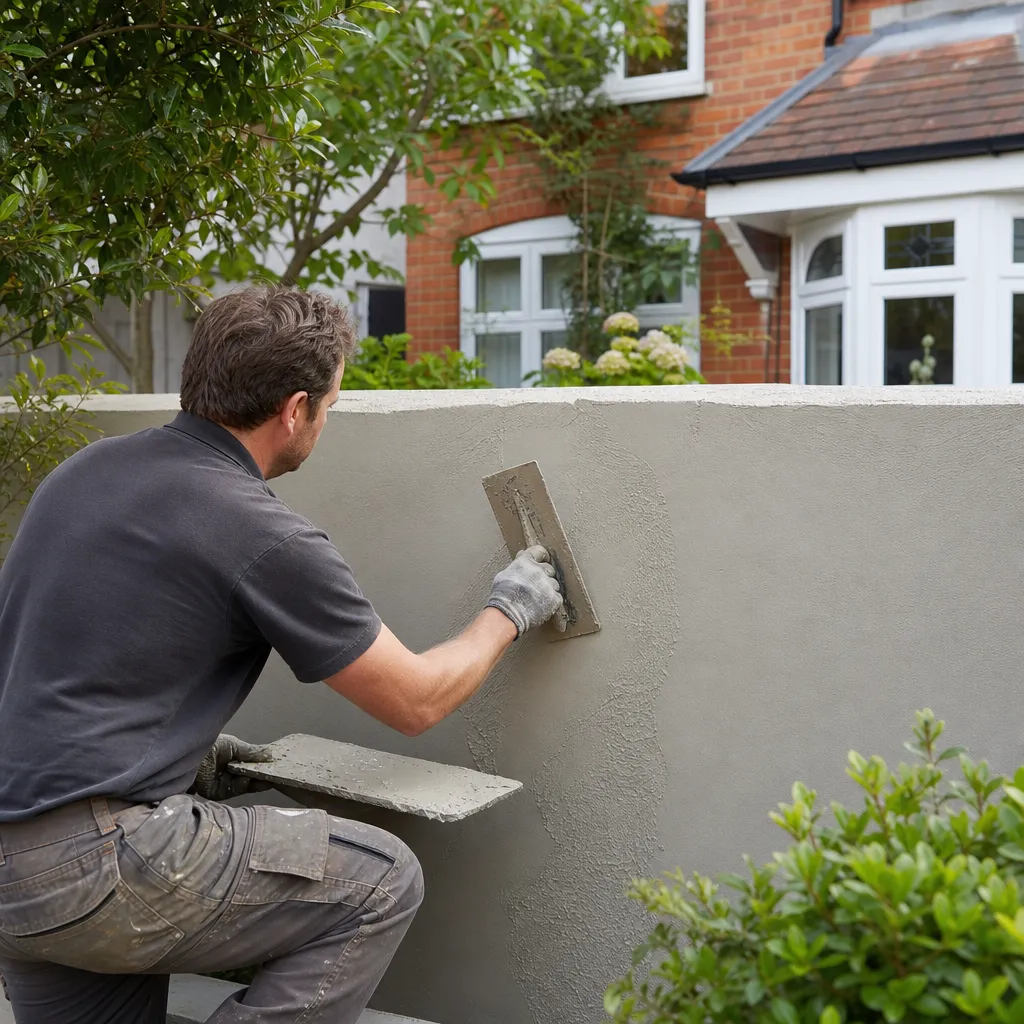 Improvement & Build
Rendering a Garden Wall: Techniques for Professional-Quality Finishes
Render a garden wall using a two-coat system: a 10–12 mm scratch coat of 4:1 sand and cement, keyed with a comb scratcher, followed by a 6–8 mm topcoat.
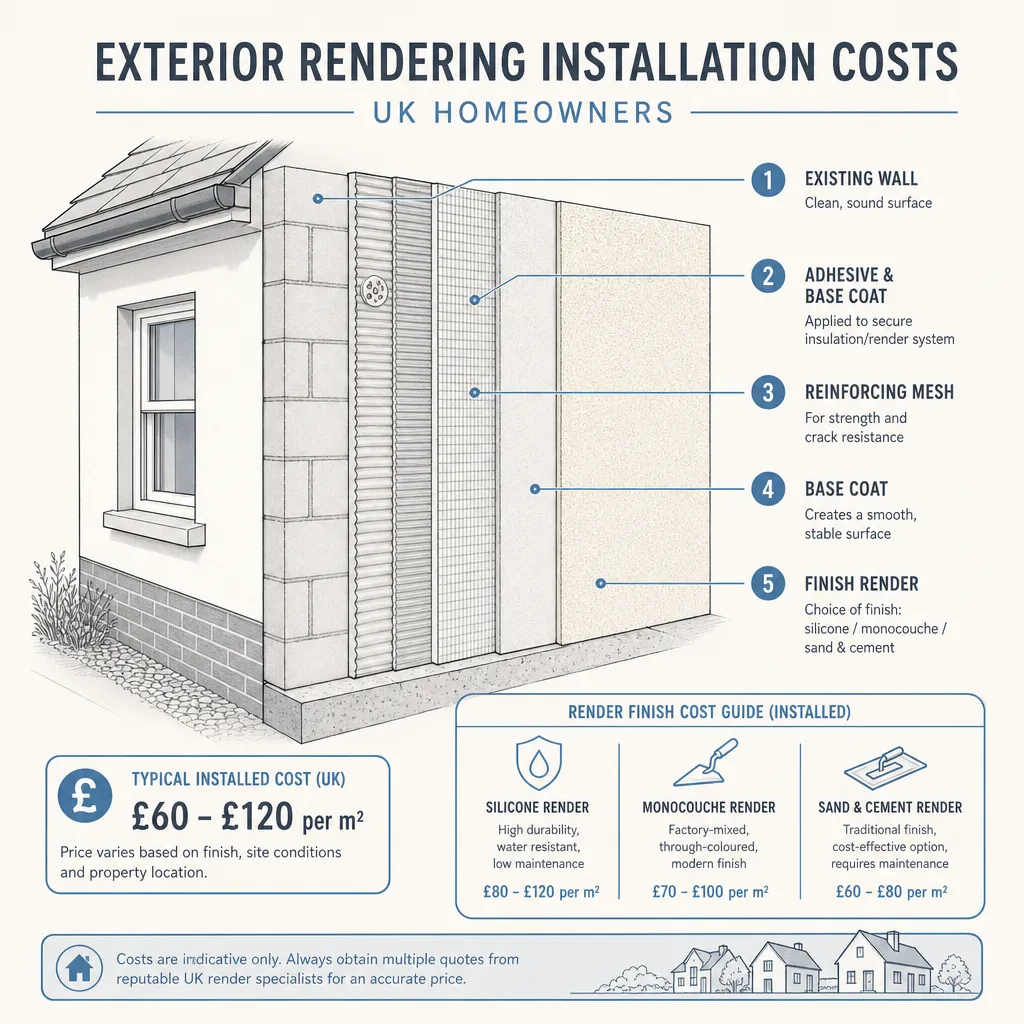 Improvement & Build
Exterior Rendering Installation Costs
Exterior rendering in the UK typically costs £20–£60 per square metre for standard render systems, or £80–£150 per square metre for External Wall Insulation with a render finish.
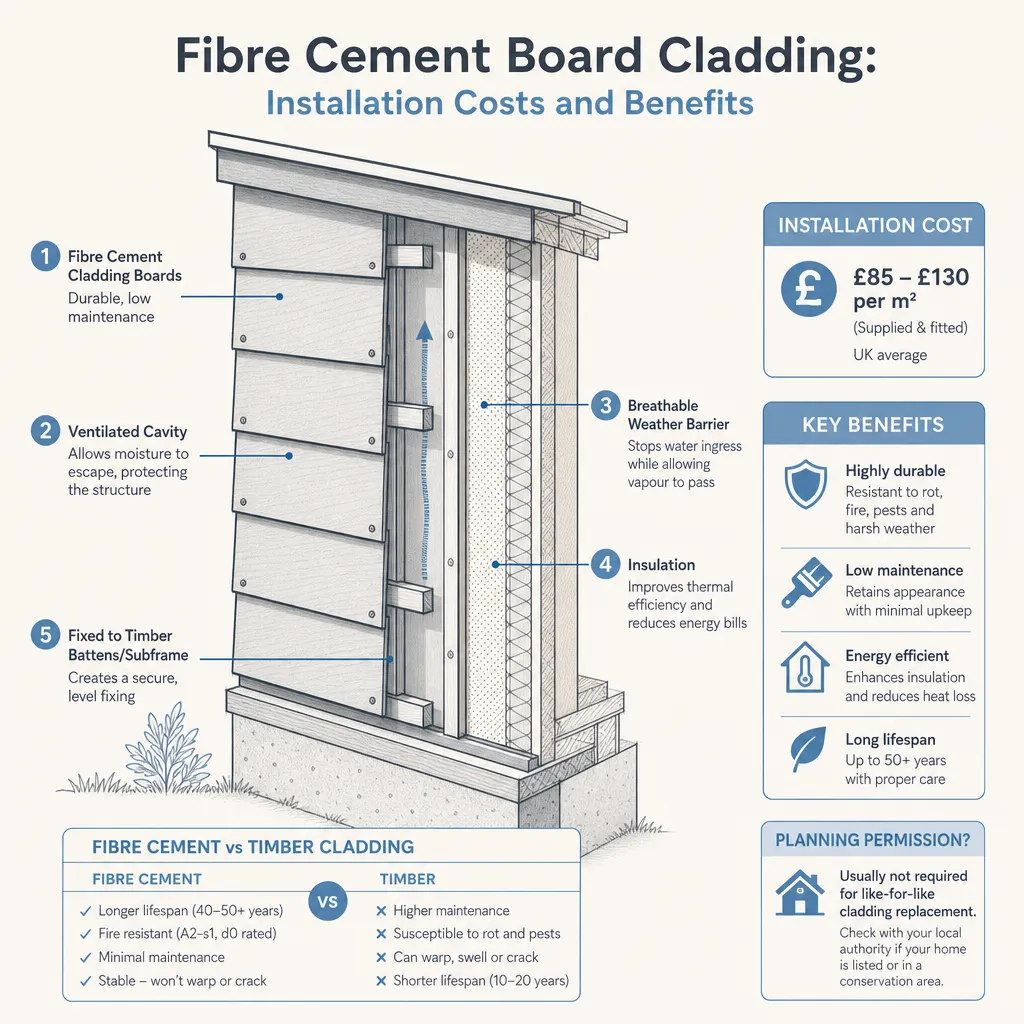 Improvement & Build
Fibre Cement Board Cladding: Installation Costs and Benefits
Fibre cement board cladding typically costs £80–£180 per m² installed in the UK, including boards, battens, breather membrane, and labour.
 Improvement & Build
Laundry Room Renovation and Fitting Costs
A basic UK laundry room fit-out typically costs £2,000–£6,000 where plumbing and electrics are already in place, rising to £8,000–£15,000 or more when structural work, new drainage connections, or new electrical circuits are needed.
 Improvement & Build
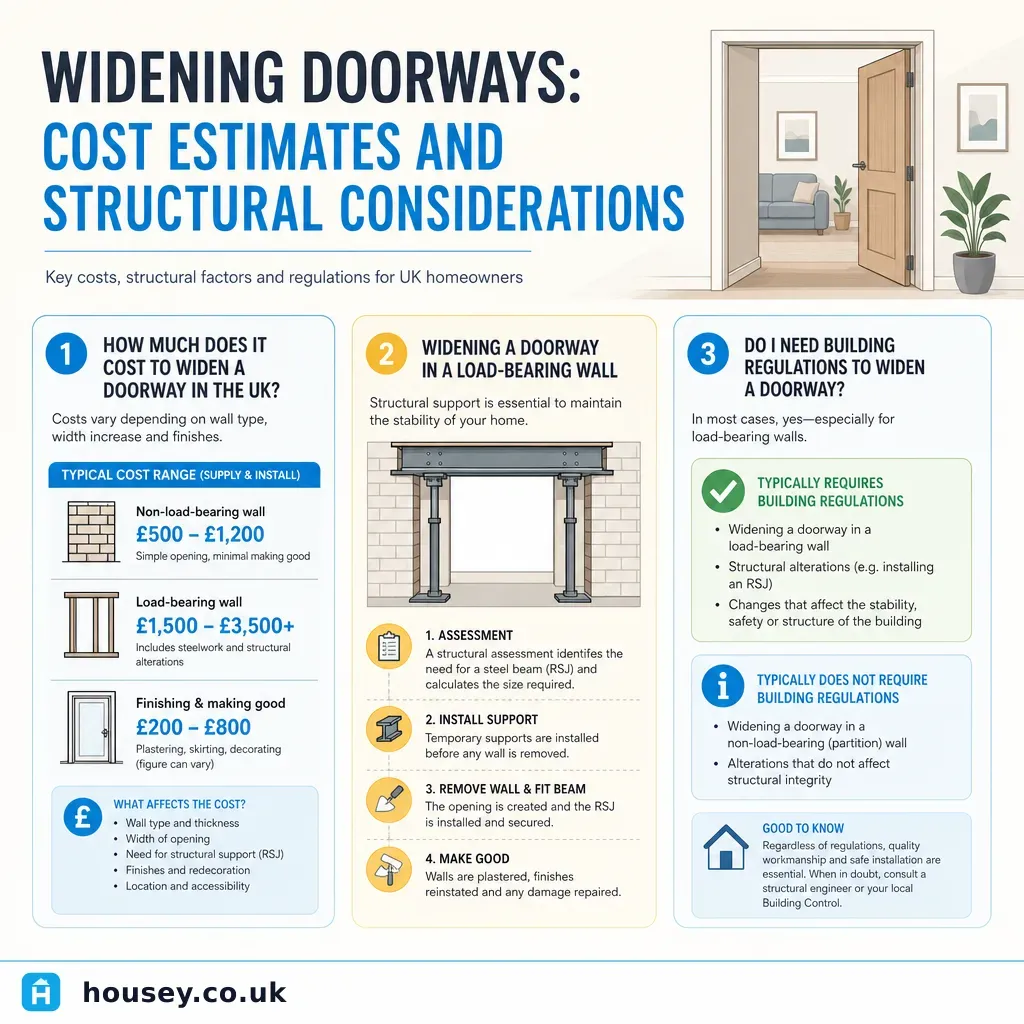
Widening Doorways: Cost Estimates and Structural Considerations
A doorway in a non-load-bearing partition can usually be widened for £500–£1,500.