Dry Stone Wall Construction and Installation Costs
By Housey · Last reviewed 6th of May 2026
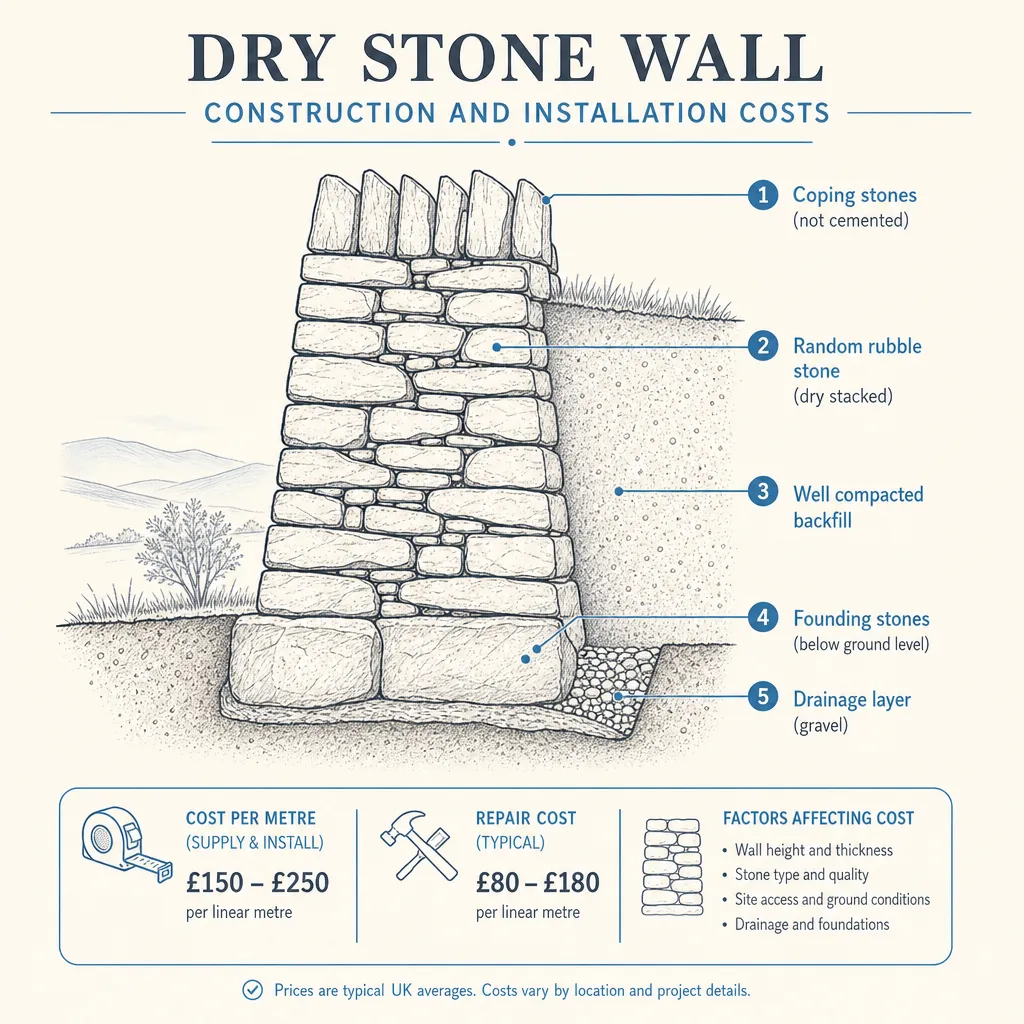
Dry Stone Wall Construction and Installation Costs
Dry stone walls are a defining feature of the UK landscape — from the moorlands of the Yorkshire Dales and Peak District to suburban garden boundaries and rural field divisions across England, Scotland, and Wales. Whether you are installing a new wall as a garden feature, restoring a collapsed boundary, or building a retaining wall on a sloping plot, the cost depends on several interrelated factors that are worth understanding before requesting quotes.
Key points
- New dry stone wall construction in the UK typically costs £150–£350 or more per linear metre, depending on stone type, wall height, site accessibility, and regional labour rates.
- Skilled dry stone wallers may hold certification from the Dry Stone Walling Association of Great Britain (DSWA), which accredits competence from Foundation to Master Craftsman level.
- Dry stone walling is generally exempt from planning permission as a boundary treatment in most settings, but restrictions apply in conservation areas, national parks, Areas of Outstanding Natural Beauty (AONBs), and for walls adjacent to highways.
- Locally sourced or reclaimed stone is often more cost-effective and visually appropriate than imported material; availability varies significantly by region.
- A well-constructed dry stone wall on a properly prepared base can last 100 years or more without mortar — poor construction leads to early collapse and costly rebuilding.
What affects the cost of a dry stone wall?
Dry stone walling is skilled, labour-intensive craft work. Each stone must be individually selected and hand-placed to create a stable interlocking structure without mortar or adhesive. Labour typically accounts for 50–70% of the total project cost.
Key cost drivers include:
- Wall height and width — taller, wider walls require more stone and more time. A typical double-walled boundary with throughstones and coping is usually 1.0–1.5 m tall.
- Stone type and source — limestone, sandstone, slate, and granite behave differently and carry different costs. Locally quarried or recovered stone reduces transport costs significantly.
- Site accessibility — remote or steeply sloping sites increase both stone delivery costs and working time.
- Ground preparation — unstable, waterlogged, or clay-heavy ground may need additional groundwork before construction begins.
- Wall length — shorter runs cost proportionally more per metre due to fixed mobilisation and setup costs.
- Type of work — repairing a partially collapsed wall using on-site stone is usually cheaper per metre than building from scratch.
- Regional labour rates — rates in London and the South East are typically higher than in northern England, Scotland, and Wales, where the craft is more widely practised.
New build, repair, and restoration: a comparison
Type of work | Indicative cost range | Best for | Key considerations |
|---|---|---|---|
New dry stone wall (garden or boundary) | £150–£350+ per linear metre | New boundaries, garden features, terracing | Stone sourcing, foundations, planning check if in conservation area |
Repair to collapsed section | £80–£200 per linear metre | Maintaining existing walls where stone is on site | Availability of matching stone; extent of collapse |
Full rebuild of existing wall | £130–£300 per linear metre | Walls beyond repair but stone recoverable | Structural check for retaining walls; groundwork may be needed |
Dry stone retaining wall | £200–£450+ per linear metre | Sloping gardens, terracing, embankment stabilisation | Drainage essential; taller walls may need structural input |
Indicative UK costs, last reviewed 2026-05-06. Costs vary significantly by region, stone type, site conditions, and contractor. Always obtain itemised written quotes.
Finding a qualified dry stone waller
Quality varies considerably in this trade. When selecting a contractor, consider:
- DSWA certification — the Dry Stone Walling Association of Great Britain offers formal certification from Foundation to Master Craftsman level. A certified waller has demonstrated competence to a nationally recognised standard.
- Portfolio and references — ask to see comparable completed work and speak to previous clients where possible.
- Local knowledge — wallers familiar with your region's stone types often produce more appropriate and cost-effective results.
- Trade body membership — landscapers and groundworkers may also hold membership of the Association of Professional Landscapers (APL) or the British Association of Landscape Industries (BALI).
Homeowner checklist: before you request quotes
Work through the following before approaching contractors:
Planning permission and permitted development
For most rural and garden boundary walls, dry stone wall construction falls within permitted development rights and does not require a formal planning application. However, restrictions apply in certain circumstances:
- Conservation areas — construction or alteration of walls may require prior notification or full consent from the local planning authority.
- Listed buildings — any work within the curtilage of a listed building may require listed building consent, including external boundary features.
- National parks and AONBs — local planning authorities in these designations often apply more restrictive permitted development rules.
- Wall height near a highway — walls over 1 metre adjacent to a highway, or over 2 metres elsewhere, may require planning permission under the Town and Country Planning Act 1990.
If in doubt, contact your local planning authority before starting work. Enforcement action for unauthorised construction can require costly removal or reinstatement.
What to ask before accepting a quote
- What stone will be used, where will it be sourced, and is stone included in the quoted price?
- What ground preparation or foundation work is included?
- Who will carry out the work — the contractor directly or a subcontractor — and what are their qualifications or accreditations?
- What is the payment schedule, and what deposit is required upfront?
- What happens if additional groundwork is needed once work begins, and how are variations priced?
- Is VAT included in the quoted price?
- Do you offer any workmanship warranty on the completed wall?
When to get professional help
For a straightforward garden boundary wall in reasonable ground conditions, a skilled dry stone waller or landscaper can typically manage the project independently. Consider involving additional professionals when:
- The wall will retain significant soil or sits on a noticeably sloping site — a structural engineer or groundworker should advise on drainage provision and structural specification.
- The project sits on or near a shared boundary — agree the works with your neighbour in writing before starting to avoid disputes.
- Planning or listed building questions arise — your local planning authority or a planning consultant can clarify what consent is required before work begins.
How Housey can help
Housey can help you request quotes from landscapers and groundworkers for dry stone wall construction, repair, or restoration. Compare credentials, methods, and pricing from local contractors before you commit to any work.
Frequently asked questions
How long does it take to build a dry stone wall?
An experienced waller can typically build three to six linear metres of standard boundary wall per day, depending on wall height, stone type, and site conditions. A 20-metre garden boundary wall might take three to five working days. Complex retaining walls or awkward sites will take longer; always confirm timescales in writing with your contractor.
Do I need planning permission for a dry stone wall?
In most cases, no — boundary walls and garden features generally fall within permitted development rights. However, properties in conservation areas, AONBs, or national parks, and walls exceeding certain heights near a highway, may require planning permission. Always check with your local planning authority if you are uncertain before starting work.
What is the difference between a dry stone wall and a mortared stone wall?
A dry stone wall is constructed without mortar — stones are individually placed to interlock and support each other by gravity and friction alone. A mortared stone wall uses cement to bond the stones. Dry stone walls are more traditional and flexible, particularly suited to rural and heritage settings, but require skilled construction to remain stable over time.
Can dry stone walls be repaired, or do they need to be rebuilt?
Partially collapsed sections can often be repaired if the original stone remains on site. A skilled waller will assess whether individual stones can be relaid or whether a full section rebuild is more practical. Where original stone has been removed or lost, sourcing matching replacement material adds to both cost and timescale.
How do I maintain a dry stone wall?
Dry stone walls require minimal maintenance if well built. Inspect periodically after severe weather, remove plants or tree saplings taking root in the wall, and repair any collapsed sections promptly. Avoid pressure washing, which can dislodge stones. Ivy and climbing plants can widen joints over time and should be managed carefully.
Sources and further reading
- Dry Stone Walling Association of Great Britain — DSWA
- Planning permission: fences, gates and garden walls — GOV.UK
- When is permission required? — GOV.UK Planning Practice Guidance
- Historic England — Dry Stone Walls — Historic England
Useful next reads
 Improvement & Build
Installing a Fire Pit: Garden Features and Outdoor Space Design
Installing a garden fire pit in the UK is generally permitted, but Smoke Control Area rules prohibit open wood-burning in most towns and cities.
 Improvement & Build
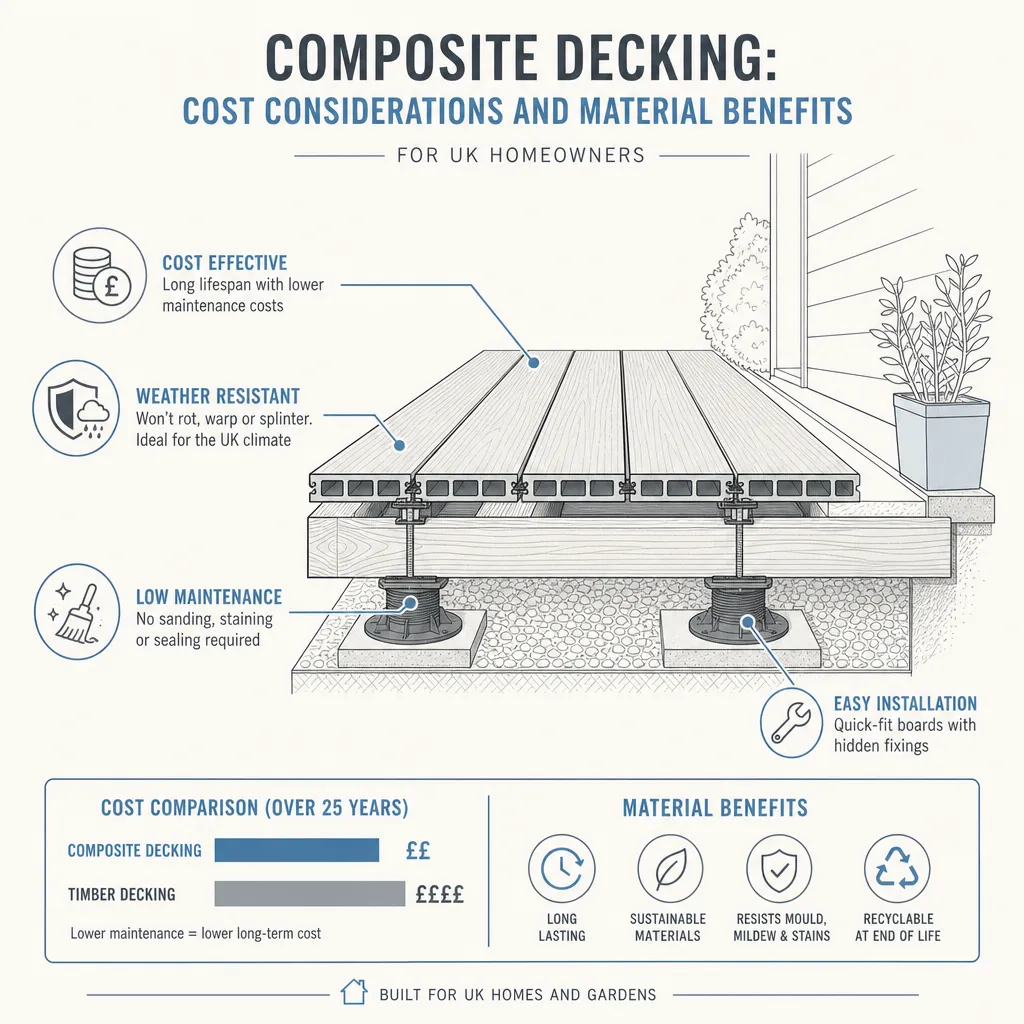
Composite Decking: Cost Considerations and Material Benefits
Composite decking typically costs £80–£150 per square metre for materials in the UK, with installation adding £30–£60 per square metre.
 Improvement & Build
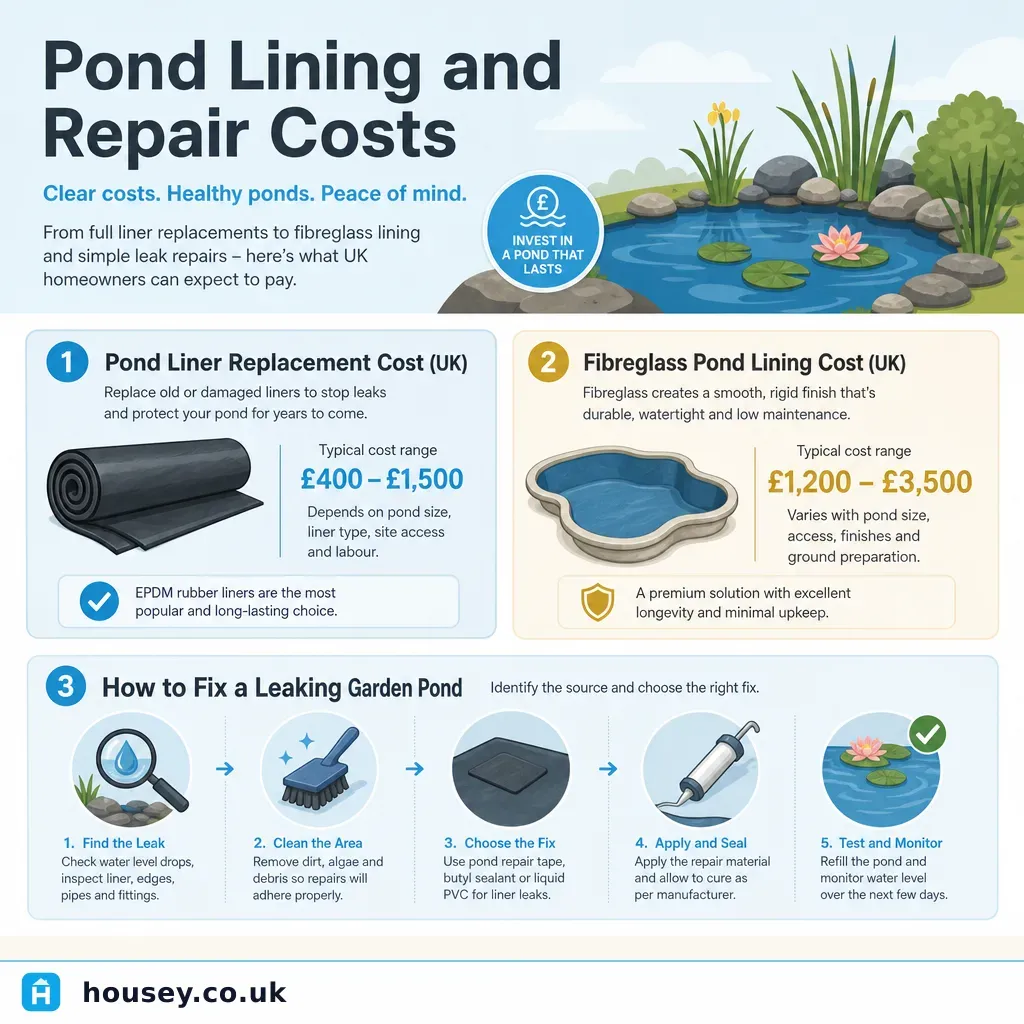
Pond Lining and Repair Costs
Pond lining costs in the UK depend on pond size, liner material, and the condition of the existing shell.
 Improvement & Build
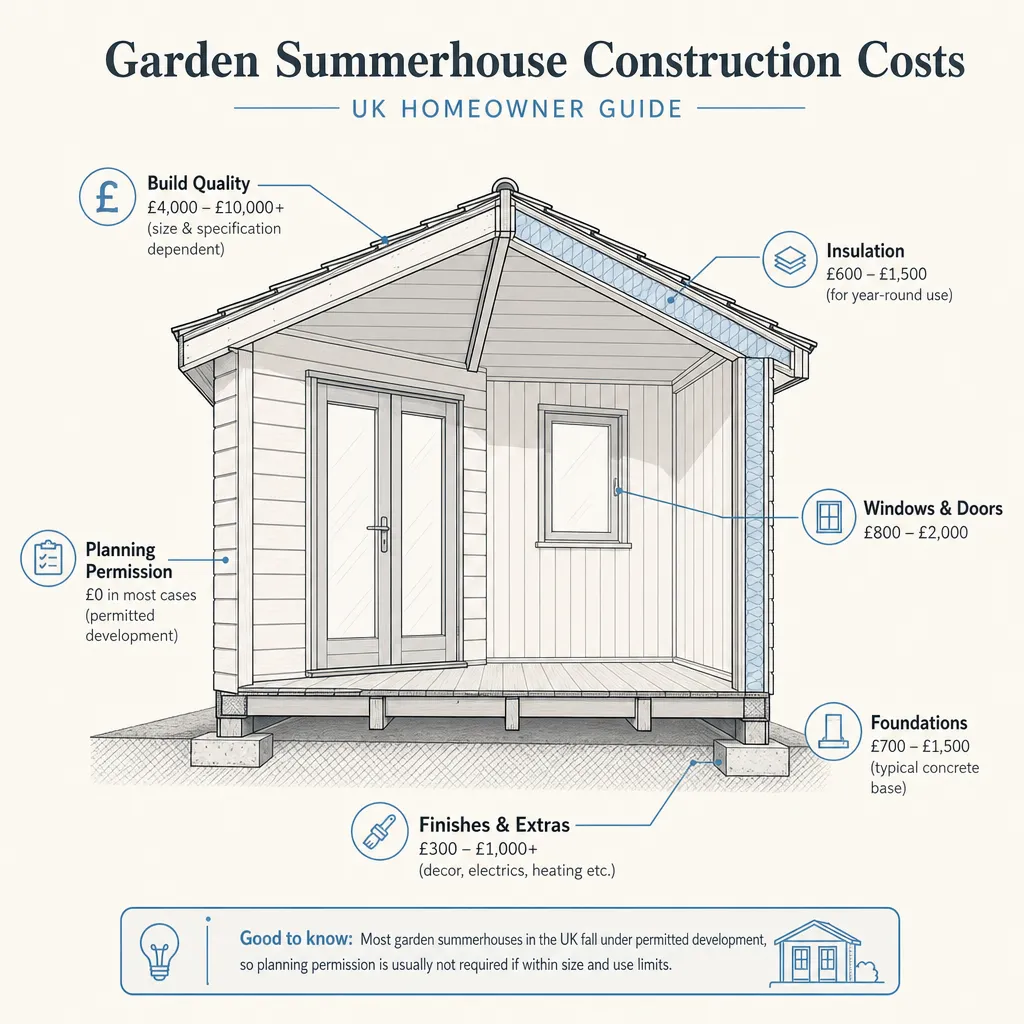
Garden Summerhouse Construction Costs
A garden summerhouse in the UK typically costs £2,000–£5,000 installed for a small standard timber unit, rising to £15,000–£25,000 for a large bespoke insulated garden room.
 Improvement & Build
Building an Outdoor Shower: Design and Installation Guide
Building an outdoor shower in the UK typically requires checking Permitted Development limits for outbuildings, complying with Building Regulations Part H for any drainage connection, and using a Gas Safe engineer or Part P electrician for any hot water supply.