Installation Costs for Drywall Partitions and Cladding
By Housey · Last reviewed 6th of May 2026
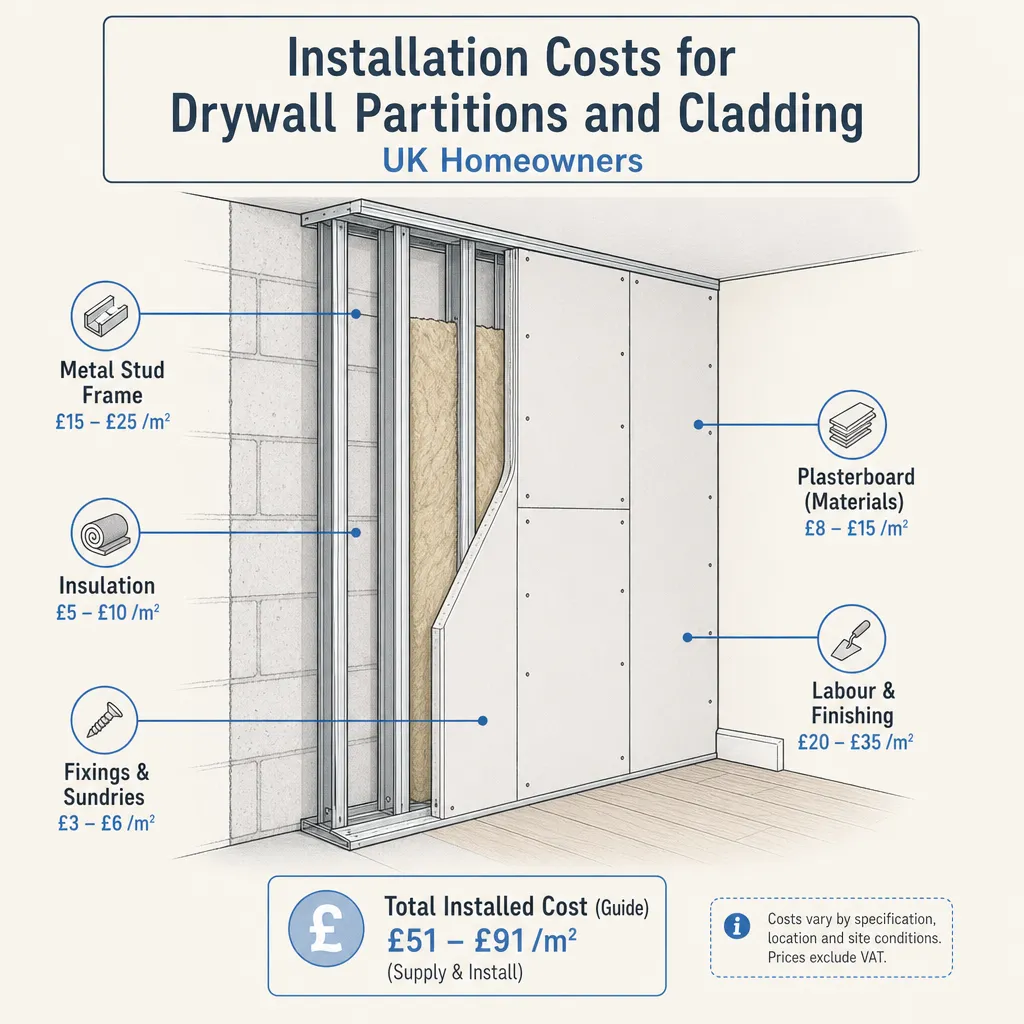
Installation Costs for Drywall Partitions and Cladding
Drywall partitions and plasterboard cladding are among the most versatile internal finishing systems used in UK homes. Cost questions typically arise when homeowners are planning a room subdivision, a loft conversion, a home extension, or a refurbishment that involves re-lining uneven, damp-damaged, or poorly insulated walls. The range of board specifications, framing systems, and finish options means that prices can vary considerably — even for apparently similar jobs.
Key points
- A single-skin metal or timber stud partition with one layer of 12.5 mm plasterboard on each face typically costs £800–£2,000 fitted and skimmed for an average room division (Indicative UK costs, last reviewed 2026-05-06).
- Plasterboard cladding (dry-lining) to an existing wall costs approximately £20–£50 per m² including boarding, jointing, and a skim finish.
- Building Regulations Part E (resistance to the passage of sound) and Part B (fire spread) may require specific board types, additional layers, or acoustic or fire-rated framing systems — all of which add to material and labour costs.
- Moisture-resistant (MR) board is required in bathrooms and kitchens; standard plasterboard must not be used in wet areas.
- Labour typically accounts for 50–65% of the total cost; ceiling height, room access, the number of door openings, and service penetrations are the main cost drivers alongside board specification.
What affects the cost of a drywall partition?
The total price for a stud partition wall depends on more than just the floor area. Key variables are:
Board specification
Standard 12.5 mm plasterboard is the baseline. Fire-rated board costs more per sheet. Double boarding — two layers on one or both faces — adds material and labour cost but is sometimes required for Part E acoustic compliance or Part B fire resistance ratings (typically 30-minute or 60-minute rated construction).
Framing system: metal stud versus timber stud
Factor | Metal stud (CW/UW profile) | Timber stud |
|---|---|---|
Material cost | Slightly higher | Slightly lower |
Labour speed | Generally faster to fix | Slightly slower to align |
Acoustic performance | Can be superior with resilient bars or isolation strips | Adequate for most domestic use |
Moisture resistance | Better; does not warp or shrink | Can warp in humid conditions |
Best for | New builds, loft conversions, commercial fitout | Traditional properties, simple room divisions |
Fire-rated system available? | Yes | Yes, with correct specification |
Door openings and services
Each door opening typically adds £150–£350 to the cost, depending on the door lining detail and whether the opening is framed for a standard or bespoke door size. Running electrical cables through the new partition requires a separate electrician's visit, which is an additional cost.
Ceiling height and access
Standard domestic ceiling heights of around 2.4 m are straightforward. Higher ceilings require additional boarding and the use of scaffolding or hop-up equipment, increasing labour time and cost.
Finish specification
Some clients require only a taped and jointed finish left ready for decoration. A full skim plaster coat adds approximately £8–£15 per m² to the cost but provides a smoother, more durable surface.
What affects the cost of plasterboard cladding?
Dry-lining an existing masonry or concrete wall is costed differently from erecting a new partition.
Dab fixing versus framing
Dot-and-dab (adhesive bonded directly to the wall surface) is faster and cheaper, but requires a reasonably flat and sound substrate. Uneven walls, walls with damp issues, or walls that need a service cavity require a metal or timber framed system, which adds both material and labour cost.
Moisture and thermal performance
Plasterboard bonded to insulated backing board (PIR foam or mineral wool laminate) costs significantly more — typically £35–£70 per m² — but improves thermal performance and may form part of a Part L (conservation of fuel and power) compliance strategy in new builds or extensions.
Board types and their typical uses
Board type | Where used | Approximate premium over standard |
|---|---|---|
Standard 12.5 mm | Dry rooms, ceilings | Baseline |
Moisture-resistant (MR / green board) | Bathrooms, kitchens | +£1–£2 per sheet |
Fire-rated board | Party walls, loft room ceilings, escape routes | +£3–£6 per sheet |
Acoustic (high-density) board | Between habitable rooms, home offices, media rooms | +£5–£10 per sheet |
Insulated dry-lining board | External walls, cold bridge treatment | +£12–£25 per m² (material only) |
Indicative cost breakdown
The figures below are indicative for UK domestic projects (Indicative UK costs, last reviewed 2026-05-06). They assume reasonable access, standard ceiling heights, and a skim plaster finish. Obtain at least three written quotes before committing.
Task | Low estimate | High estimate | Notes |
|---|---|---|---|
Single-skin stud partition, no door | £600 | £1,500 | Average room width, basic spec |
Single-skin stud partition, with door | £900 | £2,000 | Includes door lining frame |
Double-boarded fire or acoustic partition | £1,200 | £3,000 | Two layers each face, fire-rated board |
Dot-and-dab cladding, dry room | £18/m² | £40/m² | Taped and skim finish |
Framed dry-lining, uneven wall | £30/m² | £60/m² | Metal framing plus boarding |
Insulated dry-lining board | £35/m² | £70/m² | PIR-backed board, external wall |
VAT at 20% applies to labour and materials on standard domestic work. Some insulation work may qualify for a reduced VAT rate of 5% — check current HMRC guidance and confirm with your contractor before work starts.
Do I need Building Regulations approval?
For most internal partitions in existing domestic properties, Building Regulations approval is not required provided the partition is non-structural and does not affect fire escape routes. However, check with your local authority building control if:
- The partition creates a new habitable room, particularly within a loft conversion.
- The work is in a House in Multiple Occupation (HMO) where fire compartmentation standards apply.
- The partition is on or near a means of escape route.
- You are carrying out a change of use or a material alteration to the building.
Building Regulations Part E applies in new builds and dwellings created through a material change of use, setting minimum performance standards for partitions between habitable rooms.
What to ask before accepting a quote
Before instructing a dryliner or plasterer, clarify the following:
- Does the quote include all boarding, fixings, jointing tape, and skim plaster, or are materials priced separately?
- Is the board specification appropriate for the room — moisture-resistant for wet areas, fire-rated where required by Part B?
- Will the work comply with Building Regulations Part E or Part B where applicable?
- Is the finish a taped joint or a full skim coat?
- How will door openings, electrical services, and skirting or architrave be handled?
- Is VAT included in the quoted price?
- What is the expected programme, and who removes the waste material?
When to get professional help
Most drywall partition and cladding work is carried out by specialist dry-liners or plasterers and does not require structural input. Seek qualified advice if:
- You are unsure whether an existing wall is load-bearing — never penetrate or remove a structural element without a structural engineer's assessment.
- The project is in an HMO where fire compartmentation performance must be independently verified.
- The work involves a loft conversion or material change of use, where full Building Regulations compliance drawings may be required.
- You notice active damp or mould on the existing wall — dry-lining over a live damp problem can trap moisture and significantly worsen the situation.
How Housey can help
Housey connects UK homeowners with trusted local tradespeople. If you need a qualified dryliner, plasterer, or partition specialist, Housey can help you request quotes from relevant professionals in your area — so you can compare prices and credentials before committing to any work.
Frequently asked questions
How long does it take to install a drywall partition?
A single partition wall in an average-sized room typically takes one to two days, including boarding, jointing, and skimming. Larger jobs with multiple door openings or fire-rated specifications take longer. Allow an additional 24–72 hours for a skim coat to dry before decoration, depending on ventilation and temperature.
Can I install a stud partition myself?
Straightforward timber stud partitions in dry rooms are within the competence of a skilled DIYer, but achieving a good boarding, jointing, and skimming finish requires practice. If the partition must meet Part E acoustic or Part B fire performance standards, errors in specification can result in non-compliance. For work near load-bearing elements or in an HMO, use a qualified professional.
What is the difference between dot-and-dab and a framed dry-lining system?
Dot-and-dab uses adhesive to bond plasterboard directly to the wall surface — it is quicker and cheaper, but requires a reasonably flat and sound substrate. A framed system uses metal or timber studs and is better for uneven walls, where a service cavity is needed, or where higher acoustic or thermal performance is required.
Does plasterboard cladding reduce room size?
Yes. Dot-and-dab typically reduces a room dimension by 20–30 mm per wall. A framed dry-lining system with a service cavity can take 75–100 mm or more per wall. This is worth factoring in when planning fitted furniture, particularly in smaller rooms.
Sources and further reading
Useful next reads
 General property advice
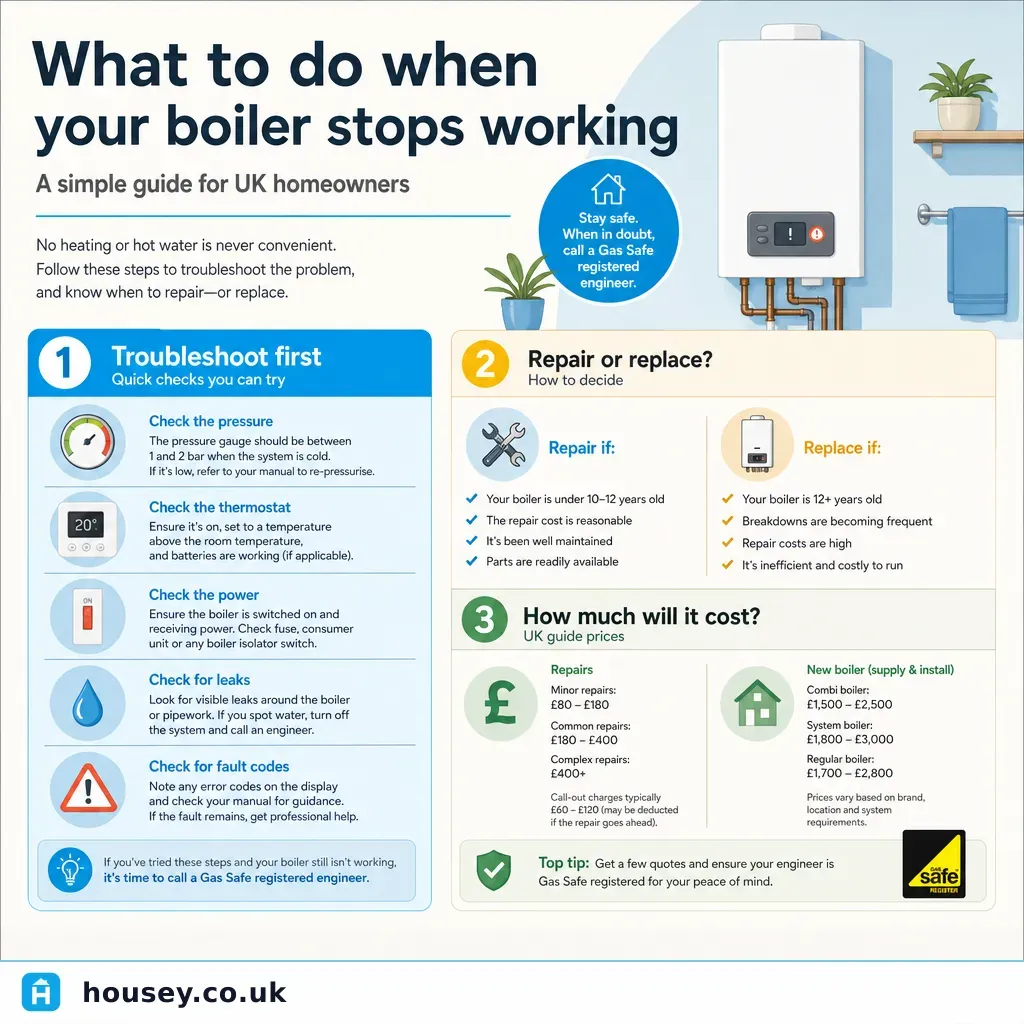
What to do when your boiler stops working
When your boiler stops working, check the pressure gauge (should read 1–1.
 General property advice
Property Market Trends: Activity Growth and Price Movements
UK property market activity is measured through completed sale registrations (HM Land Registry), lender mortgage data, and transaction volumes from HMRC.
 General property advice
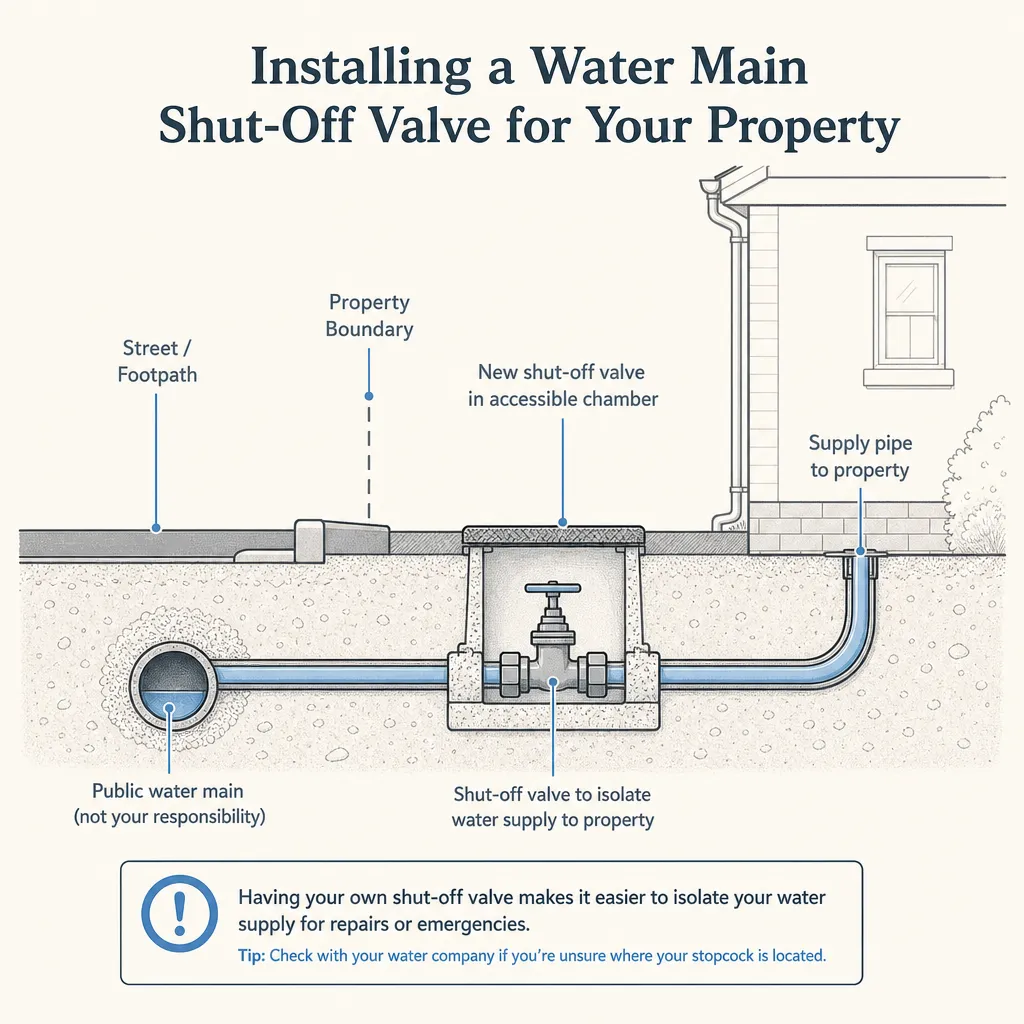
Installing a water main shut-off valve for your property
A water main shut-off valve — commonly called a stopcock — controls all water entering your home from the mains.
 General property advice
Monthly House Price Index: August Market Report and Analysis
The UK House Price Index is published monthly using completed Land Registry transaction data, meaning August figures typically reflect sales agreed months earlier.
 General property advice
Scottish Property Market: Activity and Regional Trends
Scotland's property market operates under distinct legal rules: sellers must provide a Home Report before marketing, transactions become legally binding at conclusion of missives rather than exchange of contracts, and Land and Buildings Transaction Tax replaces Stamp Duty.