Durgo Valve Installation and Drainage Vent Costs
By Housey · Last reviewed 8th of May 2026
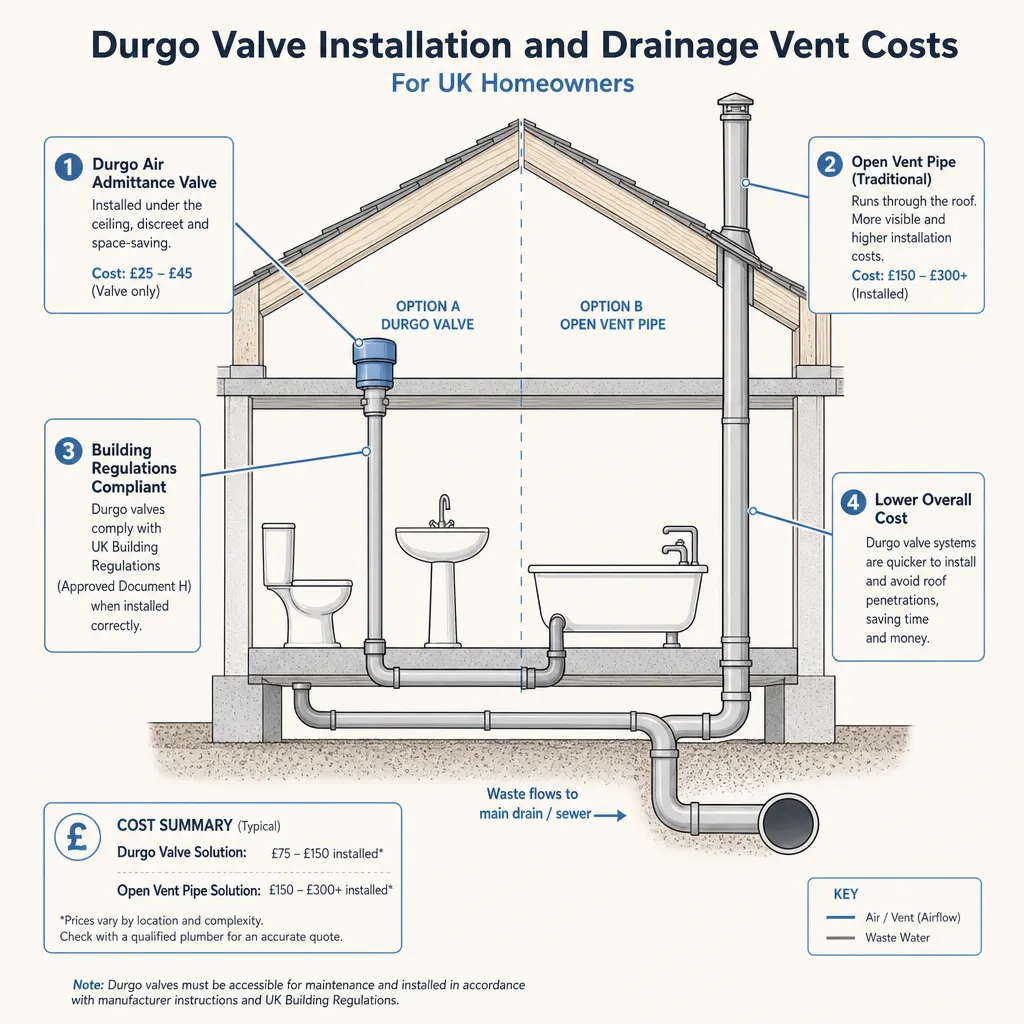
Durgo Valve Installation and Drainage Vent Costs
Drainage ventilation sits quietly behind walls and under floors, but when it fails or is missing entirely, the result is unpleasant and hard to ignore — slow drains, gurgling waste pipes, and sewer smells drifting into kitchens and bathrooms. Deciding whether a Durgo valve (also sold under the generic term air admittance valve, or AAV) is appropriate for your property often comes up during a bathroom or kitchen extension, a loft conversion drainage run, or when a building inspector flags a venting problem at sign-off.
Key points
- A Durgo valve is a proprietary brand of Air Admittance Valve (AAV) — a one-way mechanical valve that admits air into the drainage system to equalise pressure without requiring a pipe open to the atmosphere.
- AAVs must comply with BS EN 12380 and are governed by Building Regulations Approved Document H (drainage and waste disposal) in England and Wales.
- At least one stack on a property must still terminate with a conventional open vent pipe to atmosphere — AAVs cannot replace every vent on a system.
- AAVs must be installed in an accessible location, not permanently sealed behind plasterboard, to allow inspection and future replacement.
- Indicative supply cost for an AAV is £15–£80 depending on size and brand; professional installation typically adds £80–£250 depending on access and complexity. (Indicative UK costs, last reviewed 2026-05-08.)
What is a Durgo valve and how does it work?
"Durgo" is a widely recognised brand name for an AAV, in the same way "Hoover" is used loosely to mean any vacuum cleaner. The device is a sealed unit fitted to the top of a soil stack or waste pipe branch. When water flows down a drain, it creates negative pressure (suction) that would otherwise siphon the water seal from a trap, allowing sewer gases to enter the building. The AAV opens momentarily to admit air, equalising the pressure, then reseals by gravity to prevent any gases from escaping back into the room.
AAVs are particularly common in:
- Loft conversions where routing a new stack through the roof is difficult or impractical.
- Ground-floor extensions where a waste run would be very long.
- Situations where a full external stack would require planning permission or is architecturally unacceptable.
- Flats and apartments where a shared stack cannot easily be extended.
Building Regulations and compliance
AAVs installed in England and Wales fall under Approved Document H of the Building Regulations. Key compliance points include:
- The valve must conform to BS EN 12380, which sets performance, durability, and leakage standards.
- At least one open vent pipe to atmosphere must remain on the drainage system — AAVs cannot vent every branch.
- The valve must be fitted above the spill-over level of the highest fitting it serves (typically 200mm above the appliance's flood level rim).
- It must be accessible for inspection and replacement — not permanently enclosed behind a fixed ceiling or wall. A removable hatch or access panel is acceptable.
- Loft or internal installations should be adequately ventilated to prevent any sewer gas accumulation in the event of valve failure.
Building control sign-off is generally required when installing a new soil stack or drainage branch as part of notifiable building work — for example, adding a new bathroom or WC. A like-for-like replacement of an existing AAV in the same location may not require notification, but check with your local building control body if you are unsure.
AAV vs open vent pipe: which is right for your situation?
Feature | Air Admittance Valve (AAV / Durgo) | Open Vent Pipe to Atmosphere |
|---|---|---|
Planning needed | Rarely | Possibly on listed buildings or in conservation areas |
Building Regulations | Must comply with BS EN 12380 and Approved Document H | Must terminate 900mm above any openable window within 3m |
Cost | Lower — no external pipework run required | Higher if scaffold or significant roof penetration is needed |
Maintenance | Valve degrades over time; may need replacing in 10–20 years | Low maintenance once correctly installed |
Suitable for all stacks | No — at least one open vent must remain on the system | Yes |
Internal aesthetics | Tidier — no external pipe penetration visible | External pipe remains visible on the building |
Flats and conversions | Commonly used and practical | Can be difficult depending on building configuration |
Which option should you choose?
- Choose an AAV if you are adding a secondary stack or branch where routing an open vent externally is impractical, costly, or aesthetically unacceptable — provided at least one open vent already exists on the system.
- Choose an open vent pipe if you are installing the primary stack on a new build or major extension, or if an AAV has repeatedly failed on a high-use stack.
- Ask a drainage contractor or approved plumber if you are unsure whether your existing system has adequate open venting, or if the installation is part of notifiable building work requiring sign-off.
- Check with your local planning authority before any external pipe penetration on a listed building or within a conservation area.
How much does a Durgo valve cost to install?
Costs depend on the valve size, access difficulty, and whether associated drainage work is required.
Supply costs (indicative):
- 32mm–50mm AAV (basin or sink branch): £15–£35
- 110mm AAV (full soil stack): £30–£80
Installation costs (indicative):
- Simple like-for-like replacement in an accessible location: £80–£150 for a plumber's time
- New installation on an existing stack with good access: £150–£250
- New stack with AAV as part of a bathroom or loft conversion: typically included in a broader drainage package — expect £400–£1,200 or more depending on run length and complexity
Indicative UK costs, last reviewed 2026-05-08. Costs vary significantly by region and contractor. Always obtain at least three written quotes.
VAT at 20% applies to both materials and labour unless your contractor is below the VAT registration threshold.
Common installation problems
- Valve fitted below the flood level of the appliance it serves — renders it ineffective and non-compliant with Approved Document H.
- No access provision — building inspectors will reject an installation where the valve is permanently sealed behind plasterboard.
- Incorrect pipe size — a 50mm AAV on a 110mm stack will not perform adequately under load.
- Fitting on a system with no open vent — AAVs must complement, not replace, at least one conventional vent to atmosphere.
- Unbranded valves without BS EN 12380 certification — these may fail quickly, seal unreliably, or fail building control inspection.
Homeowner checklist before instructing a contractor
When to get professional help
A like-for-like AAV replacement in an accessible location is a relatively low-risk plumbing task. However, always instruct a qualified plumber or drainage contractor when:
- The installation is part of a new bathroom, en-suite, or WC addition requiring building control sign-off.
- You are experiencing persistent sewer smells despite what appears to be a functioning AAV — this may indicate a cracked pipe, failed trap, or inadequate venting elsewhere in the system.
- The stack serves multiple properties, such as a shared stack in a converted house or block of flats.
- You are unsure whether your system currently has adequate open venting to atmosphere.
- The existing stack is lead, clay, or cast iron — older materials that require specialist handling.
How Housey can help
If you need a qualified specialist to advise on AAV compliance, replace a faulty valve, or design a drainage ventilation scheme for a new bathroom or conversion, Housey can connect you with vetted local specialists. Get started by exploring drainage contractors on Housey.
Frequently asked questions
Can I fit a Durgo valve myself?
A straightforward like-for-like replacement may be within the scope of a confident DIYer, but any work forming part of notifiable building work — such as adding a new WC, bathroom, or drainage branch — should be carried out by a qualified plumber and notified to building control. Incorrectly fitted AAVs can allow sewer gases to enter the property.
How long does an air admittance valve last?
Most quality AAVs conforming to BS EN 12380 will last 10–20 years under normal use. Valves used in high-frequency settings — such as a busy kitchen or a household with multiple WCs — may wear sooner. If you notice gurgling drains or sewer smells, check the valve first before investigating the wider drainage system.
Does an air admittance valve need building regulations approval?
If the AAV is being installed as part of notifiable drainage work — for example, adding a new bathroom or soil stack — building regulations approval under Approved Document H is required. A like-for-like replacement of an existing AAV may not require notification, but check with your local building control body to confirm your specific situation.
Can a Durgo valve be used in a loft conversion?
Yes, AAVs are commonly used in loft conversions where routing a new soil stack through the roof is impractical. The valve must be installed above the flood level of the highest fitting it serves, in an accessible location, and must conform to BS EN 12380. Building control sign-off will typically be required for the conversion's drainage works.
What is the difference between a Durgo valve and an air admittance valve?
There is no functional difference — Durgo is a proprietary brand name and air admittance valve (AAV) is the generic term for the same type of one-way mechanical vent device. Other brands and own-label products are available, all of which should comply with BS EN 12380 to be used in a Building Regulations-compliant installation.
Sources and further reading
Useful next reads
 Improvement & Build
Septic Tank Installation: Planning and Budget Considerations
Installing a septic tank or sewage treatment plant in England requires Environment Agency registration or a permit, plus Building Regulations approval under Approved Document H.
 Improvement & Build
Liniar uPVC Windows: Performance, Durability, and Quality Assessment
Liniar uPVC window profiles are manufactured in the UK using multi-chambered, foamed frames.
 Improvement & Build
Garden Tap Installation with Hot and Cold Water: Plumbing Options
Adding a cold garden tap is a common DIY project, but routing hot water outdoors requires a plumber to connect to your domestic hot water system and comply with the Water Supply (Water Fittings) Regulations 1999.
 Improvement & Build
Sealing and Maintaining Historic Leaded Glass Windows: Preservation and Performance
Leaded glass windows are maintained using traditional linseed oil cement — not silicone or modern sealants, which prevent natural movement in the lead came.
 Improvement & Build
Greenhouse Construction: Glass Versus Polycarbonate Materials
Glass transmits around 90% of available light and lasts indefinitely if unbroken, but insulates poorly and shatters into sharp fragments.