Earthquake-Resistant Residential Construction: Design Principles and Methods
By Housey · Last reviewed 24th of May 2026
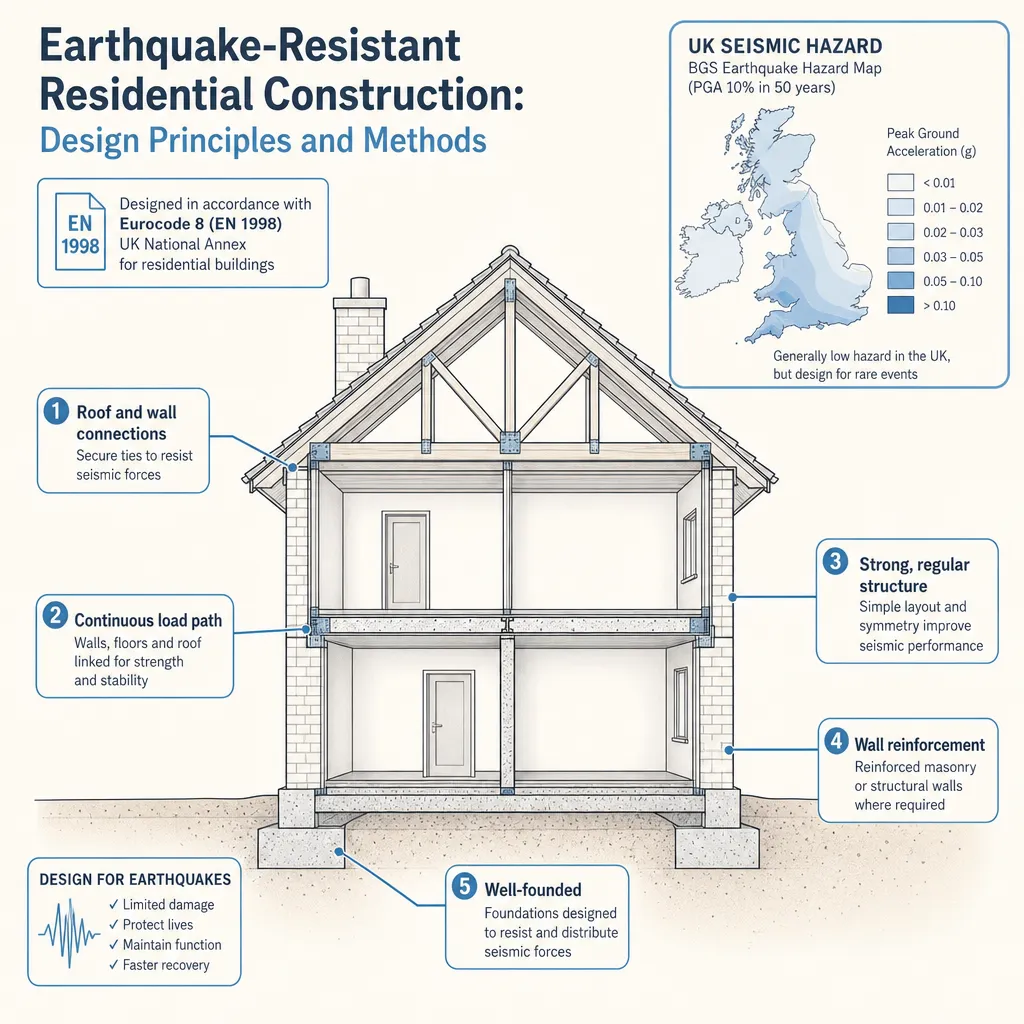
Earthquake-Resistant Residential Construction: Design Principles and Methods
The UK is not a high-seismic-risk country, but it is not seismically inactive. The British Geological Survey (BGS) records hundreds of minor earthquakes every year — most imperceptible, but occasional events reaching magnitude 4–5 have been felt across parts of the Midlands, Wales, and Scotland. For the vast majority of residential properties, dedicated seismic design is not required. However, architects, engineers, and self-builders working on new residential construction, significant structural alterations, or projects near areas of historically higher UK seismic activity should understand where Eurocode 8 (BS EN 1998) applies and what structural design principles improve resilience.
Key points
- The UK is classified as a very low seismic hazard zone by the BGS; for most residential buildings, Building Regulations do not require specific seismic design beyond standard structural provisions under Approved Document A.
- Eurocode 8 (BS EN 1998-1: Design of Structures for Earthquake Resistance) is the applicable European standard, adopted in the UK as a National Standard with a UK National Annex specifying local hazard parameters.
- The UK National Annex to BS EN 1998-1 sets design ground acceleration values for most UK locations so low that a no-seismic-design zone applies — meaning Building Regulations Part A compliance is considered sufficient without separate seismic calculations.
- Good structural practice — regular plan layout, robust connections, diaphragm action in floors and roofs, and avoiding soft storeys — improves seismic resilience as a natural benefit of general structural quality.
- For buildings near geological fault lines (e.g., parts of the Lake District, south Scotland, or the Lleyn Peninsula in Wales), a structural engineer may choose to review Eurocode 8 principles even where not strictly mandated.
UK seismic context: what the data shows
The BGS maintains the UK national seismic monitoring network. Key facts for residential builders and homeowners:
- The UK experiences around 20–30 earthquakes per year at magnitude 2.0 or above, and around 200–300 in total including smaller events.
- The strongest instrumentally recorded UK earthquake was the 1931 Dogger Bank event (approximately magnitude 6.1, offshore). The strongest recent onshore event was the 2008 Lincolnshire earthquake (magnitude 5.2).
- UK peak ground acceleration values used in Eurocode 8 for most urban residential areas are in the range 0.01–0.05 g — far below the thresholds triggering specific design requirements in high-seismic countries such as Italy, Greece, or Turkey.
- Induced seismicity from geothermal energy or hydraulic stimulation projects has triggered minor events in specific localities; BGS publishes traffic-light protocols for such activities.
For a typical three-bedroom semi-detached house or new-build estate home in England, a structural engineer following Building Regulations Part A will produce a design with adequate resilience for UK conditions without applying Eurocode 8 explicitly.
What Eurocode 8 requires and when it applies in the UK
BS EN 1998-1, together with its UK National Annex, defines design procedures for structures in seismic regions. The UK National Annex establishes:
- Design ground acceleration (agR): specified per location using the UK seismic hazard map. In most of England and Wales, agR is at or below 0.04 g.
- Importance classes: Residential buildings are Importance Class II. The reference return period for seismic action is 475 years (10% probability of exceedance in 50 years).
- No-seismic-design zone: Where the product of agR and the soil amplification factor S is at or below 0.05 g, the standard permits omission of specific seismic design. This condition applies across most of the UK for standard residential buildings.
In practice, specific Eurocode 8 compliance calculations for residential construction are rarely required in the UK. However, structural engineers working on larger or more complex structures may document a Eurocode 8 review as part of due diligence — particularly where funders, insurers, or building warranty providers request it.
Design principles that improve seismic resilience
Even where explicit seismic calculations are not required, the following structural principles improve a building's resilience to any lateral loading — including wind, ground movement, and minor ground shaking. They align with good structural practice under Building Regulations Part A.
Regularity in plan and elevation
Buildings with simple, symmetrical floor plans resist lateral forces more evenly. L-shapes, T-shapes, and irregular massing create stress concentrations at re-entrant corners. Where complex plan forms are unavoidable, structural engineers can introduce separation joints or reinforce vulnerable connections.
Robust connections and structural continuity
Seismic damage most often occurs at connections — beam-to-column junctions, wall-to-floor ties, and foundation anchors. Ensuring all structural connections are detailed, specified, and inspected during construction is one of the most effective resilience measures available on any residential project.
Diaphragm action in floors and roofs
A rigid or semi-rigid floor or roof diaphragm distributes lateral loads to vertical resisting elements (walls, frames). In traditional UK timber-frame construction, adequate noggings, blocking, and sheathing boards contribute to diaphragm action. Concrete or composite floors provide inherent diaphragm stiffness.
Avoiding soft storeys
A soft storey — typically a ground-floor open-plan area without adequate lateral resisting walls — is a well-documented seismic vulnerability. In UK residential construction this is most relevant to mixed-use buildings with commercial ground floors, or houses with large integral garages where the upper floor has limited wall support directly below.
Comparison of structural approaches for lateral resistance
Approach | How it works | Best for | UK residential applicability |
|---|---|---|---|
Masonry shear walls | Solid brick or block walls resist lateral loads through in-plane shear | Traditional terraced and semi-detached houses | High — standard UK masonry construction inherently provides lateral resistance |
Timber sheathed panels | Structural plywood or OSB fixed to timber studs | Timber-frame new builds | High — modern UK timber-frame homes use this as standard |
Reinforced concrete frame | Columns and beams act as a moment-resisting frame | Flats, larger residential blocks | Common in multi-storey UK residential development |
Cross-laminated timber (CLT) | Mass timber panels provide stiffness and diaphragm action | Modern eco-homes, modular construction | Growing in the UK; well-suited to low-seismic conditions |
Base isolation | Seismic isolators at foundation level decouple the building from ground motion | High-seismic regions; critical infrastructure | Not applicable to typical UK residential construction |
What not to assume: common misconceptions for UK builders
- "The UK doesn't have earthquakes, so seismic design is irrelevant." The UK has earthquakes; they are simply small. Good structural connections and lateral resistance are worthwhile regardless of seismic risk level.
- "Eurocode 8 only applies in Southern Europe." BS EN 1998 is adopted as a UK National Standard. The UK National Annex specifies very low design values, not zero. Engineers may apply it voluntarily on any project.
- "Modern light-gauge steel or timber-frame homes are inherently fragile in earthquakes." Well-detailed light-frame structures perform very well in earthquakes globally; they are lightweight and ductile by design.
- "A reinforced concrete frame is always the safest option." In high-seismic areas, poorly detailed concrete frames are a major failure mode. Structural quality and connection detailing matter more than material choice in UK conditions.
- "Induced seismicity from nearby industrial activity is not a concern." BGS publishes traffic-light protocols for geothermal, mining, and energy projects that cause induced seismicity. If your site is near such an installation, inform your structural engineer before design begins.
Homeowner checklist: commissioning a new build on a structurally sensitive site
Important limitations
This article provides general guidance on UK seismic context and structural design principles. Seismic hazard assessment is a specialist discipline. While the UK National Annex to BS EN 1998-1 sets very low design accelerations for most of the UK, individual sites may have atypical ground conditions warranting specific assessment. This article is not a substitute for professional structural engineering advice for any specific project. Always instruct a chartered structural engineer for new residential construction or significant structural alterations.
When to get professional help
Consult a structural engineer before work begins if:
- You are planning a new residential build and the site is near a known geological fault or has a history of subsidence or ground movement.
- Your design includes features that reduce lateral stiffness — open-plan ground floors, large unbraced glazed facades, or a pilotis configuration.
- Your project involves a building of four or more storeys.
- A funder, insurer, or building warranty provider has requested structural design calculations or a seismic hazard assessment.
- The site is near an active geothermal, mining, or industrial operation with a documented induced seismicity risk.
What to ask a qualified professional
Before instructing a structural engineer on a new residential build:
- What is the design ground acceleration (agR) for this site, and has Eurocode 8 been reviewed?
- How does your structural design address lateral loads — including wind, ground movement, and any seismic component?
- What connections are specified between floors, walls, and foundations, and how will they be inspected during construction?
- Does the structural form include any features (such as a soft storey) that reduce resilience to lateral loading?
- Is a ground investigation recommended, and what should it include?
- How does your design comply with Building Regulations Part A, and will you provide a structural design certificate for building control?
How Housey can help
Housey can connect you with experienced structural engineering services professionals who can advise on lateral load design, UK seismic context, and Building Regulations Part A compliance for your residential project.
Frequently asked questions
Does the UK really have earthquakes?
Yes. The BGS records hundreds of seismic events each year. Most are very minor (below magnitude 2.0). Notable onshore events include the 2008 Lincolnshire earthquake (magnitude 5.2) and the 2002 Dudley earthquake (magnitude 4.7). UK seismic hazard is low by international standards but not zero, and the BGS maintains a national seismic monitoring network.
Do UK building regulations require seismic design?
For most residential buildings, no. The UK National Annex to Eurocode 8 (BS EN 1998-1) sets design ground acceleration values so low that a no-seismic-design zone applies across most of the UK for standard residential buildings. Building Regulations Part A structural requirements provide adequate resilience for normal residential construction.
What makes a building more earthquake-resistant?
Key factors include a regular plan shape, robust and well-detailed structural connections, continuous load paths from roof to foundation, diaphragm action in floors and roofs, and avoiding soft or weak storeys. In UK conditions, these principles also reflect good structural practice for wind loading and differential settlement — not just seismic resilience.
Is timber-frame construction safe in seismic zones?
Well-detailed timber-frame construction performs very well in earthquakes. It is lightweight (reducing inertial forces) and inherently ductile when sheathing panels are properly fixed. UK timber-frame homes built to current standards are considered adequately resilient for UK seismic conditions, and the system is widely used in countries with moderate seismic activity.
Sources and further reading
- BGS UK Seismic Hazard — British Geological Survey
- BGS Earthquake Seismology — British Geological Survey
- Approved Document A: Structure — GOV.UK
- BS EN 1998-1: Design of Structures for Earthquake Resistance — BSI Group
- Eurocode 8 UK National Annex — BSI Group
Useful next reads
 Planning & Pre-Build
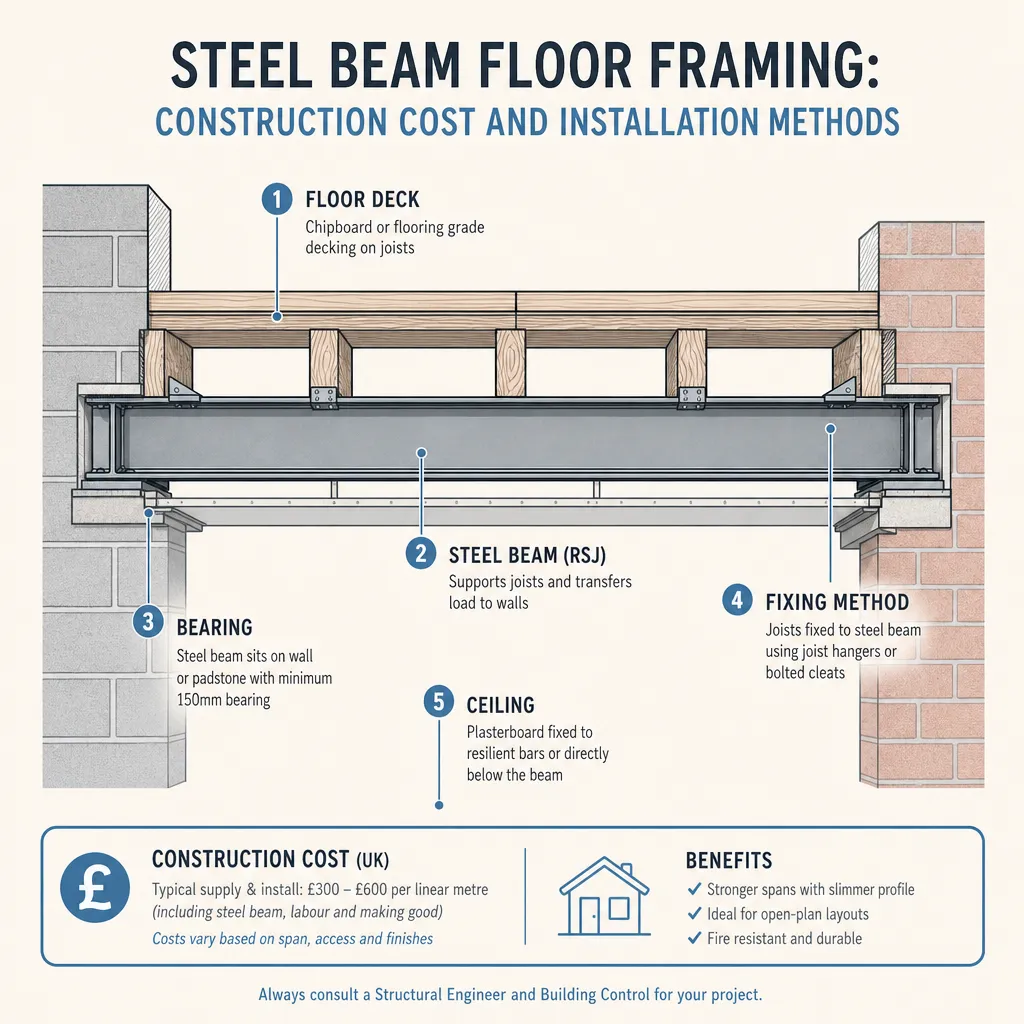
Steel Beam Floor Framing: Construction Cost and Installation Methods
Steel beam floor framing is used in UK homes when spans are too wide for timber joists, or when a load-bearing wall is removed.
 Planning & Pre-Build
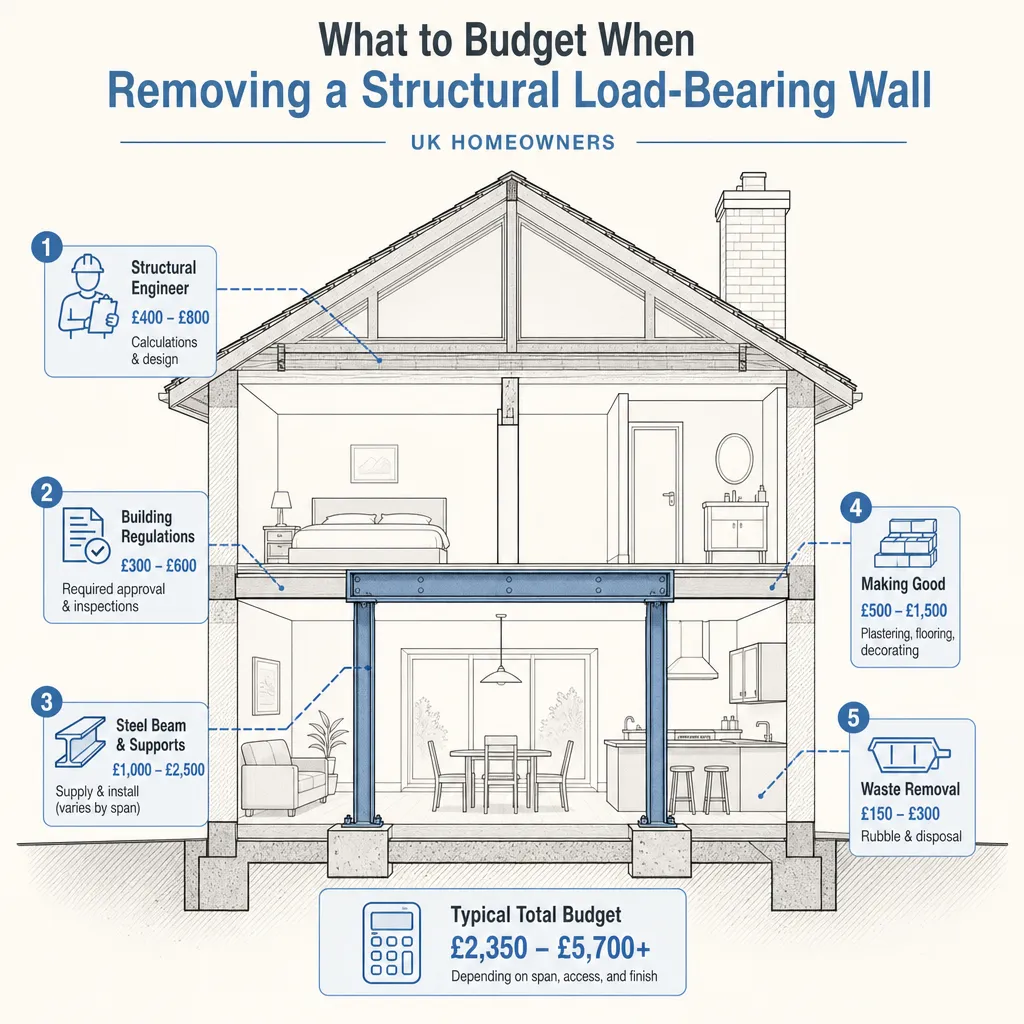
What to Budget When Removing a Structural Load-Bearing Wall
Removing a load-bearing wall in a typical UK home costs £2,500–£8,000 or more in total, covering a structural engineer's calculations, Building Regulations approval, the steel beam, builder's labour, and replastering.
 Planning & Pre-Build
Building Climate-Resilient Homes: Design and Energy Strategies
A climate-resilient UK home handles hotter summers, wetter winters, and rising energy costs through high-performance insulation, overheating mitigation, flood-resilient construction, low-carbon heating, and good water management.
 Planning & Pre-Build
Structural Arching in Walls: Load Distribution and Design
Structural arching occurs when masonry redistributes compressive loads in a triangular or parabolic path around an opening, reducing the load on the lintel below.
 Planning & Pre-Build
Architectural Design Services for Home Extensions and Renovations
Architectural design services for UK extensions and renovations span initial feasibility, planning drawings, building regulations packages, and site monitoring.