Steel Beam Floor Framing: Construction Cost and Installation Methods
By Housey · Last reviewed 24th of May 2026
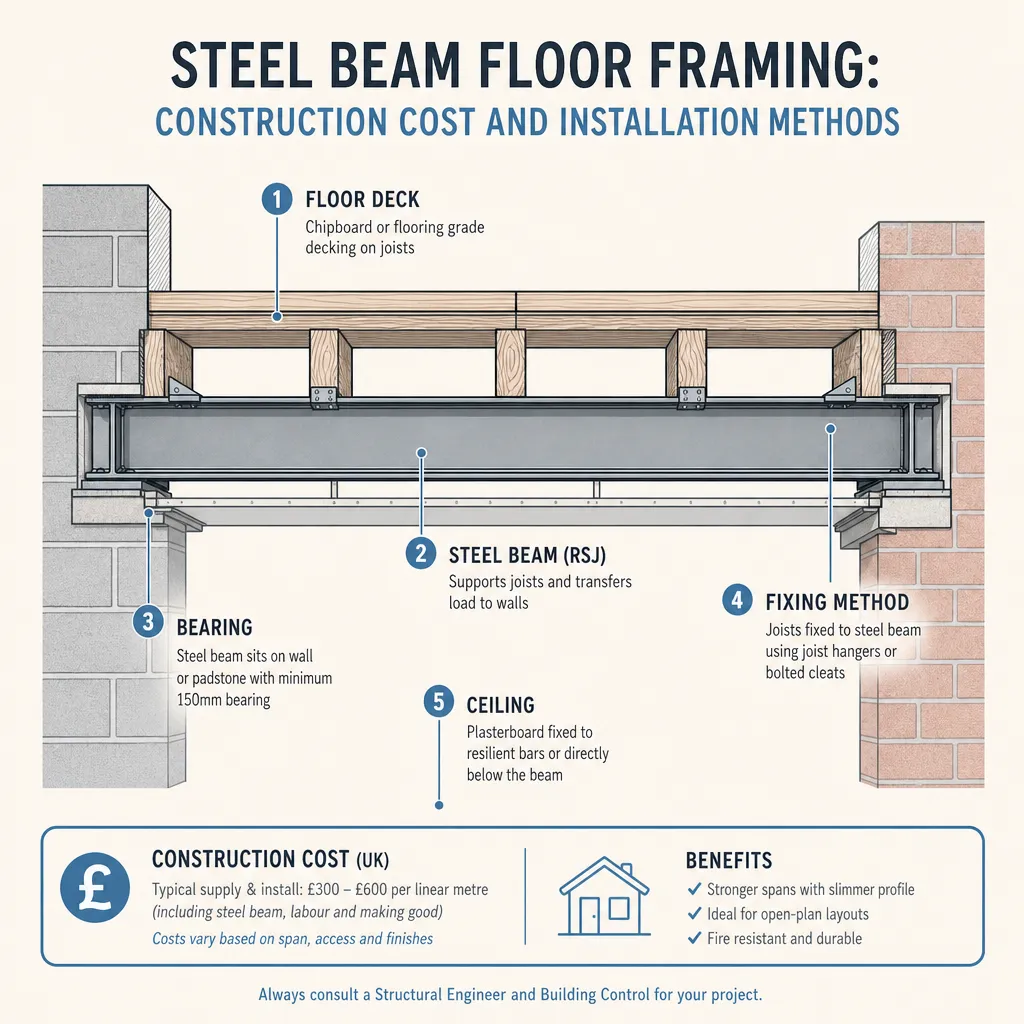
Steel Beam Floor Framing: Construction Cost and Installation Methods
Steel beam floor framing arises most commonly in UK residential construction when spans are too large for timber to carry safely, when a structural wall is being removed, or when a new extension requires a floor system that timber joists cannot deliver at the required depth. It is a decision with structural, regulatory, and cost implications that make early professional involvement essential — and one where Building Regulations approval is always mandatory before work begins.
Key points
- Structural steel floor framing must be designed by a qualified structural engineer and is subject to Building Regulations Part A (Structure); building control approval is required before any structural alteration.
- Universal Beams (UBs) — sometimes called RSJs or I-beams — are the most commonly specified steel section for residential floor framing; the exact section size is calculated by the engineer, not selected by the contractor.
- Steel floor beams must bear on adequate padstones (dense concrete block or engineering brick) or steel bearing plates set into the supporting masonry; the bearing detail is part of the engineer's specification.
- Indicative total costs for a single residential steel beam installation range from approximately £2,000–£4,000 including structural design, building control approval, material supply, and labour. Indicative UK costs, last reviewed 2026-05-24.
- Hot-rolled structural steel requires intumescent fire protection paint or encasement in most residential applications, achieving 30 or 60 minutes' fire resistance under Building Regulations Part B.
When does a residential project need steel floor framing?
Not every project requires steel. Timber floor joists remain the default for most residential floors. Steel becomes necessary or strongly preferable when:
- Spans exceed practical timber limits: engineered timber (LVL or glulam) can bridge 6–7 m in many domestic situations, but beyond this range, or where floor depth is constrained, steel becomes more efficient.
- A structural wall is being removed: a steel beam carries the load formerly taken by the wall, with floor joists bearing or hanging from it via joist hangers or cleats.
- A new extension requires a large open-plan floor: steel allows slimmer floor build-ups at long spans than timber in the same depth.
- Loading is unusually high: plant rooms, water tanks, heavy storage, or commercial use on a residential floor may require steel where timber would be undersized.
Decision tree: steel or timber floor framing?
- Choose engineered timber if spans are under 6 m, loading is standard domestic, and floor depth is not constrained — simpler to fix, lighter, and usually cheaper than steel.
- Choose structural steel if spans exceed 6–7 m, loadings are high, a wide opening is formed by removing a structural wall, or the floor depth must be minimised.
- Ask a structural engineer if you are unsure which system suits your situation, if the property is pre-1919 with unknown foundations, or if a party wall is involved.
- Check with building control early — pre-application discussions can identify design or access issues before cost is committed.
Steel vs timber floor framing: a comparison
Factor | Steel Universal Beam | Engineered timber (LVL/glulam) | Traditional softwood joists |
|---|---|---|---|
Typical maximum span (domestic) | 8–15 m+ (section-dependent) | 5–7 m | 4–5 m |
Section depth at equivalent span | Shallower | Moderate | Deepest |
Building Regulations Part A | Structural engineer design required | Engineer or certified span tables | Span tables (TRADA) for simple cases |
Fire protection required | Yes — intumescent paint or encasement | Yes — charring allowance or encasement | Encasement in some applications |
Installation method | Crane or mechanical lifting usually needed | Manual handling generally possible | Manual handling |
Indicative supply cost per metre | £50–£200 | £30–£120 | £15–£50 |
Connection to masonry | Padstone or bearing plate required | Joist hanger or padstone | Joist hanger or wall plate |
Indicative UK costs, last reviewed 2026-05-24. Costs vary by section size, supplier, and project location.
How steel floor beams are installed: typical process
A residential steel beam installation typically follows this sequence. The specific method is determined by your structural engineer and main contractor.
- Structural design: a chartered structural engineer calculates the required section size (for example, 203×133×25 UB), the required bearing length at each wall, and the padstone specification.
- Building control approval: a full plans application or building notice is submitted, with structural calculations, before work begins.
- Temporary propping: before any structural wall or floor joist is disturbed, acrow props on spreader boards are installed to support the load above.
- Padstone installation: masonry at each bearing point is cut back and a dense concrete padstone or steel plate is bedded in engineering mortar.
- Beam delivery and lifting: a 6 m length of 254×146×37 UB weighs approximately 222 kg — a small crane, Tirfor winch, or telehandler is usually required.
- Beam placement and levelling: the beam is positioned on the padstones, levelled, and packed as necessary to achieve the correct datum.
- Floor joist connection: floor joists connect to the beam via joist hangers, cleats, or web stiffeners per the engineer's specification.
- Fire protection: intumescent paint is applied to achieve the required fire resistance period — typically 30 or 60 minutes in residential use.
- Building control inspection: the building control officer visits to verify the installation before the beam is concealed by finishes.
Worked UK property scenario
Situation: a 1930s semi-detached in the East Midlands. The owner is removing the chimney breast and load-bearing partition between the dining room and kitchen to create a single open-plan living area. The clear span across the opening will be 4.8 m.
Engineer's specification: 203×133×25 UB; padstones of 140×215 mm dense concrete block at each bearing point; intumescent paint to 30 minutes' fire resistance.
Approximate costs:
- Structural engineer design and calculations: £400–£700
- Building control application fee: £200–£400 (varies by local authority)
- Steel supply (approx. 5.4 m length including bearings): £300–£500
- Labour — temporary propping, padstone installation, beam lifting, connection, and fire protection: £1,200–£2,000
- Estimated total: £2,100–£3,600, excluding making-good, decoration, and floor finishes
These figures are illustrative only. Actual costs depend on the structural specification, site conditions, access, and regional labour rates. Indicative UK costs, last reviewed 2026-05-24.
Important limitations
This article provides general information about steel beam floor framing for UK residential properties. Structural design is a technical discipline: the correct section sizes, bearing details, connection design, and fire protection specification for any individual project can only be determined by a qualified structural engineer who has assessed the specific property, loading conditions, and intended use. Nothing in this article constitutes structural design advice or a substitute for professional assessment. Always instruct a chartered structural engineer before procuring or installing structural steel.
When this becomes urgent
Seek immediate professional advice if:
- You discover that structural work has been carried out on your property without building control approval — this is a material defect affecting mortgage eligibility and saleability.
- A contractor proposes to install a steel beam without reference to a structural engineer's calculations.
- You notice cracking, deflection, or movement in a floor or ceiling near the proposed works — additional structural investigation may be needed before any alteration proceeds.
- You are under time pressure to start work — cutting corners on design and approval creates far greater delays and costs if enforcement action follows.
What to ask a qualified professional
Structural engineer:
- What section size and steel grade do you specify, and how have you calculated the bearing requirements?
- What padstone size and specification is required at each end, and does the existing masonry support this?
- What fire resistance rating does this beam require, and what protection method do you recommend?
- Will you provide structural calculations for the building control submission?
- Are there any party wall, foundation, or existing structure implications I should be aware of?
Contractor (before accepting a quote):
- Are you experienced in residential structural steel installation, and can you provide references?
- How will you lift the beam, and do you have access for the required equipment?
- Is temporary propping and its subsequent removal included in the quote?
- Is fire protection application included?
- Who notifies building control for the structural inspection, and at what stage?
- Is VAT included?
- What making-good is included after the beam is concealed by finishes?
When to get professional help
Structural alterations involving steel beams should never proceed without a qualified structural engineer and building control involvement. Seek professional input before starting any work if:
- You are removing any wall in a UK property — even walls that appear non-structural may carry concealed loads.
- The party wall is involved — a party wall agreement under the Party Wall etc. Act 1996 may be required in addition to building control approval.
- The property is pre-1919 with lime mortar brickwork — masonry bearing capacity requires more careful engineering assessment.
- Cracks or movement are visible in the structure near the proposed works — this may indicate a pre-existing structural issue.
How Housey can help
A structural engineering service on Housey can connect you with a chartered engineer to design your steel beam specification and produce the calculations needed for building control. Once the design is confirmed, experienced extension builders on Housey can provide competitive quotes for supply and installation, ensuring the work meets your engineer's specification and passes building control inspection.
Frequently asked questions
Do I need a structural engineer for steel beam floor framing?
Yes. In the UK, structural steel floor beams must be designed by a qualified structural engineer — typically a chartered member of the Institution of Structural Engineers (IStructE) or the Institution of Civil Engineers (ICE). Building control requires structural calculations as part of the approval process. Contractor sizing or rule-of-thumb beam selection is not an acceptable substitute.
What type of steel section is most commonly used for residential floor beams?
Universal Beams (UBs) — sometimes called I-beams; colloquially but inaccurately called RSJs — are the most commonly used section for spanning across openings in residential properties. The specific size (for example, 203×133×25 UB) is determined by the structural engineer based on the span, loading, and available floor depth.
Does steel beam floor framing require building control approval?
Yes, always. Any structural alteration to a UK home — including installation of a steel floor beam or removal of a load-bearing wall — requires Building Regulations approval under Part A (Structure). Failure to obtain approval creates significant problems when selling the property and may result in enforcement action requiring remedial work.
How long does a single steel beam installation take?
Physical installation of a single beam typically takes one to three days once temporary propping is in place. The overall project timeline is considerably longer — allow four to eight weeks for structural design, building control approval, and material procurement before installation can begin.
Sources and further reading
- Approved Document A: Structure — GOV.UK / DLUHC
- Approved Document B: Fire safety — GOV.UK / DLUHC
- Find a structural engineer — Institution of Structural Engineers (IStructE)
- Party Wall etc. Act 1996 — explanatory booklet — GOV.UK
- Steel Construction Institute — residential guidance — Steel Construction Institute (SCI)
Useful next reads
 Planning & Pre-Build
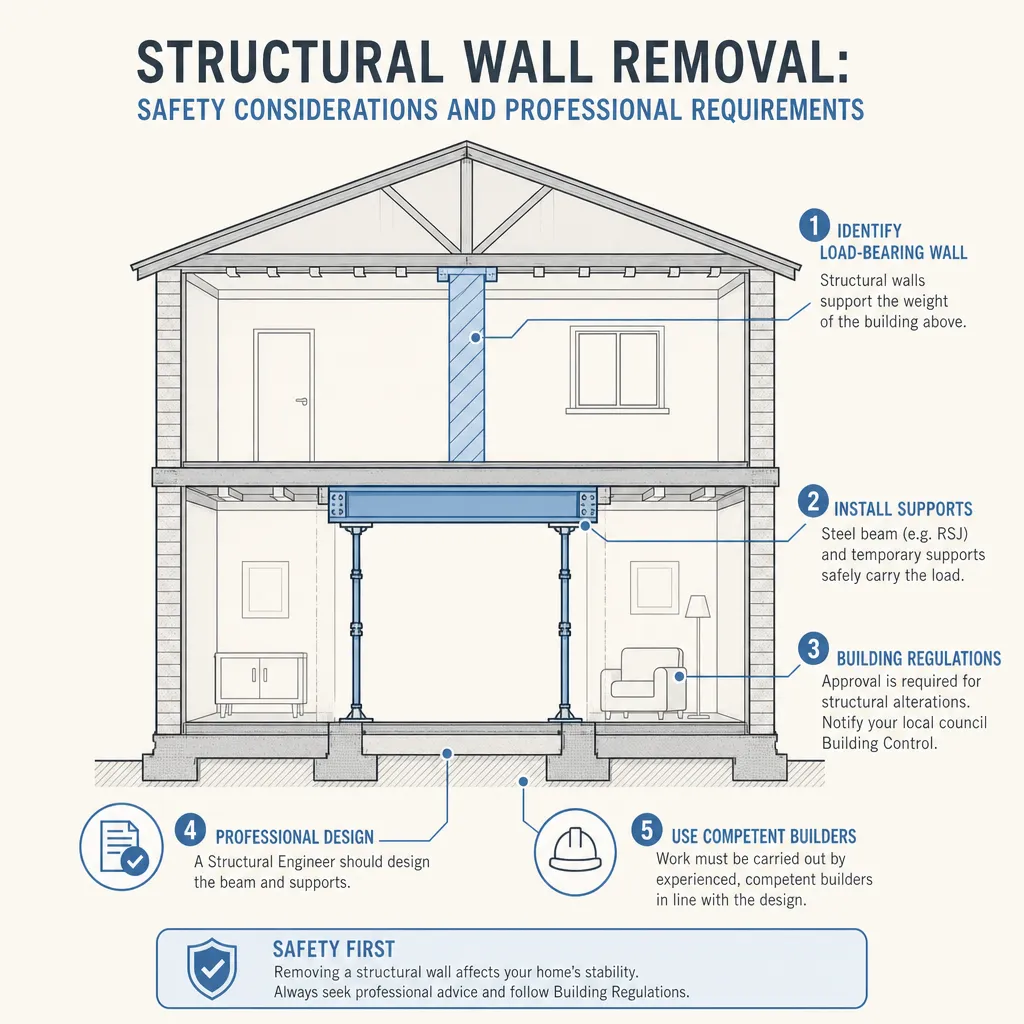
Structural Wall Removal: Safety Considerations and Professional Requirements
Removing a load-bearing wall in the UK always requires Building Regulations approval under Approved Document A, plus a structural engineer's beam calculation before any demolition begins.
 Planning & Pre-Build
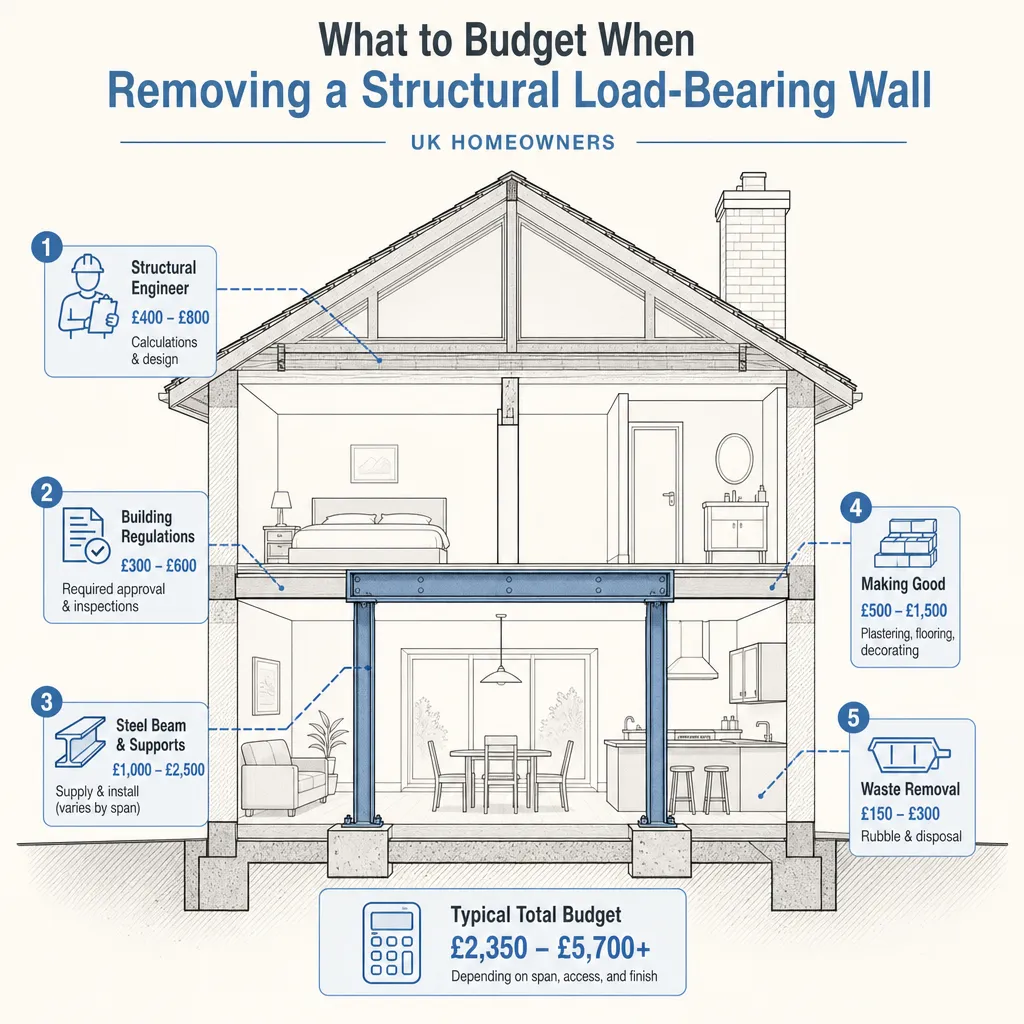
What to Budget When Removing a Structural Load-Bearing Wall
Removing a load-bearing wall in a typical UK home costs £2,500–£8,000 or more in total, covering a structural engineer's calculations, Building Regulations approval, the steel beam, builder's labour, and replastering.
 Planning & Pre-Build
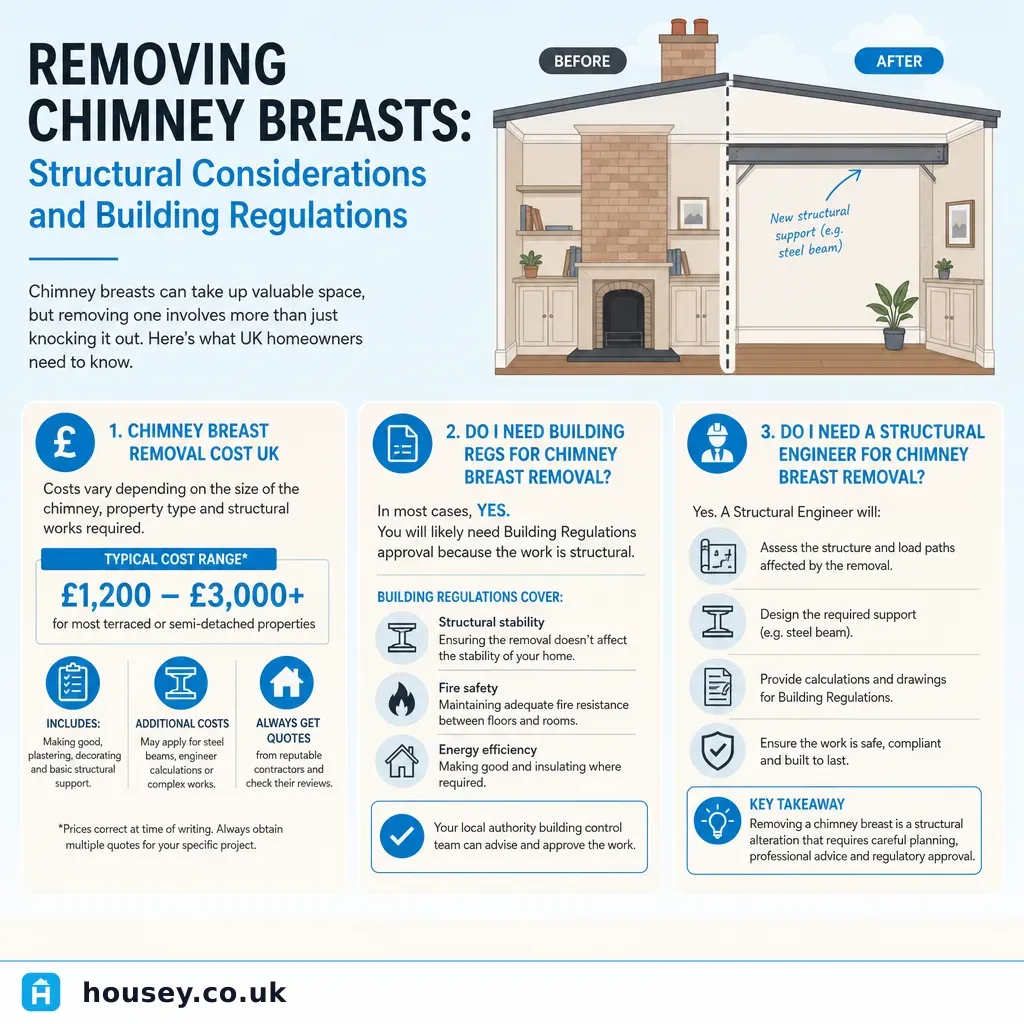
Removing Chimney Breasts: Structural Considerations and Building Regulations
Removing a chimney breast in England and Wales almost always requires building regulations approval because it is structural work.
 Planning & Pre-Build
Barn Conversion Costs: Budget Estimation and Financial Planning
Barn conversions in the UK typically cost £1,500–£3,000 or more per square metre depending on structural condition, specification, and location.
 Planning & Pre-Build
Structural Arching in Walls: Load Distribution and Design
Structural arching occurs when masonry redistributes compressive loads in a triangular or parabolic path around an opening, reducing the load on the lintel below.