Eco-Conscious Home Features for Sustainable Living
By Housey · Last reviewed 18th of May 2026
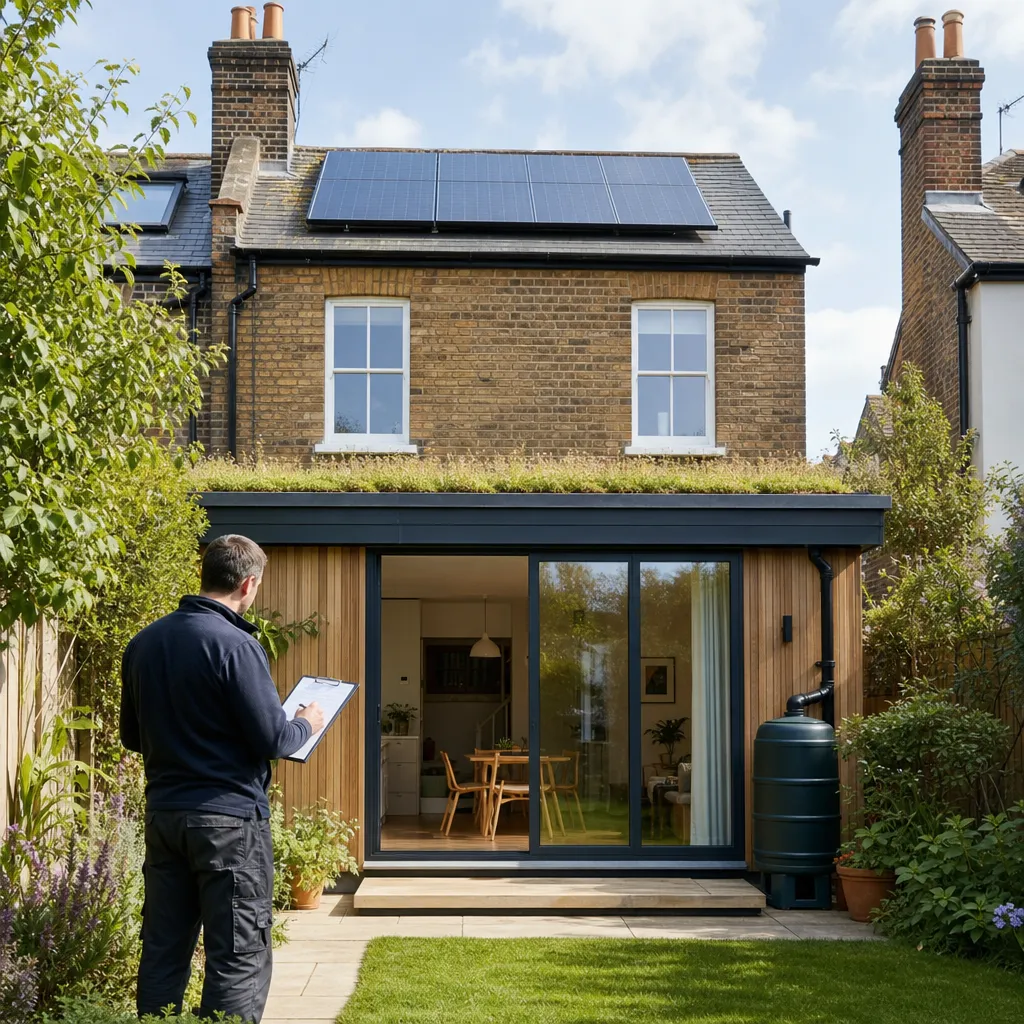
Eco-Conscious Home Features for Sustainable Living
The UK's ageing housing stock accounts for a significant share of national carbon emissions, and improving a home's environmental performance has moved from aspiration to practical priority for many owners. Questions about eco features typically arise when an EPC flags poor insulation, when energy bills rise sharply, or when a homeowner plans a renovation and wants to combine comfort improvements with lower running costs. The decisions are practical ones: which features deliver real reductions, how they interact, and which carry risks if poorly sequenced or specified.
Key points
- The UK's existing homes are responsible for around 17% of national greenhouse gas emissions, according to the Climate Change Committee.
- Building Regulations Approved Document L sets minimum thermal performance standards for improvement works on existing homes, including U-values for walls, roofs, and floors.
- The Boiler Upgrade Scheme (BUS) currently offers a £7,500 grant towards an air or ground source heat pump — check GOV.UK for current eligibility, as terms are periodically updated.
- The Smart Export Guarantee (SEG) requires licensed electricity suppliers with 150,000 or more customers to offer a tariff for surplus solar electricity exported to the grid.
- PAS 2035 is the UK standard governing whole-house energy retrofit; government-funded schemes including ECO4 and the Great British Insulation Scheme require compliance with it.
Which eco feature suits your home?
- Choose insulation first if your home was built before 1980 and has uninsulated loft or walls — it is typically the highest-impact, lowest-cost-per-saving improvement available.
- Consider solar PV if you have a south-, southeast-, or southwest-facing roof with minimal shading and reasonable daytime electricity consumption.
- Consider an air source heat pump if your home is well-insulated (or will be as part of the same project), you have space for an external unit, and you are replacing an oil or LPG boiler. An MCS heat loss calculation must be completed before sizing.
- Consider MVHR (mechanical ventilation with heat recovery) if you are making the home significantly more airtight during a deep retrofit.
- Commission a PAS 2035 retrofit assessment if you plan to combine multiple measures — the interaction between insulation, ventilation, and heating systems matters, and poor sequencing can cause moisture and condensation problems.
- Check with your local planning authority before installing solar panels, external wall insulation, or a heat pump on a listed building or in a conservation area — permitted development rights may not apply.
Insulation: the foundation of a low-energy home
Reducing heat loss is the starting point for almost all eco improvements. Which insulation type suits your home depends on construction era, wall type, and available access.
Insulation type | Typical application | Indicative cost | Best for | Key consideration |
|---|---|---|---|---|
Loft insulation (mineral wool) | Cold pitched-roof loft | £300–£600 | Most pre-1980 homes | Ensure ventilation paths are not blocked |
Cavity wall insulation | 1930s–1990s cavity-wall homes | £500–£1,500 | Homes with an intact, dry cavity | Not suitable for exposed or persistently damp walls |
External wall insulation (EWI) | Solid-wall homes | £8,000–£20,000+ | Where preserving internal floor area matters | May alter external appearance; check planning permission |
Internal wall insulation (IWI) | Solid-wall where EWI is not feasible | £5,000–£15,000+ | Conservation areas, terraced homes | Reduces floor area; cold-bridging at junctions is a risk |
Floor insulation | Suspended timber ground floors | £1,000–£3,000 | Homes with uninsulated ground floors | Check moisture levels and timber condition first |
Indicative UK costs, last reviewed 2026-05-18. Costs vary significantly by property size, access, specification, and region. Obtain at least three quotes before committing.
Renewable energy: solar PV and heat pumps
Solar photovoltaic (PV) panels generate electricity from daylight. A typical 4 kWp south-facing system in the UK generates around 3,400–3,800 kWh per year. Battery storage allows surplus daytime generation to be used in the evening, reducing grid imports. Under the Smart Export Guarantee, surplus electricity exported to the grid earns a payment from your energy supplier.
Air source heat pumps (ASHPs) extract heat from outside air and typically achieve a coefficient of performance (COP) of 2.5–3.5 at UK conditions, delivering that many units of heat per unit of electricity consumed. They perform best in well-insulated homes with low-temperature heat distribution — underfloor heating or oversized radiators. An MCS-certified heat loss calculation is required before any heat pump is sized or specified.
Ground source heat pumps (GSHPs) generally achieve higher COPs than ASHPs but require land for ground loops or a borehole, significantly increasing installation cost.
Water efficiency and smart controls
Eco improvements extend beyond energy use. Water efficiency measures include dual-flush toilets, WELS-rated taps and showerheads, and rainwater harvesting for garden irrigation. Smart controls — including home energy management systems (HEMS) — can coordinate solar generation, battery storage, heat pump operation, and electric vehicle charging to minimise grid imports at peak rates. Time-of-use electricity tariffs, available to households with a smart meter, make this coordination financially worthwhile.
Green materials and embodied carbon
A home's full environmental footprint includes embodied carbon — the emissions released during manufacturing and construction of materials — not just ongoing energy use. Lower-embodied-carbon choices include:
- Timber frame over concrete blockwork where structural requirements allow.
- Lime render and lime plaster over cement-based alternatives — particularly important for period homes where breathability is necessary to manage moisture.
- Reclaimed materials for brickwork, slate roofing, and joinery.
- Certified timber to FSC (Forest Stewardship Council) or PEFC standards.
Eco home improvement checklist
Before specifying any eco features, work through this checklist:
When to get professional help
Most eco improvements are achievable with good contractors, but professional assessment is important in these situations:
- You are planning multiple measures at once — a PAS 2035-qualified retrofit coordinator should manage sequencing and moisture risk.
- You are considering a heat pump but are unsure whether your home's insulation is sufficient — a heat loss calculation is mandatory before sizing.
- Your home has existing damp, condensation, or poor ventilation — address these before adding insulation.
- Your property is listed or in a conservation area — confirm which measures are permissible before specifying anything.
- You are considering external wall insulation — check wall condition, planning requirements, and junction detailing with a qualified assessor.
How Housey can help
Housey connects homeowners with qualified local professionals for the full range of eco improvements. A retrofit assessment can map a whole-house improvement plan sequenced to PAS 2035 requirements. A heat pump survey checks whether your home is ready and how a system should be sized. A solar survey assesses your roof's potential and likely annual generation. For broader guidance on priorities and sequencing, an energy-efficiency consultant can review your property and help you focus expenditure where it counts most.
Frequently asked questions
Do I need planning permission to install solar panels on my home?
Solar panels on houses are usually permitted development in England, provided they do not protrude more than 200 mm beyond the roof plane and are not on a wall or roof slope facing a highway. Flats, listed buildings, and properties in conservation areas face additional restrictions. Always confirm with your local planning authority before installation — rules differ in Scotland, Wales, and Northern Ireland.
What is PAS 2035 and does it affect my retrofit project?
PAS 2035 is the UK standard for energy retrofit of existing dwellings. It requires a qualified retrofit assessor and retrofit coordinator, plus approved installers, to work together. Government-funded schemes — including ECO4 and the Great British Insulation Scheme — require PAS 2035 compliance. It is especially important for whole-house improvements that combine insulation, heating, and ventilation changes.
Is a heat pump suitable for a Victorian terrace?
Potentially, but efficiency depends heavily on insulation level. Victorian terraces are often solid-walled and draughty, which reduces heat pump performance. An MCS-compliant heat loss calculation must be carried out before any system is sized — this is a mandatory step under MCS standards. Improving insulation first and pairing the heat pump with low-temperature radiators or underfloor heating usually gives the best outcome.
What government grants are available for eco home improvements in 2026?
As of May 2026, key UK schemes include the Boiler Upgrade Scheme (£7,500 towards a heat pump), ECO4 (insulation and heating for eligible lower-income households), and the Great British Insulation Scheme. Eligibility depends on income, EPC rating, and property type. Schemes open and close — always check GOV.UK for current eligibility terms before planning works that rely on grant funding.
Sources and further reading
- Approved Document L: Conservation of Fuel and Power — GOV.UK
- Boiler Upgrade Scheme guidance — GOV.UK
- Smart Export Guarantee — Ofgem
- Home energy efficiency hub — Energy Saving Trust
- PAS 2035 retrofit standard — BSI Group
Useful next reads
 Energy & Retrofit
Sustainable Homes: Features That Reduce Environmental Impact
Sustainable homes reduce environmental impact through high levels of insulation, airtight construction, low-carbon heating such as heat pumps, solar energy generation, efficient water use, and responsibly sourced materials.
 Energy & Retrofit
Designing and Building High-Performance Sustainable Homes with Eco-Friendly Systems
High-performance sustainable homes in the UK follow a fabric-first approach: maximise insulation and airtightness before adding low-carbon heating such as heat pumps, then layer in renewables like solar PV.
 Energy & Retrofit
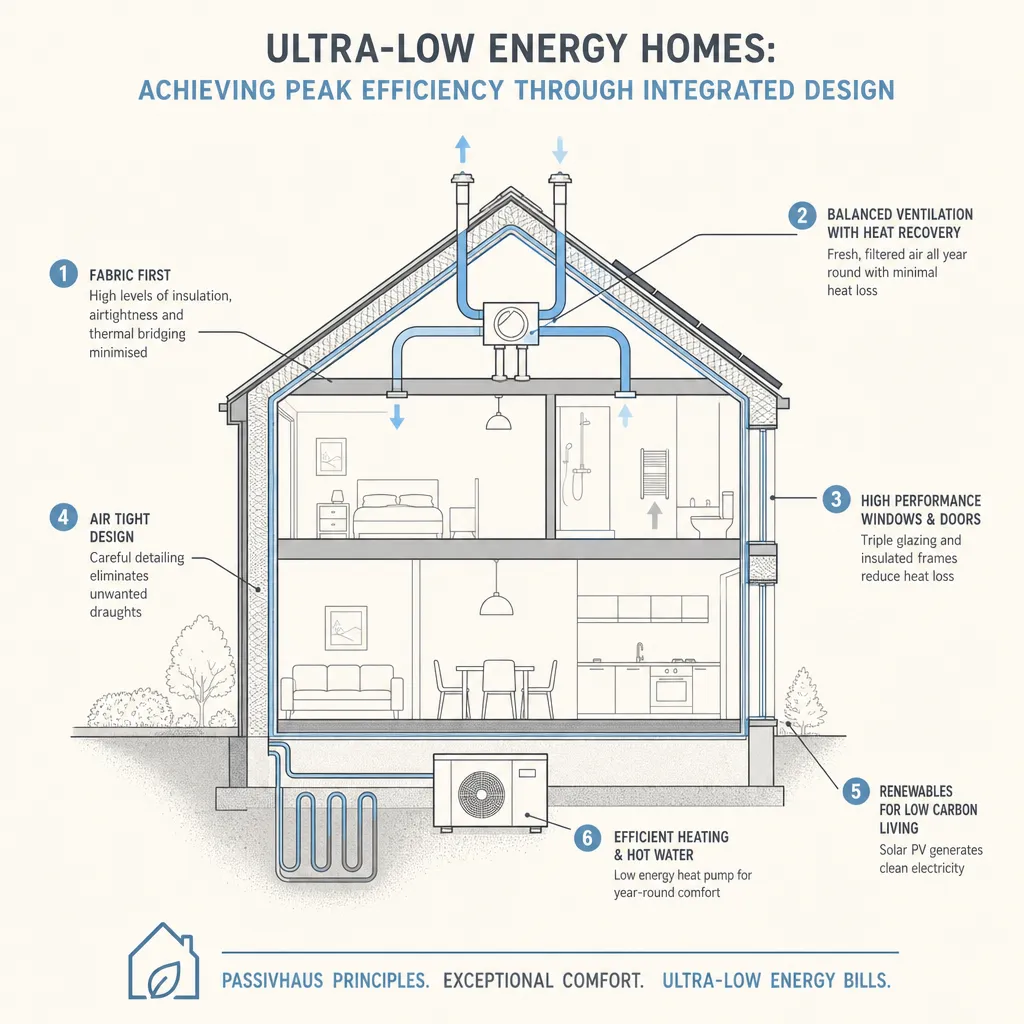
Ultra-Low Energy Homes: Achieving Peak Efficiency Through Integrated Design
Ultra-low energy homes reduce heating demand through high-performance insulation, airtight construction, and mechanical ventilation with heat recovery (MVHR).
 Energy & Retrofit
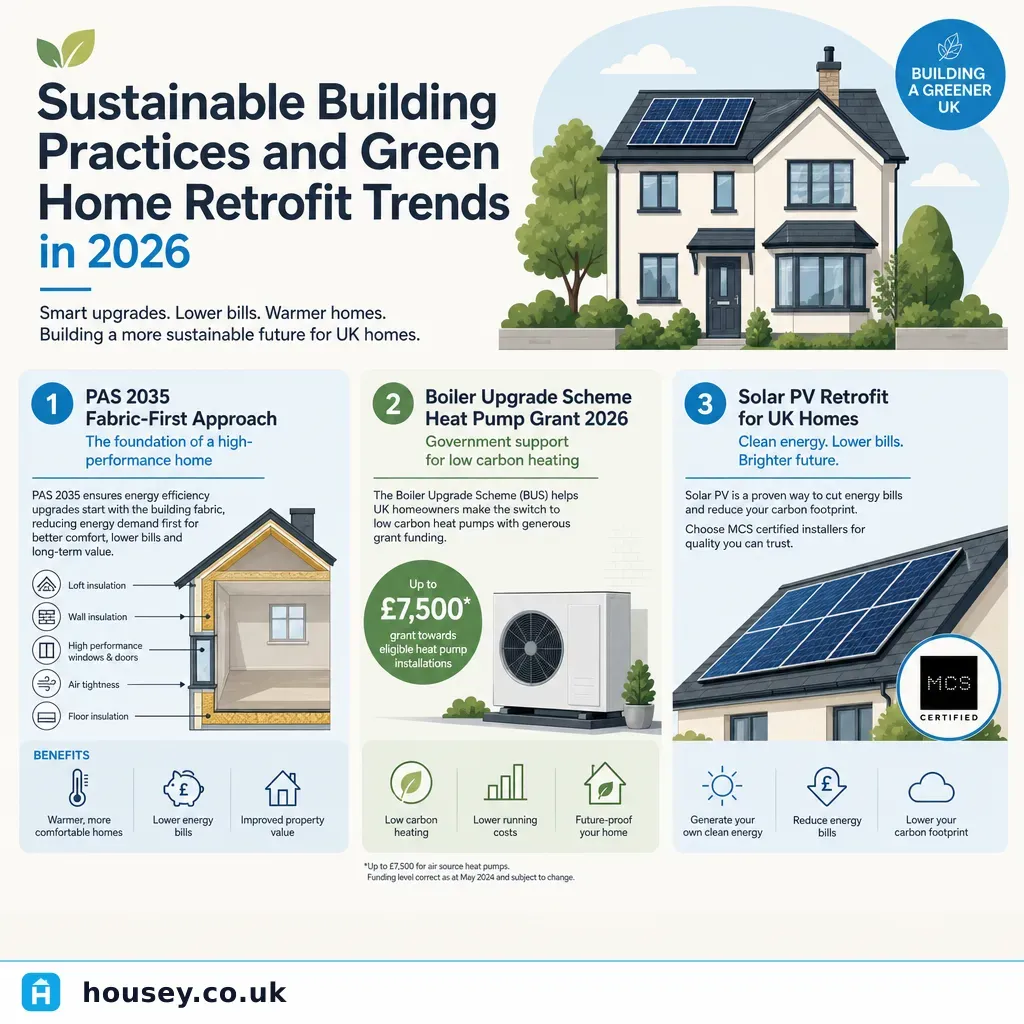
Sustainable Building Practices and Green Home Retrofit Trends in 2026
Green home retrofit in 2026 is shaped by PAS 2035's fabric-first principle, Boiler Upgrade Scheme grants of £7,500 for air source heat pumps, and growing solar PV adoption backed by the Smart Export Guarantee.
 Energy & Retrofit
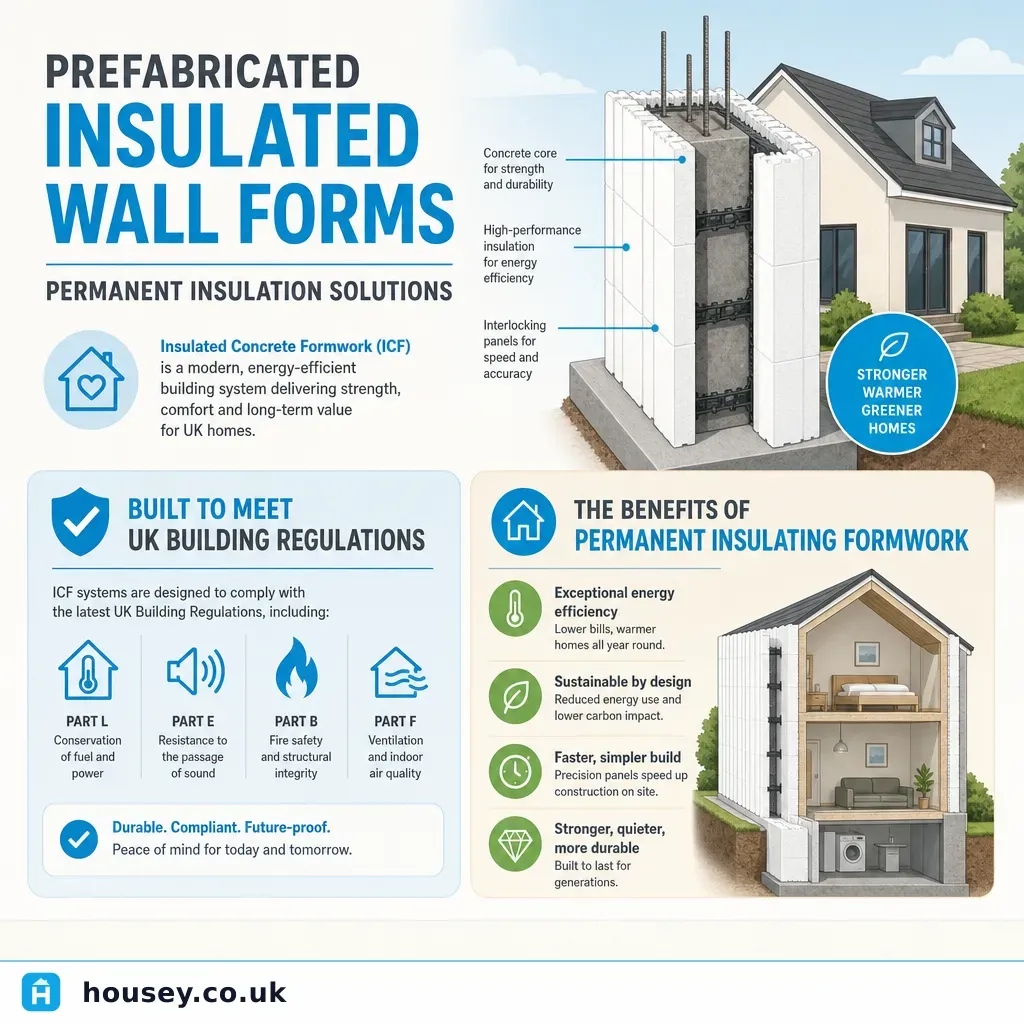
Prefabricated Insulated Wall Forms: Permanent Insulation Solutions
Prefabricated insulated wall forms — including ICF and SIPs systems — deliver high thermal performance by combining permanent insulation with structural concrete or timber in a single wall assembly.