Ultra-Low Energy Homes: Achieving Peak Efficiency Through Integrated Design
By Housey · Last reviewed 1st of June 2026
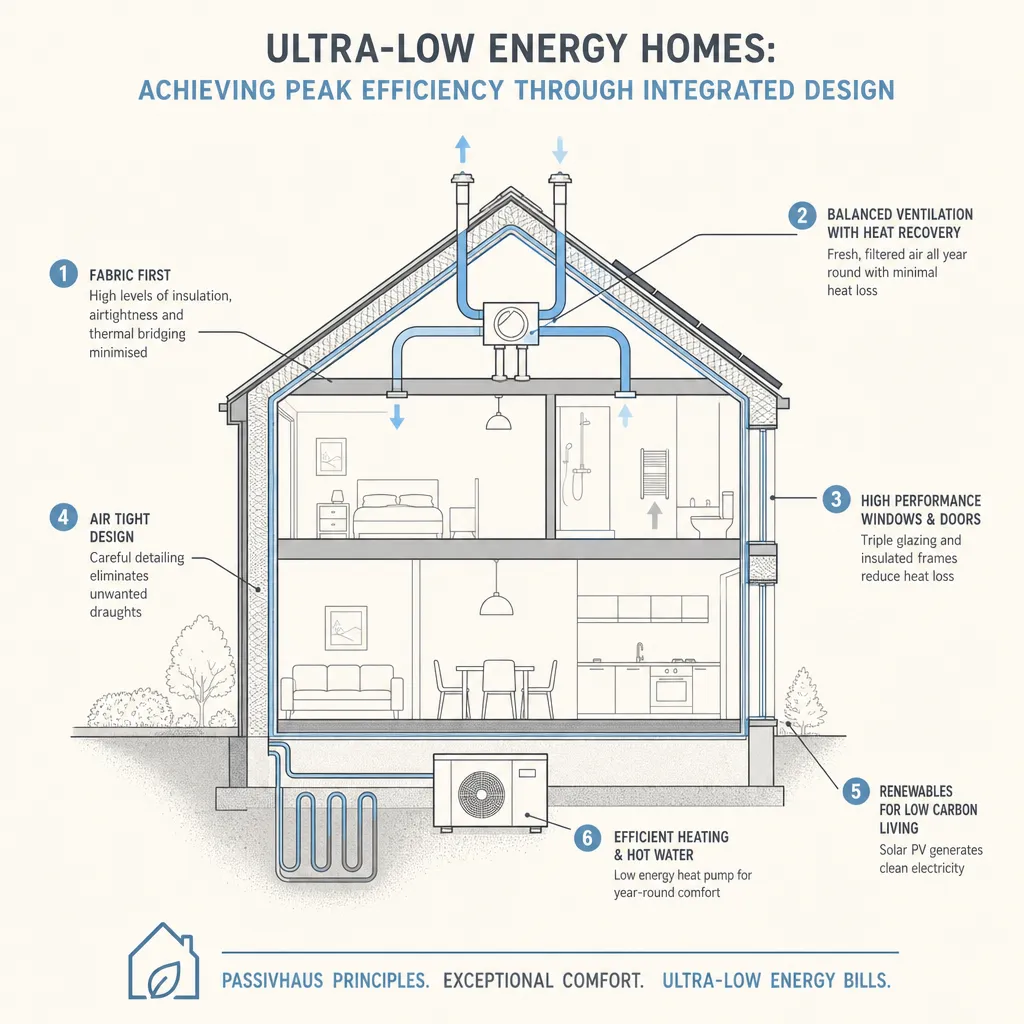
Ultra-Low Energy Homes: Achieving Peak Efficiency Through Integrated Design
Ultra-low energy homes have moved from niche self-build projects to a mainstream aspiration in the UK, driven by rising energy costs, tightening Building Regulations, and growing awareness of whole-life carbon. Whether you are planning a new build, a deep whole-house retrofit, or a major extension, understanding how the performance layers interact will determine whether you achieve genuine low-energy living or simply a more efficient version of a standard home.
Key points
- Passivhaus certified buildings must not exceed 15 kWh/m²/yr for space heating — roughly one-tenth the demand of a typical UK home.
- Building Regulations Part L (2021, England) requires new homes to achieve a 31% reduction in carbon emissions compared to the 2013 baseline, with further tightening expected under the Future Homes Standard.
- Mechanical Ventilation with Heat Recovery (MVHR) recovers up to 90% of heat from extracted air — essential in airtight construction where natural leakage cannot provide adequate ventilation.
- A fabric-first approach — prioritising the building envelope before specifying heating systems — is recommended by CIBSE and the Energy Saving Trust as the most cost-effective design sequence.
- Air permeability of ≤0.6 m³/h/m² at 50 Pa is the Passivhaus standard; Part L requires ≤8 m³/h/m², making a blower door airtightness test a practical step even for non-certified projects.
What integrated design actually means
Ultra-low energy performance rarely results from adding individual high-efficiency products at the end of a conventional design process. It depends on fabric and services decisions being made together, from the earliest stage, by professionals who understand how each element affects the others.
A fabric-first approach starts with minimising heat demand through:
- Wall, floor, and roof insulation to U-values well below Part L minimums — typically ≤0.15 W/m²K for walls in Passivhaus, versus the Part L notional ≤0.18 W/m²K.
- High-performance glazing orientated to maximise useful solar gain in winter without creating a summer overheating risk.
- Thermal bridge–free construction — eliminating cold junctions at reveals, structural members, and floor-wall junctions that bypass the insulation layer.
- A continuous airtightness layer — membranes, tapes, and seals installed and tested before plastering.
Only once the fabric performance is confirmed should the heating, cooling, and ventilation systems be sized. A heat pump specified for a low-demand fabric must be sized on dynamic thermal modelling of that specific design — not on rules of thumb developed for standard-fabric homes.
Key performance standards in the UK
Standard | Benchmark | Applies to | Certification body |
|---|---|---|---|
Passivhaus Classic | ≤15 kWh/m²/yr heating; ≤0.6 ACH airtightness | New builds | Passivhaus Trust / PHI |
EnerPHit | ≤25 kWh/m²/yr heating (retrofit allowance) | Deep whole-house retrofits | Passivhaus Trust / PHI |
Building Regulations Part L (2021) | 31% carbon reduction vs 2013; SAP 10 modelling | All new homes in England | Building Control |
Future Homes Standard (planned ~2026) | ~75–80% carbon reduction vs 2013 | New homes from approx. 2026 | Building Control |
BREEAM Domestic Refurbishment | Tiered ratings across energy, water, health | Substantial refurbishments | BRE Group |
Sources: Passivhaus Trust, GOV.UK Building Regulations, BRE Group.
Which approach is right for your project?
- Choose Passivhaus certification if you are building new, want independently verified performance, and can engage a certified designer and third-party testing throughout construction.
- Choose a fabric-first approach to Part L or beyond if certification is not a priority but you want to future-proof against the Future Homes Standard and meaningfully reduce heating bills.
- Choose EnerPHit if you are undertaking a phased deep retrofit and want a recognised framework to guide each stage towards a certified whole-house target.
- Ask an energy consultant to run dynamic thermal modelling (PHPP or IES) if you are unsure whether your design will meet your target in your specific UK climate zone.
- Check local planning policy before specifying south-facing glazing ratios or external insulation, particularly in conservation areas or for listed buildings.
Insulation: the performance foundation
The choice of insulation material, thickness, and installation method determines whether the fabric performs as designed. Common options in UK ultra-low energy construction include:
- Mineral wool (glass or rock fibre): widely available, fire-resistant, suited to timber-frame and masonry cavity systems. Easier to achieve consistent quality in factory-panelled construction.
- Rigid foam boards (PIR, PUR, EPS, XPS): high thermal resistance per millimetre, useful where space is constrained. Requires careful detailing at joints and service penetrations.
- Woodfibre and hemp batts: hygroscopic materials that buffer moisture, well-suited to older masonry or timber-frame construction where vapour management is a concern.
- Blown or injected cellulose or bead: good for filling cavities and irregular voids; thermal performance depends on correct density and workmanship.
In all cases, a poorly installed product underperforms its data-sheet value. Thermographic surveys and air pressure testing confirm whether the installed fabric matches the design intent.
Ventilation and overheating management
Airtight homes require controlled ventilation — uncontrolled leakage cannot reliably provide the air quality required by Approved Document F (2022). MVHR is the standard solution in new-build ultra-low energy homes:
- Supply fresh air to living rooms and bedrooms; extract stale air from kitchens and bathrooms.
- Heat recovery efficiency of 85–93% is typical for certified units.
- Annual maintenance (filter changes, fan checks) is required to maintain design performance.
Overheating is a growing concern in UK summers, particularly in highly glazed or south-facing spaces. Approved Document O (England, 2022) introduced mandatory overheating compliance for new dwellings. Passive mitigation strategies include external shading, thermal mass, and controlled night purge ventilation — all most effective when incorporated at design stage.
Important limitations
This article provides general information about ultra-low energy design principles as they apply in England. Building Regulations differ between England, Scotland, Wales, and Northern Ireland. Passivhaus certification requires engagement with a certified designer and third-party verification at multiple construction stages — this article does not constitute design advice or a performance guarantee. Heat pump sizing for low-energy buildings must be carried out by a suitably qualified engineer using dynamic thermal modelling of your specific design; published rules of thumb are not an adequate substitute. Retrofit projects carry additional risks related to interstitial condensation, vapour management, and existing structural conditions that a competent assessor must evaluate for your particular property.
What to ask a qualified professional
Before instructing an energy consultant, architect, or contractor for an ultra-low energy project, ask:
- Are you a certified Passivhaus designer, or can you demonstrate equivalent experience with fabric-first low-energy projects?
- What modelling software will you use to predict energy performance — PHPP, IES, or SAP 10?
- How will thermal bridges be identified, quantified, and eliminated in the design?
- Who will carry out the airtightness test, and at what construction stages?
- How is heat pump sizing calculated — from modelled peak fabric heat loss or from SAP?
- What experience do you have with MVHR specification, commissioning, and occupant handover?
- How is the interface between the airtightness layer and structural or services penetrations detailed and quality-checked?
When to get professional help
Ultra-low energy design requires coordinated professional input from the outset. Seek qualified advice immediately if:
- You are planning a new build and want to achieve Passivhaus certification.
- You are undertaking a deep whole-house retrofit and are uncertain about vapour control, insulation sequencing, or ventilation strategy.
- Your design involves significant south-facing glazing and overheating risk under Part O has not been assessed.
- You are specifying a heat pump without a professional heat-loss calculation based on your actual fabric design.
- Your project is in a conservation area, a flood zone, or involves a listed building, where standard energy-efficiency measures may need planning consent.
How Housey can help
Housey connects homeowners and self-builders with the right professionals at every stage. Start with a qualified energy-efficiency consultant to run thermal modelling, set performance targets, and coordinate specifications. Once your strategy is confirmed, find vetted insulation installers to deliver the fabric performance your design requires. When your envelope is in place, arrange a heat pump survey to ensure your heating system is sized and specified for your actual low-energy fabric — not a generic dwelling.
Frequently asked questions
What is Passivhaus and is it worth pursuing for a UK home?
Passivhaus is a rigorous international energy-performance standard, not a product or building style. Certified buildings use at least 75% less energy for space heating than a typical UK home and deliver consistently high indoor air quality. Upfront design and construction costs are typically 5–15% above standard build — estimates vary considerably — offset by lower running costs. Whether it is worthwhile depends on your budget, build programme, and long-term plans for the property.
Does designing to ultra-low energy standards require planning permission?
The performance level of a home does not itself require planning permission, but specific design elements may — external insulation that changes a building's appearance, certain roof configurations, solar panels, or high glazing ratios in some locations. Permitted development rights vary by property history and local authority. Confirm with your local planning authority before finalising the specification, particularly for listed buildings or properties in conservation areas.
How much does it cost to build an ultra-low energy home in the UK?
Indicative UK costs, last reviewed 2026-06-01. Build costs for Passivhaus or ultra-low energy new homes typically range from £2,500 to £4,000+ per square metre depending on specification, location, size, and contractor. These are indicative figures only — site conditions, regional labour rates, and specification level all significantly affect costs. Obtain detailed quotes from at least three contractors with demonstrable low-energy construction experience. Sources: Passivhaus Trust cost guidance, BCIS indicative data.
What is MVHR and is it needed in a low-energy home?
Mechanical Ventilation with Heat Recovery (MVHR) is a whole-house system supplying fresh filtered air to living spaces while extracting stale air from kitchens and bathrooms, recovering up to 90% of the extracted heat. In airtight low-energy homes, MVHR is the recommended strategy under Building Regulations Approved Document F (2022). In less airtight buildings, a demand-controlled mechanical extract ventilation (dMEV) system may be sufficient and more cost-effective.
Sources and further reading
- Approved Document L: Conservation of Fuel and Power — GOV.UK
- Approved Document O: Overheating — GOV.UK
- Passivhaus Trust — Passivhaus Trust
- Energy Saving Trust: Insulation Guidance — Energy Saving Trust
- CIBSE Guide A: Environmental Design — CIBSE
Useful next reads
 Energy & Retrofit
Designing and Building High-Performance Sustainable Homes with Eco-Friendly Systems
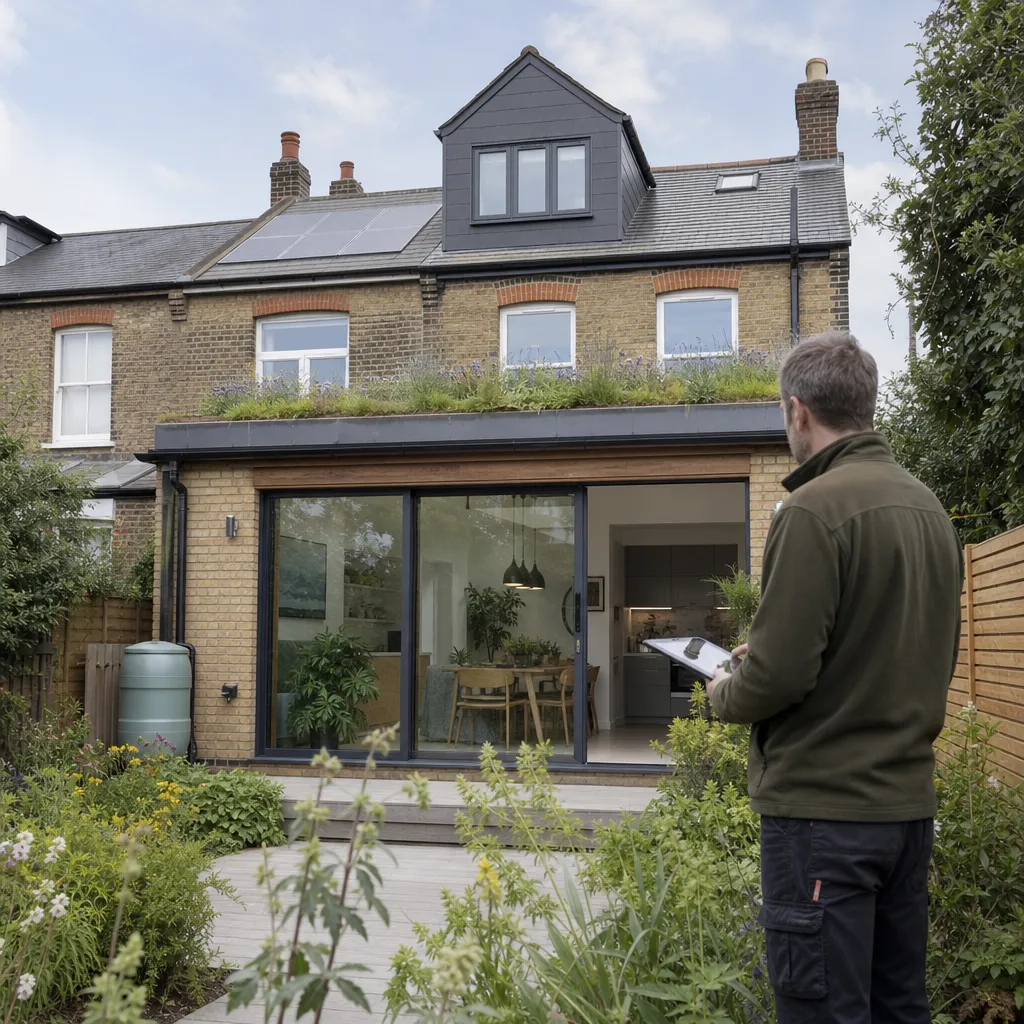
High-performance sustainable homes in the UK follow a fabric-first approach: maximise insulation and airtightness before adding low-carbon heating such as heat pumps, then layer in renewables like solar PV.
 Energy & Retrofit
Sustainable Homes: Features That Reduce Environmental Impact
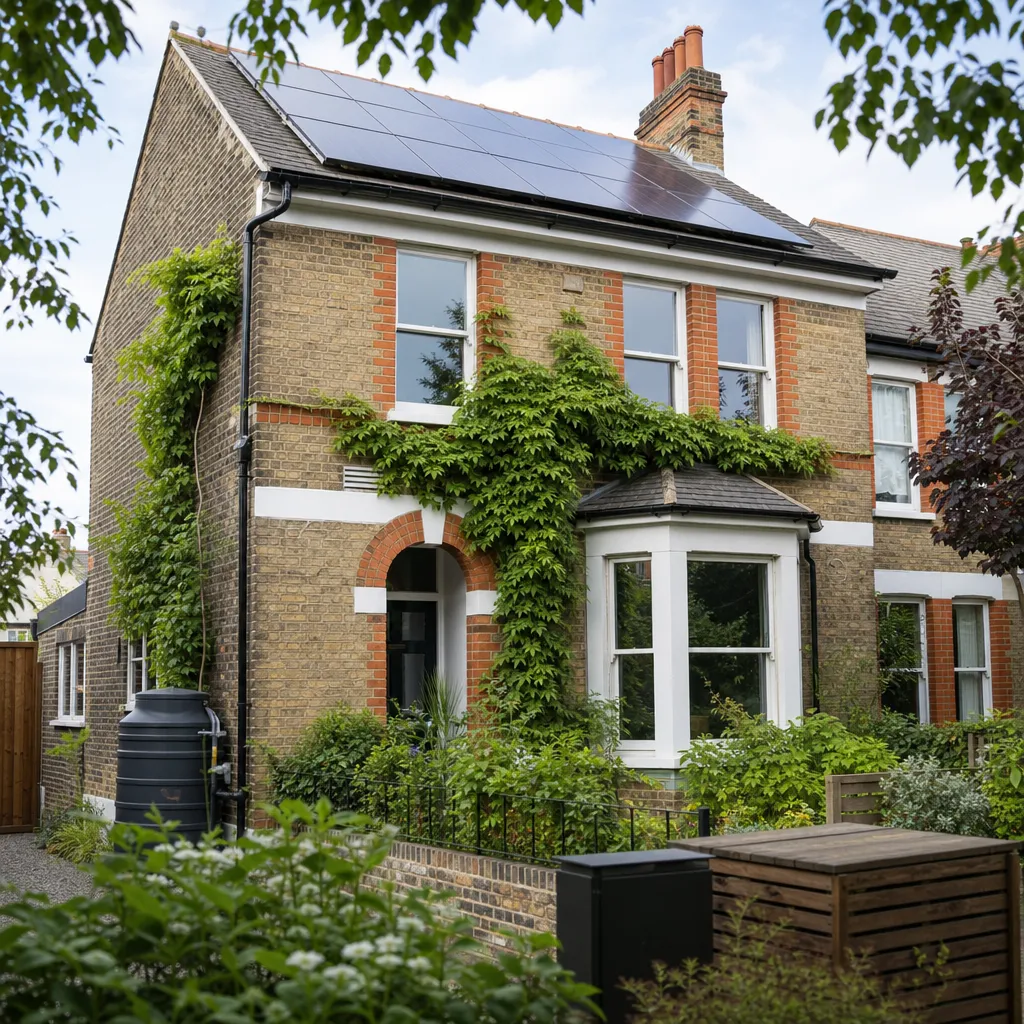
Sustainable homes reduce environmental impact through high levels of insulation, airtight construction, low-carbon heating such as heat pumps, solar energy generation, efficient water use, and responsibly sourced materials.
 Energy & Retrofit
Eco-Conscious Home Features for Sustainable Living
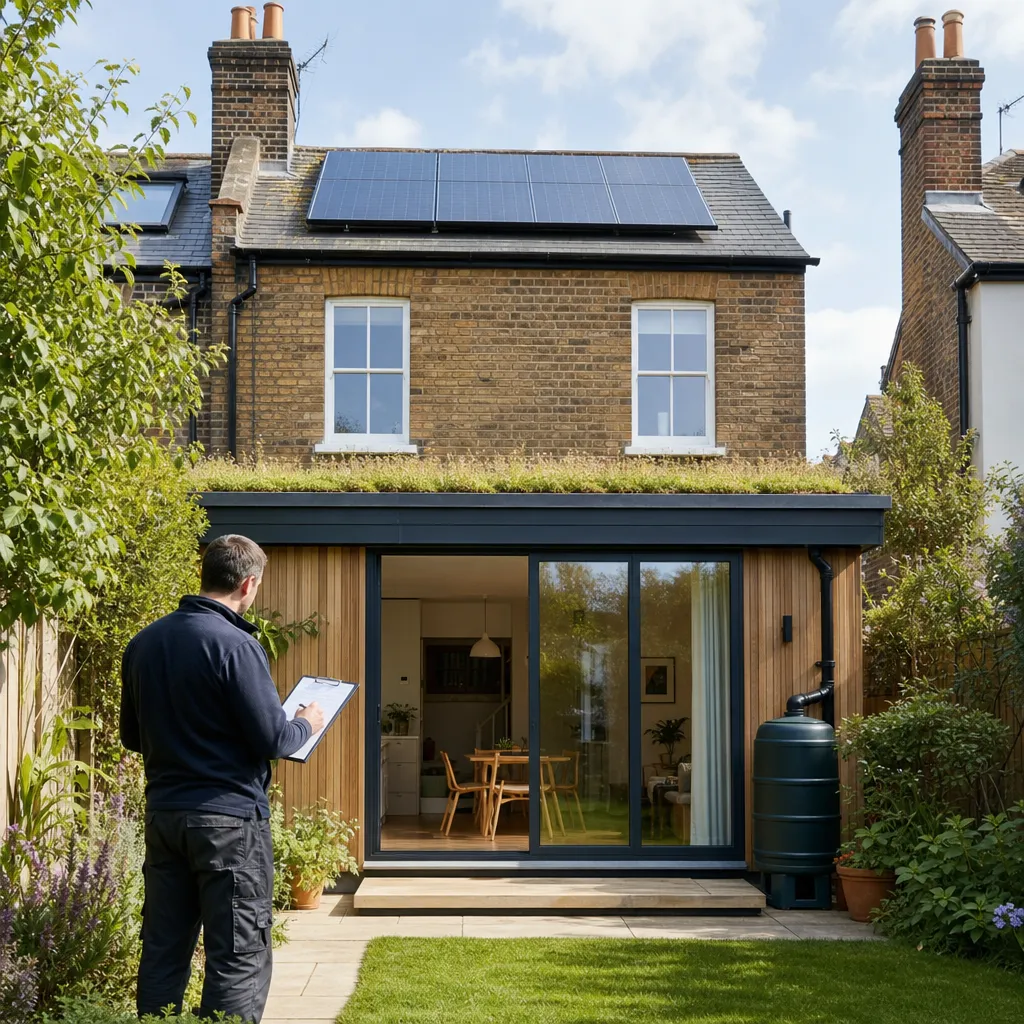
The highest-impact eco home features for UK homeowners are insulation, solar PV panels, air source heat pumps, and smart controls.
 Energy & Retrofit
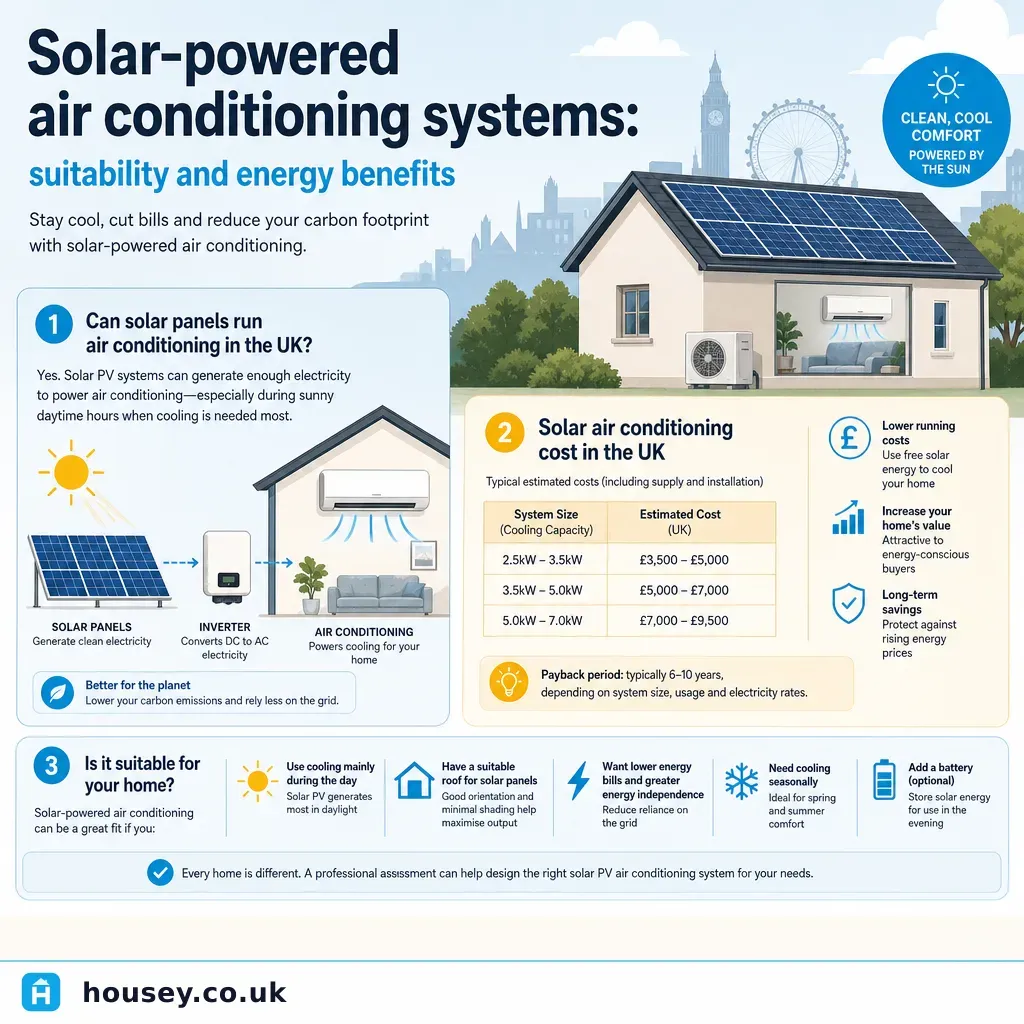
Solar-powered air conditioning systems: suitability and energy benefits
Solar-powered air conditioning pairs photovoltaic panels with an inverter-driven air conditioning unit to cool a home using renewable electricity.
 Energy & Retrofit
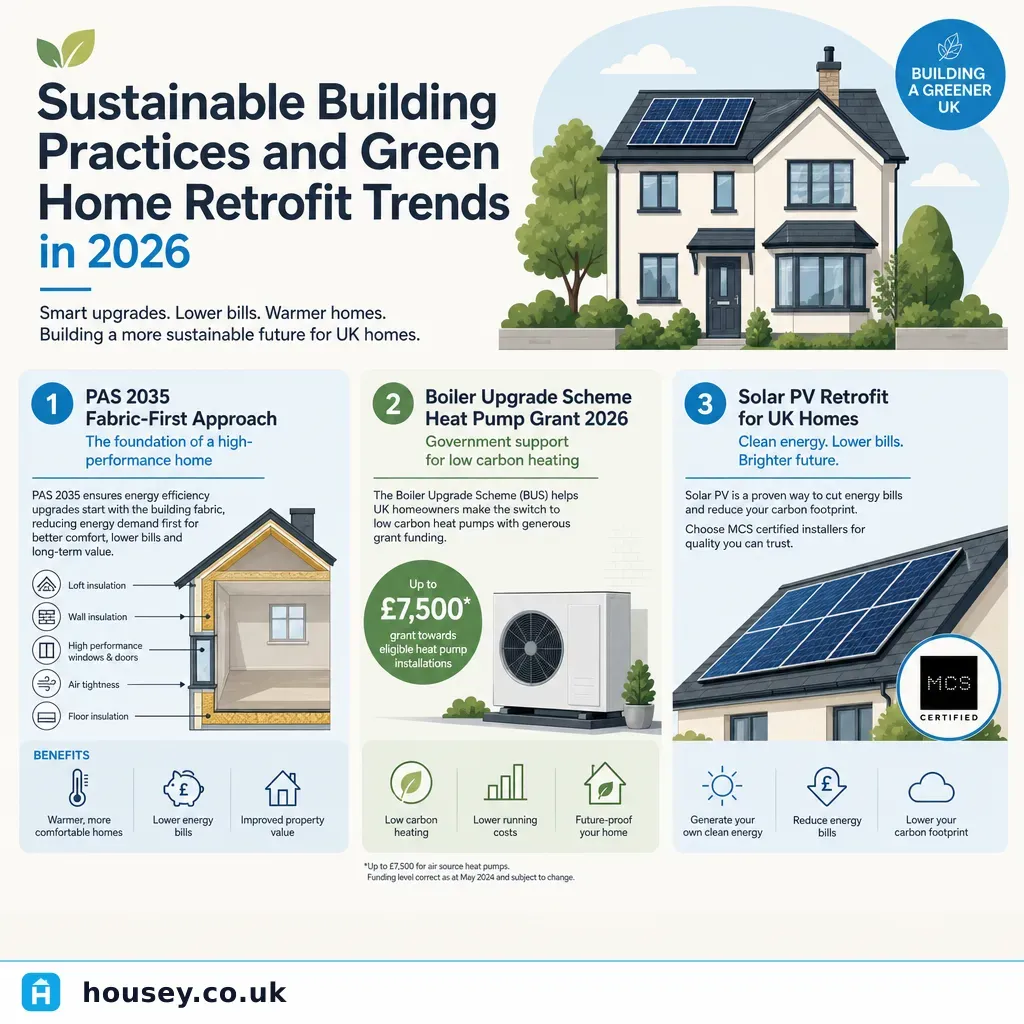
Sustainable Building Practices and Green Home Retrofit Trends in 2026
Green home retrofit in 2026 is shaped by PAS 2035's fabric-first principle, Boiler Upgrade Scheme grants of £7,500 for air source heat pumps, and growing solar PV adoption backed by the Smart Export Guarantee.