Sustainable Building Practices and Green Home Retrofit Trends in 2026
By Housey · Last reviewed 30th of May 2026
Sustainable Building Practices and Green Home Retrofit Trends in 2026
The transition to low-carbon homes is accelerating across the UK — driven by regulatory pressure, financial incentives, and the growing maturity of technologies such as heat pumps and solar PV. For homeowners considering renovation or retrofit projects in 2026, knowing which standards govern these works, which accreditations to look for, and where the genuine risks lie makes the difference between a well-sequenced improvement and a costly mistake.
Key points
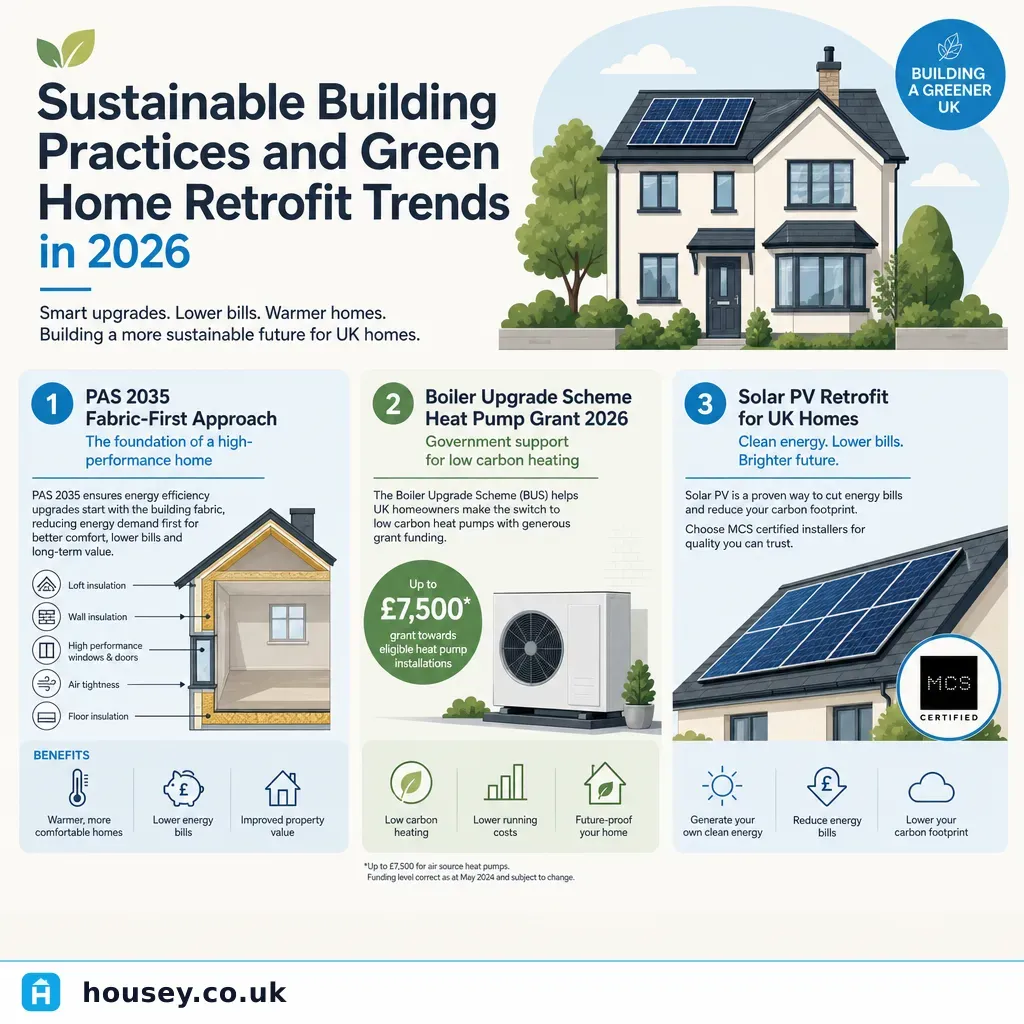
- The UK Government's Heat and Buildings Strategy targets 600,000 heat pump installations per year by 2028, with the Boiler Upgrade Scheme offering £7,500 grants toward air source heat pump installation.
- PAS 2035 (revised 2023) requires a fabric-first approach for all publicly funded retrofit work — insulation and airtightness must be addressed before installing low-carbon heating systems.
- MCS (Microgeneration Certification Scheme) certification is required for heat pump and solar PV installers in order for homeowners to access Boiler Upgrade Scheme grants or Smart Export Guarantee tariffs.
- Solar PV installations on UK homes have grown substantially, with the Smart Export Guarantee (SEG) enabling homeowners to receive payment for surplus electricity exported to the grid.
- EPC B or above is increasingly required by mortgage lenders offering green mortgage products, creating a financial incentive to improve energy performance beyond basic compliance.
What is driving green retrofit demand in 2026?
Several forces are converging to make 2026 a significant year for residential retrofit activity in the UK.
Regulatory pressure: The proposed tightening of Minimum Energy Efficiency Standards (MEES) toward EPC C for rental properties by 2030 is pushing landlords to act earlier, particularly as compliance timelines become clearer. Owner-occupiers, meanwhile, are increasingly aware that a low EPC rating can affect resale value and eligibility for green mortgage products.
Financial incentives: The Boiler Upgrade Scheme, ECO4, the Great British Insulation Scheme, and energy supplier tariffs have created a patchwork of funding that — when navigated correctly — can substantially reduce the upfront cost of retrofit measures.
Energy cost awareness: Although wholesale energy prices have eased from their 2022 peaks, the structural cost of heating an inefficient home remains significant. Homeowners planning extensions or heating system replacements are increasingly opting to combine those works with insulation upgrades and low-carbon heating.
Technology maturity: Heat pumps, solar PV, and battery storage systems have all reduced in installed cost over the past decade. Installers have greater experience, and the supply chain is more stable than during the post-pandemic period.
The fabric-first principle: why retrofit sequencing matters
PAS 2035 enshrines what the retrofit industry calls the "fabric-first" principle: the building envelope — walls, roof, floor, windows, and doors — should be addressed before upgrading or replacing heating systems. The rationale is sound: a heat pump operating in a poorly insulated home will run inefficiently, fail to reach target temperatures, and produce higher running costs than a correctly sized system in a properly insulated property.
A common and costly mistake is to install a heat pump without first addressing draughts, uninsulated walls, or a poorly performing roof. Equally, adding insulation to a home with existing moisture problems — without first addressing ventilation or the moisture source — can trap humidity and worsen damp, mould, and structural decay. Both risks illustrate why a qualified Retrofit Assessor should review your property before any measures are specified.
A retrofit assessment carried out by an accredited assessor will identify the right sequencing for your property, flag moisture or ventilation risks, and produce the document trail required for publicly funded works.
Comparing green retrofit measures: a quick reference guide
Measure | Typical heat-loss benefit | Best suited to | Indicative installed cost (2026) | Key accreditation needed |
|---|---|---|---|---|
Loft insulation (topping up) | Up to 25% reduction | Homes with accessible, unboarded loft space | £300–£600 | TrustMark or CHAS |
Cavity wall insulation | Up to 35% reduction | Post-1920s homes with unfilled cavity | £500–£1,500 | CIGA guarantee; TrustMark |
External wall insulation | Up to 40% reduction | Solid-wall pre-1919 homes | £8,000–£20,000+ | TrustMark; BBA-certified product |
Air source heat pump | Replaces gas boiler with low-carbon heat | Well-insulated homes with adequate airtightness | £10,000–£15,000 (before BUS grant) | MCS-certified installer |
Solar PV (4kWp system) | Reduces grid electricity consumption | South-facing roof with adequate pitch and space | £6,000–£9,000 | MCS-certified installer |
Battery storage | Increases solar self-consumption | Homes with existing solar PV | £2,500–£6,000 | MCS-certified installer |
Indicative UK costs, last reviewed 2026-05-30. Actual costs vary by property size, location, and site access. Always obtain multiple quotes.
Heat pumps in 2026: sizing, suitability, and grants
Heat pump uptake in the UK is accelerating, aided by the Boiler Upgrade Scheme grant of £7,500 for air source heat pumps. However, correct heat pump sizing is the most important factor in performance — an oversized pump short-cycles (switching on and off rapidly), reducing efficiency and component life, while an undersized pump fails to maintain indoor temperatures in cold weather.
Correct sizing requires a heat loss calculation (to BS EN 12831 or equivalent) that accounts for insulation levels, window areas, airtightness, and heat emitter sizing. This calculation should be carried out by an MCS-certified installer and should reflect any planned insulation upgrades. A heat pump survey by an MCS-certified engineer will assess suitability and produce a correctly sized specification for your property.
Solar PV and battery storage: 2026 market context
Solar PV continues to grow as an accessible retrofit measure. In 2026, a well-sized system (typically 3.5–6 kWp for an average family home) can meet a substantial proportion of annual electricity consumption, particularly when combined with battery storage or a heat pump. The Smart Export Guarantee (SEG) ensures homeowners receive payment for surplus generation exported to the grid, though export rates vary by supplier — compare tariffs before committing to an installer.
A solar survey assesses roof orientation, pitch, shading, structural condition, and existing electrical infrastructure to confirm technical viability and appropriate system sizing.
Important limitations
This article provides general information about green home retrofit trends and standards in the UK as of May 2026. It does not constitute technical, legal, or financial advice. Heat pump sizing, moisture risk from insulation, and compliance with PAS 2035 all depend on individual property characteristics — rules and risks vary and must be assessed by a qualified professional for your specific property. Grant eligibility criteria and funding availability change regularly: always verify current funding with GOV.UK or an accredited TrustMark or MCS installer before making decisions.
When to get professional help
Seek a qualified professional before proceeding if:
- You are planning a heat pump installation and have not yet assessed or improved your insulation and airtightness — installing before the fabric is prepared is a common source of poor performance and unexpectedly high running costs.
- You have noticed damp, condensation, or persistent mould — adding insulation without addressing moisture sources can significantly worsen these problems.
- Your home has solid walls, a flat roof, or non-standard construction.
- Your property is listed or in a conservation area — some retrofit measures require listed building consent or planning permission.
- You are applying for grant funding under ECO4, the Boiler Upgrade Scheme, or GBIS — all schemes require accredited professionals throughout the process.
What to ask a qualified professional
Before instructing any retrofit contractor or assessor, ask:
- Are you TrustMark-registered and, where applicable, MCS-certified for this type of work?
- Do you follow PAS 2035 — will you carry out or arrange a Retrofit Assessment before recommending measures?
- Have you carried out a heat loss calculation, and does it account for any planned insulation upgrades?
- What warranties and guarantees come with the installed measures?
- Can you confirm my eligibility for available grants (BUS, ECO4, GBIS) before starting work?
- What report, EPC update, or MCS certificate will I receive on completion?
- How will you manage ventilation and moisture risk during and after installation?
How Housey can help
Housey connects homeowners with accredited professionals across the full retrofit workflow — from initial scoping with an energy-efficiency consultant and a formal retrofit assessment through to heat pump surveys and solar surveys by MCS-certified engineers.
Frequently asked questions
Do I need planning permission for solar panels or a heat pump?
Most domestic solar PV installations are permitted development and do not require planning permission, provided they meet size limits and the property is not listed. Air source heat pumps on houses are also usually permitted development, subject to noise, siting, and size conditions. Listed buildings and conservation areas may need separate consent — check with your local planning authority if your property has any restrictions.
What is the Smart Export Guarantee and how much can I earn?
The Smart Export Guarantee (SEG) requires licensed electricity suppliers with more than 150,000 customers to offer a tariff for surplus solar electricity exported to the grid. Export rates vary by supplier, typically 1–15p per kWh in 2025–2026. Actual earnings depend on system size, household consumption, and the tariff chosen. Compare available tariffs before contracting with a solar installer.
How long does a retrofit assessment take?
A PAS 2035-compliant Retrofit Assessment typically involves a site visit of two to four hours for an average property, followed by a written report. The assessor inspects the construction, reviews the existing EPC, and assesses ventilation, moisture risk, and heating system condition. The completed report is a prerequisite for all publicly funded retrofit work under ECO4, GBIS, or the Social Housing Decarbonisation Fund.
Is a heat pump suitable for a Victorian terraced house?
Heat pumps can work in Victorian terraces but usually require solid wall insulation, thorough draught-proofing, and possibly radiator upgrades before installation. A detailed heat loss calculation is essential before any sizing decision is made. A heat pump survey by an MCS-certified engineer will confirm whether your specific property is a viable candidate and identify any preparatory works needed.
Sources and further reading
- Heat and Buildings Strategy — GOV.UK / DESNZ
- Boiler Upgrade Scheme guidance — GOV.UK
- PAS 2035:2019+A1:2023 — Retrofitting dwellings for improved energy efficiency — BSI Group
- Microgeneration Certification Scheme (MCS) — MCS
- Smart Export Guarantee — Ofgem
- Energy Saving Trust: air source heat pumps — Energy Saving Trust
Useful next reads
 Energy & Retrofit
Sustainable Homes: Features That Reduce Environmental Impact
Sustainable homes reduce environmental impact through high levels of insulation, airtight construction, low-carbon heating such as heat pumps, solar energy generation, efficient water use, and responsibly sourced materials.
 Energy & Retrofit
Eco-Conscious Home Features for Sustainable Living
The highest-impact eco home features for UK homeowners are insulation, solar PV panels, air source heat pumps, and smart controls.
 Energy & Retrofit
Why UK Homebuyers Prioritise Energy-Efficient Properties And How To Improve Yours
UK homebuyers increasingly favour energy-efficient properties because lower EPC ratings translate directly to higher heating bills — a significant concern after the 2021–23 energy crisis.
 Energy & Retrofit
Designing and Building High-Performance Sustainable Homes with Eco-Friendly Systems
High-performance sustainable homes in the UK follow a fabric-first approach: maximise insulation and airtightness before adding low-carbon heating such as heat pumps, then layer in renewables like solar PV.
 Energy & Retrofit
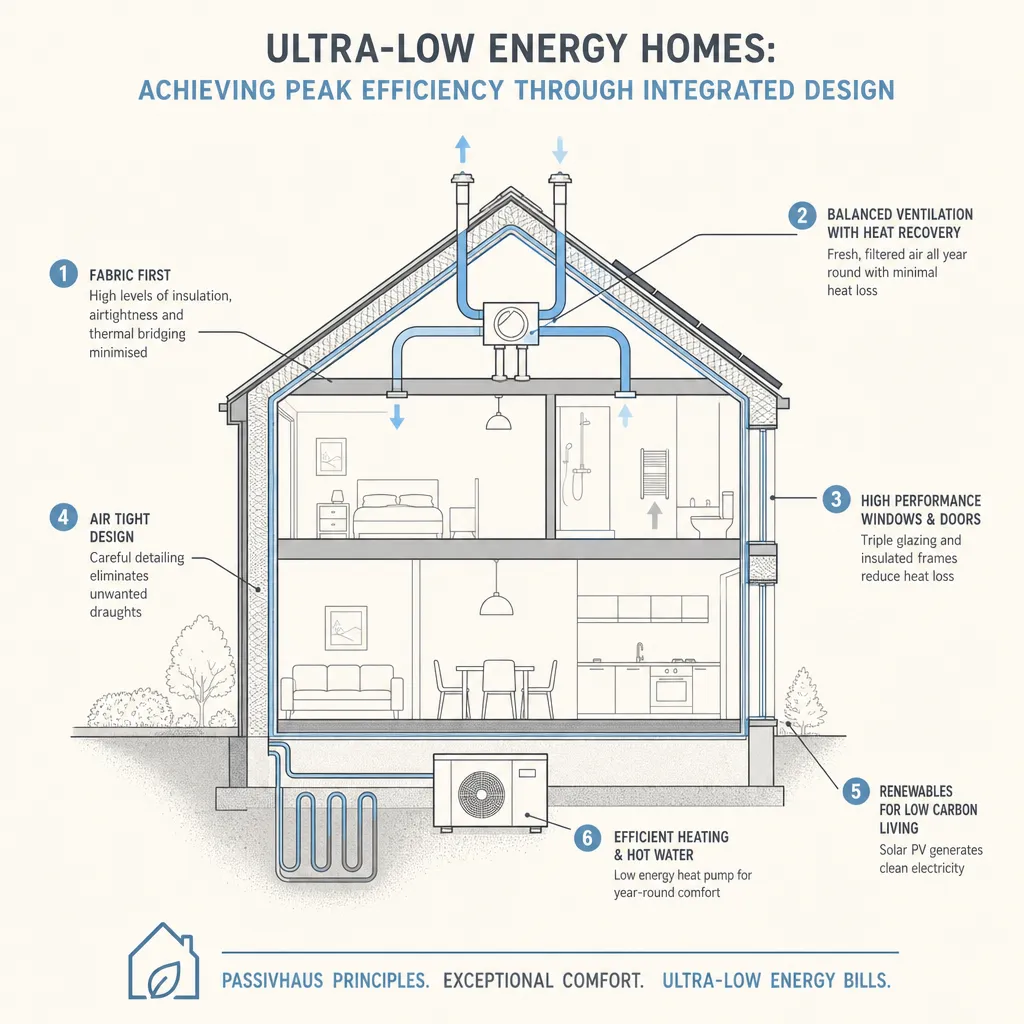
Ultra-Low Energy Homes: Achieving Peak Efficiency Through Integrated Design
Ultra-low energy homes reduce heating demand through high-performance insulation, airtight construction, and mechanical ventilation with heat recovery (MVHR).