Economic Indicators Point to Growing Residential Construction Demand
By Housey · Last reviewed 30th of May 2026
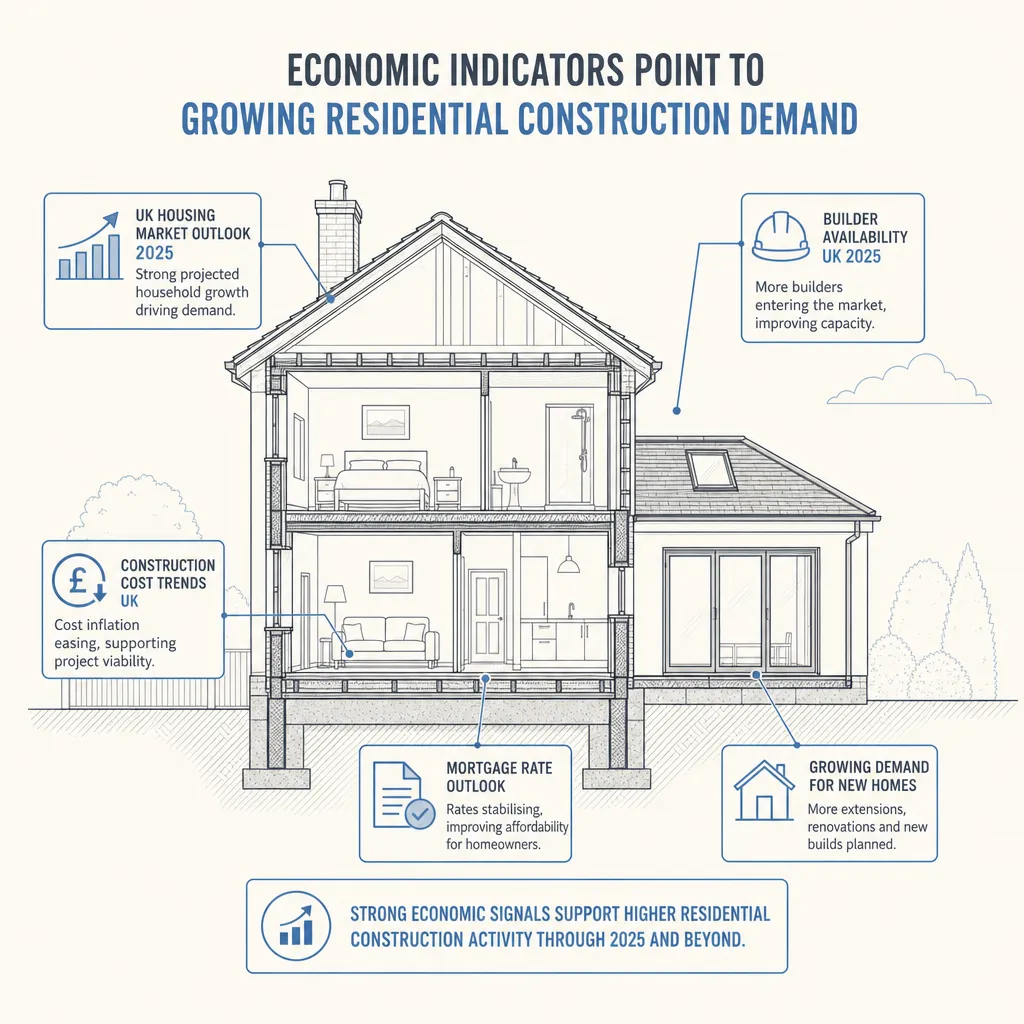
Economic Indicators Point to Growing Residential Construction Demand
UK homeowners planning extensions, renovations, or self-build projects are making decisions in a property market shaped by interest rates, planning policy, and builder availability. Whether you are finalising plans for a rear extension, commissioning a loft conversion, or thinking about a new build, understanding where the construction market sits — and where it appears to be heading — helps you time projects, set realistic budgets, and approach contractors with greater confidence.
Key points
- The Bank of England began cutting its base rate in August 2024 from a peak of 5.25%, reducing borrowing costs for homeowners financing improvement projects through remortgaging or secured lending.
- The UK Government has set a target of 1,500,000 new homes in England over this Parliament, with the Ministry of Housing, Communities and Local Government (MHCLG) introducing mandatory housing targets for local authorities.
- The Federation of Master Builders (FMB) State of Trade Survey tracks builder workloads and material availability on a quarterly basis — one of the most useful public indicators of builder capacity and lead times in the UK.
- ONS construction output figures consistently show that repair and maintenance accounts for a significant proportion of total UK construction output, reflecting sustained demand from the existing housing stock regardless of new-build cycles.
- Materials cost inflation eased through 2024 after sharp rises between 2021 and 2023, though prices remain above pre-pandemic levels according to the ONS Producer Price Index for construction materials.
What current economic conditions mean for builder demand
Several converging factors are influencing residential construction demand in 2025 and 2026.
Interest rate direction. As the Bank of England's base rate falls from its 2023 peak, mortgage affordability improves and homeowners who deferred improvement projects during the high-rate period are beginning to commission work. This pent-up demand is gradually feeding into builder workloads across the country.
Government housing targets. The government's 1.5 million homes target for England places significant pressure on the construction sector's capacity. New-build activity competes directly with the home improvement sector for skilled tradespeople — bricklayers, joiners, plasterers, and roofers. In areas of strong new-build activity, finding available subcontractors for extension or renovation work may take considerably longer.
Planning reforms. The Planning and Infrastructure Bill, introduced in Parliament in 2025, proposes reforms to speed up planning decisions and in some areas expand permitted development rights. If implemented, this could unlock more self-build and extension projects, adding further to demand for builders and design-and-build services.
Labour availability. The construction workforce faces structural pressures: an ageing skilled workforce, reduced European labour inflows since Brexit, and competing demand from public infrastructure projects. The CITB publishes annual Construction Skills Network forecasts tracking recruitment needs across trades and regions.
How to read local demand signals
Homeowners do not need to follow economics reports to gauge construction demand in their area. These practical signals give a clear picture:
Signal | What it suggests | What to do |
|---|---|---|
Builders quoting 6 or more months ahead | High local demand; limited near-term capacity | Book early; get written quotes with clear validity periods |
Multiple contractors declining to quote | Very high demand or project too small for current workloads | Consider design-and-build firms who manage subcontractors directly |
Material lead times flagged in quotes | Supply chain pressure in specific product areas | Request itemised quotes; agree a materials-cost clause for longer projects |
Quotes varying by 30% or more between contractors | Healthy competition or scope ambiguity | Verify scope is identical across all quotes; request itemised breakdowns |
Poor communication or no-shows before contract | Overstretched contractor | Walk away — a contractor already struggling to respond will not serve you well on site |
Which project types are seeing the strongest demand
Demand across the residential improvement sector is not uniform. Different project types are driven by different pressures.
Extensions and loft conversions are consistently popular as homeowners choose to trade up space rather than move, given high stamp duty and conveyancing costs. Demand is particularly strong in commuter belt and suburban areas where moving costs are prohibitive relative to the cost of improving in place.
Retrofit and energy efficiency works are growing steadily — driven by EPC requirements for rental properties, rising energy bills, and government grant schemes such as the Boiler Upgrade Scheme and Great British Insulation Scheme.
Structural repairs and maintenance provide a stable baseline of demand unaffected by interest rate cycles — an ageing housing stock requires ongoing investment regardless of wider market conditions.
New builds and self-build projects are rising from a relatively low base as planning reforms and infrastructure investment begin to unlock sites and simplify processes.
Decision guide: when and how to commission your project
- Choose to proceed now if you have approved plans or permitted development confirmation, a clear specification, and at least three competitive written quotes with fixed validity periods.
- Book a contractor early if your project is planned for spring or summer — demand peaks in the warmer months and contractors in many areas book several months in advance.
- Wait and review if you are still finalising drawings or awaiting a planning decision — rushing contractor engagement before the design is complete typically increases cost and risk.
- Consult a design-and-build firm if your project involves multiple trades and you lack the time or experience to manage them — a single point of contact is often more efficient in a tight labour market.
- Reassess your budget if all quotes come in significantly above your estimate — this frequently reflects current market pricing rather than scope errors; benchmarking against BCIS (Building Cost Information Service) data can help.
- Ask a chartered surveyor or structural engineer before appointing a contractor if your project involves removing walls, altering load-bearing elements, or you have noticed cracking or movement in the structure.
Red flags in the current market
Rising demand brings heightened risk from poor-quality or unfinished work. Watch for these warning signs before signing any contract:
- Contractors demanding large upfront payments — more than 10–20% of total contract value — before work begins.
- Quotes with no written contract, no itemised breakdown, or no clear payment schedule.
- No evidence of current public liability insurance or relevant trade accreditation such as FMB membership or NHBC registration.
- Verbal-only changes to scope during the project — always insist on written variations before additional work proceeds.
- Pressure to start immediately without a proper site survey or detailed written specification.
- Unwillingness to provide references from recent comparable projects in your area.
When to get professional help
For projects above a modest scale — typically extensions, structural alterations, or any work requiring building regulations approval — engaging a chartered architect, architectural technologist (CIAT-qualified), or project manager before approaching contractors is advisable. A professional can produce drawings and a specification that allows like-for-like quotes, manage the tender process, evaluate submissions, act as contract administrator certifying payment stages against completed work, and identify any planning or building control requirements before a spade goes in the ground. If you are uncertain whether your project requires planning permission, consult your local planning authority or use the Planning Portal's permitted development guidance for householders.
How Housey can help
Housey connects UK homeowners with vetted extension builders and design-and-build firms suited to your project type, scale, and location. Whether you are at the early planning stage or ready to obtain competitive quotes, Housey's matching service provides access to qualified contractors who cover your area.
Frequently asked questions
Is now a good time to hire a builder for a home extension?
Demand for residential builders is high across much of the UK as interest rates fall and homeowners recommission deferred projects. Lead times in many areas extend to several months. Engaging contractors well ahead of your intended start date, obtaining multiple written quotes, and checking FMB or trade body membership gives you the best chance of securing a good contractor at a competitive price.
Why are builder quotes so high at the moment?
Construction costs rose sharply between 2021 and 2023 due to materials price inflation and labour shortages. Although materials inflation has eased, labour costs remain elevated and builder capacity is constrained by competing new-build programmes. Obtaining multiple quotes from accredited contractors and comparing itemised breakdowns — rather than headline totals — helps ensure you are paying market rate.
How do government housing targets affect my home improvement project?
The government's 1.5 million homes target increases demand for skilled construction labour, which can reduce availability for home improvement contractors. Planning reforms may also unlock more self-build and extension projects, adding to aggregate demand. In areas with active new-build programmes, homeowners may find longer lead times and reduced contractor availability for renovation work.
Should I use a fixed-price or cost-plus contract for my builder?
A fixed-price contract provides cost certainty but may include a contingency for material price volatility. A cost-plus contract can be lower if material prices fall, but carries more financial risk for you. For most homeowner extension projects, a fixed-price contract with a clearly defined variation procedure is generally recommended. Always get any agreement in writing before work starts.
Sources and further reading
- Bank of England: Monetary Policy and Bank Rate — Bank of England
- Housing Statistics and Research — Ministry of Housing, Communities and Local Government
- FMB State of Trade Survey — Federation of Master Builders
- Construction Output in Great Britain — Office for National Statistics
- Construction Skills Network — Construction Industry Training Board (CITB)
Useful next reads
 Improvement & Build
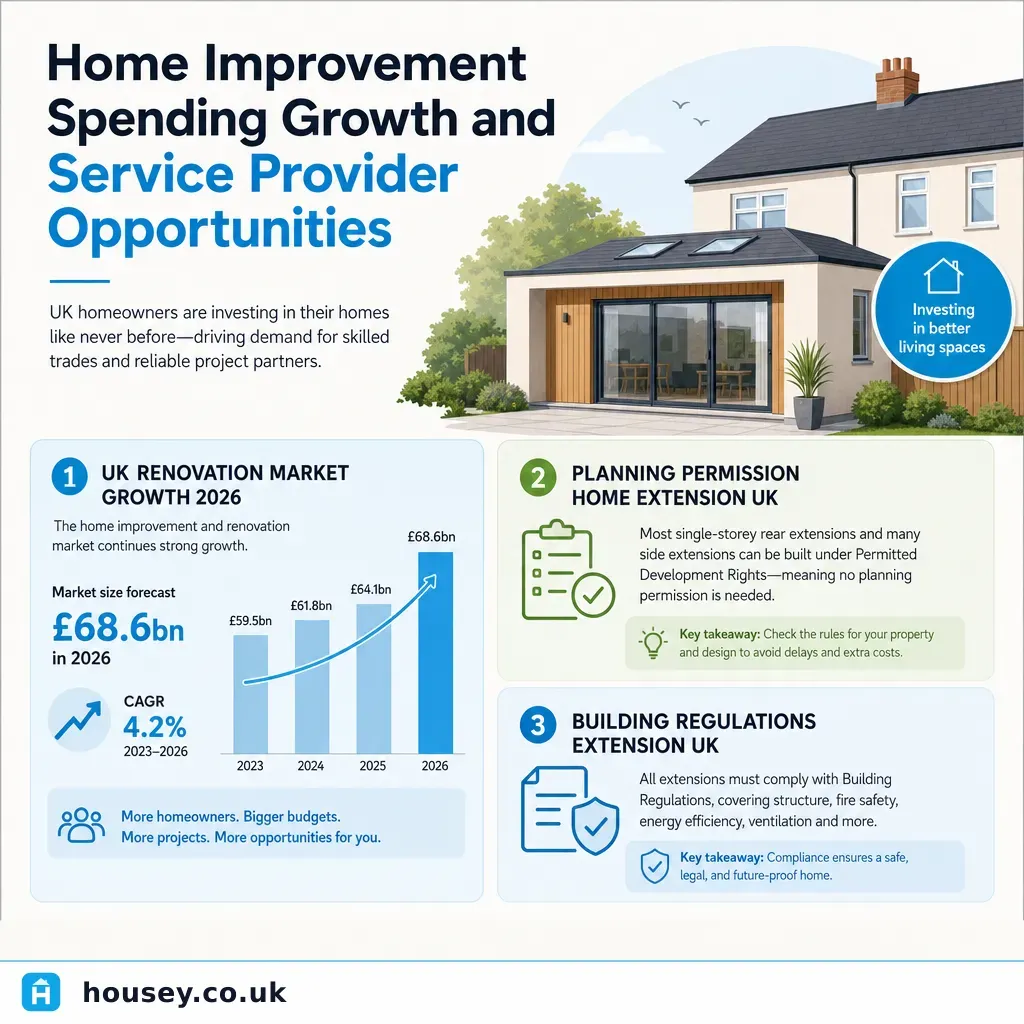
Home Improvement Spending Growth and Service Provider Opportunities
UK home improvement spending has remained elevated as subdued housing transactions push homeowners to invest in their existing properties.
 Improvement & Build
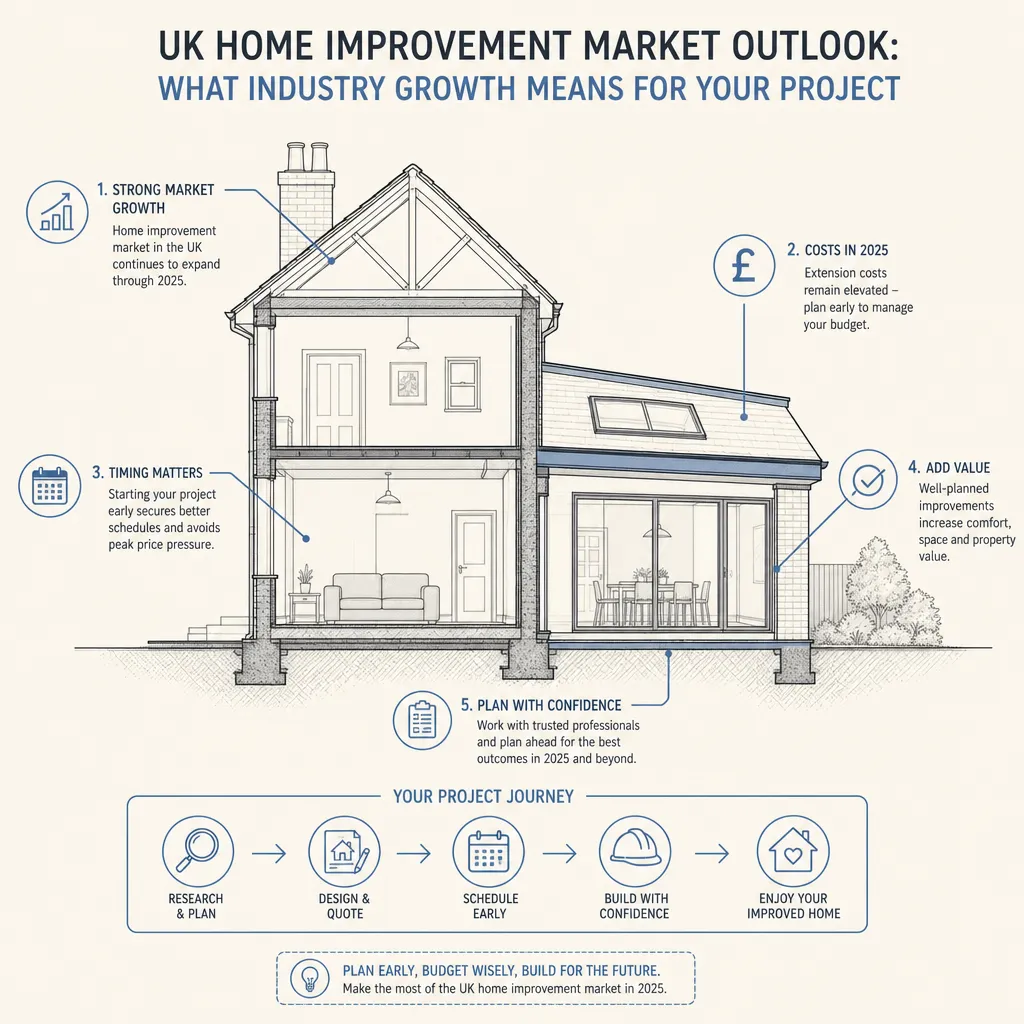
UK Home Improvement Market Outlook: What Industry Growth Means for Your Project
During periods of growth in the UK home improvement market, contractor lead times lengthen, material costs rise, and builders become more selective about which projects they tender for.
 Improvement & Build
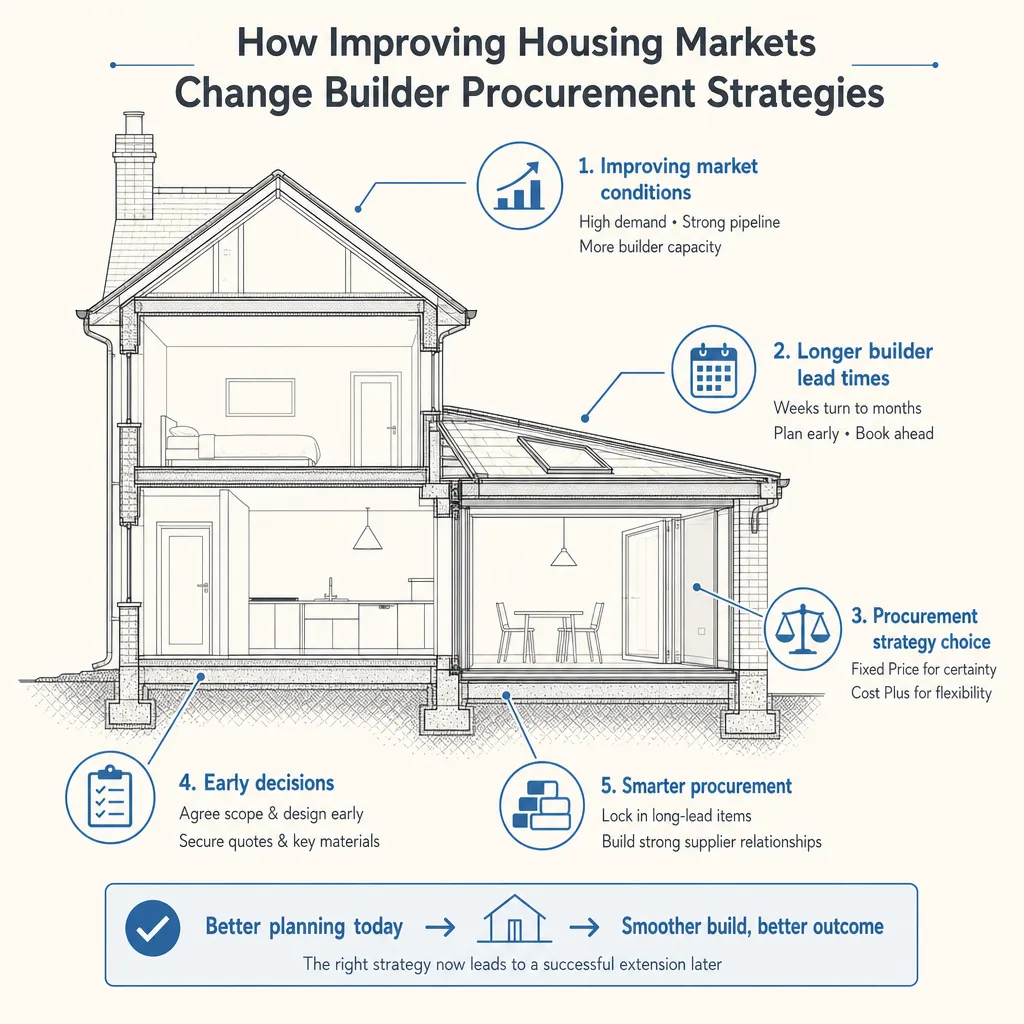
How Improving Housing Markets Change Builder Procurement Strategies
When the UK housing market improves, builders typically see a surge in enquiries, which extends lead times, raises minimum contract values and makes reputable contractors more selective.
 Improvement & Build
Roofing Market Expansion Trends and Service Demand Outlook
UK roofing demand remains strong and growing, driven by an ageing housing stock, energy efficiency requirements under Approved Document L, and increasing storm-related damage.
 Improvement & Build
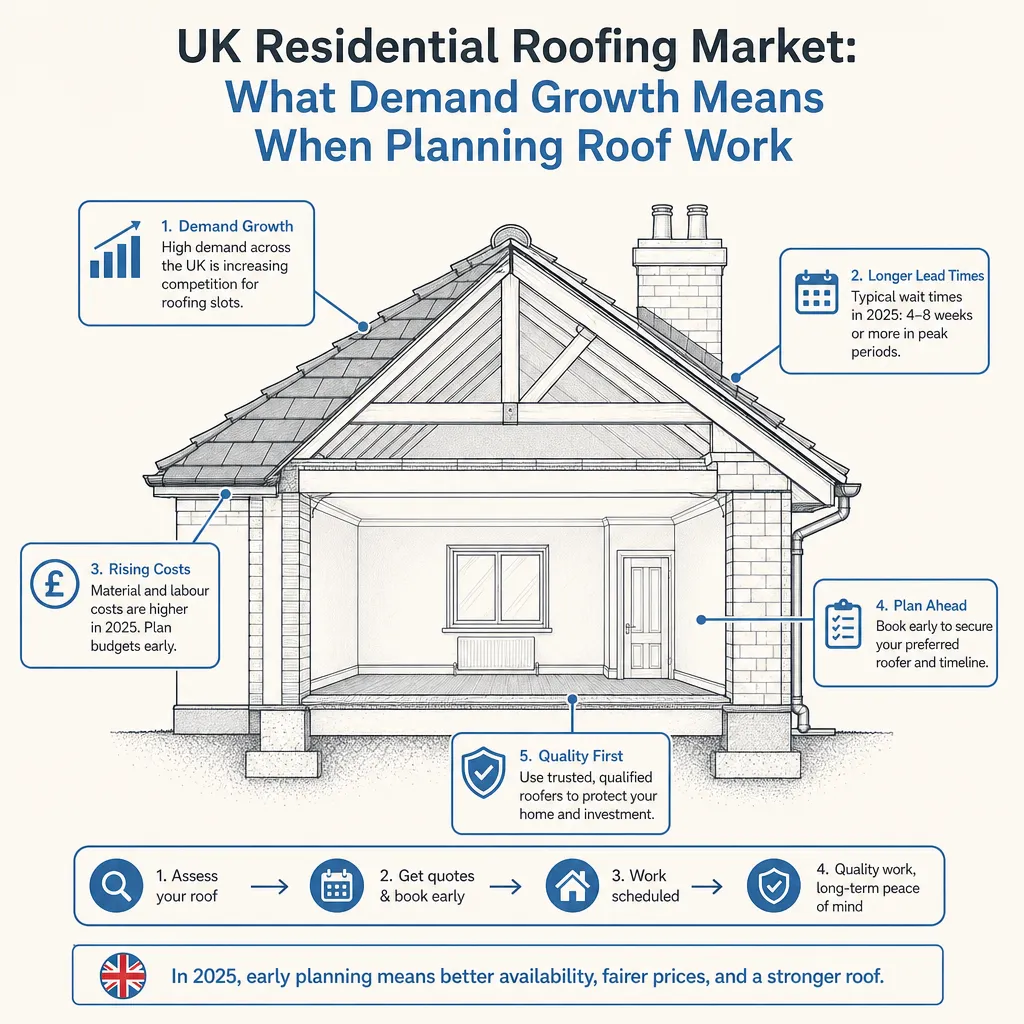
UK Residential Roofing Market: What Demand Growth Means When Planning Roof Work
Rising demand in the UK roofing market typically extends lead times from 4–8 weeks to 3–6 months and puts upward pressure on costs.