How Improving Housing Markets Change Builder Procurement Strategies
By Housey · Last reviewed 31st of May 2026
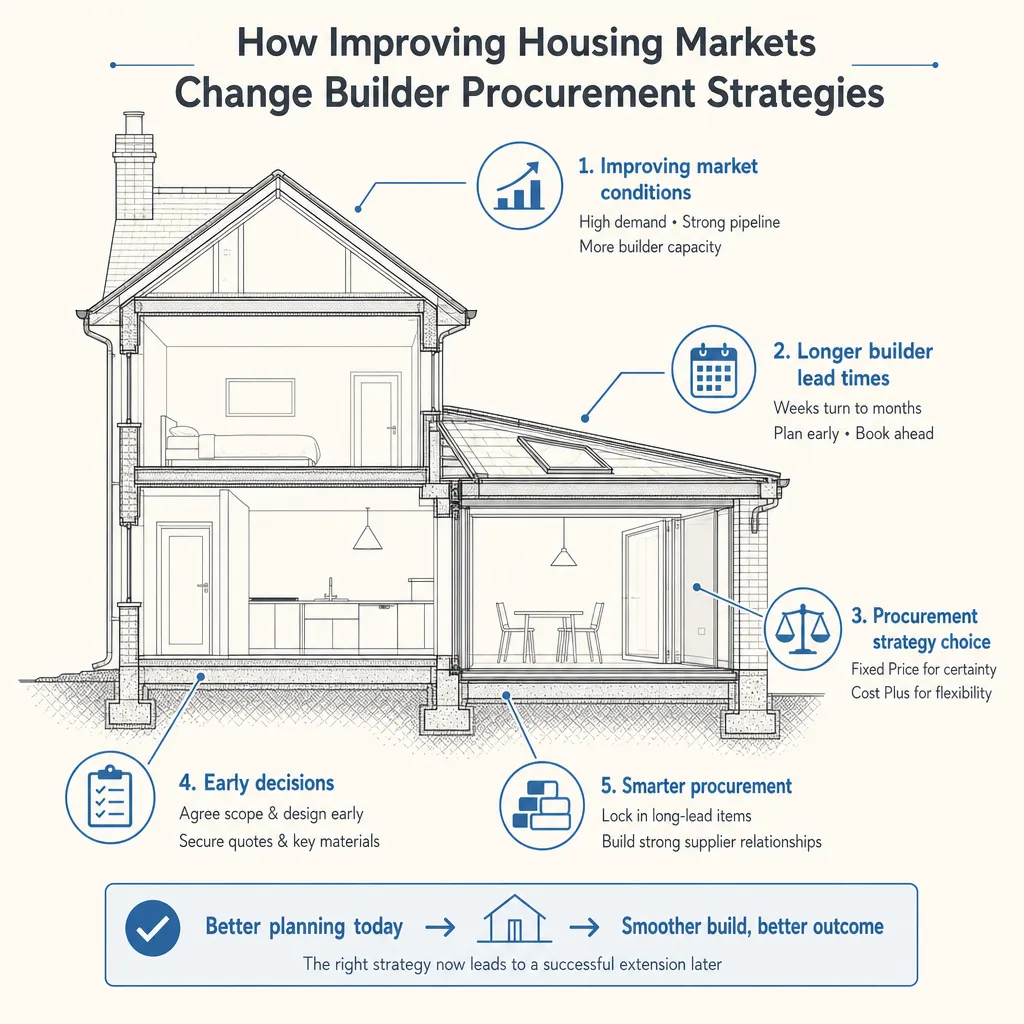
How Improving Housing Markets Change Builder Procurement Strategies
When transaction volumes rise, remortgaging activity increases, and homeowners opt to extend rather than move, the ripple effect on UK construction procurement is significant — yet rarely explained to the people who need to navigate it. For anyone planning an extension, refurbishment, or new build, understanding how builders respond to a strengthening market is practical intelligence that can save months of delay and thousands of pounds.
Key points
- In high-demand periods, lead times with established UK contractors can stretch to 6–12 months or longer for projects such as two-storey extensions or major refurbishments.
- JCT and NEC construction contracts often include fluctuation clauses allowing material and labour cost adjustments mid-project — important to understand before signing.
- Build UK's quarterly surveys consistently identify labour availability and material costs as the top two capacity constraints when the residential construction market is active.
- Design-and-build procurement — where one firm handles both design and construction — often provides greater cost certainty when supply chains are under pressure.
- Smaller domestic jobs (typically under £15,000–£25,000) may be deprioritised by larger contractors in busy periods, making specialist smaller firms more competitive at this scale.
Why housing market conditions ripple into your build project
When property values are rising and transaction volumes increase, two things happen in parallel that affect any homeowner hiring a contractor. First, demand for construction work surges — from buyers renovating newly purchased homes, from homeowners adding space rather than upsizing, and from landlords repositioning rental stock. Second, the cost and availability of materials and skilled labour come under pressure at the same time.
For builders, this means choice: they can accept more work at higher margins, become more selective about project type and complexity, or focus on clients who can demonstrate readiness — planning permission in hand, finance confirmed, clear specifications. For homeowners, it means longer waits, higher prices, and the need to plan further ahead than the market conditions of a year ago might have suggested.
The Chartered Institute of Building (CIOB) has documented repeated cycles in which contractor capacity tightens within months of an upturn in residential output. Understanding where the market is in that cycle — and how to position your project accordingly — is the first practical step.
How procurement routes compare in a busy market
When contractors are selective, the procurement route you choose affects both your chances of securing a committed team and your exposure to cost risk.
Procurement route | How it works | Best for | Risk in a busy market |
|---|---|---|---|
Traditional (separate designer then contractor) | Architect completes drawings; homeowner tenders to separate contractors | Complex projects where design detail matters most | Tendering delay; prices may rise between design completion and build stage |
Design-and-build | Single firm handles design and construction under one contract | Speed, cost certainty, single point of accountability | Less design control; quality varies significantly by firm |
Direct labour (homeowner manages trades) | Homeowner hires and coordinates each trade directly | Maximum control on straightforward refurbishments | High management burden; individual trade availability hardest to secure |
Main contractor with subcontractors | Main contractor prices and manages all trades | Most domestic extension and conversion work | Main contractor may subcontract to trades with capacity gaps |
For most homeowners planning an extension or conversion, a design-and-build firm or an experienced main contractor with a clear JCT Homeowner Contract is often the most resilient option when lead times are stretched.
Contractor pricing and the fluctuation clause question
In a stable market, many builders quote fixed prices for domestic work and absorb minor material price changes within their margin. When input costs are volatile — as seen in the UK between 2021 and 2024, when structural timber, insulation, and masonry products all saw significant price movements — contractors increasingly include fluctuation clauses or provide time-limited quotes.
A fluctuation clause in a JCT Minor Works or Homeowner Contract permits the contract sum to be adjusted if specific input costs change beyond an agreed threshold. Before you accept a quote in a rising market, establish clearly:
- Whether the price is fixed for the full contract duration.
- If not, what triggers a price adjustment, and how is it calculated?
- How long the quoted price is valid (many builders now quote for 30–60 days rather than 90).
The Joint Contracts Tribunal (JCT) publishes standard domestic building contracts, including the Homeowner Contract, which sets out rights and responsibilities for both parties.
Securing a contractor: a worked scenario
The following illustrates a common planning challenge in a rising market.
Worked scenario — Bristol, 1930s semi-detached, spring 2025: A homeowner wants a single-storey rear kitchen extension. After enquiring with four local builders, they find wait times of 5–10 months for project starts. By appointing a design-and-build firm six months ahead of their preferred start date, commissioning drawings immediately, and agreeing a JCT Homeowner fixed-price contract with a 60-day price validity window, they lock in costs before the next quarterly material price review and secure a confirmed slot on the contractor's programme.
Key actions that made the difference:
- Starting the contractor search 8–10 months before the desired completion date.
- Having a permitted development confirmation resolved before approaching contractors.
- Accepting a longer design phase to allow tendering in parallel, rather than sequencing design then procurement.
What to ask a contractor before accepting a quote
- Are you available to start within my preferred window, and what factors could delay your programme?
- Is your quote fixed-price for the full contract duration, or does it include fluctuation provisions?
- How do you manage material purchasing — do you buy forward, or order on delivery?
- What subcontractors will you use, and are they confirmed for my project dates?
- What happens if a key material becomes significantly more expensive by the time you need to order it?
- What contract will we use, and does it include a staged payment schedule?
- Is VAT included in your quote?
- Who is the named individual responsible for day-to-day site management?
When to get professional help
For any project over £20,000, or any work requiring building regulations sign-off — which covers most extensions, conversions, and structural alterations — appointing a professional to assist with procurement, such as an architect, project manager, or RICS-regulated quantity surveyor, is worth considering. This becomes especially important in a busy market where less experienced contractors may try to fill capacity gaps.
Seek professional help if:
- A contractor quotes significantly below the market range without clear justification.
- A contractor refuses to use a standard written contract.
- You are asked to pay more than a 10–15% deposit before work begins.
- The contract contains no clear mechanism for resolving disputes.
How Housey can help
Housey connects homeowners with vetted extension builders and design-and-build firms across the UK. Whether you are planning a kitchen extension, rear addition, or full refurbishment, Housey lets you compare quotes from qualified local contractors and find a team with genuine capacity to deliver your project.
Frequently asked questions
Why are builder lead times so long at the moment?
Lead times extend when demand for building work outpaces the available supply of skilled tradespeople and project management capacity. In improving market conditions, the most reputable firms — with established track records and references — fill their programmes first. Smaller or newer firms may have shorter wait times but carry more delivery risk, so checking credentials and references thoroughly remains important.
Should I get a fixed-price or cost-plus contract?
For most homeowners, a fixed-price contract such as a JCT Homeowner Contract provides greater certainty and is preferable unless the scope of work is genuinely unclear at the outset. Cost-plus arrangements transfer financial risk to you and are generally only appropriate for complex renovations where the full scope cannot be defined before work begins.
Is design-and-build worth it for a home extension?
Design-and-build can be a good option when cost certainty and a single point of contact matter more than maximum design control. Check the firm's track record on similar projects, confirm their design team's qualifications, and agree the full specification in writing before the contract is signed. Comparing at least three firms before committing is advisable regardless of market conditions.
Sources and further reading
- JCT Homeowner Contract guidance — Joint Contracts Tribunal
- Build UK industry surveys and contractor capacity data — Build UK
- Construction output statistics — Office for National Statistics
- CIOB research on construction procurement — Chartered Institute of Building
- Building regulations approval guidance — GOV.UK
Useful next reads
 Improvement & Build
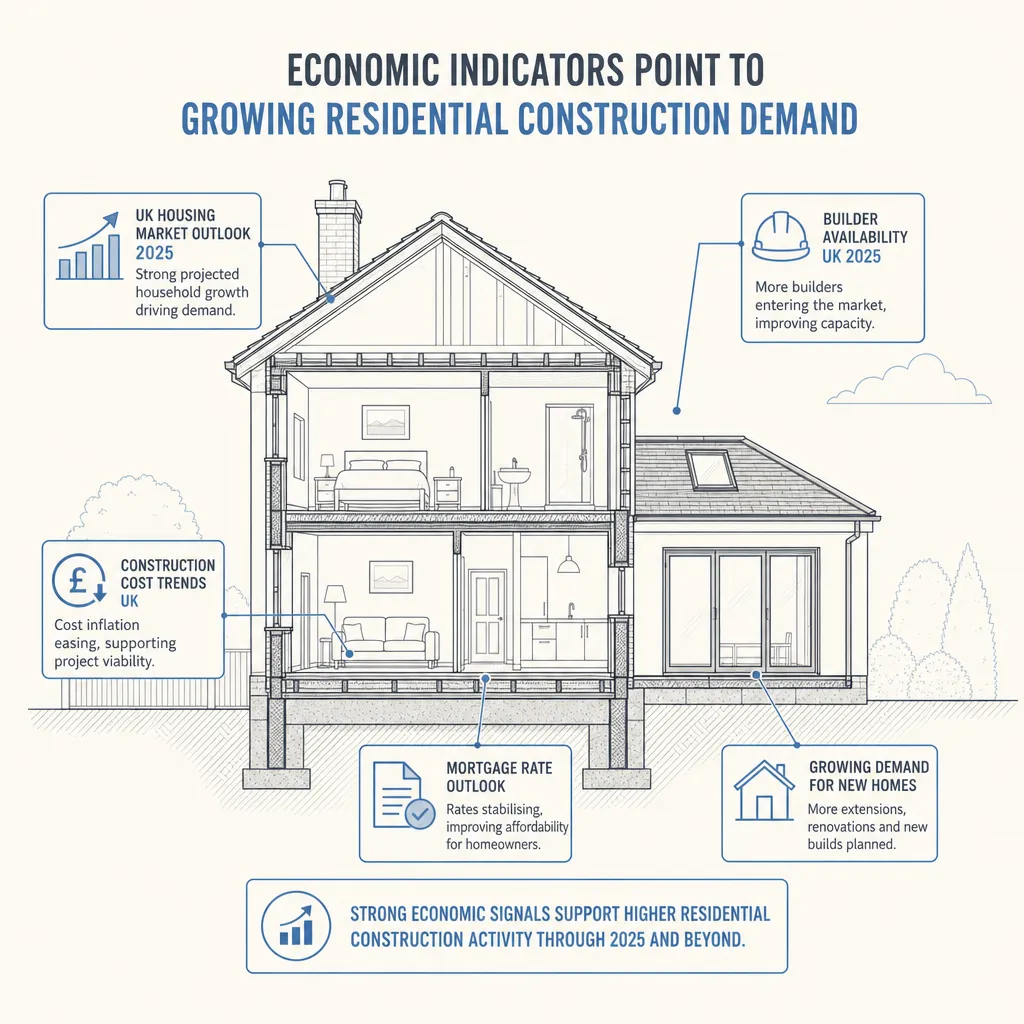
Economic Indicators Point to Growing Residential Construction Demand
Falling interest rates, the government's 1.
 Improvement & Build
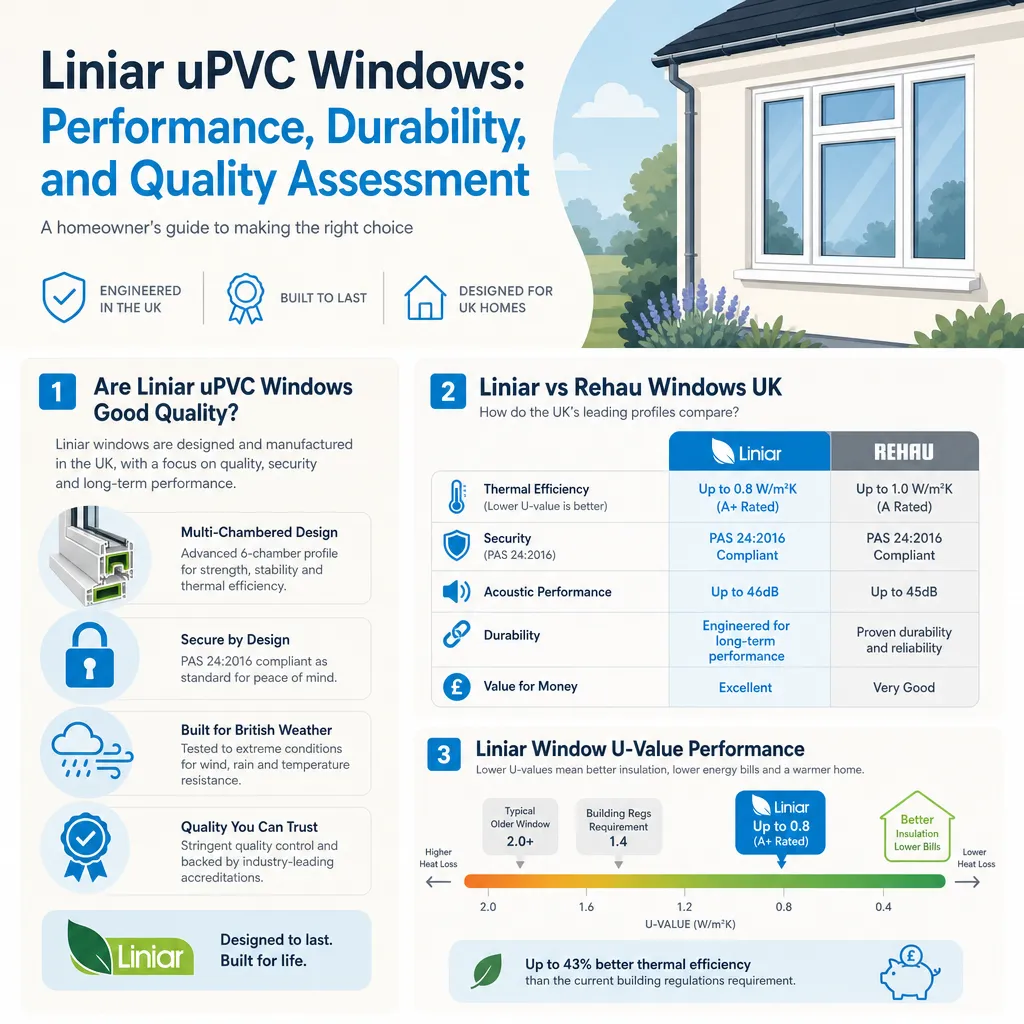
Liniar uPVC Windows: Performance, Durability, and Quality Assessment
Liniar uPVC window profiles are manufactured in the UK using multi-chambered, foamed frames.
 Improvement & Build
Garden Tap Installation with Hot and Cold Water: Plumbing Options
Adding a cold garden tap is a common DIY project, but routing hot water outdoors requires a plumber to connect to your domestic hot water system and comply with the Water Supply (Water Fittings) Regulations 1999.
 Improvement & Build
Sealing and Maintaining Historic Leaded Glass Windows: Preservation and Performance
Leaded glass windows are maintained using traditional linseed oil cement — not silicone or modern sealants, which prevent natural movement in the lead came.
 Improvement & Build
Greenhouse Construction: Glass Versus Polycarbonate Materials
Glass transmits around 90% of available light and lasts indefinitely if unbroken, but insulates poorly and shatters into sharp fragments.