Egress Window Installation and Emergency Exit Costs
By Housey · Last reviewed 6th of May 2026
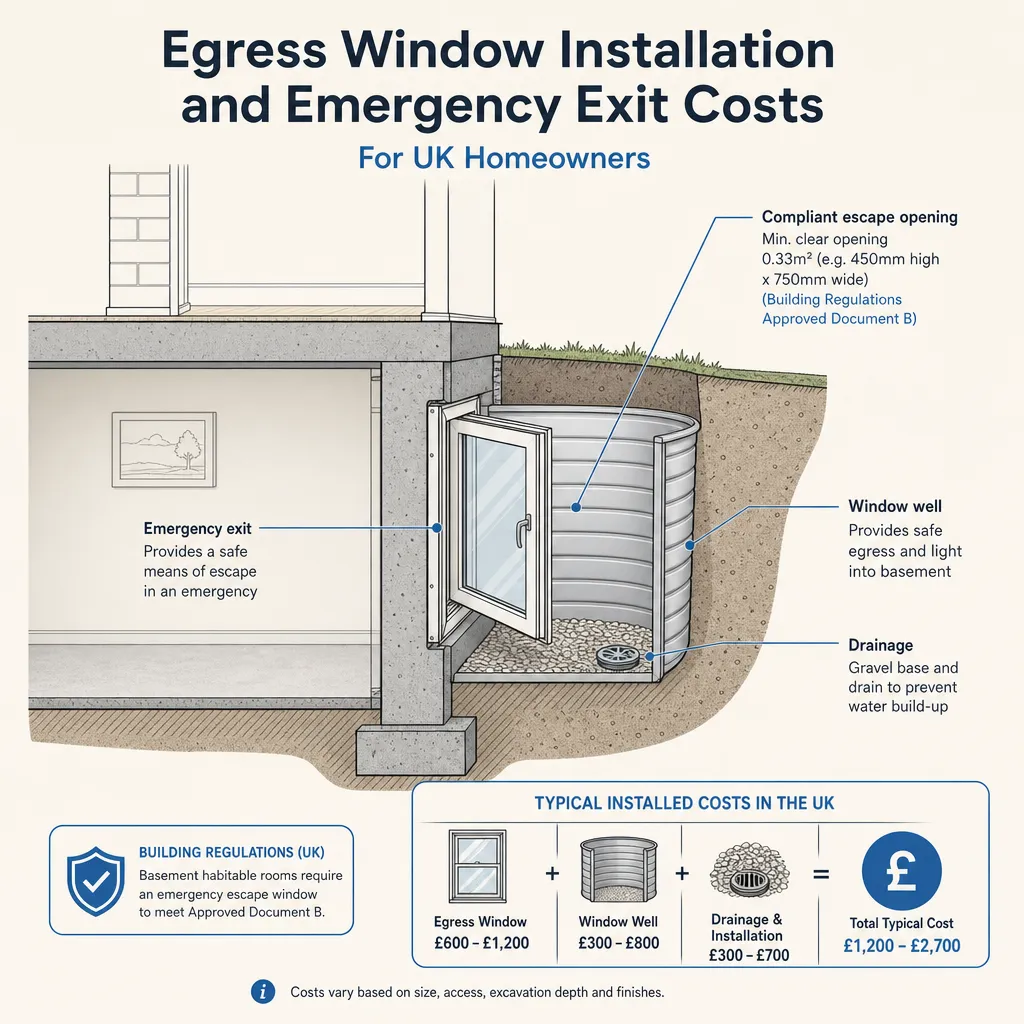
Egress Window Installation and Emergency Exit Costs
Egress windows — windows large enough to serve as an emergency escape route — are required in certain habitable rooms under UK Building Regulations and are almost always necessary when converting a basement into a living space. Whether you are planning a loft conversion, a basement conversion, or replacing an existing window that does not meet current escape requirements, understanding the costs and regulatory requirements upfront can prevent expensive remediation later.
Key points
- Building Regulations Approved Document B (fire safety) requires openable escape windows in habitable rooms above ground floor level and in basement habitable rooms where no direct ground-level escape route exists.
- The minimum clear opening for an escape window under Approved Document B is 0.33 m², with a minimum height and width of 450 mm each and a maximum sill height of 1,100 mm from finished floor level.
- Basement conversions creating a new habitable room generally require building control approval; an egress window or demonstrated alternative means of escape is part of what building control will assess.
- Installing an egress window into a masonry wall typically requires a structural lintel and may need a structural engineer's input, particularly in older properties.
- Indicative UK costs range from around £800–£1,500 for a straightforward above-ground replacement to £3,000–£8,000+ for a basement installation with a lightwell. Indicative UK costs, last reviewed 2026-05-06.
What counts as an egress window in the UK?
Under Approved Document B (Volume 1: Dwellinghouses), an escape window must meet all of the following minimum criteria:
- Clear opening area: at least 0.33 m²
- Minimum dimension: at least 450 mm in height AND 450 mm in width (both must be met; a very tall, narrow window will not qualify)
- Maximum sill height: no more than 1,100 mm above finished floor level
- Openable without a key: the window must open from inside without tools or a key; a friction stay limiting normal ventilation is acceptable provided the full minimum area can still be achieved
These requirements apply to habitable rooms above ground floor level — typically bedrooms — where escape via a protected staircase or through a ground-floor exit is not available. Ground-floor rooms generally have adequate escape via a door to outside.
When is an egress window required?
Situation | Egress window likely required? | Notes |
|---|---|---|
Loft conversion with new bedrooms | Yes | Required per Approved Document B unless a protected staircase is provided throughout |
Basement conversion to habitable room | Usually yes | Required unless an alternative escape route is demonstrated to building control |
Ground-floor bedroom, window replacement | Usually no | Direct ground-level exit via a door is typically sufficient |
First-floor bedroom, window replacement | Check current compliance | If existing window does not meet the minimum, replacement is an opportunity to comply |
New-build extension with first-floor bedrooms | Yes | Must be included in building regulations drawings |
Garage conversion with habitable room above | Likely yes | Depends on staircase arrangement and whether a protected route exists |
Egress window installation costs
Costs vary considerably depending on whether a new opening is required, the wall construction, the depth of a basement lightwell, and your location in the UK.
Above-ground egress windows
Scope | Indicative cost (inc. VAT) | Key variables |
|---|---|---|
Replace existing window with larger egress-compliant unit (masonry) | £800–£1,800 | Wall construction, lintel, making good |
New opening cut into masonry wall, window supplied and fitted | £1,200–£2,500 | Lintel size, wall depth, decoration |
Purpose-made escape roof light (loft conversion) | £600–£1,500 | Size, roof pitch, flashing, rafter modifications |
UPVC egress window, supply only | £250–£700 | Size, specification, glazing |
Below-ground egress windows (basement conversions)
Scope | Indicative cost (inc. VAT) | Key variables |
|---|---|---|
Basement egress window with pre-formed GRP lightwell | £2,500–£5,000 | Wall depth, soil conditions, drainage |
Basement egress window with bespoke masonry lightwell | £3,500–£8,000+ | Size, depth, waterproofing, access |
Lightwell cover (safety and weatherproofing) | £150–£600 | Material, size |
Indicative UK costs, last reviewed 2026-05-06. Prices vary by region, contractor, wall construction, and specification. Always obtain at least two written quotes.
Worked UK property scenario
A homeowner in a 1930s semi-detached property in the East Midlands is converting the basement into a bedroom. The existing basement window is 600 mm × 400 mm — too small to serve as an egress window. Their builder and building control officer agree that a new egress window with a lightwell is required.
Works involved:
- Structural engineer designs a new lintel for the enlarged opening (professional fee: approximately £400–£600)
- Builder cuts new opening in 9-inch brick wall, installs steel lintel and damp-proof tray
- New 1,000 mm × 750 mm UPVC tilt-and-turn window installed (clear opening: approximately 0.56 m² — above the 0.33 m² minimum)
- Pre-formed GRP lightwell installed and backfilled, with drainage channel connected to a soakaway
- Building control inspection at key stages; completion certificate issued on sign-off
Total indicative cost: approximately £4,500–£6,500 including the structural engineer fee and making good. The completion certificate confirms the works were inspected and approved — keep it with the property deeds.
Does an egress window need building regulations approval?
In most cases, yes — either via a full application or through a competent-person scheme.
- Like-for-like replacement within the same opening: may be self-certified under FENSA or another competent-person scheme, provided no structural alterations are involved and the replacement window meets current thermal performance requirements.
- Creating a new opening or enlarging an existing one: notifiable to your local authority building control (LABC) or an approved inspector, as structural work is involved.
- Basement conversions creating a new habitable room: almost always require a full building regulations application. The egress window is one of several items building control will assess — others include damp-proofing, ventilation, heating, and fire detection.
Check with your local authority building control before starting work. A building regulations completion certificate (typically £300–£600 for a domestic alteration) is far less costly than remediation required if work proceeds without approval.
Choosing the right window type
Window type | Egress suitability | Typical use | Key consideration |
|---|---|---|---|
Tilt-and-turn (UPVC or aluminium) | Excellent | Basements, ground and first-floor bedrooms | Full-width opening; straightforward egress |
Casement (side-hung) | Good | First-floor bedrooms, loft rooms | Check hinge-side clearance and opening area |
Purpose-made escape roof light | Good for lofts | Loft conversions | Must be specified as an escape roof light |
Traditional sash | Check opening area | Victorian or period properties | Upper or lower sash alone may not achieve 0.33 m² |
Fixed glazing | Not suitable | Any habitable room | Cannot serve as escape; do not use in required-escape rooms |
Important limitations
This article provides general information about egress window requirements and costs in England. Building Regulations are devolved: Scotland is covered by the Scottish Building Standards, Wales by the Welsh Building Regulations, and Northern Ireland by its own Building Regulations. Requirements differ across all four nations — always check with your local authority building control or an approved inspector for your specific property, location, and proposed works.
This article does not constitute structural, building regulations, or planning advice. If your property is listed, in a conservation area, or has unusual construction, additional consents may be required before any structural alteration.
What to ask a qualified professional
- Does my proposed window achieve a minimum 0.33 m² clear opening with both the 450 mm height and 450 mm width requirements met?
- Will cutting the new or enlarged opening require a structural engineer's lintel design?
- Do I need a full building regulations application, or can the installation be self-certified under FENSA?
- If a lightwell is needed, what drainage provision is required, and who designs the waterproofing detail?
- Will you supply a FENSA certificate or building regulations completion certificate when the work is done?
- What happens if building control requires changes after an inspection visit?
- Is VAT included in the quote, and what is your payment schedule?
When to get professional help
Always involve a professional for egress window work when:
- The work involves cutting a new or enlarged opening in a masonry or structural wall.
- The property is a basement or semi-basement conversion.
- The building is listed or in a conservation area, where listed building consent may also be required.
- The roof structure needs modification to accommodate an escape roof light.
- You are uncertain whether the proposed window achieves the minimum clear opening dimensions — do not rely solely on the manufacturer's frame size, which differs from the clear opening area.
How Housey can help
Housey can connect you with experienced window and door installers who are familiar with UK Building Regulations escape window requirements. Whether you need a straightforward above-ground egress window or a full basement lightwell installation, request quotes from vetted local installers through Housey.
Frequently asked questions
Can a Velux window count as an egress window?
Yes, if it is a purpose-made escape roof light achieving the minimum 0.33 m² clear opening with at least 450 mm in both height and width. Standard roof lights vary — some sizes meet the requirement and others do not. Always check the product specification for the actual clear opening area rather than the overall frame size. Purpose-made escape roof lights are labelled as such by manufacturers.
Do I need an egress window in a loft conversion bedroom?
Almost always yes, unless a fully protected staircase — with fire-resistant construction and fire doors at each level throughout — is provided. Most domestic loft conversions use an open staircase, so an escape window is typically required in each new habitable room. Confirm requirements with your building control officer during the application stage, as interpretations can vary.
What is a lightwell for a basement egress window?
A lightwell is a below-ground enclosure — typically pre-formed GRP, concrete, or brick — excavated adjacent to the external wall to allow light and air to reach a basement window and to provide clear space to climb out in an emergency. Lightwells must drain effectively and be large enough to allow unobstructed egress. Their design is agreed with building control as part of a basement conversion application.
Will adding an egress window affect my home insurance?
Possibly in both directions. An escape window improves fire safety, which insurers generally view positively. A below-ground lightwell can create a perceived security concern, which some insurers may note. Always inform your insurer of significant structural alterations and retain your building regulations completion certificate as evidence of compliant construction.
How long does egress window installation take?
A like-for-like replacement in an existing opening typically takes one to two days. Creating a new opening in a masonry wall, including lintel installation and making good, typically takes two to four days. A basement egress window with a lightwell — including excavation, drainage, and making good — may take one to two weeks depending on soil conditions and waterproofing complexity.
Sources and further reading
- Approved Document B: Fire Safety — Volume 1: Dwellinghouses — GOV.UK / Ministry of Housing, Communities and Local Government
- FENSA: competent person scheme for windows and doors — FENSA
- Planning Portal: building regulations guidance — Planning Portal
- HSE: structural safety — Health and Safety Executive
Useful next reads
 Improvement & Build
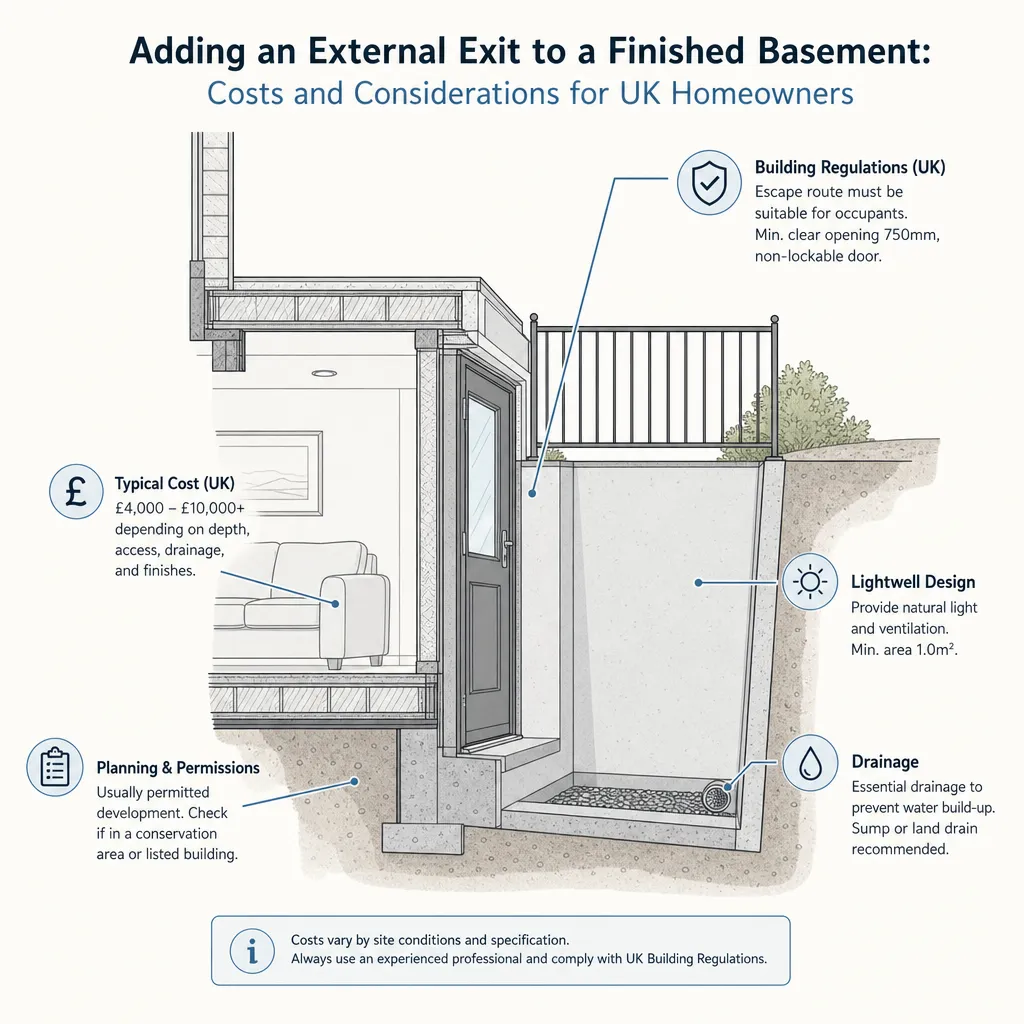
Adding an External Exit to a Finished Basement: Costs and Considerations
Adding an external exit to a finished UK basement always requires building regulations approval and a structural engineer's assessment before any wall is cut.
 Improvement & Build
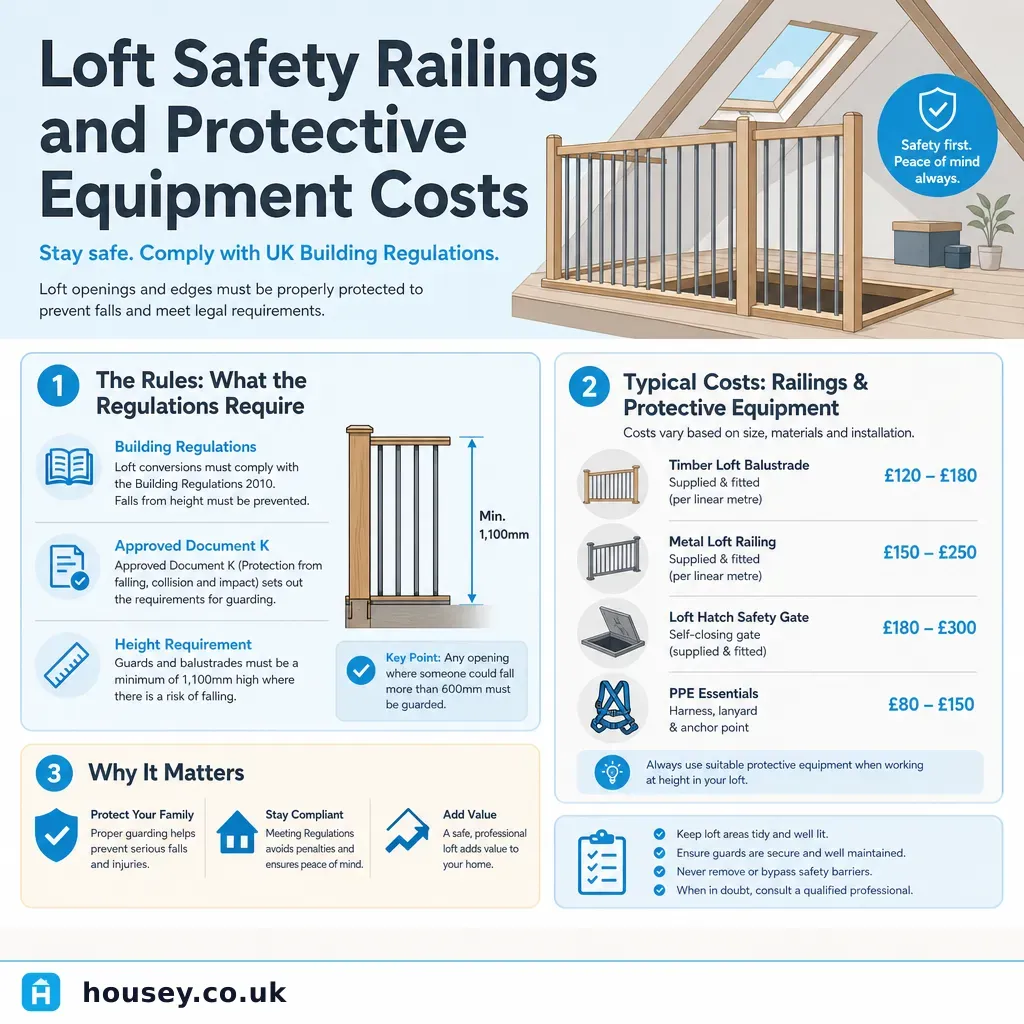
Loft Safety Railings and Protective Equipment Costs
Loft safety railings typically cost £300–£1,800 for a standard balustrade run, depending on material and length.
 Improvement & Build
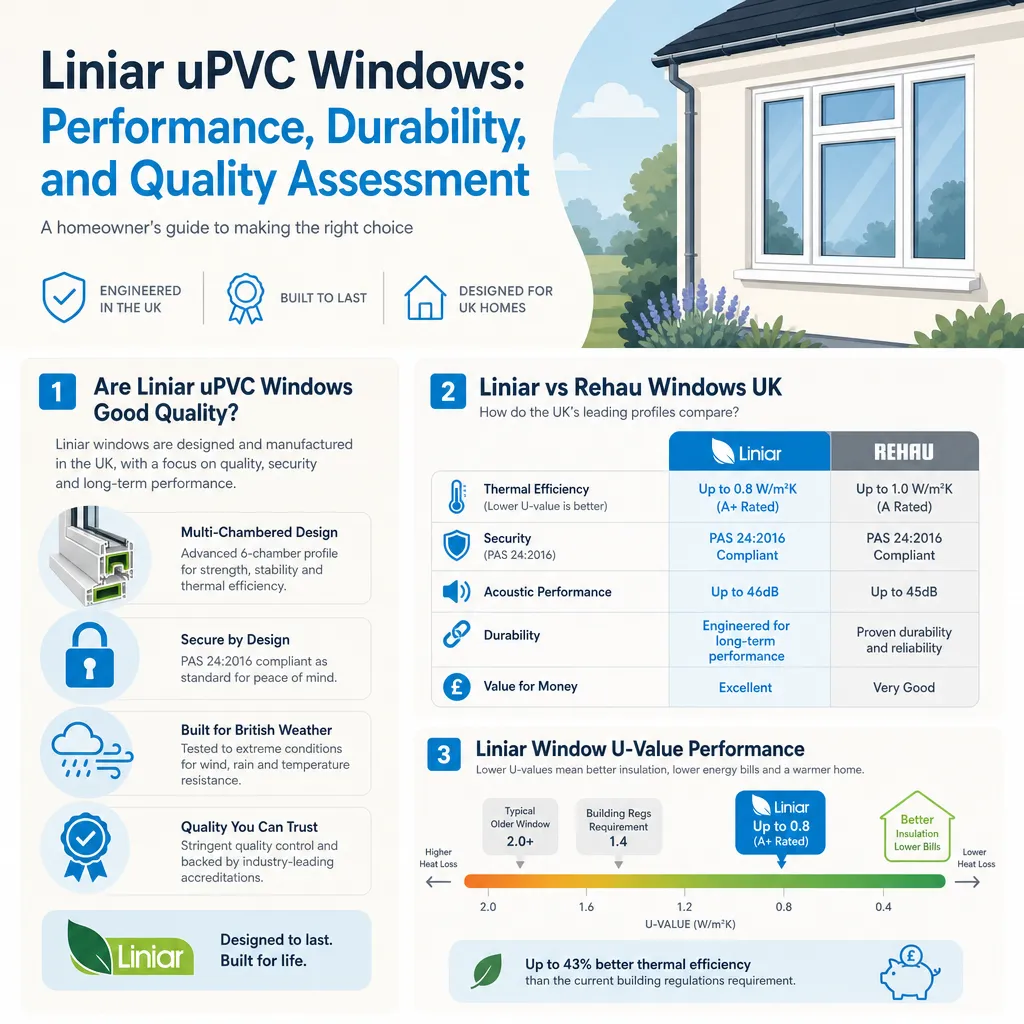
Liniar uPVC Windows: Performance, Durability, and Quality Assessment
Liniar uPVC window profiles are manufactured in the UK using multi-chambered, foamed frames.
 Improvement & Build
Garden Tap Installation with Hot and Cold Water: Plumbing Options
Adding a cold garden tap is a common DIY project, but routing hot water outdoors requires a plumber to connect to your domestic hot water system and comply with the Water Supply (Water Fittings) Regulations 1999.
 Improvement & Build
Sealing and Maintaining Historic Leaded Glass Windows: Preservation and Performance
Leaded glass windows are maintained using traditional linseed oil cement — not silicone or modern sealants, which prevent natural movement in the lead came.