Electric Storage Heater Running Costs: What to Expect
By Housey · Last reviewed 6th of May 2026
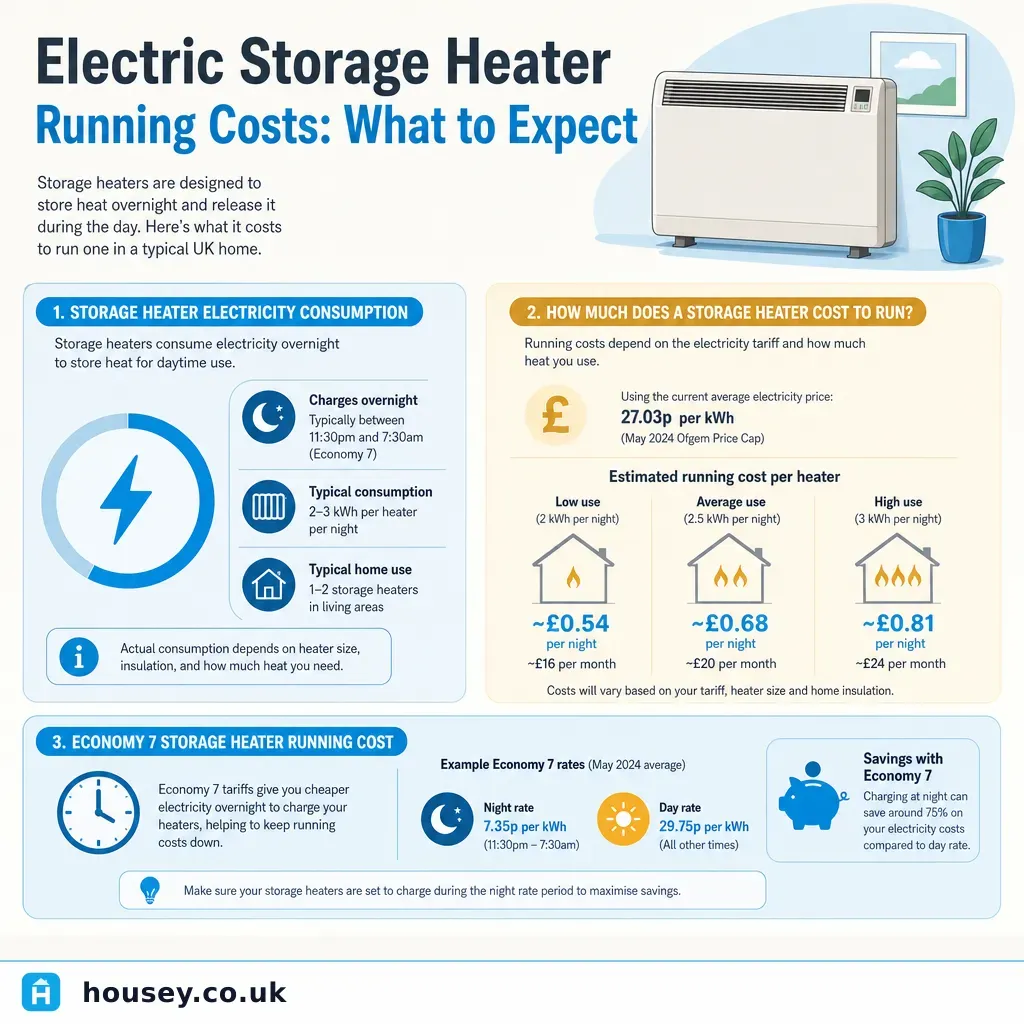
Electric Storage Heater Running Costs: What to Expect
Storage heaters are most common in flats, older social housing, and properties without a gas connection — particularly pre-1980s construction where off-peak electricity was seen as a practical alternative to wet central heating. Understanding what they actually cost to run matters most when you are budgeting for winter, choosing an electricity tariff, or weighing up whether to replace the system. The figures vary considerably depending on heater size, controls, property insulation, and the off-peak rate you pay per unit.
Key points
- Economy 7 night rates typically range from around 9p to 16p per kWh depending on supplier and region, compared with standard daytime rates of 24–34p/kWh under the Ofgem price cap
- A 2.0 kW storage heater charging for 7 hours overnight uses approximately 14 kWh per charging cycle
- Modern high heat retention storage heaters (HHRS) must meet Lot 20 energy labelling requirements and carry efficiency ratings from A to G — older models without automatic charge control (ACC) can waste 20–30% of stored heat
- The Warm Home Discount provides a £150 rebate on electricity bills for eligible lower-income households, directly reducing effective storage heating costs
- Automatic charge control (ACC) or an electronic thermostat can reduce energy consumption by 15–30% compared with older fixed-input heaters
How storage heaters work and why the tariff matters
Storage heaters draw electricity during cheaper off-peak periods — usually overnight — and store heat in ceramic or clay bricks, which release it gradually through the day. Unlike a gas boiler or direct electric panel heater, the running cost depends almost entirely on the off-peak unit rate, not the standard daytime rate.
Economy 7 and Economy 10 tariffs split electricity into cheap off-peak and more expensive peak periods. On a typical Economy 7 tariff:
- Night rate: approximately 9p–16p/kWh (7 hours overnight)
- Day rate: approximately 28p–35p/kWh
If your storage heater charges at the night rate but you supplement with direct electric heaters during the day, the additional cost at the peak rate can substantially increase your overall bill. Always confirm with your supplier exactly when the off-peak period starts and ends, as hours vary by region and distribution network.
Running costs by heater size
These figures are based on a 7-hour overnight charging cycle at an assumed off-peak rate of 12p/kWh. Actual costs will vary by supplier, region, and tariff. Indicative UK costs, last reviewed 2026-05-06.
Heater input rating | Overnight charge (7 hrs) | Cost per night at 12p/kWh | Estimated 200-day season cost |
|---|---|---|---|
0.5 kW | 3.5 kWh | ~42p | ~£84 |
1.0 kW | 7.0 kWh | ~84p | ~£168 |
1.5 kW | 10.5 kWh | ~£1.26 | ~£252 |
2.0 kW | 14.0 kWh | ~£1.68 | ~£336 |
2.5 kW | 17.5 kWh | ~£2.10 | ~£420 |
3.4 kW | 23.8 kWh | ~£2.86 | ~£572 |
A typical 3-bedroom home with one 2.0 kW heater in the living room, two 1.5 kW heaters in bedrooms, and one 1.0 kW heater in the hallway (6.0 kW combined) uses approximately 42 kWh per night. Over a 200-day heating season at 12p/kWh, that comes to roughly £1,008. At 16p/kWh, the higher end of current off-peak rates, the same setup costs closer to £1,344 for the season.
Economy 7 vs Economy 10: which suits storage heaters?
Tariff | Off-peak hours | Best for | Potential drawback |
|---|---|---|---|
Economy 7 | 7 hours overnight | Homes using storage heaters as the primary heating source | Higher day rate than a standard tariff; costly if daytime electricity use is significant |
Economy 10 | ~10 hours (overnight plus an afternoon slot) | Homes with storage heaters and an electric hot water cylinder | More complex to manage; not available from all suppliers |
Standard flat rate | None | N/A for storage heaters | Overnight charging at full rate removes the cost advantage of storage heating entirely |
Running storage heaters on a standard tariff eliminates most of the cost benefit. If you have storage heaters, confirm with your supplier that you are on an appropriate two-rate tariff before assuming high bills are caused by the heaters themselves.
Factors that affect your annual running costs
- Heater age and controls: Older heaters with manual input dials often over-charge, releasing stored heat overnight or early morning when no one needs it. Models with ACC adjust to room temperature and can reduce energy use by 15–30%.
- Property insulation: Storage heaters in poorly insulated homes lose heat faster, requiring higher charge settings. Improving loft insulation and draught-proofing reduces heating demand before any heater upgrade is considered.
- Tariff rate: The difference between 9p/kWh and 16p/kWh off-peak is substantial over a full heating season. Compare tariffs using an Ofgem-authorised price comparison service.
- Heater sizing: An oversized heater in a small room wastes energy. Correct sizing is addressed in manufacturers' technical specifications and British Standard BS EN 60675.
- Top-up heating: Using plug-in panel heaters or fan heaters during the day adds cost at the full peak rate, potentially doubling the effective cost of heating for those hours.
Choosing the right approach: a decision guide
- Stay on your current system and adjust controls if your heaters are under 10–15 years old, already have ACC, and bills seem proportionate to usage — the issue may be the tariff or insulation rather than the heaters themselves.
- Upgrade to modern HHRS heaters with ACC if your current heaters are more than 15–20 years old and lack thermostatic controls — energy savings from better control can justify replacement costs within a few heating seasons.
- Switch to a two-rate tariff first if you have storage heaters but are currently on a standard flat rate — this alone can substantially reduce overnight charging costs without any hardware expenditure.
- Consider an air source heat pump if you own the property, have reasonable fabric insulation, and are planning a significant upgrade — heat pumps typically deliver 2.5–4 units of heat per unit of electricity consumed (coefficient of performance 2.5–4.0) compared with a 1:1 ratio for storage heaters.
- Commission a PAS 2035 retrofit assessment before replacing any heating system — a qualified retrofit assessor can identify insulation and ventilation improvements that reduce heating demand and change the right system specification.
- Check ECO4 or Warm Home Discount eligibility if household income is limited or a member of the household receives certain means-tested benefits — grants may be available for insulation or heating upgrades under the ECO4 scheme.
Red flags to investigate
- Storage heaters that feel cold by mid-morning even at maximum charge settings may have failed heating elements or cracked ceramic bricks — repair or replacement is needed rather than simply raising the input dial
- Unusually high electricity bills despite apparently normal usage could indicate a heater stuck in continuous charge, a faulty thermostat, or a meter or billing error — check current meter readings and contact your supplier
- Persistent condensation or damp in a poorly heated room suggests inadequate heat output overall, not just a billing problem — address insulation and ventilation alongside the heating system
- Economy 7 meters where the cheaper rate does not appear to apply during charging hours should be checked with your supplier; if overnight charging is happening at the day rate, you may be significantly overpaying
When to get professional help
For most storage heater questions, checking your tariff type and adjusting controls will go a long way. Seek professional input if:
- You are considering a heat pump or whole-home electrification — an MCS-certified heat pump engineer should carry out a heat loss calculation and full system design before any equipment is specified
- You suspect the property needs insulation work before upgrading heating — a PAS 2035-qualified retrofit assessor should evaluate the building fabric first to ensure any new system is correctly sized
- You are a landlord and the property has an EPC rating of F or G — you may have obligations under the Domestic Minimum Energy Efficiency Standard (MEES) Regulations, and professional advice on compliant improvement routes is advisable
How Housey can help
Housey connects homeowners and landlords with qualified energy and retrofit professionals across the UK. If you are considering upgrading your storage heaters, improving insulation, or commissioning a PAS 2035 retrofit assessment to understand your options, Housey can help you request quotes from relevant local providers.
Frequently asked questions
How much does a storage heater cost to run per day?
A single 2.0 kW storage heater charging for 7 hours overnight uses approximately 14 kWh per cycle. At a typical Economy 7 off-peak rate of 12p/kWh, this costs around £1.68 per night; at 16p/kWh it rises to around £2.24. Actual figures depend on your tariff, the heater's input rating, and the charge level set on the dial or thermostat.
Can I run storage heaters on a standard electricity tariff?
Storage heaters can physically run on any supply, but they are designed to charge using cheaper off-peak rates. On a standard flat-rate tariff, overnight charging costs the same as daytime electricity — typically 24–34p/kWh under the current Ofgem price cap — which removes most of the cost advantage. If you have storage heaters, switching to Economy 7 or Economy 10 is usually worthwhile.
Are storage heaters cheaper to run than gas central heating?
In most UK homes, gas central heating has lower running costs per unit of heat because gas remains cheaper per kWh than electricity even at off-peak rates. Properties without a gas connection have limited alternatives. Heat pumps now offer an all-electric option with significantly lower running costs than storage heaters in well-insulated homes, though they require upfront capital investment.
What is the Warm Home Discount and does it apply to storage heater users?
The Warm Home Discount is a GOV.UK scheme providing a £150 rebate on electricity bills for eligible households in England, Scotland, and Wales. Because the rebate applies to electricity bills, it is directly relevant to storage heater users. Eligibility is based on means-tested benefits or a low-income and high-energy-cost assessment. Check current criteria on GOV.UK as thresholds vary by year.
How do I know if my storage heater is working efficiently?
Signs of efficient operation include the heater being warm in the morning and releasing heat gradually through the day without frequent use of the boost setting. Poor efficiency signs include the heater cooling by late morning, heavy reliance on boost, or bills that seem high for the heater's rated size. Older models with manual input dials may be over-charging — upgrading to a model with automatic charge control often improves efficiency noticeably.
Sources and further reading
- Ofgem Energy Price Cap — Ofgem
- Warm Home Discount Scheme — GOV.UK
- ECO4: Help to improve home energy efficiency — GOV.UK
- Heating your home — Energy Saving Trust
- PAS 2035: Retrofitting dwellings for improved energy efficiency — BSI Group
Useful next reads
 Energy & Retrofit
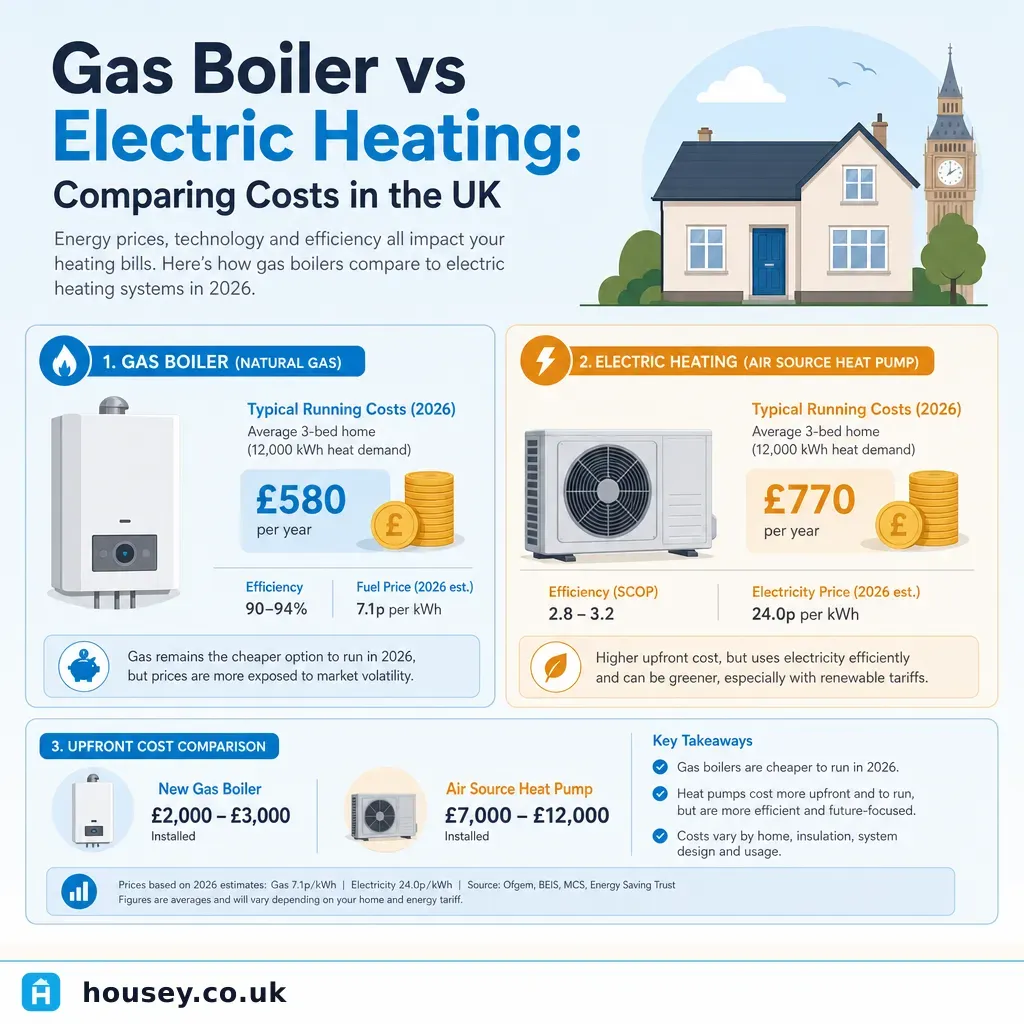
Gas Boiler vs Electric Heating: Comparing Costs in the UK
Gas boilers currently cost around 6.
 Energy & Retrofit
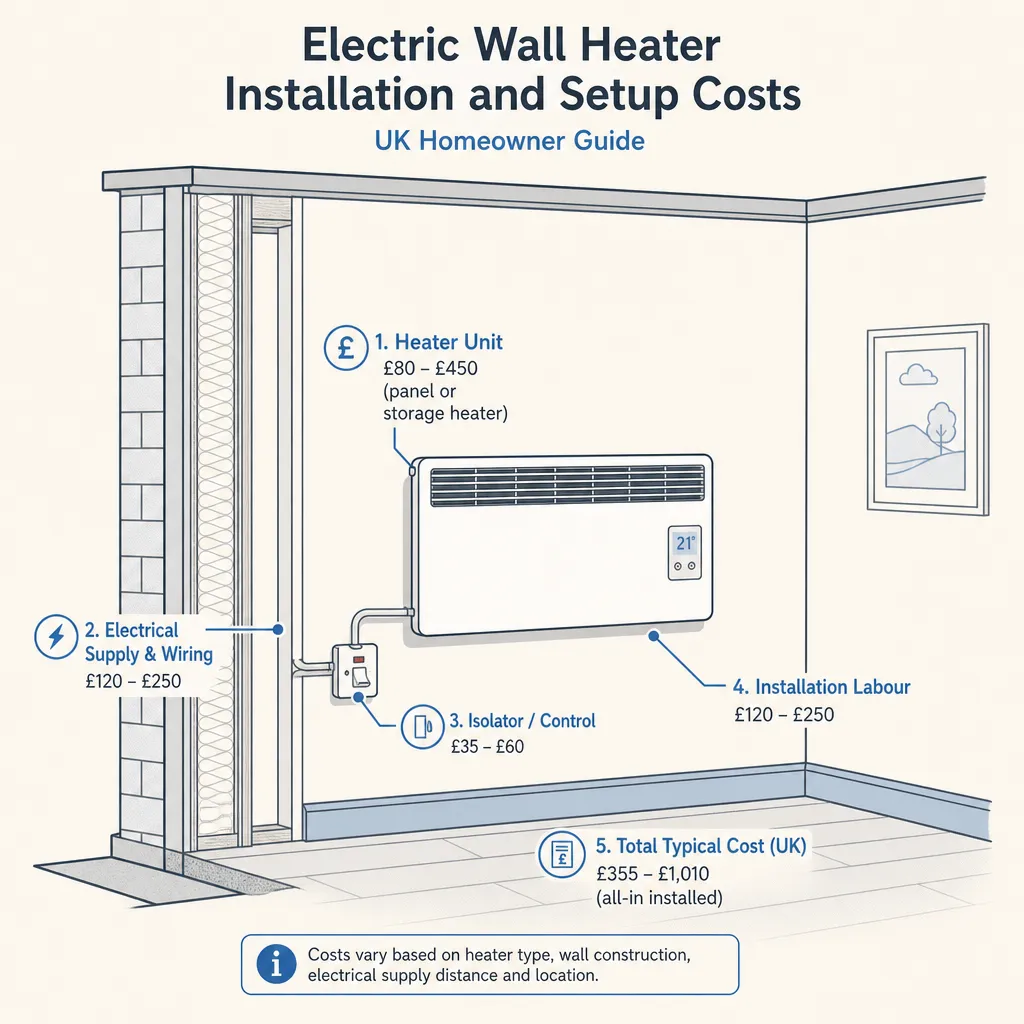
Electric Wall Heater Installation and Setup Costs
Electric wall heater installation in the UK typically costs £150–£350 per unit for a panel heater, plus £100–£250 if a new spur or circuit is needed.
 Energy & Retrofit
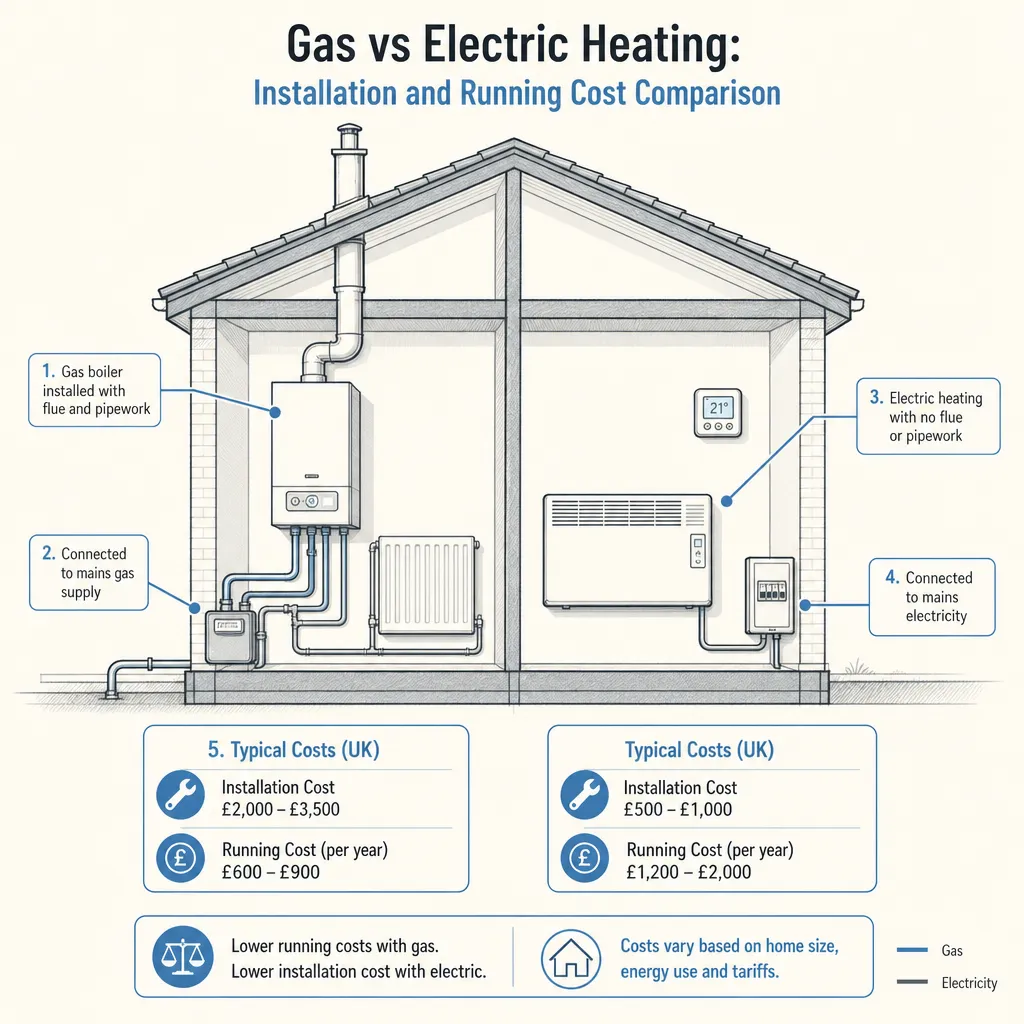
Gas vs Electric Heating: Installation and Running Cost Comparison
Gas central heating usually has lower running costs per kWh than direct electric heating in the UK, though heat pumps can change that equation.
 Energy & Retrofit
Maximising Energy Efficiency: Smart Tips for UK Homes
Improving energy efficiency in a UK home typically starts with draught-proofing and loft insulation — the measures with the fastest payback — before moving to wall insulation, heating system upgrades, and low-carbon technologies such as heat pumps or solar panels.
 Energy & Retrofit
Infrared Heating System Installation and Running Costs
Infrared heating panels supply heat through radiant energy rather than warming air, making them efficient in well-insulated spaces.